2852
LEFT-RIGHT HEAD MOVEMENT FOR CONTROLLING
SMART WHEELCHAIR BY USING CENTROID
COORDINATES DISTANCE
1FITRI UTAMININGRUM, 2PUTRA PANDU ADIKARA, 3YUITA ARUM SARI, 4DAHNIAL SYAUQY, 5ANGGI GUSTININGSIH HAPSANI
1,2,3,4,5Computer Vision Research Group, Faculty of Computer Science, Brawijaya University, Indonesia
E-mail: 1[email protected], 2[email protected], 3[email protected], 4[email protected],
ABSTRACT
Head movement is one stage to handle the movement of smart wheelchair for hands-free disabled person. This tool is useful to help disability of having free movement using computer vision. In this paper, we propose a new framework to recognize left-right head movement by using diagonal coordinates distance (DCD) and horizontal coordinates distance (HCD). Face detection as main part is applied at the first stage and skin detection is combined in terms of failure of face detection. Skin detection stages has some steps as well. First step is image conversion from RGB to HSV and YCbCr channel to get the skin detection to work over face image. From the detected face area, eyes recognition is utilized by using only a half of upper side face’s image. Nose detection is applied as well based on whole face area. The center coordinates of eyes and nose are used to determine the movement referred as centroid. The result shows that HCD is better than DCD. HCD could cope the accuracy 82.5% for head movement detection. This accuracy represents that by using HCD left-right head movement outcome the problem of person with and without glasses as well as the various position of web camera which is mounted in front of smart wheelchair. Keywords: Head Movement, Eye Gaze Movement, Eye Detection, Face Detection
1. INTRODUCTION
A wheelchair is needed by people with disability to help them move from one place to another, either indoor or outdoor. There are two
main types of wheelchair, manual and
power/electric. Manual wheelchair is a type where user can self-propel using hand-rims or pushed by the companion. Meanwhile the power/electric one is a wheelchair that utilize a motor to propel the seated user. The latter is specialized for people with weaker upper extremities, even though any user can also use the wheelchair. This wheelchair has developed in many ways, heavy duty, safe driving in rugged terrain and up/down hills, fully adjustable to elevate or lower seat, and many other developments. The power/electric wheelchair usually have joystick in the left or right armrest that is ideal for left or right-handed individuals. This joystick is used to control the movement of the power wheelchair. A research has been done to control the wheelchair with smartphone [1], [2]. However, even power wheelchair traditionally with joystick or with smartphone also have drawback and only feasible in certain cases. The user must be
able to move their hand or fingers to control the joystick. Thus, this kind of wheelchair is not suitable for people who cannot use their hand and fingers properly or quadriplegic.
2853 gaze control can be replaced by head gestures [9]. In short, head gestures can be used as controller in human computer interaction in addition to eye/gaze tracking or even replace it.
Kupetz [10] used this approach to control wheelchair by tracking head movement using infrared camera and lights emitted from infrared LED array that is placed on the back of the head. However, this approach need to place the LED array every time it was detached. It might be also not comfortable to the user because something is attached on the back of the head. This approach still need further experiment to prove its accuracy. Song et al [11] used head and mouth tracking by using Adaboost. Head movement then detected by analysing the location of the face. Though it fast, however, it’s accuracy and the performance for real time application was not reported. Another approach by Zhao and Yan using neural network [12], optical flow such as Lucas Kanade by Berjón et al [13], Zhao et al [14] still need further experiment for real time application due to its computation time. These researches that using face detection to find eyes also not mention how the studies cope with people wearing glasses and not wearing ones.
We propose much simpler approach to detect head movement for controlling smart wheelchair by using centroid coordinated distance. This approach has benefit that can be used in real time application with low computational time and low resource. This approach uses simple method so later it can be applied in an embedded system. This approach utilizes Haar Cascade because it can be used in real time application [15]. Haar Cascade is used to detect eyes and nose in the face from continuously captured image taken from camera mounted in front of the user then calculate the centroid of the eyes and nose area. From this triangle centroid, left-right movement detection is computed from the ratio between left and right area of eye and nose area using diagonal coordinates distance (DCD) and horizontal coordinates distance (HCD). By using this approach we try to overcome the problem that occurs in detecting the eyes of people with glasses.
Our motivation of research is focusing on people with quadriplegic whom cannot move their limbs and only able to move their head. Head movement then later can be used to control/navigate the wheelchair. The simpler approach is needed because we’re intend to apply this method in affordable mini-computer (low computational time and low resource) such as Raspberry PI instead of high-spec machine to control the smart wheelchair. Current head movement detection/tracker such as
optical flow using Lucas-Kanade (already explained in page 2) needs high computational time/CPU or GPU intensive while mini-computer is not able to do this and will give lag time in processing the continuously captured image. By using simpler approach thus reducing computational time we’re trying to achieve real time in detecting the head movement.
2. METHOD OF RESEARCH
The dataset of this research is taken from any lighting condition using web camera that is mounted on the smart wheelchair. There are 200 images in indoor with various illumination. The distance of captured image is less than 100 cm without considering angle and coordinate of the image. In addition, this paper experimented on the people who wear glasses and not. The system detects people when moving their head to the left, right or slightly and even do not have any movement from the straight point.
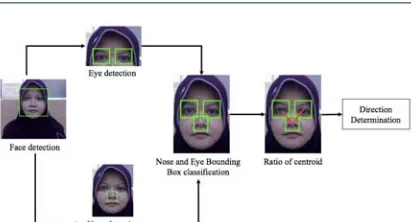
Figure 1 shows the general step of proposed method. The first stage is understanding the face area of an image. All face features are necessary to be recognized, since it will be used as instructions to control the device, which is in this case smart wheelchair. The face image will be captured using camera that is mounted on the wheelchair. In this stage, face detection algorithm is applied by means of classifying the color skin of face as well, because Haar Cascade has drawback to detect face for several images. Face detection is the main feature to take the boundary of pairing eyes as handling of smart wheelchair movement. In this research, left and right of head movement will be used to drive the wheelchair into turning left and turning right, respectively as observed. While looking forward means go straight, thus the movement is restricted only three types of navigation.
2854 algorithm by taking Cb and Cr in segmentation stage as well as adding H channel, is then detecting pairing of left and right of eye for further step.
The algorithm of eye detection applies Haar Cascade in which can caught pairing of eyes. Nevertheless, in one frame of face image the algorithm can detect more than one area of eyes’ image, which is not all detected eyes’ area is suitable as expected. This problem affects eye gaze movement afterwards because of ambiguous direction. Therefore, in this case we also add nose detection as a control to predict where the pupil is moving. Regarding to the correct detection, the centroid of each eyes’ and nose area is also calculated. This stage reduces the noise when the algorithm of detecting area returns false detection.
Defining left-right direction is experimented by using DCD and HCD with computation of ratio of left and right area of eyes and nose area. DCD and HCD treat the problem of the distance ratio that could define the certain movement. Controlling direction is calculated based on the centroid of nose and eyes’ area of an image.
2.1 Face and Skin Detection
Face detection is applied at the first stage due to all features related to head movement is focused in the face. To recognize a proper area of a face, Haar Cascade algorithm is used. However, for some cases Haar Cascade algorithm could not cope a problem when false face detection is happened. Therefore, in this paper skin detection algorithm is applied as well to detect face area precisely by creating the algorithm based on YCbCr color transformation. The default image captured by web camera is shown as RGB and then convert it to the YCbCr color model. This model is able to distinguish between the lighting and the color channel of an image.
[image:3.612.318.526.84.195.2]Y represents luma which is not utilized in this research, however, H is used to represent the lighting environment that arbitrarily change to obtain the skin area of an image. Equation (1) shows the formula of Cb and Cr feature transformation from RGB. This formula is able to distinguish the skin color or not in face area. After getting the skin of face area by using Equation 1, then having segmentation by using the combination of H and Cb, Cr color channel with rules that depicted in Equation 2. Equation 2 tends to prove that face area is determined by using particular skin color. Figure 2 shows the example of skin detection in face area. Figure 3 explains the detail process of obtaining skin area of an image.
Figure 1: General phase of proposed method
[image:3.612.331.498.344.531.2]Figure 2: Face and skin detection
Figure 3: Skin detection stage
Cb = 0.148*R - 0.291*G + 0.439*B
Cr = 0.439*R - 0.368*G - 0.071*B + 128 (1)
Rules of segmentation:
Cr 130 AND Cr = 180
Cb 130 AND Cb = 180
H 0.1 (2)
2.2 Eye and Nose Detection
2855 main part of certain area of eyes and nose. Haar Cascade still has some drawbacks for capturing the specific area, especially when the image captured in different lighting condition. Based on our experiment, the algorithm can retrieve some area neither eyes or nose. Even can capture something that similar with eyes or nose, such as mole. Haar cascade returns bounding box which represents in some matrices and not all matrices will be taken in this part, thus we only select the matrix with the correct area. The correct area is the place that can affect the recognizing process of determining direction without depending on overlap boxes around incorrect area.
Figure 4 shows the result of eyes detection by removing half part of the original size of an image. This stage is considered be able to reduce any noise when capturing some areas which is similar with eye’s shape, for instance mouth or the nostril. In this research, our proposed method uses a half of upper face, so that eyes’ feature can be taken properly. This procedure is different with nose detection, in which all the face area is needed. Figure 5 shows the example of nose detection which uses Haar Cascade as the right algorithm for detecting nose in adaptive way.
Nose feature extraction is completed already to define nose area in the right path. Therefore, to determine the direction from both decisions of detected eyes and nose, the distance calculation with two types of method is utilized. DCD and HCD is proposed to be equated between those of two to determine the direction in indoor condition with various lighting condition.
2.3 DCD and HCD
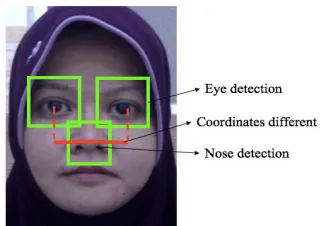
DCD and HCD are method to calculate the distance between centroid of eyes and nose area. The illustration of DCD and HCD is depicted in the Figure 6 and Figure 7, respectively. DCD is a method to find the distance by its diagonal from the x-coordinate of left and right eye and nose area. DCD is method to find the distance of the centroid of nose and left-right eyes using the concept of diagonal lines directly. This method goal is to find the ratio between the centroid in order to get the direction in straightforward way with the robust result. If the diagonal lines of right area is shorter than left area, thus the result direction is right and vice versa.
This method is also accommodated by HCD, the diagonal distance is used to reach the best path of finding the direction, as well as horizontal distance. The horizontal distance could reach more accurate in finding the direction because of using
Figure 4: Eye Detection
[image:4.612.310.522.63.420.2]Figure 5: Nose Detection
Figure 6: Head movement detection based on diagonal coordinates different
Figure 7: Head movement detection based on horizontal coordinates different
the ideal distance of nose’s centroid to the distance of centroid of left and right eye. Figure 7 depicts the illustration of HCD in which the center of eyes
area is drawn the line down until find the x
coordinate same as x coordinate of the nose’s
centroid. This method is not as straightforward as diagonal, however more detail to find the directions through the pixel distance.
[image:4.612.336.496.461.574.2]2856 person, the algorithm detects two areas of eye, which is left and right, and nose for finding the ratio afterwards. 2 y) (x, I = e ye Centroid_e 2 y) (x, I =
_nose n
Centroid (3)
where, x and y is pixels of width and height of an
image and I(x, y) is an image especially of detected
face image. The centroid is computed by dividing the area into two parts, thus the center point
becoming x/2 and y/2. The center point of eyes’
area is referred as centroid_eye, with two types of
eye’s area, that is for left eye and right eye. In this case we called the centroid based on two areas as
centroid_left_eye and centroid_right_eye. While
the center point of nose’s area is referred as
centroid_nose. Based on the Equation 3 is then
calculate the difference of the distance between eyes and nose in order to have information where the place of direction should be. Equation 4 shows the different based on left and right direction.
difLeft = centroid_left_eye - centroid nose
difRight = centroid nose - centroid_right_eye (4)
From the Equation 4, the rules is derived to give the determination of left and right head movement based on certain threshold which is proper in our self-made dataset.
2.4 Head Movement Determination
Direction is determined by using the ratio of x
coordinates of left-right eyes and nose. There are some rules that are applied in order to have decision by driving the function of centroid in each eye and nose. The rules of head movement determination are given in the following rule:
IFdifRight > difLeft AND centroid_left_eye >
0 THEN
checkComparison (LEFT, otherwise
STRAIGHT)
ELSE IF difRight < difLeftI AND
centroid_right_eye > THEN
checkComparison (RIGHT, otherwise
STRAIGHT)
ELSEIFcentroid_right_eye is 0 THEN
RIGHT
ELSE IF centroid_left_eye is 0 THEN
LEFT
Otherwise, is STRAIGHT
where checkComparison is defined in the Equation
5, in which ratio of the differences is calculated
between difLeft and diftRight as follows:
100 ) ( = difRight difLeft rison
checkCompa (5)
Equation 5 plays important role to have the direction of left and right, as well as go ahead command. The differences of those two parameters is came out with any types of centroid in the nose of left eye or nose of the right eye. If the
comparison between difLeft and difRight is smaller
than 45 or checkComparison is equal to zero, then
“left” or “right” direction is detected, otherwise a
command to go “straight” is given.
CheckComparison is detected to be “right” when
centroid_right_eye is greater than zero. Vice versa,
checkComparison determines “left” detection
when centroid_left_eye is greater than zero.
Head movement determination is the final stage of this research to be embedded in the smart wheelchair for disabled person to handle it properly. Based on the computer vision with web camera sensor, the image of face area containing eyes and nose is utilized to recognize the determination. To get correct command for any cases in indoor place with unconditional lighting condition, the prepocessing of color transformation is needes as explained in Subsection 2.1.
3. RESULTS AND DISCUSSION
The experiment of the proposed method is by comparing between two types of centroid coordinates distance, that are by using diagonal and horizontal referred as DCD and HCD, respectively. The experiment is applied for two conditions with person who wear glasses and without wear glasses. The lighting condition of indoor is taken by lux meter and wide range of lux meter is 90-150 of lux. It is indicated that the lighting in indoor is sufficient to capture image with normal condition without any obstacles of noise. Therefore, complex pre-processing is not needed to be applied in this research, because of the average of intensities is covered.
2857 parallel positions is experimented as well. The position of the camera is happened in the real-time condition to calibrate the color of image because of lighting environment. The condition of position can be calibrated with some degrees of slope of web camera. However, in this research three types of position already represented many degrees to simplify.
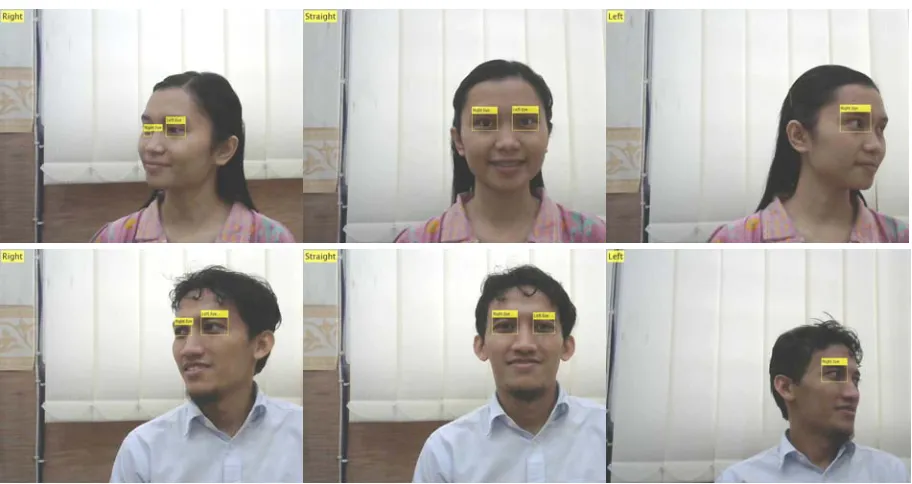
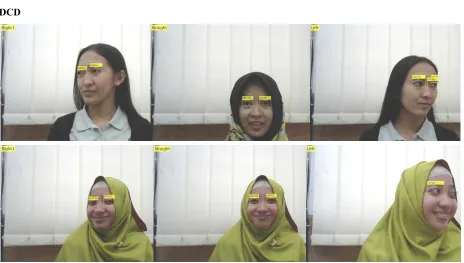
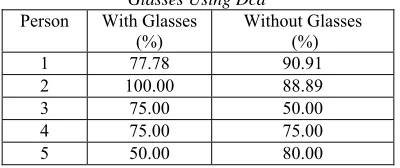
DCD is a method involving diagonal type of calculation from the distance of centroid in left-right eye and nose. Figure 8, Figure 9 is sample images from many images to be used in testing of HCD and DCD respectively. Table 1 shows the accuracy of five people who experimented with and without glasses. From those experiments, people without glasses give
better accuracy than those with glasses. Nevertheless, for person 2 and 3, even by using glasses, the algorithm can still cope the problem in determining direction of head movement. However, in experiment without glasses the accuracy is lower. This problem affected by the detection of nose and eye that cannot be caught in a good way. The bigger of eye or even smaller could affect the detection as well. Sample images of people with glasses is shown in Figure 10 and Figure 11 by using HCD and DCD respectively. Sample of images from incorrect detection is shown in Figure 12 and Figure 13.
[image:6.612.96.552.280.522.2]HCD
Figure 8: Result of head movement detection based on Horizontal Coordinates Different (HCD)
[image:6.612.92.518.572.667.2]HCD: Person with Glasses
2858 DCD
Figure 9: Result of head movement detection based on Diagonal Coordinates Distance (DCD)
[image:7.612.97.519.409.507.2]DCD: Person with Glasses
Figure 11: Samples of head movement detection of person with glasses based on Diagonal Coordinates Different (DCD)
HCD, DCD: Detection Error (Undetected)
[image:7.612.87.526.561.655.2]2859 HCD, DCD: Detection Error (Wrong Movement Detection)
[image:8.612.96.296.284.368.2]Figure 13: Error samples of head movement detection (wrong movement) from both method
Table 1: Accuracy of Persons Wearing and Without Glasses Using Dcd
Person With Glasses
(%) Without Glasses (%)
1 77.78 90.91
2 100.00 88.89
3 75.00 50.00
4 75.00 75.00
5 50.00 80.00
Table 2: Accuracy Based on Position of Camera using DCD
Position of Camera Accuracy (%) Lower position 88.10 Parallel Position 70.45 Upper Position 72.86
Table 2 shows the accuracy of experiments by positioning web camera in three types of position. The lower position is the best in all observations, because the high intensities of coping the whole detail area of eye and nose detection is well captured. Lower position can clearly detect face area and the diagonal distance is suitable for this experiment because of the centroid is defined appropriately. In our experiments, upper position gives better result than parallel position. Parallel position gives ambiguous declaration of the right intensities that can make detection either skin or face is not good for all lighting condition. The position of the web camera is good for any types of lighter or darker illuminance, thus the color transformation well applied.
Similar as DCD, HCD is finding distance by using horizontal way of calculating the centroid of left-right area with nose area. HCD is slightly accurate for detecting head movement because it
computes pixels around x-coordinates corresponding
with centroid of nose’s centroid. The results also different with DCD, in HCD all of experiments in all users can cope the problems without glasses very good
rather than wearing glasses. Table 3 shows the accuracy of persons who wearing and without glasses by using HCD calculation. Three persons out of five in the experiments yield 100% of detecting left-right head movement determination (although the sample images are not included in this paper).
[image:8.612.316.520.455.714.2]In contrary of DCD, in HCD wearing glasses bring down the accuracy, because in HCD problem the reflection taken into account. This condition is not appropriate with the output of the system. Even almost in all experiments in HCD with glasses are lower than using DCD. It is indicated that using DCD could cope the problem with glasses rather than without glasses.
Table 3: Accuracy of Persons Wearing and Without Glasses using HCD
Person With Glasses (%)
Without Glasses (%)
1 88.89 90.91
2 77.78 100.00
3 85.71 100.00
4 57.14 77.78
5 54.55 100.00
Table 4: Accuracy Based on Position of Camera using HCD
Position of Camera Accuracy (%) Lower position 85.71 Parallel Position 77.46 Upper Position 85.00
Table 5: Accuracy of DCD and HCD Method Number of Correct
Detection (out of 200) Accuracy (%)
DCD 150 75
2860 Table 4 shows the accuracy of the position web camera when capturing the image of giving command in smart wheelchair. The condition of position is same as with DCD that lower position is the best position in all experiments rather that upper position. However, by using HCD, the accuracy of upper and lower position has slightly different that represents HCD outcomes the problem with darker or lighter intensities. Parallel position of the camera is better than using HCD calculation instead of DCD. Overall from the position HCD is the best way to calculate the ratio of the centroid coordinate distance to determine left-right as well as straight head movement command.
Table 5 shows the accuracy of whole experiments of 200 dataset of HCD and DCD. There are 150 data out of 200 that correctly detected by using DCD with 75% of accuracy, while HCD gives 15 more correctly detected data and yield the accuracy greater than DCD, 82.5%. HCD is good almost in whole observation from people without glasses as well as the position of the camera.
4. CONCLUSSION
A new method for applying left-right head movement by using eyes and nose features with centroid coordinates distances is utilized. HCD outperforms all experiments over DCD. DCD is good for some cases when person on smart wheelchair using glasses. HCD reached 82.5% of detecting left and right head movement.
For improving the algorithm, future work should propose the combination of horizontal and diagonal distance for calculating the ration of the centroid of nose and left-right of eye. The reflection of person who wear glasses can affect the problem of detection, especially eye detection. Thus, the improvement of creating rules by using ratio of glasses position detection and nose position is needed. In addition, we will try to reformulate or combine another algorithm to improve accuracy so it will have better precision in detecting the head movement.
REFRENCES:
[1] A. Milenkovic, M. Milosevic, and E.
Jovanov, “Smartphones for Smart
Wheelchairs,” in 2013 IEEE International
Conference on Body Sensor Networks,
2013, pp. 1–6.
[2] Q. Mourcou, A. Fleury, P. Dupuy, B. Diot,
C. Franco, and N. Vuillerme, “Wegoto: A Smartphone-based approach to assess and improve accessibility for wheelchair users,”
in 2013 35th Annual International
Conference of the IEEE Engineering in
Medicine and Biology Society (EMBC),
2013, pp. 1194–1197.
[3] R. C. Simpson and S. P. Levine, “Voice
Control of a Powered Wheelchair,” IEEE
Transactions on Neural Systems and
Rehabilitation Engineering, vol. 10, no. 2,
pp. 122–125, Jun. 2002.
[4] S. U. Khadilkar and N. Wagdarikar,
“Android Phone Controlled Voice, Gesture and Touch Screen Operated Smart
Wheelchair,” in 2015 International
Conference on Pervasive Computing
(ICPC), 2015, pp. 1–4.
[5] M. B. Kumaran and A. P. Renold,
“Implementation of Voice Based Wheelchair
for Differently Abled,” in 2013 Fourth
International Conference on Computing, Communications and Networking
Technologies (ICCCNT), 2013, pp. 1–6.
[6] F. Utaminingrum, M. A. Fauzi, Y. A. Sari,
R. Primaswara, and S. Adinugroho, “Eye Movement as Navigator for Disabled
Person,” in International Conference on
Communication and Information System
(ICCIS), 2016.
[7] F. Utaminingrum, T. A. Kurniawan, M. A.
Fauzi, R. Maulana, D. Syauqy, R. Cahya, Y. A. Sari, and P. P. Adikara, “A Laser-Vision based Obstacle Detection and Distance Estimation for Smart Wheelchair
Navigation,” in 2016 IEEE International
Conference on Signal and Image
Processing, 2016, pp. 123–127.
[8] M. A. Fauzi, F. Utaminingrum, D. Syaugy,
R. Maulana, R. C. Wihandika, Y. A. Sari, and P. P. Adikara, “A Practical Obstacle Avoidance Subsystem for Intelligent Wheelchair using Line Laser and RANSAC
Method,” in International Conference on
Computer Science, Engineering and Applied
Science (ICCSEAS 2016), 2016, pp. 40–51.
[9] O. Špakov and P. Majaranta, “Enhanced
Gaze Interaction Using Simple Head
Gestures,” in Proceedings of the 2012 ACM
Conference on Ubiquitous Computing,
2012, pp. 705–710.
[10] D. J. Kupetz, S. A. Wentzell, and B. F.
BuSha, “Head Motion Controlled Power
Wheelchair,” in Proceedings of the 2010
IEEE 36th Annual Northeast
Bioengineering Conference, NEBEC 2010,
2861
[11] Y. Song, Y. Luo, and J. Lin, “Detection of
Movements of Head and Mouth to Provide
Computer Access for Disabled,” in 2011
International Conference on Technologies
and Applications of Artificial Intelligence,
2011, pp. 223–226.
[12] L. Zhao, G. Pingali, and I. Carlbom,
“Real-Time Head Orientation Estimation Using
Neural Networks,” in Proceedings.
International Conference on Image
Processing, 2002, vol. 1, p. I-297-I-300 vol.1.
[13] R. Berjón, M. Mateos, A. L. Barriuso, I.
Muriel, and G. Villarrubia, “Alternative Human-Machine Interface system for
powered wheelchairs,” in 2011 IEEE 1st
International Conference on Serious Games
and Applications for Health (SeGAH),
2011, pp. 1–5.
[14] Z. Zhao, Y. Wang, and S. Fu, “Head
Movement Recognition Based on
Lucas-Kanade Algorithm,” in 2012 International
Conference on Computer Science and
Service System, 2012, pp. 2303–2306.
[15] Y. Li, X. Xu, N. Mu, and L. Chen,
“Eye-gaze tracking system by haar cascade
classifier,” in 2016 IEEE 11th Conference
on Industrial Electronics and Applications