2480
A NORM’S TRUST MODEL FOR NORM ADOPTION IN AN
OPEN AGENT COMMUNITY
1
AL-MUTAZBELLAH KHAMEES ITAIWI, 2MOHD SHARIFUDDIN AHMAD, 2ALICIA Y.C. TANG
1
College of Graduate Studies, Universiti Tenaga Nasional, 43000 Kajang, Selangor, Malaysia
2
College of Computer Science & Information Technology Universiti Tenaga Nasional, 43000 Kajang,
Selangor, Malaysia
E-mail: [email protected], [email protected], [email protected]
ABSTRACT
In recent developments, norms have become an important entity that is considered in agent-based system’s design. Norms are not only able to organize and coordinate the actions and behaviour of agents but have a direct impact on the achievement of agents’ goals. Therefore, an agent in a multi-agent system requires a mechanism to detect the right norms and adopt them. For this reason, the agent needs a mechanism to evaluate the trust in each norm it detects. On the other hand, the impact of norms on the agent’s goal and its plan may be at risk ensuing from the probability of positive or negative results when the agent adopts the right or wrong norms. In this paper, we propose a norm’s trust model that could be utilized in norms adoption or rejection. Ultimately, we determine the benefits of adopting the norm as a consequence of a favourable trust value as an additional factor in norms’ adoption.
Keywords: Norm’s Benefits, Norm’s Trust, Norm Detection, Normative Multi-agent Systems, Intelligent Software Agent.
1.
INTRODUCTIONTrust is a necessary element in human interactions. We often depend on trust and recognition to figure out whom to interact, cooperate and deal with. The notion of trust has been discussed in many fields (e.g., sociology, business, management, computer science) and is defined with a range of meanings. Trust is also regarded as an essential mechanism for dealing with uncertainty in agent-based systems [1].
Analysis of research on trust shows divergent definitions in these disciplines (e.g., sociology, psychology, economics and pedagogy) [2, 3]. Romano [4] in his work describes trust in generic definition considering all domains: “trust is a subjective assessment of another’s influence in terms of the extent of one’s perceptions about the first-rate and significance of another’s influence on one’s consequences in a given situation, such that one’s expectation of, openness to, and inclination towards such influence grant a sense manage over the achievable outcomes of the situation.” Josang, Ismail and Boyd [5] outline trust into two predominant definitions; reliability and decision trust. They define reliability trust as: “Trust is the
subjective probability by using which an individual, A, expects that any other individual, B, performs a given action on which its welfare depends on." However, the act of trusting is much more complex [6]. Falcone and Castelfranchi [7] endorse the cognitive disposition, which consists of three main concepts; mental attitude, decision, and behaviour. Mental attitude trust is simply a prediction or opinion closer to a trustee. The definition of decision in this context is the decision to depend upon the trustee and behaviour refers to the intentional act of trusting; the consequent overt and sensible relation between the trustor and trustee. They describe trust in a layered idea which consists of three layers; Trust Attitude (TA); Decision to Trust (DtT) and Act of Trusting (AoT).
2481 determine whether the norms increase or decrease their utilities for eventual adoption or rejection.
Norm’s Trust (NT) is one parameter in the formulation that motivates an agent to adopt a norm when the agent is able to compute a norm’s trust value. A norm’s trust refers to the degree of an agent’s belief in a norm that influences other agents to adopt the norm. If the trust value of a particular norm is high, it increases the possibility of adopting the norm.
Our motivation in this work stems from the need for software agents to detect and recognize the norms that are prevailing in a society of agents. In open normative-MAS, agents adopt a norms to increase their utilities. Implementations for such adoption are manifested by mechanisms, which are based on sanction, imitation, or social learning. However, without further analysis on these norms, all agents ultimately adopt the new norms. In real world situation, there is usually a number of agents that persistently violate the norms for their benefits. Hence, we propose, in this work, that intelligent agents should adopt new norms based on their awareness of the norms’ expected benefits on their utilities and not merely by sanctions or imitating other agents.
In open-MAS, different types of norms are
practiced in many multi-agent societies.
Consequently, a visitor agent must be able to evaluate all norm variations used to execute a task in an agent society. To avoid the adverse effect of failure to comply with the society’s norm, an agent must be able to evaluate a norm’s trust, which is one of the factors that is perceived as beneficial for the agent in achieving its goals [11].
In this paper, we present the work-in-progress of our research in norm’s benefits awareness. It discusses the final parameter in formulating a norm’s benefit, which is the norm’s trust.
2. LITERATURE REVIEW
In perfect circumstances, norms are described and programmed off-line in which agents are assumed to have adequate knowledge about its environment [9, 10]. However, as works in this area cross towards open multi-agent systems (OMAS), this assumption becomes a drawback and does not reflect the real-world environment. Heterogeneous attributes in OMAS allow an agent to be a part of
many normative societies simultaneously,
exhibiting self-interest with different goals [11]. In such conditions, an agent may additionally stumble
upon a variety of applicable norms to execute similar tasks.
In norms enforcement, third-party sanctions or direct punishment are imposed on agents. Contrary to a closed-MAS, an open-MAS implements indirect sanction, which gradually affects an agent's reputation and emotion [12]. Norm enforcement implies that any non-compliance behaviour of an agent to a norm may negatively influence other agents from complying with the norm. Hence, the agent ought to be able to detect all norm variations used to execute a task in the society. This is very vital to avoid adverse impact of failure to comply with the society’s norms. The credibly detected norm is the one that is perceived as beneficial for the agent in accomplishing its goal [13]. Nonetheless, this is not a trivial task due to the fact that the agent has limited knowledge of the new environment. It does not possess a worldview of the surrounding along with the norms that are presently being practiced by nearby agents. Moreover, in accordance with Conte et al. [14], it is possible for an agent to detect versions of similar norms due to
different interpretations of other agents’
behaviours.
Several researchers (e.g., Mahmoud et al. [15]; Savarimuthu et al. [16]; Andrighetto, Villatoro and Conte, [17]) have proposed algorithms to detect norms. However, these algorithms suffer from two main limitations. Firstly, the detection process assumes solely one set of norms enacted through nearby agents. Secondly, the detected norms are verified only by asking a nearby agent. By doing so, they assumed that all agents in the surrounding are
trustworthy. In contrast, the heterogeneous
standards of OMAS assume that not all agents are trustable [10, 18, 19].
In open-MASs, trust models serve as a social-based mechanism to control interactions among
agents. In open, complex and uncertain
environments, trust and reputation systems are social approaches used to support agents’ decision-making in choosing trusted agents to cooperate with [18, 19]. In such context, trust is discussed (i) as models to allow agents trusting other agents and reason over their trusting behaviour; (ii) as a mechanism to compute trust values of their interaction partners; trust models help agents to decide how, when and who to interact with [19].
2482 Manager, Decision Making Module and Entity Recognition Module. The Evidence Manager accumulates evidence such as recommendations from others and comparisons of the expected and real outcomes of a chosen action.
Figure 1: The High-Level View of a Trust Engine [3]
In human societies, trust is dynamic rather than static. Trust grows and destroys based on interactions over time [12]. Currall and Epstein [20] describe a trust life cycle that consists of three main phases; building trust, maintaining trust and destroying trust. These phases are referred to as evolutionary phases of trust. They propose that in a relationship, building trust starts at a point of neither trust nor distrust due to the limited information on the trustworthiness of a counterpart. This phase builds incrementally as the trustor cautiously observes whether the trust is upheld or violated. Once the trust building behaviours are taken or observed, the trust level continues to grow to maintain the trust phase. In this phase, the trust value is maintained unless a trust-violating event occurs and the move to the ‘destroying trust' phase.
Josang et al. [5] define reputation as “what is believed by the member of a society about a person’s or thing’s character or standing.” In the context of this work, it is a collective measurement of an agent’s or a thing’s trustworthiness. As a trust system, a direct score to reflect an entity’s assessment of another entity, the reputation system provides a score that is available to the society.
In general, there is two types of reputation systems; centralized and decentralized system. Reputation scores are derived from computation engines using average ratings, Bayesian systems, discrete trust models, belief models, fuzzy models, or flow models. The main processes in reputation systems are each agent rate their interactions and store this information. In centralized reputation systems, ratings are reported to the central authority, where each agent simply stores the information personally or submits it to distributed stores. These ratings are available to all agents [5].
2.1. Discussion
The literature provides useful information for the development and computation of the norm’s benefits concept that incorporate trust as an element in the computation. We review topics in norms, norms detection, trust and reputation. The literature in each of these topics provide general and basic ideas that are important to build the trust model.
While there are many techniques of norms detection that have been proposed by researchers, the issue of open MAS has made the problem somewhat complex when dealing with similar norms in multiple agent societies. Consequently, we opt for the concept of norm’s benefits to enable agents to compute specific factors that contribute to the objective determination of norms for adoption in multiple agent societies.
3. THE CONCEPT OF NORM’S BENEFITS
We identify the components that constitute the norms’ benefit from the analysis of the literature. In our previous work [8], we proposed that these components include the Norm’s Adoption Ratio, Norm’s Yield, Norm’s Morality, and Norm’s Trust. We justify the significance of these parameters by assessing the influence of each of the following parameter on the decision of agents to adopt or reject a norm:
• Norm’s Adoption Ratio (NAR): It is the ratio
of agents enacting a particular norm to the
population of agents in a community. If P is
the agents’ population, and Na is the number of
agents enacting a particular norm, then NAR =
Na:P. A high ratio is obtained when a majority of agents enact a norm while experiencing its benefits. Such experience reinforces an agent’s decision to enact the norm and gain the expected benefits or violate the norm to avoid expected losses. For example, in an elevator scenario, if a majority practices the norm of excusing oneself when exiting the elevator, an agent expects that the benefit from adopting such norm increases its reputation.
• Norm’s Yield (NY): A norm’s yield is the
2483 norm of many communities because it is inexpensive and convenient.
• Norm’s Morality (NM): This refers to the
state of a norm (good or bad) with reference to a moral code. The morality of a norm allows an agent to check whether the norm conforms to its moral code. If it conforms, the probability of adopting the norm is high and vice versa. For example, talking loudly or shouting is generally considered as a low morality norm for many communities. But if it is computed as a strong norm in a particular community, an agent has the option to accept or reject the norm basing on the norm’s expected benefits.
• Norm’s Trust (NT): A norm’s trust refers to
the degree of an agent’s belief in a norm that influences other agents to adopt the norm. If the trust value of a particular norm is high, it increases the possibility of adopting the norm. Andrighetto et al. [17] exemplify a bus stop scenario of a particular community, in which when people arrive at the bus stop, they do not form a queue but sit on a bench and memorize who came earlier than them. In such situation, because people highly trust the norm, they adopt the norm.
If an agent is able to determine the values of the above parameters, it can compute the norm’s benefits, which provides a more elegant method to adopt or reject the norm.
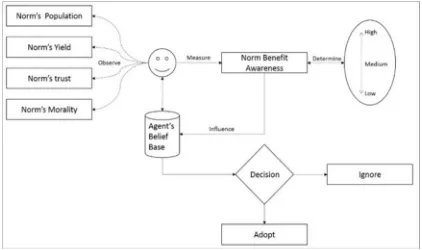
[image:4.612.89.300.573.698.2]Figure 2 shows a proposed norm’s benefits model. A visitor agent observes and evaluates the parameters’ values (i.e., Norm’s Adoption Ratio, Norm’s Yield, Norm’s Trust, and Norm’s Morality). Having determined the parameters’ values, e.g. high; medium; or low, the agent’s belief is influenced by these values, which in turn influence its decision to adopt or ignore the norm.
Figure 2 Evaluating the Norm’s Benefit Awareness
4. THE CONCEPT OF NORM’S TRUST
4.1. Definition
Norm Trust, as a research topic, has several meanings. For example, McKnight and Chervany [2] refers trust to one party who is willing to rely on the actions of another party. For our purpose, a Norm’s Trust is the degree to which an agent can be expected to rely on the social norms that are believed, applied and followed without adversely affecting its objectives while reaping the norm’s benefits.
4.2. The Norms’ Trust Model
We validate of this concept by proposing a norm’s trust model based on an agent’s belief about Authority, Reputation, and Adoption for adopting the norms in a new environment.
4.3. Authority
A factor that determines the trust value of a particular norm is observing authorized agents, which is one of the resources for a new agent when joining a society. Authorized agents represent their societies and have the authority to reward or sanction a society’s member. Therefore, authorized agents are trusted and its norm has a high trust value. The verification is justified by an agent, which endorses the norm indicating that the norm is trusted by the authorized body.
Therborn [21] suggests that an individual is more likely to adopt a norm if he/she identifies that the source is credible (i.e. organization's authority, parents). However, we exploit the agent's authority level proposed by Abdul Hamid et al. [22], who divide the trust level into three categories; low, medium and high. While Abdul Hamid et al. [22] divide the trust level into three categories, we exploit only two categories: Trust (1) and Distrust (0).
4.4. Reputation
2484 interactions between members of a society sets reputation values for others.
Therborn [21] and Bicchieri [24] suggest that norms play an important role in impacting other individuals to follow a norm. Abdul Hamid et al. [22] believe that the reputation of an agent, which practices a norm in a new environment impacts the norm’s trust value. We exploit the Neighbour-Trust Algorithm to calculate the reputation score of each agent [25].
∑ ∈ .
∑ ∈ . (1)
where is the reputation value, is the direct
trust values of N neighbouring agents, and are
the weights that represent the personal opinion of the requesting agent. These weights are normally independent of the context of the direct trust values the neighbours provide.
For example, if a visitor agent, A, wants to get information about agent C, agent A asks agent B
about its opinion on agent C. In this case, is the
trust weight that agent A gives based on the
information which agent B provides. is the
direct trust value agent B has about agent C. Later when agent A might have a direct experience with
agent C, the trust value is represented by only.
To get a more accurate value, agent A should ask many more neighbour agents.
4.5. Adoption Ratio
A Norm Adoption Ratio (NAR) is the ratio of
agents practicing a particular norm to the population of agents in a community. To calculate
the NAR, we exploit a formula proposed by
Mahmoud et al. [15]. The formula is called a Norm Strength (NS). In their work, they assume that an agent observes a society’s members activities, collects episodes and add these to a record file to be analysed for detecting the potential norms. The episode is a set of events that an agent practices in a domain to achieve its goal. For example, in a restaurant domain, the episode might be “arrive, sit, order, eat, pay, tip, and depart” [26].
The calculation of the Norm Strength according to Mahmoud et al. [15], is as follows, where n is a norm:
NS n +" ,* ) ! "# $ %"& % ' (' )(* & ) ! "# $ %"& % (2)
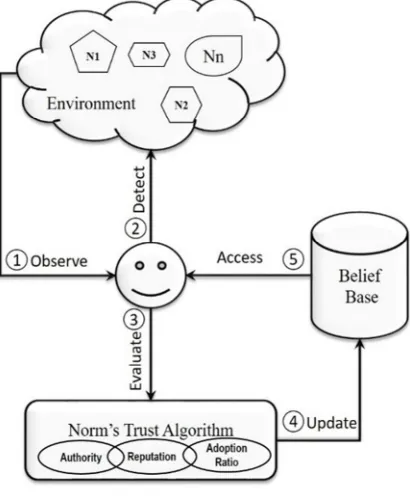
From Figure 3, there is an agent and a number of norms. The agent first (1) observes the norms of an environment. Then, it (2) detects the potential norm
[image:5.612.316.521.171.419.2]and (3) evaluates the norm based on Authority, Reputation, and Adoption to obtain the norm's trust. The agent then (4) updates the norm's trust value of the detected norms to its belief base. (5) The agent can reason and decide to comply with or even adopt the potential norm.
Figure 3: The Norm’s Trust Model
The norm’s trust algorithm assesses the Authority, Reputation and Adoption Ratio of the potential norm to evaluate the norms’ trust value. The norms’ trust value determines the adopt/reject decision.
5. NORM’S TRUST EVALUATION MODEL
Abdul Hamid et al. [22] propose a norm’s trust concept, which is based on the transitive trust of a visitor agent who trusts a local agent’s information of another local agent enacting a detected norm. We exploit this concept using the three factors associated with our process; Authority, Reputation, and Adoption Ratio.
2485
Figure 4: Trust Inferences through Filters
According to the literature in trust and reputation models for MAS [17, 18], we recognize several sources of information such as, direct experience, witnesses and sociological information that influence the trust value. However, the trust contexts in these models are used to assess the trustworthiness of agents. In our study, we analyse these sources along with the norms’ adoption motives. Based on these analyses, we categorize three main factors that influence norms existence in a society, which are Authority, Reputation, and Adoption Ratio that we mentioned earlier.
A trust value influences the decisions which can be determined from the identified factors. To determine the norms’ trust (NT) value, we consider the three factors (Authority, А; Reputation, R; and Adoption Ratio, AR). We assume that the threshold value for a norm trust value, NT = 0.5. While Abdul Hamid et al. [22] describe three levels of a norm’s trust, we exploit only two levels:
• Trust, NTF: A norm is fully trusted when all
the three parameters (A, R, AR) each holds a value that jointly produces a high value of the norm’s trust. There is no conflict between the values of the parameters and the agent positively verifies the norm with all factors. An agent, α, entirely trusts the norm, η, if and only if all the three parameters indicate high values of trust in the norm, η:
NT. α,η ⟷ trust A ∧ R ∧ AR ,η (3)
• Distrust, NTD: A norm is distrusted when all
the three parameters negatively produce a very
low value. This means that the agent, α, distrusts the norm, η, if and only if all the three parameters indicate low values of trust in the norm, η.
NT3 α,η ⟷distrust A ∧ R ∧ AR ,η (4)
Therefore, the formulation of a decision to Trust or Distrust is as follows:
For an agent, α, the detected norm, η, a Trust
decision is 1, and Distrust decision is 0:
NT η5 6 1, NTF 9 0.5 0, NTD = 0.5 (5)
We show these decisions as a willingness matrix that portrays the adoption or rejection of a norm. The willingness level to adopt or reject depends on the NT threshold value (0.5). Table 1 shows the summary of the decision’s options.
Table 1. The Summary of Norm Adopt/Reject Decision
Condition
Norm’s Trust
(ΝΤ) Level
Decision
ΝΤ 1 Trust
The agent will adopt a norm if its norm’s trust value is equal to the highest possible value, 1.
NTF: NT = 1
ΝΤ 0 Distrust
An agent will reject a norm if its norm’s trust value is equal to the lowest possible value, 0. NTD: NT = 0
6. SOCIAL SIMULATION
We present an example of a social simulation, in which a visitor agent, A, enters a train station to
take a train to another station. Agent A observes
other local agents’ behaviours in the domain and through its norm detection function, agent A detects three different behaviours practised by the local agents which are; 11 agents queue and wait behind
a yellow line (N1), five agents wait while sitting on
a bench (N2), and four agents loiter around the
platform (N3). Agent A has to decide which
behaviour it has to trust and adopt. In this example, the first stage in a norm’s trustevaluation, agent A
evaluates its neighbours’ norm trust values basedon
the reputation scores using Equation (1) and the
authority level [21]. Based on theNeighbour-Trust
Algorithm [19] to calculate the trust level for norm
n1, agent A evaluates the reputation score for
[image:6.612.316.516.344.495.2]2486 agents’ opinions about Agent1. We assume that the
visitor agent A obtains all the reputation values, .
It then assigns the corresponding weights, as
[image:7.612.114.484.377.615.2]shown in Table 2 below for each of the neighbor agents.
Table 2: Reputation Score of Neighbour Agents
Agent1
Neighbours .
Agent2 0.99 0.92 0.9108
Agent4 0.88 0.80 0.7040
Agent8 0.89 0.88 0.7832
Agent11 0.77 0.90 0.6930
Agent15 0.66 0.88 0.5808
Agent16 0.75 0.88 0.6600
Agent19 0.95 0.88 0.8360
Sum 5.89 6.14 5.1678
0.87739
From the table, the reputation score of Agent1 is 0.87739, which is a high reputation.
In the second stage, agent A evaluates the
authority level of Agent1 based on agent A’s
database. Consequently, the Authority is (1). Then,
in the third stage, agent A evaluates the Adoption
Ratio. As we mentioned earlier, the trust value of the potential norms (NT) is calculated based on its Adoption Ratio, AR. Using Equation (2), the list of Reputation Scores and Authority for each neighbour and the Adoption Ratio for each potential norm is as listed in Table 3.
Consequently, the visitor agent decides to adopt the norm, n1, as it is the only trusted behaviour.
Table 3. The Trust Value of Potential Norm
Practicing Agents
Norm, ni
Neighbour, Ni
Reputation Score
Authority Level
Adoption Ratio, AR
Trust Level
Agent1 n1 N1 0.87 1 0.55 Trusted
Agent2 n1 N2 0.45 0 0.55 Distrust
Agent3 n1 N3 0.4 0 0.55 Distrust
Agent4 n1 N4 0.43 0 0.55 Distrust
Agent5 n1 N5 0.49 0 0.55 Distrust
Agent6 n1 N6 0.43 0 0.55 Distrust
Agent7 n1 N7 0.49 0 0.55 Distrust
Agent8 n1 N8 0.45 0 0.55 Distrust
Agent9 n1 N9 0.81 1 0.55 Trusted
Agent10 n1 N10 0.43 0 0.55 Distrust
Agent11 n1 N11 0.39 0 0.55 Distrust
Agent12 n2 N12 0.36 0 0.41 Distrust
Agent13 n2 N13 0.33 0 0.41 Distrust
Agent14 n2 N14 0.38 0 0.41 Distrust
Agent15 n2 N15 0.31 0 0.41 Distrust
Agent16 n2 N16 0.44 0 0.41 Distrust
Agent17 n3 N17 0.49 0 0.33 Distrust
Agent18 n3 N18 0.45 0 0.33 Distrust
Agent19 n3 N19 0.42 0 0.33 Distrust
[image:7.612.128.482.379.613.2]2487
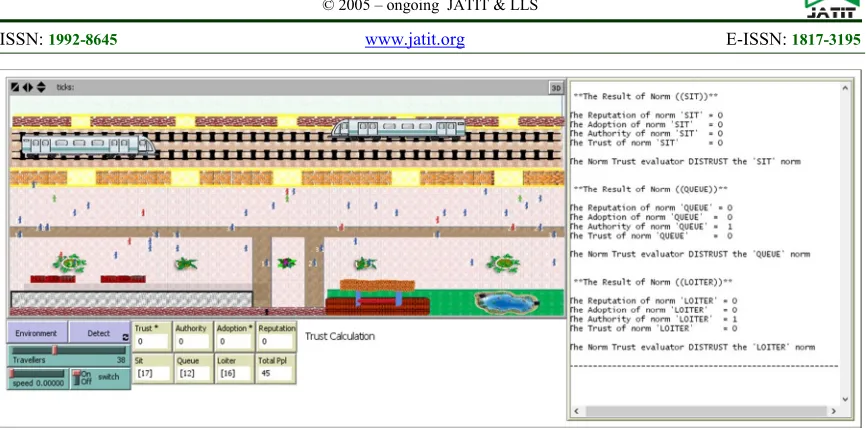
Figure 5: Trust Modelling Simulation
We validate the trust model as a simulation of the train station scenario by using Netlogo, which is a programmable agent-based modelling environment for simulating natural and social phenomena. We run the simulation five times and each run has a new environment with a different number of norms (see Figure 5). In each run, the visitor agent observes and detects the norms in the environment, calculates and evaluates the trust value for the potential norm and decides whether to trust or distrust it.
Based on these premises, Table 4 below shows the simulation results.
Table 4: Simulation Results
The results show that in Runs 1 and 3, the trusted norm is SIT, while in Runs 2 and 4, QUEUE is the trusted norm. Hence a visitor agent may adopt these two norms in this particular environment.
The findings in this research are significant in that they offer an elaborate approach to norms’
analysis and computation for an eventual norm’s adoption or rejection in normative multi-agent systems. The norm’s adoption or rejection is based on the computation of the norms’ factors which manifest the benefits that the norms would entail to achieve the agents’ goals. Consequently, these findings significantly contribute to the literature in normative multi-agent systems.
7. CONCLUSIONS AND FURTHER WORK
In this paper, we propose a norm’s trust model to facilitate agents’ decision-making process in norm adoption or rejection. The model constitutes a technique that assists agents in determining the norm’s benefits to improve agents’ decisions in adopting or rejecting the norms. We exploit a norm’s trust formula based on Abdul Hamid et al. [22], but we propose a new architecture for calculating the norm’s trust. We validate the model by a simulation, in which a visitor agent observes other local agents’ behaviours in a train station and detects three different behaviours enacted by the local agents. The simulation results indicate that the trust model imparts a trustable value for the detected norms, which the agent can use to adopt or reject the norms.
In cases where agents encounter multiple norms, the norms’ trust levels indicate how much they can be relied upon in fulfilling the normative goals (generated from the adopted norms), neither conflicting with the agents’ internal structures nor interfering with their intended goals.
[image:8.612.90.298.481.654.2]2488 norm’s benefit. The benefits are a measure with which a decision is made whether to adopt or reject a detected norm. The other parameters in an earlier publication [8] are Norm’s Adoption Ratio, Norm’s Yield, and Norm’s Morality.
In our future work, we shall include all these parameters in the formulation of the norm’s benefits and developed a comprehensive simulation to validate our formulation.
REFRENCES:
[1] Parsonsa, S., et al., Argument schemes for
reasoning about trust. Computational Models of Argument: Proceedings of COMMA 2012,
2012. 245: p. 430.
[2] McKnight, D.H., and N.L. Chervany, The
meanings of trust. 1996.
[3] Seigneur, J.-M. and P. Dondio, Trust and
reputation for successful software self-organisation, in Self-organizing Software. 2011, Springer. p. 163-192.
[4] Romano, D.M., The nature of trust: conceptual
and operational clarification. 2003, Louisiana State University.
[5] Jøsang, A., R. Ismail, and C. Boyd, A survey of
trust and reputation systems for online service provision. Decision Support Systems, 2007.
43(2): p. 618-644.
[6] Falcone, R. and C. Castelfranchi, Social trust:
A cognitive approach, in Trust and deception in virtual societies. 2001, Springer. p. 55-90.
[7] Castelfranchi, C. and R. Falcone, Trust theory:
A socio-cognitive and computational model. Vol. 18. 2010: John Wiley & Sons.
[8] Itaiwi, A.-M.K., et al. Norm’s Benefit
Awareness in Open Normative Multi-agent Communities: A Conceptual Framework. in Distributed Computing and Artificial Intelligence, 11th International Conference. 2014. Springer.
[9] Criado, N., E. Argente, and V. Botti, Open
issues for normative multi-agent systems. AI
Communications, 2011. 24(3): p. 233-264.
[10]Huynh T.D., Jennings N.R., Shadbolt N.R., An
integrated trust and reputation model for open multi-agent systems. Autonomous Agents and
Multi-Agent Systems, 2006. 13(2): p. 119-154.
[11]Artikis, A., M. Sergot, and J. Pitt, Specifying
norm-governed computational societies. ACM
Transactions on Computational Logic
(TOCL), 2009. 10(1): p. 1.
[12]Andrighetto, G., et al., (Social) Norm
Dynamics. Dagstuhl Follow-Ups, 2013. 4.
[13]Hollander, C.D. and A.S. Wu, The current
state of normative agent-based systems. Journal of Artificial Societies and Social
Simulation, 2011. 14(2): p. 6.
[14]Conte, R., C. Castelfranchi, and F. Dignum.
Autonomous norm acceptance. in International Workshop on Agent Theories, Architectures, and Languages. 1998. Springer.
[15]Mahmoud, M.A., et al., Potential norms
detection in social agent societies, in Distributed Computing and Artificial Intelligence. 2013, Springer. p. 419-428.
[16]Savarimuthu, B.T.R., et al., Identifying
prohibition norms in agent societies. Artificial
intelligence and law, 2013. 21(1): p. 1-46.
[17]Andrighetto, G., D. Villatoro, and R. Conte,
Norm internalization in artificial societies. AI
Communications, 2010. 23(4): p. 325-339.
[18]Pinyol, I. and J. Sabater-Mir, Computational
trust and reputation models for open multi-agent systems: a review. Artificial Intelligence
Review, 2013. 40(1): p. 1-25.
[19]Jung, Y., et al., A survey of a security issue in
multi-agent systems. Artificial Intelligence
Review, 2012. 37(3): p. 239-260.
[20]Currall, S.C. and M.J. Epstein, The Fragility of
Organizational Trust:: Lessons From the Rise and Fall of Enron. Organizational Dynamics,
2003. 32(2): p. 193-206.
[21]Therborn, G., Back to norms! On the scope
and dynamics of norms and normative action.
Current Sociology, 2002. 50(6): p. 863-880.
[22]Abdul Hamid, N.H., et al. Trusting Norms: A
Conceptual Norms’ Trust Framework for Norms Adoption in Open Normative Multi-agent Systems. in Distributed Computing and Artificial Intelligence, 12th International Conference. 2015. Springer.
[23]Misztal, B., Trust in modern societies: The
search for the bases of social order. 2013: John Wiley & Sons.
[24]Bicchieri, C., The grammar of society: The
nature and dynamics of social norms. 2005: Cambridge University Press.
[25]Kiefhaber, R., et al. The neighbor-trust metric
to measure reputation in organic computing systems. in Self-Adaptive and Self-Organizing Systems Workshops (SASOW), 2011 Fifth IEEE Conference on. 2011. IEEE.
[26]Savarimuthu, B.T.R., Mechanisms for norm
![Figure 1: The High-Level View of a Trust Engine [3]](https://thumb-us.123doks.com/thumbv2/123dok_us/8906791.957205/3.612.89.299.156.264/figure-high-level-view-trust-engine.webp)