AWARENESS AND ATTITUDES TOWARD
IT GOVERNANCE: EMPIRICAL STUDY
1
UKY YUDATAMA, 2ACMAD NIZAR HIDAYANTO, 2BOBBY A.A. NAZIEF
123
Faculty of Computer Science, University of Indonesia, Depok 16424, Indonesia
E-mail: [email protected], [email protected], [email protected],
ABSTRACT
This study aims to examine in more depth about how, why awareness and attitudes towards the implementation of IT governance is very important, so it can affect the performance of an organization or company. The methods used in this study began with literature review and interviews with some experts in their field, 4 from academics and 2 practitioners. To strengthen this research, we have distributed 100 questionnaires, but 96 respondents actively provided feedback, then analyzed and validated using a correlation test (r). To understand awareness and attitudes towards IT Governance, there are several factors that can be used. As for factors such as; Benefits, risks, opportunities and obstacles. These factors are very important and relate entirely with awareness and attitudes. By knowing these factors, all parties involved in IT Governance become easy to understand, then awareness and attitude will grow from itself, so as to improve performance and ultimately organizational goals can be achieved optimally as expected. The results obtained from this research indicate that the benefit factor and opportunity factor have more value, while the risk factor and constraint factor is smaller. In order for the implementation of IT Governance to run properly, it is necessary to be encouraged in understanding the knowledge and knowing the implementation of IT Governance that is being implemented.
Keywords: Awareness; Attitude; Implementation; Factors; IT Governance
1. INTRODUCTION
Information technology now becomes very important for almost any organization or company, because it is believed to help improve the effectiveness and efficiency of the business process of an organization or company. To achieve this requires a good IT management, so that IT can support the success of the organization in achieving its objectives.
Every new innovation brings about changes in its implementation. IT governance causes significant resistance and change, especially in work procedures and can also trigger the whole process of corporate reengineering and even lead to loss of job relocation. Resistance to change can be attributed to a lack of internal awareness of the importance of IT governance. Surveys and research show that resistance to change is a significant barrier to IT governance [1], [2]. Lack of awareness of the importance of IT governance can be an obstacle to their daily tasks [3]. There are many examples of organizations, especially SMEs, that are often associated with IT governance that really affect them [4].
Awareness of IT governance declined as a result of financial scandals in the US so Sarbanes-Oxley in 2002 restored the confidence of the stakeholders. Since then IT Governance has been revived. Awareness and attitudes in the implementation of IT governance in business circles, do not seem to be well developed in this field, regardless of the focus on IT governance.
Awareness and attitude are fundamental things that can affect success or failure. In addition, awareness also affects the user in responding, accepting or even rejecting something well or badly [5].
It is rare to find a study that discusses awareness and attitudes toward the implementation of IT Governance within an organization, there are several studies that address alignment between business and IT strategies [6][7]. Actually there are some studies that discuss awareness and attitude, not in the realm of IT governance, but in the field of food (agribusiness) using nanotechnology [8].
implementing IT Governance implementation in developing countries, little effort has been made to achieve results in general. These challenges include lack of awareness, lack of standard terminology and also lack of clarity in determining roles and responsibilities [9]. There are several studies that have identified some of these challenges by adopting ITIL in a case study of companies using public facilities in Malaysia [10].
From a series of descriptions above, researchers are motivated to conduct research that focuses on awareness and attitudes towards the implementation of IT Governance. In addition, there has been no study to discuss, the gap that became an important point in this study with previous research is to know and observe factors related to awareness and attitude of all parties involved, on the implementation of IT Governance. Factors used in this study include: benefits, risk reduction, constraints and opportunities. The results of this study are expected to give a real contribution, especially in the field of IT Governance as reference material theory and input materials for all parties who want to develop IT Governance in an effort to improve the quality better in the future.
2. METHODS
In this study the method or stage used to analyze and discuss the results, consists of four stages: a) literature review; b) interview; c) questionnaire; d) analysis. For more details will be explained as follows:
2.1. Literature review
The first step in this method, the process of searching for some literature related to awareness and attitude. We have obtained some important literature, among others shown in Table 1.
Table 1: Relevant Literature
Researchers Findings Weaknesses
[8]
Significant relationship between IT governance mechanisms and strategic alignment and, furthermore, between strategic alignment and organizational performance.
Associated with nanotechnology, not IT Governance
Lin, Y.M. et al., 2014 [11]
A positive correlation
Need to identify contingencies,
between the concept of awareness and the practice of IT governance is not necessarily absolute.
affect domains and need to involve related parties such as organizations or experts.
Norman, H., 2014 [12]
Types of awareness of IT security according to specific needs (communication )
Has not provided a term for security awareness.
Kuusk, A. & Gao, J., 2015 [13]
Factors
influencing the role of government information to provide a verifiable holistic framework in applying Integration Theory. Utilizing people's understanding, processes and technology. [14]
A significant relationship between consumer awareness and effective behavior, consumer awareness differs significantly based on location.
Need to involve experts to provide input in determining the variables and research instruments, so the results have better
validation.
Desa, A., Ba, N. & Yusooff, F., 2011 [15]
Student awareness and behavior in waste
management should be encouraged, through education and implemented on an ongoing basis.
Assess student's knowledge, attitude, awareness and behavioral status in terms of waste management
# ! " $
[16]
This study provides an indication of the usefulness of awareness based on user experience.
The limitations of this study only provide a dichotomous response (yes and no), so the results are less accurate.
Amokrane, Y., Tchangani, A.P. & Pérès, F., 2012 [17]
explicit
modeling of risks and opportunities that depend on the
quantification and evaluation of uncertain parameters.
structural framework for obtaining necessary information.
2.2. Interview
At this stage we have conducted interviews with experts in the field of IT Governance especially those who have the competence both academically and practically. A total of 6 people consisted of 4 academics and 2 practitioners we interviewed with some questions regarding awareness and attitudes towards the implementation of IT Governance. After reviewing with previous literary studies. From these two results, there are four important factors that can be used to understand awareness and attitudes. These factors are:
a. Benefits, using information technology to help complete the work easier and faster and can provide solutions with better quality, on time and within budget.
b. Risk, in this case there is a reduction of risk after IT governance is applied such as, business losses can be minimized as possible, as it can be controlled or monitored, and the risk of delays can be avoided.
c. Opportunities, that the implementation of IT Governance there are many opportunities that can be developed, because it provides a competitive advantage and offers the completeness to increase productivity and add value in the future.
d. Obstacles, in the application of IT Governance may vary, in knowing how to use the system, even downtime errors can result in substantial potential losses, so this is considered an obstacle.
2.3. Questionnaire
The observations and questionnaires that we did in this study were to take the object of higher education in Indonesia by involving the stakeholders from the top level (echelon 1) to the lowest level (echelon 4). A total of 100 questionnaires have been distributed to be filled by respondents. Some important questions we have compiled in accordance with the results of literature
[image:3.612.313.527.141.503.2]studies and previous interviews. The main content of the question can be seen in table 2.
Table 2: Free Semi-Structured Questions
Categories Questions
Keywords in Question
Demographics
a. Stakeholder involvement.
b. CV.
Awareness and Perception
a. Knowing about the IT Governance.
b. Realizing IT Governance can be used.
c. Recognizing the application of IT Governance.
benefits of
a. Support the achievement of organizational goals.
b. Assist completion of the work.
c. Speeding up the process.
d. Provide better quality.
e. Saving energy costs and.
reduction of
a. Risk.Business losses can be pressed
b. Delays can be avoided
Opportunities
a. Many opportunities and opportunities that can be developed.
b. Many offer equipment to improve productivity.
c. Gives the added value in the future.
Obstacles
a. The lack of a good understanding.
b. Error on the network (downtime).
Table 2 is a semi-structured interview guide overview. From this table, was made to be developed into an interview summary shown in Table 3.
Table 3: Summary Of Questions For The Survey
Category Keyword In Question Type Question
Demographics
CV respondents
Multiple choice Gender, Age,
Education, and Job Level.
Awareness and Perception
a. Do you know more about IT Governance?
Likert scale (0-5)
b.Do you realize that the IT Governance can be used?
Likert scale (0-5)
c.Are you aware governance of IT has
been implemented in your institution?
Benefits
a.Do you agree on Governance IT support the achievement of organizational goals?
Likert scale (0-5)
b.Do you agree on Governance does IT assist in the of completion the work?
Likert scale (0-5)
c.Do you agree on Governance IT can speed up the process work?
Likert scale (0-5)
d.Do you agree on Governance IT provides quality?
Likert scale (0-5)
e.Do you agree on Governance IT will be able to save costs and energy?
Likert scale (0-5)
Risks
a.Do you agree on Governance IT can reduce a loss of business?
Likert scale (0-5)
b.Do you agree on IT Governance Can delays be avoided?
Likert scale (0-5)
a.Do you agree Governance IT opportunities and opportunities that can be developed?
Likert scale (0-5)
Opportunities
b.Do you agree with of governance a lot IT offering to increase productivity?
Likert scale (0-5)
c.Do you agree on governance IT can bring value added in the future?
Likert scale (0-5)
Obstacles
a. How many levels of your confidence in
receiving IT Governance?
Rank order (0-9)
b.The extent to which your support of IT Governance?
Rank order (0-9) c.Is the fault on the
network (downtime) can disrupt IT Governance?
Likert scale (0-5)
2.4. Analysis
By looking at the above results, obtained through interviews and questionnaires. The results were observed closely, especially on the subject of the study. Quantitative data from questionnaires
involving 100 respondents, 96 respondents have given us feedback. This means as many as 94.8% of respondents who contributed or participated. The result is then processed using a simple software: MS. Excel processing model and simple statistics to calculate the results of two-way correlation test, to get the results.
3. RESULT
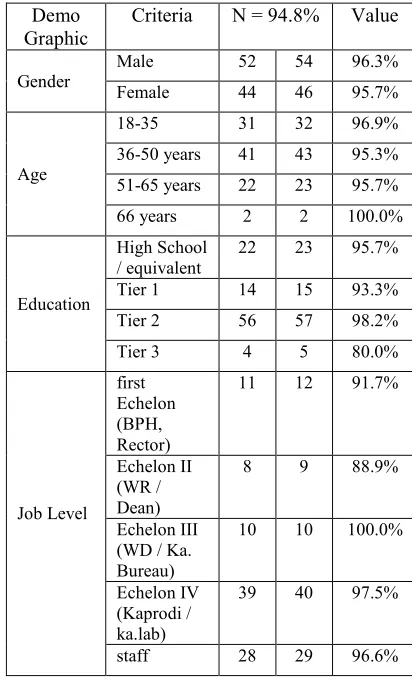
[image:4.612.310.516.354.693.2]Preliminary results from this questionnaire, on demographics containing the respondent's biodata in terms of gender, age, education and occupation of respondents who have responded to this questionnaire. Can be seen in Table 4, while in Table 5 shows the results of each factor related to awareness and attitudes toward the implementation of IT Governance. Starting from the benefits, risks, opportunities and obstacles that occur during the implementation of IT Governance.
Table 4: Demographic Information Questionnaire Results
Demo Graphic
Criteria N = 94.8% Value
Gender
Male 52 54 96.3%
Female 44 46 95.7%
Age
18-35 31 32 96.9%
36-50 years 41 43 95.3%
51-65 years 22 23 95.7%
66 years 2 2 100.0%
Education
High School / equivalent
22 23 95.7%
Tier 1 14 15 93.3%
Tier 2 56 57 98.2%
Tier 3 4 5 80.0%
Job Level first Echelon (BPH, Rector)
11 12 91.7%
Echelon II (WR / Dean)
8 9 88.9%
Echelon III (WD / Ka. Bureau)
10 10 100.0%
Echelon IV (Kaprodi / ka.lab)
39 40 97.5%
staff 28 29 96.6%
Table 5: Final Results
Category Value
(Average)
Achievement (%) Awareness
perception
3.7 74%
a. Benefits 3.7 74%
b. Risks 1.4
Reduction
72%
c. Opportunities 3.6 72%
d. Obstacles: - Level of faith - Support
- Disorders network
7.0 7.3 3.6
77.3% 81.6% 62.3 % 28%
3.1. Awareness and attitudes towards IT Governance
From Table 5 indicated that awareness and attitudes gained an average value of 3.7 of the total value of 5. This shows that awareness and attitudes are good enough if used in the percentage of achievement by 74% of the maximum value of 100%.
a. Benefits
Table 5 shows that awareness and average attitudes resulted in 3.7 out of a total of 5. This indicates that awareness and attitudes are good enough, with a percentage of achievement of 74%.
b. Risks
Implementation of good IT Governance will have a positive impact on risk reduction, because everything is well organized and well planned, hence risk-related issues will be minimized. From the results of data in table 4, obtained a value of 1.4 from a maximum value of 5, it turns out the risk can be reduced by 28% and Percentage of achievement 72%.
c. Opportunities
Opportunity opportunities that exist in the implementation of IT Governance actually quite a lot, because by utilizing IT a lot of things can be done and developed. The results of this study obtained a value of 3.6 from a maximum value of 5 and if used in the percentage reached a value of 72%. This indicates there are still many opportunities that need to be explored further.
d. Obstacles.
As has been said that the presence of something new may not necessarily get a good response to receive IT Governance. However, from the survey results obtained the value is quite encouraging as shown in table 5. The level of confidence in the
[image:5.612.315.524.228.374.2]implementation of IT Governance of 7 out of a maximum of 9 with the percentage of achievement of 77.3%. For support get a value of 7.3 with a percentage of 81.6% achievement. This is a fantastic thing. In the network disruption (down time) is a concern in the implementation of IT Governance to get a value of 3.6 from a maximum of 5 and a percentage of 72.7%. This means network disruption needs to be taken seriously. The percentage of average achievement of obstacle factor is 62,3%. Requires special attention.
Figure 1: Graph Of Percentage Of Achievement About Awareness And Attitude Toward The
Implementation Of IT Governance.
Figure 1 illustrates the percentage of data achievement that has been processed. What is interesting about this graph is the risk factor that gets the percentage of achievement score of 72%. This value is derived from the amount of risk reduction value obtained that is equal to 1.4 or in the form of percentage 28%. The value of reduction means there is a level of risk reduction after the implementation of IT Governance. The smaller the reduction value the better, because the smaller the risk. Another interesting feature of the graph is the inhibiting factor, which scored a 62.3% percentage. This shows that constraints are still a serious factor and must be addressed so that the implementation of IT governance in this organization can work well.
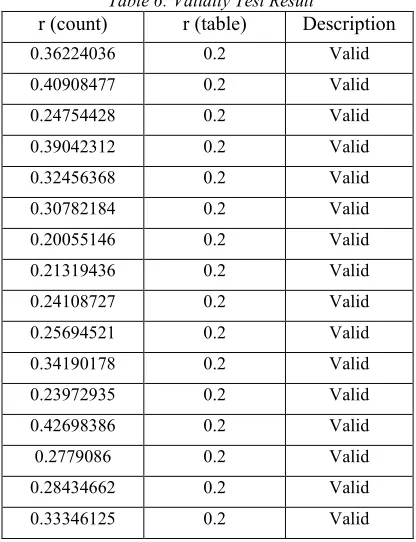
4. TEST VALIDITY OF
arithmetic> r table, then the data is Valid, but if r arithmetic <r then not valid. For validity test results can be seen in Table 6.
Table 6: Validity Test Result
r (count) r (table) Description 0.36224036 0.2 Valid
0.40908477 0.2 Valid
0.24754428 0.2 Valid
0.39042312 0.2 Valid
0.32456368 0.2 Valid
0.30782184 0.2 Valid
0.20055146 0.2 Valid
0.21319436 0.2 Valid
0.24108727 0.2 Valid
0.25694521 0.2 Valid
0.34190178 0.2 Valid
0.23972935 0.2 Valid
0.42698386 0.2 Valid
0.2779086 0.2 Valid
0.28434662 0.2 Valid
0.33346125 0.2 Valid
5. DISCUSSION
Awareness and attitude in the IT field, especially in IT Governance is very rarely noticed, this is something new and needs to get serious attention. Awareness and attitude do not directly affect the efficiency and effectiveness of an organization, but have a very significant impact, especially in the performance of an organization or company. Awareness and attitudes towards the effective application of information systems [5] to create two-way communication between user community and top management on IT governance that has responded positively. So that Business can be smooth, success in the future And can be better through active management control [6]. Awareness and attitude in the IT field is very closely related to the parties involved in IT Governance especially for users. To that end, the user is an object or human resource to get special attention especially to behave as the expected IT user [10].
From the above findings can provide a picture that awareness and attitudes toward the implementation of IT Governance is directly proportional to the understanding of knowledge and know that IT Governance is being implemented and
can be used. The greater the value gained, the greater the level of awareness and attitudes toward the implementation of IT Governance in an organization or company
Factor benefits and opportunity factors in awareness and attitudes toward the implementation of IT Governance, the value is also comparable with the results of questionnaires given by the respondents. The greater the value, the greater the impact on benefits and opportunities.
Risk factors and constraints with smaller final values will be better in the application of IT Governance within an organization or company. Implementation of good IT Governance, will be able to minimize the risks posed. Similarly, obstacles, the smaller the value of IT Governance implementation to be good or will be successful.
The presence of something new may not get a good response. Increased awareness in the implementation of IT Governance is not easy, therefore required continuity of work, so that organizational performance can be improved optimally and organizational goals can be achieved in accordance with what is expected. [1], [8].
The above findings are empirical findings, probably not absolute. The successful implementation of IT Governance is not only because of the level of knowledge, understanding and knowing that the organization is implementing IT Governance, this alone is not enough. Perhaps integrity and loyalty must be owned by all users or all parties. Because by having integrity and work loyalty work done with full responsibility and consistent. Excavations to find innovative opportunities and breakthroughs seem to be needed. Many things can be done so that the implementation of IT Governance can really be optimized.
6. LIMITATIONS
practitioners (4) or (4:4). With respect to the respondents, more is needed. Not only internally but also externally. For further questions it needs to be developed in terms of both quality and quantity.
7. CONCLUSION
Awareness and attitude is very important, therefore need to get serious attention in an organization or company that closely related to the influence of a performance. Awareness and attitudes towards the implementation of IT Governance is essential to be recognized as a positive control of effective information systems to create two-way communication between the user community and executive management to what extent the application of IT governance [11] ][18].
The average consciousness level obtained from this study was 3.5 with an average percentage of ± 72% with a risk reduction of ± 28%. That is, the implementation of IT governance has a very positive impact on the performance that exist in the organization because the risk has been reduced.
Knowledge and understanding of IT Governance is a fundamental issue in the implementation of IT Governance in an organization or company. Factor benefits and probability factors are directly proportional, but for risk reduction and inhibiting factors, the proportions are inversely proportional.
In the next study, it is necessary to review the question both in terms of quantity and quality, so that the results obtained will be more valid than previous results. In addition, it is necessary to involve all parties involved (stakeholders) in the distribution of questionnaires. Finally, this research needs to be developed not limited to one organization, but within a wider scope.
REFRENCES:
[1] Willson, P., & Pollard, C. “Exploring IT Governance in Theory and Practice in a
Large Multi-National Organisation in
Australia”. Information Systems
Management, 26 (2), 2009, 98 - 109.
[2] Winniford, M., Conger, S., & Erickson-Harris,
L. “Confusion in the Ranks: IT Service
Management Practice and Terminology”. Information Systems Management, 26 (2), 2009, 153 - 163.
[3] Gartner. “CIOs Reveal Their Issues with IT
Governance”. Retrieved 22 November 2009
Gopalakrishnan.
[4] Barlette, Y., & Fomin, VV. “Exploring the Suitability of IS Security Management
Standards for SMEs”. Proceedings of the 41st
Hawaii International Conference on System Sciences (HICSS), Hawaii, 2008, pp. 308-308. [5] Merhout, JW & Havelka, D. “Information
Technology Auditing: A Value-Added IT
Governance Partnership between IT
Management and Audit”. Communications of
the Association for Information Systems, 23 (articel 26), 2008, pp.463-482. Available at: http://search.ebscohost.com/login.aspx?direct =true&db=bth&AN=41671737&site=ehost-live.
[6] Van Grembergen, De Haes, & Guldentops
.“Structures, Processes and Relational
Mechanisms for IT Governance”. IGI Global,
2004, 1-36. https://doi.org/10.4018/978-1-59140-140-7.ch001
[7] Yudatama, Uky., Setiawan, Agus., Trismanto, A., 2017. Alignment Between Val IT And Risk IT for Choosing A Business Strategy By Fuzzy AHP and TOPSIS. Advanced Science Letters, 23 (3)(March 2017), p.2492–2494(3). [8] Handford, CE et al. “Awareness and attitudes
towards the emerging use of nanotechnology in the agri-food sector”. Food Control, 57,
2015, pp.24-34. Available at:
http://www.sciencedirect.com/science/article/ pii/S0956713515001966.
[9] Othman, MFI et al. “Obstacles to Adoption
Information Technology Governance : A
Preliminary Empirical Investigation”.
Proceedings of 15th International Business Information Management Association Conference, 2011, pp.1771-1787.
[10] Latif, AA, Din, MM, & Ismail, R. “Challenges in Adopting and Integrating ITIL and CMMI in ICT Division of a Public Utility
Company”. Proceedings of the Second
International Conference on Computer Engineering and Applications (ICCEA), 2011, (pp. 81-86).
[11] Lin, YM et al.“IT Governance Awareness and Practices: an Insight from Malaysian Senior
Management Perspective”. Journal of
Business Systems, Governance and Ethics, 5 (1), 2014, pp.43-58. Available at: http://jbsge.vu.edu.au/article/view/177. [12] Norman, H. ”Specifying IT security
[13] Kuusk, A. & Gao, J. “Factors for successfully integrating operational and information
technologies”. Portland International
Conference on Management of Engineering and Technology, 2015-Septe, pp.1513-1523. [14] Isaac, S. & Zabil, NFM. “Impact of Consumer
Awareness and Knowledge to Effective
Consumer Behavior”. 2017, 8 (13).
[15] Desa, A., Ba, N. & Yusooff, F., 2011. A Study on the Knowledge , Attitudes , Awareness Status and Behaviour Concerning Solid Waste
Management. , 18, pp.643–648.
[16] Hussein, I., Mahmud, M. & Tap, AO. “A Survey of Usability Awareness in Malaysia IT Industry”. , 1982 (March 1982), 2011, pp.146-151.
[17] Bouzarour-Amokrane, Y., Tchangani, AP & Peres, F. “Defining and Measuring Risk and Opportunity in Bocr Framework for Decision Analysis”. 9th International Conference on Modeling, Optimization and Simulation, 2012, pp.6-8.