IJPSR (2013), Vol. 4, Issue 12 (Research Article)
Received on 05 July, 2013; received in revised form, 25 August, 2013; accepted, 16 November, 2013; published 01 December, 2013
DEVELOPMENT AND VALIDATION OF SPECTROPHOTOMETRIC METHOD FOR THE ESTIMATION OF RITONAVIR IN TABLET DOSAGE FORM
C.D. Trivedi*, R. B. Mardia, B.N. Suhagia and S.P. Chauhan
Faculty of Pharmacy Dharamsinh Desai University, Nadiad- 387001, Gujarat, India
ABSTRACT: A simple, precise, accurate and repeatable method for bulk and tablet dosage form of Ritonavir have been developed using spectrophotometric method. Differential spectrophotometric method was used. The developed method was validated according to ICH
(Q2R1) guidelines and was found to be accurate, precise and specific.
Amplitude difference was taken at absorbance maxima at 246 nm and absorbance minima at 266 nm. Linearity range was found to be within the concentration range of 10-30 μg/mL. Limit of detection and quantification was found to be 2.62 and 7.96 μg/mL respectively. The proposed method was found accurate in the range of 95.5 to 105.5%. It can be successfully applied for the estimation of Ritonavir in bulk and pharmaceutical dosage forms. Results of the analysis were validated statistically and by recovery studies.
INTRODUCTION: Ritonavir, an anti-retro-viral agent (HIV protease inhibitor), chemically it is
1,3-thiazol-5-ylmethyl
N-[(2S,3S,5S)-3-hydroxy-5- [(2S)-3-methyl-2-{[methyl({[2-(propan-2-yl)-1,3-thiazol-4-yl]methyl})carbamoyl]amino}butan
amido]-1,6-diphenylhexan-2-yl]carbamate (figure
1), having molecular formula C37H48N6O5S2 and
molecular weight 720.944. Ritonavir has been reported to be quantified individually or in combination by spectrophotographic method and HPLC 1, 2.
Literature survey revealed that few analytical methods are available for determination of Ritonavir from biological fluid with combination
of other drugs by RP-HPLC 3, 4, 5.
QUICK RESPONSE CODE
DOI:
10.13040/IJPSR.0975-8232.4(12).4567-72
Article can be accessed online on: www.ijpsr.com
DOI link: http://dx.doi.org/10.13040/IJPSR.0975-8232.4(12).4567-72
Isosorbide mononitrate is a nitrate- class drug used for the prophylactic treatment of angina pectoris; that is, it is taken in order to prevent or at least
reduce the occurrence of angina 3.
There were many methods for Ritonavir estimation
including spectroscopic methods 6, 7, 8, 9 as well as
RP-HPLC 10 methods. But no any difference
spectrometric method has been reported for estimation of Ritonavir. So it was thought of our interest to develop and validate simple difference spectrometric method by measuring absorbance difference in two equimolar solution of Ritonavir different chemical form which exhibit different
spectral characteristics. Difference spectroscopy 13
is selectivity and accuracy of spectrophotometric analysis of sample containing absorbing interferent may be markedly improved by the technique of difference spectrometry. The essential feature of a difference spectroscopic assay is that measured value is the difference absorbance (∆A) between two equimolar solutions of the analyte in different chemical form which exhibit different spectral characteristics.
Keywords:
Ritonavir, Differential spectrophotometric method, accurate,
precise Correspondence to Author:
Chintan Trivedi
Faculty of Pharmacy Dharamsinh Desai University, Nadiad- 387001, Gujarat, India
FIGURE 1: STRUCTURE OF RITONAVIR 1
EXPERIMENTAL:
Materials: Ritonavir API was obtained from Aurobindo, Hyderabad obtained as a gift sample. Dosage form of Ritonavir, Viriton (Ranbaxy, Mumbai) Tablet labeled to contain 100 mg of ritonavir was purchased from local market.
In Reagents, Sodium hydroxide (0.1 N) solution which was prepared by weighing 4 gm and dissolved and diluted up to 1000 ml using distilled water in laboratory. Distilled water was prepared by using distillation assembly in laboratory. Methanol having AR grade was used for preparing solutions.
Instrument, Shimadzu UV 1800 UV-visible double-beam spectrophotometer with 1 cm matched quartz cells was used.
Method development:
1. Selection of solvent: Selection of solvent was carried out by checking the solubility of Ritonavir in different solvents. Various solvents were used like distilled water, methanol etc. Methanol was selected as a solvent on the basis of solubility of Ritonavir.
2. Preparation of stock solution: The given standard drug Ritonavir was weighed accurately (0.1 gm) and transferred to 100 ml volumetric flask. To prepare solution having concentration 1000 µg/ml (100 ml), it was dissolved and diluted up to the mark by methanol which was used as a solvent. This solution was stored as a stock solution. From this solution calibrating standards were prepared.
3. Preparation of calibrating standards:
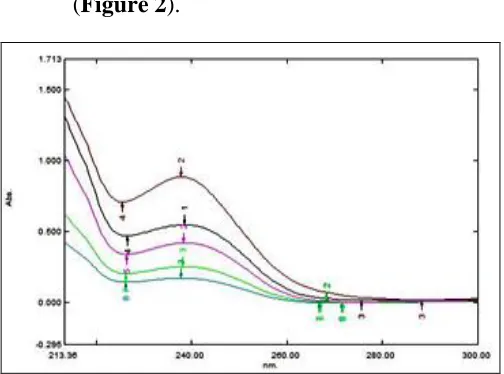
From the stock solution solutions having concentration 10 ppm, 15 ppm, 20 ppm, 25 ppm and 30 ppm were prepared. For this we had withdrawn 0.5 ml, 0.75 ml, 1 ml, 1.25 ml and 1.5 ml in five 50 ml volumetric flask. These solutions were diluted with methanol upto the mark so the resulting solutions have concentration of 10, 15, 20, 25, 30 ppm respectively. Using these solutions scanning between 200-400 nm was taken with help of UV instrument (Figure 2).
FIGURE 2: OVERLAIN SPECTRA OF RITONAVIR IN METHANOL FROM 10 TO 30 PPM BETWEEN 200-400 nm
Selection of solvent for difference spectroscopic method condition: Differential Spectrophoto-metric method was selected for the further process. There were three solvents tried (NaOH, HCl, and Water) randomly by making set of two solvents. For the six possibilities e.g. one of the above solvent was taken as reference and other one was taken as sample or test and baseline was corrected. From them based on linearity NaOH as reference and Water as test possibility was selected. The calibration curve was as follow.
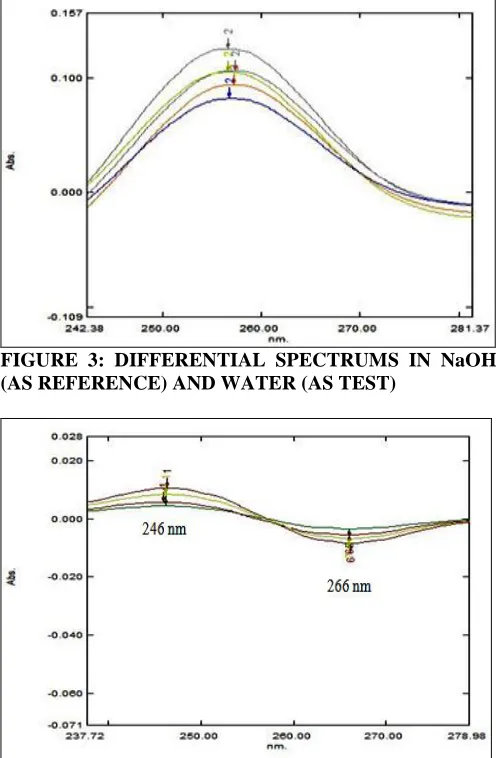
[image:2.612.314.566.213.400.2]The base line was taken using NaOH and water as a blank between 200nm to 400nm. The solution of NaOH having concentration 10 ppm was filled in cuvette and kept in reference holder while solution of water having concentration 10 ppm was filled in cuvette and was kept in test holder. Then the spectrums between 200-400 nm were taken. Remaining calibration standards were scanned in above manner and their spectrums were taken. (Figure 3) Then 1st derivative spectra were
calculated and overlain as shown in figure 4.
FIGURE 3: DIFFERENTIAL SPECTRUMS IN NaOH (AS REFERENCE) AND WATER (AS TEST)
FIGURE 4: 1ST DERIVATIVE DIFFERENCE OF SPECTRUM OF RITONAVIR IN NaOH (REFERENCE) AND WATER (TEST)
Preparation of calibration curve:
1st derivative absorbance difference for each
calibration standard were measured at 246 nm and 266 nm. Amplitude difference was calculated between these two wavelengths and plotted against
[image:3.612.315.565.43.200.2]concentration (figure 5).
FIGURE 5: CALIBRATION CURVE OF RITONAVIR
Tablet Analysis:
1. Preparation of stock solution of Tablet: The given 20 tablets of Ritonavir were crushed in clean and dry crucible and from that weighed accurately (equivalent to 0.1 gm) and transferred to 100 ml volumetric flask and diluted to 100 ml with methanol, as a solvent, to prepare solution having concentration 1000 µg/ml (100 ml), which was filtered using filter paper to remove excipient and stored as a stock solution. Form the stock solution of tablet, 1.5 ml aliquot was withdrawn and transferred in 50 ml volumetric flask and diluted with NaOH solution up to the mark. Solution in Water was prepared in similar manner.
2. Analysis of tablet sample: Above sample was scanned and its spectra was derivatised in the same manner as standard. Amplitude difference between 246 nm and 266 nm was calculated and put into calibration curve to find out the concentration.
RESULT AND DISCUSSION: The method was
validated according to ICH Q2R1 guidelines 10, 12
for validation of analytical procedures in order to determine the linearity, sensitivity, precision, Range, limit of detection (LOD), limit of quantification (LOQ) and accuracy for the analyte.
Analysis of Tablet Formulation: Marketed tablet formulation containing Ritonavir 100 mg was analyzed using this method. From the 20 tablets, an amount of tablet powder equivalent to 100 mg Ritonavir was weighed and transferred into 100 ml volumetric flask. Volume was made up to 100 ml with methanol (1000 µg/ml).
[image:3.612.48.298.208.381.2] [image:3.612.48.296.209.588.2]It was filtered for getting completely clear solution and removal of drug excipients. 1.25 ml and 1.5 ml of resulting solution was withdrawn in 50 ml volumetric flasks (2 sets, total 4 volumetric flasks) and volume was made up to 50 ml with NaOH and Water for preparing 25µg/ml and 30µg/ml
respectively. Differential spectrums of resulting concentration were taken by putting NaOH solution in to reference holder and water solution in to test holder and scanning was done between
200-400 nm and spectra was obtained. 1st
derivative spectra were calculated (Table 1).
TABLE 1: RESULTS OF ANALYSIS OF TABLET FORMULATION
Marketed formulation (tablet) Label Claim % Assay ± STDEV
Viriton 100 mg 100 % ± 0.23%
Accuracy: To study accuracy of the developed methods, recovery studies were carried out by using standard addition at three different concentration levels. Recovery study was carried out at three concentration levels (50%, 100% and 150%) of standard in to test sample having concentration of 10 μg/ml. From the amount of
drug Ritonavir found, percentage recovery was
calculated (Table 2). The accuracy of the methods
was confirmed by recovery studies from tablet at three different levels of standard additions recovery in the range of 95.5 – 105.5% justify the accuracy of method.
TABLE 2: RESULTS OF RECOVERY STUDIES OF RITONAVIR
Brand name Formulation (μg/ml) Addition of pure drug (μg/ml) Amount recovered (μg/ml) % Recovery
Viriton
10 0 10 100
10 5 15 100
10 10 20.34 101.66
10 15 26.10 105
Linearity: The linearity of this method was determined at five concentration levels ranging from 10µg/ml to30 µg/ml. The plot of amplitude
difference Vs concentration (Fig. 5) of Ritonavir
was found to be linear in the range of 10µg/ml- 30 µg/ml. Beer’s law was obeyed over this
concentration range (Table 3).
The regression equation was found to be Y=
0.006X - 0.002 and the correlation of
determination (r2) of the standard curve was found
to be 0.9961 (Figure 5).
TABLE 3: DATA FOR THE STANDARD CURVE OF RITONAVIR
Concentration (μg/ml) Amplitude difference
10 0.008
15 0.012
20 0.015
25 0.018
30 0.021
LOD & LOQ: The linearity study was carried out for six times. LOD (k = 3.3) and LOQ (k = 10) of the method were established according to ICH definitions. LOD and LOQ of method are reported in Table 8. In this study, LOD and LOQ were based on the standard deviation of the response and
the slope of the corresponding curve using the following equations
LOD = 3.3 σ/S; LOQ = 10 σ/S
Where σ is the standard deviation of the absorbance of the sample and s is the slope of calibration curve.
Precision:
Repeatability: The repeatability of the method was confirmed by repeating all calibration
standards 5 times at 95 % confidence level (Table
4).
TABLE 4: RESULTS OF REPEATABILITY
Concentration (30 μg/ml) Amplitude difference ( 246 nm, 266 nm)
1 0.021
2 0.021
3 0.021
4 0.020
5 0.021
Mean 0.0208
STDEV 0.000447
RSD 0.02015
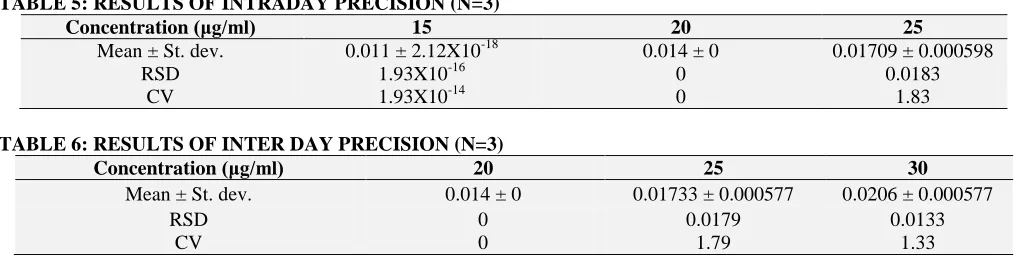
Intermediate precision: The intermediate precision of the method was confirmed by intraday and inter day analysis i.e. the analysis of formulation was repeated three times in the same day and on three successive days. For this,
[image:5.612.49.556.126.254.2]10μg/ml, 15 μg/ml, 20 μg/ml concentration solution was analyzed three times in day and same was measured in next three days and CV also calculated. CV was found to be less than 2% (Table 5 and 6).
TABLE 5: RESULTS OF INTRADAY PRECISION (N=3)
Concentration (μg/ml) 15 20 25
Mean ± St. dev. 0.011 ± 2.12X10⁻¹⁸ 0.014 ± 0 0.01709 ± 0.000598
RSD 1.93X10⁻¹⁶ 0 0.0183
CV 1.93X10⁻¹⁴ 0 1.83
TABLE 6: RESULTS OF INTER DAY PRECISION (N=3)
Concentration (μg/ml) 20 25 30
Mean ± St. dev. 0.014 ± 0 0.01733 ± 0.000577 0.0206 ± 0.000577
RSD 0 0.0179 0.0133
CV 0 1.79 1.33
[image:5.612.57.545.282.578.2]Summary of Validation Parameters:
TABLE 7: REGRESSION AND OPTICAL CHARACTERISTICS OF RITONAVIR
Parameters Value For Ritonavir
Beer’s Law Limit (µg/ml) 10-30
Correlation of determination (r2) 0.9961
Regression equation (Y=0.006X + 0.002)
Slope 0.000646
Intercept 0.002
STDEV of Slope 1.76X10-05
STDEV of Intercept 0.000514
TABLE 8: VALIDATION PARAMETERS
Parameters Results
Absorption maxima (nm) 246 nm
Absorption minima (nm) 266 nm
Linearity range (μg/ml) 10-30
%Assay 100 ± 0.23
%Recovery of Drug 102.98 ± 0.000447
Specificity Specific
Selectivity Selective
LOD (μg/ml) 2.628
LOQ (μg/ml) 7.963
Inter day (n=3) %RSD 1.562
Intraday (n=3) %RSD 1.93X10⁻¹⁴
CONCLUSION: From the validation study of the developed method for Ritonavir was found to be simple accurate, precise, and repeatable. Hence it can be applied for routine analysis of Ritonavir in its tablet dosage form for quality control.
ACKNOWLEDGEMENT: My heartily thank to
Faculty of Pharmacy, Dharamsinh Desai
University, for permitting to conduct this work. My special thanks to my guide Mr. Rajanikant Mardia for guiding me and supporting me at every level of this work.
At last I am thankful to almighty and of course my parents and all dear friends for their indirect support and blessings.
REFERENCES:
1. http://en.wikipedia.org/wiki/ritonavir 2. http://www.drugbank.ca/drugs/DB00503
4. Mardia RB. “Analysis of some antiretroviral drugs in bulk, pharmaceutical formulations and biological fluid”, Unpublished, Ph. D thesis, Saurashtra University. (http://etheses.saurashtrauniversity.edu/977/1/mardia_rb_t hesis_pharmacy.pdf 2012.
5. Mardia R.B., Suhagia B. N., Pasha T.Y., Chauhan S. P. and Solanki S. D.: Development and validation of HPTLC method for simultaneous analysis of lopinavir and ritonavir in their combined tablet dosage form. International Journal for Pharmaceutical Research Scholars 2012; 1(1): 39- 44.
6. Chiranjeevi K., Kumar GV., Channabasavaraj K.P., Manjunath Y and T. Tamizh mani: Third order derivative estimation of ritonavir in bulk and pharmaceutical dosage forms spectrophotometric. International Journal of Pharmaceutical Sciences 2011; 3(1):1017-1020
7. Nagulwar. V.P. and Bhusari .K. P.: Simultaneous Estimation of ritonavir and Lopinavir by Absorption ratio (Q-analysis) UV Spectrophotometric Method in Combined Tablet Dosage Form: Scholars Research Library (http://scholarsresearchlibrary.com/archive.html)”. 8. Chiranjeevi K., Channabasavaraj K.P., Reddy P.S. and Nagaraju P.T, Development and Validation of Spectrophotometric Method for Quantitative estimation of
ritonavir in Bulk and Pharmaceutical Dosage Forms. International Journal of Chem.Tech Research 2011; Vol.3 (1): 58-62
9. Behera A: Method development, validation and stability study of ritonavir in bulk and pharmaceutical dosage form using spectroscopic method. ChronYoungSci 2011; Vol. 2(3): 161-168.
10. Chiranjeevi K. and Channabasavaraj K.P: Development and validation of RP-HPLC method for quantitative estimation of ritonavir in bulk and pharmaceutical dosage form. International Journal of Pharmaceutical Sciences and Research 2011; Vol. 2(3): 596-600.
11. Swartz. M. E, Krull. I. S.: Analytical Method Development and Validation. Published by Marcel Dekker, First Indian Reprint, 26-27
12. Beckett A. H., Stenlake J. B.: Practical Pharmaceutical Chemistry. CBS Publishers and distributors 2005; 4(2): 272-302
13. ICH Harmonized Tripartite guideline, Validation of Analytical Procedures text and Methodology Q2 (R1) Currant step 4 version, Parent guideline dated 27 October 1994 (Complementary guideline on Methodology dated 6 November 1996 incorporated in November 2005).
All © 2013 are reserved by International Journal of Pharmaceutical Sciences and Research. This Journal licensed under a Creative Commons Attribution-NonCommercial-ShareAlike 3.0 Unported License.
This article can be downloaded to ANDROID OS based mobile. Scan QR Code using Code/Bar Scanner from your mobile. (Scanners are available on Google Playstore)
How to cite this article: