7054
THE PROPOSED IMAGE SEGMENTATION METHOD
BASED ON ADAPTIVE K-MEANS ALGORITHM
INTEDHAR SHAKIR NASIR
Lecturer at College of Medicine, Dept. of Family and Community Medicine, University of Kerbala, Kerbala, IRAQ E-mail: [email protected]
ABSTRACT
Image Segmentation is a significant process in image analysis, which refer to partition an image into coherent regions called (segments). Image segmentation is a mostly useful task in computer vision applications, which used commonly in several applications like image compression, object tracking, object detection, and so on. Current image segmentation techniques, either required prior information about the number of desired parts or segment the image based on certain criteria like uniform texture or color. Current research works, focused on segmentation to classifying the images based on extracted objects, which help to improve retrieving process in advance search engine. The difficulty in segmentation process is how to known the number of coherence regions in the given image. No one can achieve this process except the human mind, and the human only can decided what the interesting or unusual objects in the image. However, this paper suggested a new approach by combine two famous segmentation approaches, which are, region growing based method and clustering based method. The first approach aims to segment the image through sequence of image transformation procedures, then the connected component typically the objects regions in that image. Hence, by count these regions in the image; we can estimate the number of objects in the given image. By knowing the estimated number for the objects in the given image, second approach consider this value in for evaluation process. K-Means++ typically implemented in initial step to initialize the seeds when applying standard Means algorithm. After the initializing step, standard K-Means algorithm used by consider the pixels’ color properties at CIE color space. Both algorithms takes into consideration the SSE as a base metric to estimate the number of clusters (objects) in the image. This approach is very useful to understanding images and gives a good perception about it. Finally, the proposed system has tested and evaluated using Barkley dataset, and the experimental results have analyzed using accuracy measure. The evaluation metrics and experimental results shows that the proposed system has achieved better accuracy in order to segment the given images when compared with traditional segmentation methods.
Keywords: Image Segmentation, Images Analysis, K-Means++, Region Growing, SSE, K-Means.
1. INTRODUCTION
Image segmentation is a significant process in computer vision field and commonly selected as a major topic by researchers due its essentials in image processing. The main goal behind image segmentation is partition image into uniform regions that can be consider homogenous groups based on such given criterion like texture, color, motion, etc. These regions could be objects, or parts of objects, which may use in critical process such as object detection, object recognition, object tracking, and object based image retrieval (OBIR) [1]. Image segmentation considered as one of the most challenging task in image processing, where the main aim behind this process is to produce meaningful parts from the given image used later for image analysis. Therefore, the challenging arise
7055 Finally, hybrid techniques used the combination of the previous techniques by coupled the pixels values with the structural information of image [4]. Several methods used belong to the previous techniques, where either these methods use global or local information, the researcher aspires to find a method that produced an optimal results than other for the desired forthcoming process. Hence, based on the information used in segmentation task, these methods that comes under segmentation techniques can classified into four types, which are illustrate as follow: Thresholding based, region based, edge based, clustering based, watershed based, ANN based, and statistics based segmentation [5]. The aim of this paper is to illustrate the methods that used for image segmentation, and then proposed a new approach to predict the number of segment that the image should segmented. This approach proposed under clustering based segmentation method as a novel modification upon this technique. The remaining sections in this paper includes the following: an overview section, challenges in image segmentation, related works, proposed approach, result discussion, and finally conclusion and future work.
2. OVERVIEW OF SEGMENTATION
METHODS
Currently, there is no optimal technique nor unique method can used to segment all images. The process of image segmentation is varied and complex and its totally depends on the type of image and the adopted method. Therefore, this section illustrate an overview of the most common segmentation methods used currently, which illustrated as follow [5, 6]:
2.1 Thresholding Based Methods
Thresholding based segmentation methods, are the simplest and fastest than other methods. These methods concern with the pixel intensities by adopt appropriate Thresholding value. Then the image pixel classified into either background region or object region. The Selection of Thresholding value could base on prior knowledge or such information extracted from image features. Thresholding are classify into three approaches, which are [6]:
2.1.1 Global Thresholding Approach
This approach typically used a global Thresholding value called (T), this value actually constant for the whole image, the basic equation for global Thresholding technique calculated as follow:
(1)
Where the S (x, y) is the result image (segmented image), that resulting from the origin image I(x, y).
2.1.2 Local Thresholding Approach
This approach is adapted threshold based on the neighborhood pixels of the desired region. The thresholds can vary upon whole image and can calculated based on the following equation, where the R(x, y) is the result region, and S(x, y) is the segmented image:
(2)
2.1.3 Multiple Thresholding Approach
This approach use more than one threshold values based on computed the peaks of the image histograms. Therefore, these thresholds can used upon image regions, and every region satisfy certain threshold, the resulting involve the desired object. The output image can segmented by using the following equation:
(3)
2.2 Regions Based Method
In this approach, the main idea to extract the segments is by aggregation the pixels that have similar characteristics or patterns. This approach typically called (region growing), where the region started from the wining pixels, then the neighborhood pixels compared to the origin pixel. Thus, if these pixels have similar patterns, the adjacent pixels are compose to form a large region. This approach can be classify into two classes [2]:
2.2.1 Region Growing Based Segmentation
Region growing based approach use the connectivity property of image pixel, where the initial pixel compared with its 4/8-connected pixels. Initial pixels selected either manually, or by employing prior knowledge about the problem. There is basic equation can used in this model where the given image converted ostensibly to the binary image, and then the following equation is applied.
7056 Where P_T (x,y) is the initial pixel, typically in region growing method there are many initial pixels, the difficulty in region growing algorithm is how do we decided if the pixel is similar to initial one or not, and how the dissimilar range can calculated properly [5, 6].
2.2.2 Splitting and Merging Based Segmentation
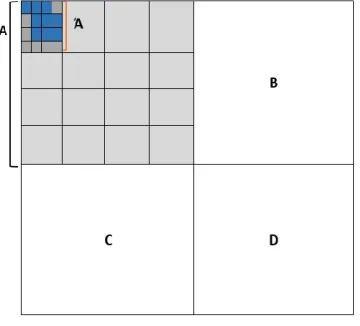
[image:3.612.103.283.333.496.2]In this method, the origin image partitioned into such segments then the similar segments (regions) are merging to form a large region. Generally, the adjacent region involve at most similar patterns with relatively small difference. The basic representation for this model is a pyramid tree, where the main goal is to partition the image into uniform regions until arriving a convincing result, where no Furth splitting is required. In the following figure (fig.1), the given image partitioned into fourth smaller squared regions as shown below:
Fig. 1: Splitting an Image to Quad Areas In the above figure (fig.1) we can notice that, the given image I, partitioned into four uniform areas (A, B, C and D), then the process is repeated as shown in the segment (A). When the process of splitting stopped, merging technique started by combining the adjacent pixels based on intensity patterns [8].
2.3 Edge Based Method
Edge based method based on some reference books; consider one of the most popular method to segment the image. The main idea of this method is by detect the rapid changes in pixels’ intensity values. The problem is that a sudden change in the intensity values of pixels may not give a good decision about object boundary. Hence, first or second derivative of intensity values has calculated to detect the edges and then connected to form the object boundaries. The most common techniques
used for edge detection are Robert, Sobel and Canny operators [9].
2.4 Clustering Based Method
This method typically segment the image into clusters, where each cluster having pixels own similar patterns or characteristics and this process called clustering. Clustering is a technique that divided the data points or elements into coherence groups called clusters, where the element in the same clusters are similar to each other than other clusters. The clustering techniques involve many categories based on the method the element are partitioned. The most common clustering methods used with image data are hierarchal and partition based methods. In each category, there is an optimization method and objective function. Optimization method try to find an optimal implementation of an algorithm with respect to time and space complexity. While objective function try to implement the desired algorithm with minimum error rate as possible. Clustering algorithm typically used the attached features that derived from image pixels and applying the clustering model where elements partitioned into coherence clusters based on the applied model. Commonly there are two types of clustering are hard clustering and soft clustering, which explained as follow [10, 11]:
2.4.1 Hard Clustering Method
This method also called partitioning based clustering. In this type of clustering method, the data points (elements) partitioned into set of clusters where every element exist only in one cluster. Therefore, in image data each pixel can exist only in one cluster, and in this case, each pixel has a single membership value that is either (0) or (1). Main goal of this method is by minimizing the intra clustering similarity, and maximizing inter cluster parity. One of the most popular algorithm used in hard clustering method is K-means algorithm, where (K) refers to the number of clustering results. K-means started by select set of initial points (pixels) as initial clusters centroids, and then every pixel is assign to the nearest one. This process is repeated number of time (iteration) until there is no change in the clustering results [12].
2.4.2 Soft Clustering Method
7057 should selected to discard the lowest membership values, and to reduce the noise in clustering results. One example of popular algorithm used in this type is fuzzy C-means algorithm, which correspond to K-means algorithm with the difference that, C-means algorithm used membership value to assign data points to appropriate clusters. The main critical task in this type of clustering is the way that used to pick the appropriate membership value, which perhaps gives an optimal result [13].
2.5 Watershed Based Method
This method treat with the image as topographic map, where the goal of this method is to detect the watershed of object on the image. The idea behind this method comes from the real watershed where in real life when the water reach to the basin, it’s made a border, then by merging the borders the object boundaries shown as a morphological plan. The watershed method depends on the gradient of the given image where the pixels have the maximum gradient values represented as boundary [14].
2.6 ANN Based Method
ANN (Artificial Neural Network) used the human learning strategy to make the decision. This method typically used in medical images to separate the region of interest or such image objects from background. Neural network look like human brain where the working procedure of this method is by construct a network of connected nodes and every node has its own weight. Then the weight has adjusted as in neurons to be able to give a decision in such circumstances [3].
3. IMAGE SEGMENTATION CHALLENGES
Image segmentation still one of the most critical challenge in image processing and especially in computer vision application due to the objects and background in real images scenes are very complicated. Typically, segmentation algorithms worked by either consider the object features or based on the object motion. In first class, the pixels features are not uniform and may the segmentation algorithms produces fraction segments [10]. Another types of segmentation algorithm, focus on separating the objects from background by using sequence of images, this process called motion estimation [17]. Another significant challenge is the image resolution, when image include a noise or such blurring transformation issue, the segmentation results are not sufficient also and the objects may involve several segments over sever regions. Any segmentation method or algorithm
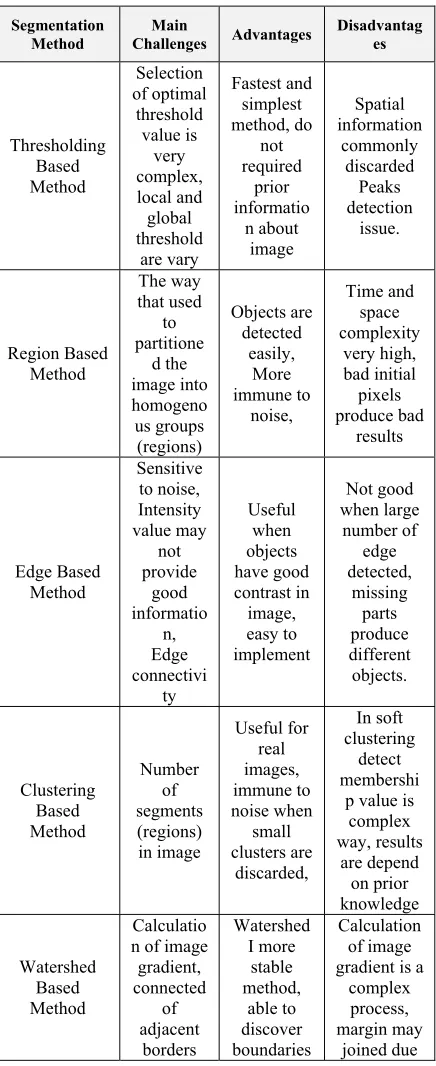
[image:4.612.310.528.204.737.2]satisfy only certain type of image as discussed earlier, therefore this is the main reason for proposed several segmentation research works. In the following table (table 1), the main challenges are illustrated opposed the discussed segmentation methods in section 2 as well as the advantages and disadvantages of each method [13, 14].
Table 1: Challenges, Advantages and Disadvantages of Segmentation Methods
Segmentation Method
Main
Challenges Advantages
Disadvantag es Thresholding Based Method Selection of optimal threshold value is very complex, local and global threshold are vary Fastest and simplest method, do not required prior informatio n about image Spatial information commonly discarded Peaks detection issue. Region Based Method The way that used to partitione d the image into homogeno us groups (regions) Objects are detected easily, More immune to noise, Time and space complexity very high, bad initial pixels produce bad results Edge Based Method Sensitive to noise, Intensity value may not provide good informatio n, Edge connectivi ty Useful when objects have good contrast in image, easy to implement Not good when large number of edge detected, missing parts produce different objects. Clustering Based Method Number of segments (regions) in image Useful for real images, immune to noise when small clusters are discarded, In soft clustering detect membershi
p value is complex way, results are depend on prior knowledge Watershed Based Method Calculatio n of image
gradient, connected of adjacent borders Watershed I more stable method, able to discover boundaries Calculation of image gradient is a
complex process, margin may
7058 under
blurring transformat
ion
its came from different sources.
ANN Based Method
Learning time, accuracy
of decision,
Able to handle complex status, high
level of accuracy
Learning is a time complexity,
typically used for certain images
4. RELATED WORKS
Image segmentation as discussed earlier is an important task in image processing field. Due to explosive growth of image that exist either in grayscale space or in different color spaces, this made the segmentation process is a very complex process. Hence, there are always new research works published in the world, and researchers solve certain types of segmentation issues. With several image types there are of course several segmentation methods. In this section, clustering based segmentation method is consider based on the goal of this paper, so the most related works to this paper are illustrated briefly. Nassir Salman, 2006, [8], the author has combine the watershed algorithm and edge detection technique to segment the image. This process actually required image gradient calculation, which is a time complexity, and noise pixels produce wrong edges. Naz et all, 2010, [5], illustrate some of research works that segment the image by using k-means and fuzzy c-means algorithms. The critical challenges in these methods are; we should give the number of clusters, and select an appropriate membership values. Thodeti et all, 2011, [9], the authors combine region growing algorithm and watershed algorithm. This work is useful for splitting the images that do not include much noise, and it required a time for image gradient. Patel et all, 2013, [10], the authors used K-means algorithm to segment MRI image, the challenge in this work, Cluster number should be give based on human perception, otherwise error will be occur in clustering results. Rizvi et all, 2014, [11], the median filter has used to enhance the performance the watershed algorithm. Median filter and watershed algorithm are sensitive to noise and required high accuracy image. Bora and Gupta, 2014, [1], proposed a new approach to segment the image based on K-means algorithm after converting image to l*a*b color space. This process typically
required in the beginning the number of segments (regions) for the given image, and only the human brain can decided the correct number. Kumar and kumar, 2016, [12], authors used Gaussian and K-means algorithm to segment the image based on pixel density. This method typically required number of clusters, and Gaussian kernel is time complexity. Nasir et all, 2018, [13], authors enhanced K-means algorithm to segment malaria images by produced sequence-clustering groups and find the SEE for optimal number of clusters (K). Malaria images actually exist in uniform background and the process of segment these images typically easy than other complicated images. In this paper, a new approach has introduced to give better perception about the image segmentation. Where knowing the number of coherent regions in any given image, typically if not possible is also so complex due to overlapping among the regions. However, in any segmentation method, the number of desired segments should known or at least expected. Then the user start segment the image and adjust the result until reach to the desired results. This process is waist time, and actually need a lot of time, hence, from this motivation step, the proposed system start by try to find a solution for manual interaction with the active user. The proposed system adopt K-means++ algorithm as an initial step for finding the seed points, this algorithm also consider as an initialize step for K-means algorithm in many data analysis applications. After perform K-means++ algorithm and the seed pixels have selected, K-means algorithm has implemented to segment the given image. The methodology of this work also used another approach to expect or estimate the number of segments by using region-growing approach. However, the proposed system can be consider as hybrid system in which, the number of expected segments is estimated using two approaches, then the result is evaluated against them. After the number of segments (clusters) has estimated, the proposed system partitioned the image according to the prior analysis. The proposed system details and experimental results explained in the following sections.
5. PROPOSED SYSTEM
7059 clustering algorithm. The main goal for applying region growing based method is to expect the number of segments in the image. Where in the RGB image, the image converted into Grayscale image, then to binary. Connected groups separated from background, which already got different values from background. By counted these groups, the expected number of clusters can be estimated which used to verify the resulting of second part. In the second part of proposed system, K-means algorithm used to segment the acquired image. The critical issues in k-means algorithm is the number of clusters (K) and selecting the initial seed pixels, where bad initial seeds produced bad clustering results. Therefore, to avoid previous issue, K-means++ algorithm is used in the beginning for the following two reasons: k-means++ algorithm used as initialization step for k-means algorithm to select the seed pixels, where bad seed pixels of course produces bad segmentation results. K-means++ algorithm also used to expect the number of clusters by calculating SSE (Sum of Squared Error) where minimum SSE value refer to good clustering results. The following figure (fig.2) shows the block diagram of proposed system, which portioned into two main parts.
Fig.2: The Proposed System Block Diagram for Image Segmentation
5.1 An Adaptive Step to Initialize K-Means Algorithm
One of the great solution for some drawbacks in K-means algorithm is K-Means ++ algorithm. The main challenge if K-means is the difficulty of choosing the initial seed points where its take much time until converge the optimization function. K-Means algorithm one of the most reliable and fast partitioning based algorithm, and used commonly for wide range application to partition the data into coherent groups. The basic K-means algorithm steps explained as follow [15]:
Basic K-Means Algorithm Steps
Step1:
Step2:
Step3:
Step4:
An initial step in K-means is choosing (K) initial seed points as initial clusters centroids, C= {C1, C2… Ck}.
For each pixel in an Image (I), compute the distance (D) between the pixels and all centroids based on the following equation:
(5)
where j=1..n,i=1..k,
Moreover, assign pixels to the clusters with the minimum distance value.
Recalculate the cluster centroids by using the following equation:
(6)
Repeat step 2-3 until no change in
As mention earlier, K-Means++ consider as an initialization step to standard k-Means algorithm, so the algorithm steps of K-Means++ explained as follow:
Basic K-Means++ Algorithm Steps
Step1: Step2:
Step3:
Choose one center randomly from C= {C1, C2… Ck}.
For each pixel in an Image (I), compute the distance (D) between the pixels and the nearest centroid that already chosen with probability
where j=1..n,i=1..k
7060 Step4: Proceed with standard K-Means
algorithm.
The optimization function that algorithm should be converge in K-Means algorithm is to find a SSE with minimum value, which is calculated, based on the following equation:
5.2 Segmentation of Image Using Region Growing Method
Region growing method one of the most popular method to segment the image based on pixel connected property. Region growing also called (region propos) started by converting the RGB image into gray scale. A grayscale threshold selected to convert the grayscale image into binary image, and then the pixels classified into two classes: either background pixel or object pixel as shown in the following equation, where R (P) is the image Region, V(P) is the value of the current pixel and is the gray scale threshold [16].
(8)
The result of applying above step is a binary image and the pixels values are (0’s) for background pixels and 1 for objects. The main goal of applying region-growing method in this paper is to count the coherence regions. Coherence region actually have connected pixels as shown in the figure (fig.3), where the connected component construct a uniform region. In the following figure (fig.3) the connected property in the right side, and by take the advantages of 4-connected / 8-connected operation; the pixels colored with uniform color to distinguish it from background, then by count the connected pixels in uniform region, every region can counted with its area as shown below.
Fig.3: Region Growing Based Image Segmentation Method
After the image has segmented using region growing method, every region got a uniform label, and then every pixel in the labeled region got its own region index. At this step, the region can counted and used to verify the opposite step when K-Means algorithm applies upon the given image.
6. EXPERIMENTAL REULTS
6.1 Image Segmentation (Region Growing)
Implementation of proposed system start by reading an image (e.g. RGB image). Proposed system start by enhance the image using histogram equalization after converting the RGB image for example into grayscale image. Grayscale threshold implemented to convert the image into binary then extract coherent segments. After the coherent segments are labeled and indexed, the proposed system then used the pixels index to view the segment in the original RGB image as shown in the following figure (fig.4).
Fig.4: Segmentation an Image Using Region Growing Based Method
In the above figure (fig.4), proposed system segment the RGB image based on Region growing, the result of applied images as shown above is (5) segments. Therefore, the estimate number of clusters could found for the given image is not exceed (5) by large range value. The above figure (fig, 4) shows the result of region growing method and the mainframe view the segment number=3 as shown above.
6.2 Estimate the Number of Segments (“K”)
7061 segment the given image. K-Means algorithm required the number of clusters (K) entered before starting the clustering procedure. In proposed system, K-Means++ implement to estimate the number of clusters based on the minimum SSE value. K-means++ Started from a given range by consider the result of region growing method where, minimum and maximum number of clusters are given priori. This algorithm also speeded up the standard K-Means algorithm by reducing the number of iteration due to the initial seed pixels are selected priory. The following figure shows the estimated number of clusters for the same input image in previous step.
Fig.5: Estimation the Number of Clusters in Proposed System
In the above figure (fig.5), the number of clusters (K) been estimated and the optimal number of clusters is chosen based on the minimum SSE as shown above, where the optimal number of clusters for the given image is (4) while in region growing method its shown there are (5) segments.
6.3 Image Segmentation Using K-Means Algorithm
[image:8.612.91.303.279.402.2]Last step in proposed system after the number of segments in the corresponding image has estimated and the image has analyzed by using two different approach. Now, the user known or at least expect the correct range of segment that should produce from the given image. In the following figure (fig.6), the input image in previous step has selected and the number of clusters given based on estimation steps as shown below.
Fig.6: Segmentation of RGB Image Based on K-Means Algorithm
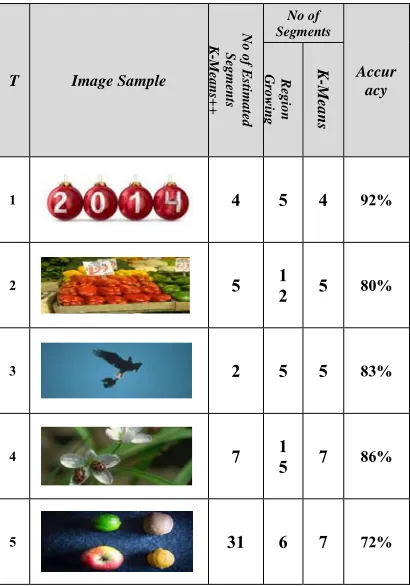
In the above figure (fig.6), K-means algorithm has implemented upon the given image where the result of clustering where the number of clusters given prior as an input parameter. The following table (Table 2) illustrate the results of segmentation (8) images by using two approaches (region propos and K-Means) as shown below.
Table 2: Implementation of Proposed System upon Barkley Dataset
T Image Sample
No of
E
st
im
a
te
d
Segme
n
ts
K-Means+
+
No of Segments
Accur acy
Region
Gr
ow
in
g
K-Means
1 4 5 4 92%
2 5 12 5 80%
3 2 5 5 83%
4 7 15 7 86%
[image:8.612.314.519.419.712.2]7062
6 4 8 8 100%
7 11 9 9 93%
8 5 3 3 89%
[image:9.612.90.315.69.226.2]In the above table (table 2), proposed system is tested against some RGB images. Based on the above results, we conclude the accuracy of image segmentation is totally depend on the image itself and the adopted method. Typically, the image that given to be segmented, should the desired object appeared clearly in that image, otherwise no segmentation algorithm nor proposed method can provides a solutions for all types of images. In the above table (table 2), when complex images are used the result of course is far away from human perception and the resulting of segmentation conclude fraction objects. Therefore, when image conclude a cleared object, of course it is possible for common segmentation method to segment it. In the following table (table 3) illustrate the performance of proposed system when four Barkley images dataset used.
Table 3: Proposed System Performance upon Four Barkley Images Dataset Used
Numb er of Cluste rs
Im
age N
a
me
Sensitivity of Proposed
System Execution
Time in MS. (Milliseco
nd) Region
Growi ng
K-Means
++ K-Mea
ns
3
4 Apples
97% 88% 92% 8.71
4 98% 91% 94% 10.21
5 99% 93% 98% 12.11
6 92% 87% 82% 16.41
2
Fa
lco
n
91% 92% 95% 6.40
3 88% 89% 91% 9.22
4 81% 84% 83% 11.24
5 72% 75% 69% 15.22
4 rt a E 95% 88% 81% 12.41
6 92% 89% 88% 16.13
8 85% 92% 94% 18.17
7 Natural 95% 82% 77% 21.14
10 92% 84% 85% 23.33
13 84% 91% 92% 25.18
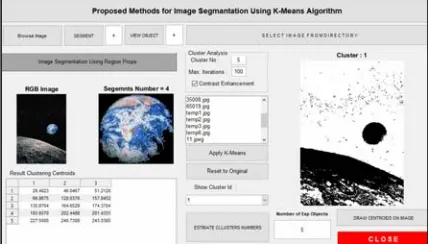
Segmentation of complicated image is a critical issue in many computer vision applications, in the following figure (fig.7), when nature image used in proposed system. The Earth can be shown is segmented successfully in both methods (Region growing and K-Means algorithm). This results show the Earth object segmented in spite of the image it has also complicated with the background and other objects in the scene. Therefore, we can conclude the segmentation method is totally depend on the image itself and the characteristics of objects in the scene as shown in the following figure.
Fig.7: Segmentation of Earth Image Using Proposed System
7. MOTIVATION AND WORK LIMITATIONS
The motivation of the proposed system as discussed earlier in this paper, which illustrates as follow: first, the proposed system combine two different approaches to segment the given image where the user can estimate the number of segments before applying the corresponding method. Second, the number of clusters is estimated priori in the proposed system by using K-Means++ algorithm. Hence, this facility preceding the speed of K-Means and avoids as possible bad clustering results when standard K-Means algorithm used. Third, proposed system gives a facility to view each object individually as well as each cluster in K-Means algorithm clustering results.
[image:9.612.313.527.350.472.2]7063 segmentation research works. Therefore, the limitations of this research work illustrated as follow: first, the proposed system able to segment certain type of images and do not overcome all complicated images. Region growing do not always gives an optimal result, due to this method in the beginning convert RGB image into grayscale space, after that its convert the gray image into binary by adopt gray scale threshold. This task typically causes to lose most of pixels information through this transformation, and this process successfully either with uniform background images, or with images that do not involve complicated objects. Second, in second part of proposed system, where K-Means algorithm used, RGB image converted priori into CIE color space, thus this procedure segment the regions in image based on pixels color properties. This method, working efficiently when object has uniform texture patterns, but when object has different colors in its surface, the algorithm produced fraction parts for the same object. Finally, the number of iteration in K-Means algorithm is time complexity, this number actually spend by K-means until converge the objective function and because the image data is relatively big and take time when the number of iterations is increase
.
8. CONCLUSION
Knowing the number of segments in image Segmentation typically one of the biggest challenges in complex images. However, knowing or expect the number of uniform objects could be found in the given images help to achieve high accuracy in segmentation process. Knowing the number of estimated regions in medical imaging could give better perception about the medial disease. However, the accuracy of segmentation and better separation of objects gives more help in this science. Segmentation approach is relatively important and consider as an interesting field by most researchers around the world. Therefore, with each kinds of image, there is certain segmentation method and one approach typically developed to overcome the issues of segmentation on these images. In this paper, new approach has introduced to estimate the number of segments (objects) that could found in the given image. Number of objects estimate priory by applying two approaches, the first one is by applying region growing approach and second by use K-Means++ algorithm. After that, when the number of objects (also called regions, clusters) has estimated, the proposed system applied K-Mean algorithm. The result of clustering algorithm represented as coherent
clusters, where every cluster shows a certain region in the image and colored based on cluster label values. The result shows the proposed system has achieved high level of accuracy than other existing methods. In addition to that, the proposed system provide a novel approach by avoiding manual estimation from human.
REFRENCES:
[1] Dibya J. Bora, Anil K. Gupta, “A Novel Approach Towards Clustering Based Image Segmentation”, International Journal of Emerging Science and Engineering, Volume 2, Issue 11, pp. 6-10, 2014.
[2] Dilpreet Kaur, Yadwinder Kaur, “Various Image Segmentation Techniques: A Review”, International Journal of Computer Science and Mobile Computing, Volume 3, Issue 5, pp. 809-814, 2014.
[3] M.R. Khokher, A. Ghafoor, A.M. Siddiqui, “Image Segmentation Using Multilevel Graph Cuts and Graph Development Using Fuzzy Rule Based System”, IET Image Processing, Volume 7, Issue 3, pp. 201-211, 2013.
[4] Naveen Tokas, Shruti Karkra, Manoj Kumar Pandey, “Comparison of Digital Image Segmentation Techniques- A Research Review”, International Journal of Computer Science and Mobile Computing, Volume 5, Issue 5, pp. 215-220, 2016.
[5] S. Naz, H. Majeed, H. irshad, “Image Segmentation using Fuzzy Clustering: A Survey”, International Conference on ICET, pp. 181-186, 2010.
[6] Devarshi Naik, Pinal Shah, “A Review on Image Segmentation Clustering Algorithms" International Journal of Innovative Research and Development, Volume 3, Issue 12, pp. 234-239, 2014.
[7] K. Bhargavi, S. Jyothi, “A Survey on Threshold Based Segmentation Technique in Image Processing”, International Arab Journal of Information Technology, Volume 3, Issue 2, pp. 104-110, 2006.
[8] Nassir Salman, “Image Segmentation Based on Watershed and Edge Detection Techniques”, International Arab Journal of Information Technology, Volume 3, Issue 2, pp. 104-110, 2006.
7064 Computer Science and Information Technologies, Volume 2, Issue 5, pp. 2332-2334, 2011.
[10] Piyush M. Patel, Brijesh N Shah, Vandana Shah, “Image Segmentation Using K-mean Clustering for Finding Tumor in Medical Application”, International Journal of Computer Science and Information Technologies, Volume 4, Issue 5, pp. 1239-1243, 2013.
[11] Samina T. Rizvi, Mandeep S. Sandhu, Shan E. Fatima, “Image Segmentation Using Improved Watershed Algorithm”, International Journal of Computer Science and Information Technologies, Volume 5, Issue 2, pp. 2543-2545, 2014.
[12] Ajay Kumar, Shishir Kumar, “Color Image Segmentation via Improved K-Means Algorithm”, International Journal of Advanced Computer Science and Applications, Volume 7, Issue 3, pp. 46-53, 2016.
[13] Aimi Salihah Abdul Nasir, Mohd Yusoff Mashor, Zeehaida Mohamed, “Enhanced k-Means Clustering Algorithm for Malaria Image Segmentation”, Journal of Advanced Research in Fluid Mechanics and Thermal Sciences, Volume 42, Issue 1, pp. 1-15, 2018.
[14] S. M. Aqil Burney, Humera Tariq, “K-Means Cluster Analysis for Image Segmentation”, International Journal of Computer Applications, Volume 69, Issue 4, pp. 1-8, 2014.
[15] D.; Vassilvitskii, S., “K-means++: The Advantages of Careful Seeding" (PDF). Proceedings of the eighteenth annual ACM-SIAM symposium on discrete algorithms. Society for Industrial and Applied Mathematics Philadelphia, PA, USA, 2007.
[16] Santanu Bhowmik, Viki Datta, “A Survey on Clustering Based Image Segmentation" International Journal of Advanced Research in Computer Engineering and Technology, Volume 1, Issue 5, pp. 280-284, 2012.