5694
SECURITY REQUIREMENTS AND TECHNOLOGIES FOR
THE INTERNET OF THINGS (IOT) APPLICATIONS:
A SYSTEMATIC LITERATURE REVIEW
1ASMA ASDAYANA IBRAHIM, 2MASSILA KAMALRUDIN
1Faculty of Information and Communication Technology, Universiti Teknikal Malaysia Melaka, 76100, Malaysia
2Innovative Software System and Service Group, Universiti Teknikal Malaysia Melaka, 76100, Malaysia E-mail: 1[email protected], 2[email protected]
ABSTRACT
Security requirement is one of the most important intangible requirements which could be taken as a burden on the smooth functioning of the system or application. Requirements engineers without expertise in security are at risk of overlooking security requirement, which frequently leads to the act of misuse. This study plans to identify the security requirements and technologies being used in IoT applications. We conducted a systematic literature review in order to identify and analyse related literature on elicitation of security requirements for IoT applications. We found that the most used technologies for IoT applications are sensors, mobility networks, RFID systems, WiFi, Bluetooth and Zigbee and the security requirements that are relevant for IoT applications are authentication, confidentiality, integrity, authorization, access control and availability. Finally, the characteristics and properties of the security requirements and technologies were also discussed. It can be concluded that the primary challenge of security requirements is to identify the most appropriate security requirements. Furthermore, requirement engineers should consider challenges posed by security requirements such as to analyse and develop security requirements for IoT applications. In addition, right security requirements for IoT applications should be recognized at the early phase of IoT applications development.
Keywords: Internet Of Things, Systematic Literature Review, Security Requirements, Internet Of Things,
Iot Technologies
1 INTRODUCTION
The internet of thing (IoT) is a system that is expected to interconnect compelled devices; for instance, sensors, actuators, RFID from the physical world to the Internet. The IoT is considered as an empowering innovation for few applications like healthcare, assembling and overwhelming industry, finance and banking, transportation and smart environments. It is expected that 50 billion devices will be interconnected by 2020, and this number is expected to achieve trillion [1]. Nowadays, IoT can provide a more propelled services to people, which connects variety of devices, applications, and systems. However, it covers variety of devices, protocols and application, which makes it much more complex. Recently, IoT technologies are applied in various areas. The large-scale implementation of IoT devices promises to transform many aspects of the way we live. For consumers, new IoT products like Internet-enabled
appliances, home automation components, and energy management devices are moving us toward a vision of the smart city, offering more security and energy-efficiency. Other personal IoT devices like wearable fitness and health monitoring devices and network-enabled medical devices are transforming the way healthcare services are delivered. The IoT will demand a wide range of new technologies and skills, including new hardware platforms, networks, operating systems, high-volume data processing, cloud services, endpoint management tools, as well as standards and ecosystems.
5695 the privacy issues that an end-user may face as a consequence of the spread of IoT. Majority of the survey is focused on the security loopholes arising from the information exchange technologies used in Internet of Things. However, no security requirements in IoT application has been analysed in the paper. Furthermore, Zhou et. al [4] introduced the architecture and unique security and privacy requirements for the next generation mobile technologies on a cloud-based IoT. This work also identifying the inappropriateness of most existing work, and addressing the challenging issues of secured packet forwarding and efficient privacy. All of this work preserving authentication by proposing new efficient privacy preserving data aggregation without public key homomorphic encryption.
Another work by [5] provides an overview about the security and privacy challenges of IoT applications in smart grids. Furthermore, they highlight and analyze some solutions and practices being used in coping with security and privacy requirements for IoT on deployment and management of smart grid. They address three types of challenge domains; customer domain, information and communication domain and the grid domain. They represent a comprehensive survey of the most recent contributions on security and privacy aspects of IoT applications in smart grid and identify some of the remaining challenges and vulnerabilities related to security and privacy. Even though the benefits of smart grid are evident and are widely acknowledged by utility companies, cyber-attacks will be more innovative than ever. The insights and recommendations outlined in all of the reviewed research works can help utilities to be in a strong position in preventing these potential threats although it is impossible to completely neutralize the likelihood of destructive cyber intrusions. Privacy and security requirements in IoT based smart grids is only partially researched and there is a wide space of research aspects to be investigated further in order to build well-defined and more secured standards for communication and protection. There are also some IoT-specific characteristics like power consumption and low computing power and this leads to existing ICT technologies to be restricted. Therefore, security requirements for IoT devices and technologies are necessary.
Based on the findings, we have identified that the most used attributes/key technologies for IoT applications are sensors, mobility networks, RFID systems, WiFi, Bluetooth, and Zigbee. The results also show that sensors have become the
most frequently-used technology in IoT applications. We have discovered the important security requirements for IoT applications, namely; authentication, confidentiality, integrity, authorization, access control, and availability were applied to IoT applications. The result also shows that authentication is the most important properties needed for IoT based applications. This paper is organized in five sections. After the introduction section, we present the three phase of methodology which are planning, conducting the review and reporting the review in the second section. This is followed by the third section which described the review results of this study. The fourth section summarizes the findings of this study. Lastly, this paper will end with a section on the conclusion.
2 REVIEWMETHOD
This review has to be attempted as Systematic Literature Review (SLR) in light of the first rule as proposed by [6]. The SLR consists of three phases which are Planning, Conducting the Review and Reporting the Review. Figure 1 demonstrates the systematic literature review process.
Figure 1: Systematic Literature Review Process
2.1 Planning the Review
2.1.1 The Research Question (s)
To keep the review focused, Research Question (RQ) were formulated by Kitchenham [7] using the Population, Intervention, Comparison, Outcomes and Context (PICOC) criteria in structuring the research questions. Table 1 shows summary of PICOC in arranging the research questions.
Table 1: Summary of PICOC
PICOC Criteria
Population IoT technologies, IoT application, security requirements, security properties
5696 Comparison Existing technologies, properties,
attributes
Outcomes Prediction of accuracy of IoT technologies, security requirements of IoT application
Context Empirical studies in academia and industry
[image:3.612.320.530.156.258.2]Specifying the research question is the most important part of any systematic review. During the planning of SLR, the following questions were designed for the purpose of data extractions as shown in Table 2. The SLR was conducted in addressing the objectives which are to identify the most used technologies for the Internet of Things (IoT) applications and to identify the important security requirements needed for the Internet of Things (IoT) based applications.
Table 2: Research Questions
ID Research Question Motivation
RQ1 What are the most used technologies for Internet of Things (IoT) applications?
Identify the most used technologies for Internet of Things (IoT) applications? RQ2 What are the
important security requirements needed for Internet of Things (IoT) applications?
Identify the important security requirements needed for Internet of Things (IoT) applications.
2.1.2 Developing a Review Protocol
A review protocol indicates the methods that will be used to undertake a specific systematic review. The aim of this review is to thoroughly examine the empirical on validating security requirements of IoT applications development. The strategy that will be used to search for primary studies will include search terms and resources to be searched. Recourses include digital libraries, specific journals, and conference proceedings.
2.1.2.1 Study Selection Criteria
Study selection criteria are used to determine which studies are included in, or excluded from the systematic review. After the research questions is finalized, we have conducting the search process. The source of the search was digital libraries and databases using search string, and refining search string. The list of the digital databases is based on the most popular and acquainted databases to ease and develop the set of related search papers. The
list of the digital databases used to search the papers in this study is shown in Table 3.
Table 3: Digital Database Library
2.1.2.2 Study Selection Procedure
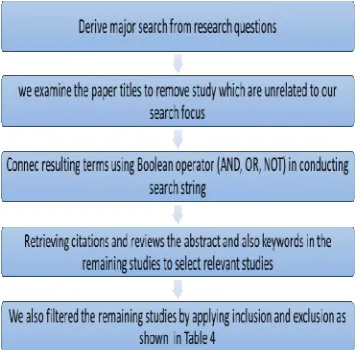
[image:3.612.84.304.334.441.2]The search strings are based on the research questions and the keywords of the research field such as security requirements and IoT technologies. The searches for relevant papers were also based on the title and the author’s name. Language for the search was limited to English only. The selection procedure was conducted systematically based on the following steps as shown in Figure 2. Table 4 shows the inclusion and exclusion criteria for the remaining paper studies.
Figure 2: Selection process
Source Links
IEEE Xplore ScienceDirect Google Scholar Elsevier Emerald Insight Elvedit
Springer Link ACM Digital Library
[image:3.612.335.515.439.614.2]5697 Table 4: Inclusion and exclusion criteria
Inclusion Criteria Exclusion Criteria
Papers focusing on security
requirements Papers presented are not subjected to peer review Papers describing IoT
applications Papers presenting results without supporting evidence
Papers describing IoT
technologies and attributes Paper being studied are not related to research questions
Studies unclear Systematic Literature
Review
2.1.2.3 Study Quality Assessment Checklist
Each SLR was evaluated using the selected items from the quality checklist provided by Kitchenham et. al [8]. The criteria are based on four quality assessment (QA) questions as shown in Table 5:
Table 5: Quality Assessment
QA1 Are the review’s inclusion and exclusion criteria described and appropriate?
QA2 Is the literature search likely to have covered all relevant studies?
QA3 Did the reviewers assess the quality/validity of the relevant studies?
QA4 Were the basic data/studies adequately described?
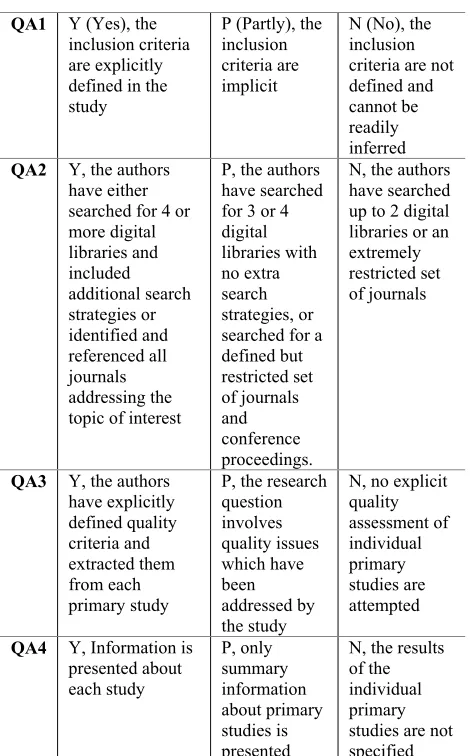
The questions were scored as shown in Table 6. The scoring procedure was Y=1, P=0.5, N=0, or Unknown if the information is not specified. If any of the criteria was not applicable on any studies, it was included from evaluating for only that particular study. Studies that scored less than 50% in the quality assessment were excluded as they do not provide the basic information about their research methodology.
Table 6: Question Scores
2.1.2.4 Data Extraction Strategy
The relevant information in answering the research questions required were extracted from selected primary studies is shown in Table 7. We used data extraction form to make sure that this task was carried out in an accurate, consistent and complete manner.
QA1 Y (Yes), the inclusion criteria are explicitly defined in the study
P (Partly), the inclusion criteria are implicit
N (No), the inclusion criteria are not defined and cannot be readily inferred
QA2 Y, the authors have either searched for 4 or more digital libraries and included additional search strategies or identified and referenced all journals addressing the topic of interest
P, the authors have searched for 3 or 4 digital libraries with no extra search strategies, or searched for a defined but restricted set of journals and conference proceedings.
N, the authors have searched up to 2 digital libraries or an extremely restricted set of journals
QA3 Y, the authors have explicitly defined quality criteria and extracted them from each primary study
P, the research question involves quality issues which have been addressed by the study
N, no explicit quality assessment of individual primary studies are attempted
QA4 Y, Information is presented about each study
P, only summary information about primary studies is presented
5698 Table 7: Data Extraction
2.2 Conducting the Review
2.2.1 Identify Relevant Research and
Primary Studies
Firstly, we examined title of the papers to remove any studies which are not related to the research focus. Next, we used the abstract, keywords and the conclusion to eliminate additional unrelated studies. After applying these two steps, there are 122 studies remained. We examined these 122 studies and applied the inclusion/exclusion criteria in Table 4 to select 109 papers as primary studies for this SLR. Furthermore, we applied the same selection steps to reference list of the selected 84 primary studies to find additional primary studies which are related to the research focus.
2.2.2 Data Extraction and Quality
Assessments
We used data extraction from Table 7 to extract data from the primary studies. Many primary studies did not answer all of the questions in the data extraction form. We extracted important information provided by the primary studies using the data extraction form. Next, depending on the type of the study, we applied quality assessment questions in Table 5 or Table 6 to each primary study. We provided ‘yes’ and ‘no’ answer to our quality assessment questions. We used a binary scale since we were not interested in providing a quality score for the studies.
2.3 Reporting the Review
The data extracted from 84 primary papers were used to formulate answers to the two research questions. We closely followed the guidelines provided by Kitchenham et. al [8] in preparing the SLR report.
3 THEREVIEWRESULTS
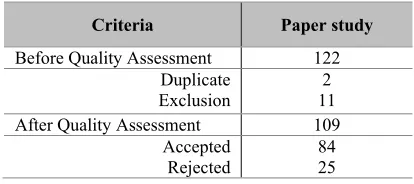
[image:5.612.316.523.401.493.2]In this section, we present the synthesis of evidence of our SLR, starting with the analysis of the literature. We used selected primary papers to provide answers to research questions as well. Table 8 shows the number of studies for quality assessment through the level layer of SLR. The exclusion on this paper, 11 studies were investigated and two were investigated as redundancy during this study. After quality assessment of 109 studies, 84 of them were identified for the synthesis of evidence.
Table 8: Paper Study for Quality Assessment
3.1 Quality Assurances
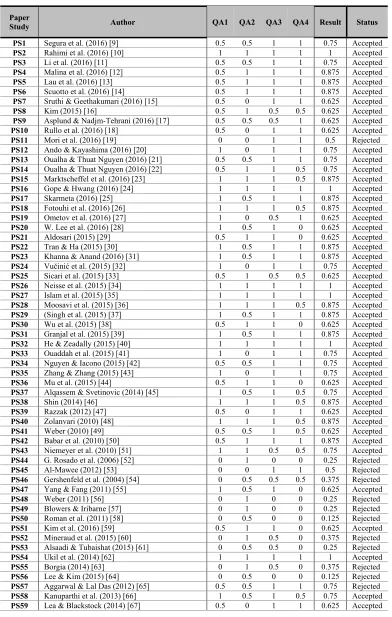
The table shows details based on the quality assessments conducted during the process of searching. The calculation result of this quality assessment identified above than 0.5 were considered accepted, while below or than 0.5 was rejected. Table 9 shows the final result which is 84 studies were accepted and 25 primary studies were rejected.
Search
focus Data item Description
General Bibliography
Type of paper
Study aims Study design
Author, title, year, source
Article, book, conference proceeding, journals, thesis, white paper The goals of the primary study
Controlled
experiments/survey
RQ1 Examples Examples of
technologies for the IoT applications
RQ2 Examples Examples of security requirements for the IoT applications
Criteria Paper study
Before Quality Assessment 122 Duplicate
Exclusion 11 2 After Quality Assessment 109
Accepted
5699
Table 9: Quality Assurances
Paper
Study Author QA1 QA2 QA3 QA4 Result Status
PS1 Segura et al. (2016) [9] 0.5 0.5 1 1 0.75 Accepted
PS2 Rahimi et al. (2016) [10] 1 1 1 1 1 Accepted
PS3 Li et al. (2016) [11] 0.5 0.5 1 1 0.75 Accepted
PS4 Malina et al. (2016) [12] 0.5 1 1 1 0.875 Accepted
PS5 Lau et al. (2016) [13] 0.5 1 1 1 0.875 Accepted
PS6 Scuotto et al. (2016) [14] 0.5 1 1 1 0.875 Accepted
PS7 Sruthi & Geethakumari (2016) [15] 0.5 0 1 1 0.625 Accepted
PS8 Kim (2015) [16] 0.5 1 0.5 0.5 0.625 Accepted
PS9 Asplund & Nadjm-Tehrani (2016) [17] 0.5 0.5 0.5 1 0.625 Accepted
PS10 Rullo et al. (2016) [18] 0.5 0 1 1 0.625 Accepted
PS11 Mori et al. (2016) [19] 0 0 1 1 0.5 Rejected
PS12 Ando & Kayashima (2016) [20] 1 0 1 1 0.75 Accepted
PS13 Oualha & Thuat Nguyen (2016) [21] 0.5 0.5 1 1 0.75 Accepted
PS14 Oualha & Thuat Nguyen (2016) [22] 0.5 1 1 0.5 0.75 Accepted
PS15 Marktscheffel et al. (2016) [23] 1 1 1 0.5 0.875 Accepted
PS16 Gope & Hwang (2016) [24] 1 1 1 1 1 Accepted
PS17 Skarmeta (2016) [25] 1 0.5 1 1 0.875 Accepted
PS18 Fotouhi et al. (2016) [26] 1 1 1 0.5 0.875 Accepted
PS19 Ometov et al. (2016) [27] 1 0 0.5 1 0.625 Accepted
PS20 W. Lee et al. (2016) [28] 1 0.5 1 0 0.625 Accepted
PS21 Aldosari (2015) [29] 0.5 1 1 0 0.625 Accepted
PS22 Tran & Ha (2015) [30] 1 0.5 1 1 0.875 Accepted
PS23 Khanna & Anand (2016) [31] 1 0.5 1 1 0.875 Accepted
PS24 Vučinić et al. (2015) [32] 1 0 1 1 0.75 Accepted
PS25 Sicari et al. (2015) [33] 0.5 1 0.5 0.5 0.625 Accepted
PS26 Neisse et al. (2015) [34] 1 1 1 1 1 Accepted
PS27 Islam et al. (2015) [35] 1 1 1 1 1 Accepted
PS28 Moosavi et al. (2015) [36] 1 1 1 0.5 0.875 Accepted
PS29 (Singh et al. (2015) [37] 1 0.5 1 1 0.875 Accepted
PS30 Wu et al. (2015) [38] 0.5 1 1 0 0.625 Accepted
PS31 Granjal et al. (2015) [39] 1 0.5 1 1 0.875 Accepted
PS32 He & Zeadally (2015) [40] 1 1 1 1 1 Accepted
PS33 Ouaddah et al. (2015) [41] 1 0 1 1 0.75 Accepted
PS34 Nguyen & Iacono (2015) [42] 0.5 0.5 1 1 0.75 Accepted
PS35 Zhang & Zhang (2015) [43] 1 0 1 1 0.75 Accepted
PS36 Mu et al. (2015) [44] 0.5 1 1 0 0.625 Accepted
PS37 Alqassem & Svetinovic (2014) [45] 1 0.5 1 0.5 0.75 Accepted
PS38 Shin (2014) [46] 1 1 1 0.5 0.875 Accepted
PS39 Razzak (2012) [47] 0.5 0 1 1 0.625 Accepted
PS40 Zolanvari (2010) [48] 1 1 1 0.5 0.875 Accepted
PS41 Weber (2010) [49] 0.5 0.5 1 0.5 0.625 Accepted
PS42 Babar et al. (2010) [50] 0.5 1 1 1 0.875 Accepted
PS43 Niemeyer et al. (2010) [51] 1 1 0.5 0.5 0.75 Accepted
PS44 G. Rosado et al. (2006) [52] 0 1 0 0 0.25 Rejected
PS45 Al-Mawee (2012) [53] 0 0 1 1 0.5 Rejected
PS46 Gershenfeld et al. (2004) [54] 0 0.5 0.5 0.5 0.375 Rejected
PS47 Yang & Fang (2011) [55] 1 0.5 1 0 0.625 Accepted
PS48 Weber (2011) [56] 0 1 0 0 0.25 Rejected
PS49 Blowers & Iribarne [57] 0 1 0 0 0.25 Rejected
PS50 Roman et al. (2011) [58] 0 0.5 0 0 0.125 Rejected
PS51 Kim et al. (2016) [59] 0.5 1 1 0 0.625 Accepted
PS52 Mineraud et al. (2015) [60] 0 1 0.5 0 0.375 Rejected
PS53 Alsaadi & Tubaishat (2015) [61] 0 0.5 0.5 0 0.25 Rejected
PS54 Ukil et al. (2014) [62] 1 1 1 1 1 Accepted
PS55 Borgia (2014) [63] 0 1 0.5 0 0.375 Rejected
PS56 Lee & Kim (2015) [64] 0 0.5 0 0 0.125 Rejected
PS57 Aggarwal & Lal Das (2012) [65] 0.5 0.5 1 1 0.75 Rejected
PS58 Kanuparthi et al. (2013) [66] 1 0.5 1 0.5 0.75 Accepted
5700
Paper
Study Author QA1 QA2 QA3 QA4 Result Status
PS60 Ferati et al. (2016) [68] 0.5 0.5 1 0.5 0.625 Accepted
PS61 Tank et al. (2016) [69] 0.5 1 1 0 0.625 Accepted
PS62 Alqassem (2014) [70] 1 1 0.5 0.5 0.75 Accepted
PS63 Riliskis et al. (2015) [71] 0.5 1 1 0 0.625 Accepted
PS64 Banu et al. (2016) [72] 0.5 1 1 0 0.625 Accepted
PS65 C. Lee et al. (2016) [73] 1 1 1 0 0.75 Accepted
PS66 Lee & Lee (2016) [74] 0.5 1 1 0.5 0.75 Accepted
PS67 Tsang et al. (2016) [75] 1 1 1 0.5 0.875 Accepted
PS68 Fink et al. (2015) [76] 0.5 0.5 1 0.5 0.625 Accepted
PS69 Hussien et al. (2016) [77] 1 1 0.5 0 0.625 Accepted
PS70 Idoga et al. (2016) [78] 1 1 0.5 0 0.625 Accepted
PS71 Huang et al. (2016) [79] 0.5 0.5 1 1 0.75 Accepted
PS72 Kamalrudin et al. (2011) [80] 0 0.5 0.5 0.5 0.375 Rejected
PS73 Hibshi et al. (2015) [81] 0 0.5 1 0.5 0.5 Rejected
PS74 Mumtaz et al. (2016) [82] 1 0.5 0.5 0.5 0.625 Accepted
PS75 Islam & Mukhopadhyay (2016) [83] 0 0 0.5 0.5 0.25 Rejected
PS76 Abraham et al. (2017) [84] 0.5 0 1 1 0.625 Accepted
PS77 Maleh et al. (2016) [85] 0 0.5 0 0.5 0.25 Rejected
PS78 C. Lee et al. (2016) [73] 0.5 0 0 0 0.125 Rejected
PS79 Wang et al. (2012) [86] 1 1 0 0.5 0.625 Accepted
PS80 Kowkutla & Ravi (2017) [87] 0.5 0.5 1 1 0.75 Accepted
PS81 Zhou et al. (2017) [4] 1 0 1 0.5 0.625 Accepted
PS82 Muvuna et al. (2016) [88] 1 0.5 1 1 0.875 Accepted
PS83 Gabriel et al. (2017) [89] 1 0.5 1 0.5 0.75 Accepted
PS84 Dalipi & Yayilgan (2016) [5] 1 1 0.5 0 0.625 Accepted
PS85 Pradeep et al. (2016) [90] 0.5 1 1 0 0.625 Accepted
PS86 Ribeiro et al. (2016) [91] 1 1 1 0 0.75 Accepted
PS87 Reddy et al. (2017) [92] 1 0 1 0.5 0.625 Accepted
PS88 Kamalakannan & Tamilselvan (2017) [93] 0.5 0.5 1 1 0.75 Accepted
PS89 Kishore & Sharma (2016) [94] 1 0.5 0.5 0.5 0.625 Accepted
PS90 Dhillon & Kalra (2017) [95] 0.5 1 1 0.5 0.75 Accepted
PS91 Oltsik (2014) [96] 0 1 0 0 0.25 Rejected
PS92 David & Sarah (2014) [97] 0.5 1 1 0 0.625 Accepted
PS93 Dhariwal & Mehta (2017) [98] 0 1 0 0 0.25 Rejected
PS94 Selinger et al. (2013) [99] 0 0.5 0 0 0.125 Rejected
PS95 Russell et al. (2015) [100] 0.5 1 0.5 0.5 0.625 Rejected
PS96 Rose et al. (2015) [101] 0 0 0.5 0 0.125 Rejected
PS97 Peter & K.Gopal (2016) [102] 1 0.5 1 0.5 0.75 Accepted
PS98 Ukil et al. (2015) [103] 0.5 1 0.5 0.5 0.625 Accepted
PS99 Mattern & Floerkemeier (2010) [104] 0.5 0.5 1 0.5 0.625 Accepted
PS100 Tankard (2015) [105] 0 0.5 0.5 0 0.25 Rejected
PS101 Gubbi et al. (2013) [106] 0 0 0.5 0.5 0.25 Rejected
PS102 Borgohain et al. (2015) [3] 0.5 1 0.5 1 0.75 Accepted
PS103 Liu et al. (2016) [107] 0 1 0.5 1 0.625 Accepted
PS104 Das et al. (2016) [108] 0 1 1 0.5 0.625 Accepted
PS105 Nolin & Olson (2016) [109] 0 1 0.5 0 0.375 Rejected
PS106 Thatmann et al. (2015) [110] 0 0.5 1 0.5 0.5 Rejected
PS107 Summerville et al. (2015) [111] 0 0 1 1 0.5 Rejected
PS108 Vasilomanolakis (2015) [112] 0.5 1 1 0 0.625 Accepted
5701
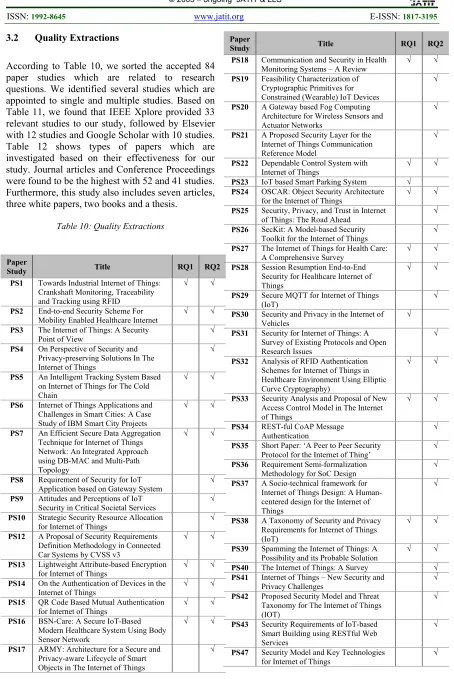
3.2 Quality Extractions
[image:8.612.84.538.62.741.2]According to Table 10, we sorted the accepted 84 paper studies which are related to research questions. We identified several studies which are appointed to single and multiple studies. Based on Table 11, we found that IEEE Xplore provided 33 relevant studies to our study, followed by Elsevier with 12 studies and Google Scholar with 10 studies. Table 12 shows types of papers which are investigated based on their effectiveness for our study. Journal articles and Conference Proceedings were found to be the highest with 52 and 41 studies. Furthermore, this study also includes seven articles, three white papers, two books and a thesis.
Table 10: Quality Extractions
Paper
Study Title RQ1 RQ2
PS1 Towards Industrial Internet of Things: Crankshaft Monitoring, Traceability and Tracking using RFID
√ √
PS2 End-to-end Security Scheme For Mobility Enabled Healthcare Internet
√ √
PS3 The Internet of Things: A Security Point of View
√
PS4 On Perspective of Security and Privacy-preserving Solutions In The Internet of Things
√
PS5 An Intelligent Tracking System Based on Internet of Things for The Cold Chain
√ √
PS6 Internet of Things Applications and Challenges in Smart Cities: A Case Study of IBM Smart City Projects
√ √
PS7 An Efficient Secure Data Aggregation Technique for Internet of Things Network: An Integrated Approach using DB-MAC and Multi-Path Topology
√ √
PS8 Requirement of Security for IoT
Application based on Gateway System √ PS9 Attitudes and Perceptions of IoT
Security in Critical Societal Services
√
PS10 Strategic Security Resource Allocation
for Internet of Things
√
PS12 A Proposal of Security Requirements
Definition Methodology in Connected Car Systems by CVSS v3
√ √
PS13 Lightweight Attribute-based Encryption
for Internet of Things
√ √
PS14 On the Authentication of Devices in the
Internet of Things
√ √
PS15 QR Code Based Mutual Authentication
for Internet of Things √ √
PS16 BSN-Care: A Secure IoT-Based
Modern Healthcare System Using Body Sensor Network
√ √
PS17 ARMY: Architecture for a Secure and
Privacy-aware Lifecycle of Smart Objects in The Internet of Things
√
Paper
Study Title RQ1 RQ2
PS18 Communication and Security in Health
Monitoring Systems – A Review
√ √
PS19 Feasibility Characterization of
Cryptographic Primitives for Constrained (Wearable) IoT Devices
√
PS20 A Gateway based Fog Computing
Architecture for Wireless Sensors and Actuator Networks
√
PS21 A Proposed Security Layer for the
Internet of Things Communication Reference Model
√
PS22 Dependable Control System with
Internet of Things √ √
PS23 IoT based Smart Parking System √
PS24 OSCAR: Object Security Architecture
for the Internet of Things √ √
PS25 Security, Privacy, and Trust in Internet
of Things: The Road Ahead
√
PS26 SecKit: A Model-based Security
Toolkit for the Internet of Things
√
PS27 The Internet of Things for Health Care:
A Comprehensive Survey √ √
PS28 Session Resumption End-to-End
Security for Healthcare Internet of Things
√ √
PS29 Secure MQTT for Internet of Things
(IoT)
√
PS30 Security and Privacy in the Internet of
Vehicles
√
PS31 Security for Internet of Things: A
Survey of Existing Protocols and Open Research Issues
√
PS32 Analysis of RFID Authentication
Schemes for Internet of Things in Healthcare Environment Using Elliptic Curve Cryptography)
√ √
PS33 Security Analysis and Proposal of New
Access Control Model in The Internet of Things
√ √
PS34 REST-ful CoAP Message
Authentication
√
PS35 Short Paper: ‘A Peer to Peer Security
Protocol for the Internet of Thing’
√
PS36 Requirement Semi-formalization
Methodology for SoC Design
√
PS37 A Socio-technical framework for
Internet of Things Design: A Human-centered design for the Internet of Things
√
PS38 A Taxonomy of Security and Privacy
Requirements for Internet of Things (IoT)
√ √
PS39 Spamming the Internet of Things: A
Possibility and its Probable Solution
√ √
PS40 The Internet of Things: A Survey √
PS41 Internet of Things – New Security and
Privacy Challenges
√
PS42 Proposed Security Model and Threat
Taxonomy for The Internet of Things (IOT)
√
PS43 Security Requirements of IoT-based
Smart Building using RESTful Web Services
√
PS47 Security Model and Key Technologies
for Internet of Things
5702
Paper
Study Title RQ1 RQ2
PS51 A Study on Device Security in IoT
Convergence
√
PS54 Lightweight Security Scheme for IoT
Application using CoAP
√ √
PS57 RFID Security in The Context of
“Internet of Things” √ √
PS58 Hardware and Embedded Security in
the Context of Internet of Things
√ √
PS59 Smart Cities: An IoT-centric Approach √ √
PS60 Augmenting Requirements Gathering
for People with Need using IoT: A Position Paper
√
PS61 A Survey on IoT Privacy Issues and
Mitigation Techniques
√
PS62 Privacy and Security Requirements
Framework for the Internet of Things
√ √
PS63 POSTER: Computations on Encrypted
Data in the Internet of Things Applications
√
PS64 A Review on Biologically Inspired
Approaches to Security for Internet of Things (IoT)
√
PS65 A Resource-Efficient System
Architecture for Processing Various Sensor Data in Smart Home Environment
√ √
PS66 An User Authentication Scheme Based
on The ECC and OpenID Techniques in The Internet of Things
√
PS67 An IoT-based Occupational Safety
Management System in Cold Storage Facilities
√ √
PS68 Security and Privacy Grand Challenges
for the Internet of Things
√
PS69 Secure and Efficient E-health Scheme
Based on the Internet of Things √ √
PS70 Review of Security Issues in
E-Healthcare and Solutions
√
PS71 Lightweight Authentication Scheme
with Dynamic Group Members in IoT Environments
√
PS74 Strong Authentication Protocol based
on Java Crypto Chip as Secure Element
√ √
PS75 Smart Sensors and Internet of Things:
A Postgraduate Paper
√
PS76 Garmdroid: IoT Potential Security
Threats Analysis Through the Inference of Android Applications Hardware Features Requirements
√ √
PS79 Research on Application and Security
Protection on Internet of Things in Smart Grid
√ √
PS80 Chapter 12 Security Standard for
Embedded Devices and Systems
√
PS81 Security and Privacy for Cloud-Based
IoT: Challenges, Countermeasures and Future Directions
√ √
PS82 System Engineering Approach to
Design and Modelling of Smart Cities √
PS83 Security analysis of a proposed internet
of things middleware
√
PS84 Security and Privacy Considerations for
IoT Application on Smart Grids: Survey and Research Challenge
√
Paper
Study Title RQ1 RQ2
PS85 IoT and Its Connectivity Challenges in
Smart Home
√
PS86 Providing Security and Privacy in
Smart House Through Mobile Cloud Computing
√
PS87 Building Smart Cities Based on Web
Architecture and using IoT
√ √
PS88 Design of Secured and Intelligent
Architecture for Security in Perceptual Layer of the Internet of Things
√
PS89 Evolution of Wireless Sensor Networks
as the Framework of Internet of Things - A Review
√
PS90 A lightweight biometrics based remote
user authentication scheme for IoT services
√
PS92 Lack of Security in Internet of Things
devices
√
PS97 Multi-level Authentication System for
Smart Home Security Analysis and Implementation
√
PS98 Embedded security for internet of
things √
PS99 From the Internet of Computers to the
Internet of Things
√
PS102 Survey of Security and Privacy Issues
of Internet of Things
√
PS103 On Emerging Family of Elliptic Curves
to Secure Internet of Things: ECC Comes of Age
√
PS104 Context-Sensitive Policy Based
Security in Internet of Things
√
PS108 On the Security and Privacy of Internet
of Things Architectures and Systems
√
PS109 SmartOrBAC: Security and Privacy in
[image:9.612.83.534.57.737.2]the Internet of Things √
Table 11: Digital library of Paper Study
Database Library No. Paper Study Paper Study
ACM DL 9 PS57, PS58, PS59, PS60, PS61,
PS62, PS63, PS71, PS72
Atlantis Press 1 PS67
Elsevier 12 PS1, PS2, PS4, PS5, PS24, PS25,
PS37, PS39, PS40, PS90, PS101
Elvedit 1 PS53
Emerald
Insight 5
PS3, PS6, PS44, PS54, PS105
Scholar 10
PS8, PS17, PS23, PS43, PS65, PS66, PS85, PS87, PS88, PS102
IEEE Access 3 PS9, PS11, PS75
IEEE Xplore
35
PS7, PS10, PS12, PS13, P14, PS15, PS16, PS18, PS19, PS20, PS27, PS28, PS29, PS30, PS31, PS32, P33, PS34,PS35, PS36, PS38, PS51, PS64, PS68, PS69, PS70, PS77, PS78, PS82, PS84, PS86, PS97, PS98, PS106, PS107
ScienceDirect 8 PS21, PS26, PS41, PS47, PS48,
PS49, PS52, PS55 Springer
Link 3
5703 Table 12: Type of Paper Study
Type study Quantity Paper Study
Article 7 PS17, PS50, PS81, PS92, PS93, PS100
Book 2 PS46, PS80
Conference
proceeding 41
PS7, PS10, PS13, PS14, PS15, PS18, PS20, PS28, PS30, PS33, PS34, PS35, PS36, PS38, PS51, PS57, PS58, PS59, PS60, PS61, PS62, PS63, PS64, PS67, PS68, PS69, PS70, PS71, PS72, PS75, PS76, PS77, PS79, PS82, PS84, PS86, PS97, PS98, PS104, PS106, PS107
Journal
article 52
PS1, PS2, PS3, PS4, PS5, PS6, PS8, PS9, PS11, PS12, PS16, PS19, PS21, PS22, PS23, PS24, PS25, PS26, PS27, PS31, PS32, PS37, PS39, PS40, PS41, PS42, PS43, PS44, PS47, PS48, PS49, PS52, PS53, PS54, PS55, PS56, PS65, PS66, PS73, PS74, PS78, PS83, PS85, PS88, PS89, PS90, PS99, PS101, PS103, PS105
Thesis 1 PS45
White
paper 3
PS91, PS95, PS96
3.3 RQ1: What are the most used
technologies in Internet of Things (IoT) applications?
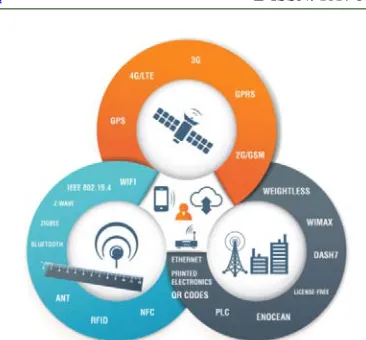
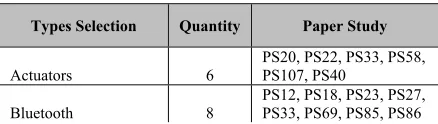
[image:10.612.83.304.97.376.2]Figure 3 shows the technologies involves in IoT applications. IoT is fascinating and it connects everyday devices to the internet. It can be hard to wrap the head around at times. However, with all the technologies, everyone is moving forward to a future where devices are smarter and we will be able to leverage technology to create more efficient, intelligent machines. This study identifies 20 technologies which are being used in IoT applications. Based on the list of the most used technologies in Table 13, we found that sensors are the most used technology for IoT, which accounts for 23 studies. This is followed by mobility networks with 15 studies, RFID systems with 12 studies, WiFi with 9 studies, Bluetooth and Zigbee with 8 studies.
Figure 3: IoT Technologies (www.postscapes.com)
a) Sensors
They are currently used in various fields like healthcare, military, and industry. Each sensor network consists of a large number of sensing nodes, in addition to a special node called sink, where the sink node is used to collect sensing results reported by other nodes in the network [45]. Because such networks can cooperate with RFID systems to enhance objects tracking, sensor networks have a significant role in the IoT development.
b) Mobility networks
Mobility is referred as the capacity to maintain connections and service no matter where user's data are located. The location data must be transparent and used only by the system to protect users' privacy [114]. loT environment can be characterized by a high level of mobility. Other than that, smart mobility generally involves efficient transportation systems which make use of time and energy efficiently. It also involves transportation systems which use renewable energy rather than relying on fossil fuel as well as encouraging and promoting non-motorised transportation [88].
c) RFID Systems
5704 or reading points are located throughout the production line configured to read/write data from/to RFID tags affixed to parts, where in each RFID tag uniquely identifies a part. Next, a data processing system is configured to process the data collected by the RFID reader and a service application is developed to provide tracking and traceable information to the end users. RFID is considered as an enabling technology and it has a wide range of beneficial applications such as electronic toll collection systems, access management systems, airport baggage tracking logistics and other applications.
d) WiFi
Wi-Fi is a technology that allows electronic devices to exchange data wirelessly (using radio waves) over a computer network, including high-speed Internet connections. WiFi enables communication between electronic devices such as smartphones, tablets, and others [90]. The Wi-Fi Alliance defines Wi-Fi as any wireless local area network (WLAN) products which are based on the Institute of Electrical and Electronics Engineers (IEEE) 802.11 standards. Variation of wireless network protocols are being applied in smart home applications, like IEEE 802.11 (Wi-Fi), Bluetooth LE (Low Energy), cellular, ZigBee (a low- power wireless technology), Z-Wave and Thread.
e) Bluetooth
[image:11.612.306.529.82.532.2]Bluetooth is a wireless technology standard for exchanging data over short distances from fixed and mobile devices, creating personal area networks (PANs) with high levels of security. Bluetooth is a technology intended at being a secured and a tawdry means of connecting and transmitting data between supported devices. Bluetooth has the frequency radio bands from 2.4 to 2.485 GHz [90]. It importantly reduces power consumption of Bluetooth devices and enables long term operation using coin cell batteries. Bluetooth offers an infrastructure of direct connection from smartphones and tablets, leaving users to control household appliances from their mobile devices.
Table 13: IoT Technologies
Types Selection Quantity Paper Study
Actuators 6
PS20, PS22, PS33, PS58, PS107, PS40
Bluetooth 8 PS12, PS18, PS23, PS27, PS33, PS69, PS85, PS86
Types Selection Quantity Paper Study
Cloud 5
PS6, PS18, PS81, PS86, PS87
Embedded system 3 PS2, PS19, PS27
Ethernet 1 PS20
GPRS 2 PS16, PS69
GPS 5
PS5, PS23, PS54, PS79, PS40
IEEE 802.11/
802.15/802.16 5
PS4, PS18, PS28, PS31, PS85
IPv6 4 PS27, PS28, PS31, PS85
Mobility networks
(GSM/3G/LTE/GPRS) 15
PS5, PS6, PS14, PS16, PS18, PS20, PS23, PS27, PS30,
PS54, PS69, PS74, PS79, PS86, PS40
QR Code 1 PS15
RFID Systems 12
PS1, PS5, PS14, PS23, PS27, PS32, PS39, PS40, PS57, PS62, PS67, PS74
Sensors 23
PS76, PS2, PS5, PS13, PS16, PS18, PS19, PS20, PS65, PS69, PS75, PS104, PS23, PS27, PS28, PS30, PS33, PS38, PS54, PS59, PS62, PS58, PS40
Smart gateways 1 PS2
WiFi 9
PS18, PS28, PS33, PS67, PS69, PS85, PS86, PS79, PS40
WiMAX 1 PS19
Wireless sensor
network 7
PS7, PS23, PS27, PS30, PS31, PS33, PS40
Z-Wave 1 PS85
Zigbee 8
PS5, PS18, PS20, PS23, PS33, PS80, PS85, PS79
2D Barcode 1 PS39
3.4 RQ2: What are the important security
requirements needed for Internet of Things (IoT) applications?
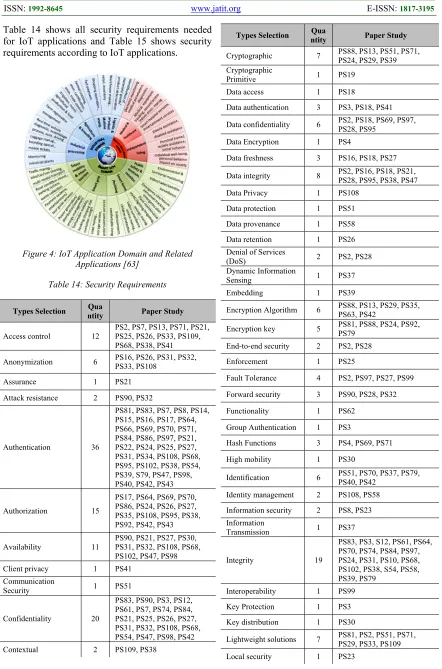
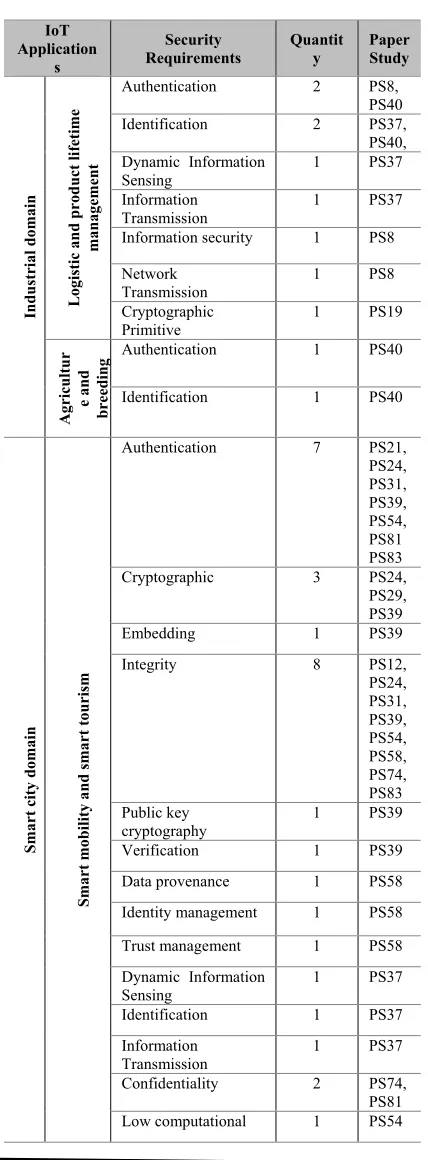
[image:11.612.85.304.669.731.2]5705 Table 14 shows all security requirements needed for IoT applications and Table 15 shows security requirements according to IoT applications.
Figure 4: IoT Application Domain and Related Applications [63]
Table 14: Security Requirements
Types Selection ntity Qua Paper Study
Access control 12
PS2, PS7, PS13, PS71, PS21, PS25, PS26, PS33, PS109, PS68, PS38, PS41
Anonymization 6 PS16, PS26, PS31, PS32, PS33, PS108
Assurance 1 PS21
Attack resistance 2 PS90, PS32
Authentication 36
PS81, PS83, PS7, PS8, PS14, PS15, PS16, PS17, PS64, PS66, PS69, PS70, PS71, PS84, PS86, PS97, PS21, PS22, PS24, PS25, PS27, PS31, PS34, PS108, PS68, PS95, PS102, PS38, PS54, PS39, S79, PS47, PS98, PS40, PS42, PS43
Authorization 15
PS17, PS64, PS69, PS70, PS86, PS24, PS26, PS27, PS35, PS108, PS95, PS38, PS92, PS42, PS43
Availability 11
PS90, PS21, PS27, PS30, PS31, PS32, PS108, PS68, PS102, PS47, PS98
Client privacy 1 PS41
Communication
Security 1 PS51
Confidentiality 20
PS83, PS90, PS3, PS12, PS61, PS7, PS74, PS84, PS21, PS25, PS26, PS27, PS31, PS32, PS108, PS68, PS54, PS47, PS98, PS42
Contextual 2 PS109, PS38
Types Selection ntity Qua Paper Study
Cryptographic 7 PS88, PS13, PS51, PS71, PS24, PS29, PS39 Cryptographic
Primitive 1 PS19
Data access 1 PS18
Data authentication 3 PS3, PS18, PS41
Data confidentiality 6 PS2, PS18, PS69, PS97, PS28, PS95
Data Encryption 1 PS4
Data freshness 3 PS16, PS18, PS27
Data integrity 8 PS2, PS16, PS18, PS21, PS28, PS95, PS38, PS47
Data Privacy 1 PS108
Data protection 1 PS51
Data provenance 1 PS58
Data retention 1 PS26
Denial of Services
(DoS) 2 PS2, PS28
Dynamic Information
Sensing 1 PS37
Embedding 1 PS39
Encryption Algorithm 6 PS88, PS13, PS29, PS35, PS63, PS42
Encryption key 5 PS81, PS88, PS24, PS92, PS79
End-to-end security 2 PS2, PS28
Enforcement 1 PS25
Fault Tolerance 4 PS2, PS97, PS27, PS99
Forward security 3 PS90, PS28, PS32
Functionality 1 PS62
Group Authentication 1 PS3
Hash Functions 3 PS4, PS69, PS71
High mobility 1 PS30
Identification 6 PS51, PS70, PS37, PS79, PS40, PS42
Identity management 2 PS108, PS58
Information security 2 PS8, PS23 Information
Transmission 1 PS37
Integrity 19
PS83, PS3, S12, PS61, PS64, PS70, PS74, PS84, PS97, PS24, PS31, PS10, PS68, PS102, PS38, S54, PS58, PS39, PS79
Interoperability 1 PS99
Key Protection 1 PS3
Key distribution 1 PS30
Lightweight solutions 7 PS81, PS2, PS51, PS71, PS29, PS33, PS109
[image:12.612.87.529.70.739.2]5706
Types Selection ntity Qua Paper Study
Low computational 1 PS54
Low error tolerance 1 PS30
Manageability 1 PS20
Middleware 1 PS25
Mutual authentication 8 PS90, PS2, PS69, PS71, PS97, PS28, PS32, PS54
Mutual authorization 3 PS2, PS28, PS57
Network security 1 PS7 Network
Transmission 2 PS8, PS23
Non-repudiation 9
PS3, PS18, PS70, PS74, PS84, PS21, PS26, PS31, PS98
Notarization/Signatur
e 1 PS21
Physical protection 1 PS51
Privacy 7 PS81, PS83, PS7, PS25, PS38, PS92, PS42
Privacy Preservation 1 PS97
Privacy Protection 1 PS3
Pseudonymity 1 PS108
Public key
cryptography 1 PS39
Reliability 3 PS28, PS62, PS47
Resiliency 3 PS27, PS31, PS108
Resistance to relay
attacks 1 PS57
Resistance to
disclosure attacks 1 PS57 Resistance to
desynchronization attacks
1 PS57
Robustness 1 PS108
Scalability 8 PS87, PS90, PS20, PS28, PS32, PS33, PS109, PS99
Secure Localization 1 PS16
Security of Keys 1 PS3
Self-healing 1 PS27
Semi-formalization 1 PS36
Sensor spoofing 1 PS2
Service
Authentication 1 PS3
Smart gateway 1 PS2
Support security 1 PS38
Trust 4 PS25, PS31, PS108, PS42
Trust management 2 PS26, PS58
Unlink ability 1 PS33, PS38, PS62
Usability 3 PS33, PS38, PS108
Types Selection ntity Qua Paper Study
User content 1 PS26
Verification 3 PS34, PS39, PS43
Based on the list of IoT applications and its security requirements in Table 14, we found that authentication is the most commonly investigated property which accounts for 36 studies. This is followed by confidentiality with 20 studies, integrity with 19 studies, authorization with 15 studies, access control with 12 studies and availability with 11 studies.
a) Authentication
One of the important security requirements found in this study is authentication. Authentication enables an IoT device to ensure the identity of the peer that it communicates [35]. Authentication is essential to create trustable services. IoT is a network in which billions of entities are connected. Managing identity is a major challenge. The edges are equipped with the computational capability and can communicate with any other edge without external intervention [15]. Hence, authentication logic is required in every entity. Interactions are very dynamic and a user might not know whom he will have to interact with in a particular event. This means that even in a network of users whose information is gathered, users are not encouraged to trust others except for the base station offering the service.
b) Confidentiality
Most of the studies focus on confidentiality. Confidentiality ensures private information will not be accessible for unauthorized users. In addition, confidential messages will not reveal their content to eavesdroppers. This requirement means that secret information must be transmitted securely during all communications between communicating parties. For that reason, communicating parties must exchange all information in an encrypted form in order to ensure confidentiality. [95].
c) Integrity
5707 file permissions and user access controls. Backups or redundancies must be available to restore the affected data to its correct state. Furthermore, integrity ensures that important data received will not be altered in transit by an adversary. In addition, the integrity of stored data and content should not be compromised [35].
d) Authorization
Authorization ensures that only authorized nodes are accessible for network services or recourses. Authorization is granting a right or permission to a system or application entity in accessing system resources. This function determines who can be trusted for a given purpose. In addition, security authorization is the process in which a senior management official and the authorizing official reviews security-related information describing the current security posture of an information system. Then the information is used to determine whether or not the mission/business risk of operating a system is acceptable and if it is, explicitly accepts the risk [115].
e) Access control
Access control is prevention of unauthorized use of a resource, including prevention of the use of a resource in an unauthorized manner. Several studies choose access control that verifies user’s identity in each and every step of the request similar to the point-to-point access control scheme. Access control refers to permission in the usage of the resources, assigned to differentiate actors of wide IoT network [33].
f) Availability
Availability enforces the check on the server or the nodes so that it is continuously available for the user to access information or to send commands to the nodes when required. Availability as the ability to make information and related physical and logical resources accessible as needed, when they are needed and where they are needed [115]. In IoT healthcare services, an availability ensures survival of IoT healthcare services (either local or global/cloud services) to authorized parties when needed even under denial-of-services attacks [77].
As a conclusion, although authentication is the most concerned property identified in this study, the weight of applying the security properties is different. It shows all six security requirements
[image:14.612.317.531.163.743.2]which are confidentiality, integrity, authorization, access control, and availability have gained more attention in IoT applications.
Table 15: IoT Based Applications and Security Requirements
IoT Application
s
Security Requirements
Quantit y
Paper Study
Industrial domain Logistic and prod
uct li
fetime
management
Authentication 2 PS8,
PS40
Identification 2 PS37,
PS40, Dynamic Information
Sensing
1 PS37
Information Transmission
1 PS37
Information security 1 PS8
Network Transmission
1 PS8
Cryptographic Primitive
1 PS19
Agricultur e and breedin
g Authentication 1 PS40
Identification 1 PS40
Smart
cit
y domain
Smart mobility a
nd smart
tourism
Authentication 7 PS21,
PS24, PS31, PS39, PS54, PS81 PS83
Cryptographic 3 PS24,
PS29, PS39
Embedding 1 PS39
Integrity 8 PS12,
PS24, PS31, PS39, PS54, PS58, PS74, PS83 Public key
cryptography
1 PS39
Verification 1 PS39
Data provenance 1 PS58
Identity management 1 PS58
Trust management 1 PS58
Dynamic Information Sensing
1 PS37
Identification 1 PS37
Information Transmission
1 PS37
Confidentiality 2 PS74,
PS81
5708
IoT Application
s
Security
Requirements Quantity Paper Study
Mutual authentication 1 PS54
Access control 1 PS21
Assurance 1 PS21
Availability 4 PS12,
PS21, PS30, PS31
Data integrity 1 PS21
Non-repudiation 3 PS21,
PS31, PS74 Notarization/Signatur
e 1 PS21
Authorization 2 PS24,
PS35
Encryption key 2 PS24,
PS81 Encryption Algorithm 2 PS29,
PS35 Lightweight solutions 2 PS29,
PS81
High mobility 1 PS30
Key distribution 1 PS30
Low error tolerance 1 PS30
Anonymization 1 PS31
Resiliency 1 PS31
Trust 1 PS31
Semi-formalization 1 PS36
Privacy 2 PS81,
PS83
Smart
grid
Authentication 2 PS38,
PS79
Encryption key 1 PS79
Identification 3 PS37,
PS79, PS51
Integrity 3 PS38,
PS58, PS79
Data provenance 1 PS58
Identity management 1 PS58
Trust management 1 PS58
Dynamic Information Sensing
1 PS37
Information Transmission
1 PS37
Access control 2 PS13,
PS38
Authorization 1 PS38
Contextual 1 PS38
Data integrity 1 PS38
Cryptographic Primitive
1 PS4
IoT Application
s
Security
Requirements Quantity Paper Study
Data Encryption 1 PS4
Hash Functions 1 PS4
Cryptographic 2 PS13,
PS51 Encryption Algorithm 1 PS13
Manageability 1 PS20
Scalability 1 PS20
Communication Security
1 PS51
Data protection 1 PS51
Lightweight solutions 1 PS51
Physical protection 1 PS51
Smart home/buil
d
ing
Authentication 6 PS8,
PS15, PS40, PS43, PS84, PS97
Authorization 2 PS26,
PS43 Encryption Algorithm 1 PS43
Verification 1 PS43
Identification 2 PS37,
PS40 Dynamic Information
Sensing
1 PS37
Information Transmission
1 PS37
Access control
3 PS26,
PS33, PS10 9
Anonymization 2 PS26,
PS33
Confidentiality 2 PS26,
PS84
Data retention 1 PS26
Non-repudiation 2 PS26,
PS84
Trust management 1 PS26
User content 1 PS26
Lightweight solutions 2 PS33, PS10 9
Scalability 3 PS33,
PS83, PS10 9
Usability 2 PS33,
PS38
Privacy 1 PS38
Support security 1 PS38
Contextual 1 PS10
5709
IoT Application
s
Security
Requirements Quantity Paper Study
Cryptographic
Primitive 1 PS4
Data Encryption 1 PS4
Hash Functions 1 PS4
Information security 1 PS8
Network
Transmission 1 PS8
Integrity 1 PS84
Data confidentiality 1 PS97
Forward security 1 PS97
Mutual authentication 1 PS97
Privacy Preservation 1 PS97
P
ublic
saf
et
y
and
environment monitorin
g
Authentication 1 PS40
Identification 1 PS40
Privacy 1 PS38
Support security 1 PS38
Usability 1 PS38
Health
w
ell-being
domain
Medical and healt
h
care
Data provenance 1 PS58
Identity management 1 PS58
Integrity 2 PS58,
PS70
Trust management 1 PS58
Dynamic Information Sensing
1 PS37
Identification 2 PS37,
PS70 Information
Transmission
1 PS37
Authentication 4 PS16,
PS27, PS69, PS70
Authorization 3 PS27,
PS69, PS70
Availability 2 PS27,
PS32
Confidentiality 3 PS27,
PS32, PS70
Data freshness 3 PS16,
PS18, PS27
Fault Tolerance 1 PS27
Resiliency 1 PS27
Self-healing 1 PS27
Data confidentiality 4 PS2, PS18, PS28, PS69
IoT Application
s
Security
Requirements Quantity Paper Study
Data integrity 4 PS2,
PS16, PS18, PS28 Denial of Services
(DoS)
2 PS2,
PS28 End-to-end security 2 PS2,
PS28
Forward security 3 PS2,
PS28, PS32 Mutual authentication 4 PS2,
PS28, PS32, PS69 Mutual authorization 2 PS2,
PS28
Reliability 1 PS28
Scalability 2 PS28,
PS32
Anonymization 2 PS16,
PS32
Attack resistance 1 PS32
Privacy 1 PS38
Support security 1 PS38
Usability 1 PS38
Access control 1 PS2
Architecture scalability
1 PS2
Lightweight solutions 1 PS2
Sensor spoofing 1 PS2
Smart gateway 1 PS2
Secure Localization 1 PS16
Data access 1 PS18
Data authentication 1 PS18
Non-repudiation 2 PS18,
PS70
Hash Functions 1 PS69
Indep enden t
Usability 1 PS60
Acceptability 1 PS60
4 FINDINGS
The findings have addressed the following two research questions of this study:
a) QA1: What are the most used technologies for Internet of Things (IoT) applications? b) QA2: What are the important security
requirements needed for Internet of Things (IoT) applications?
5710 considered as the challenges in the security requirements for IoT applications.
4.1 The most used technologies for the
Internet of Things (IoT) Applications.
There are many technologies that enable IoT. Crucial to this field is the network used to communicate between devices of an IoT installation, a role that several wireless or wired technologies may fulfill. We have identified that the most used technologies for IoT applications are sensors, mobility networks, RFID systems, WiFi, Bluetooth, and Zigbee. Based on the result, sensors become the most technology used in IoT base applications. Sensors are now found in a wide variety of applications, such as smart mobile devices, automotive systems, industrial control, healthcare, smart city and climate monitoring. Sensors are used almost everywhere and now sensor technology is beginning to closely mimic the ultimate sensing machine which are the human being. Furthermore, in IoT, sensors are the troops of it, in which the small hardware who does all the critical work of monitoring process, taking measurements and collecting data. The first things that people think when picturing the IoT is sensors.
4.2 The important security requirements
needed for the Internet of Things (IoT) applications.
We discovered important security requirements for IoT applications, namely; authentication, confidentiality, integrity, authorization, access control, and availability were applied in IoT applications. The focus of the six security requirements are to help the requirements engineer to improve security requirements relevant for IoT applications. Authentication is the most important properties needed for IoT based applications. It is the process of identifying an individual, usually based on a username and password. In IoT security, authentication is usually distinct from authorization, in which it is the process of giving individuals an access to system objects based on their identity. Authentication merely ensures that the individual is who he or she claims to be, but says nothing about the access rights of the individual.
4.3 Strengths and weakness of SLR
The strength and weakness of SLR conducted are identified based on keyword search as well as inclusion and exclusion process. The strength of SLR is the use of a systematic approach which includes inclusion and exclusion. This SLR examined a reference list of selected primary studies in identifying any additional studies. SLR also extracts relevant information consistency while reducing biases and validity by authors. The weakness of this SLR is that it cannot ensure that the search facilities will return a set of papers similar to a search process conducted independently. Therefore, there may be other solutions provided by the IoT security methods due to the failure in capturing some of the methods proposed.
4.4 Implications for Research and Society
This study is the first SLR conducted to investigate an analysis of security requirements for IoT applications. It is also the first SLR to identify security requirements related to IoT applications development. Our research work contributes to research efforts for IoT analysis especially on security requirements for IoT applications. The security requirements discussed in this paper will help requirements engineer and client-stakeholder to analyze and identify appropriate security requirements for any IoT applications and improve the quality of security requirements. In addition, there are also advantages for IoT engineering researcher to find solution, be aware of the process and method as well as identify and approach related security requirements in solving challenges which have been identified.
5 CONCLUSION
5711 applications are rarely employed in the development of IoT applications although it is a crucial process needed from early phase as it is highly exposed to privacy and security issues.
ACKNOWLEDGEMENTS
The authors would like to acknowledge Universiti Teknikal Malaysia Melaka (UTeM) and Ministry of Education (MoE) for its support and the funding of
this FRGS research grant:
FRGS/1/2016/ICT01/FTMK-CACT/F00325.
REFERENCES
[1] Cisco, “IoT Threat Environment : An Overview of the Iot Threat Lanscape with Risk-based Security Prigram Recommendations,” 2015.
[2] L. Atzori, A. Iera, and G. Morabito, “The Internet of Things: A Survey,” Comput.
Networks, vol. 54, no. 15, pp. 2787–2805,
2010.
[3] T. Borgohain, U. Kumar, and S. Sanyal, “Survey of Security and Privacy Issues of Internet of Things,” Cryptogr. Secur., p. 7, 2015.
[4] J. Zhou, Z. Cao, X. Dong, and A. V Vasilakos, “Security and Privacy for Cloud-Based IoT: Challenges, Countermeasures, and Future Directions,” Impact Next-Generation Mob. Technol. IoT Cloud
Converg., no. January, pp. 26–33, 2017.
[5] F. Dalipi and S. Y. Yayilgan, “Security and Privacy Considerations for IoT Application on Smart Grids: Survey and Research Challenges,” in 2016 4th Conference on Future Internet of Things and Cloud
Workshops, 2016.
[6] P. Brereton, B. A. Kitchenham, D. Budgen, M. Turner, and M. Khalil, “Lessons from Applying the Systematic Literature Review Process within The Software Engineering Domain,” J. Syst. Softw., vol. 80, no. 4, pp. 571–583, 2007.
[7] B. A. Kitchenham, “Guidelines for Performing Systematic Literature Reviews in Software Engineering,” 2007.
[8] B. Kitchenham, O. P. Brereton, D. Budgen, M. Turner, J. Bailey, and S. Linkman, “Systematic literature reviews in software engineering – A systematic literature review,” Inf. Softw. Technol., vol. 51, no. 1, pp. 7–15, 2009.
[9] D. M. Segura, N. Kaur, W. G. Whittow, P. P. Conway, and A. A. West, “Towards
industrial internet of things: Crankshaft Monitoring, Traceability and Tracking using RFID,” Robot. Comput. Integr.
Manuf., vol. 41, pp. 66–77, 2016.
[10] S. Rahimi, T. Nguyen, and A. M. Rahmani, “End-to-end Security Scheme for Mobility Enabled Healthcare Internet of Things,”
Futur. Gener. Comput. Syst., vol. 64, pp.
108–124, 2016.
[11] S. Li, T. Tyrfonas, and H. Li, “The Internet of Things: A Security Point of View,”
Internet Res., vol. 26, no. 26, pp. 337–356,
2016.
[12] L. Malina, J. Hajny, R. Fujdiak, and J. Hosek, “On Perspective of Security and Privacy-preserving Solutions in The Internet of Things,” Comput. Networks, vol. 102, pp. 83–95, 2016.
[13] H. Lau, M. Zhu, and S. Ye, “An Intelligent Tracking System Based on Internet of Things for The Cold Chain,” Internet Res., vol. 26, no. 2, pp. 435–445, 2016.
[14] V. Scuotto, A. Ferraris, and S. Bresciani, “Internet of Things: Applications and Challenges in Smart Cities: A Case Study of IBM Smart City Projects,” Bus. Process
Manag. J., vol. 22, no. 2, pp. 357–367,
2016.
[15] S. S. Sruthi and G. Geethakumari, “An Efficient Secure Data Aggregation Technique for Internet of Things Network: An Integrated Approach Using DB-MAC and Multi-path Topology,” 2016 IEEE 6th
Int. Conf. Adv. Comput., pp. 599–603,
2016.
[16] J. T. Kim, “Requirement of Security for IoT Application Based on Gateway,” Int. J.
Secur. Its Appl., vol. 9, no. 10, pp. 201–
208, 2015.
[17] M. Asplund and S. Nadjm-Tehrani, “Attitudes and Perceptions of IoT Security in Critical Societal Services,” IEEE Access, vol. 4, pp. 2130–2138, 2016.
[18] A. Rullo, D. Midi, E. Serra, and E. Bertino, “Strategic Security Resource Allocation for Internet of Things,” in 2016 IEEE 36th International Conference on Distributed
Computing Systems (ICDCS), 2016, pp.
737–738.
[19] M. Mori, Y. Sueda, and M. Aihara, “Secure Connection Assistence Architecture for IoT Devices,” IEEE Access, pp. 34–35, 2016. [20] E. Ando and M. Kayashima, “A Proposal of