PAPER • OPEN ACCESS
Moisture Sensitivity of Crumb Rubber Modified
Modifier Warm Mix Asphalt Additive for Two
Different Compaction Temperatures
To cite this article: Munder A Bilema et al 2018 IOP Conf. Ser.: Earth Environ. Sci. 140 012072
View the article online for updates and enhancements.
Related content
Design and Properties of Thin Surfacing Hot Mix Asphalt Containing Crumb Rubber as Partial Aggregate Replacement Ary Setyawan, Nugroho Febrianto and Djoko Sarwono
-The use of Crumb Rubber as Substitute of Fine Aggregate for Hot Asphalt Mixture using Polymer Modified Bitumen A Setyawan, S K Nugroho, A M Irsyad et al.
-Evaluation of moisture-induced damage of dense graded and gap graded asphalt mixture with nanopolymer modified binder E Shaffie, A K Arshad, J Ahmad et al.
1
Content from this work may be used under the terms of theCreative Commons Attribution 3.0 licence. Any further distribution of this work must maintain attribution to the author(s) and the title of the work, journal citation and DOI.
Published under licence by IOP Publishing Ltd
Moisture Sensitivity of Crumb Rubber Modified Modifier
Warm Mix Asphalt Additive for Two Different Compaction
Temperatures
Munder A Bilema¹·³, Mohamad Y Aman¹, Norhidayah A Hassan², Kabiru A Ahmad¹, Hamza M Elghatas¹, Ashraf A Radwan¹ and Ahmed S Shyaa¹
¹ Department of Highway and Traffic Engineering, Faculty of Civil Engineering and Environmental, University Tun Hussein Onn Malaysia, 86400 Parit Raja, Batu Pahat, Johor, Malaysia.
² Department of Geotechnics & Transpiration, Faculty of Civil Engineering, Universiti Teknologi Malaysia, 81310 Johor Bahru, Johor, Malaysia.
³ E-mail: [email protected]
Abstract. Crumb rubber obtained from scrap tires has been incorporated with asphalt binder to improve the performance of asphalt mixtures in the past decades. Pavements containing crumb-rubber modified (CRM) binders present one major drawback: larger amounts of greenhouse gas emissions are produced as there is rise in the energy consumption at the asphalt plant due to the higher viscosity of these type of binders compared with a conventional mixture. The objective of this paper is to calculate the optimum bitumen content for each percentage and evaluate the moisture sensitivity of crumb rubber modified asphalt at two different compacting temperatures. In this study, crumb rubber modified percentages was 0%, 5%, 10% and 15% from the binder weight, with adding 1.5% warm mix asphalt additive (Sasobit) and crush granite aggregate of 9.5mm Nominal maximum size was used after assessing its properties. Ordinary Portland Cement (OPC) used by 2% from fine aggregate. The wet method was using to mix the CRM with bitumen, the CRM conducted at 177°C for 30 min with 700rpm and Sasobit conducted at 120°C for 10 min with 1000rpm. As a result, from this study the optimum bitumen content (OBC) was increased with increased crumb rubber content. For performance test, it was conducted using the AASHTO T283 (2007): Resistance of Compacted Bituminous Mixture to Moisture-Induced Damage. The result was as expected and it was within the specification of the test, the result show that the moisture damage increased with increased the crumb rubber content but it is not exceeding the limit of specification 80% for indirect tension strength ratio (ITSR). For the temperature was with lowing the temperature the moisture damage increased.
1. Introduction
2
of rubber asphalt pavement indicated reduction of pavement thickness, increase of pavement life, becoming less refractive, less reflective rate, less traffic noise, reduction of maintenance costs, reduction of pollution and improve environmental issues [12].
Generally, crumb rubber is manufactured from automotive and truck scrap tires. From an engineering point of view, crumb rubber has a number of special thermo-mechanical and chemical physical properties. The size of the rubber particles is graded and can be found in many shapes and sizes. The finest one can be as small as about 0.2 mm and below. The gradation commonly used in rubberized asphalt pavement is between about 2.0 mm to 0.5 mm. Crumb rubber is light in weight, durable and from safety aspect crumb rubber can be categorized as a non-toxic and inert material [11]. Annually, about one billion, equivalent 9 million tons’ waste tires are produced in the world, due to the shortage of landfill space and environmental issues, recycling old tires seem necessary [6]. A number of methods have been applied in attempt to find more effective ways to recycle the scrap tires, one of the methods among them is to use the crumb rubber in modification of asphalt binders. It is reported that the asphalt industry can absorb up to 40% of scrap tire [5]. [15] study on the effect of crumb rubber modifier on the sensitivity of high temperature of the surface mixture and evaluated the effect of different sizes of crumb rubber on high temperature sensitivity of three type of surface mixture.
The evaluation was conducted in two parts: first, the properties of the modified and unmodified bitumen in a wide range of test temperatures and second, aging conditions have been compared. The results showed that the bitumen modified with crumb rubber have better resistance against moisture sensitivity [14]. The moisture sensitivity evaluation using Superpave method to determine the optimal conditions for the use of tire rubber in asphalt concrete, granulated crumb rubber was considered, fusion temperature, aggregate gradation, and the amount of crumb rubber, density, temperature, the amount of bitumen and fusion time as experimental variables. In their study, the method of dry mixing crumb rubber in asphalt concrete was used [13]. Moisture damage can be defined as the loss of strength and durability in asphalt mixtures due to the effects of moisture. Moisture damage can occur because of a loss of bond between the asphalt cement and mastic (asphalt cement plus the mineral filler-74µm and smaller aggregate) and the fine and coarse aggregate. Moisture damage also can happen because moisture permeates and weakens the mastic, making it more susceptible to moisture during cyclic loading.
The distress problems in asphalt pavement include stripping, potholes, rutting and others distress effect is causes from the presence of water at asphalt pavement. The presence water is can affect the durability and workability of pavement layer. Moisture can cause adhesion failure, hence stripping of asphalt binder from aggregates [7].
3
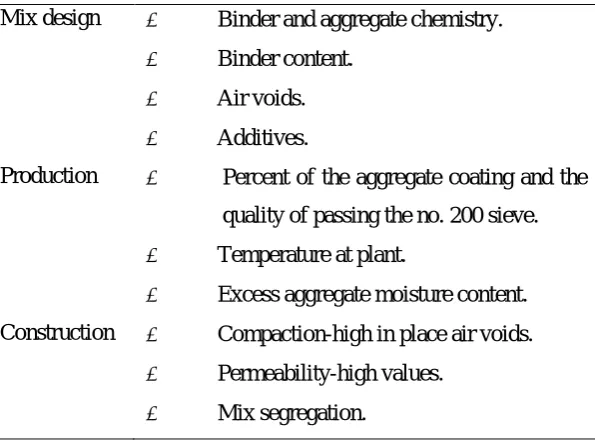
Table1. The factors influencing moisture damage.
Mix design Binder and aggregate chemistry.
Binder content. Air voids. Additives.
Production Percent of the aggregate coating and the
quality of passing the no. 200 sieve. Temperature at plant.
Excess aggregate moisture content.
Construction Compaction-high in place air voids.
Permeability-high values. Mix segregation.
2. Methodology
2.1 Materials preparation
In this study, bitumen binder 80\100 penetration grade was used. In this study crush granite aggregate of 9.5mm Nominal maximum size provided by the UTHM laboratory was used after assessing its properties, and found to have met the requirement of the relevant specifications. Crumb rubber powder of 20 mesh sizes (passing 0.15mm) used. The Crumb rubber was obtained from a Malaysian Supplier (Miroad Rubber Industries Sdn Bhd) the crumb rubber modifier (CRM) was produced by mechanical shredding and then grinded at ambient temperature. The Sasobit was fixed addition by 1.5% from the binder weight and Ordinary Portland Cement (OPC) used by 2% from fine aggregate. According to [9] the percentage of OPC must be not exceeds 2%.
2.2 Experimental work
[image:4.595.151.449.130.350.2]The Modified binders used in this study were prepared by blending the Original 80/100 bitumen with Sasobit and Crumb Rubber, this process is known as ‘Wet Process’ because the additive(s) were added to the bitumen. The unmodified penetration grade bitumen 80/100 (Original or virginal ‘A’) was blended with the additives to produce three additional binders; X, Y and Z depending on the binder composition. Table 2, shows the Matrix of binder identity and composition.
Table 2. Binder Identity and Composition Matrix.
Binder Identity
Constituent Materials (%)
80/100 Bitumen Sasobit® % Crumb Rubber %
A 100 - -
X 100 1.5 5
Y 100 1.5 10
Z 100 1.5 15
[image:4.595.120.462.607.724.2]4
min, using mechanical mixer at 700rpm [17]. The 1.5% Sasobit by weight of the base binder which is within the recommended dosage of 0.8 to 3% [8]. The Sasobit was added at 120oC and was blended the
same way the CRM was blended only that the mixing speed and time was 1000 rpm and 10 minutes respectively. The prepared binders were used immediately after modification, to avoid segregation upon storage due to its poor storage stability. The steps followed to prepare the samples are: the blended aggregate was placed in a bowl and weigh to the required weight (1200 g of aggregate was used for batching) and mixed thoroughly and then the aggregate sample together with the required asphalt binder were placed for conditioning in the oven at mix temperature for 2 hours and then both the aggregate and the binder were removed and mix using the mechanical mixer until the specimen were thoroughly coated. The mixture (rice) was then put back to the bowl and placed in an oven for short-term aging for 2 hours at the temperature equals the required mixtures compaction temperature then the mixture was then compacted using Superpave Gyratory Compactor. The optimum Bitumen content was determined according to Superpave mix design method, after establishing the aggregate blend. Four trial asphalt content of 5.5%, 6.0%, 6.5% and 7.0% was used, traffic level selected was for 3 to < 30 ESALS with compaction levels of 8, 100 and 160 for Ninitial, Ndesign and Nmax respectively [1], [2]. The plot of air void
versus binder content was plotted, and the binder content that gives 4.0% air void at Ndesign was
determined as the optimum binder content. Before the conduct of the test, the mix was short-term aged in an oven for 2 hours at 1450C and 1350C for mixing and 1350C and 1250C for compaction temperatures
respectively. The procedure adopted was based on [1], [2]. Each percentage need 6 samples so for 4 percentages and two mixing temperatures, it prepared 48 samples to conduct the test and another 75 samples for OBC.
3. Result and discussion
3.1 Optimum binder content result
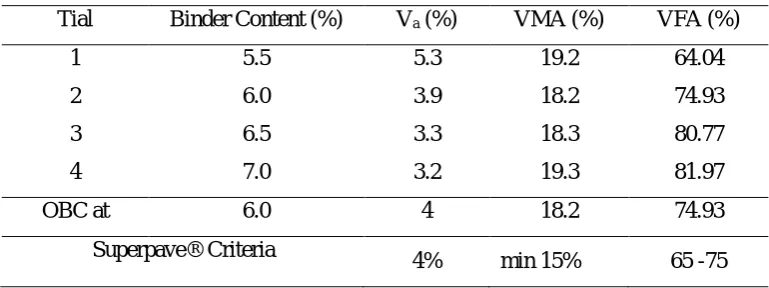
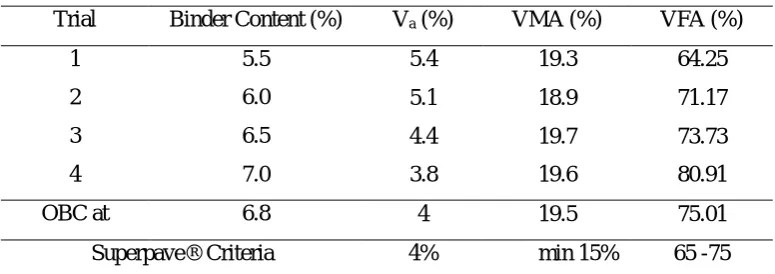
[image:5.595.105.490.489.633.2]The OBC was conducted for all 4 percentages (0%, 5%, 10%, 15%) and the Tables 3, 4, 5, 6 shown that results.
Table 3. Volumetric properties for original at the Ndesign (100gyration).
Tial Binder Content (%) Va (%) VMA (%) VFA (%)
1 5.5 5.3 19.2 64.04
2 6.0 3.9 18.2 74.93
3 6.5 3.3 18.3 80.77
4 7.0 3.2 19.3 81.97
OBC at 6.0 4 18.2 74.93
Superpave® Criteria 4% min 15% 65 -75
5
Table 4. Volumetric properties for 5%CRM at the Ndesign (100gyration).
Trial Binder Content (%) Va (%) VMA (%) VFA (%)
1 5.5 5.5 19.6 62.67
2 6.0 4.4 18.6 72.49
3 6.5 3.6 18.6 77.41
4 7.0 2.9 19 85.66
OBC at 6.25 4 18.6 74.95
Superpave® Criteria 4% min 15% 65 -75
The Table 4 present the optimum binder content on modified binder with 5% CRM and at 4% air voids the binder content was 6.25%. There are two reason of high binder content which are: nominal maximum aggregate (size 9.5mm) and the crumb rubber modified need more binder content because the particles of rubber absorb the bitumen that needed to make strong bond between the aggregate and the bitumen.
[image:6.595.105.491.372.506.2]
Table 5. Volumetric properties for 10%CRM at the Ndesign (100gyration).
Trial Binder Content (%) Va (%) VMA (%) VFA (%)
1 5.5 5.3 18.7 65.72
2 6.0 4.6 18.2 74.02
3 6.5 3.9 19.2 75.19
4 7.0 2.9 18.7 84.97
OBC at 6.5 4 19.2 75.19
Superpave® Criteria 4% min 15% 65 -75
Table 6. Volumetric properties for 15%CRM at the Ndesign (100gyration)
Trial Binder Content (%) Va (%) VMA (%) VFA (%)
1 5.5 5.4 19.3 64.25
2 6.0 5.1 18.9 71.17
3 6.5 4.4 19.7 73.73
4 7.0 3.8 19.6 80.91
OBC at 6.8 4 19.5 75.01
Superpave® Criteria 4% min 15% 65 -75
[image:6.595.104.492.540.677.2]6
have surface area and the surface area will cover by the bitumen. The size of the aggregate gradation is small that’s mean the surface area of the aggregate will be wider and it will lead to increase the amount of the bitumen in the mixture. As a result, with raise the content of CRM, the bitumen amount will increase.
3.2 The performance test
The moisture sensitivity test was conducted accordance to AASHTO T283: Resistance of Compacted Bituminous Mixture to Moisture-Induced Damage. In order to:
I - Assess the effect of Crumb Rubber Modifier CRM on moisture sensitivity of warm mix asphalt mixtures incorporating Sasobit.
II - Assess the effect of compaction temperature on moisture sensitivity of warm mix asphalt mixtures modified with CRM.
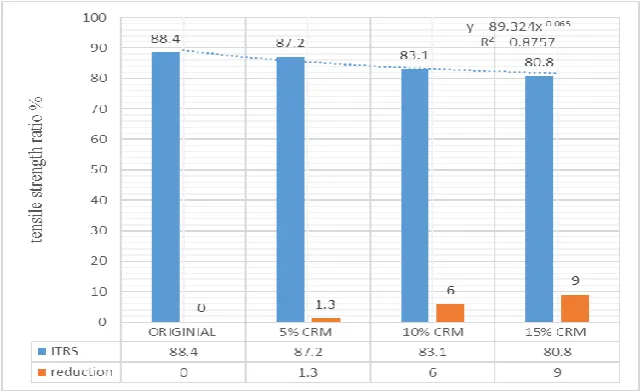
[image:7.595.137.459.398.594.2]3.2.1 Effect of CRM on moisture sensitivity on warm mix asphalt. The indirect tensile strength ratio (ITSR) test was performed to evaluate the resistance of water sensitivity of asphalt mixtures incorporating Sasobit and anti-stripping agent. Figure 1 depicts the tensile strength ratio whit different percentages of CRM (original, 5%, 10%, 15%). The original binder giving 88.4% tensile strength ratio this is high compare to the modified binder. Meanwhile the tensile strength ratio with 5% of CRM is 87.2% that show slight decreased compare to unmodified binder. However, the value of tensile strength ratio for 10% and 15% are 83.1%, 80.8 respectively and this mean with rising the percentage of CRM the tensile ratio decreased.
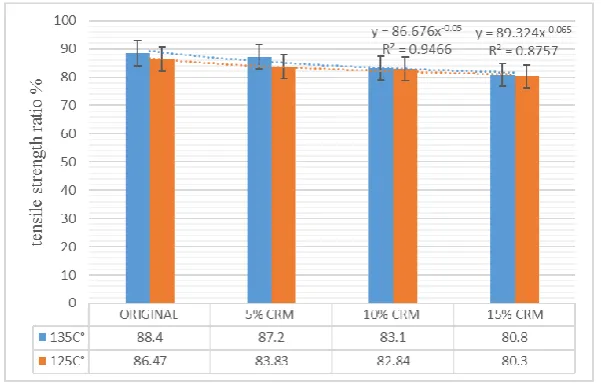
Figure 1. Effect of CRM on tensile strength ratio in WMA.
There is reduction at ITSR result between the original mixture and the modified mixtures, and the drooping happened with add the CRM to the binder. The run-down was 1.3% between the original and the 5% of CRM and the reduction between the original mixture and 10% of CRM was 6%. The reduction
at 15% of CRM was the highest reduction and it was 9%. According to [10], the tensile strength ratio
7
make it increasing that lead to lager binder surface area at mixture. The correlation coefficients R² was 0.8757, the result of R² was good according to the fit statistical parameters.
[image:8.595.148.449.273.466.2]3.2.2 Effect the compaction temperature on CRM warm mix asphalt in moistures Sensitivity. The indirect tensile strength ratio (ITSR) test conducted at two different compaction temperatures 135°Cand 125°C and 145°C, 135°C for mixing temperature. From figure 2 the result of original binder at 135°C higher than original binder at 125C°.the result decreased from 88.4% to 86%. For the modified mixture was the same result which is when the temperature of compacting decreased the tensile ratio is lower. The reduction in compaction temperature adversely affects the mixture susceptibility to water damage due to incomplete drying and entrapment of moisture in the aggregate during heating and mixing at lower temperature.
Figure 2. Effect of CRM on tensile strength ratio at different compaction temperature.
The specimens compacted at low temperature are more susceptible to water damage. However, due to high air voids, the water infiltration into the PA mixture and wish away of mastic through the connected macro pores, loss of cohesion and the failure of the asphalt bond with aggregate happened resulting in low ITSR values. For the modified mixture 5%, 10% and 15% at 135°C compacted temperature the result was 87.2%, 83.1% and 80.8%. Meanwhile for modified mixture 5%, 10% and 15% at 125°Ccompated temperature the result was 83.83%, 82.84% and 80.3%. The R² for 135°C was 0.8757 this good quality of correlation. Meanwhile the R² for 125°C was 0.9466 that excellent quality of correlation.
4. Conclusion
The crumb rubber modified shows lower tensile strength ratio compared to the original mixture, for the mixtures compacted at 125oC and 135oC. Also, the tensile strength ratio of the WMA mixtures decreases
8
was decreased by adding CRM, the result was over the limit of (ITSR) specification 80% and that good result according to specification of the moisture damage test.
Acknowledgements
The authors wish to acknowledge the support by centre for graduate studies university Tun Huseein Onn Malaysia. The authors also acknowledge the GUP grant (Q.J13000.2522.11H76) support by Universiti Teknologi Malaysia.
5. Reference
[1] AASHTO, 2004. Standard Specifications for Transportation Materials and Methods of Sampling and Testing, Part 2A, 24th Edition. Washington, D.C.
[2] AASHTO, 2004. Standard Specifications for Transportation Materials and Methods of Sampling and Testing, Part 2B, 24th Edition. Washington, D.C.
[3] Aman, M. Y., Suhadi, Z., Radhwa, S., & Zawami, Z. I. 2014. Evaluation of Rutting in Warm Asphalt Mixtures Incorporating Anti-Stripping Agents. Australian Journal of Basic and Applied Sciences, 8(10), 438–446.
[4] Asphalt Institute, 2003, Superpave Mix Design. Superpave Series No. 2 (SP-02). Lexington, KY. [5] Avraam I. Isayev, 2005, Recycling of Rubbers: Science and Technology of Rubber. Third Edition,
Academic Press.
[6] Bidaki S. M, Haj Abbasi M. A, Khoshgoftarmanesh A. M. 2012. The effect of adding worn rubber particles on the chemical characteristics of a calcareous soil. Agric Sci Technol Nat Resour Soil Water Sci; 59.
[7] Hamzah, M.O., Kakar, M.R., Quadri, 2013, Quantification of moisture sensitivity of warm mix asphalt using image analysis technique. Journal of cleaner production, 68. 200-208.
[8] Hurley, G. C., & Prowell, B. D. (2005). Evaluation of Sasobit for use in warm mix asphalt. NCAT
report, 5(6), 1-27.
[9] JKR, 2008, Standard Specification for Road Works (JKR/SPJ/2008-Section 4: Flexible Pavement.
[10] Navarro, F. M., & Gámez, M. C. R. 2011. Influence of crumb rubber on the indirect tensile strength and stiffness modulus of hot bituminous mixes. Journal of Materials in Civil Engineering, 24(6), 715-724.
[11] Salem, W., & Altamzwi, A. L. I. 2011. The Effect of Crumb Rubber Additive into Hot Mix Asphalt Performance. University of Diponegoro, Semarang. Master thesis.
[12] Shafabakhsh, G. H., Sadeghnejad, M., & Sajed, Y. 2014. Case study of rutting performance of {HMA} modified with waste rubber powder. Case Studies in ConstructionMaterials,1(0),69–76. [13] Tortum A, Celik C, Aydin A. 2005. Determination of the optimum conditions for tire rubber in
asphalt concrete. Build Environ; 40:1492–504.
[14] Wong, C. C., & Wong, W. G. 2007. Effect of crumb rubber modifiers on high temperature susceptibility of wearing course mixtures. Construction and Building Materials, 21(8), 1741–1745. [15] Wang, H., You, Z., Mills-Beale, J., & Hao, P. 2012. Laboratory evaluation on high temperature viscosity and low temperature stiffness of asphalt binder with high percent scrap tire
rubber. Construction and building Materials, 26(1), 583-590.
[16] Poulikakos, L. D., & Partl, M. N. 2009. Evaluation of moisture susceptibility of porous asphalt
concrete using water submersion fatigue tests. Construction and Building Materials, 23(12),
3475-3484.
[17] Xiao, F., Amirkhanian, S., & Juang, C. H. 2007. Rutting Resistance of Rubberized Asphalt Concrete Pavements Containing Reclaimed Asphalt Pavement Mixtures. Journal of Materials in Civil Engineering, 19(6), 475–483.
[18] Yilmaz, A., & Sargin, S. 2012. Water effect on deteriorations of asphalt pavements. Online J. Sci.