INFLUENCE OF PERFORMANCE
MEASUREMENT TOWARDS
CONSTRUCTION RESEARCH AND
DEVELOPMENT
Udayangani KULATUNGA
INFLUENCE OF PERFORMANCE
MEASUREMENT TOWARDS
CONSTRUCTION RESEARCH AND
DEVELOPMENT
Udayangani KULATUNGA
Research Institute for the Built and Human Environment
School of the Built Environment
The University of Salford
Salford, UK
Submitted in Partial Fulfilment of the Requirements of the
Degree of Doctor of Philosophy
TABLE OF CONTENTS
TABLE OF CONTENTS ... I LIST OF FIGURES ...VII list OF TABLES ... X ACKNOWLEDGEMENTS...XII DEDICATION ... XIV DECLARATION...XV ABBREVIATIONS ... XVI ABSTRACT ... XVII
CHAPTER 1 INTRODUCTION ... 1
1.1 BACKGROUND TO THE STUDY... 1
1.2 JUSTIFICATION FOR THE STUDY... 2
1.3 AIM AND OBJECTIVES... 4
1.4 RESEARCH METHODOLOGY... 4
1.5 CONTRIBUTION TO KNOWLEDGE... 5
1.6 ORGANISATION OF THE THESIS... 6
1.6.1 Chapter 1: Introduction... 6
1.6.2 Chapter 2: Literature review... 6
1.6.3 Chapter 3: Research methodology ... 6
1.6.4 Chapter 4: Conceptual framework ... 6
1.6.5 Chapter 5: Data analysis and findings... 6
1.6.6 Chapter 6: Conclusion ... 7
1.7 SUMMARY AND LINK... 7
CHAPTER 2 LITERATURE REVIEW ... 8
2.1 INTRODUCTION... 8
2.2 RESEARCH AND DEVELOPMENT IN GENERAL... 8
2.2.1 Need for research and development ... 8
2.2.2 Strategic impact of research and development work... 10
2.2.3 Life cycle of new ventures ... 11
2.3 ROLE OF RESEARCH AND DEVELOPMENT IN CONSTRUCTION... 15
2.3.1 The UK construction industry ... 15
2.3.2 Challenges faced by the UK construction industry ... 17
2.3.3 Importance of research and development in construction... 19
2.4 STATUS OF CONSTRUCTION RESEARCH AND DEVELOPMENT... 23
2.4.1 What is construction research? ... 23
2.4.2 Construction research base... 25
2.4.3 Research organisations ... 26
2.4.3.2 Universities...27
2.4.3.3 Construction organisations...27
2.4.4 Collaborative research activities ... 30
2.4.5 Issues in construction research and development ... 32
2.5 PERFORMANCE MEASUREMENT... 36
2.5.1 What is performance measurement? ... 36
2.5.2 Importance of performance measurement ... 39
2.5.3 Performance measures ... 40
2.5.3.1 Development of performance measures...40
2.5.4 Performance measurement systems... 43
2.5.4.1 Characteristics of performance measurement systems...43
2.5.4.2 Performance measurement systems...45
2.6 RESEARCH AND DEVELOPMENT PERFORMANCE MEASUREMENT... 51
2.6.1 Value of performance measurement to research and development ... 51
2.6.2 Need for performance measurement in research and development work... 52
2.6.3 Development of research and development performance measures... 54
2.6.4 Performance measurement systems and performance measures used within research and development work ... 55
2.6.5 Performance measurement and construction research and development ... 57
2.7 SUCCESS FACTORS OF RESEARCH AND DEVELOPMENT... 59
2.7.1 Success factors of construction research and development... 60
2.8 RESEARCH QUESTIONS... 62
2.9 SUMMARY AND LINK... 63
CHAPTER 3 RESEARCH METHODOLOGY ... 65
3.1 INTRODUCTION... 65
3.2 ESTABLISHMENT OF THE RESEARCH PROBLEM... 65
3.2.1 Initial impetus... 65
3.2.2 Literature review ... 66
3.2.3 Expert opinion ... 69
3.2.4 Research problem... 69
3.3 RESEARCH METHODOLOGICAL DESIGN... 70
3.3.1 Research philosophy... 71
3.3.1.1 Positivism...72
3.3.1.2 Interpretivism ...72
3.3.2 Research approach... 74
3.3.3 Case study design ... 77
3.3.3.1 Single vs. multiple case studies...78
3.3.3.2 Unit of analysis...81
3.3.3.3 Case study selection...82
3.3.3.4 Case study process for theory building ...84
3.3.4.1 Data collection techniques...89
3.3.4.2 Unstructured interviews...91
3.3.4.3 Semi structured interviews ...91
3.3.4.4 Questionnaire survey...94
3.3.4.5 Selection of respondents for the questionnaire survey...96
3.3.4.6 Documents reviews...97
3.3.5 Objectives of the study and how they are addressed through the data collection methods... 98
3.4 DATA ANALYSIS AND WRITE UP... 98
3.4.1 Analysis of the semi structured interviews ... 99
3.4.1.1 Code based analysis...99
3.4.1.2 Word based analysis...100
3.4.1.3 Content analysis...101
3.4.1.4 Cognitive mapping...103
3.4.1.5 Use of computer aided software ...104
3.4.1.6 Selecting an appropriate software for data analysis...105
3.4.1.7 Decision explorer...108
3.4.1.8 Data analysing steps in Decision Explorer...109
3.4.2 Analysis of the questionnaire surveys... 111
3.4.2.1 Measurement scales ...111
3.4.2.2 Dealing with missing data ...112
3.4.2.3 Analysing techniques used...113
3.5 TRIANGULATION... 115
3.5.1 Write up ... 116
3.6 CASE STUDY DESIGN ACCEPTABILITY... 116
3.7 RESEARCH METHODOLOGICAL FRAMEWORK... 121
3.8 SUMMARY AND LINK... 124
CHAPTER 4 CONCEPTUAL FRAMEWORK... 125
4.1 INTRODUCTION... 125
4.2 IMPORTANCE OF DEVELOPING A CONCEPTUAL FRAMEWORK... 125
4.3 KEY ISSUES IDENTIFIED FROM THE LITERATURE... 126
4.3.1 Importance of research and development for the construction industry ... 126
4.3.2 Issues within construction research and development ... 127
4.3.3 Need of performance measurement for effective research and development ... 127
4.3.4 Targeting performance measurement on critical success factors ... 128
4.4 EXPERT OPINION... 129
4.4.1 Importance of performance measurement for construction research & development 129 4.4.2 Establishing correct targets for measurement... 129
4.4.3 Collaborative research work ... 130
4.4.4 Research and development process... 130
4.5 DEVELOPMENT OF THE CONCEPTUAL FRAMEWORK... 131
4.5.2 Relationships between the concepts ... 133
4.5.3 Boundary/scope of the study... 133
4.6 CONCEPTUAL FRAMEWORK... 133
4.7 SUMMARY AND LINK... 136
CHAPTER 5 DATA ANALYSIS AND RESEARCH FINDINGS... 137
5.1 INTRODUCTION... 137
5.2 BACKGROUND INFORMATION IN RELATION TO THE CASE STUDY... 137
5.3 STAGES AND KEY ACTIVITIES OF THE CASE STUDY... 138
5.4 EXPLORATORY STAGE... 139
5.4.1 Influence of performance measurement on construction research and development. 139 5.4.1.1 Positive influences of performance measurement on construction research and development: academic members’ perspective...139
5.4.1.2 Positive influences of performance measurement in construction research and development: industrial partners’ perspective...143
5.4.1.3 Negative influences of performance measurement in construction research and development: academic members’ perspective...145
5.4.1.4 Negative influences of performance measurement in construction research and development: industrial partners’ perspective...146
5.4.1.5 Synthesis on the influence of performance measurement in construction research and development...148
5.4.2 Critical success factors for construction research and development function ... 152
5.4.2.1 Critical success factors during the initiation phase...156
5.4.2.2 Synthesis of the critical success factors at initiation phase...157
5.4.2.3 Critical success factors during the conceptualising phase...164
5.4.2.4 Synthesis of the critical success factors at conceptualising phase...166
5.4.2.5 Critical success factors during the development phase...175
5.4.2.6 Synthesis of the critical success factors at development phase ...177
5.4.2.7 Critical success factors during the launch phase...185
5.4.2.8 Synthesis of the critical success factors at launch phase ...186
5.4.2.9 Critical success factors during the project management...188
5.4.2.10 Synthesis of the critical success factors at project management ...189
5.4.3 Implementation of success factors... 197
5.4.3.1 Analysis of the importance of success factors against their implementation/consideration...197
5.4.3.2 Synthesis of the importance of success factors against their implementation/consideration...200
5.4.4 Status of the application of performance measurement, performance indicators and measures ... 202
5.4.4.1 Status of performance measurement applications in construction research and development...202
5.4.4.2 Applicability of performance measures during the construction research and development project...204
5.4.4.3 Synthesis on the current performance measurement applications...209
5.5 THEORY DEVELOPMENT... 212
5.5.1 Need of a performance measurement system to measure success of construction research and development ... 212
5.5.3 Development of performance measurement system for construction research and
development ... 214
5.5.4 Success map... 215
5.5.4.1 Stakeholder satisfaction...215
5.5.4.2 Internal business process...215
5.5.4.3 Learning and growth...216
5.5.4.4 Strengths of the performance measurement system...217
5.5.4.5 Applicability of the performance measurement system...218
5.5.4.6 Advantageous of the performance measurement system...218
5.6 EXPLANATORY STAGE: REFINEMENT AND ASSESSING THE IMPACT OF THE PERFORMANCE MEASUREMENT SYSTEM ON CONSTRUCTION RESEARCH AND DEVELOPMENT... 226
5.6.1 Refinement of the performance measurement system ... 227
5.6.2 Assessing the impact of the performance measurement system in construction research and development ... 228
5.7 SUMMARY AND LINK... 231
CHAPTER 6 CONCLUSION ... 234
6.1 INTRODUCTION... 234
6.2 SYNTHESIS ON THE OBJECTIVES OF THE STUDY... 234
6.3 OBJECTIVE 1:IDENTIFY THE IMPORTANCE OF RESEARCH AND DEVELOPMENT IN THE CONSTRUCTION INDUSTRY... 235
6.4 OBJECTIVE 2:IDENTIFY THE CURRENT POSITION OF CONSTRUCTION RESEARCH AND DEVELOPMENT... 236
6.5 OBJECTIVE 3:EVALUATE THE IMPORTANCE OF PERFORMANCE MEASUREMENT IN CONSTRUCTION RESEARCH AND DEVELOPMENT FUNCTION... 237
6.6 OBJECTIVE 4:EXPLORE HOW PERFORMANCE OF THE CONSTRUCTION RESEARCH AND DEVELOPMENT FUNCTION IS MEASURED... 238
6.7 OBJECTIVE 5:DETERMINE THE CRITICAL SUCCESS FACTORS OF CONSTRUCTION RESEARCH AND DEVELOPMENT FUNCTION... 239
6.8 OBJECTIVE 6:DEVELOP A PERFORMANCE MEASUREMENT SYSTEM THAT ENABLES MANAGEMENT TO ASSESS THE SUCCESS OF THE CONSTRUCTION RESEARCH AND DEVELOPMENT FUNCTION... 242
6.9 CONTRIBUTION TO THEORY... 243
6.9.1 Identification of critical success factors for construction research and development function ... 243
6.9.2 Benefits of performance measurement in construction research and development.... 244
6.9.3 Definition for performance measurement in construction research and development244 6.10 CONTRIBUTION TO PRACTICE... 245
6.10.1 Facilitating the implementation of critical success factors ... 245
6.10.3 Satisfaction of the stakeholders ... 246
6.11 LIMITATIONS OF THE STUDY... 246
6.12 FURTHER RESEARCH... 247
6.12.1 Implementing the performance measurement system developed through the study... 247
6.12.2 Similar studies with different units of analysis and contexts... 247
6.12.3 Application of the performance measurement system in other disciplines ... 247
6.13 FINAL NOTE... 247
Appendix A The list of journal and conference publications By The Author ... 248
Appendix B Summary of the success factors ... 250
Appendix C Interview guidelines during the explanatory stage... 253
Appendix D Case study brief ... 254
Appendix E Interview guidelines during the exploratory stage ... 255
Appendix F Interview transcript ... 260
Appendix G Questionnaire... 270
Appendix H Comparison of the quality criteria... 276
LIST OF FIGURES
FIGURE 2.1:CATEGORIES OF RESEARCH AND DEVELOPMENT (SOURCE:TROTT,2005)... 10
FIGURE 2.2:PHASES OF A NEW VENTURE... 12
FIGURE 2.3:R&D FUNCTION... 13
FIGURE 2.4:MAIN ACTIVITIES AND ACTORS OF THE CONSTRUCTION INDUSTRY,SOURCE (GANN AND SALTER,2000)... 16
FIGURE 2.5:ISSUES IN CONSTRUCTION R&D FUNCTION... 36
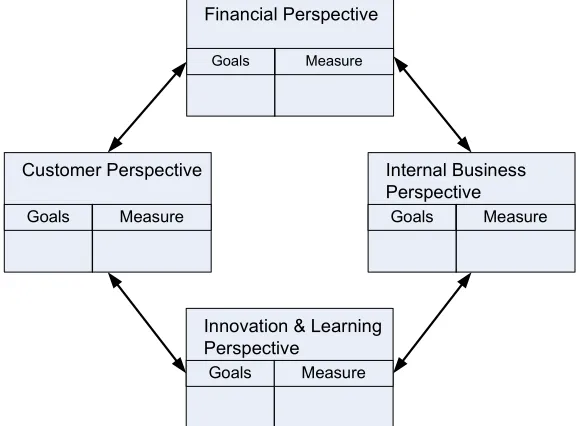
FIGURE 2.6:BALANCED SCORECARD (SOURCE:KAPLAN AND NORTON,1992)... 46
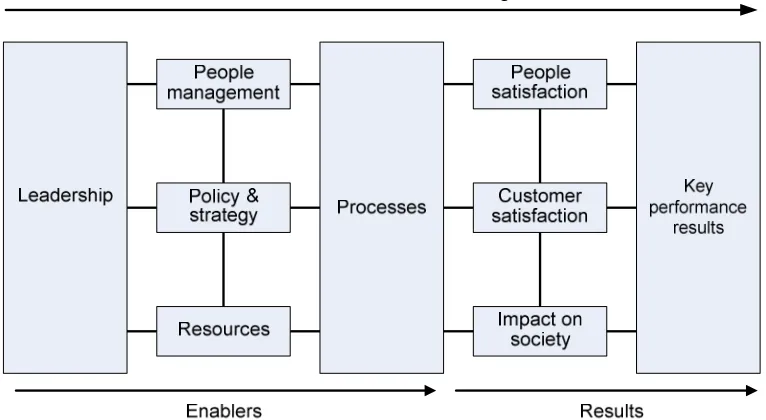
FIGURE 2.7:EFQM MODEL (SOURCE:THE EUROPEAN FOUNDATION FOR QUALITY MANAGEMENT, 2000)... 47
FIGURE 2.8:BROWN’S FRAMEWORK (SOURCE:BROWN,1996) ... 48
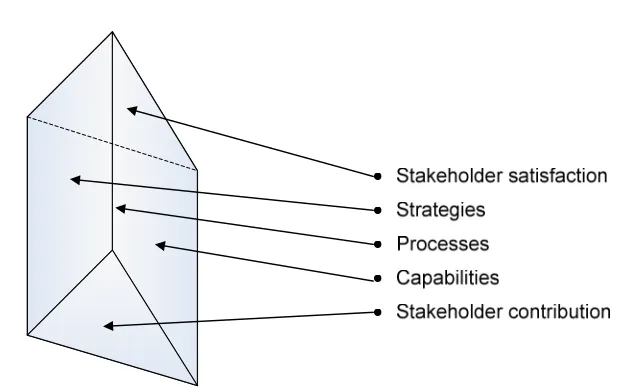
FIGURE 2.9:PERFORMANCE PRISM (SOURCE:NEELY AND ADAMS,2001)... 49
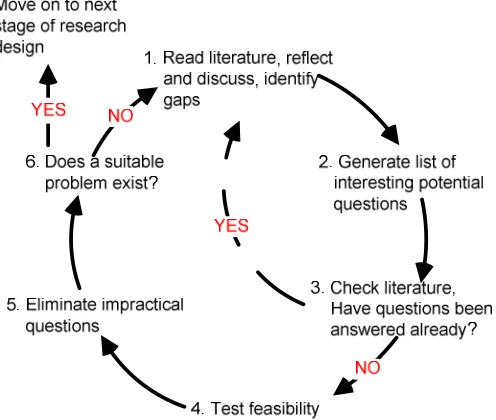
FIGURE 3.1:PROCEDURE FOR IDENTIFYING A RESEARCH PROBLEM (SOURCE:COLLIS AND HUSSEY, 2003)... 66
FIGURE 3.2:IDENTIFICATION OF THE FOCUS OF THE STUDY... 68
FIGURE 3.3:NESTED APPROACH (KAGIOGLOU ET AL,2000) ... 71
FIGURE 3.4:THE PHILOSOPHICAL STANCE PERTAINING TO THE STUDY AGAINST THE RESEARCH PHILOSOPHICAL CONTINUUM... 74
FIGURE 3.5:RESEARCH APPROACHES WITHIN THE PHILOSOPHICAL CONTINUUM... 76
FIGURE 3.6:TYPES OF CASE STUDIES BASED ON THE NUMBER AND UNITS... 79
FIGURE 3.7:UNIT OF ANALYSIS OF THE STUDY:R&D FUNCTION... 81
FIGURE 3.8:UNIT OF ANALYSIS INBUILT WITHIN THE SCOPE OF THE STUDY... 82
FIGURE 3.9:CASE STUDY PROCESS... 86
FIGURE 3.10:DATA COLLECTION STAGES OF THE CASE STUDY... 87
FIGURE 3.11:CREATING AND UPLOADING THE TRANSCRIPTS ONTO NVIVO SOFTWARE... 106
FIGURE 3.12:CODING THE TRANSCRIPTS... 107
FIGURE 3.13:LINKING THE FREE NODES WITH THE TREE NODES... 108
FIGURE 3.14:SYNTHESIS OF THE DATA ANALYSIS PROCESS USING NVIVO... 108
FIGURE 3.15:IMPORTING THE NVIVO TREE NODES TO DECISION EXPLORER... 109
FIGURE 3.16:TRANSFERRING THE CONCEPTS FROM TRANSCRIPTS TO DECISION EXPLORER MAP... 110
FIGURE 3.17:LINKS USED IN DECISION EXPLORER DIAGRAMS... 110
FIGURE 3.18:THE USE OF NEGATIVE LINKS... 111
FIGURE 3.19:THE QUALITY CRITERIA USED WITHIN THE STUDY... 120
FIGURE 3.20:RESEARCH METHODOLOGICAL FRAMEWORK... 123
FIGURE 4.1:DEVELOPMENT OF THE CONCEPTUAL FRAMEWORK... 126
FIGURE 4.2:THE CONCEPTUAL FRAMEWORK... 135
FIGURE 5.1:CODING STRUCTURE ON THE ACADEMIC MEMBERS’ VIEW ON THE INFLUENCE OF PERFORMANCE MEASUREMENT IN CONSTRUCTION RESEARCH AND DEVELOPMENT... 140
FIGURE 5.3:CODING STRUCTURE ON THE INDUSTRIAL PARTNERS VIEW ON THE INFLUENCE OF
PERFORMANCE MEASUREMENT IN CONSTRUCTION RESEARCH AND DEVELOPMENT... 144 FIGURE 5.4:COGNITIVE MAP ON THE INDUSTRIAL PARTNERS’ VIEW ON THE POSITIVE INFLUENCES OF
PERFORMANCE MEASUREMENT IN CONSTRUCTION RESEARCH AND DEVELOPMENT... 144 FIGURE 5.5:COGNITIVE MAP ON THE ACADEMIC MEMBERS’ VIEW ON THE NEGATIVE INFLUENCE OF
PERFORMANCE MEASUREMENT IN CONSTRUCTION RESEARCH AND DEVELOPMENT... 145 FIGURE 5.6:COGNITIVE MAP ON THE INDUSTRIAL PARTNERS’ VIEW ON THE NEGATIVE INFLUENCE OF
PERFORMANCE MEASUREMENT IN CONSTRUCTION RESEARCH AND DEVELOPMENT... 147 FIGURE 5.7:CODING STRUCTURE FOR THE CRITICAL SUCCESS FACTORS AT INITIATION PHASE OF
RESEARCH AND DEVELOPMENT FUNCTION... 158 FIGURE 5.8:COGNITIVE MAP OF THE CRITICAL SUCCESS FACTOR "SOLID UPFRONT WORK" AT INITIATION
PHASE... 160 FIGURE 5.9:COGNITIVE MAP OF THE CRITICAL SUCCESS FACTOR “CONSIDER STAKEHOLDER
REQUIREMENT" AT INITIATION PHASE... 162 FIGURE 5.10:COGNITIVE MAP OF THE CRITICAL SUCCESS FACTOR "AUTHORITY AND COMMITMENT OF
THE PRINCIPAL INVESTIGATOR" AT THE INITIATION PHASE... 163 FIGURE 5.11:CODING STRUCTURE FOR THE CRITICAL SUCCESS FACTORS AT CONCEPTUALISATION PHASE
... 167 FIGURE 5.12:COGNITIVE MAP OF THE CRITICAL SUCCESS FACTOR "CLARITY AND FOCUS OF WORK" AT
THE CONCEPTUALISING PHASE... 170 FIGURE 5.13:COGNITIVE MAP OF THE CRITICAL SUCCESS FACTOR "ADEQUATE RESOURCES AND
CAPABILITIES" AT THE CONCEPTUALISING PHASE... 171 FIGURE 5.14:COGNITIVE MAP OF THE CRITICAL SUCCESS FACTOR "CONSIDER STAKEHOLDER
REQUIREMENTS" AT THE CONCEPTUALISING PHASE... 173 FIGURE 5.15:COGNITIVE MAP OF THE CRITICAL SUCCESS FACTOR "TEAM DYNAMICS" AT
CONCEPTUALISING PHASE... 174 FIGURE 5.16:CODING STRUCTURE FOR THE CRITICAL SUCCESS FACTORS AT DEVELOPMENT PHASE... 178 FIGURE 5.17:COGNITIVE MAP OF THE CRITICAL SUCCESS FACTOR "STAKEHOLDER SATISFACTION" AT
DEVELOPMENT PHASE... 179 FIGURE 5.18:COGNITIVE MAP OF THE CRITICAL SUCCESS FACTOR "ADEQUATE RESOURCES AND
CAPABILITIES" AT DEVELOPMENT PHASE... 180 FIGURE 5.19:COGNITIVE MAP OF THE CRITICAL SUCCESS FACTOR "AUTHORITY AND COMMITMENT OF
THE PRINCIPAL INVESTIGATOR" AT DEVELOPMENT PHASE... 181 FIGURE 5.20:COGNITIVE MAP OF THE CRITICAL SUCCESS FACTOR "MOTIVATIONAL AND BEHAVIOURAL
ISSUES OF THE TEAM MEMBERS" AT DEVELOPMENT PHASE... 183 FIGURE 5.21:CODING STRUCTURE FOR THE CRITICAL SUCCESS FACTORS AT LAUNCH PHASE... 186 FIGURE 5.22:COGNITIVE MAP FOR CRITICAL SUCCESS FACTORS AT THE LAUNCH PHASE... 187 FIGURE 5.23:CODING STRUCTURE FOR THE CRITICAL SUCCESS FACTORS AT PROJECT MANAGEMENT190 FIGURE 5.24:COGNITIVE MAP OF THE CRITICAL SUCCESS FACTOR "PROJECT COORDINATION" AT
FIGURE 5.25:COGNITIVE MAP OF THE CRITICAL SUCCESS FACTOR "RESOURCE MANAGEMENT" AT PROJECT MANAGEMENT... 194 FIGURE 5.26:INFLUENCES OF PERFORMANCE MEASUREMENT TOWARDS CONSTRUCTION RESEARCH AND
DEVELOPMENT... 196 FIGURE 5.27:COMPARISON OF THE IMPORTANCE OF SUCCESS FACTORS AGAINST THEIR
IMPLEMENTATION/CONSIDERATION AT THE INITIATION PHASE... 197 FIGURE 5.28:COMPARISON OF THE IMPORTANCE OF SUCCESS FACTORS AGAINST THEIR
IMPLEMENTATION/CONSIDERATION AT THE CONCEPTUALISING PHASE... 198 FIGURE 5.29:COMPARISON OF THE IMPORTANCE OF SUCCESS FACTORS AGAINST THEIR
IMPLEMENTATION/CONSIDERATION AT DEVELOPMENT PHASE... 199 FIGURE 5.30:COMPARISON OF THE IMPORTANCE OF SUCCESS FACTORS AGAINST THEIR
IMPLEMENTATION/CONSIDERATION AT THE LAUNCH PHASE... 199 FIGURE 5.31:COMPARISON OF THE IMPORTANCE OF SUCCESS FACTORS AGAINST THEIR
IMPLEMENTATION/CONSIDERATION AT PROJECT MANAGEMENT... 200 FIGURE 5.32:PERFORMANCE MEASUREMENT SYSTEM FOR CONSTRUCTION RESEARCH AND
LIST OF TABLES
TABLE 2.1:PHASES AND ACTIVITIES INVOLVED IN NEW VENTURE DEVELOPMENT... 14
TABLE 2.2:A COMPARISON OF RESEARCH CULTURES BETWEEN UNIVERSITIES AND CONSTRUCTION ORGANISATIONS (ADOPTED FROM BRANDON ET AL,1999)... 29
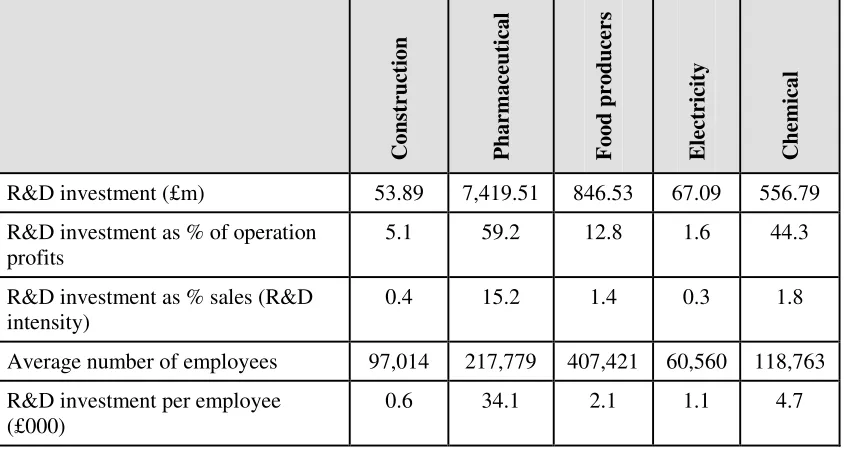
TABLE 2.3:COMPARISON OF CONSTRUCTION R&D WITH OTHER INDUSTRIES (SOURCE:DEPARTMENT FOR BUSINESS ENTERPRISE AND REGULATORY REFORM,2007) ... 33
TABLE 3.1:CONTRASTING IMPLICATIONS OF POSITIVISM AND INTERPRETIVISM (EASTERBY-SMITH ET AL,2002)... 73
TABLE 3.2:THE COMPARISON OF NOMOTHETIC AND IDEOGRAPHIC METHODS (SOURCE:GILL AND JOHNSON,2002) ... 76
TABLE 3.3:CHARACTERISTICS OF AN EXEMPLARILY CASE... 88
TABLE 3.4:DETAILS OF THE SEMI STRUCTURED INTERVIEWS AT THE EXPLORATORY AND EXPLANATORY STAGES OF THE CASE STUDY... 94
TABLE 3.5:VALUES ASSIGNED FOR THE LIKERT SCALE... 95
TABLE 3.6:RESPONSE RATE FOR THE QUESTIONNAIRE SURVEY... 96
TABLE 3.7:LINK BETWEEN THE RESEARCH QUESTIONS, SEMI STRUCTURED INTERVIEWS, SURVEY QUESTIONS, AND THE LITERATURE SECTION... 97
TABLE 3.8-OBJECTIVE OF THE STUDY AND THE MODE OF INVESTIGATION... 98
TABLE 3.9:SUMMARY OF THE DATA ANALYSING METHODS USED... 115
TABLE 3.10:TRIANGULATION METHODS... 116
TABLE 5.1:INFLUENCES OF PERFORMANCE MEASUREMENT IN CONSTRUCTION RESEARCH AND DEVELOPMENT... 148
TABLE 5.2:PRESENTATION OF THE ASYMPTOTIC SIGNIFICANCE IN TABLES... 154
TABLE 5.3:RANKING OF THE SUCCESS FACTORS AT THE INITIATION PHASE... 156
TABLE 5.4:DIFFERENCE IN OPINION OF THE ACADEMIC MEMBERS AND INDUSTRIAL PARTNERS AT THE INITIATION PHASE... 157
TABLE 5.5:CRITICAL SUCCESS FACTORS DURING THE INITIATION PHASE... 164
TABLE 5.6:RANKING OF THE SUCCESS FACTORS AT THE CONCEPTUALISING PHASE... 165
TABLE 5.7:DIFFERENCE IN OPINION OF THE ACADEMIC MEMBERS’ AND INDUSTRIAL PARTNERS AT THE CONCEPTUALISING PHASE... 166
TABLE 5.8:CRITICAL SUCCESS FACTORS DURING THE CONCEPTUALISING PHASE... 175
TABLE 5.9:RANKING OF THE SUCCESS FACTORS AT THE DEVELOPMENT PHASE... 176
TABLE 5.10:DIFFERENCE IN OPINION OF THE ACADEMIC MEMBERS AND INDUSTRIAL PARTNERS AT THE DEVELOPMENT PHASE... 177
TABLE 5.11:CRITICAL SUCCESS FACTORS DURING THE DEVELOPMENT PHASE... 184
TABLE 5.12:RANKING OF THE SUCCESS FACTORS AT THE LAUNCH PHASE... 185
TABLE 5.13:DIFFERENCE IN OPINION OF THE ACADEMIC MEMBERS AND INDUSTRIAL PARTNERS AT THE LAUNCH PHASE... 186
TABLE 5.14:CRITICAL SUCCESS FACTORS DURING THE LAUNCH PHASE... 188
TABLE 5.16:DIFFERENCE IN OPINION OF THE ACADEMIC MEMBERS AND INDUSTRIAL PARTNERS AT THE
PROJECT MANAGEMENT... 189
TABLE 5.17:CRITICAL SUCCESS FACTORS DURING THE PROJECT MANAGEMENT... 195
TABLE 5.18:TYPES AND PERCENTAGE USAGE OF PERFORMANCE MEASURES... 206
TABLE 5.19:PERFORMANCE MEASURES OF CONSTRUCTION RESEARCH AND DEVELOPMENT... 222
ACKNOWLEDGEMENTS
I would like to thank the following people and organisations for supporting me in numerous ways throughout my PhD. First and foremost, I am indebted to my supervisor Professor Dilanthi Amaratunga for her continuous support and guidance throughout the PhD process. Dilanthi, I am so lucky to have you as my supervisor and I would have never completed my PhD without your knowledge, advice and most importantly your encouragement! I would also like to extend my gratitude to my co-supervisor Dr. Richard Haigh for his guidance during the PhD.
I would like to take this opportunity to thank the School of the Built Environment for providing me with the Graduate Teaching Assistantship to fund my PhD which gave me the opportunity of starting my postgraduate career. I am grateful to the academic and support staff from the School of the Built Environment and the support staff from the Research Institute for the Built and Human Environment for their efficient service and support.
Special thanks to the interview participants and questionnaire survey respondents for spending their valuable time. Without their support I would not have completed the PhD as expected. I would also like to thank my lecturers at the University of Moratuwa, Sri Lanka for their guidance and knowledge given during the course of my undergraduate studies. I owe a special thanks to my big “sis” Dr. Champika Liyanage to her continuous guidance and encouragement to complete the PhD as planned. Dr. Chaminda Pathirage is also thanked for his guidance and suggestions given throughout the PhD process. Special thanks to Dr. Bingunath Ingirige, Mohan Siriwardane and Kaushal Keraminiyage for their constructive criticism given to further improve my research. I would also like to thank Niraj Thurairajah for his support and being there, like a brother to me, since my undergraduate studies. Many thanks to Ms. Menaha Shanmugam for her constant help and sacrificing her valuable time on compiling the PhD thesis. Further, Gayani, Roshani, Nuwani, Nirooja, Kanchana and Shariffa are also thanked for their close friendship and support.
proud of my work. My parents in-laws, brothers, sisters and in-laws are also thanked for their love and support.
DEDICATION
I dedicate this piece of research to my dearest husband Kushan and my
DECLARATION
This thesis is submitted under the University of Salford rules and regulations for the award of a PhD degree by research. While the research was in progress, some research findings were published in refereed journals and conference papers prior to this submission (refer to Appendix A).
The researcher declares that no portion of the work referred to in this thesis has been submitted in support of an application for another degree of qualification of this, or any other university or institution of learning.
ABBREVIATIONS
BSC Balanced Scorecard CSFs Critical Success Factors
EFQM European Foundation for Quality Management GDP Gross Domestic Product
KPI Key Performance Indicators NPD New Product Development PM Performance Measurement
ABSTRACT
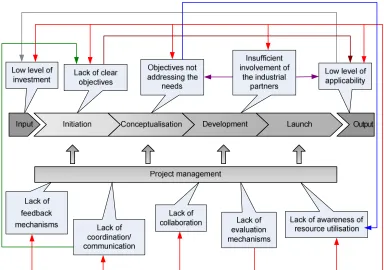
The UK construction industry is being challenged to produce economically, socially and environmentally acceptable products; to satisfy its stakeholders, to improve efficiency and effectiveness of the construction processes and to address resource constraints and sustainable goals. In this context research and development (R&D) activities are identified as vital to address the challenges faced by the construction industry. Despite the importance, there are number of issues that hinder the success of construction R&D activities such as lack of accountability of the R&D resources, inadequate mechanisms to evaluate the success, output not addressing the requirements of the stakeholders, lack of communication and coordination between the parties involved in the R&D process etc.
Consequently, these issues have resulted in producing research results with low applicability and have discouraged the investment towards construction R&D. Furthermore, it has been revealed that the cause of a majority of the issues in construction R&D is directly or indirectly rooted with the lack of evaluation mechanisms implying the need for performance measurement (PM). Therefore this study addresses this eminent need by exploring the influence of PM on the construction R&D.
The study was argued to be residing in the interpretivism paradigm. A single case study method was used to refine a conceptual framework developed through literature review and expert interviews. Semi structured interviews and a questionnaire survey were used as the data collection techniques. Content analysis and cognitive mapping techniques were used for the analysis of the semi structured interviews whilst descriptive and inferential statistics were used for analysis of the questionnaire survey.
C
C
H
H
A
A
P
P
T
T
E
E
R
R
1
1
I
I
N
N
T
T
R
R
O
O
D
D
U
U
C
C
T
T
I
I
O
O
N
N
1
1
.
.
1
1
B
B
a
a
c
c
k
k
g
g
r
r
o
o
u
u
n
n
d
d
t
t
o
o
t
t
h
h
e
e
s
s
t
t
u
u
d
d
y
y
The contribution from the UK construction industry towards the economy and the built environment is significant. It contributes around 8% to the gross domestic product (GDP) while providing employment to around 2.1 million people (Department for Business, Enterprise & Regulatory Reform, 2007). The production and the uses of the built environment are constantly changing due to the expectations of the society, environmental considerations, government rules and regulations etc. As a subset of the built environment, the construction industry has a greater responsibility in responding to these changes and making a better built environment (European construction platform, 2005; CRISP, 2004; Fairclough, 2002). Along with these expectations for a better economy and a built environment, the construction industry is subjected to a number of challenges such as improving the efficiency and effectiveness of the construction processes and materials, addressing the growing concerns of environmental considerations, health and safety issues, complying with sustainable development requirements and addressing cost, time, quality parameters whilst improving the image of the industry (see Department for Business, Enterprise & Regulatory Reform, 2007; DTI, 2007; European construction platform, 2005; Hampson and Brandon, 2004; Fairclough, 2002; Laing, 2001).
creation of new knowledge and capabilities gained through R&D activities help organisations to compete successfully in the marketplace (Lim and Ofori, 2007; Gilkinson and Barrett, 2004).
The Fairclough report (2002) revealed that the main research providers within the UK construction industry are universities, construction organisations and other independent research institutions such as Building Research Establishment (BRE), Building Services Research and Information Association (BSRIA) and Construction Industry Research and Information Association (CIRIA) with universities being the largest group of research providers. The research carried out within these organisations varies depending on the organisation’s priorities and availability of skilled employees to undertake research work etc. For instance, universities follow a systematic approach to research work, investigating issues in a more rigorous manner with good theoretical background (see Fairclough, 2002; Brandon et al, 1999), though they are often accused of lack of practicality (Gilkinson and Barrett, 2004; Barrett and Barrett, 2003; Townsend, 1999). As research is not their primary activity, the construction organisations prefer to engage in research which could provide them with quick results (Fairclough, 2002; Brandon et al, 1999). Nevertheless, many assert that the collaborative research work between universities and construction organisations yields success as it combines theory with practice.
1
1
.
.
2
2
J
J
u
u
s
s
t
t
i
i
f
f
i
i
c
c
a
a
t
t
i
i
o
o
n
n
f
f
o
o
r
r
t
t
h
h
e
e
s
s
t
t
u
u
d
d
y
y
2001; Lorch, 2000; Hodkinson, 1999), inadequate mechanisms to evaluate the successfulness of activities (Lorch, 2000), lack of clear and visible links between investment and contributions (Print, 1999; Hodkinson, 1999) have negatively affected construction R&D activities, resulting in a decrease in investment in R&D activities. Further, when the expectations are not met, a low level of contribution from industrial partners is evident (Barrett and Barrett, 2003; Print, 1999). Moreover, lack of feedback on the progress and success of R&D activities and lack of communication between the parties involved (Dulaimi et al, 2002; Print, 1999; CRISP consultancy commission, 1999) have reduced the interest and attraction for contributors to ongoing R&D activities.
Accordingly, the justification for this study is twofold. Firstly, PM can be identified and highlighted as a valuable means of evaluating the success of construction R&D activities and hence a necessity for its success. Secondly, though there are number of studies on PM and R&D in other disciplines, a paucity of literature is evident within the construction sector creating a gap between the need for PM in construction R&D and its availability. Therefore, this study is aimed at addressing this gap in construction R&D with particular reference to its PM applications.
1
1
.
.
3
3
A
A
i
i
m
m
a
a
n
n
d
d
o
o
b
b
j
j
e
e
c
c
t
t
i
i
v
v
e
e
s
s
The aim of the study is to explore the influence of PM on the construction R&D function. Accordingly, the following objectives are formulated to address this aim: Objectives:
identify the importance of R&D in the construction industry identify the current position of construction R&D
evaluate the importance of performance measurement in construction R&D function
explore how performance of construction R&D function is measured determine the critical success factors of construction R&D function
develop a performance measurement system (PMS) that enables management to assess the successfulness of the construction R&D function. To fulfil the aim and objectives of this study, the following research methodology is used.
1
1
.
.
4
4
R
R
e
e
s
s
e
e
a
a
r
r
c
c
h
h
m
m
e
e
t
t
h
h
o
o
d
d
o
o
l
l
o
o
g
g
y
y
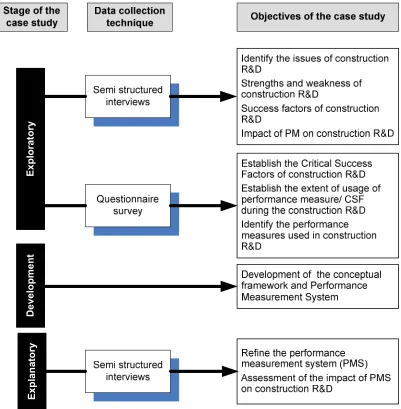
study design and data collection process. Interpretivism is established as the philosophical stance for the study whereas case studies as the research approach (see Section 3.3.1 and 3.3.2 for justifications). Whilst increasing the depth against the breadth of the study, a single case study design was preferred with the unit of analysis being the R&D function (see Section 3.3.3.1 and Section 3.3.3.2). Further, by considering the characteristics of the construction research base, collaborative research work was identified as the scope of the study. Accordingly, data was collected from academic members and industrial partners involved within university lead collaborative research environment. The study used unstructured interviews to gather expert opinions regarding the phenomenon under consideration. During the exploratory stage of the case study, semi structured interviews and a questionnaire survey were used. Furthermore, documents were reviewed as a supplement to the aforementioned data collection techniques. Finally, expert opinions were gathered to refine the PMS and to establish the influence of PM towards construction R&D function.
The third section of the research methodological framework explains how the study analysed and arrived at the conclusions to fulfil the aim and objectives. Content analysis and cognitive maps were used for the analysis of semi structured interviews whilst descriptive and inferential statistics were used for the analysis of the questionnaire survey. The data analysing process was supported by using a number of computer aided software programmes namely: NVivo (version 2), Decision explorer (version 3.1.2) and SPSS (version 13). The study corroborated the findings through source, methodological and discipline triangulation thus increasing the acceptability of the findings.
1
1
.
.
5
5
C
C
o
o
n
n
t
t
r
r
i
i
b
b
u
u
t
t
i
i
o
o
n
n
t
t
o
o
k
k
n
n
o
o
w
w
l
l
e
e
d
d
g
g
e
e
1
1
.
.
6
6
O
O
r
r
g
g
a
a
n
n
i
i
s
s
a
a
t
t
i
i
o
o
n
n
o
o
f
f
t
t
h
h
e
e
t
t
h
h
e
e
s
s
i
i
s
s
The chapters of the thesis are organised as follows:
1
1..66..11 CChhaapptteerr11::IInnttrroodduuccttiioonn
Chapter 1 of the thesis provides an overall view by discussing the key issues which led to the initiation of this study, its aims and objectives, a brief introduction about the research methodology and contribution to theory and practice of the study.
1
1..66..22 CChhaapptteerr22::LLiitteerraattuurreerreevviieeww
Chapter 2 provides the key issues identified from literature in progressively formulating the research problem of the study. Accordingly, general and construction specific literature related to R&D and PM is presented and synthesised.
1
1..66..33 CChhaapptteerr33::RReesseeaarrcchhmmeetthhooddoollooggyy
Chapter 3 provides the research methodological design and the research process followed during the study. The chapter details the research philosophy, approach and data collection and analysing techniques used for the study.
1
1..66..44 CChhaapptteerr44::CCoonncceeppttuuaallffrraammeewwoorrkk
Chapter 4 conceptualises the phenomenon under consideration by developing a framework to illustrate the key areas identified from the literature and expert opinion and shows the issues which will be focused on during the course of the study.
1
1..66..55 CChhaapptteerr55::DDaattaaaannaallyyssiissaannddffiinnddiinnggss
1
1..66..66 CChhaapptteerr66::CCoonncclluussiioonn
Chapter 6 draws conclusions for the aim and objectives of the study based on the empirical investigations. Further, the implications for the theory and practice are also provided followed by the limitations and future research areas.
1
1
.
.
7
7
S
S
u
u
m
m
m
m
a
a
r
r
y
y
a
a
n
n
d
d
l
l
i
i
n
n
k
k
C
C
H
H
A
A
P
P
T
T
E
E
R
R
2
2
L
L
I
I
T
T
E
E
R
R
A
A
T
T
U
U
R
R
E
E
R
R
E
E
V
V
I
I
E
E
W
W
2
2
.
.
1
1
I
I
n
n
t
t
r
r
o
o
d
d
u
u
c
c
t
t
i
i
o
o
n
n
The previous chapter introduced the research area under investigation for this study. This chapter focuses on identifying the key research areas pertaining to this study through a comprehensive literature synthesis. Accordingly, the chapter is structured as follows:
First, it identifies the importance of Research and Development (R&D) in general and discusses the life cycle of a new venture.
Second, the role of R&D within the construction industry is discussed specifically in identifying solutions to the challenges faced by the UK construction industry.
Third, the status of the UK construction R&D is investigated by identifying the main research providers and their inherent characteristics. Following this, the discussion evaluates the UK construction R&D.
Fourth, the chapter explores the subject area Performance Measurement (PM) by identifying its importance, its development over past decades and discusses some commonly used PMSs.
Fifth, the chapter combines the two main areas of this study: construction R&D and Performance Measurement. Accordingly, this section details the importance of PM in R&D by using studies carried out in various disciplines and justifies the need for PM within construction R&D.
Finally, the need for identifying the critical success factors in establishing the performance measures are discussed.
2
2
.
.
2
2
R
R
e
e
s
s
e
e
a
a
r
r
c
c
h
h
a
a
n
n
d
d
d
d
e
e
v
v
e
e
l
l
o
o
p
p
m
m
e
e
n
n
t
t
i
i
n
n
g
g
e
e
n
n
e
e
r
r
a
a
l
l
2
2..22..11 NNeeeeddffoorrrreesseeaarrcchhaannddddeevveellooppmmeenntt
Globalisation, advancement in technology and environmental factors challenge existing working practices, thus demanding increased efficiency and effectiveness of activities while optimising the use of resources. The ability to offer products and services with higher quality and lower prices, have become important factors for organisations in order to secure the greatest market share. The change from
(Nixon, 1998). To survive in the competitive marketplace, organisations have to address the current and future needs of their customers. Rapidly changing customer needs, competitiveness in domestic and international markets, resource and economic constraints have forced organisations to engage in more Research and Development (R&D) activities and to find solutions to the challenges they are facing (Business Link, 2007; Kerssens-van Drongelen et al, 2000; Cooper, 1998). Research carried out in various sectors has indicated that R&D has had a significant impact on productivity (HM Treasury, 2002). In addition to the direct benefits from R&D activities, spill over effects such as knowledge transfer has created social returns and added value to the economy as a whole (HM Treasury, 2002). Based on a survey conducted with Industrial Research Institute member companies in USA, Scinta (2008) reports that a significant increase in the R&D expenditure is evident for years to come as companies are optimistic about the gains yield from R&D activities. Similarly, based on the findings of R&D scoreboard 2007, massive investments for R&D activities are evident (Carr, 2007). Further, Carr (2007) views the increase of R&D investments as a factor which indicates future success and as a sign of business confidence. On the down side Tubbs (2007) claims that the organisations who under invest in R&D compared to their competitors shows a decline in their organisational performance and competitiveness.
Trott (2005) identifies four categories of R&D as basic research, applied research, development, and technical services. These categories are briefly discussed below (see Figure 2.1).
Basic research: This is also referred to as fundamental science, which involves work of a general nature intended to be applied to a broad range of uses or to new knowledge about an area. Outputs of basic research will result in scientific papers for journals and some findings will be developed to produce new technologies.
Applied research: This involves the use of existing scientific principles/ knowledge to solve a particular problem and is sometimes referred to as an application of science. It is from applied research that new products emerge. Development: Development uses existing knowledge but focuses on a
10 Technical services: This involves providing services for existing products or
processes, mainly for cost and performance improvements.
Technical services: This involves providing services for existing products or processes, mainly for cost and performance improvements.
Figure 2.1: Categories of research and development (Source: Trott, 2005)
2
2..22..22 SSttrraatteeggiicciimmppaaccttooffrreesseeaarrcchhaannddddeevveellooppmmeennttwwoorrkk
Product development in most industries has been challenged by the increased pace of innovation, shortened product life cycle, development of information and communication technologies and globalisation (Dahan and Srinivasan, 2000; Soderquist and Nellore, 2000; Tomkovich and Miller, 2000). Companies have to excel not only in efficiency, but also in quality, flexibility, and innovation (McNair and Liebfried, 1992; Wheelwright and Clark, 1992; Bolwijn and Kumpe, 1990). Accordingly, the scope of R&D activities includes a broad array of fields to fulfil the requirements of company, customer, and shareholder needs (Cooper, 1998; Cooper, 1995). Consequently, these demands placed upon R&D require a more strategic role for the R&D activities (Edelheit, 2004; Athaide and Stump, 1999; Comstock and Sjolseth, 1999; Khurana and Rosenthal, 1997). van Rooij (2008) also takes the view that R&D activities need to be integrated within the business strategy. Accepting its strategic role, Trott (2005, p: 253) asserts that over the past years, R&D has been
Having identified the need for R&D and the strategic impact of R&D in general, the Section 2.3 moves on to the literature review and synthesis of R&D related to construction industry. Before that, the section below discusses the life cycle of a new venture in order to understand the typical phases that a R&D function (see Section 3.3.3.2) undergo.
2
2..22..33 LLiiffeeccyycclleeooffnneewwvveennttuurreess
The life cycle of a new venture (new product/process/services) can be divided into a number of distinct phases. The exact division of these phases is governed by the complexities of the final output, management structure of the organisation etc. (Aw, 2005). The development of a new venture can involve a number of activities which are carried out by multidisciplinary teams, different departments and are influenced by various decisions. By considering these factors Saren (1984) identifies five types of models.
departmental stage models: based on the departments or functions which hold responsibility for the tasks carried out in the innovation process;
active stage model: based on the activities that are performed;
decision stage model: represent the innovation process as a series of evaluation points to decide if the work should go ahead or be abandoned; conversion process model: based on the concept that the innovation process
is a conversion of inputs to outputs; and
response model: focuses on the individuals’ or organisations’ response to change of ideas or project proposals in terms of acceptance or rejection of ideas or proposals.
departmental stage models. The decision stage model consists of specific decision points to evaluate the success of activities and can be incorporated in the department stage and active stage models. Saren (1984) claims that the aforementioned models indicate that the new venture moves in a rational manner. The conversion process model takes the standpoint that conversion of inputs to outputs avoids assigning the responsibility to separate departments (Hart and Baker, 1994), avoids the sequential approach and the presence of activities (Saren, 1984). The response model is based on the responses to a change of idea/proposal thus evaluating the factors which influence the decision to move ahead or to reject (Hart and Baker, 1994).
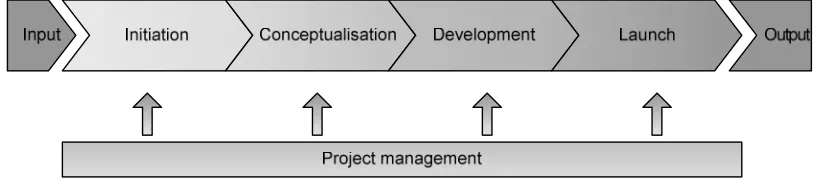
In addition to the above models which represent the involvement of different decisions, activities, departments, and responses, the life cycle of a new venture can be divided into number of distinctive phases. Pillai et al (2002) divide it into three phases: project selection phase (initial screening, detailed evaluation, project selection); project execution phase (effective resource management to accomplish project goals within the stipulated time and cost); and project implementation phase (focusing on customer satisfaction and return on investment). Further, there are number of models proposed by various authors depicting various activities in a new venture development (see Table 2.1). It is noticeable that the phases of those models proposed by different authors follow a similar pattern, whilst activities coincide with one another. By reviewing the characteristics of the models, the researcher categorises the phases of development of new venture into four categories as Initiation, Conceptualisation, Development and Launch (Figure 2.2).
Figure 2.2: Phases of a new venture
launched at the launch phase. Some models consider a maturity phase where they examine the effect of the new venture on the market (see Price, 2004). Table 2.1 summarises leading models of new venture development in relation to the identified four categories.
For the new venture to be successful within its life cycle, it requires a number of project management roles, such as effective coordination of activities, communication, resource management and evaluation of output against the goals. Despite this, the success of a new venture depends on resources such as knowledge, funds, time and commitment of people, and equipment. By taking these issues into account Kerssens-van Drongelen (1999) developed the concept of the R&D function which is defined as a “set of activities necessary to effectively and efficiently initiate, co-ordinate and accomplish the product and process development activities of a
company”. Similarly, Fisscher and Weerd-Nederhof (2000) define the R&D function
[image:32.595.114.524.465.555.2]as a set of resources and competencies that carry out the R&D process. By combining the phases of the new venture (Figure 2.2) with the resources and competencies needed for its success, the researcher has arrived at the following diagram which illustrates the R&D function (Figure 2.3).
Table 2.1: Phases and activities involved in new venture development
Snelson and Hart
(1991) Theije et al (1998)
Loch and Tapper
(2000) Cooper (2001) Price (2004)
Moultrie et al (2006)
Initiation Idea generation
Screening ideas
Concept stage Generate idea Discover scope
Opportunity recognition
Project generation
Conceptualisation Concept
development Business analysis
Specification stage Basic design stage Detail design stage
Select fund Generate concept Define specs
Business case Opportunity focusing Commitment of resources
Requirement capture
Concept design
Development Product
development Test marketing
Engineering stage Design Test
Develop
Test and Validate
Market entry Implementation
Launch Commercialisation Launch Launch Full Launch and
Growth
Maturity Maturity and
When designing the R&D process pertaining to this study, the concepts of “active
stage” and “conversion” models were used (see Saren, 1984). Agreeing with Saren
(1984) the researcher also believes that the life cycle of a new venture should not be a rational or sequential one. Nevertheless, the researcher believes that the identification of activities involved within the phases of the life cycle of the new venture would help to prioritise them and lead to the successful accomplishment of them. The identification of activities involved during different phases would facilitate effective controlling and monitoring of the activities. It ensures the establishment of milestones and short term goals for their accomplishment, during a particular phase, and direction of the team members towards those goals. Though it is recommended to overcome the phase based approach and to integrate the phases of the life cycle of a new venture, Sun and Wing (2005) comment that such integration could dilute the essential activities involved in R&D work. Thus, the model designed for this study combines the characteristics of the active stage and conversion process models acknowledging the iterative processes, while representing the activities involved within each phase for ease of understanding of the R&D work.
Having identified the life cycle of a new venture and supporting resources and activities for a new venture to be successful, the next section discusses the importance of R&D to construction industry.
2
2
.
.
3
3
R
R
o
o
l
l
e
e
o
o
f
f
r
r
e
e
s
s
e
e
a
a
r
r
c
c
h
h
a
a
n
n
d
d
d
d
e
e
v
v
e
e
l
l
o
o
p
p
m
m
e
e
n
n
t
t
i
i
n
n
c
c
o
o
n
n
s
s
t
t
r
r
u
u
c
c
t
t
i
i
o
o
n
n
2
2..33..11 TThheeUUKKccoonnssttrruuccttiioonniinndduussttrryy
The built environment makes a substantial contribution towards the social, economic and environmental developments (Lorch, 2004) thus Clarke and White (2006) claim it as a major economic driver. Agreeing with this views, Saxon (2003. p: 3) asserts that the nation’s lifestyle and economy rests in a “cradle of built environment and
utilities”. Society expects the built environment to be accessible and comfortable for
construction industry should create a proper vision and be responsible for making sure that the built environment addresses society’s needs.
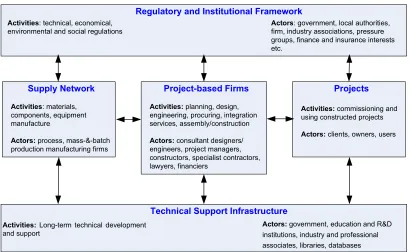
McCaffer (2004, p: 2) asserts that the construction industry comprises of a number of activities and different segments: house building, commercial and industrial building, infrastructure and civil engineering, repair and maintenance; services sector including materials and component suppliers, plant manufacturers and plant hire. Appreciating the presence of a spectrum of activities and segments within the construction industry, Gann and Salter (2000) illustrate the “actors” and “activities” within the construction industry (see Figure 2.4). Accordingly, the construction output (e.g.: houses and other buildings, infrastructure, repair and maintenance work) is delivered by “project based firms”; materials, components and equipment required for construction output is produced and supplied by the “supply network”. They are regulated by such bodies as government and local authorities, and technical assistance is given through education, R&D institutes and the government etc (see Figure 2.4).
Regulatory and Institutional Framework Activities: technical, economical,
environmental and social regulations
Actors: government, local authorities, firm, industry associations, pressure groups, finance and insurance interests etc.
Supply Network
Activities: materials, components, equipment manufacture
Actors:process, mass-&-batch production manufacturing firms
Projects
Activities:commissioning and using constructed projects
Actors:clients, owners, users
Technical Support Infrastructure
Activities: Long-term technical development and support
Actors:government, education and R&D institutions, industry and professional associates, libraries, databases
Project-based Firms
Activities: planning, design, engineering, procuring, integration services, assembly/construction
Actors:consultant designers/ engineers, project managers, constructors, specialist contractors, lawyers, financiers
Figure 2.4: Main activities and actors of the construction industry, Source (Gann and Salter, 2000)
[image:35.595.116.526.402.654.2]million people (Department for Business, Enterprise & Regulatory Reform, 2007). Further, the industry produces, maintains, and adapts approximately 60% of fixed capital investment such as buildings and infrastructure upon which other economic activities depend (Fairclough, 2002). Therefore, the influence of the construction industry on the economy is immense. Hence, Cripps et al (2004) state that the construction industry is fundamental for the present and future success of the UK. This section identified the significant contribution from the construction industry towards the built environment and the economy. Whilst making these contributions, the construction industry is being challenged in numerous ways by its stakeholders. The following section discusses the challenges faced by the construction industry.
2
2..33..22 CChhaalllleennggeessffaacceeddbbyytthheeUUKKccoonnssttrruuccttiioonniinndduussttrryy
There are number of challenges which the UK construction industry encounters. As a result of demographic and climate changes, globalisation, and the decline of natural resources society is facing a vast number of challenges, thus society depends on the construction industry to provide better living and working environments (European construction platform, 2005). In addition, construction processes, desirability, cost, sustainability and utility of finished products have had an effect on the quality of life of the general public (Fairclough, 2002). Further, the construction industry is under pressure to meet sustainable goals by optimising the use of natural resources and by minimising environmental impact (Department for Business, Enterprise & Regulatory Reform, 2007; European Construction Platform, 2005; Fairclough, 2002), by designing energy efficient buildings and reducing construction waste (Plooij-van Gorsel, 2000). Moreover, the construction industry has to increase its efficiency by reducing construction costs and life cycle costs of buildings, minimise site activities and construction time, and improve the quality of its products (Hampson and Brandon, 2004; Foresight Construction Associate Programme Panel, 2001). As a result, the industry is being challenged to produce economically, socially and environmentally acceptable products while meeting the aspirations and needs of its clients (Sexton and Barrett, 2003).
construction industry is being required to contribute to sustainable development, i.e. to provide a better quality of life for everyone today, and for the generations to come by increasing the stock of productive assets of the economy such as man-made (buildings and infrastructure), human (construction labour force), social and environmental capital (reducing the environmental impact, optimisation of natural resources). In order to align with sustainable development, the construction industry’s activities are being required to provide economic, social and environmental benefits (DTI, 2007).
In addition to the above challenges, the worldwide study by Courtney and Winch (2002) revealed a number of factors which hinder the development of the construction industry. These includes factors such as concentration on initial costs, fragmentation of responsibilities, poor design management, lack of long-term relationships, culture of conflict, poor construction quality, failure to meet time and cost targets, inadequate briefing, low profitability, poor working conditions and safety, poor image of construction, low use of technology and information technology. Further, the construction industry has scored low in the Excellence Model (British Quality Foundation) indicating the dissatisfaction of the customer due to unfocused services, dissatisfaction of society due to un-sustainability and dissatisfaction of people due to poor recruitment and low profits and growth in the overall business (Saxon, 2003). As a result of these negative impacts, Pearce (2003) believes that the construction industry suffers from a problem of self-image.
2
2..33..33 IImmppoorrttaanncceeooffrreesseeaarrcchhaannddddeevveellooppmmeennttiinnccoonnssttrruuccttiioonn
In his report Sir John Fairclough asserts that society needs to benefit from a modern, efficient, high quality construction industry and suggests innovation, driven by R&D, as the best way forward (Fairclough, 2002). Expanding this view Barrett (2007) states that R&D can contribute towards finding solutions to the challenges faced by the construction industry and making it highly valued by its customers. Thus, he recognises research work as a factor which influences better practice within the construction industry (Barrett, 2007). Not limiting the importance within the UK, R&D is being identified as a key factor which develops the construction industries worldwide (Fox and Skitmore, 2007).
The contribution from R&D on the development of the construction industry is immense as it helps to enhance the effectiveness of construction organisations and to raise their international competitiveness through technological advances and managerial developments (Hampson and Brandon, 2004). To remain competitive in the market, organisations should ensure their customer expectations are properly met, and future demands of their customers are properly addressed. In this respect R&D acts as a valuable “input” for the development of organisations (Business Link, 2007). Edelheit (2004) argues that speed in marketing a new venture is important in challenging competitors as well as safeguarding their market share. In addition, increased quality and the ability to produce products with lower prices have become vital factors for competing in the marketplace (Karlsson et al, 2004; Edelheit, 2004). Further, clients and consumers expect the organisations to search for new ideas and thereby to provide better construction outputs (Lim and Ofori, 2007; Seaden et al., 2003; Gann, 2000). In this regard, R&D can lead an organisation to successfully compete in the market through developing new and improved construction materials, products with lower costs, and improved quality.
of the outcomes of R&D applications in achieving sustainability (European Construction Platform, 2005). In the UK construction industry, R&D lays the foundation for achieving the objectives of ‘Rethinking Construction, Accelerating Change’ and the ‘Successful Operation of Government’s Strategy for Sustainable Construction’ (DTI, 2004) while providing maximum value for clients, end users, and stakeholders through quality products and services (DTI, 2005a).
Plooij-van Gorsel (2000) argues that competitiveness of the construction industry depends largely on its capacity to innovate new construction processes and techniques, in product development and in the organisation of the workforce. Since R&D has been identified as one of the vital factors behind the progression of innovation (Carr, 2007; DTI, 2005a; DTI, 2004; Roberts, 2002; HM Treasury,2002), the capacity for innovation within construction industry can be influenced through the engagement of R&D activities. Further, it has been claimed that the innovation gained through the active participation of R&D work embeds well in construction organisations (Fairclough, 2002). Such innovations align well with the environment, work practices and procedures of the organisation. Thus, Fairclough (2002) stresses the need for encouraging the construction sector to actively involve in R&D.