Abstract
This work has considered the intrinsic influence of bond energy on the macroscopic, thermodynamic, and mechanical properties of crystalline materials. A general criterion is proposed to evaluate the properties of nanocrystalline materials. The interrelation between the thermodynamic and mechanical properties of nanomaterials is presented and the relationship between the variation of these properties and the size of the nanomaterials is explained. The results of our work agree well with thermodynamics, molecular dynamics simulations, and experimental results. This method is of significance in investigating the size effects of nanomaterials and provides a new approach for studying their thermodynamic and mechanical properties.
Keywords:Size effects; Nanocrystalline materials; Thermodynamic; Mechanical; Bond energy
Background
Nanocrystalline materials exhibit novel physical and chemical properties which are different from the bulk behavior [1-5]. There are a great many theoretical and experimental investigations showing the size-dependent properties of nanomaterials. The typical trend is that the values of the thermodynamic and mechanical parameters fall with decreasing size of nanoparticles and nanostructure. These parameters include melting entropy and melting point [6-15], Debye temperature [10,16,17], cohesive energy [6,18-23], diffusion activation energy [24,25], amplitude of the thermal vibration [26,27], thermal expansion coefficient [28-30], specific heat [31,32], Young’s modulus [33-36], and mass density [37,38]. All these behaviors are generally explained as a result of the high surface-to-volume ratio of nanomaterials. The proportion of atoms at the surface is no longer negligible and they possess higher energies than atoms in the interior of the particle. Over many decades, a huge volume of data has been established by experiments. However, the mechanism of the size effect is not clear be-cause of the variation of these experimental results. Some excellent models have been developed using classical ther-modynamics and modern molecular dynamics. However,
most of them focus on only one or two parameters and give different explanations. As a result, there is no common un-derstanding of the mechanism of size effects on nanomater-ials. In particular, the question of whether it is possible to correlate the variation of the properties of nanomaterials has rarely received attention.
It is well known that the macroscopic thermodynamic and mechanical properties of crystalline materials are in-trinsically determined by the binding energy. Therefore, the change of binding energy is the key to explaining the variation of the thermodynamic and mechanical properties of nanomaterials. In this paper, we present a model based on bond energy. By investigating the energy variation of a nanoparticle, an intrinsic interrelation between the thermo-dynamic and mechanical properties is achieved, revealing the effects of the size of nanocrystalline materials.
Theoretical model
Figure 1 is a physical model used for the description of the energy change of a nanoparticle. In a perfect crystal (Figure 1A), there are no defects and all the atoms are located at their equilibrium lattice positions. The atomic radius is r0and the density of the crystal is ρ0. A nano-scale spherical particle, with radiusR0is taken out of the perfect crystal, as shown in Figure 1B. As bond cleavage of surface atoms takes place, the atoms on the outside of * Correspondence:[email protected]
Faculty of Materials Science and Engineering, Kunming University of Science and Technology, Kunming 650093, People’s Republic of China
the particle depart from their equilibrium positions, resulting in compression of the particle. The radius of
the outside particle decreases to R. The average
gyr-ation radius is r and the average density is ρR. Since mass is conserved in the above process, the mass of the sphere in the perfect crystal is equal to the mass of the outside particle. Therefore we have
R03 r03 ¼
R3 r3 ¼
N
η ð1Þ
and
ρ0 ρR¼ RRo
3
¼ r
ro
3
ð2Þ
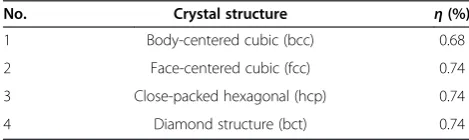
whereNis the overall number of atoms in the sphere.η is the atomic packing factor and can be determined by calculating the volume of the overall atoms in a unit cell Vatoms, and dividing this by the volume of the unit cell Vcell as follows, η¼VVatomscell . The values of ηare listed in Table1.
In the above process, the energy of the outside particle
would increase by an amountΔW, including the surface
energyW1 induced by the bond cleavage of the surface
atoms and the lattice distortion energy W2 induced by
the compression, due to the surface tension of the out-side particle. This is summarized by
ΔW ¼W1þW2 ð3Þ
According to thermodynamics, the surface energy of the outside particle is equivalent to the increase of the
Gibbs free energy. Therefore, the surface energyW1can
be calculated from σ⋅ΔS. ΔS is the surface area of the outside particle andσis the surface tension. That is
W1¼σ⋅ΔS¼σ⋅4π⋅R2¼σ⋅N⋅4π⋅r02⋅r0 R⋅
ρ0 ρR⋅
1 η ð4Þ
In addition, the lattice distortion energy W2 can be
calculated by considering the area change of one atom, namely Nσ(4πr02−4πr2), where N is the overall number of atoms in the particle. This can be expressed by
W2¼N⋅σ⋅ 4π⋅r02−4π⋅r2
¼N⋅σ⋅4π⋅r02 1− r r0
2
" #
ð5Þ
Combining Equations 4 and 5, Equation 3 becomes
ΔW W0 ¼
r0 R⋅
ρ0 ρR
⋅1η− ρ0 ρR
2 3
þ1 ð6Þ
whereW0is defined asW0=N ⋅ σ ⋅ 4 ⋅ π ⋅ r02, referring to the overall bond energy or the standard cohesive energy of the spherical particle in the perfect crystal.
We define the termΔW/W0in Equation 6 as the energy
variation rate of a nanoscale system. Thus, Equation 6 represents a size-dependent expression of the energy
of the nanoparticle. Because ΔW/W0 is based on the
bond energy, which intrinsically influences the macro-scopic thermodynamic and mechanical properties of
[image:2.595.60.540.90.236.2]crystal materials, it is reasonable that ΔW/W0is used
Figure 1A perfect crystal (A) and a nanoparticle taken out of it (B). (A)All the atoms are located at their equilibrium lattice positions. The atomic radius isr0and the density isρ0.(B)The particle radius is compressed fromR0toR, the average gyration radius reduces tor, and the
[image:2.595.55.290.663.733.2]average density increases toρR.
Table 1 The values of the atomic packing factor (η)for different crystal structures
No. Crystal structure η(%)
1 Body-centered cubic (bcc) 0.68
2 Face-centered cubic (fcc) 0.74
3 Close-packed hexagonal (hcp) 0.74
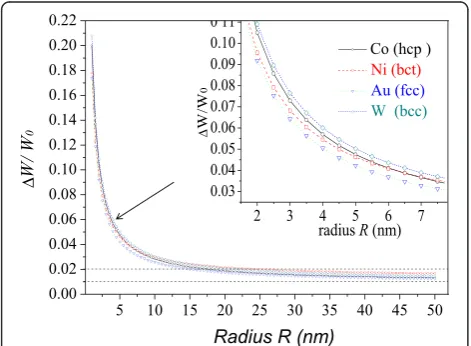
2.2% for Co, 2.43% for Ni, 2.03% for Au, and 2.39% for W, respectively, for radii around 15 nm. Sharp increases occur for radii less than 5 nm. The rates of change of energy for Co, Ni, Au, and W are 10.5%, 9.56%, 9.18%, and 10.9%, respectively, for radii around 2 nm.
Based on the principle of conservation of energy, the change of energy of the spherical particle is equal to the increase of the Gibbs free energy and the decrease of the cohesive energy when the spherical particle is removed from the perfect crystal. Therefore Equation 6 can be written as
ΔW W0 ¼
ΔE E0 ¼
ΔG G0 ¼
r0 R⋅
ρ0 ρR⋅
1 η−
ρ0 ρR
2 3
þ1 ð7Þ
where ΔE and E0 are the variational and standard cohesive energy of the nanomaterial, respectively. ΔG andG0are the variational and standard Gibbs free energy, respectively, for a given value ofΔ.
By using thermodynamic investigations, molecular dynamics simulations, and experimental methods, consid-erable research has been carried out in order to investi-gate the thermodynamic and mechanical properties of
ΔW W0 ¼
ΔE E0 ¼
ΔG G0 ¼
ΔTm
Tm0
¼ΔQd
Qd0
¼ΔC−1m
C−1m0
¼ΔLs
Ls0
¼ΔΘD2 ΘD02
¼ΔY
Y0 ð
8Þ
Combining Equations 7 and 8, this general expression can be simplified to give
ΔX Rð Þ X0 ¼
r0 R⋅
ρ0 ρR
⋅1η− ρ0 ρR
2 3
þ1 ð9Þ
where, ΔX and X0 are the variational and standard thermodynamic and mechanical parameters, as determined by the bond energy, respectively.
Discussion
In Figure 3A, our model (Equation 9) is compared to the result of a molecular dynamics simulation and other models, illustrated using the melting points of copper (Cu) nanoparticles. The best agreement is obtained be-tween our model and the results of molecular dynamics simulation, as the particle radius is increased from 1.08 to 9.10 nm. Other models apparently underestimate the melting points of the copper nanoparticles. The ratio ofT(R)/Tmin our model is slightly higher than the molecu-lar dynamics simulation results, where the size-dependent melting points are lower than those of the experimental
data [7]. Figure 3B shows a comparison of the Young’s
modulus of copper nanoparticles obtained using Equation 9, with experimental results. Our model predicts the experi-mental data quite well.
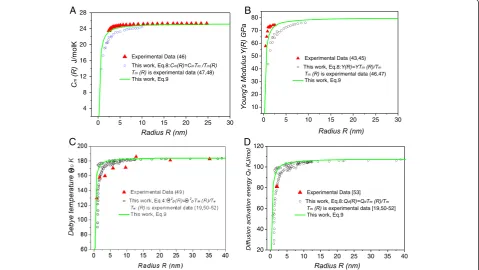
Equations 8 and 9 reveal the essential relationships between the thermodynamic and mechanical properties of nanomaterials. With Equation 8, we can calculate the thermodynamic and mechanical parameters of nanoma-terials using data obtained from either experiments or thermodynamic models. The size dependence of the heat
capacity Cm and Young’s modulus Yfor Ag, the Debye
temperature ΘD and diffusion activation energy Qd for
[image:3.595.56.292.511.684.2]Au, calculated from Equation 8 using experimental melt-ing point dataTm,are plotted in Figure 4. The prediction of our model (Equation 9) and the experimental results
Figure 2The change of energy of Co, Ni, Au, and W as a function
of the radius of spherical particles.(r0Co= 0.1253 nm,σCo= 1.889 N/m;
r0Ni= 0.1246 nm,σNi= 1.823 N/m;r0Au= 0.1442 nm,σAu= 1.331 N/m;
are also plotted for comparison. Good agreement is ob-tained between them.
Conclusions
In summary, we have demonstrated the intrinsic inter-relations between the thermodynamic and mechanical properties of nanomaterials using our bond energy model and previous results to characterize aspects of
[image:4.595.61.539.89.225.2]the size effects on nanocrystalline materials. Equation 9 not only presents a new model to better describe the thermodynamic and mechanical properties of nanomater-ials, but also provides a new approach to obtain these pa-rameters from others without requiring the formulation and proof of new models. In other words, most of the thermodynamic and mechanical properties of nanomater-ials can be predicted by using either experimental data or
Figure 3Size dependence of (A) melting pointsT(R)/Tmand (B) Young’s modulus for Cu nanoparticles. (A)The solid lines denote
predictions from our model ofT(R)/Tmin terms of Equation 9, while the black triangles show the molecular dynamics simulation data. Other
models [41-43] are also plotted for comparison.(B)Agreement between predictions (solid lines) and experimental observations of the size dependence of the Young’s modulus for Cu particles [43-45]. Parameters are given asr0Cu= 0.1228 nm,σCu= 1.534 N/m,YCu= 128 GPa [39,40].
0 5 10 15 20 25 30 35 40 20
40 60 80 100 120
D
Diffusion activation energy Q
d
KJ/mol
Radius R (nm)
Experimental Data [53]
This work, Eq.8:Qd(R)=QdTm (R)/Tm
Tm (R) is experimental data [19,50-52] This work, Eq.9
0 5 10 15 20 25 30 4
8 12 16 20 24 28
A
C
m
(R)
J/mol
K
Radius R (nm)
Experimental Data (46)
This work, Eq.8:Cm(R)=CmTm /Tm(R)
Tm (R) is experimental data (47,48) This work, Eq.9
0 5 10 15 20 25 30 10
20 30 40 50 60 70 80
B
Experimental Data (43,45) This work, Eq.8:Y(R)=YTm (R)/Tm
Tm (R) is experimental data (46,47) This work, Eq.9
You
ng's Modulus
Y
(R)
GPa
Radius R (nm)
C
Figure 4Effects of size on the mechanical and thermodynamic properties of nanocrystalline materials.Size dependence of(A)heat capacityCm[46-48] and(B)Young’s modulusYfor Ag [43,45-47],(C)Debye temperatureΘD, [49,19,50-52] and(D)diffusion activation energyQd
for Au [53,19,50-52]. Solid lines refer to parameters calculated from Equation 9 (our model prediction). The white circle is plotted using Equation 4 and experimental data for the melting pointsTm. The solid triangles show the experimental data (r0Ag= 0.1444 nm,σAg= 1.998 N/m,CmAg= 25.36 J/mol · K,
[image:4.595.59.539.404.674.2]XH proposed the theoretical conception and drafted the manuscript. ZL participated in the theoretical design and helped to draft the manuscript. Both authors read and approved the final manuscript.
Acknowledgements
This work was financially supported by the Natural Science Foundation of China (no. 51165016).
Received: 24 May 2014 Accepted: 9 September 2014 Published: 21 September 2014
References
1. Gleite H:Nanocrystalline materials.Prog Mater Sci1989,33:223–315. 2. Edelstein AS, Murday JS, Rath BB:Challenges in nanomaterials design.
Prog Mater Sci1997,42:5–21.
3. Giebultowicz T:Nanothermodynamics: breathing life into an old model.
Nature2000,408:299–301.
4. Tong WP, Tao NR, Wang ZB, Lu J, Lu K:Nitriding iron at lower temperatures.Science2003,299:686–688.
5. Meyers MA, Mishra A, Benson DJ:Mechanical properties of nanocrystalline materials.Prog Mater Sci2006,51:427–556.
6. Sun CQ, Wang Y, Tay BK, Li S, Huang H, Zhang YB:Correlation between the melting point of a nanosolid and the cohesive energy of a surface atom.J Phys Chem B2002,106:10701–10705.
7. Delogu F:Structural and energetic properties of unsupported Cu nanoparticles from room temperature to the melting point: molecular dynamics simulations.Phys Rev B2005,72:205418.
8. Zhang Z, Li JC, Jiang Q:Size effect on the freezing temperature of lead particles.J Mater Sci Lett2000,19:1893–1895.
9. Guisbiers G, Buchaillot L:Modeling the melting enthalpy of nanomaterials.J Phys Chem C2009,113:3566–3568.
10. Zhu YF, Lian JS, Jiang Q:Modeling of the melting point, Debye temperature, thermal expansion coefficient, and the specific heat of nanostructured materials.J Phys Chem C2009,113:16896–16900. 11. Li YJ, Qi WH, Huang BY, Wang MP, Xiong SY:Modeling the
thermodynamic properties of bimetallic nanosolids.J Phys Chem Solids
2010,71:810–817.
12. Guisbiers G, Buchaillot L:Universal size/shape-dependent law for characteristic temperatures.Phys Lett A2009,374:305–308. 13. Guisbiers G:Size-dependent materials properties towards a universal
equation.Nanoscale Res Lett2010,5:1132–1136.
14. Guisbiers G:Review on the analytical models describing melting at the nanoscale.J Nanoscience Lett2012,2:8.
15. Ganguli D:Size effect in melting: a historical overview.T Indian Ceramsoc
2008,67:49–62.
16. Sadaiyandi K:Size dependent Debye temperature and mean square displacements of nanocrystalline Au, Ag and Al.Mater Chem Phys2009,
115:703–706.
17. Jasiukiewicza C, Karpusb V:Debye temperature of cubic crystals.Solid State Commun2003,128:167–169.
18. Qi WH, Wang MP, Xu GY:The particle size dependence of cohesive energy of metallic nanoparticles.Chem Phys Lett2003,372:632–634. 19. Safaei A:Shape, structural, and energetic effects on the cohesive energy
and melting point of nanocrystals.J Phys Chem C2010,114:13482–13496. 20. Jiang Q, Li JC, Chi BQ:Size-dependent cohesive energy of nanocrystals.
Chem Phys Lett2002,366:551–554.
molecular-dynamics simulation and Mössbauer study.Phys Rev B2000,
62:5117–5128.
27. Jiang Q, Ao ZM, Zheng WT:Temperature and size effects on the amplitude of atomic vibration of Co nanocrystals embedded in Ag matrix.Chem Phys Lett2007,439:102–104.
28. Gleiter H:Nanostructured materials: basic concepts and microstructure.
Acta Mater2000,48:1–29.
29. Zhao YH, Lu K:Grain-size dependence of thermal properties of nanocrystalline elemental selenium studied by X-ray diffraction.
Phys Rev B1997,56:14330–14337.
30. Yang CC, Xiao MX, Li W, Jiang Q:Size effects on Debye temperature, Einstein temperature, and volume thermal expansion coefficient of nanocrystals.Solid State Commun2006,139:148–152.
31. Rupp J, Birringer R:Enhanced specific-heat-capacity (cp) measurements (150–300 K) of nanometer-sized crystalline materials.Phys Rev B1987,
36:7888–7890.
32. Hellstern E, Fecht HJ, Fu Z, Johnson WL:Structural and thermodynamic properties of heavily mechanically deformed Ru and AlRu.J Appl Phys
1989,65:305–310.
33. Lucas M, Mai W, Yang R, Wang ZL, Riedo E:Aspect ratio dependence of the elastic properties of ZnO nanobelts.Nano Lett2007,7:1314–1317. 34. Kulkarni AJ, Zhou M, Ke FJ:Orientation and size dependence of the elastic properties of zinc oxide nanobelts.Nanotechnology2005,16:2749–2756. 35. Zhang LX, Huang HC:Young’s moduli of ZnO nanoplates: ab initio
determinations.Appl Phys Lett2006,89:183111.
36. Miller RE, Shenoy VB:Size-dependent elastic properties of nanosized structural elements.Nanotechnology2000,11:139–147.
37. Safaei A:Size-dependent mass density of nanocrystals.Nano2012,
71:250009.
38. Nanda KK:Size-dependent density of nanoparticles and nanostructured materials.Phys Lett A2012,376:3301–3302.
39. Warlimont M:Springer Handbook of Condensed Matter and Materials Data.
New York: Spinger Berlin Heidelberg; 2005.
40. Keene BJ:Review of data for the surface tension of pure metals.Int Mater Views1993,38:157–192.
41. Jing Q, Yang CC:Size effect on the phase stability of nanostructures.
Curr Nanoscience2008,4:179–200.
42. Guisbiers G, Kazan M, Overschelde OV, Wautelet M, Pereira S:Mechanical and thermal properties of metallic and semiconductive nanostructures.
J Phys Chem C2008,112:4097–4103.
43. Sun CQ, Tay BK, Zeng XT, Li S, Chen TP, Zhou J, Bai HL, Jiang EY:
Bond-order–bond-length–bond-strength (bond-OLS) correlation mechanism for the shape-and-size dependence of a nanosolid.
J Phys Cond Matter2002,14:7781–7795.
44. Streitz FH, Cammarata RC, Sieradzki K:Surface-stress effects on elastic properties. I. Thin metal films.Phys Rev B1994,49:10699–10706. 45. Wong EW, Sheehan PE, Lieber CM:Nanobeam mechanics: elasticity, strength,
and toughness of nanorods and nanotubes.Science1997,277:1971–1975. 46. Xiong SY, Qi WH, Cheng YJ, Huang BY, Wang MP, Li YJ:Universal relation
for size dependent thermodynamic properties of metallic nanoparticles.
Phys Chem Chem Phys2011,13:10652–10660.
47. Xiao SF, Hu WY, Yang JY:Melting temperature: from nanocrystalline to amorphous.J Chem Phys2006,125:184504.
48. Luo WH, Hu WY, Xiao SF:Size Effect on the thermodynamic properties of silver nanoparticles.J Phys Chem C2008,112:2359–2369.
50. Buffat P, Borel JP:Size effect on the melting temperature of gold particles.Phys Rev A1976,13:2287–2298.
51. Dick K, Dhanasekaran T, Zhang ZY, Meisel D:Size-dependent melting of silica-encapsulated gold nanoparticles.J Am Chem Soc2002,124:2312–2317. 52. Sambles JR:An electron microscope study of evaporating gold particles:
the Kelvin equation for liquid and the lowering of the melting point of solid gold particles.Proc R Soc London A1971,324:339–351.
53. Shibata T, Bunker BA, Zhang ZY, Meisel D, Vardeman CF, Gezelter JD:
Size-dependent spontaneous alloying of Au-Ag nanoparticles.J Am Chem Soc2002,124:11989–11996.
54. Edalati K, Horita Z:Correlations between hardness and atomic bond parameters of pure metals and semi-metals after processing by high-pressure torsion.Scr Mater2011,64:161–164.
doi:10.1186/1556-276X-9-516
Cite this article as:Yu and Zhan:The effects of the size of nanocrystalline materials on their thermodynamic and mechanical properties.Nanoscale Research Letters20149:516.
Submit your manuscript to a
journal and benefi t from:
7Convenient online submission
7Rigorous peer review
7Immediate publication on acceptance
7Open access: articles freely available online
7High visibility within the fi eld
7Retaining the copyright to your article