N A N O E X P R E S S
Open Access
Amorphous Vanadium Oxide Thin Films as
Stable Performing Cathodes of Lithium and
Sodium-Ion Batteries
Shaikshavali Petnikota
*†, Rodney Chua
†, Yang Zhou
†, Eldho Edison and Madhavi Srinivasan
Abstract
Herein, we report additive- and binder-free pristine amorphous vanadium oxide (a-VOx) for Li- and Na-ion battery application. Thin films of a-VOx with a thickness of about 650 nm are grown onto stainless steel substrate from crystalline V2O5target using pulsed laser deposition (PLD) technique. Under varying oxygen partial pressure (pO2) environment of 0, 6, 13 and 30 Pa, films bear O/V atomic ratios 0.76, 2.13, 2.25 and 2.0, respectively. The films
deposited at 6‑30 Pa have a more atomic percentage of V5+ than that of V4+ with a tendency of later state
increased as pO2 rises. Amorphous VOx films obtained at moderate pO2 levels are found superior to other
counterparts for cathode application in Li- and Na-ion batteries with reversible capacities as high as 300 and 164 mAh g−1 at 0.1 C current rate, respectively. At the end of the 100th cycle, 90% capacity retention is
noticed in both cases. The observed cycling trend suggests that more is the (V5+) stoichiometric nature of
a-VOx better is the electrochemistry.
Keywords: Amorphous vanadium oxide, PLD, Thin films, Cathode, Li- and Na-ion batteries
Introduction
Amorphous vanadium oxides (a-VOx) are becoming in-creasingly popular for the application of electronic de-vices [1, 2], secondary lithium and post-lithium-ion batteries [3–13]. Compared to crystalline counterparts, a-VOx could offer shorter diffusion paths and, in turn, easy lithiation kinetics that facilitates achieving theoret-ical capacities in practtheoret-ical conditions. Crystalline oxides such as V2O5possess the theoretical capacity of lithium
intake up to 441 mAh g−1(1 C). In practice, this theoret-ical capacity accounts for 3 mol of Li that needs to be discharged to 1.5 V. But the formation of irreversible ω-LixV2O5 phase when discharged below 1.9 V limits
the reversible capacity to 2 mol of Li only [8]. For this reason, crystalline V2O5must be cycled within a voltage
window of 4.0–2.0 V that corresponds to theoretical capacity 292 mAh g−1. Hence, despite the huge theoret-ical capacity, crystalline vanadium oxides exhibit lower
experimental capacities. In this context, a-VOx materials emerged as high capacity cathodes that are free from ir-reversible phase formations and thus overcoming the operating voltage constraint [5, 8]. For example, sol-gel synthesised amorphous V2O5·xH2O (x= 2–2.3) exhibited
a high reversible capacity of 410 mAh g−1 at a C/8 current rate [14]. In a recent report, electrodeposited a-VOx film as a cathode of Na-ion battery (SIB) per-formed better than their crystalline counterpart with double the capacity (241 mAh g−1) [10]. However, in these two cases, cycling stability is not good. In the late 1990s, Zhang et al. and McGraw et al. reported a-VOx films prepared by pulsed laser deposition (PLD) with specific capacity of 346 mAh g−1 at 100th cycle in the voltage range of 1.5–4.1 V and at a current rate of 0.1 mA cm−2[3,4]. However, in these cases, the collect-ive contribution of the conductcollect-ive SnO2substrate that is
electrochemically active to the high capacity remains un-known. The film of a-VOx about 450 nm thick prepared by atomic layer chemical vapour deposition (ALCVD) touted good cycling stability at 0.1 C rate with reversible capacity of 275 mAh g−1 at the end of the 100th cycle [6]. A 30-nm-thick a-VOx film grown by ALD exhibited * Correspondence:[email protected];[email protected]
†Shaikshavali Petnikota, Rodney Chua and Yang Zhou contributed equally to
this work.
School of Materials Science and Engineering, Nanyang Technological University, Singapore 639798, Singapore
superior cycling performance than afore-discussed amorphous materials with a 100th cycle capacity of 330 mAh g−1at 1 C rate in-between 1.5 and 4.0 V [7]. Similar cycling behaviour was noticed for quasi-amorph-ous VOx films deposited by ALD with a capacity around 60 mAh g−1 at 1 C rate in the voltage range of 2.75– 3.8 V [14]. In a recent study, a-VOx electrochemically deposited onto graphite paper as a cathode for sodium-ion battery showed superior cyclability than the crystalline counterpart at lower specific currents in the range of 80–320 mA g−1 [11]. Therefore, amorphous vanadium oxides are superior to the crystalline counter-part for the electrochemical energy storage applications. However, to the best of our knowledge, there is no com-prehensive study regarding the cathodic functioning of pristine a-VOx that extensively correlates the perform-ance with key fundamental properties such as the extent of amorphization, stoichiometry and oxygen to van-adium coordination. Such a study was initiated by Julien et al. in 1999 to get amorphous V2O5thin films by PLD
at pO2 ~ 13.33 and 19.995 Pa and at a substrate
temperature of 300 °C that is too high to get the amorphous phase [15]. At this temperature, amorphous V2O5phase formation is not likely possible as it is well
above 200 °C which is widely agreed minimum temperature limit to get the crystalline phase [16–21]. The detailed elemental and chemical (XPS) composition analysis of the so claimed amorphous V2O5phase needs
to be studied. The presented lithiation electrochemistry of V2O5 deposited at 300 °C on glass or silicon
sub-strates confirms that films were indeed crystalline by visualizing clear long-lasting (~ 35 h) Li-intercalation plateaus around 2.6 V. In addition, presented electro-chemistry measured over perfect insulating natured Si and glass (including V2O5 film) substrates without
proper current collector pose ambiguity in considering it to compare with other similar works. However, in com-parison to the present PLD a-VOx study, there was no lithiation or sodiation electrochemistry of the amorph-ous phase was discussed. Hence, we opted to study pulsed laser-deposited a-VOx films grown at different oxygen partial pressures (pO2) for lithium-ion and
sodium-ion battery applications.
Physical and chemical nature of the PLD films can be easily tailored by controlling the reactive oxygen gas. A systematic study of such controlling parameters and the consequences on the final property are in due to report. Such a study is very important for exploring the funda-mental aspects as a function of varying oxygen stoichi-ometry. Pulsed laser deposition is one of the best ways to study the fundamental electrochemical properties of a-VOx in their pristine state. Additionally, there is no need for additives such as carbon and binder. Further-more, chemical impurities like water molecules occupied
lattice sites or surface hydroxyls that emerge during wet chemical synthesis process could be avoided through PLD. Moreover, the chemical impurities could cause consider-able capacity loss or pose ambiguity in exact electrochem-ical characteristics. For example, electrodeposited a-VOx·nH2O [10], a-V2O5 [11] and melt-quenched
V2O5·nH2O xero-gel [22] compounds as cathodes of SIBs
exhibited totally different and asymmetric sodium inser-tion and deserinser-tion features than in the present study. Moreover, a-VOx·nH2O [10] and V2O5·nH2O [22]
com-pounds delivered high initial capacities that rapidly decayed to the stable capacities obtained throughout the cycling in the present study. Such a rapid decay in capacity might plausibly arise from the interaction of hydroxyl spe-cies with Na-ions and/or with electrolyte molecules to form irreversible covalent compounds. Therefore, in this present study, a-VOx films prepared by PLD are investi-gated for their physical and chemical properties in correl-ation with lithicorrel-ation and sodicorrel-ation electrochemistry. The obtained results are compared with available literature as well as with commercial V2O5 bulk powder whose
elec-trodes were made by adding carbon and binder.
Methods
Thin Film Deposition
Vanadium oxide films were deposited using crystalline V2O5as a target by PLD. High-energy KrF excimer laser
(λ= 248 nm) was focused on the surface of V2O5target,
with a power of ~ 200 mJ and repetition of 5 Hz. Amorph-ous VOx films were grown on 304-grade stainless steel (SS) substrate preheated to 100 °C and under different oxygen partial pressures (pO2). The substrate-target
dis-tance was kept at ~ 5 cm. The deposition was carried out under a high vacuum of 0.6 × 10⁻⁵mbar at first, and then oxygen gas was introduced equivalent to pO2~ 6, 13 and
30 Pa. Each film was deposited for 44 min that resulted in approximately 650 nm thickness. For forthcoming discus-sion, these four types of films are abbreviated as a-VOx-0 Pa, a-VOx-6 Pa, a-VOx-13 Pa and a-VOx-30 Pa.
Characterization
High-resolution survey spectra were analysed with Casa XPS software package.
Electrochemical Characterization
As-deposited films were used as cathodes to fabricate coin cells CR2016 with Li and Na metal as the counter electrodes. Whatman glass microfiber filter paper was used as the separator. One molar LiPF6in ethylene
car-bonate (EC) and diethyl carcar-bonate (DEC) (1:1 by vol-ume) was used as the electrolyte for Li-ion batteries (LIBs). One molar NaClO4in propylene carbonate (PC)
with 5% fluoroethylene carbonate (FEC) was used as electrolyte to fabricate SIBs. Coin cell fabrication was carried out inside a glove box filled with Ar gas where moisture and oxygen levels strictly limited to less than 0.1 ppm.
Battery testing was carried out at room temperature after 8 h of relaxation. The cyclic voltammetry (CV) measurements for both LIBs and SIBs were carried out in the voltage range of 1.5–4.0 V at a scan rate of 0.1 mV s−1 using SOLARTRON 1470E equipment. The galvanostatic charge-discharge (GC) tests were carried out in the same voltage range as in the case of CV mea-surements and at a current rate of 0.1 to 10.0 C using NEWARE battery test system. Here, 1 C = 294 and 441 mA g−1for voltage windows 2.0–4.0 and 1.5–4.0 V, respectively, for LIBs. In case of SIBs, 1 C = 236 mA g−1 for a voltage range of 1.5–4.0 V. Electrochemical imped-ance spectroscopy (EIS) measurements were carried out in the frequency range of 100,000–0.01 Hz and with a voltage amplitude of 10 mV using Frequency Response Analyser, Solartron Analytical 1400 CellTest System.
Results and Discussion
Physical and Chemical Characterization
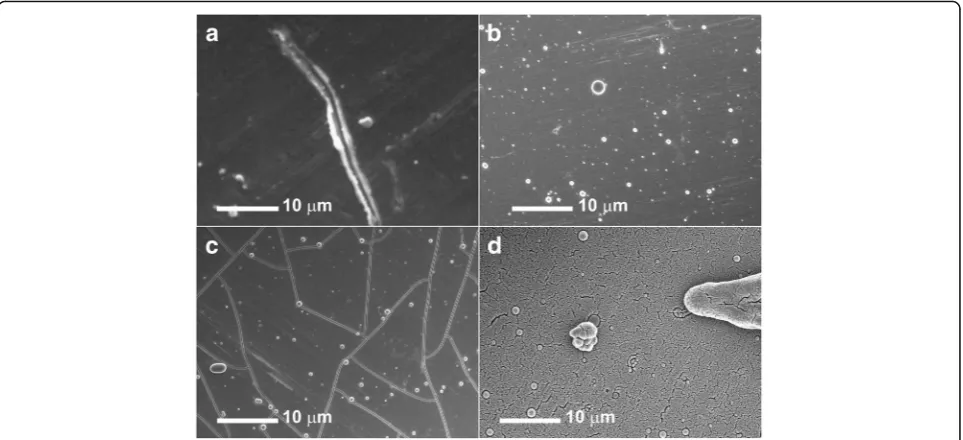
Physical morphology of the as-deposited films observed under FESEM is as shown in Fig. 1. Film a-VOx-0 Pa (Fig. 1a) is smooth and continuous but resembled bare stainless steel substrate (Additional file 1: Figure S11) possessing trenches on the surface. In Fig. 1b, a-VOx-6 Pa film is also found to be continuous but with lots of accumulated spherical particulates. Similar fea-tures are observed in the case of a-VOx-13 Pa film (Fig. 1c) but is totally different from the other two films by having large grain boundaries several tens of microns in size. In common, these three films are highly trans-parent to electron beam as scratch marks on bare stain-less steel are clearly discernable. In contrast to these three films, a-VOx-30 Pa is opaque and non-continuous (Fig. 1d). It possesses very small submicron-sized grain boundaries and very large randomly shaped particulates at the order of 10μm in length. In typical PLD system, high-energy laser strikes on the surface of the target and causes the evaporation of the target materials, which forms the active plume (i.e. the mixture of energetic spe-cies such as atoms, molecules, electrons and ions) and then the growth of thin films on the substrates. During deposition, pO2highly affects the collision and reaction
[image:3.595.58.540.88.308.2]Fig. 1Field emission scanning electron micrographs of a-VOx films deposited at pO2(a) 0 Pa, (b) 6 Pa, (c) 13 Pa and (d) 30 Pa
Table 1Elemental composition of a-VOx films
Film O (At%) V (At%) O/V ratio
a-VOx-0 Pa 43.1 56.9 0.757
a-VOx-6 Pa 68.1 31.9 2.135
a-VOx-13 Pa 69.2 30.8 2.247
[image:3.595.305.540.661.732.2]between the plume and the oxygen atoms, and thus the shape and size of the plume. Therefore, the growth mode, deposition rate and the homogeneity of the thin film depend on pO2 [23, 24]. In general, higher pO2
leads to attenuation and slowing of the plume, resulting in larger grain size and rougher film [25]. In our case, when pO2is fixed at 30 Pa, the roughness of the VOx
film is too large (non-reflective) and some of the grains are isolated, and hence, the film featured opaque and non-continuous topography. The elemental composi-tions of a-VOx films obtained by EDAX technique are enumerated in Table 1. Film deposition under vacuum resulted in very poor O/V atomic ratio, and for this rea-son, a-VOx-0 Pa film was omitted from further analysis. Next, the O/V ratio is increased to 2.135 with the
introduction of oxygen into the deposition chamber that is equivalent to 6 Pa. As shown in Table 1, there is no significant increase in the O/V ratio even after doubling oxygen to 13 Pa. Further increase in oxygen to a very high level of 30 Pa lowered the O/V ratio to 2.003. The unchanged or decreased O/V ratio might have plausibly taken place from a change in the transport property such as reduction in mean free path (λ) of the oxygen species with increasing pO2(λ α1/pO2) [26].
XRD patterns of all the films are similar and contained peaks corresponding to stainless steel only as shown in Additional file 1: Figure S12. This clearly confirms that all the films are solely amorphous. AFM surface topog-raphy of a-VOx films as shown in Fig.2is well comply-ing with the physical morphology observed in electron Fig. 2AFM surface topography of a-VOx-6 Pa (a), a-VOx-13 Pa (b) and a-VOx-30 Pa (c)
[image:4.595.59.541.88.233.2] [image:4.595.60.539.453.716.2]micrographs (Fig. 1). Films a-VOx-6 Pa (Fig. 2a) and a-VOx-13 Pa (Fig. 2b) bear similar surface features and smooth in accordance with their respective elec-tron micrographs. On the other hand, the surface of a-VOx-30 Pa (Fig. 2c) film is very rough and uneven in contrast to the other two films. Measured average roughness over a 3 × 3 μm scanning is found to be ~ 8.6, ~ 9.2 and ~ 24 nm for a-VOx-6 Pa, a-VOx-13 Pa and a-VOx-30 Pa films, respectively. Therefore, an increase in oxygen partial pressure not only increases the surface roughness but also induces a change in morphology as observed in the FESEM micrographs.
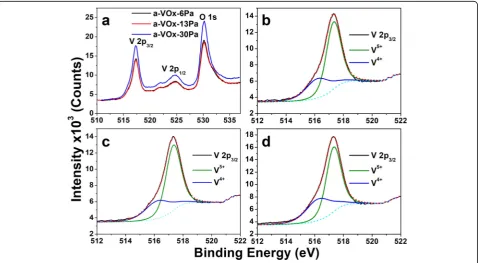
High-resolution XPS spectra of a-VOx-6, a-VOx-13 and a-VOx-30 Pa films that comprised of characteris-tic V 2p doublet and O 1s core level peaks are shown in Fig. 3. The features and positions of each peak superimpose on each other in the three cases with
slight variation in intensity counts. The peaks of V2p3/2, V2p1/3 and O 1s are found to be centred at
517.30, 524.8 and 530.2 eV, respectively, and are in good agreement with the reported work [6, 10, 11]. Among the three films, a-VOx-30 Pa film possesses slightly higher mass than the other two, and hence, its spectrum showed higher intensity counts (Fig. 3a. Films a-VOx-6 Pa and a-VOx-13 Pa have shown the same intensity counts that is in strong agreement with nearly equal V/O atomic ratio observed in EDAX findings. A close examination of V2p3/2
re-gion revealed a substantial difference in these three films as listed in Table 2. Each V 2p3/2 spectrum is
further deconvoluted into two peaks corresponding to V5+ (green) and V4+ (blue) oxidation states (Fig. 3b–d). In all three cases, At% of V5+ (~ 68– 64%) is found greater than V4+ (~ 32–36%). As listed in Table 2, At% of V5+ continuously decreased with increasing pO2. At% of V5+ is noticed to decrease
about 0.35% and 4.7% when pO2 increased from 6 to
13 Pa and 6 to 30 Pa, respectively. The changing trend in At% of V4+ is found exact opposite and equal to V5+ oxidation state. Therefore, higher pO2
[image:5.595.57.290.99.197.2]environment say above 13 Pa seems to create more V4+ state, i.e. more oxygen deficiency. These ob-served changes in At% are well consistent with O/V atomic ratio variations noticed in EDAX analysis. Thus, overall XPS analysis is well complementing with the EDAX inferences.
Table 2XPS analysis of V 2p3/2in a-VOx thin films
Name Oxidation state Position (eV) FWHM (eV) At% a-VOx-6 Pa V5+2p3/2 517.31 1.21 68.35
V4+2p3/2 516.20 1.98 31.65
a-VOx-13 Pa V5+2p3/2 517.32 1.22 68.00
V4+2p3/2 516.23 2.10 32.00
a-VOx-30 Pa V5+2p3/2 517.31 1.21 63.65
V4+2p3/2 516.27 2.08 36.35
[image:5.595.58.540.444.717.2]Electrochemical Characterization
Li-Ion Battery Results
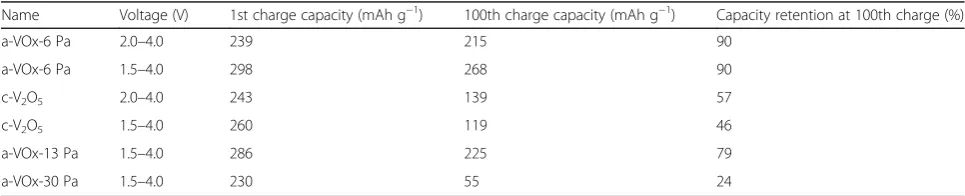
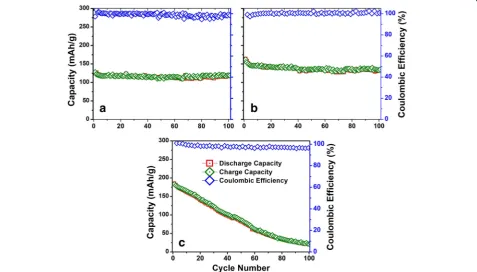
The LIB test results of as-deposited a-VOx-6 Pa, a-VOx-13 Pa and a-VOx-30 Pa films are shown in Fig.4 and Additional file1: Figure S13. Amongst the three, the a-VOx-6 Pa films demonstrated excellent performance with high reversible capacities and stable cycling in both voltage windows 2.0–4.0 and 1.5–4.0 V. The CV charac-teristics of a-VOx-6 Pa resembled pseudocapacitive behav-iour in both voltage windows (Fig. 4a, c). Fast faradaic reactions due to lithium’s surface adsorption and desorp-tion process are mainly responsible for the pseudocapaci-tive behaviour [10]. Here, irreversible current peaks observed up to the fifth cycle are mainly originated from the stainless steel substrate (Additional file1: Figure S14) with least contribution from electrolyte decomposition that leads to solid electrolyte interphase (SEI) formation. Li-ion (de)intercalation signatures are totally absent when compared to bulk crystalline V2O5 as shown in
[image:6.595.58.538.88.344.2]Additional file1: Figure S15. The absence of the intercal-ation features confirms the complete amorphous nature in tune with the XRD inferences. The observed GC charge-discharge profiles obtained after mitigating substrate effect (Fig.4b, d) are consistent with CV results. A small char-ging capacity plateau around 4 V is evolved and disap-peared when cycled in-between 2.0 and 4.0 V (Fig.4b) as a consequence of continuous modifications of vanadium local environment to acquire more symmetry for lithiation [5]. This plateau became much smaller for 1.5–4.0 V cycling, but midpoint of capacity curves shifted towards higher voltage which is an indication for increased ionicity of the matrix. Such increase in ionicity might originate from vanadium reduction to V(III) in addition to local vanadium-oxygen coordination changes, i.e. further amorphisation [5, 27–29]. Overall charge-discharge features of a-VOx-6 Pa are similar to other a-VOx materials synthesised by different routes in other works as referred in the present work. During Fig. 5Li-ion battery cyclic performance of a-VOx-6 Pa (a,b) in comparison with bulk c-V2O5(c,d) in the voltage windows 2.0–4.0 V (a,c) and 1.5–4.0 V (b,d)
Table 3Li-ion battery cycling performance of a-VOx films and c-V2O5at the 0.1 C current rate
Name Voltage (V) 1st charge capacity (mAh g−1) 100th charge capacity (mAh g−1) Capacity retention at 100th charge (%)
a-VOx-6 Pa 2.0–4.0 239 215 90
a-VOx-6 Pa 1.5–4.0 298 268 90
c-V2O5 2.0–4.0 243 139 57
c-V2O5 1.5–4.0 260 119 46
a-VOx-13 Pa 1.5–4.0 286 225 79
[image:6.595.56.539.633.731.2]the first cycle at 0.1 C rate, a-VOx-6 Pa showed high reversible capacities of 239 and 298 mAh g−1in volt-age windows 2.0–4.0 and 1.5–4.0 V, respectively. At the end of the 100th cycle, nearly 90% of capacity re-tention is noticed in both the voltage windows (Fig.5a, b) as mentioned in Table 3. A 100% Coulombic effi-ciency is observed throughout the 1.5–4.0 V window cycling whereas it slightly fluctuated around 100% in
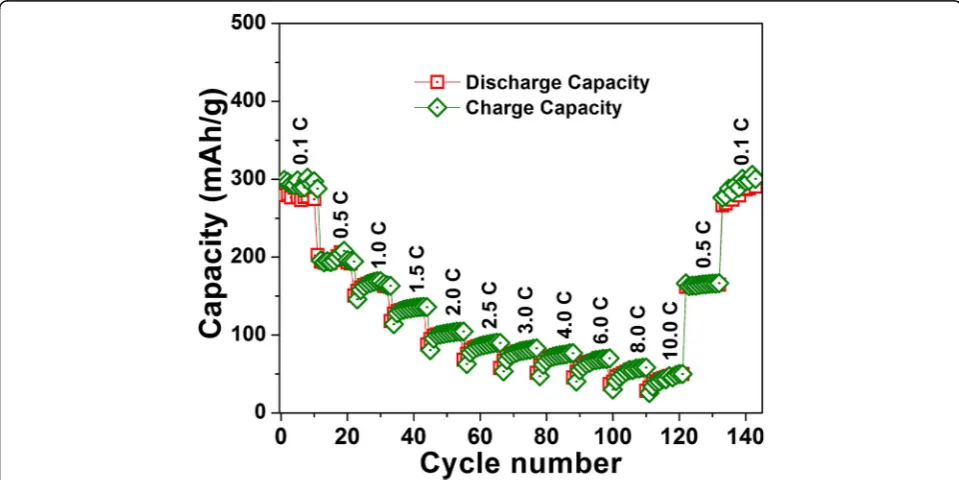
case of 2.0–4.0 V window as a result of continuous changes to the local vanadium-oxygen environment [5]. Further, it has shown good rate capability as shown in Fig. 6 with capacities ranging from 300 to 50 mAh g−1 at 0.1 and 10.0 C current rates, respect-ively. At 1.0 and 10.0 C, it delivered capacities more than 150 and 40 mAh g−1, respectively. The observed cycling is far better than the commercial crystalline
[image:7.595.56.540.100.323.2]Fig. 6Li-ion battery rate performance of a-VOx-6 Pa
Table 4Li-ion battery performance comparison of a-VOx-6 Pa films with other its class of materials
Reference Film thickness (nm)
Current rate Voltage range (V)
Capacity (mAh g−1) Remarks Cycle 1 Cycle 100
Li-ion battery
a-VOx-6 Pa 650 0.1 C 2.0–4.0 239 215
a-VOx-6 Pa 650 0.1 C 1.5–4.0 298 268
1 310 0.1 mA cm−2 1.5–4.1 390* 346 SnO
2substrate
150 2.0–4.1 240* 193
2# – 0.2 C 1.8–4.1 330* 240*
4 450 0.1 C 1.5–4.0 290* 275 ALCVD
5 30 1.0 C 1.5–4.0 356 310* ALD
7 3.5 1.0 C 2.75–3.0 65 – ALD
Na-ion battery
a-VOx-6 Pa 650 0.1 C 1.5–4.0 128 118
a-VOx-13 Pa 650 0.1 C 1.5–4.0 162 136
8 – 0.1 C 1.5–3.8 216 140* Electrodeposition
9 – 0.17 C 1.0–4.0 220* –
#
Plasma enhanced CVD (PECVD)
*Values deduced from images unless otherwise clearly claimed by authors
[image:7.595.57.537.473.713.2]V2O5 powder that was tested in a conventional way
(Fig.5c, d); it retained only 38–57% of initial capacity in both the voltage windows. During galvanostatic cyc-ling in the 1.5–4.0 V potential window, a-VOx-6 Pa showed ~ 15% more capacity than crystalline V2O5
during the first cycle and that difference goes up to 63% at the cycling termination. Furthermore, its performance is found to be superior to some of the re-ported PLD a-VOx films deposited on the electro-chemically active SnO2 substrate as listed in Table 4.
SnO2 is a well-known anode material for LIBs and
could deliver a capacity around 150 mAh g−1 in-between 1.5 and 3.0 V at a current rate of 100 mA g−1[30,31]. The performance of a-VOx-6 Pa is comparable even with the advanced ALD films (3.5 nm) at 1 C as shown in rate capability test (Fig.6). But its performance is found slightly inferior to other
CVD and ALD films. In PLD, very harsh ambient con-ditions might lead to poor quality V-O coordination when compared with CVD or ALD methods in which slow and steady low-temperature deposition condi-tions may generate high-quality V-O coordinacondi-tions. Nevertheless, the overall performance of a-VOx-6 Pa is well superior to c-V2O5 bulk powder and reported
PLD a-VOx films. The performance of a-VOx films can be best suitable for space constraint and limited capacity requirement applications and comparable to latest Li-S batteries [32–37] vowing to their unique advantages such as no requirement of binder, carbon additive, simple preparation and promising scope to in-corporate them into all solid-state batteries. Further-more, a-VOx films are free from capacity loses due to irreversible compound formation such as solid electro-lyte interface and polysulfide ring structures [32–37].
[image:8.595.57.539.317.714.2]Na-Ion Battery Results
Sodium-ion battery characteristics of a-VOx films are shown in Fig.7. The GC and CV profile features are found in accordance with each other. Especially CV profiles showed profound pseudocapacitance features with a larger area under the curves than the LIB profiles. Here, no stainless steel peaks appeared, unlike the LIBs case. Out of the three films, a-VOx-30 Pa showed a continuous de-crease in CV current whilst the other two stabilized from the fifth cycle onward. Even after the 100th cycle, the simi-lar trend continued as shown in Additional file 1: Figure SI6. The continuous decrease in CV current together with the change of charge-discharge midpoint to a higher volt-age is a combined evidence for continuous amorphization of a-VOx-30 Pa film [5, 27–29]. The GC profiles of the three cases are found to be similar, but their charge-dis-charge crossover points are slightly higher than the respective LIB counterparts. The continuous sloped charge-discharge curve features are the consequence of pseudocapacitance behaviour that originates from fast faradaic surface reactions occurring at cavities and
disorders in the cathode matrix [10]. The initial capacities as enumerated in Table5 are noted to increase with in-creasing pO2. We speculate that this effect might plausibly
arise from increased porosity like increased surface rough-ness observed in the AFM and FESEM analyses that in-take more sodium. The absence of such increasing capacity trend in LIBs cycling suggests the type of cavities and porous environment formed best suits for Na-ion in-sertion with current electrolyte selection. It seems that more porosity leads to a high extent surface adsorption-desorption of sodium, i.e. occurring of very fast faradaic reactions as seen in Fig.7f. Here, CV curves formed an al-most rectangular profile which is very close to a pure elec-tric double-layer capacitor nature [38]. This increased porosity effect is advantageous for only the initial few cy-cles as capacity continuously faded over the course of cyc-ling as shown in Fig. 7e and Fig. 8c. Continuous SEI formation due to high oxygen-deficient (>V4+) environ-ment might be one of the many reasons to the observed capacity fading that imposes more and more insulating nature to electrode matrix, i.e. losing electrical contacts
[image:9.595.56.542.99.155.2]Fig. 8Na-ion battery cycling performance of (a) a-VOx-6 Pa, (b) a-VOx-13 Pa and (c) a-VOx-30 Pa films at 0.1 C Table 5Na-ion battery cycling performance of a-VOx films and at 0.1 C current rate
Name Voltage (V) 1st charge capacity (mAh g−1) 100th charge capacity (mAh g−1) Capacity retention at 100th charge (%)
a-VOx-6 Pa 1.5–4.0 128 118 92
a-VOx-13 Pa 1.5–4.0 162 136 84
[image:9.595.60.538.440.712.2]with the current collector. On the other hand, films de-posited below pO2~ 13 Pa exhibited good cycling stability
with Coulombic efficiencies fluctuated around 100% as shown in Fig.8a, b vowing to good V-O coordination as observed in EDAX and XPS analysis. Among these two films, a-VOx-6 Pa showed excellent cycling stability with 90% capacity retention at the end of the 100th cycle even though its capacity is lesser than a-VOx-13 Pa. The depos-ition at pO2~ 13 Pa seems to be good for practical
appli-cation as it enabled the film to deliver a reversible capacity of 162 mAh g−1that can be retained up to 84% at the end of testing. To compare with present investigation findings, there are very few reports available on pristine a-VOx for sodium-ion storage as listed in Table4. For example, elec-trodeposited a-VOx exhibited high capacity of 216 mAh g−1 at 1st and that increased to 241 mAh g−1 at 2nd cycle from where it faded continuously to 140 mAh g−1 at 100th cycle. This inferior cycling behaviour might have
resulted from the presence of 12 wt% residual water moi-eties even after annealing in vacuum. Compared to this case, a-VOx-13 Pa showed far better cycling stability being free from water molecules. In another similar report, a-VOx electrodeposited on graphite paper exhibited a cap-acity of 220 mAh g−1 during first discharge to 1.0 V. When compared to 1.5 V cutoff, it could deliver about 150 mAh g−1capacity that is comparable to a-VOx-13 Pa. In addition, information about the effect of water species that was left either in a-VOx or in graphite substrate was not mentioned. Hence, electrochemistry of PLD a-VOx films is found to be unique and superior to other their kind of materials.
Electrochemical Impedance Spectroscopy Analysis
[image:10.595.59.541.87.262.2]Lithiation and sodiation kinetics and impedance charac-teristics of a-Vox films are obtained at open circuit voltage (OCV), discharged to 1.5 V and charged to 4.0 V
Fig. 10Na-ion battery impedance analysis of a-VOx films deposited at pO2 (a) 6 Pa, (b) 13 Pa and (c) 30 Pa
[image:10.595.58.540.525.719.2]conditions. The EIS results plotted as Nyquist plots are shown in Fig. 9 for LIBs and Fig. 10 for SIBs. The values of various circuit elements shown in the corresponding equivalent circuits are furnished in Table 6 for LIBs and Table 7 for SIBs. The circuits shown contain electrolyte-electrode contact resistance Re, resistance due to surface film formation Rsf,
resist-ance to charge transfer Rct, bulk (substrate) resistance
Rb, capacitance components due to surface film
for-mation CPEsf, double layer of charge formation CPEdl,
bulk phase CPEb and ionic intercalation Ci [31, 39–
44]. In case of LIBs cycling, Rsf and Rct values varied
as 13 Pa < 30 Pa < 6 Pa whilst CPEdl value varied as
30 Pa < 6 Pa < 13 Pa. The very low CPEdl values and
2.5-fold decrease in Ci (after the first charge) of
a-VOx-30 Pa can explain its inferior and rapidly decaying capacity values. In all three cases, Rb is
found greater than Rct that indicates lithiation by fast
faradaic surface reactions whose rate seems to be slow down with increasing pO2 as the difference
be-tween Rb and Rct is decreasing [40, 42]. The
decreas-ing Rsf, consistent Rct and very large difference
between Rb and Rct, i.e. very fast lithiation reactions
of a-VOx-6 Pa, enabled it to outperform the other two films. On the other hand, during the SIBs cyc-ling, Rct values varied randomly, but a-VOx-13 Pa
film has lower values than the other two films. Fur-ther, it possesses similar and consistent Rct, Rb, CPEdl,
CPEb and Ci during the first discharge and charge.
Thus, a-VOx-13 Pa film achieved superior capacity stable cycling performance than the other two films. Therefore, the overall impedance analysis is in good agreement with the cycling features.
Conclusions
We successfully investigated the electrochemical prop-erties of pristine a-VOx films as cathodes in Li- and Na-ion batteries. The growth of a-VOx thin films by PLD as a function of varying pO2 is probed
systemat-ically with a multitude of characterization techniques. At selected pO2 of 0, 6, 13 and 30 Pa, O/V atomic
ratios of the films were found to be 0.76, 2.13, 2.25 and 2.0, respectively. Vanadium in the films a-VOx-6, a-VOx-13 and a-VOx-30 Pa is found in 5+ and 4+ oxidation states with a tendency of later state in-creased as pO2 rises. Amorphous VOx films obtained
at pO2 ~ 6 and 13 Pa found superior to other
[image:11.595.57.539.98.239.2]coun-terparts for cathode application in Li- and Na-ion batteries with reversible capacities as high as 300 and 164 mAh g−1 at 0.1 C current rate, respectively. High Coulombic efficiencies around 100% are noticed throughout the cycling. At the end of the 100th cycle,
Table 7Na-ion battery impedance analysis of a-VOx films
Film State Rsf(Ω) Rct(Ω) Rb(Ω) CPEsf(μF) CPEdl(μF) CPEb(μF) Ci(mF)
a-VOx-6 Pa OCV 311 280.4 7769 99.1 175.3 293.4 0.002
1.5 V – 522.3 12,446 – 5.2 75.3 0.57
4.0 V – 209.1 12,520 – 5.8 100.5 0.54
a-VOx-13 Pa OCV – 106.8 – – 11.8 – 0.21
1.5 V – 111.7 4622 – 26.4 542.1 1.41
4.0 V – 111.9 4621 – 26.3 542.0 1.42
a-VOx-30 Pa OCV – 297.8 – – 7.3 – 8.2
1.5 V – 450.0 – – 28.8 – 15.8
4.0 V – 273.3 – – 7.6 – 4.6
Table 6Li-ion battery impedance analysis of a-VOx films
Film State Rsf(Ω) Rct(Ω) Rb(Ω) CPEsf(μF) CPEdl(μF) CPEb(μF) Ci(mF)
a-VOx-6 Pa OCV 198.1 415.5 4369 20.6 444.2 285.9 54.2
1.5 V 158.4 451.6 4483 34.4 265.9 283.3 78.3
4.0 V 144.4 433.5 4838 45.2 155.0 272.7 12.2
a-VOx-13 Pa OCV 39.6 16 × 10−6 122.3 8.6 723.6 388.3 40.6
1.5 V 44.6 2.2 × 10⁻⁶ 130 10.1 731.0 259.2 39.5
4.0 V 50.5 2.0 × 10⁻⁶ 148.5 17.2 840.6 70.0 42.4
a-VOx-30 Pa OCV 43.8 11.2 16.5 9.2 3 × 10⁻⁶ 315.2 75.0
1.5 V 76.0 6.6 43.6 30.7 1 × 10⁻⁴ 196.5 149.5
[image:11.595.56.539.591.732.2]nearly 90% of capacity retention is noticed in both cases. The observed cycling trend suggests that the (V5+) stoichiometric nature of a-VOx is better than the electrochemistry. The superior performance of a-VOx-6 Pa vs. Li and a-VOx-13 Pa vs. Na cycling is aided from low-resistance charge transfer and fast faradaic surface reactions.
Additional file
Additional file 1:Figure S11.SEM images of bare 304 SS.Figure S12. XRD patterns of a-VOx films deposited under different pO2 conditions in comparison with 304 SS.Figure S13.GC profiles of a-VOx-13Pa (a, b) and a-VOx-30Pa (c, d) at 0.1 C.Figure S14.Li-ion battery CV profile of bare 304 SS at 0.1 mV s−1.Figure S15.Li-ion battery CV (a and c) at 0.1 mV s−1 and GC at 0.1 C profiles of crystalline V2O5 (b and d).Figure S16.Na-ion battery CV profiles about 10 cycles of a-VOx films at 0.1 mV s−1after 100th GC cycling. (DOCX 1728 kb)
Abbreviations
AFM:Atomic force microscope; a-VOx: Amorphous vanadium oxide; CV: Cyclic voltammetry; DEC: Diethyl carbonate; EC: Ethylene carbonate; FESEM: Field emission scanning electron microscopy; LIB: Lithium-ion battery; PC: Propylene carbonate; PLD: Pulsed laser deposition; SEI: Solid electrolyte interface; SIB: Sodium-ion battery; XPS: X-ray photoelectron spectroscopy; XRD: X-ray diffraction
Acknowledgements
The authors are thankful to the Ministry of Education, Singapore, for providing financial support. The authors thank Dr. Sivaramapanicker Sreejith, Centre for Advanced 2D Materials-NUS, Singapore, for helping in the XPS characterization.
Funding
This work was fully supported by the Ministry of Education, Singapore, through the Ministry of Education Academic Research Fund MOE2015-T2-1-011.
Availability of Data and Materials All data are fully available without restriction.
Authors’Contributions
The experiments and characterization presented in this work were carried out by SSP, RC, YZ, and EE. All authors read and approved the final manuscript.
Authors’Information Not applicable
Competing Interests
The authors declare that they have no competing interests.
Publisher’s Note
Springer Nature remains neutral with regard to jurisdictional claims in published maps and institutional affiliations.
Received: 9 March 2018 Accepted: 17 October 2018
References
1. Zhang D, Wen T, Xiong Y, Qiu D, Wen Q (2017) Effect of Al2O3buffer layers on the properties of sputtered VO2thin films. Nano-Micro Lett 9(3):29. 2. Edward PJP, Chunrui H, Fei Y, Georges H, Annie B, Aurelian C et al (2016)
Vanadium dioxide devices for terahertz wave modulation: a study of wire grid structures. Nanotechnology 27(20):205206.
3. Zhang JG, McGraw JM, Turner J, Ginley D (1997) Charging capacity and cycling stability of VOx films prepared by pulsed laser deposition. J Electrochem Soc 144(5):1630–1634.
4. McGraw JM, Perkins JD, Zhang JG, Liu P, Parilla PA, Turner J et al (1998) Next generation V2O5cathode materials for li rechargeable batteries. Solid State Ionics 113:407–413.
5. Kim TA, Kim JH, Kim MG, Oh SM (2003) Li + storage sites in amorphous V2O5 prepared by precipitation method. J Electrochem Soc 150(7):A985–A9A9. 6. Le Van K, Groult H, Mantoux A, Perrigaud L, Lantelme F, Lindström R et al
(2006) Amorphous vanadium oxide films synthesised by ALCVD for Lithium rechargeable batteries. J Power Sources 160(1):592–601.
7. Chen X, Pomerantseva E, Gregorczyk K, Ghodssi R, Rubloff G (2013) Cathodic ALD V2O5thin films for high-rate electrochemical energy storage. RSC Adv 3(13):4294–4302.
8. Chae OB, Kim J, Park I, Jeong H, Ku JH, Ryu JH et al (2014) Reversible lithium storage at highly populated vacant sites in an amorphous vanadium pentoxide electrode. Chem Mater 26(20):5874–5881.
9. Ostreng E, Gandrud KB, Hu Y, Nilsen O, Fjellvag H (2014) High power nano-structured V2O5thin film cathodes by atomic layer deposition. J Mater Chem A 2(36):15044–15051.
10. Uchaker E, Zheng YZ, Li S, Candelaria SL, Hu S, Cao GZ (2014) Better than crystalline: amorphous vanadium oxide for sodium-ion batteries. J Mater Chem A 2(43):18208–18214.
11. Liu S, Tong Z, Zhao J, Liu X, wang J, Ma X et al (2016) Rational selection of amorphous or crystalline V2O5cathode for sodium-ion batteries. Phys Chem Chem Phys 18(36):25645–25654.
12. Chiku M, Takeda H, Matsumura S, Higuchi E, Inoue H (2015) Amorphous vanadium oxide/carbon composite positive electrode for rechargeable aluminum battery. ACS Appl Mater Interfaces 7(44):24385–24389. 13. Ali G, Lee JH, Oh SH, Cho BW, Nam K-W, Chung KY (2016) Investigation
of the Na intercalation mechanism into nanosized V2O5/C composite cathode material for Na-ion batteries. ACS Appl Mater Interfaces 8(9): 6032–6039.
14. Li H, He P, Wang Y, Hosono E, Zhou H (2011) High-surface vanadium oxides with large capacities for lithium-ion batteries: from hydrated aerogel to nanocrystalline VO2(B), V6O13and V2O5. J Mater Chem 21(29):10999–11009. 15. Julien C, Haro-Poniatowski E, Camacho-Lopez MA, Escobar-Alarcon L,
Jimenez-Jarquin J (1999) Growth of V2O5thin films by pulsed laser deposition and their applications in lithium microbatteries. Mater Sci Eng B 65(3):170–176.
16. McGraw JM, Perkins JD, Hasoon F, Parilla PA, Warmsingh C, Ginley DS et al (2011) Pulsed laser deposition of oriented V2O5thin films. J Mater Res 15(10):2249–2265.
17. Ramana CV, Naidu BS, Hussain OM, Pinto R (2001) Low-temperature growth of vanadium pentoxide thin films produced by pulsed laser ablation. J Phys D Appl Phys 34(7):L35.
18. Madhuri KV, Rao KS, Naidu BS, Hussain OM, Pinto R (2002) Characterization of laser-ablated V2O5thin films. J Mater Sci Mater Electron 13(7):425–432. 19. Ramana CV, Smith RJ, Hussain OM, Julien CM (2004) On the growth
mechanism of pulsed-laser deposited vanadium oxide thin films. Mater Sci Eng B 111(2):218–225.
20. Ramana CV, Smith RJ, Hussain OM, Chusuei CC, Julien CM (2005) Correlation between growth conditions, microstructure, and optical properties in pulsed-laser-deposited V2O5thin films. Chem Mater 17(5):1213–1219. 21. Scarminio J, Catarini PR, Urbano A, Gelamo RV, Rouxinol FP, MABd M (2008)
Li diffusion and electrochromism in amorphous and crystalline vanadium oxide thin film electrodes. J Braz Chem Soc 19:788–794.
22. Wei Q, Liu J, Feng W, Sheng J, Tian X, He L et al (2015) Hydrated vanadium pentoxide with superior sodium storage capacity. J Mater Chem A 3(15): 8070–8075.
23. Rijnders GJHM, Koster G, Blank DHA, Rogalla H (1997) In situ monitoring during pulsed laser deposition of complex oxides using reflection high energy electron diffraction under high oxygen pressure. Appl Phys Lett 70(14):1888–1890.
24. Choopun S, Vispute RD, Noch W, Balsamo A, Sharma RP, Venkatesan T et al (1999) Oxygen pressure-tuned epitaxy and optoelectronic properties of laser-deposited ZnO films on sapphire. Appl Phys Lett 75(25):3947–3949.
25. Xia H, Tang SB, Lu L, Meng YS, Ceder G (2007) The influence of preparation conditions on electrochemical properties of LiNi0.5Mn1.5O4thin film electrodes by PLD. Electrochim Acta 52(8):2822–2828.
27. Legrain F, Malyi O, Manzhos S (2015) Insertion energetics of lithium, sodium, and magnesium in crystalline and amorphous titanium dioxide: a comparative first-principles study. J Power Sources 278(Supplement C):197–202. 28. Legrain F, Malyi OI, Manzhos S (2014) Comparative computational study of
the energetics of Li, Na, and mg storage in amorphous and crystalline silicon. Comput Mater Sci 94(Supplement C):214–217.
29. Legrain F, Sottmann J, Kotsis K, Gorantla S, Sartori S, Manzhos S (2015) Amorphous (glassy) carbon, a promising material for sodium ion battery anodes: a combined first-principles and experimental study. J Phys Chem C 119(24):13496–13501.
30. Reddy MV, Yu Tse L, Bruce WKZ, Chowdari BVR (2015) Low temperature molten salt preparation of nano-SnO2as anode for lithium-ion batteries. Mater Lett 138:231–234.
31. Nithyadharseni P, Abhilash KP, Petnikota S, Anilkumar MR, Jose R, Ozoemena KI et al (2017) Synthesis and lithium storage properties of Zn, Co and Mg doped SnO2nano materials. Electrochim Acta 247(Supplement C): 358–370.
32. Yang Y, McDowell MT, Jackson A, Cha JJ, Hong SS, Cui Y (2010) New nanostructured Li2S/silicon rechargeable battery with high specific energy. Nano Lett 10(4):1486–1491.
33. Chen W, Qian T, Xiong J, Xu N, Liu X, Liu J et al (2017) A new type of multifunctional polar binder: toward practical application of high energy lithium sulfur batteries. Adv Mater 29(12):1605160.
34. Lei T, Xie Y, Wang X, Miao S, Xiong J, Yan C (2017) TiO2feather duster as effective polysulfides restrictor for enhanced electrochemical kinetics in lithium–sulfur batteries. Small 13(37):1701013.
35. Lei T, Chen W, Huang J, Yan C, Sun H, Wang C et al (2017) Multi-functional layered WS2nanosheets for enhancing the performance of lithium–sulfur batteries. Adv Energy Mater 7(4):1601843.
36. Chen W, Lei T, Qian T, Lv W, He W, Wu C et al (2018) A new hydrophilic binder enabling strongly anchoring polysulfides for high-performance sulfur electrodes in lithium-sulfur battery. Adv Energy Mater 8(12):1702889. 37. Chen W, Lei T, Wu C, Deng M, Gong C, Hu K et al (2018) Designing safe
electrolyte systems for a high-stability lithium–sulfur battery. Adv Energy Mater 8(10):1702348.
38. Kim T, Jung G, Yoo S, Suh KS, Ruoff RS (2013) Activated graphene-based carbons as supercapacitor electrodes with macro- and mesopores. ACS Nano 7(8):6899–6905.
39. Marka SK, Petnikota S, Srikanth VVSS, Reddy MV, Adams S, Chowdari BVR (2016) Co2Mo3O8/reduced graphene oxide composite: synthesis, characterization, and its role as a prospective anode material in lithium ion batteries. RSC Adv 6(60):55167–55175.
40. Petnikota S, Marka SK, Banerjee A, Reddy MV, Srikanth VVSS, Chowdari BVR (2015) Graphenothermal reduction synthesis of‘exfoliated graphene oxide/ iron (II) oxide’composite for anode application in lithium ion batteries. J Power Sources 293:253–263.
41. Petnikota S, Marka SK, Srikanth VVSS, Reddy MV, Chowdari BVR (2015) Elucidation of few layered graphene-complex metal oxide (A2Mo3O8, a = Co, Mn and Zn) composites as robust anode materials in Li ion batteries. Electrochim Acta 178:699–708.
42. Petnikota S, Rotte NK, Reddy MV, Srikanth VVSS, Chowdari BVR (2015) MgO-decorated few-layered graphene as an anode for li-ion batteries. ACS Appl Mater Interfaces 7(4):2301–2309.
43. Petnikota S, Srikanth VVSS, Nithyadharseni P, Reddy MV, Adams S, Chowdari BVR (2015) Sustainable graphenothermal reduction chemistry to obtain MnO nanonetwork supported exfoliated graphene oxide composite and its electrochemical characteristics. ACS Sustain Chem Eng 3(12):3205–3213. 44. Petnikota S, Teo KW, Chen L, Sim A, Marka SK, Reddy MV et al (2016)