Prime Numbers Classification and Composite
Numbers Factorization
V. A. Meshkoff
Evpatoria, Republic Crimea, Russian Federation
Copyright©2017 by authors, all rights reserved. Authors agree that this article remains permanently open access under the terms of the Creative Commons Attribution License 4.0 International License
Abstract
On the ground of Prime Numbers Classification it is generalized approach to Composite Numbers Factorization presented. The resulting task goes to the different Diophantine equations reducing. Some methods of reducing and its practical application, in particular for Fermat numbers, are demonstrated.Keywords
Classification, Factorization, Diophantine Equations, Prime Numbers, Fermat Numbers, Generalized Approach1. Introduction
In simplest presentation the task of the natural numbers factorization determinate as the nontrivial problem of decision for equations in positive numbers
X Y = N, X, Y > 1 (1) Till present time we have not generalized algebraic methods for those equations, but we have some calculating algorithms for determination all prime components of number N (look [1, 3] and its references). As N rise very big, the calculating problem is growing very hard even for contemporary computing techniques. That situation is remained for numbers sequences, defined algebraic formulas, as Fermat numbers, Mersenne numbers and etc..
As far back Gauss remarked, «… that problem, how to discriminate composite numbers from primes and decompose first’s on its prime components belong to the whole arithmetic major problems» [2, p. 496]. Since then on,
beside way proposed by Gauss, it was found many algorithms, for that goal intended. There we will consider only second problem – composite numbers factorization. Present state and achievements at that field is reviewed, for example, in [1, 3], and it connected with algorithmic theory of numbers and computers programming. Though with hard efforts it was attained decomposing on factors very big numbers, generalized theory of factorization doesn’t exist, and we may only talk about phenomenological and particular methods.
In that article the problem of factorization examined on the basis of the prime numbers classification [4]. It permits to reduce factorization to decision of sufficiently simple Diophantine equations.
2. Two Prime Numbers Products
Classification
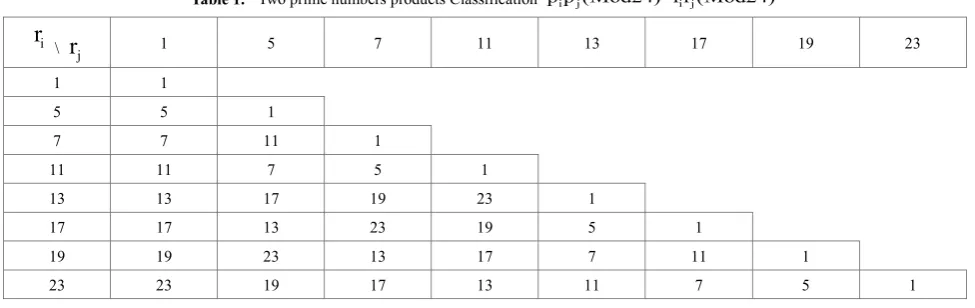
According to classification, presented in [4, p. 37], beside some first, all prime numbers have the linear form
i i i
p =24m+r , r {1, 5, 7,11,13,17,19, 23}, m 0.
=
≥
We may compose all its products, calculatei j i j
Table 1. Two prime numbers products Classification p p (Mod24)=r r (Mod24) i j i j
i
r
\j
r
1 5 7 11 13 17 19 231 1
5 5 1
7 7 11 1
11 11 7 5 1
13 13 17 19 23 1
17 17 13 23 19 5 1
19 19 23 13 17 7 11 1
23 23 19 17 13 11 7 5 1
3. Factorization as Diophantine Equations Decision
Proposed approach we may demonstrate on simplest examples. For comparing with present methods we take, as example, composite number 45113, which used in [1, pp. 150-168] for discussion of different factorizations algorithms.
We compute 45113 17(≡ Mod24). Then from Table 1, we find 4 possible variants for that composite number:
i j
(r ,r ) (1,17), (5,13), (7,23), (11,19).= If we have not any additional information, then we must examine all 4 equations, that
follows from possible presentations composite number. It is expediently to solve those equations in parallels, that possible diminish computations and permit to escape for proving absence of decision, as for big numbers it may be not simple problem. Then we easy writing out uniformity equations and find out the simple decision of one of its. For other equations that determinates the absence of decisions too.
For variant (1, 17) we have after obvious transformations
(24x+1)(24y +17)=45113, 24xy+17x+y=1879=78 24+7,
17x+y=24s+7, xy+s=78
⋅
(1)
Then we make further transformations and substitutions
( )
17x+y=24s+7, 24s-17x=y-7, s=5 y-7 17h, x=7(y-7)+24h
+
(2)Under conditions
x>0, y>0
and if we substitute its presentations from (2) to last formulae from (1), then we may to see, that have not decision ifh>0.
So forh<0
we have to change sign h in (2) on minus(
)
s=5 y 7 17h, x=7(y 7) 24h>0, y 7=4h+a, s=3h+5a, x=4h+7a
− −
− −
−
(3)After substitution formulas for
x, y, s
from (3) to last formulae from (1) we have equation with positive unknowns(4h+a+7)(4h+7a)+3h+5a=78
(4) We leave that equation for the time, analogically examine other and present it briefly.For variant (5, 13) it is
(24x+5)(24y +13)=45113, 24xy+13x+5y=1877=78 24+5,
13x+5(y-1)=24s, 24s-13x=5(y-1), s=4(y-1)+13h, x=7(y-1)+24h 0,h<0
y-1=4h+a, s=3h+a, x=4h+7a, xy+s=78, (4h+a+1)(4h+7a)+3h+a=78
⋅
>
(5)For variant (11, 19) it is
(24x+11)(24y +19)=45113, 24xy+19x+11y=1871=78 24-1,
19x+11y+1=24s,19(x-4)+11(y+7)=24s, 24s-19(x-4)=11(y+7),
s=4(y+7)+19h, x-4=5(y+7)+24h, h<0
h
-h
y=5h+a-7, s=h+4a, x=h+5a+4, xy+s=78, (h+5a+4)(h+5a-7)+h+4a=78
⋅
→ ⇒
For variant (7, 23) it is
(24x+7)(24y +23)=45113, 24xy+23x+7y=1873=78 24+1,
23x+7y-1=24s, 23(x-4)+7(y+13)=24s, 24s-23(x-4)=7(y+13),
s=7(y+13)+23h, x-4=7(y+13)+24h, h<0, h
-h
y=4h+a-13, s=5h+7a, x=4h+7a+4, xy+s=78,(4h+7a+4)(4h+a-13)+5h
⋅
⇒
→
+7a=78
(7)
In result from variant (5, 13) it is easy to have factorization
a=0, h=2, x=8, y=9, 45113=197 229
⋅
(8)4. Factorization and Diophantine Equations Methods of Decision
Then we examine more complex problem, which Shanks solved with his specially developed algorithm and program for simplest computer or programming calculator [5]. The example that Shanks examine N=13290059, our methods may to solve with aid of «pencil and paper».
We find
N (Mod24)=11.
Then from Table 1 we find four possible variants for that composite number:i j
(r ,r ) (1,11), (5,7), (13,23), (17,19).
=
We write out four initial equations, as we have not any information for some variants. The result is
1) (24x+1)(24y +11)=N, 24xy+11x+y=553752=23073 24
2) (24x+5)(24y +7)=N, 24xy+7x+5y=553751=23073 24-1
3) (24x+13)(24y +23)=N, 24xy+23x+13y=553740=46145 12=23072 24+12
4) (24x+17)(24y +19)=N, 24xy+19x+17y=553
⋅
→
⋅
→
⋅
⋅
739=23072 24+11
⋅
(9)
Simpler it is presentations of 1st and 3rd variants, then we continue its solving For variant (1, 11) it is
h<0
11x+y=24s, 24s-11x=y
s=6y-11h, x=13y-24h,
y=2h+a, s=h+6a, x=2h+13a, xy+s=23073 (2h+a)(2h+13a)+h+6a
→
=
(10)For variant (13, 23) it is
1 1 1 1 1 1
h<0
1 1 1 1 1 1 1 1
23x+13y=24s+12, x=x 1, y y 1, s=s +1, 23x +13y =24s ,
24s 23x 13y
s =13y -23h, x =13y -24h, y =2h+a,
y=2h+a+1, s=3h+13a+1, x=2h+13a+1,
xy+s=23072 (2h+a+1)(2h+13a+1)+3h+13a+1
+
=
+
−
=
→
=
(11)
Then we present (11) as
2 2 2 2
4h +28ah+7h+13a +27a=23070, 4h
+
h(28a+7)-23070+27a +13a
=
0
(12)If that equation has decision in positive whole numbers, then its determinant will be quadrate, so
2 2 2 2
h
D =(28a+7)
− ⋅ −
4 4( 23070+27a +13a ) 369169 - 40a + 576a
=
=
X
(13) Last presentation we may to transform with aid of substitutions and find decision2 2 2 2
2 2
1 1 1 1
2 2
1 1 1 1 1 1
- 40a+576a
X -369169 0, X=607+b, - 40a+576a
2 607b+b -720,
b 8b , - 5a + 72a
90 2 607b +8b , a=2a ,
- 5a + 144a
45 607b +4b , a =2, b =1, a=4
=
>
= ⋅
=
+
= ⋅
+
=
(14)
2 2 2
4h
+
h(28a+7)-23070+27a +13a
=
0, a=4, 4h 119h-22754=0, h=62
+
(15)From formulas (11) we have factorization
y=2h+a+1, s=3h+13a+1, x=2h+13a+1, a=4, b=62, y=129, x=177,
(24x+13)(24y +23)=(24 177+13)(24 129 +23)=4261 3119=13290059
⋅
⋅
⋅
(16) Another method for that factorization is useful too, ifx y
,
are sufficiently close numbers. Then it’s sufficiently close to estimation1/2 1/2 1/2
x y, X (xy) , X N / 24 13290059 /24=151.898
≅
≈
≈
=
(17)With that estimation we may to write out another initial equation for
N
(24(144+x)+13)(24(144+y)+23)=13290059, 3479 x + 3469 y + 24 x y 50892
=
(18) Continue to transform we have2
2
-12 4241 + 24 144(x+y) +23x +13y+24xy =0, x+y=z,
-12 4241 + 24 144z+10x+13z+24(zx-x ) 0,
10x+13z=12w, 2 144z+2(zx-x )+w=4241
⋅
⋅
⋅
⋅
=
⋅
(19)
Then we find decisions for linear equation from (19) and use it for subsequent substitutions h
12w-13z=10x
w=3x-13h, z=2x-12h,
x=7k+a, z=2k+2a, w=8k+3a
−→
(20)
The last formulas are substituted in last equation of (19) and give presentation that have simple decision for first equation of (18)
2 2
1
2 2
1 1 1 1
579a+2a +584k+4ak - 70k
4241, a=2a 1,
583a +4a +294k+4a k - 35k
1830, a
2,k=4, a=5,
x=7k+a=33, z=x+y=2k+2a=18, y=z-x=-15
=
+
=
=
(21)Thus, in that way practically with «pencil and paper» calculations we may to get number factorization, which Shanks solved with skillful algorithms and computer program [5]. To our mind if such mathematicians as Fermat, Gauss, Euler and another classics of numbers theory were known about presented here approach, they were able even some centuries ago to solve similar problems of number factorization. In principle, our methods give decision of first problem as formulated by Gauss. If we use four equations for factorization like in (9) to prime number, so we will not get components as for composite number. It is proving for prime.
5. Fermat Numbers Factorization
One of old classic problem is factorization of Fermat numbers, which have presentation
n
2 n
F =2
+
1,
n
=
1,2...
(22)In work [4, p. 38] it was come in sight that components of composite Fermat numbers must be only prime numbers 24m+1 in some quantity and prime numbers 24m+17in odd quantity. So in that case the problem of factorization is simplified, as for decision it is enough to examine only one equation.
Besides that, it is another property of the components, which we may to use: components of composite
F
n have presentation2
n+2k
+
1
[1, p. 47]. That information permits to get new formulas for components.Then for
F
5 we have for first component presentation7 7 4
5,1
For another component analogically we have
7 7
5,17
2 k+1 24p +17, 2 k 24p =16, 16k-3p =2,
k=2+3p, p =10+16p,
f
384p 257
′
′
′
=
−
′
=
+
(24)Thus we may to write out initial equation for
F
5 factorization 3224
(384m 1)(384p 257) 2
1,
384mp 257m p 2(2
1) / 3 11184810 384 29127+42,
257m p 42 384s
mp s 29127
+
+
=
+
+
+ =
−
=
=
⋅
+ =
+
→
+ =
(25)
We find the decision for last linear equation from (25)
257m 384s 42 p, m= 127(p 42) + 384 t, s = 85(p 42) + 257 t
−
=
−
−
−
(26) Substitution this to last equation from (25) gives2
p(127(p 42) + 384 t)+85(p 42) + 257 t=29127,
- 5249p + 127p + 257t + 384pt=32697
−
−
(27)
We use then simple identity and get final equation
2
127=384-257, 5249=13 384+257,
384p(p t 13) 257(t p ) 32954
⋅
+ −
+
−
=
(28)It is easy to find analogical presentation for right side (28) and end decision
2
5
384a =32954(Mod257), 384a = 58(Mod257), a=47,
32954=384 47 257 58, p(p t 13) 47, t p
58,
p 1, t 59, m= 127(p 42) + 384 t=17449,
F (384m 1)(384p 257) (384 17449 1)(384 257) 6700417 641
⋅
+
⋅
+ −
=
−
=
=
=
−
=
+
+
=
⋅
+
+
=
⋅
(29)
Of course, the factorization search in that case is relieved, as the result is known. But our aim is to demonstrate process of decision with elementary methods, which do not used since Fermat time to present. Fermat error suggested (in 1640-1654) that all numbers
F
n are primes. Euler since century found component 641, that divideF
5. Next factorization forF
6 was found at 1880 [6, pp. 375-380]. Those give us some foundations to suggest: if the way demonstrated above may be known Fermat and his colleagues, the development of factorization methods went another and more rapid road.6. Fermat Numbers Factorization (Continuation)
The problem
F
6factorization is harder in sense of calculations. In general the complicate situation with Fermat numbers consist in its rapid increasing and even for best method of decision get up straight technical complexities in the field of «big numbers». The case withF
6is transitional as its factorization was found «after several months’ labor» [6, p. 377]. Factorization forF
7occurred at 1975 in era of computers, so there we restrict that article only of caseF
6.Initial equation we get after transformation, analogical (23-25)
64 8 8 5
6 1 2 1
8 5 5
2 2 2
64 56
2
1 (2 k 1)(2 k 1) (24a 1)(24b 17), k =3n, a=2 n,
24b 17 2 k 1, 2 k 3b 2, k
1 3m, b 10 2 m,
(768n 1)(768m 257) 2
1, 768mn 257n m (2
1) / 3=
24019198012642645=768 31274997412295+85
F
=
+ =
+
+ =
+
+
+
=
+
−
=
= +
=
+
+
+
=
+
+
+ =
−
⋅
(30)
257n+m=85+768s, mn+s=M=31274997412295=768 40722652880+455,
m=85+768s-257n, s=k+n, m=85+768k+511n
⋅
(31)
Substitution those presentations give us
2
2
1 1
mn+s=768nk+511n +86n+k=M,
511n +86n+k=768s +455, nk+s
=
40722652880
(32)We take transformations with parameter A – whole positive number
2 2
1
s
=
n
+
An+r, k=257n
+
(A-86)n+768r+455
(33) After further substitutions (33) to last formulae (32) we have Diophantine equation third degree, where A is variable parameter3 2
257n +(768A 85)n +(455+A)n+768nr+r=40722652880
−
(34)That equation has transformation to
3 2
257n 85n +455n+(768n+1)(An+r)=40722652880
−
(35)As n>0, so if whole number A>0 and r>0 there is some value
A
when exist minimumn>r>0.
But it is known, that equation (34) has one decision in whole positive numbers(n, r ), r
A A=
An+r=const.
If A=0, thenr =r
A 0. When we will to increase A toA
, r will be to decrease tor
A=
min r.
If then we takeA A+1 A A+1 A
A=A+1, r
=
n(A+1)+r
=
nA+r , r
= −
r
n<0.
Then for all
A>A, r 0.
<
So it is monotone dependence, and forr=r
A=
min r
there is local positive minimum, and forr=r
A+1<
0
there is local maximum. From (35) we get3 2
40722652880 (257n 85n +455n)
r=
An
768n+1
−
−
−
(36)We come to problem of two-dimension searching on field of positive natural numbers for whole local extremum of
r
near valuer=0
with simplifying conditionsA 0, n>r>0.
≥
There we present decision results omit details:A A+1
A=296, n=357, r
=
245; A+1=297, n=357, r
= −
112
We must note that problems (35) and (36) now it is easy to decide with computer program, in particular with Mathematica of Wolfram Research. Reduce program decide (35) and (36) for all values A, and for negative values too, as when
A<0
decrease, r increase andr=r
0+
A n.
Now it is great amount of studies, guides and manuals on Diophantine equations, but as we may to see, the approach to factorization presented here was unknown, so corresponding equations have no attention of researchers. The equations of second degree is mentioned in [6, pp. 412-417], as with use of classical methods lead to problem of factorization, but another methods did not studied. Diophantine equation third degree, similar to (34-35) also did not study, but may be classified as inhomogeneous Thue equation
f x y
( , )
=
m
[7]. There authors assert, that their paper «gives in details a practical general method for explicit determination of all solutions of any Thue equation». But now it is unknown Thue equations application for factorization problem.7. Conclusions
For our mind, we presented new approach to factorization problem. It is surprising, why it was unknown some centuries ago, as demand highly elementary mathematical means and notions. Here we in the main examined examples, that may be decided with «pencil and paper». Diophantine equations, ensuing from presented concrete tasks and its methods of decision are not exhaustive. It needs further development and researching.
Now it is known private effective algorithms and computer programs for factorizations in the wide diapason to big numbers. In that sense the list of references has not fullness and is biased to aim of article. For other well-known material on Factorization we refer to MathWorld – A Wolfram Web Resource.
There is whole factorization for
F
11 and all previous Fermat numbers. ButF
12 is factored incomplete and composite fragment of it has 1133 decimal digits. So it is interesting whether presented here Diophantine equations methods will be effective for big number problems. However, that needs serious special studying with high quality programming and technical means, and so exceed the limits of present article, as its main aim is only to demonstrate opportunity of new generalized approach for factorization.REFERENCES
[1] Sh.T. Ishmukhametov. Methods for the factorization of natural numbers: a tutorial. Kazan University Publ., Kazan, 2011. (Russian edition: Kazan, 2011).
[2] K.F. Gauss. Works on number theory. Publishing House of the Academy of Sciences, Moscow, 1959. (Russian edition: Moskow, 1959).
[3] R. Crandall, C. Pomerance. Prime numbers. A computational perspective. Springer, New York, 2005.
[4] V. Meshkoff. Prime Numbers Classification with Linear and Quadratic Forms. Universal Journal of Applied Mathematics 3(3): 35-39, 2015
[5] D. Shanks. SQUFOF Notes. Manuscript. Available at: David Joyner and Stephen McMath.
http://cadigweb.ew.usna.edu/~wdj/mcmath/
[6] L.E. Dickson. History of the theory of numbers. Vol. I. Chelsea Publishing Company, New York, 1952.