DEAKIN UNIVERSITY
CANDIDATE DECLARATIONEnhancing RFID Data Quality and Reliability
by
Hairulnizam Mahdin
Bachelor of Science (Comp. Sc.) Master of Science (Comp. Sc.)
Submitted in fulfilment of the requirements for the degree of
Doctor of Philosophy
Deakin University
iv
Abstract
Radio Frequency Identification (RFID) is gaining significant thrust as the preferred choice of automatic identification and data collection system. RFID technology has been increasingly deployed in a wide range of applications, such as animal tracking, automatic toll collection and mass transportation. A RFID system consists of a transponder (i.e., tag), which is attached to the objects to be identified, an interrogator (i.e., reader) that creates an RF field for detecting radio waves, and a backend database system for maintaining expanded information on the objects and other associated objects. While RFID provides promising benefits in many applications, there are serious data management issues that must be overcome before these benefits can be fully realized.
In this thesis, we address the RFID data quality and reliability problems. RFID data is fundamentally different from the traditional relational and data warehouse technologies. These differences pose great challenges and they need to be fully considered in RFID data management systems. Also, RFID uses radio waves to capture data automatically. Unfortunately, despite vast improvements in the quality of RFID technology, a significant amount of erroneous data is still captured in the system. The observed read rate in real world RFID deployments is often in the 60-70 % range. Such level of error rates render raw RFID data essentially useless for mission-critical applications such as healthcare and inventory management systems. Moreover, RFID data are large, dynamic and time-dependent. Therefore, missed and unreliable readings are very common in RFID applications and often happen in situations of low-cost, low-power hardware and wireless communications, which lead to frequently dropped readings or with faulty individual readers. RFID data stream is full of duplicate readings. The duplicate data results in unnecessary transmissions and consumes network bandwidth.
v
Table of Contents
ACKNOWLEDGEMENT... ABSTRACT... Table of Contents... List of Figures... List of Tables...
iii iv v viii x
CHAPTER 1 INTRODUCTION...
1.2Research Significance………..……….... 1.3Research Problems………..………. 1.4Research Objectives………..……….….. 1.5Methodology………..…….……. 1.6Research Contributions………..……... 1.7Thesis Organization………..……….…………..
1 3 4 6 6 7 8
CHAPTER 2: RFID DATA FILTERING SYSTEM ………….………....
2.1Introduction………..………...……... 2.2RFID System Architecture ……….. 2.2.1 Tag………...……. 2.2.2 Readers………. 2.2.3 Middleware……….. 2.2.4 Enterprise Application & Database………..……… 2.3RFID Data Filtering Approaches ………...
2.3.1 Reading Classes………... 2.3.2 Basic of RFID Data Filtering………... 2.4Filtering Approaches……….………..……. 2.4.1 Windows-based………...………. 2.4.2 Query Processing………. 2.4.3 Bloom-Filter based Approach...………...……..………. 2.4.4 Peer-to-Peer Filtering……….……….. 2.4.5 Slotting Algorithm..……….……… 2.4.6 Data Modelling……….……… 2.4.7 In-Network Filtering………...………. 2.5Summary………...………... 11 11 13 13 16 17 17 18 18 22 23 24 30 33 36 42 45 47 50
CHAPTER 3: NOISE FILTERING IN RFID DATA STREAM………..…
3.1Introduction………. 3.2Problem Overview ………..
3.2.1 Definition of noise reading...….……….. 3.2.2 Effects of noise readings...…….………. 3.2.3 Sources of noise read………... 3.2.4 Noise readings minimisation……….... 3.2.5 Noise readings filtering strategies..……….. 3.3The Denoising algorithm……….. 3.4Performance Analysis………..
vi
3.4.2 Result and Discussion………. 3.5Summary………..
68 71
CHAPTER 4: FILTERING DUPLICATE READINGS………
4.1Introduction... 4.2Problem Overview………... 4.3RFID Data Stream Filtering Approach……….... 4.3.1 Duplicate Data Removal Algorithm (DRA)……… 4.3.2 False positive rate of DRA……….. 4.3.3 Landmark Window in DRA……… 4.3.4 Memory Requirement in DRA……… 4.4Performance Analysis……….. 4.4.1 Experimental Setup………. 4.4.2 Results and Discussions………...
4.4.2.1False Positive Rate as a Function of Hashing Function………….. 4.4.2.2Comparative Analysis of False Positive rate………... 4.4.2.3Rate of Unfiltered Duplicate Readings………... 4.4.2.4Execution Time Analysis………. 4.5Summary……….. 72 72 74 78 78 83 85 86 87 87 88 88 90 91 92 94
CHAPTER 5: MISSED READINGS DETECTION IN FAULTY RFID READER...
5.1Introduction……….. 5.2Missed readings in RFID………. 5.2.1 Types of reader faults………... 5.2.2 Sources of faulty reader……….... 5.2.3 Faulty reader in RFID system……….. 5.3Missed Readings Detection Approach………. 5.4Performance Analysis……….. 5.4.1 Comparative Analysis……….. 5.4.2 Sensitivity to tag detection rate……… 5.5Summary………... 95 96 97 99 100 100 102 108 108 111 113
CHAPTER 6: ENERGY-AWARE DATA FILTERING MECHANISM……….
vii
CHAPTER 7: CONCLUSION AND FUTURE DIRECTIONS………
7.1Conclusion……… 7.2Future Directions……….. 7.2.1 Dynamic Settings………. 7.2.2 Missed Readings Detection……….. 7.2.3 Data Filtering Framework………
REFERENCES……….……….
viii
List of Figures
Figure 1.1: RFID system architecture……… Figure 2.1: An RFID-enabled system architecture………. Figure 2.2: Structure of EPC tag data………. Figure 2.3: Types of reading possibly generated when reader reads tag 100E…….. Figure 2.4: (a) Sliding windows, and (b) landmark windows ………... Figure 2.5: Longer max_distance takes long time to scan along the window, shorter max_distance leaving some duplicate data unfiltered
Figure 2.6: Stages in ESP………... Figure 2.7: (a) Insertion of “Apple” in the filter and (b) checking whether
“Orange” already has been in the filter………...…………
Figure 2.8: (a) Insertion of “Apple” in CBF (b) Insertion of “Orange” in CBF (c) Deletion of “Apple” in CBF………...
Figure 2.9: (a) DCCP of the system (b) BPL derived from (a)……….. Figure 2.10: Logical relation among the readers and tags movement……… Figure 2.11: Time latency in exchanging message in networks………
Figure 2.12: (a) Three readers group into two slots (b) R2 and R3 is assigned to the same slot………..
Figure 2.13: RFID readings is merge based on time_in and time_out………
Figure 2.14: R1, R3 and R4 are redundant………. Figure 2.15: Only R1 and R5 are redundant using RRE……… Figure 2.16: New route for data from CH1 after CH2 found duplicate……….. Figure 3.1: Tagged objects on a conveyor belt………... Figure 3.2: Tag orientation on the object influence signal strength………... Figure 3.3: Noise readings removal based on threshold………. Figure 3.4: Noise Removal Algorithm (NRA)….……….. Figure 3.5: Tag 1 and Tag 2 reading from time 0 to 90……….. Figure 3.6: Tag reading model……… Figure 3.7: Time execution under different arrival rates……… Figure 3.8: Time execution under noise rates………. Figure 4.1. An RFID-enabled system for warehouse loading bay………. Figure 4.2. Multi-level RFID data filtering approach………. Figure 4.3. Duplicate Removal Algorithm………. Figure 4.4. The state of DRA based readings in Table 4.3………. Figure 4.5: Example of filtering in (a) sliding windows and (b) landmark windows. Figure 4.6: Memory comparison of DRA and sliding windows……… Figure 4.7. FPR of DRA as a functions k with counter size m = 5,000………. Figure 4.8. FPR of DRA as a functions k with counter size m = 15,000…………... Figure 4.9. Comparison of FPR between Bloom filter approach………... Figure 4.10. Percentage of unfiltered duplicate readings..………. Figure 4.11. Time execution as function of number of readings……… Figure 4.12. Time execution as function of tag arrival rate………
ix
Figure 5.1: Missed readings by functioning (Reader A) and faulty reader
(Reader B and Reader C)………. Figure 5.2: Illustration of interval intersection………... Figure 5.3: ValidateReading Algorithm……….……… Figure 5.4: False positive rate comparison under different percentage of faulty
reader………... Figure 5.5: False negative rate comparison under different percentage of faulty
reader………... Figure 5.6: False positive rate comparison under different tag arrival rate………… Figure 5.7: False negative rate comparison under different tag arrival rate………... Figure 6.1: Readers and tags deployment in RFID system……… Figure 6.2: Energy State in RFID reader……… Figure 6.3: Slotting algorithm for networked RFID readers……….. Figure 6.4: Multiple networked RFID readers sitting next to another………... Figure 6.5: Every reader is assign a slot by SELECT (a) only reader in slot 1
operating (b) 2 reader in slot 2 operating (c) slot 3 operating and (d) slot 4 is operating………...
Figure 6.6: Slot assigned by using DCS, two slot are working well as shown in (a) and (b), but slot 5 in (c) experience collision and (d) is the new slot assign after the collision………
Figure 6.7: Algorithm to save energy on reader by putting it in the sleep mode…... Figure 6.8: Reader 1 act as gate reader allowing other reader to be in sleep mode… Figure 6.9: Comparison of amount of energy consumption using slotting algorithm Figure 6.10: Comparison of amount of energy consumption………. Figure 6.11: The percentage of energy savings………..
98 106 107 109 110 111 112 119 121 124 125
127
128 129 131 132 133 134
x
List of Tables
Table 2.1: Tags read ranges……… Table 2.2: The advantages and disadvantages for each type of tag……… Table 2.3: Summary of reading classes considered as anomalies in RFID………… Table 2.4: RFID raw reading example………... Table 2.5: RFID raw reading example………... Table 2.6: List of tag ID………. Table 2.7: Summary of the data filtering approaches………. Table 4.1. The condition of DRA after tag 1 is hashed 3 times……….. Table 4.2. Reading on tag A1 by different readers………. Table 4.3: False positive rate with different m/n and k combination………. Table 5.1: Number of objects read by each reader………. Table 5.2: The tuple <offset, type> from Table 1 after sorted ascending………….. Table 6.1: Current consumption in different reader mode……….. Table 6.2: List of reader derived from Figure 6.4………..
1
Chapter 1
Introduction
RFID (Radio frequency identification) systems are vastly emerging as primary object identification mechanism especially in the supply chain management. Automation is one of the RFID advantages compared to the traditional barcodes [1]. The manual work of scanning is omitted with the use of RFID. Take the example of items replenishment on the shelf. In practice, employees need to monitor manually every shelf in the store to ensure the item quantities are sufficient. This task is repeated for a number of times in a day. This is not efficient as it is time consuming and not all the shelf needs regular monitoring. By using RFID, no manual monitoring is required. Monitoring is carried by readers that will alert the system for shelf replenishment if the items quantity falls below the threshold.
2
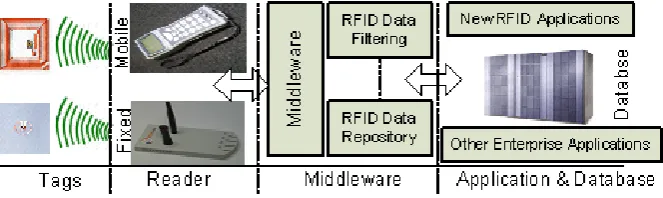
[image:10.595.124.456.200.299.2]The applications then respond to these events and application processes orchestrate corresponding actions; such as ordering additional products, sending theft alerts, raising alarms regarding harmful chemicals or replacing fragile components before failure.
Figure 1.1: RFID System Architecture
In many applications such as manufacturing, distribution logistics, access control, and healthcare, the ability to uniquely identify, real-time product track, locate and monitor individual objects is indispensable for efficient business processes and inventory visibility. The use of RFID technology has simplified the process of identifying, tracking, locating and monitoring objects in many applications. RFID uses radio-frequency waves to transfer identifying information between tagged objects and readers without line of sight, providing a means of automatic identification, tracking, locating and monitoring. Many organizations are planning to or have already exploited RFID to achieve more automation, efficient business processes, and inventory visibility. For instance, after implementing RFID system, Wal-Mart reportedly reduced out-of-stocks by 30 precent on average.
3
shelf. In practice, employees need to monitor manually every shelf in the store to ensure the item quantities are sufficient. This task is repeated for a number of times in a day. This is not efficient as it is time consuming and not all the shelf needs regular monitoring. By using RFID, no manual monitoring is required. Monitoring is carried by readers that will alert the system for shelf replenishment if the items quantity falls below the threshold.
1.2 Research Significance
Although RFID systems are vastly emerging as primary object identification mechanism, the raw data collected by RFID readers are inherently unreliable [23, 17]. Since data unreliability would lead to inaccurate decisions or responses, it is imperative that the data is cleaned before being sent to the back end system for use by RFID applications. There are several factors that lead to the RFID data unreliability: noise reading, missed reading, duplicate reading. A noise reading at one’s check-out point will trigger false alarm to a customer who has paid for the purchased items. The system here can be considered not reliable and useless because it cannot detect the purchased item correctly. The system should be able to filter noise readings completely to avoid such thing from happening.
4
shelf. For instance, the system will have views that the shelf still have enough quantity of items and does not need replenishment while the real case it is not.
Another class of unreliability of RFID data occurs due to missed readings. This occurs for a number of reasons including faulty readers and readers with low power. In such situations, it is important to ensure that the system received all the readings on the tagged objects. The existence of missed readings will affect the system reliability such that the system is unable to monitor or record the object accurately. Therefore a mechanism to detect missed readings in RFID data stream is a must to ensure that the system operate correctly.
1.3 Research Problems
This thesis deals with RFID data unreliability problem and proposes energy efficient RFID data stream filtering techniques. In particular we address the following four research issues in this thesis:
5
How to filter duplicate readings in efficient manner: Duplicate readings are considered as a serious problem in RFID. Duplicate readings detection and elimination is a part of data cleaning problem. It detects and removes errors and inconsistencies from data and improves its quality. Presence of similar duplicate records causes over representation of data which is unnecessary. The source of the problem originate from (i) RFID reader continuously read tags even there is no event occurred (ii) Multiple readers are use for the same vicinity, and (iii) Multiple tags used on the same object to increase reading reliability. This thesis present ideas for making duplicate detection algorithms faster and efficient with aim to preserved readings to the authorized reader.
How to detect missed readings: Missed readings can occur in RFID system without being noticed by the user. This happen when the reader experience faulty either temporarily or permanent. The reader still generates readings which make it looks still working properly. However, the reader missed a majority of the reading and the reader must to be quarantined from sending new readings. The events of faulty reader need to be detect quickly to control the potential damage it can bring to the system.
6
the tag can complete its mission. Therefore a mechanism for energy savings is very important and addressed in this thesis.
1.4 Research Objectives
To achieve the research aim, three main research objectives are identified and need to be fulfilled:
1. To develop a taxonomy of RFID data filtering system that contributes understanding towards current approaches, issues and challenges related to the topic;
2. To develop an efficient approach to filter noise readings in an efficient manner. 3. To develop an efficient approach for filtering duplicate readings in RFID data
stream;
4. To propose an approach to detect missed reading that may be caused by faulty reader in order to ensure the system is working correctly; and
5. To propose mechanism to achieve energy aware RFID data stream filtering approach.
1.5 Methodology
The proposed work will be carried out based on the experimental computer science method [6]. This method examines the research work to demonstrate two important concepts: proof-of-concept and proof-of-performance.
7
overview that leads to the formulation of valid problem statements. From this review, the research work in is justified. Then, the proposed approach of RFID data filtering is designed and analytically analysed.
Proof-of-performance is demonstrated by conducting the implementation for the filtering algorithm using simulations. In those simulations, various parameters and workloads were used to examine and demonstrate the viability of the proposed solutions compared to the similar baseline solutions. Also, analytical analysis of some proposed algorithms is performed to evaluate the correctness.
1.6 Research Contributions
We detail the thesis contributions as the following:
1. RFID data filtering taxonomy. This thesis presents taxonomy of RFID Data filtering. It investigates related concepts, describes the design themes and identifies implementation components required. The presented taxonomy is mapped to current RFID system to demonstrate its applicability. Also, the mapping assists to perform a gap analysis in this research field.
2. Noise filtering. The thesis introduces approach to filter noise data in RFID data streams. The noise is detected by the number of its occurrence which is normally less than correct readings. The approach is compare with other baseline method and proves that it performance is superior to others.
8
4. Missed reading detection. The thesis presents a mechanism to detect missed reading that caused by faulty reader in the system. The detection of missed reading is extremely important to ensure that the readings does not go through into system and be treated as correct readings.
5. Energy Savings Mechanism. This thesis introduces mechanism to achieve energy savings in RFID system by reducing a number of readings to be made. Energy saving is very important as some RFID is depending on onboard battery that have limited life time. In some cases the hardware is expected to perform longer especially in the case of emergency.
To summarize, the work presented in this thesis is in line with the current trends that enable RFID data filtering without having to build a dedicated infrastructure [5, 14]. Therefore, it is our thesis to present RFID data filtering solutions that are scalable and efficient.
1.7 Thesis Organization
The chapters of this thesis are derived from various papers published during the PhD candidature. The remainder of the thesis is organized as the following:
Chapter 2: RFID Data Filtering System. This chapter provides an in-depth analysis and overview of existing RFID data filtering approaches, presented within a comprehensive taxonomy.
9 o Hairulnizam Mahdin, Jemal Abawajy (2009). An Approach to Filtering RFID Data Streams. 10th International Symposium on Pervasive Systems, Algorithms, and Networks, pp. 742-746.
Chapter 4: Filtering Duplicate Readings from RFID Data Streams. This chapter presents an approach to filter duplicate reading in RFID . The results presented in this chapter are derived from the following publications:
o H. Mahdin, and J. Abawajy (2010). An Approach to Filtering Duplicate RFID Data Streams, Lecture Notes on Computer Science: U- and E-Service, Science and Technology, pp. 125-133. Springer: Heidelberg. This paper has won best paper award at UNESST 2010, Jeju Island, Korea.
o Mahdin, H.; Abawajy, J. An Approach for Removing Redundant Data from RFID Data Streams. Sensors 2011, 11, 9863-9877.
Chapter 5: Missed Reading Detection. This chapter presents an approach to detect missed reading in the system. The mechanism and the simulation results presented in this chapter are derived from the following publications:
o H. Mahdin, and J. Abawajy (2011). An Approach To Faulty Reader Detection. In Internet and Distributed Computing Advancements: Theoretical Frameworks and Practical Solution, Jemal Abawajy, Mukaddim Pathan, Al-Sakib Khan, Mustafizur Rahman and Mustafa Deris (eds.). IGI-Global: USA.
10
11
Chapter 2
Literature Review
This chapter provides comprehensive review about the various data management issues in RFID. It serves the purpose to understand the current undertakings to ensure data quality in RFID. It focused on three major RFID data issues which are noise readings, duplicate readings and missed readings. The chapter include in-depth analysis on existing approaches, listing the advantages and disadvantages of each approach that specifying on solving the data problems. The literature can be used by researcher to understand the background of RFID data filtering, the challenges and expectation in the future.
2.1 Introduction
12
There are two types of filtering: (i) low level data filtering and (ii) semantic data filtering [7]. Low level data filtering clean raw RFID data streams. For examples removing duplicate and noise readings from the data stream. The semantic data filtering filters data based on demands from system such as list of manufacturers that did shipment in July. In this thesis we worked on low level data filtering with focus on noise and duplicate readings. We also focus on detecting faulty reader and energy savings in data filtering.
The RFID data stream is different from the common relational and data warehousing because of (i) large size of data (ii) simple tuple structure (iii) inaccuracy and (iv) temporal and spatial information that make it require new data management approach [8][9]. The size of the data stream is very large because the reader can read multiple tags in seconds and repeat it for indefinite times. To illustrate the RFID data size, consider small store that have 10,000 items. In single reading cycle there will be 10,000 readings generated. If the readings are repeated for every 10 minutes, in eight hours there will be already 480,000 tuples. It is not easy to dig up information by using query to this large data.
13
2.2 RFID System Architecture
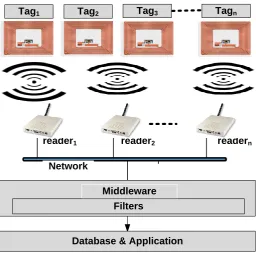
A typical RFID system consists of a transponder (i.e., tag), which is attached to the objects to be identified, an interrogator (i.e., reader) that creates an RF field for detecting radio waves, and a backend database system for maintaining expanded information on the objects and other associated objects. Figure 2.1 shows RFID-enabled a generic system of interest. Generally RFID system architecture is made of four layers: tags, readers, middleware and database and enterprise applications.
Database & Application Middleware reader1
Tag1 Tag2 Tag3
Filters
Tagn
reader2 readern
[image:21.595.169.426.312.565.2]Network
Figure 2.1: An RFID-enabled system architecture.
2.2.1 Tag
14
[image:22.595.182.414.345.541.2]tags have their own battery on-boards. Active tags can emit their signal to the reader to start the communication while semi-active and passive tag needs to wait the signal from the reader to power them up before replying to the signal. The battery on boards owned by semi-active tags is only used for processing purposes. For passive tags, it uses the power supplied from the reader for both processing and communicating. Passive tag is the most commonly used tags in the market and has an indefinite operational life compare to other tags. Relative to both active and semi-active tags, passive tags are very cheap and they are widely used in very large quantities in many applications such as supply chain management.
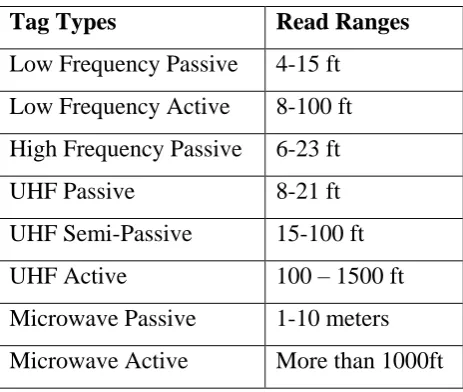
Table 2.1: Tags read ranges
Tag Types Read Ranges
Low Frequency Passive 4-15 ft Low Frequency Active 8-100 ft High Frequency Passive 6-23 ft UHF Passive 8-21 ft UHF Semi-Passive 15-100 ft UHF Active 100 – 1500 ft Microwave Passive 1-10 meters Microwave Active More than 1000ft
15
Table 2.2: The advantages and disadvantages for each type of tag
Type of tags Advantages Disadvantages
Passive
Unlimited life-time Short read range distance Cheap Not possible to integrate with
sensors Small size: make it easy to be used
with any object
The tag remains readable for a very long time, exposed user to privacy breach.
Active
Longest read range
The tag cannot function without battery power, which limits the lifetime of the tag.
Capability of initiating
communications Expensive Capability of performing
diagnostics Larger in size. Limit application Highest data bandwidth Long term maintenance that is
costly if need to replace battery Capability to determine the best
communication path.
Battery outages in an active tag can result in expensive misreads. Semi-passive Longer read range than passive tag Limited life-time
16
2.2.2 Readers
The RFID system is assumed to contain multiple networked RFID readers deployed to collaboratively collect data from tagged objects in their vicinity. The reading distance ranges from a few centimetres to more than 300 feet depending on factors such as interference from other RF devices [10]. The RFID readers query tags to obtain data and forward the resulting readings to the middleware. The middleware processes these data and then send it to the backend applications or database servers. The applications then respond to these events and orchestrate corresponding actions such as ordering additional products, sending theft alerts, raising alarms regarding harmful chemicals or replacing fragile components before failure.
There are two types of RFID reader: fixed and mobile. Fixed RFID reader is installed at specific checkpoint to read objects passing by. It is also installed to monitor objects around them such as items on the shelf. The reader also can be mounted on moving object such as forklifts to read the objects that the forklift is carrying. The mobile RFID reader is a handheld device and usually used to read fixed tag. It can be carried around to read tags in a larger area that needs number of fixed reader to do that. However it is not suitable to be used for constant monitoring as it needs humans to operate and moving it around which is not cost effective. One of issues that always been discussed with mobile reader is the energy saving approach. Mobile reader has limited life time because it depends on the battery. The energy saving become critical when mobile reader is going to be used in critical condition such as in emergency and natural disaster. During an emergency mobile reader might be used for a long time which requires efficient energy usage to prolong the reader life time.
17
The typical reader’s read rate on EPC Class1 Generation 2 tags is 1600 reads per second [10]. This contributes to the problem of duplicate readings. Although we can increase the distance between each reading cycle, there is opposing challenge on it. There are objects that are going to stay for a short while in the vicinity. By increasing the distance between reading cycle, the reader will missed to read this object which increase the false negative. This issue are among the main challenges in providing reliable and efficient RFID systems.
2.2.3 Middleware
The middleware acts as the centre of RFID systems [12][13]. The primary function of RFID middleware is to process large amounts of data within a short period. It collects and processes the readings from readers for the use of enterprise applications and enterprise database. The process such as filtering and aggregation transform raw data into required format for the application. Both low level filtering and semantic data filtering can be performed at the middleware. The semantic data filtering is based on the requirement given by the application from the next layer. It also provides custom format for data storage before it is sent to the database. The middleware also coordinate the readers’ activities, ensure reliability in data transmission, improving network communications and allowing heterogeneous devices to collaborate together [12]. It also provides user interface to allow the user control and configure the process.
2.2.4 Enterprise Application & Database
18
middleware into meaningful information. It then can deliversinformation to other application system or database. Therefore, a user can refer to the designation database or obtain data in the XML format [12]. The system makes business decision based on this information. For example user can gather check the objects that are below threshold in their stock. From this information they can make decision to order new stock from the supplier.
2.3 RFID Data Filtering Approaches
In this section, we provide in-depth analysis on current data filtering approaches. We categorized the approach based on their technique and data problem. First, we look at the type of reading classes in RFID.
2.3.1 Reading Classes
The type of readings generate by reader could be generally classified into four classes: true positive, false positive, false negative and duplicate readings. Each of these readings can be possibly generated when a tag tries to reply a signal to reader. That is basically the only data that being sent from the tag. The reader ID and time are recorded when the tag ID reach the reader.
19
(i) True positive
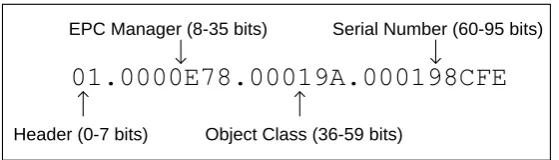
True positive is correct readings made by the reader. It returns the actual ID on the tag to the reader. The structure of tag ID according to the EPC Tag Data Standard consists of four parts: Header, EPC manager, Object Class and Serial Number as shown in Figure 2.2 [10]. Header identifies the length, type and structure of EPC, EPC Manager identifies the manufacturer, Object class identify the type of product and Serial Number is the unique identifier for the item.
01.0000E78.00019A.000198CFE
Header (0-7 bits)
EPC Manager (8-35 bits)
Object Class (36-59 bits)
[image:27.595.158.438.292.372.2]Serial Number (60-95 bits)
Figure 2.2: Structure of EPC tag data
(ii) False positive
The second reading class in RFID readings is false positive, also known as noise reading. The reading returns tag ID that does not exist in the system. The corrupted reading can be caused by: (i) low power signal, (ii) signal interference, (iii) signal collision, and (iv) infrastructure obstacle [8]. Low power signals occur when the tag is located at the end of reader’s vicinity or the reader trying to read too many tags at the same time [16]. The tag will not be having sufficient power to reply the signal back to the reader successfully. The radio signal also can be weaken by interference from metal and water [16].
20
Another source of noise readings is the infrastructure obstacle such as the orientation of the objects and obstacles from the surrounding environment. When numbers of pallets are coming together, some of the tags can be buried deep in the pallet arrangement, which made them hard to be read. The amount of power coming to them is not enough for the tag to responds to the reader correctly, which results in noise readings.
The effect of false positive or noise readings is it reports an existence of an object that is not exists, causing the system to take wrong decision opposing the reality. For example a noise read at the security check-out in a shopping mall will trigger alarm indicating that a customer did not pay for an item. The noise read also can indicate inaccurate number of items available in the store which causing delays in ordering new stock. The noise readings need to be removed from the data stream to avoid such confusion in those examples. A pro-active step that can be taken to reduce the noise readings problem is to ensure that the right tag is used for the application. For example it is better to use high frequency (HF) tag to read object that is build up from metal compare to ultra high frequency (UHF) tag because HF tag have good performance with metal.
(iii)False negative
21
negative to the system is opposed to false positive errors. While false positive add the quantity ups from the reality, the false negative reduces the real quantity. There problem with the incorrect quantity is like business loss because some of the items shipped to customer is not being detected. Simple ways to increase the chances of the tag being read is by increasing the number of read cycle or use more than one reader to read the same area [19].
(iv) Duplicate reading
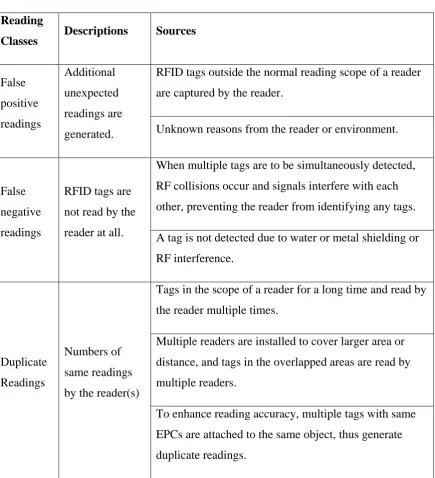
The next reading class that considered as anomaly is duplicate reading. Duplicate reading is common problem in RFID. It is exists because RFID reader has the ability to read the same tag number of times as long the tag’s is still the reader’s vicinity. Duplicate reading need to be removed because it over represent the data, unnecessarily occupying the memory space and require unnecessary processing. We are only interested on the data that indicate the occurrence of events. For example on smart shelf application, the readings that are most important are when the item is put on the shelf and when it is being pickup by customer. That can indicate the current number of items that are currently available on the shelf. Another source of duplicate readings is because more than one reader is covering the same vicinity to increase the reliability of the readings. In some cases, the reader’s vicinity was overlapped with each other that causing the redundancy. Figure 2.3 shows the RFID types of readings and Table 2.3 represent the summary of anomalies reading classes in RFID.
100E
Readings
Time ID
100 100E True Positive 200 300E False Positive 300
400 100E False NegativeDuplicate Reading Types
[image:29.595.148.445.637.742.2]
-500 100E Duplicate
22
Table 2.3: Summary of reading classes considered as anomalies in RFID
Reading
Classes Descriptions Sources
False positive readings
Additional unexpected readings are generated.
RFID tags outside the normal reading scope of a reader are captured by the reader.
Unknown reasons from the reader or environment.
False negative readings
RFID tags are not read by the reader at all.
When multiple tags are to be simultaneously detected, RF collisions occur and signals interfere with each other, preventing the reader from identifying any tags. A tag is not detected due to water or metal shielding or RF interference.
Duplicate Readings
Numbers of same readings by the reader(s)
Tags in the scope of a reader for a long time and read by the reader multiple times.
Multiple readers are installed to cover larger area or distance, and tags in the overlapped areas are read by multiple readers.
To enhance reading accuracy, multiple tags with same EPCs are attached to the same object, thus generate duplicate readings.
2.3.2 Basic of RFID Data Filtering
23
300 it misses to read the tag but at time 400 and 500 it read the tag correctly which create duplicate readings in the data stream.
Basically, the occurrence of true positive is higher than false positive [19]. The false positive can be filtered by removing readings that have low readings. The problem now is how to set the threshold and how to perform the filtering efficiently. The second anomaly, the false negative can be solved by adding more reading cycles, so that tag have more chances to be read. By filtering the duplicate reading too, the missed reading can be recovered. For example, it has gone missing at time 300, but at time 400 and 500 it is being read again. That’s mean the tag exist in the reader interrogation area from time 100 to 500. Based on this, the problem of false negative has been solved. The problem now when we increase the reading cycle, there will be higher probability on false positive and duplicate readings occurrence. Our research will be focusing on filtering these anomalies which in the same time recover the missed readings.
2.3.3 Filtering Approaches
24
reading and recover missed reading. Then we have the slotting algorithm, which aim to put reader into different slot to avoid signal collision, which is the main source of noise reading. The sixth category is by using data modelling. By having specialized data model for RFID, the filtering of anomalies data can be done automatically. The storage of the readings needs to follow the data structure in the model that does not allow duplicate data. The last category is the in-network filtering. The filtering is done in-network. One of the approaches is to eliminate redundant reader to save energy. In the same time it reduces the duplicate readings by letting less reader to operate.
2.3.3.1 Windows-based
The incoming readings from reader can be filtered by comparing their number of occurrence. Noise readings are low in occurrence compared to true positive readings [19]. Therefore, a threshold can be set based on the occurrence rate of noise reading. For example if noise readings can occur no more than three times in 10 cycle readings, the threshold can be set to 4. Only readings that appear more or equal to 4 in the specified range can be verified as true positive. The specified range can be expressed in terms of the number of readings or time unit. A window can be used to realize the range based on either number of elements or using time unit. Generally two types of windows that usually use in data filtering are: (i) sliding windows (ii) landmark windows. Figure 2.4 shows the movement differences between each window.
(i) Sliding window
141
References
[1] F. Taghaboni-Dutta, B. Velthouse, RFID technology is revolutionary: who should be involved in this game of tag?, Academy of Management Perspectives2006, 20, 65–78 [2] Hardgrave, BC; Waller, M.; Miller, R. RFID’s impact on out of stocks: A sales
velocity analysis, University of Arkansas 2006.
[3] Weinstein, R. RFID: A technical overview and its application to the enterprise, IT Professional2005, 7, 27- 33.
[4] Lee, C.-Y.; Tsui, H.D.; Ya, C.B.; Lin, H.-J.; Wang, Y.-D. Cross referencing algorithm for identifying group completeness in RFID system. In Proceedings of the Sixth International Conference on Networked Computing and Advanced Information Management, Seoul, South Korea,16-18 Aug. 2010, pp.461-465.
[5] Huang, C.-T.; Lo, L.-W.; Wang, W.-L.; Chen, H.-L. A study for optimizing the reading rate of RFID tagged cartons in palletizing process, In Proceedings of the IEEE International Conference on Industrial Engineering and Engineering Management, Singapore,8-11 Dec. 2008, pp.1138-1142.
[6] Snyder, L.; Baskett, F.; Caroll, M.; Colemanm, D.; Estrin, D.; Furst, M.; Hennessy, J.; Kung, H.; Maly, K.; Reid, B. Academic Careers for Experimental Computer Scientists and Engineers. National Academy Press: Washington. 1994.
[7] Wang, F.; Liu, P. Temporal management of RFID data. In Proceedings of the 31st International Conference on Very Large Data Bases, Trento, Italy, 04-06 October 2004; pp.1128-1139.
[8] Derakhshan, R.; Orlowska, M.; Li, X. RFID data management: challenges and opportunities. In Proceedings of the IEEE International Conference on RFID, Grapevine, Texas, 26-28 March 2007; pp.175–182.
[9] Chawathe, S. S.; Krishnamurthy, V.; Ramachandran, S.; Sarma, S. Managing RFID data. In Proceedings of the 30th International Conference on Very Large Data Bases, Toronto, Canada, 29 August - 3 September 2004; pp. 1189-1195.
[10] Clampitt, H.G. RFID Certification Textbook. 3rd edition, American RFID Solution, LLC, 2007.
[11] Chawla, V.; Ha, D.S. An overview of passive RFID. IEEE Communications Magazine 2007, 45, 11-17.
142
[13] Wenchong Shi; Maohua Liu; Honggang Liu. On the current situation of developing RFID middleware in China. In Proceedings of the International Conference on Mechatronic Science, Electric Engineering and Computer (MEC), Jilin, China,19-22 Aug. 2011; pp.1278-1280.
[14] Darcy, P.; Stantic, B.; Sattar, A. A fusion of data analysis and non-monotonic reasoning to restore missed RFID readings. In Proceedings of the 5th International Conference on Intelligent Sensors, Sensor Networks and Information Processing, Melbourne, Victoria, 27-10 Dec. 2009; pp. 313-318.
[15] Nogee, A. RFID tags and chips: Opportunities in the second generation. In-Stat/MDR Reports. December 2005.
[16] Jeffery, S. R.; Alonso, G.; Franklin, M.J.; Hong, W.; Widom, J. A pipelined framework for online cleaning of sensor data streams. In Proceedings of the 22nd International Conference on Data Engineering, Atlanta, Georgia, 3-7 April 2006; p.140.
[17] Leong, K. S.; Ng, M. L.; Grasso, A. R.; Cole, P. H. Synchronization of RFID readers for dense RFID reader environments. In Proceedings of the International Symposium on Applications and the Internet Workshops, Phoenix, Arizona, 23-27 Jan, 2006; pp. 48–51.
[18] Azambuja, M.C.d.; Jung, C.F.; Caten, C.S.; Hessel, F.P. RFID-Env: Methods and software simulation for RFID environments. Business Process Management Journal 2010, 16, 1014 – 1038.
[19] Bai, Y.; Wang, F.; Liu, P. Efficiently filtering RFID data streams. In Proceedings of the CleanDB Workshop, Seoul, South Korea, September 2006; pp. 50-57.
[20] Shen H.; Zhang Y. Improved approximate detection of duplicates for data streams over sliding windows. Journal of Computer Science and Technology 2008; 23, 973– 987.
[21] Tyagi, S.; Ansari, A.Q.; Khan, M.A. Dynamic threshold based sliding-window filtering technique for RFID data. In Proceedings of the IEEE 2nd International Advance Computing Conference, Patiala, India, 19-20 Feb 2010; pp.115-120.
[22] Zhang, L.; Guan, Y. Detecting click fraud in pay-per-click streams of online advertising networks. In Proceedings of the 28th International Conference on Distributed Computing Systems, Beijing, China, 17-20 June 2008; pp.77-84. [23] Metwally, A.; Agrawal, D.; Abbadi. A.E. Duplicate detection in click streams.
In Proceedings of the 14th International Conference on World Wide Web, Chiba, Japan, 10-14 May 2005; pp.12-21.
143
[25] Jeffery, S. R.; Garofalakis, M.; Franklin, M.J. Adaptive cleaning for RFID data streams. In Proceedings of the 32nd International Conference on Very Large Databases, Seoul, Korea, 12-15 September 2006; pp.163 -174.
[26] Palmer, M. Seven Principles of effective RFID data management,
http://www.objectstore.com/docs/articles/7principles rfid mgmnt.pdf, Aug. 2004. [27] Bai, Y.; Thakkar, H.; Wang, H.; Luo, C.; Zaniolo, C. A data stream language and
system designed for power and extensibility. In Proceedings of the 15th ACM International Conference on Information and Knowledge Management, Virginia, USA, 6-11 November 2006; pp.337-346.
[28] Bai, Y.; Wang, F.; Liu, P.; Zaniolo, C.; Liu, S. RFID data processing with a data stream query language. In Proceedings of the IEEE 23rd International Data Engineering, Istanbul, Turkey, 15-20 April 2007; pp. 1184 - 1193
[29] Bloom, B. Space/Time tradeoffs in hash coding with allowable errors. Commun. ACM 1970; 13, 422–426.
[30] Wang, X.; Zhang, Q.; Jia, Y. Efficiently filtering duplicates over distributed data streams. In Proceedings of the International Conference on Computer Science and Software Engineering, Wuhan, Hubei, 12-14 Dec. 2008; pp. 631 – 634.
[31] Fan L.; Cao P.; Almeida J.; Broder A.Z. Summary cache: A Scalable Wide-Area Web Cache Sharing Protocol. IEEE/ACM Trans. Networking 2000; 8, 281-293.
[32] Ouyang Y., Hou Y., Pang L., Wang D.; Xiong Z. An intelligent RFID reader and its application in airport baggage handling system, In Proceedings of the International Conference on Wireless Communications, Networking and Mobile Computing, Dalian, China, 12-14 Oct. 2008; pp. 1-4.
[33] Wang J., Luo Z.; Wong E.C. RFID-enabled tracking in flexible assembly line.
International Journal Advanced Manufacturing Technology 2010; 46, 351–360. [34] Peng, X. Z., Ji, Luo, Z., Wong, E. C.; Tan, C. J. A P2P collaborative rfid data
cleaning model. In Proceedings of the 3rd International Conference on Grid and Pervasive Computing, Kunming, China, 25-28 May 2008; pp. 304-309.
[35] Ilie-Zudor, E.; Kemeny, Z.; Blommestein, F.v.; Monostori, L.; Meulen, A.v.d. A survey of applications and requirements of unique identification systems and RFID techniques, Computers in Industry 2010, 62, 227-25.
144
[37] Ni, L. M.; Liu, Y.; Lau, Y. C.; Patil, A. P. LANDMARC: Indoor location sensing using active RFID, Wireless Networks2004, 10, 701-710.
[38] Chetan, S.; Ranganathan, A.; Campbell, R. Towards fault tolerance pervasive computing, IEEE Technology and Society Magazine, 2005, pp. 38-44.
[39] Zhou, S.; Luo, Z.; Wong, E.; Tan, C.J.; Luo, J. Interconnected RFID reader collision model and its application in reader anti-collision, In Proceedings of the IEEE International Conference on RFID, Grapevine, Texas, 26-28 March 2007; pp.212-219.
[40] Lin X.; Pan J.; Liang, J.; Wang, D. An RFID reader coordination model for data process. In Proceedings of the Second International Symposium on Computational Intelligence and Design,Changsa, China, 12-14 Dec. 2009; pp. 83-86.
[41] Peng, X. Z.; Ji, Luo, Z.; Wong, E. C.; Tan, C. J. A P2P collaborative rfid data cleaning model. In Proceedings of the 3rd International Conference on Grid and Pervasive Computing, Kunming, China, 25-18 May 2008; pp. 304-309.
[42] Ding, M.; Liu, F.; Thaeler, A.; Chen, D.; Cheng, X. Fault-tolerant target localization in sensor networks, EURASIP Journal on Wireless Communications and Networking, 2007, 2007, 19.
[43] Marzullo, K. Tolerating failures of continuous-valued sensors. ACM Transactions on Computer Systems1990, 8, 284-304.
[44] Rajasegarar, S.; Leckie, C.; Bezdek, J.C.; Palaniswami, M. Centered hyperspherical and hyperellipsoidal one-class support vector machines for anomaly detection in sensor networks. IEEE Transactions on Information Forensics and Security 2010, 5, 518-533.
[45] Jeffery, S.R.; Garofalakis, M.; Franklin, M.J. Adaptive cleaning for RFID data streams. In Proceedings of the 32nd international conference on Very large data bases, Seoul, Korea, 12-15 Sept 2006; pp. 163-174.
[46] Zug, S.; Dietrich, A.; Kaiser, J. An architecture for a dependable distributed sensor system, IEEE Transactions onInstrumentation and Measurement2010, 60, 408-419. [47] Mills, D.L. A brief history of NTP time: memoirs of an Internet
timekeeper. SIGCOMM Comput. Commun. Rev. 2003, 9-21.
[48] Marzullo, K.; S. Owicki. Maintaining the time in a distributed system. ACM Operating Systems Review 1985, 19, 44-54.
145
[50] Shin, K.C.; Park, S.B.; Jo, G.S. Enhanced TDMA based anti-collision algorithm with a dynamic frame size adjustment strategy for mobile RFID readers. Sensors 2009, 9, 845-858.
[51] Namboodiri, V.; Gao, L. Energy-aware tag anticollision protocols for RFID systems.
IEEE Transactions on Mobile Computing2010, 9, 44-59.
[52] Gonzalez, H.; Han, J.; Li, X.; Klabjan, D. Warehousing and analysing massive RFID data sets. In Proceedings of the International Conference on Data Engineering, Atlanta, USA, 3-7 April 2006; pp. 1-10.
[53] Liu, S.; Wang, F.; Liu, P. Integrated data modeling for querying physical objects in rfid-enabled pervasive computing. In Proceedings of the International Conference on Mobile Data Management, Mannheim, Germany, 7-11 May 2007; pp.140-145.
[54] Carbunar, B.; Ramanathan, M. K.; Koyuturk, M.; Hoffmann, C.; Grama, A. Redundant reader elimination in RFID systems. In Proceedings of the Second Annual IEEE Communications and Networks, Santa Clara, California, 25-29 Sept 2005; pp. 176-184.
[55] Irfan, N.; Yagoub, M. CE. Efficient algorithm for redundant reader elimination in wireless RFID networks. International Journal of Computer Science Issues 2010, 7, 1-8.
[56] Ko, C.-H. RFID-based Building Maintenance System, Automation in Construction 2009, 18, 275-284.
[57] Bashir, A.K.; Lim, S.-J.; Hussain, C.S.; Park, M.-S. Energy efficient in-network RFID data filtering scheme in wireless sensor networks. Sensors2011, 11, 7004-7021. [58] Im, S.; Kim I-J; Ahn S.C.; Kim, H-G. Automatic ADL classification using 3-axial
accelerometers and RFID sensor. In Proceedings of the IEEE International Conference on Multisensor Fusion and Integration for Intelligent Systems, Seoul, South Korea,20-22 Aug. 2008; pp.697-702.
[59] Soberg, J.; Goebel, V.; Plagemann, T.; Detection of spatial events in CommonSens. In
Proceedings of the 2nd ACM International Workshop on Events in Multimedia, Firenze, Italy, 25 October 2010; pp. 53-58.
[60] Liu, H.; Li, J.; Zhang, J.; Deng, H. RFID data management in manufactory. In
Proceedings of the 2nd International Conference on Anti-counterfeiting, Security and Identification, Guiyang, China, 20-23 Aug. 2008; pp.420-423.
[61] Ranasinghe, D.C.; Cole, P.H. Networked RFID systems and lightweight cryptography. Networked RFID Systems 2008, pp. 45-58.
146
[63] Chin, K.-W.; Klair, D. E2MAC : An energy efficient MAC for RFID-enhanced wireless sensor networks, Pervasive and Mobile Computing, 7, April 2011, pp. 241-255.
[64] Dong, Q.; Shukla, A.; Shrivastava, V.; Agrawal, D.; Banerjee, S.; Kar, K. Load balancing in large-scale RFID systems, Computer Networks, 52, 26 June 2008, pp. 1782-1796.
[65] Liu, L.; Lai, S. ALOHA-based anti-collision algorithms used in RFID system. In
Proceedings of the International Conference on Wireless Communications, Networking and Mobile Computing, 22-24 Sept. 2006, pp.1-4.
[66] Waldrop, J.; Engels, D.W.; Sarma, S.E. Colorwave: an anticollision algorithm for the reader collision problem. IEEE International Conference onCommunications, 11-15 May 2003, pp. 1206- 1210.
[67] Kapoor, G.; Zhou, W.; Piramuthu, S. Challenges associated with RFID tag implementations in supply chains. European Journal of Information Systems2009, 18 (6), 526–533.
[68] Jeffery, S.; Alonso, G.; Franklin, M.; Hong, W.; Widom, J. Declarative support for sensor data cleaning. Pervasive, May 2006.
[69] Palmer, M. Principles of effective RFID data management. Enterprise System, March 2004.
[70] Roberti, M. Using RFID at item level. Chain Store Age, 82(7):56, 2006.
[71] Pala, Z.; Inanc, N. Smart parking applications using RFID technology, In Proceedings of the 1st Annual RFID Eurasia, Istanbul, Turkey, 5-6 Sept. 2007;pp.1-3.
[72] Jeffery, S.R.; Garofalakis, M.; Franklin, M.J. An adaptive RFID middleware for supporting metaphysical data independence. VLDB J. 2008, 17, 265-289.
[73] Mahdin, H.; Abawajy, J. An approach to filtering RFID data streams. In Proceedings of the 10th International Symposium on Pervasive Systems, Algorithms, and Networks, Kaoshiung, Taiwan, 14–16 December 2009; pp. 742-746.
[74] Pupunwiwat, P.; Bela, S. Location filtering and duplication elimination for RFID data streams. Int. J. Princ. Appl. Inf. Sci. Technol.2007, 1, 29-43.
147
[76] Chen, W.T. An accurate tag estimate method for improving the performance of an RFID anti collision algorithm based on dynamic frame length ALOHA. Proc. IEICE Trans. Autom. Sci. Eng.2009, 6, 9-15.
[77] Christian F.; Christof R.; Matthias L. RFID application development with the Accada middleware platform, IEEE Systems Journal2007, 1, 82-94.
[78] Saygin C.; Natarajan, B. RFID-based baggage-handling system design, Sensor Review 2010, 30, 324 – 335.
[79] Ouyang Y.; Hou Y.; Pang L.; Wang D.; Xiong Z. An intelligent RFID reader and its application in airport baggage handling system, In Proceedings of the International Conference on Wireless Communications, Networking and Mobile Computing, Dalian, China, 12-14 Oct. 2008; pp.1-4.
[80] Johnstone, M.; Creighton, D.; Nahavandi, S. Status-based routing in baggage handling systems: searching verses learning, IEEE Transactions on Systems, Man, and Cybernetics, Part C: Applications and Reviews2010, 40, 189-200.
[81] Harrison, J. Supply Chain Security and International Terrorism. In Supply Chain Security, Thomas, A.R., Eds.; Praeger Security International: Westport, CT, US, 2009; Volume 1, pp. 57-74.
[82] Roach, K. The air india report and the regulation of charities and terrorism financing,
University of Toronto Law Journal 2011, 6, 45-57.
[83] Marchi E.; Ferri N.; Comellini F. Pig identification: comparison of results from injected transponders and electronic ear tags. Vet Ital 2007, 43, 89-95.
[84] Rajasegarar, S.; Leckie, C.; Bezdek, J.C.; Palaniswami, M. Centered hyperspherical and hyperellipsoidal one-class support vector machines for anomaly detection in sensor networks. IEEE Transactions on Information Forensics and Security, 2010, 5, 518-533.
[85] Park, N.; Song, Y.; Won, D.; Kim, H. Multilateral approaches to the mobile RFID security problem using web service. In Proceedings Of The 10th Asia-Pacific Web Conference On Progress In WWW Research And Development, Busan, Korea, 6-8 April 2010; pp. 331–341.
[86] Sengupta, A.; Sethi, V. RFID preventive maintenance and troubleshooting, Wright Brothers Institute Inc Dayton Ohio2007.
[87] Lee, J.G.; Hwang, S.J.; Kim, S.W.; Ahn, S.; Park K.; Koo, J.H.; Kang, W.S. Software architecture for a multi-protocol RFID reader on mobile devices. In Proceedings of the Second International Conference on Embedded Software and Systems, Xi’an,
148
[88] Drzaic, P.S.; Penzias, A.A. Location management for radio frequency identification readers. 2007, US Patent 7295114
[89] Rekik, Y. An analysis of the impact of RFID technology on inventory systems, In
Unique Radio Innovation for the 21st Century, Sheng, Q., Zeadally, S., Eds.; Springer Berlin Heidelberg: 2010; Part 5, pp.435-450.
[90] Schuster, E.W. Auto-id technology: creating an intelligent infrastructure for business,
The Data Center Massachusetts Institute of Technology Cambridge. http://web.mit.edu/edmund_w/www/CutterAutoIDReportV2.pdf (accessed Dec 2011).
[91] Cocci, R.; Tran, T.; Diao, Y.; Shenoy, P. Efficient data interpretation and compression over rfid streams. In Proceedings of the IEEE 24th International Conference on Data Engineering, Cancun, Mexico, 7-12 April 2008; pp.1445-1447.
[92] Ilie-Zudor, E.; Kemény, Z.; Egri, P. and Monostori, L. The RFID technology and its current applications. In Proceedings of The Modern Information Technology in the Innovation Processes of the Industrial Enterprises, Budapest, Bulgaria, 2004; pp. 29-36.
[93] Prabakar, V.; Kumar, B.V.; Subrahmanya, S.V. Management of RFID-centric business networks using Web Services, In Proceedings of the Advanced International Conference on Telecommunications and International Conference on Internet and Web Applications and Services, Guadeloupe, French Caribbean, 19-25 Feb. 2006; pp. 133-141.
[94] Sen, P.; Sen, D.; Das, A. RFID for energy and utility industries, Pennwell Books, 2009.
[95] Shutzberg, L. RFID in the consumer goods supply chain: Mandated compliance or remarkable innovation? October 2004, white paper, www.rfidjournals.com
[96] Cato, R.T.; Do, P.K.; Pierce, J.M. Diagnosing a radio frequency identification reader,
2010, US Patent 7760074
[97] Casden, M.S. Metal housing with integral antenna for RFID reader/writer. 2008, US Patent 7411507
[98] Schneider, G.G.; Blasczak, M.; Giebel, J.; Barkan, E.; Sackett, W.; Difazio, C. Management of data capture systems. 2007, US Patent 7267283
[99] Kemény, Zs.; Ilie-Zudor, E.; Kajosaari, R.; Holmström, J.; van Bolmmestein, F. State of the Art in Tracking-Based Business . Technical report, EU 6th Framework Specific Targeted Research Project TraSer, 2007.
149 on Ultra Modern Telecommunications & Workshops, St. Petersburg, Russia, 12-14 Oct. 2009; pp.1-4.
[101] Tang, S.; Yuan, J.; Li, X.-Y.; Chen, G.; Liu, Y.; Zhao, J. RASPberry: A stable reader activation scheduling protocol in multi-reader RFID systems. In Proceedings of the 17th IEEE International Conference on Network Protocols, Princeton, New Jersey, 13-16 Oct. 2009; pp.304-313.
[102] Li, Z.; Chu, C.-H.; Yao, W. SIP-RLTS: An RFID location tracking system based on SIP. In Proceedings of the IEEE International Conference on RFID, Las Vegas, Nevada, 16-17 April 2008; pp. 173-182.
[103] Alani, O.; Elmirghani, J. Mix queues approach for indoor network traffic modelling. In Proceedings of the Fifth International Conference on Networking and Services, Valencia, Spain. 20-25 April 2009; pp. 438-443.
[104] Jiang, B.; Smith, J.R.; Philipose, M.; Roy, S.; Sundara-Rajan, K.; Mamishev, A.V. Energy scavenging FOR inductively coupled passive RFID systems. IEEE Transactions onInstrumentation and Measurement, 2007, 56, pp. 118-125.
[105] Tian, J.; Zhu, J. Positioning system for miners based on RFID. In Proceedings of the International Conference onMultimedia Technology (ICMT). Hangzhou, China, 26-28 July 2011; pp.626-629,
[106] Sun, Q.; Zhang, H.; Mo, L. Dual-reader wireless protocols for dense active RFID identification. International Journal Of Communication Systems 2011, 24, 1431– 1444.
[107] Falk, R.; Hof, H.-J. Fighting insomnia: A secure wake-up scheme for wireless sensor networks. In Proceedings of the Third International Conference on Emerging Security Information, Systems and Technologies, Athens, Glyfada, 18-23 June 2009, pp.191-196.
[108] Klair, D.; Chin, K.; Raad, R. On the energy consumption of pure and slotted aloha based RFID anti-collision protocols. ComputerCommunications, 2008. 32, 961–973. [109] Jurdak, R.; Ruzzelli, A.G.; O'Hare, G.M.P. Radio sleep mode optimization in wireless
sensor networks. IEEE Transactions onMobile Computing2010,9, 955-968.
[110] Pinto, A.; Zhang, Z.; Dong. X.; Velipasalar, S.; Vuran, M.C.; Gursoy, M.C. Energy consumption and latency analysis for wireless multimedia sensor networks. In
Proceedings of the Global Telecommunications Conference, Miami, Florida, 6-10 Dec. 2010, pp.1-5.
[111] Mysore, N.; Nenavat, P.; Unnithan, R.S.; Mulukutla, R.; Rao, S. An efficient algorithm for RFID reader positioning for coverage of irregularly-shaped areas. In
150