17
M.K. Shamshuddin 1*, M.E. Abdullah2 and S.M. Rhasbudin Shah3 1,2Faculty of Civil and Environmental Engineering, UTHM, Malaysia
3Faculty of Civil Engineering, Universiti Teknologi MARA (UiTM), Pulau Pinang, Malaysia
*Corresponding email: [email protected]
Abstract
Moisture damage is one of the major issues in asphalt distress. It is due to the adhesive and cohesive failure of asphalt mixture and it will shorten pavement life. Moisture-sensitive mixtures need to be identified during the course of the mixture design process which fulfills the specified minimum standard. The laboratory testing procedures currently available for compacted Hot Mix Asphalt (HMA) to test the moisture sensitivity were primarily developed to determine the degree of resistance to moisture damage by a particular combination of asphalt and aggregate. These moisture sensitivity tests evaluate the effect of moisture damage in laboratory by measuring the relative change of a single parameter before and after conditioning (i.e., Tensile Strength Ratio, Resilient Modulus Ratio). The tests were simple to conduct and widely accepted by various state and federal agencies, but their drawback include the empirical nature of the procedures, the dependence of the results on the moisture conditioning methodology and in several cases, the poor correlation with field performance. Many new approaches were conducted to overcome the weaknesses of the existing method. These new approaches mostly designed to conduct the test as close as the field condition and consider the material properties of asphalt to give the useful result for the asphalt performance. For better asphalt mixture design, it needs to have the test procedure which considered the effect of traffic loading. The moisture conditioning methodology should avoid using the vacuum saturation method since this method contributes to the asphalt mixture strength. The scale of performance measurement can be conducted either microscale or macroscle. Besides that the test also must be repeatable, reproducible, feasible, practical, and economical enough that it can be included in routine asphalt mixture design practice.
Keywords:Moisture damage, Moisture sensitivity tests.
The Development of Moisture
18
1. INTRODUCTION
[image:2.595.69.276.350.724.2]Moisture damage is one of the major issues in asphalt distress and can be considered as a degradation of the mechanical properties of the asphalt due to the action of moisture. Moisture-related problem are due to or are accelerated by the adhesive and cohesive failure. The adhesive failure is the stripping of the asphalt film from the aggregate surface and cohesion failure is due to the loss of mixture stiffness. These mechanisms can be associated with the aggregate, the binder or the interaction between the two ingredients. Moisture-related distresses are also accelerated by mixture design or construction issues, including those in Table 1 [1].
Table 1: Factors that can contribute to moisture-related distress (after [1])
Mixture
design Binder and aggregate chemistry Binder content Air voids Additives
Production Percent aggregate coating and quality of passing of the No. 200 sieve
Temperature at plant
Excess aggregate
moisture content Presence of clay
Construction Construction – high in-place air voids
Permeability – high values
Mix segregation
Change from the mix design to field production (field variability)
Climate High-rainfall areas Freeze-thaw cycles Desert issues (steam
stripping) Other factors Surface drainage
Sub-surface drainage Rehab strategies – chip
seals over marginal HMA materials
High truck Average Daily Traffic (ADT)
The asphalt which influenced by the moisture damage will exhibit the distress like corrugations, pumping and water bleeding, ravelling, weathering and striping. With the extent and severity due to moisture damage, it generates some major failures of asphalt like cracking, potholes, patches and rutting [2]. Based on this situation, moisture damage can be a significant problem that severely shorten a pavement’s life [3]. Therefore, moisture-sensitive mixtures need to be identified during the course of the mixture design process which fulfills the specified minimum standard. In order to achieve this requirement, numerous laboratory tests have been used to identify moisture-related problems. These include tests on loose mixture to determine coating during water immersion or in boiling water.
Besides the loose mixture, the test also conducted on the compacted mixture. The laboratory testing procedures currently available for compacted Hot Mix Asphalt (HMA) to test the moisture sensitivity were primarily developed to determine the degree of resistance to moisture damage by a particular combination of asphalt and aggregate. These moisture sensitivity tests evaluate the effect of moisture damage in laboratory by measuring the relative change of a single parameter before and after conditioning (i.e., Tensile Strength Ratio, Resilient Modulus Ratio). Both types of test (loose and compacted) measure the effects of moisture on adhesion, cohesion or some combination of the two [4, 5]. The tests were simple to conduct and widely accepted by various state and federal agencies, but their drawback include the empirical nature of the procedures, the dependence of the results on the moisture conditioning methodology and in several cases, the poor correlation with field performance [5, 6]. This prompted further research in term of improvement of the test methods and procedures to characterise the moisture sensitivity of asphalt mixtures.
19
and asphalt mixtures which suffer premature distress from the presence of moisture can be identified, however none of them has been consistently successful. Although the problem of moisture susceptibility has been widely studied, its complexity has made it difficult to find a unique test or analytical method to comprehensively quantify damage and accurately predict the material performance in the field [7]. Therefore, there is a need to an improvement of the test method and procedure to characterize the moisture sensitivity of asphalt mixtures. The objectives of this paper are to describe the important criteria of the physical test of the compacted mixture to evaluate the moisture sensitivity of asphalt. The criteria will give the most suitable and beneficial test for the future asphalt mixture design and contributes to the extension of the pavement life since the developing a highly reliable laboratory test to predict the susceptibility of HMA concrete to moisture damage remains a challenge to asphalt industry [8].
2. MOISTUREDAMAGETESTON COMPACTEDMIXTURE
[image:3.595.317.530.108.589.2]The development of the test to determine the moisture sensitivity of asphalt mixtures began in 1930’s. The test procedures have an attempt to simulate the strength loss from moisture damage that can occur in the field so asphalt mixtures which suffer premature distress from the presence of moisture can be identified [9]. An improvement over the visual qualitative method to assess moisture damage is the use of a performance parameter derived from a mechanical test on compacted mixture that is linked to moisture damage. A widely used approach for quantifying moisture damage for the compacted mixture is the ratio of a parameter derived by testing in dry or control specimens to the same parameter derived by testing in moisture conditioned specimens [10]. The list of test methods for this category is shown in Table 2.
Table 2: Moisture sensitivity test on compacted specimens (after [7])
Test Method AST M AASHT O Other Moisture vapour susceptibility
California Test
307 Developed in late 1940s Immersion/Co mpression Tests [4, 6, 12]
D10
75 T165 ASTM STP 252 (Goode 1959)
Marshall
Immersion Stuart 1986
Texas Freeze-Thaw Pedestal Test [4]
Kennedy et al
(1982)
Original Lottman indirect tension [4, 6, 12-14]
NCHRP Report
246 (Lottman 1982); Transportation Research Record 515 (1974) Modified Lottman indirect tension [6]
T 283 NCHRP Report 274 (Tunnicliff and Root 1984), Tex 531-C Tunnicliff and
Root [6, 12, 15, 16]
D48 67
NCHRP Report 274 (Tunnicliff and Root 1984) Environmental
Conditioning System (ECS) with resilient modulus [4, 13, 17]
SHRP-A-403
(Al Swailmi and Terrel 1994)
Hamburg Wheel Tracking Test [4, 12, 13]
1993
Tex-242-F
Asphalt pavement analyzer
ECS/SPT NCHRP-9-34
2002-03 Multiple
freeze-thaw
20
However, there are some disadvantages of the existing method to determine the moisture susceptibility of asphalt as follows [11]:
a. Not capable to measure the potential for moisture saturation in service
b. The conditioning process to simulate the field exposure condition but accelerating the rate of strength loss
c. Not identify the causes responsible for the poor or good performance of the mixture.
d. Exhibit poor reproducibility between field and laboratories
According to the disadvantages of the existing method to determine moisture sensitivity of asphalt, it is a need to find the most suitable test to replace the existing method. With the better test method, the reliable and useful result will be obtained and contribute to the better asphalt mixture design and can extent the pavement life.
3. NEWAPPROACHOFMOISTURE DAMAGETESTONCOMPACTED MIXTURE
In order to overcome the disadvantages of the existing method to determine moisture sensitivity of asphalt, several new approaches were developed to improve the test method to evaluate the moisture sensitivity of asphalt during this decade. These new approaches mostly designed to conduct the test as close as the field condition and consider the material properties of asphalt to give the useful result for the asphalt performance. As an alternative to measure indirect tensile strength of the asphalt mixture is a test that evaluates a mixture’s fundamental properties. A research conducted by Khosla, et. al [18] introduced a simple axial test to determine the fundamental material properties such as cohesion (C) and friction angle (ø). The proposed axial test is based on the area of a flexible pavement under a wheel load tends to be confined by the frictional forces of the load and by support from the surrounding material. These effects can be duplicated in a closed-system triaxial test [19]. The triaxial test will provide a method of determining the cohesion (C) and friction
angle (ø) of the material which can be represented on a Mohr diagram. The cohesion value is affected by the bitumen-aggregate bonding of the mixture and the friction angle is related to the internal friction of the mixture. On the basis of these definitions, moisture should only affect the cohesion of the mixture and not the friction angle. The indirect tensile strength used in AASHTO T-283 measures this adhesion loss to some extent by comparing tensile strength of conditioned and unconditioned samples; however, the effect of C is not clear. This new test method provides a simple method for determining a mixture’s cohesion. Hence this proposed an axial test that will determine C and ø value of asphalt. The loss of cohesion due to conditioning can be used to determine a mixture’s moisture susceptibility and it would provide a further means of a new way for the assessing of moisture sensitivity of asphalt.
In real condition, moisture damage in asphalt occurs from the combination of several factors. Based on this situation, it needs to have the test methods which incorporate several sources of damage in conditioning the tested sample to demonstrate the real condition. An effort towards this approach was conducted by Collop, et. al [20] which developed of a combined ageing and moisture sensitivity laboratory test for asphalt. This test used to evaluate the performance of asphalt mixtures with relatively low binder content and relatively high air void contents. The test is known as the saturation ageing tensile stiffness (SATS) test and consists of initial saturation prior to placing compacted asphalt core samples in a high-temperature and high pressure environment in the presence of moisture for an extended period of time. The stiffness modulus measured after the test divided by the stiffness modulus measured before the test (retained stiffness modulus) and the specimen saturation after the test (retained saturation), are used as an indication of the sensitivity of the compacted mixture to combined ageing an moisture effects.
21
test with the action of water. This test method is known as Coaxial Shear Test (CAST). It is being used at Swiss Federal Laboratories for Materials and Testing and Research (EMPA) road engineering centre for determining the mechanical properties of asphalt concrete under repeated sinusoidal loading in both load and strain controlled mode at different temperatures and frequencies. CAST provides stiffness information under lateral deformation confinement, thus simulating the situation in a pavement layer under an idealized traffic loading [21]. The difference of this method with the recent moisture sensitivity test method is its allows following the development of the mechanical properties of a test specimen subjected to repeated loading under saturated conditions and immersed in water. It was found that this new test method appears fairly well to reflect the condition of a real road under warm humid climatic condition combined with heavy traffic. Beside that, based on this research, it is also shows that the test methods able to discriminate between different aggregates while the standard Indirect Tensile Test (ITT) tests failed.
Other works conducted by Birgisson et. al [22] evaluates the moisture susceptibility of asphalt mixtures with new performance-based fracture parameter, the energy ratio (ER). This effort allowed into quantifying the effects of moisture damage on the fracture resistance of asphalt mixture. It was found that the ER is capable of detecting a range of moisture damage in mixtures and it is also shown to detect the presence of antistripping agents in mixtures. It indicates that ER may form the basis of a promising combined-performance based specification criterion for evaluating the effects of moisture damage in mixtures as well as the overall resistance fracture. The ER also provides a framework for focusing in a systematic way on key mixture properties and factors that affect the moisture sensitivity for a given mixture.
Besides monitoring of the stiffness modulus, recovery that occurs during an immersion-drying cycles of asphalt has been studied by Pinzon and Such [23]. In this research, it proposed a non-destructive method for
evaluating the effects of immersion and drying on the mechanical performance of asphalt by a complex modulus approach. Monitoring the stiffness modulus could provide a clearer picture of the process of deterioration and recovery that occurs during immersion-drying cycle.
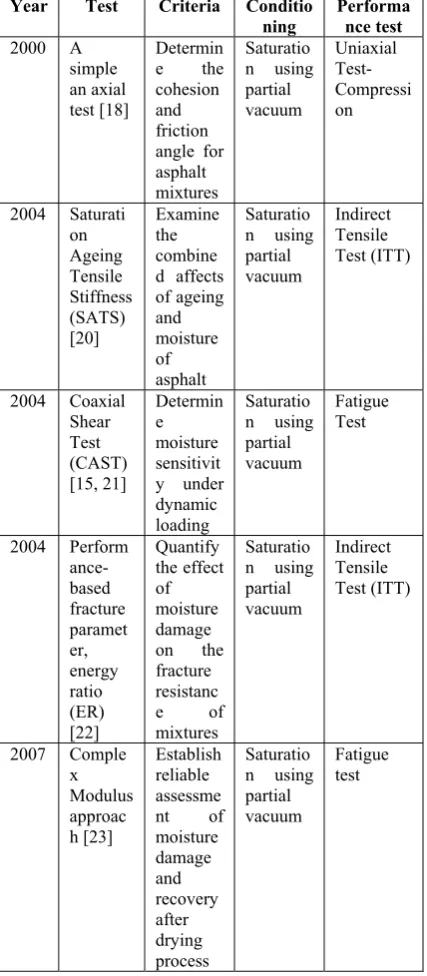
Table 3 shows the summary of new approaches conducted to evaluate the moisture sensitivity of asphalt. It was found that, many efforts have been done to have better testing procedure or analysis of moisture sensitivity of asphalt. Most of the effort was developed to encounter the weaknesses of the existing method. Testing test condition and analysis were conducted as close as the real condition.
4. DISCUSSION
22
[image:6.595.67.281.151.640.2]mixture strength or stiffness and the coating on the aggregate.
Table 3: Previous research on new approach of moisture sensitivity test on compacted specimens
Year Test Criteria Conditio
ning Performa nce test 2000 A simple an axial test [18] Determin e the cohesion and friction angle for asphalt mixtures Saturatio n using partial vacuum Uniaxial Test-Compressi on 2004 Saturati on Ageing Tensile Stiffness (SATS) [20] Examine the combine d affects of ageing and moisture of asphalt Saturatio n using partial vacuum Indirect Tensile Test (ITT) 2004 Coaxial Shear Test (CAST) [15, 21] Determin e moisture sensitivit y under dynamic loading Saturatio n using partial vacuum Fatigue Test 2004 Perform ance-based fracture paramet er, energy ratio (ER) [22] Quantify the effect of moisture damage on the fracture resistanc e of mixtures Saturatio n using partial vacuum Indirect Tensile Test (ITT) 2007 Comple x Modulus approac h [23] Establish reliable assessme nt of moisture damage and recovery after drying process Saturatio n using partial vacuum Fatigue test
Based on the weaknesses of the existing test method to determine the moisture susceptibility of asphalt, many efforts were conducted to find the new way to determine the moisture damage with more realistic approach. One of the fundamental task to develop the mechanical test for asphalt is the determination of the modulus [21]. It is essential to establish the test method which
can measure the stiffness of the asphalt until the failure since monitoring of the stiffness modulus could provide a clearer picture of the process of deterioration [23]. Determining the change in asphalt stiffness modulus as a result of moisture damage has the potential to be utilized with the mechanistic empirical design for performance prediction purposes [8], since the degradation of modulus plays an important role in pavement damage and should be included in calculations that predict long-term flexible pavement performance [24].
Another important thing that should be considered in the developing the test method is the calibration of the test to the conditions for which it will be applied. The test should not only calibrated and implemented on a local basis (a region within a state) but should be across a wide spectrum of conditions [7]. Reasons for the lack of widespread calibration with field performance include lack of accessible field performance data and difficulties with the tests such as variability and difficulty of operation. Many variables in the field make field correlation difficult, but development of such a correlation remains absolutely necessary. This has been a major shortcoming in the development of effective laboratory tests that can provide quantitative results used in specifications and design across a wide range of conditions. Mechanisms of moisture susceptibility or stripping may be different because of the different variables, but tests and their calibration must take into account materials, construction, traffic, and climate. The result will be that a given mixture will have different risks depending on where and how it will be used, and these factors must be accounted in the test development, test evaluation and calibration, and test implementation.
23
moisture sensitivity of asphalt. In general, the processes typically associated with moisture damage are complex and occur over a long period of time in the field. Some of the researchers explained that this method seems an extreme effort to allow water to infiltrate into the asphalt mixture. This ‘force’ itself has weakening the mastic film and the adhesive bond between aggregate and binder. Therefore, for the ideal laboratory-based conditioning, the system should accelerate the penetration of moisture through the asphalt film and at the same time minimize the complicating effects [25].
It is extremely difficult to find a single parameter that can be used successfully to characterise and predict moisture damage of asphalt. The main reason for the need to use multiple parameters to characterise moisture damage is a single material property cannot simultaneously account for the physical, mechanical and chemical changes that occur in the materials during the development of the moisture damage [10]. The multiple-parameter for moisture damage ratio utilises an analytically-based function to quantify damage by combining more than one material property and considering both dry and moisture conditioned states. This approach allows a more comprehensive evaluation of moisture damage based on several physical, chemical and mechanical properties [10]. The existing test method do not account for the interactions between the fundamental chemical and mechanical properties of the mixture constituents that influence the resistance to moisture damage. Consequently, these methods offer only a limited understanding of the factors influencing moisture damage. As an example, the advantage of the ER method is that it was derived based on principles of fracture mechanics. It takes into account for several fundamental chemical and mechanical properties.
It is an enormous contribution to the pavement engineer if there is a test method which incorporates the variables such as traffic, weather and structural design of the pavement since these factors are very important. Recently, there is not enough information is currently available to fully understand how these variables influence the
long-term moisture damage that may occur [13].
5. SUMMARYANDCONCLUSION
In conclusion, this paper shows an expression to refine an existing test procedure to test the moisture sensitivity of compacted asphalt. It should be based on the mode of loading, methodology used to induce moisture and scale of performance measurement.
The effect of traffic loading should be considered in the test procedure. From the repeated load, it will develop the dynamic movement of moisture within and between void spaces under the action of traffic.
It needs to find the other method to infiltrate moisture into the asphalt mixture beside the vacuum saturation method since this method will contribute to the adhesive and cohesive failure of the asphalt mixture.
Scale of performance measurement can be conducted either in macro or microscale.
Besides that, the test procedure also must be repeatable, reproducible, feasible, practical, and economical enough that it can be included in routine asphalt mixture design practice.
REFERENCES
[1] Hicks, R.G., L. Santucci, and T. Aschenbrener. Introduction and Seminar Objectives. in Moisture Sensitivity of Asphalt (A National Seminar). 2003. San Diego, California, United States of America.
[2] Arambula, E., E. Masad, and A.E. Martin, Influence of Air Void Distribution on the Moisture Damage of Asphalt Mixes. Journal of Materials in Civil Engineering, 2007. Vol. 19(No. 8): p. 655 - 664.
[3] D'Angelo, J. and P.M. Anderson.
24
[4] Airey, G.D. and Y.K. Choi, State of the Art Report on Moisture Sensitivity Test Methods for Bituminous Pavement Materials. International Journal of Road Materials and Pavement Design, 2002. Volume 3(No. 4): p. 355-372.
[5] Caro, S., et al., Moisture Susceptibility of Asphalt Mixture, Part 1: Mechanisms. International Journal of Pavement Engineering, 2008. 9(2): p. 81-98.
[6] Prithvi, S.K., Moisture Susceptibility of HMA Mixes: Identification of Problem and Recommended Solutions. 1992, National Center for Asphalt Technology (NCAT), Auburn University.
[7] Solaimanian, M., et al. Test Methods to Predict Moisture Sensitivity of Hot-Mix Asphalt Pavements. in Moisture Sensitivity of Asphalt Pavement (A National Seminar). 2003. San Diego, California, United States of America: Transport Research Board.
[8] Solaimanian, M., et al., Simple Performance Test for Moisture Damage Prediction in Asphalt Concrete. Journal of Association of Asphalt Paving Technologists, 2006. Vol. 75: p. 346 - 380.
[9] Terrel, R.L. and J.W. Shute, Summary Report on Water Sensitivity, in SHRP-A/IR-89-003. 1989, Strategic Highway Research Program.
[10]Caro, S., et al., Moisture Susceptibility of Asphalt Mixtures, Part 2: Characterisation and Modelling.
International Journal of Pavement Engineering, 2008. 9(2): p. 99-114. [11]Bhasin, A., et al., Use of Surface Free
Energy to Identify Moisture Sensitivity of Materials for Asphalt Mixes, in
Transportation Research Board 86th Annual Meeting. 2007, Transport Research Board: Washington DC, United States. p. 07-1579.
[12]Santucci, L. Moisture Sensitivity of Asphalt Pavements. [cited; Available from:
http://www.techtransfer.barkeley.edu/te chtopics/2002techtopics.pdf.
[13]Aschenbrener, T., R.B. McGennis, and R.L. Terrel, Comparison of Several Moisture Susceptibility Tests to
Pavements of Known Field Performance. Journal of Association of Asphalt Paving Technologists, 1995. 64: p. 163-208.
[14]Choubane, B., G.C. Page, and J.A. Musselman, Effects of Water Saturation Level on Resistance of Compacted Hot-Mix Asphalt Sample to Moisture-Induced Damage. Transportation Research Record, 2000. 1723: p. 97-106.
[15]Gubler, R., L.G. Baida, and M.N. Partl,
A New Method to Determine the Influence of Water on Mechanical Properties of Asphalt Concrete.
International Journal of Road Materials and Pavement Design, 2004. Volume 5(Special Issue): p. 259-279.
[16]Gubler, R., et al., Influence of Water and Temperature on Mechanical Properties of Selected Asphalt Pavements. Journal of Materials and Structures, 2005. Volume 38(June): p. 523-532.
[17]Alam, M.M., et al., Identification of Moisture-Susceptible Asphalt Concrete Using Modified Environmental Conditioning System. Transportation Research Record, 1998. 1630: p. 106-116.
[18]Khosla, N.P., B.G. Birdsall, and S. Kawaguchi, Evaluation of Moisture Susceptibility of Asphalt Mixtures (Conventional and New Methods).
Transportation Research Record, 2000. 1728: p. 43-51.
[19]Read, J. and D. Whiteoak, The Shell Bitumen Handbook. Fifth ed. 2003, London: Thomas Telford Publishing. [20]Collop, A.C. Development of the
Saturation Ageing Tensile Stiffness (SATS) Test. in Proceeding of the Institution of Civil Engineers Transport 157. 2004.
[21]Sokolov, K., R. Gubler, and M.N.Partl,
Extended Numerical Modeling and Application of the Coaxial Shear Test for Asphalt Pavements. Materials and Structures, 2005. 38(June): p. 515-522. [22]Birgisson, B., R. Roque, and G.C. Page,
25
Journal of the Transportation Research Board, 2004(No. 1891): p. 55-61. [23]Pinzon, E.C. and C. Such, Evaluation of
Moisture Sensitivity of Bituminous Mixtures by a Complex Modulus Approach. Journal of the Transportation Research Board, 2004(No. 1891): p. 62-67.
[24]Collop, A.C. and D. Cebon, Stiffness Reductions of Flexible Pavements Due to Cumulative Fatigue Damage. Journal of Transportation Engineering, 1996. Vol. 122(No. 2): p. 131 - 139.
![Table 1: Factors that can contribute to moisture-related distress (after [1])](https://thumb-us.123doks.com/thumbv2/123dok_us/8780613.904006/2.595.69.276.350.724/table-factors-contribute-moisture-related-distress.webp)
![Table 2: Moisture sensitivity test on compacted specimens (after [7])](https://thumb-us.123doks.com/thumbv2/123dok_us/8780613.904006/3.595.317.530.108.589/table-moisture-sensitivity-test-compacted-specimens-after.webp)