Artificial Noise Based Security Algorithm for
Multi-User MIMO System
Jian-hua Peng, Kai-zhi Huang, Jiang Ji
National Digital Switching System Engineering & Technological Research Center, Zhengzhou, China Email: [email protected]
Received June, 2013
ABSTRACT
The existing physical layer security algorithm, which is based on artificial noise, could affect legitimate receivers nega-tively when the number of users is no less than sending antennas in multi-user MIMO system. In order to improve secu-rity of multi-user MIMO system under this scenario, we propose a new multi-user MIMO system physical layer secusecu-rity algorithm based on joint channel state matrix. Firstly, multiple users are processed together, thus a multi-user joint channel state matrix is established. After achieving Singular Value Decomposition (SVD) of the joint channel state ma-trix, the minimum singular value is obtained, which can be utilized for precoding to eliminate the interference of artifi-cial noise to legitimate receivers. Further, we also present an approach to optimize the power allocation. Simulation results show that the proposed algorithm can increase secrecy capacity by 0.1 bit/s/HZ averagely.
Keywords: Multi-user MIMO System; Joint Channel State Matrix; Secrecy Capacity; Artificial Noise; Physical Layer Security
1. Introduction
The multiple-input-multiple-output (MIMO) technology has become one of the key technologies for the next gen-eration wireless communication systems. Besides, it has been introduced in the standards like IEEE 802.11/16 and 3GPP LTE. Due to the broadcast characteristics of the electromagnetic signal propagation and the openness of wireless channels, however, transmission of communica-tion contents in the wireless communicacommunica-tion system can be easily intercepted. Thusly, it has become important increasingly for protecting the multi-user MIMO system communication security.
Considering the scenario without null space in the multi-user MIMO system (number of legitimate users is more than or equal to the number of antennas at the transmitter), artificial noise for the physical layer security will introduce additional noise to the legitimate users. For this reason, available research about using artificial noise to achieve multi-user MIMO system physical layer security is conducted under the scenario of null space existing in the system. [1,2] proposed a method improv-ing security of the legitimate users by sendimprov-ing artificial noise to third-party users: the potential eavesdropper’s receiving could be inhibited by setting main lobe direct-ing at the desired users at the multi-antenna transmittdirect-ing terminal and transmitting artificial noise in the other beam. Communication security can be improved via combining the beam forming and the artificial noise
when the locations of eavesdroppers are unknown [3]. Another way to protect the security of the legitimate us-ers is achieved by introducing redundancy and transmit-ting artificial noise in the view of space and frequency domains combined [4]. An encipherment scheme under multi-user downlinks situation is proposed using artifi-cial noise jamming the eavesdroppers [5, 6]. Espeartifi-cially, [5] discusses the security effectiveness of linear beam forming with artificial noise integrated respectively in the MIMO broadcast channel and the MIMO transmission multicast; besides, the noise power allocation scheme is also considered with the SINR of desired users un-changed. [7-9] provide a derivation and prove the secrecy capacity range when there are multiple legitimate users and eavesdroppers in Gaussian MIMO and MISO witap channel. The noise power allocation is specific re-searched to maximize the secrecy capacity in literature [10]. In order to ensure the existence of system null space when the number of antennas in transmitting terminal is limited, literature [11] studies how to select users from the downlink multi-users to keep the security of the sys-tem. However, the application scenarios discussed above are limited, which restrict the system users’ capacity.
legitimate users are processed together at transmitting terminal, thus a multi-user joint channel state matrix and its complement matrix are established. Then, after Sin-gular Value Decomposition of the joint channel state matrix and the complement matrix respectively, the minimum singular value can be utilized for precoding, so as to eliminate the interference of artificial noise to le-gitimate receivers and multi-user. At last, the paper pre-sented an approach to optimize the power allocation. The paper established a joint channel state matrix and suffi-ciently considered the problems might exist in the multi-user system, by precoding both the artificial noise affect to the legitimate users is suppressed and the inter-ference between the multi-user is eliminated; the artifi-cial noise is forced to be transmitted via the small-est-affect sub-channel, while the majority artificial noise falls on the eavesdropping side. Simulation results show that the proposed algorithm can increase the secrecy ca-pacity by 0.1 bit/s/HZ averagely.
2. Security Model of the Multi-user MIMO
System
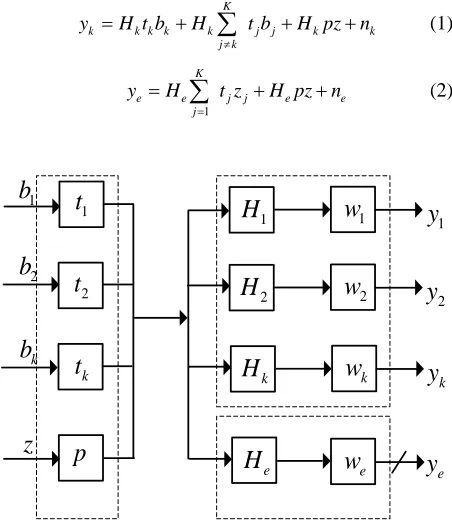
The encipherment model of the multi-user MIMO system is shown as Figure 1. Supposing there are NT transmit-ting antennas at transmittransmit-ting terminal, the number of re-ceiving antennas of each K legitimate users is present as NR. There is also a eavesdropper whose number of receiving antennas is NE.
Respectively, the signals received by the -thk le-gitimate user and the eavesdropper can be shown as:
K
k k k k k j j k k
j k
y H t b H t b H pz n
(1)1 K
e e j j e e
j
y H t z H pz n
(2)k
y
e
H
k
H
k
t
k
b
k
w
e
w
y
ep
z
2
b
1
b
2
t
1
t
2
y
2H
w
21
y
1 [image:2.595.61.287.458.720.2]H
w
1Figure 1. The Security model of multi-user MIMO system.
Among them: bk is the transmitting signal of the -th
k legitimate user, Hk is the channel state matrix of the k-th legitimate user, He is the channel state ma-trix of the eavesdropper, tk and p, the dimension all being NT1, are respectively stand for the precoding of eliminating affection to legitimate users caused by multi-user interference and artificial noise, z is the artifi-cial noise, nk and ne separately stand for the additive white Gaussian noise of the legitimate users and the eavesdropper.
Then, the signal estimation from the -thk legitimate user and the eavesdropper are separately:
' '
' '
K
k k k k k k k j j
j k
k k k k
y w H t b w H t b
w H pz w n
(3)
' ' '
1 K
e e e j j e e e e
j
y w H t b w H pz w n
(4)
Among them: wk and we are both NT1 dimen-sion and stands for beam forming weight for the -thk
legitimate user and the eavesdropper respectively, w'k
and w'e are the conjugate transposed matrixes of wk and we .
3. A Multi-user MIMO System Security
Algorithm Based on Artificial Noise
When there is more than one legitimate user, security using artificial noise should meet two requirements: 1) to prevent mutual interference between multi-user; 2) to minimize the artificial noise affection to legitimate users. Based on the two requirements, the main idea of the se-curity algorithm is the precoding design of p and tk , so that the numerous artificial noise and mutual interfer-ence between multi-user could be filtered as signal is transmitted though the legitimate users’ channel and the eavesdropper could not demodulate correctly due to the artificial noise affection. From (3) and (4), the legitimate users are affected by a small part of the artificial noise interference w H pz'k k , and the natural additive noise
from the channel w n'k k. Meanwhile, the eavesdropper is
effected by the mutual interference between multi-user
' K
e e j j
j k
w H t b
, the most part of the artificial noise inter- ference w H pz'e e and the natural additive noise fromthe channel w n'e e. As can be seen from the analysis
divided into two modules: precoding based on the Sin-gular Value Decomposition of complement matrix and precoding based on the Singular Value Decomposition of joint channel state matrix.
3.1. Precoding Based on the Singular Value Decomposition of Complement Matrix
Taking the modified Zero-Forcing beam forming method, in the receiving terminal [5], firstly, having process of beam forming and getting the weight vector wl, then defining the complement matrix
1 1 1
[ .... .... ]T
l l l K
H h h h h ,
in which the ( H )T
l l l
h w H is NT1 in dimension , so the dimension of Hl can be known as (K 1) NT ,
at last, the H
l l l l
H U D V would be got by the Singular Value Decomposition of Hl. At the time of KNT, the row number of Hl is less than the column number,
there would be a null space existing in the Singular Value Decomposition, then the right singular vector could be sequentially decomposed to [ ( )s (0)]H
l l l
V V V , while the ( )s
l
V is the corresponding right singular vector of the nonzero singular values and the (0)
l
V stands for the null space of the complement matrix. Therefore, the
precoding (0)
k l
t V based on the Singular Value
De-composition of Hl is available.
3.2. Precoding Based on the Singular Value Decomposition of Joint Channel State Matrix
To minimize the affection of the artificial noise at the same time on the K legitimate users, the joint channel state matrix can be defined as [ ...1 ]
T
k K
H h h , in
which the ( H )T
l l l
h w H is a NT1 dimension vector and the Hk is KNT dimension, so
H
k k k k
H U D V
would be got by the Singular Value Decomposition. At the time of KNT, the row number of Hk is less than the column number, there would be a null space existing in the Singular Value Decomposition, then the right singular vector could be sequentially decomposed to [ ( )s (0)]H
k k k
V V V , while the (0)
k
V stands for the null space of the complement matrix. Therefore, the precod-ing pVk(0) based on the Singular Value
Decomposi-tion of Hk is available, then, the artificial noise inter-ference to the legitimate users is zero by the precoding at the moment. At the time of KNT, the right singular vector could be sequentially decomposed to
( ) (0) [ s ]H
k k k
V V V ,
and there would be no null space existing in the decom-position of Hk , that is, there is no null space existing in the multi-user MIMO system. To make artificial noise being transmitted via the smallest-affect to the legitimate
users sub-channel and in order to reduce the affection to the legitimate users, the vector with smallest corre-sponding singular value in Vk( )s can be chosen as the
precoding p. The specific calculation steps are as fol-lows:
1) By the Singular Value Decomposition of hk, select the left singular vectors to be the wk corresponding to the largest singular value.
2) Constructing the complement matrix
1 1 1
[ .... .... ]T
l l l K
H h h h h ,
the precoding tk is available via the Singular Value Decomposition, which can eliminate the multi-user in-terference.
3) Constructing the joint channel state matrix
1
[ ... ]T
k K
H h h , the precoding p is available via the Singular Value Decomposition, to eliminate the artificial noise affection on the legitimate users.
4. Performance Analysis
4.1. Security Performance Analysis
On the basis of definition of secrecy capacity in literature [4], the secrecy capacity of the -thk user in the multi-user MIMO system in the case of no null space existing could be derived as:
2
' 2
sec 2
' 2 2
2
' 2
2 2
' 2 ' 2 2
log(1 )
log(1 )
k k k u
k k z n
e e k u
K
e e j u e e z e
j k
w H t C
w H p
w H t w H t w H p
(5)
Wherein, u2, z2, n2, e2 separately stand for the
signal power, artificial noise power, noise power in the legitimate user channel and the noise power in the eavesdropper channel of the k-th user.
2
' 2
sec 2
' 2 2
2
' 2
2 2
' 2 ' 2 2
log(1 )
log(1 )
k k k u
k k z n
e e k u
K
e e j u e e z e
j k
w H t C
w H p
w H t w H t w H p
(6)
user is pk P K
,the allocated noise power of the k-th
user is n
1
P p
K
and the channel capacity of the
-th
k user is:
2 ' 2 ' 2 log(1 ) 1k k k
Ak
k k n
w H t P
C
w H p P K
(7)
The channel capacity of the eavesdropper is:
2'
2 2
' ' 2
log(1 )
1
e e k
Ae K
e e j e e e
j k
w H t P
C
w H t P w H p P K
(8) Assuming:2 2 2
' ' 2 '
2 2
' ' 2
, , , ,
, ,
k k k k k n e e k
K
e e j e e e
j k
A W H t B W H p C K D W H t
E W H t F W H p G K
Then: log(1 ) (1 ) Ak A P CB P C
(9)
log(1 )
(1 )
Ae
D P C
E P F P G
(10)
After derivation to the secrecy formula
sec Ak Ae
C C C ,
make it equal to zero then get a unary quadratic equation about :
2
1 1 1 2 2 2 1 1 1 1 1 1 2 2 2 2 2 2
2 2
1 1 2 2 0
z a b z a b z a h z b h z a h z b h
z h z h
(11)
where in
1 2 1 2
1 2 1 2 2 1
, , , ,
, , ,
a E F D a A B b E F b B
h F G h B C z Ah z dh
By the discussion and judgment of the formulas above, the value of which could maximize the -thk user secrecy capacity can be available.
4.2. System Performance Analysis
From (7), the k-th user’s channel capacity without arti-ficial noise, i.e. 1 , can be acquired.
2 '
2
log(1 k k k )
Ak
n
w H t P C
K
(12)
Then, the system sum capacity without artificial noise is: 2 ' 2 1 log(1 ) K
k k k
k n
w H t P C
K
(13)Similarly, system sum capacity with artificial noise added is:
2 'z ' 2 2
1
log(1 )
1
K
k k k
k
k k n
w H t P
C
w H p P K
(14)So, with artificial noise security loss of system sum capacity is:
2 ' z 2 1 2 ' 2 ' 2 1= - = log(1 )
log(1 )
1
K
k k k
k n
K
k k k
k
k k n
w H t P C C C
K
w H t P
w H p P K
(15)Obviously, from (15), the loss of system sum capacity is closely related with the receiving terminal beam form-ing vector wk, the precoding eliminating the multi-user
interference tk, the precoding eliminating the artificial noise affection p and the useful power allocation coef-ficient . Taking advantages of precoding design prin-ciples in the previous section, which means the useful signal is transmitted through the primary channel and the artificial takes the secondary channel i.e. maximizing the
2 '
k k k
w H t and minimizing the ' 2
k k
w H p , the artificial
noise affection to the legitimate users and the loss of system sum capacity can be minimized.
5. Simulation and Analysis
5.1. Secrecy Capacity
First of all, according to the method given in [6], a simu-lation about secrecy capacity and sum capacity is taken as the null space being existent and security being taken in the system. Assuming that the numbers of antennas in the transmitting and receiving terminal are both 4, the number of legitimate users is 3, while the channel state of legitimate users is given and normalized and total power is 500 mW constantly. The simulation results of the
-th
k user’s secrecy capacity and sum capacity are
shown in Figures 3 and 4.
Secondly, raise the number of legitimate users to 4 and maintain the other simulation conditions. Now the null space will be inexistent, and the simulation results of the
-th
k user’s secrecy capacity and sum capacity are
shown in Figures 4 and 5 following the proposed algo-rithm.
[image:5.595.58.306.334.721.2]From Figure 4, when the system null space is inexist-ent, the system secrecy capacity can be also improved via the artificial noise, nonetheless, as the null space is in-existent, the secrecy capacity is decreased comparing with the null space existent condition. In addition, the system secure communication cannot be achieved when the useful power allocation coefficient is 0.8 and the ratio range is 70 n2 e2 100. With the legitimate user’s channel conditions deteriorated, the secrecy capacity when useful power distribution coefficient is 0.6 or 0.4 gets gradatim higher than the condition as useful power distribution coefficient being 0.8. This indicates that un-der certain conditions, by more artificial noise transmit-ted, the secrecy capacity can be improved and secure
Figure 2. Secrecy capacity.
Figure 3. Sum capacity.
communication will be realized.
From Figure 5, when the system null space is inexist-ent, the artificial noise has partial impact on the legiti-mate users, so the loss of sum capacity is intensified be-cause of the artificial noise security; the loss of sum ca-pacity with useful power allocation coefficients being 0.8 and 0.4 is separately as much as 1/4 and 1/2 of the sum capacity without encryption. In spite of big loss of sum capacity, as the users number increasing the sum capacity after encryption is still higher than sum capacity of the null space existing system. In summary, the substance of the proposed algorithm is via a certain loss of sum capac-ity to improve the secrecy capaccapac-ity.
5.2. Power Allocation
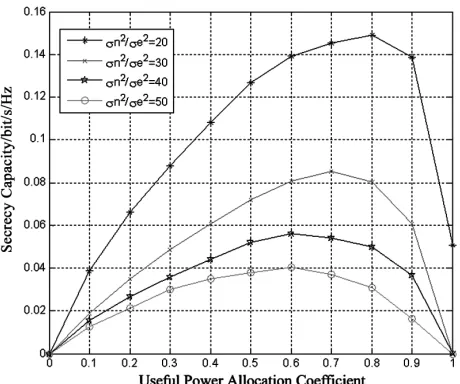
Assuming the total power to be 500 mW constantly, the simulation result of the -thk user secrecy capacity in the system changing with the useful signal power alloca-tion coefficient is shown as Figure 6. When n2 e2 20, known conditions from the simulation are:
Figure 4. Secrecy capacity.
[image:5.595.86.536.343.725.2]Figure 6. The Relationship between secrecy capacity and useful power allocation coefficient.
4
0.0775, 0.0067, 80, 9.786 10 ,
1.0048, 0.0012, 4
A B C D
E F G
Substituting results above into (10), the power alloca-tion coefficient which maximize the secrecy capacity (i.e. maximum transmitting speed under security trans-mission) could be present, similarly when the n2 e2
changes, only C need to be changed.
It is shown in Figure 6 that in the multi-user MIMO system with null space inexistent, the secrecy capacity will decline rapidly, when the transmission power of the artificial noise is too small, especially less than the 10 percent of total power, and the secure transmission can-not be achieved if the condition getting even worse. With legitimate users’ channel conditions deteriorate, the op-timum allocation coefficient gradually shifts left, namely, the allocated artificial noise power will be more and more if the channel condition of the eavesdropper is bet-ter than the legitimate user.
6. Conclusions
In this paper, a multi-user MIMO system security algo-rithm based on artificial noise is proposed, which em-phasizes the no null space in multi-user MIMO system scenario. In the algorithm, the affection of artificial noise to legitimate user is eliminated by precoding. For this purpose, the joint channel state matrix is established; then, after Singular Value Decomposition of the joint channel state matrix, the precoding is completed based on the minimum singular value; at last, an optimized power allocation scheme is proposed. As shown from simulation result, in the multi-user MIMO system with
null space inexistent, with artificial noise introduced for physical layer security, the secrecy capacity will be im-proved efficiently by a certain sacrifice of sum capacity; especially, with the channel condition of the legitimate user getting worse, the allocated artificial noise power will be more and more to maximize the secrecy capacity.
REFERENCES
[1] R. Negi and S. Goel, Secure Communications Using Arti-ficial Noise, IEEE Vehicle Technology Conference (VTC), Dallas, TX, September 2005, pp. 1906-1910.
[2] S. Goel and R. Negi, “Guaranteeing secrecy using artifi-cial noise,” IEEE Transactions on Wireless Communica-tion, Vol. 7, No. 6, 2008, pp. 2180-2189.
[3] M. Ghogho and A. Swami, “Physical Layer Secrecy of MIMO Communications in the Presence of a Poisson Random Field of Eavesdroppers,” IEEE ICC Workshop on Physical Layer Security, Kyoto, Japan, June 2011, pp. 1-5.
[4] M. Ghogho and Ananthram, “Physical Layer Security of MIMO frequency selective channels by beamforming and noise generation,” European Signal Processing Confer-ence, Barcelona, Spain, Augest 2011, pp. 829-833. [5] A. Mukherjee and A. L. Swindlehurst, “Utility of
Beam-forming Strategies for Secrecy in Multi-user MIMO Wiretap Channels, in Proc. of Forty-Seventh Allerton Conf., Oct 2009: 1268-1276.
[6] W. Liao, T. Chang, W. Ma and C. Chi, “Joint transmit beamforming and artificial noise design for QoS dis-crimination in wireless downlink,” in Proc. IEEE ICASSP, Dallas, Mar 2010, pp. 256-2565.
[7] E. Ekrem and S. Ulukus, “The Secrecy Capacity Region of the Gaussian MIMO Multi-Receiver Wiretap Chan-nel,” IEEE Transactions on Information Theory, Vol. 57, No. 4, 2011, pp. 2083-2113.
doi:10.1109/TIT.2011.2111750
[8] A. Khisti and G. W. Wornell, “Secure Transmission with Multiple Antennas Part II: The MIMOME Wiretap Chan-nel,” IEEE Transactions on Information Theory, Vol. 56, No. 11, 2010, pp. 5515-5532.
doi:10.1109/TIT.2010.2068852
[9] A. Khisti and G. W. Wornell, “Secure Transmission with Multiple Antennas I: The MISOME Wiretap Channel,”
IEEE Transactions on Information Theory, 2010, Vol. 56, No. 11, pp. 3088-3104.doi:10.1109/TIT.2010.2048445 [10] X. Zhou and M. R. Mckay, Secure Transmission with
Artificial Noise over Fading Channels: Achievable Rate and Optimal Power Allocation, International Conference Signal Processing and Communication Systems, Omaha, NE, Oct. 2010, pp. 3831-3842.