Relations among Main Operating Parameters of
Gasifier in IGCC
Hao Xie1, Zhongxiao Zhang1, Zhenzhong Li2, Yang Wang2
1
University of Shanghai for Science and Technology, Shanghai, China 2
National Plant Combustion Center, Shenyang, China Email: [email protected]
Received April, 2013
ABSTRACT
Gasification unit is one of the key subsystems in the IGCC power system; the operating parameters of gasifier directly affect syngas quality and performance of whole IGCC system. The system model of gasification unit with coal water slurry gasifier was simulated and calculated using THERMOFLEX software, and the relations of oxygen coal ratio (Roc), water coal ratio (Rsc), gasification pressure, gasification temperature and cold gas efficiency were mostly researched. The results show that Roc and Rsc have effect of mutual restriction on gasification temperature, cold gas efficiency and syngas composition. Gasification pressure mainly determines the capacity of the gasifier, little effects on syngas com-position.
Keywords: Integrated Gasification Combined Cycle (IGCC); Gasifier; Oxygen Coal Ratio; Water Coal Ratio; Cold Gas Efficiency
1. Introduction
The gasifier is the core of gasification unit and the source of the IGCC system, gasification performance directly affects the chemical energy of syngas and cold gas effi-ciency, relevant to the economic operation of the whole IGCC system. However, the gasification performance mainly depends on the gasification parameters, such as oxygen coal ratio, water coal ratio, gasification pressure, gasification temperature, which is mutual influence and restrict on each other. How to configure operating pa-rameters reasonably is the key to achieve efficient opera-tion of the gasifier. So the research on gasificaopera-tion effect of operation parameters on gasification performance has important significance.
Domestic and foreign scholars have done a lot of re-search on gasification mechanism and models, such as JIAO Shujian [1] gave the introduction to the key tech-nology of some IGCC, and the direction of development of IGCC system are analyzed and discussed. Li Zheng [2] established a mathematical model to predict the per-formance of Texaco coal gasifier, and analyzed in detail the influence of the effect of the main operating parame-ters on the performance of gasification furnace by the model. Wu Xuecheng [3] has established a flow gasifica-tion kinetics model, predicting and studying the influence of various gasification methods on the performance of gas bed. G.S Liu [4] established the entrained-flow
gasi-fier model, researching the influence of coal particle size on syngas from the point of reaction kinetics. NI Qizhi [5] put forward a new simulation method of entrained-flow gasifier, analyzing the effect of O/C ratio, temperature and pressure on the gasification components and cold gas efficiency. Y.C Choi [6] studied the gasification charac-teristics of entrained-flow gasifier.
On the basis of the above researches, in order to seek the optimal parameters configuration mode, a gasifica-tion system model was established, the relagasifica-tions among mainly operating parameters and the effect on gasifica-tion performance were analyzed. The result can help to find the optimal operation conditions, to provide refer-ences for the design and operation of IGCC power plant.
2. Model and Parameters
2.1. System Model
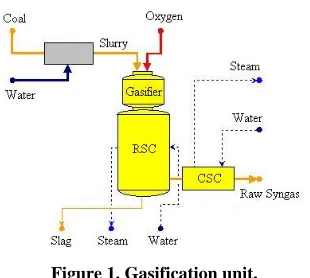
Gasification unit comprises a gasifier, radiation syngas cooler (RSC), convection syngas cooler (CSC), air sepa-ration unit (ASU) and etc, as in Figure 1. Gasifier is adopted with slurry gasification and slag-tap mode. Firstly, coal water slurry and oxygen from ASU are fed into gasifier to produce raw syngas, high temperature raw syngas is cooled by RSC and CSC, and then enters syn-gas purification unit.
Table 1. The pressure losses caused by the flow of syn-gas, steam and water are assumed equal through any equipment in gasification unit. The main operating pa-rameters in designed condition are shown in Table 2.
2.2. Operating Parameters
In coal water slurry gasification process, oxygen carbon ratio is a very important index, which usually refers to oxygen carbon molar ratio (ε), and in engineering appli-cations, it can also refer to the ratio of the oxygen con-sumption and pulverized coal (Roc) in gasifier, as shown in equation 1 and 2.
o c Car 16 / 12 c Oa
B B B r、 (1)
oc o/ c 4 / 3 Car Oar
R B B 、 (2)
where Roc denotes oxygen coal ratio in g/g, Bo and Bc respectively denote consumption of oxygen and pulver-ized coal, Car and Oar mean carbon and oxygen elemental mass percentage of coal, ε denotes oxygen and carbon atom ratio.
[image:2.595.95.250.395.534.2]Water coal ratio (Rsc) refers to feed water and pulver-ized coal mass ratio, which directly affects the flow characteristics, combustion characteristics and calorific value of coal water slurry, as shown in equation 3 and 4.
Figure 1. Gasification unit.
Table 1. Proximate and ultimate analysis of coal.
Ultimate analysis of coal /%
C H O Mar(%)
qnet,coal (kJ·kg-1)
[image:2.595.57.287.638.736.2]57.81 3.62 9.29 17.3 21740
Table 2. the main parameters of gansifier.
parameters data parameters data
Gasifier capacity
(t/d) 2 000
Oxygen coal ratio
(g/g) 0.756
Gasification pressure
(MPa) 3.6
Water coal ratio
(g/g) 0.386
Gasification
temperature(K) 1584
Carbon conversion
efficiency(%) 98
w c (1 M ) /ar s c
B B C B Ba (3)
sc w/ c (1 M ) /ar s 1
R B B C (4)
where Rsc denotes water coal ratio in g/g, Bw, Ba respec-tively denote consumption of water and additive for coal water slurry, Cs denotes the concentration of coal water slurry, Mar is water mass percentage of pulverized coal,
Φ denotes the proportion of additive in coal water slurry (0.5%-1.5%).
Cold gas efficiency is another important index to measure the gasifier operating performance, which de-notes the ratio of the chemical energy of syngas by gasi-fication to the chemical energy of coal for gasigasi-fication, as in equation 5.
2 4
c (qH qCO qCH ) /qnet ,coal
, (5)
The chemical energy of syngas ( H2, CO and CH4) and coal ( net, coal)are both corresponding net calorific value. Obviously to improve the cold gas efficiency of gasifier can promote transforming the chemical energy from storage in coal to syngas, improving the whole per-formance of IGCC.
q q q q
Pressurized gasification can improve the gasification capacity effectively, and bring obvious economic bene-fits for transmission, distribution and subsequent chemi-cal processing. But if the pressure is too high, the gas into the combustion engine should be reduced pressure firstly, thus leading to the waste of energy.
3. Results and Discussion
3.1. Oxygen Coal Ratio (Roc)
Figure 2 shows the effect of oxygen carbon ratio on the syngas components. With the increase of Roc, the content of CO first increases and then decreases. When the Roc is 0.75, the maximum mounts to 37.1%. The content of H2 is similar to CO, the maximum of H2 amounts to 30.43% when Roc is 0.64. The content of CH4 decreases sharply from 4.9%, and when Roc is greater than 0.71, it reduces slowly, until close to 0. With the increase of Roc, the content of H2O increases, and the trend of CO2 content is opposite to CO. The content of the effective gas compo-sition (CO+H2) firstly increases and then decreases and at Roc of 0.66, the maximum reaches 66.43%.
Figure 3 shows the effect of Roc on gasification tem-perature and cold gas efficiency. With the increase of Roc, gasification temperature rises, while cold gas efficiency reduces.
gasi-fication temperature increases about 352K when Roc 0.1 per growth. Therefore, we can regulate the gasification temperature accurately and effectively by controlling Roc value in the actual operation.
Based on the chemical kinetics theory, the combustion heat release of CO is basic equal to H2 under the same pressure and volume, while the heat release of CH4 is 3 times as much as CO. In the process of the increase of CO+H2 content to maximum value, CO+ H2 content in-creases from 59.78% to 66.43%, while CH4 dein-creases from 4.9% to 0.77%. Therefore, the chemical energy of syngas is reduced totally, which leads to the decrease of cold gas efficiency.
3.2. Water Coal Ratio (Rsc)
[image:3.595.309.538.366.512.2]It is two situations to change water coal ratio, one sumes oxygen coal ratio is unchanged and the other as-sumes gasification temperature is constant. But the sec-ond is difficult to be implemented when practically op-eration. Figure 4 gives the effect of Rsc on the compo-nents of syngas under the condition of Roc is 0.75. When Rsc increases from 0.27 to 0.57, only the content of CO
[image:3.595.68.272.368.519.2]Figure 2. Effect of oxygen coal ratio on syngas components.
Figure 3. Effect of oxygen coal ratio on gasification tem-perature and efficiency.
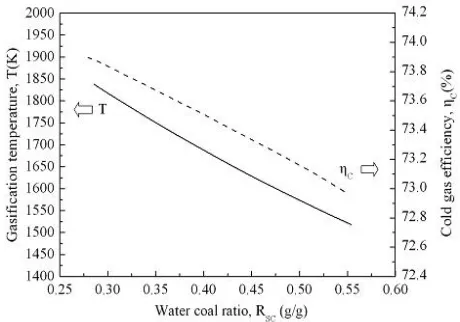
decreases, while the other main components increase. The content of CO decreases from 45.76% to 34.63%, H2 increases from 23.97% to 25.49%, CH4 from 0.0006% to 0.0107%, CO2 from 9.512% to 13.06% and H2O from 20.01% to 26.16%. Figure 5 shows the effect of Rsc on gasification and cold gas efficiency. When Rsc increases from 0.27 to 0.57, the efficiency of cold gas decreases from 73.9% to 72.98%, , and the gasification temperature decreases from 1518K to 1838K.
The above reasons can be analyzed from the following aspects. With the increase of Rsc, the amount of steam also increases, while the amount of pulverized coal and oxygen relatively decreases, leading to weaken combus-tion reaccombus-tion in the gasifier. At the same time, a large amount of heat is carried by steam, all these lead to gasi-fication temperature decrease.
[image:3.595.308.538.543.704.2]It is generally believed that methanogenesis (6) oc-curred in pressure and temperature lower than 1423K, and that reforming reaction of methane-steam (7) is a reversible and endothermic reaction. Therefore, with the increase of Rsc, gasification temperature decreases, lead-ing to the increase of methane content.
Figure 4. Effect of water coal ratio on syngas components.
[image:3.595.57.276.553.708.2]Figure 6. Double effects of water coal ratio and oxygen coal ratio on gasification temperature.
Figure 7. Effect of gasification pressure on syngas compo-nents.
C+2H2
CH4+74.9MJ.(kmol)-1 (6)CH4+H2O
CO+3H2-319.3MJ.(kmol)-1 (7)The decrease of gasification temperature prevents the reduction reaction (8) of CO2, at the same time leads to the equilibrium point of CO conversion reaction (9) moves right, eventually lead to the decrease of CO con-tent and the increase of CO2 concon-tent.
C+CO2
2CO-162.4MJ.(kmol)-1 (8)CO+H2O
CO2+H2+41.2MJ.(kmol)-1 (9)On one hand, with the decrease of gasification tem-perature, water-gas reaction (10) weakens, methanogene-sis (6) strengthens and the equilibrium point of methane- steam reforming reaction (7) moves left, all these lead to the decrease of H2 content. On the other hand, as water content increases, water-gas reaction (10) strengthens, the equilibrium point of CO reforming reaction (9) moves right, leading to the increase of H2 content. The combined effects of the two aspects result in H2 content increasing slightly.
[image:4.595.60.285.293.442.2]C+H2O
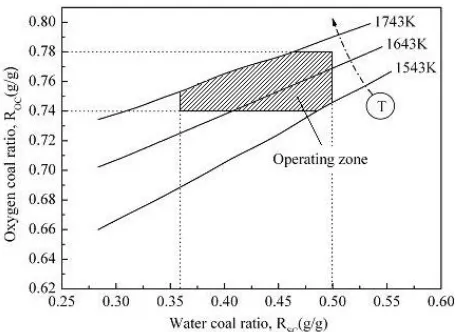
CO+H2-131.5MJ.(kmol)-1 (10)Figure 6 shows the matching relationships between Roc, Rsc and gasification temperature. We can see that there are double effects of Roc and Rsc on gasification temperature. When Increasing the value of Roc, gasifica-tion temperature become higher, while increasing the value of Rsc, gasification temperature become lower.
Generally, as far as possible to reduce Rsc can improve the gasification performance, at the same time, it can also be affected the flow and combustion characteristics of coal water slurry. The selection of gasification tempera-ture depends on the characteristics of coal and the re-quirements of syngas. Gasification temperature is gener-ally higher than the ash melting point 30~50 K.
According to the specific coal and IGCC system, sha-dow in Figure 7 indicates the region of the optimum operating points, which Rocis from 0.74 to 0.78, oxygen carbon molar ratio corresponding is 0.96 to 1.01, Rsc is from 0.36 to 0.5, the concentration of coal water slurry corresponding is 60% to 66%, gasification temperature is from 1543K to 1743K.
3.3. Gasification Pressure
Figure 7 shows the effect of gasification pressure on syngas components. We can see that the volume fraction of syngas has little change under different gasification pressures. The content of CO increased slightly from 37.08% to 37.12%, H2 content increased from 25.10% to 25.14%, H2O content decreased from 24.91% to 24.86% and CH4 content increases slightly from 0.003% to 0.008%.
4. Conclusions
Oxygen coal ratio, water coal ratio and gasification pressure are initial operating parameters of coal gasifica-tion. With the increase of oxygen coal ratio, gasification temperature increases, while cold coal efficiency de-creases. With the increase of water coal ratio, gasifica-tion temperature and cold coal efficiency both decrease. Influence of gasification pressure is mainly reflected the overall effect in the gasifier, under the high temperature conditions, pressure has little effect on syngas compo-nents. All these can provide the reference for low energy consumption, high performance gasification operation in IGCC system.
REFERENCES
[1] S. J. Jiao, “Development and Prospect of Some Key Technologies of IGCC,” Power engineering, Vol. 26, No. 2, 2006, pp. 153-165.
Analy-sis,” Power engineering, Vol. 21, No. 4, 2001, pp. 1316-1319.
[3] X. C. Wu, Q. H. Wang and Z. Y. Luo, “Kinetic Model Prediction for Various Coal Gasification Schemes in a Fluidized Bed II. Model Prediction and Analysis,” Jour-nal of Fuel Chemistry and Technology, Vol. 32, No. 3, 2004, pp. 292-296.
[4] G. S Liu, H. R Rezaei, J. A Lucas, et al, “Modelling of a Pressurized Entrained Flow Coal Gasifier: the Effect of Reaction Kinetics and Char Structure,” Fuel, Vol. 79, No. 14, 2000, pp. 1767-1779.
doi:10.1016/S0016-2361(00)00037-5
[5] N. Qizhi and W. Alan. “Simulation Study on the Per-formance of an Entrained-flow Coal Gasifier,” Fuel, Vol. 74, No.1, 1995, pp. 102-110.
doi:10.1016/0016-2361(94)P4339-4
[6] Y. C. Choi, X. Y. Li and T. J. Park “Numerical Study on the Coal Gasification Characteristics in an Entrained Flow Coal Gasifier,” Fuel, Vol. 80, No.15, 2001, pp. 2193-2201.