http://dx.doi.org/10.4236/ape.2016.63018
Exploring Instructors’ Verbal
Aggressiveness and Students’ Personal
Orientations and Reasons of Discipline in
Physical Education Class
Alexandra Bekiari, Ioanna Tsiana
Faculty of Physical Education and Sports Science, University of Thessaly, Thessaly, Greece
Received 5 June 2016; accepted 1 August 2016; published 4 August 2016
Copyright © 2016 by authors and Scientific Research Publishing Inc.
This work is licensed under the Creative Commons Attribution International License (CC BY).
http://creativecommons.org/licenses/by/4.0/
Abstract
In this study we examined associations among physical education instructors’ verbal aggressive-ness as perceived by students and students’ task and ego orientations and reasons for discipline. The sample consisted of 283 Greek adolescent students (124 males, 159 females) aged 10 - 14 years old (M = 12.6, SD = .94) from primary and secondary schools who completed three types of questionnaires during physical education classes. The results supported the internal consistency of the instruments. MANOVA’s findings supported that there is a significant dependence between school classes on the factors of each questionnaire. Specifically, the 2nd grade of secondary school
proved to have the lower score on verbal aggressiveness, the 2nd grade of secondary school the
higher score on ego-orientation, the 1st grade of secondary school the higher score on external
reasons of discipline and the 5th grade of primary school the lower score on caring reasons.
Corre-lational analysis indicated that perceived instructors’ verbal aggressiveness was positively related to students’ ego orientation, external reasons, introjected reasons, no reasons, and self-responsi- bility reasons for discipline. Significant negative correlations were noted for instructors’ verbal aggression with students’ task orientation, intrinsic reasons and caring reasons for discipline. The results of regression analysis revealed that perceived instructors’ verbal aggressiveness could significantly predict the variables of students’ personal orientations and external reasons, intrin-sic reasons and self-responsibility reasons for discipline. Distinct types of disciplined students are also proposed: 1) the “obedient” and 2) “altruist”. The findings and implications of the contribu-tion of instructors’ verbal aggressive behavior to the students’ personal orientacontribu-tions and reasons for discipline are further discussed as well as future research suggestions.
Keywords
1. Introduction
1.1. Verbal Aggressiveness
Verbal aggression is defined as the attack a person’s self-concept of the other in order to cause psychological pain as attack on character, competence, physical appearance, teasing, ridicule, threats, swearing, and profanity (Infante & Rancer, 1996). In all types of relationships, research consistently shows that verbal aggressiveness leads to negative outcomes (Anderson & Martin, 1995; Bekiari, 2012, 2014; Bekiari & Hasanagas, 2015, 2016; Bekiari & Manoli, 2016; Bekiari & Sakellariou, 2002; Hasanagas & Bekiari, 2015; Infante, Myers, & Buerkel, 1994; Infante & Rancer, 1996; Manoli & Bekiari, 2015). Concerning education system, it has been supported that verbal aggressiveness is a demotivating force in the classroom (Gorham & Christophel, 1992) that is nega-tively related to social, task and physicalattraction (Syrmpas & Bekiari, 2015), perceptions of immediacy (Mar-tin, Weber, & Burant, 1997; Rocca & McCroskey, 1999), student affect toward the course content, the teacher and the recommended course behaviors (Bekiari, 2012; Myers & Knox, 1999; Wrench & Richmond, 2004), mo-tivation climate and satisfaction (Bekiari, 2014; Bekiari, Kokaridas, & Sakellariou, 2005, 2006; Bekiari, Perkos, & Gerodimos, 2015; Bekiari & Syrmpas, 2015; Claus, Chory, & Malachowski, 2011; Manoli & Bekiari, 2015; Myers, Edwards, Wahl, & Martin, 2007; Myers & Rocca, 2001; Schrodt, 2003), student prosocial fair play (Hassandra, Bekiari & Sakellariou, 2007) and behavior, thinking, motivation (Bekiari & Hasanagas, 2015; Maz-er & Stowe, 2016; Richmond & Gorham, 1992). Additionally, students considMaz-er teachMaz-ers vMaz-erbally aggressive as less reliable than teachers avoid unconstructive communication in the classroom (Bekiari, Koustelios, & Sakel-lariou, 2000; Edwards & Myers, 2007; Mazer & Stowe, 2016; Schrodt, 2003).
Moreover, students who consider that their physical education instructors are verbally aggressive present a tendency to learning loss (Bekiari & Sakellariou, 2002) adopting a similar aggressive behavior (Bekiari, Koka-ridas, & Sakellariou, 2005). In a similar context, it has been supported that instructors’ verbal aggressiveness has a negative effect on the students’ satisfaction, intrinsic motivation factors (such enjoyment and interest, effort/ importance and competence) and discipline factors related to intrinsic and caring reasons (Bekiari, Kokaridas, & Sakellariou, 2006). Also, Bekiari (2012) found a negative relationship between perceived instructors’ verbal ag-gressiveness and students’ affective learning and satisfaction in physical education context. Furthermore, ver-bally aggressive coaches are likely to be considered as less credible and they probably make athletes feel less motivated (Mazer, Barnes, Grevious, & Boger, 2013). Moreover, researchers mainly examined the relationship between athletes’ aggressiveness and the type of sport (contact or non-contact) (Bredemeier, Weiss, Shields, & Cooper, 1986; Huang, Cherek, & Lane, 1999; Lemieux, McKelvie, & Stout, 2002). Additionally, Bekiari, Dige-lidis and Sakellariou (2006) argued that athletes who participated in a noncontact sport perceived their coaches as emitting less verbal aggressiveness compared to athletes participating in a high-contact sport. Moreover, male volleyball players rated somatic anxiety higher and were more affected by coaches’ verbal aggressiveness than female volleyball players (Bekiari, Patsiaouras, Kokaridas, & Sakellariou, 2006).
1.2. Personal Orientations
The concepts of goal orientation and motivation are referred generally to the way with which each person con-ceives his ability, defines success and prompts himself to achieve his objectives. Related researches in this field were based on the perception that the individual’s achievement targets are determined by whatever the individu-al considers important and desirable (Dweck & Leggett, 1988; Nicholls, 1984, 1989; Duda, 1989; Duda & Nicholls, 1992). The better comprehension of motivation however, requires that the target of behavior should be recognized. According to the theory of Nicholls (1989), inter-personal differences exist in the way with which the people perceive their ability and define success. Thus, in environments of achievement such as the school and sports, two different objectives independent with each other are revealed, the objective of task and ego rein-forcement (Duda & Nicholls, 1992; Li, Harmer et al., 1998; Nicholls, 1989; Williams & Gill, 1995). Individuals, who are task-orientated conceive success and judge their ability on the basis of their own efforts and personal improvement. On the contrary, individuals who are ego-oriented compare themselves with others or with certain norms in order to decide how good they are. For them, success means the surpassing of others and the demon-stration of a high level of abilities.
mo-tivation. So, they participate more actively and have more fun, because they do not worry about their errors or they probably know that when somebody wants to learn it is natural to make mistakes. After all, they all accept that everyone can accomplish his/her goals through practice. On the contrary, in the case of children realizing that the physical education course is directed toward performance, their feeling of success depends on their per-ception of how good they are compared to others. As a consequence, the errors become sources of stress and the children tend to avoid their participation in physical education classes, especially when they believe that they do not demonstrate the skills to accomplish a task.
It is supported that children with high task orientation demonstrate higher and more constant in time motiva-tion, whereas children directed toward “ego” demonstrate a low or moderate perception for their athletic abilities (Fox, Goudas, Biddle, Duda, & Armstrong, 1994; Kokaridas, Bekiari, & Sakellariou, 2005). Research of Lin-nenbrink and Pintrich (2002) noted that people who are task-oriented believe that slow progress but not meeting expectations is a good opportunity to improve more, while the people who are ego-oriented thought that these problems are an indication of the low competence in relation to others. Furthermore, the instructors’ task-orien- tation associated with students’ reports that teachers actively supported the formulation of questions and seeking help (Butler & Shibaz, 2008; Shim, Sho, & Cassady, 2013).
The achievement goal framework in terms of task-ego and approach-avoidance dimensions has also been in-tensively discussed, exploring the possible role of gender, athlete status and psychological parameters (Wang, Biddle, & Elliot, 2007). Interesting profiles have also been suggested concerning goal orientation, motivation climate and relationship perceptions in young athletes (Smith, Balaguer, & Duda, 2006). The high perceived sport ability group was featured by an engagement of task-based motivation to enjoyment. In this concept, the relevance of effort, personal development and improvement was pointed out. Task orientation and enjoyment in physical education are emphasized as salient factors inhibiting decline in physical activity (Yli-Piipari, Barkou-kis, Jaakkola, & Liukkonen, 2013). Goal orientations seem to remain independent from the course of the season, as late season task orientation appears to depend on early season and coach task orientation (McPherson, 2015).
Task-based motivation constitutes a predictor of enjoyment in physical education through perceived physical competence and intrinsic motivation. This supported previous findings (Vallerand, Brière, Blanchard, & Pro-vencher, 1997), involving self-determination and the achievement goal theory and excluding ego-involving cli-mate as rather irrelevant factor (Gråstén, Jaakkola, Liukkonen, Watt, & Yli-Piipari, 2012).
1.3. Reasons for Discipline
2. The Present Study
From the above, it is obvious that the concepts of verbal aggressiveness, personal orientations and discipline reasons have been sufficiently examined. However, students’ personal orientations and discipline reasons during physical education lessons has not yet being linked with verbal aggressiveness of physical education instructors as perceived by students. This study intended to examine the relations among perceived instructors’ verbal ag-gressiveness and students’ personal orientations and reasons for discipline during physical education lessons.
In particular, this study intends to answer the following research questions:
- Are there significant differences noted between the sexes and classes regarding verbal aggressiveness, per-sonal orientations and discipline reasons?
- Is there a positive or negative relationship between instructors’ verbal aggressiveness as perceived by stu-dents with stustu-dents’ self-reports of personal orientations and their perceptions of reasons for discipline in physical education classes?
- To what extent the perceived instructors’ verbal aggressiveness could be a significant predictor of the stu-dents’ personal orientations and discipline reasons?
- Can a students’ typology regarding parameters of verbal aggressiveness perception, orientation and disci-pline be extracted?
In the light of the findings, useful conclusions is expected to be drawn regarding the relation of instructors’ verbal aggression as perceived by students with personal orientations and reasons for being disciplined.
3. Method
3.1. Participants and Procedures
The sample of the study consisted of 283 students (124 males, 159 females) aged 10 - 14 years old (M = 12.6, SD = .94) in four cities of central Greece and Athens. All the participants were between the 5th and 6th grade of public primary schools and between the 1st and 2nd grade of public secondary schools and belonged to different socio-economic status. All students completed questionnaires referring to the instructors’ verbal aggressiveness and students’ personal orientations and discipline reasons, during their physical education lessons, in winter 2015. The completion of questionnaires lasted for 20 - 30 minutes approximately and flowed freely. The ano-nymity of the participants was ensured and student participation in the process was voluntary in order to obtain sincere answers. The study was conducted in accordance with the best practice rules and research ethics.
3.2. Instruments
Verbal aggressiveness. The Greek version (Bekiari & Digelidis, 2015), which was used to assess physical edu-cation teacher verbal aggressiveness, relied on the theoretical framework and the Verbal Aggressiveness Ques-tionnaire (20 items) developed by Infante and Wigley (1986). Preliminary examination (Bekiari & Digelidis, 2015) supported the psychometric properties of the instrument. In particular, confirmatory factor analysis indi-cated satisfactory fit indices (confirmatory factor analysis: .97, SRMR: .02), and internal consistency of the scale (α = .96). The scale consisted of eight items (e.g., “the teacher insults students,” “the teacher makes negative judgments of students’ ability”). Participants were asked to respond on a 5-point Likert-type scale ranging from 1: Strongly disagree to 5: Strongly agree.
Personal orientations. The Task and Ego Orientation questionnaire (Duda, 1989), adapted in Greek popula-tion (Papaioannou & Macdonald, 1993; Papaioannou & Theodorakis, 1996), was used to assess students’ task and ego orientation. The scale consisted of two factors (“task” and “ego” orientation) and includes a total of 13 questions. Specifically, it is consisted of 7 questions describingtask orientation (e.g. I learn a new exercise trying hard) and 6 questions describing the ego orientation (e.g. I am the only one who can do the exercise). Partici-pants were asked to respond on a 5 point Likert scale (from 1 = never to 5 = often).
3.3. Data Analysis
Data analysis included the use of the Statistical Package for Social Sciences (SPSS 21.0). Cronbach’s α reliabil-ity analysis was used to examine the internal consistency of the factors of each questionnaire. Differences in students’ perceptions about the verbal aggressiveness, personal orientations and discipline reasons respectively with the gender and class, were examined by performing a two-way MANOVA analysis. The Pearson correla-tion coefficient was used to measure the correlacorrela-tion between the subscales of the quescorrela-tionnaires.Moreover, re-gression analysis was conducted in order to explore the extent to which the perceived instructors’ verbal aggres-siveness could be a significant predictor of the students’ personal orientations and discipline reasons.The level of statistical significance was set at .05.
Finally, a students’ typology regarding parameters of verbal aggressiveness perception, orientation and disci-pline will be formulated using principal component analysis.
4. Results
Cronbach’s α reliability analysis for the Verbal Aggressiveness Scale (Bekiari & Digelidis, 2015) was .92. The factors of task orientation (α = .89) and ego-orientation (α = .91) for the Task and Ego Orientation Questionnaire (Duda, 1989) showed a high level of reliability. The factors of external reasons (α = .88), introjected reasons (α = .89), intrinsic reasons (α = .87), no reasons (α = .85), self-responsibility reasons (α = .79), and caring reasons (α = .81), for the Reasons of Discipline Scale (Papaioannou, 1998) showed a high degree of reliability.
Moreover, two-way MANOVA was performed to examine differences in verbal aggressiveness, personal orientations and discipline reasons between gender and school class (5th-6th class of primary school and 1st-2nd class of secondary school). The findings showed statistically significant multivariate effect on gender (Wilk’s λ = .918, F[9,268] = 2.06, p < .05) and on school class(Wilk’s λ = .811, F[9,268] = 1.96, p < .01), but no interac-tion between gender and school class was detected (Wilk’s λ = .917, F[9,268] = .69, p = .921). The examination of the univariate effects revealed no significant effect of gender on verbal aggressiveness, personal orientations and discipline reasons, but revealed significant effect of school class on verbal aggressiveness (F[3,273] = 2.96, p < .05), on ego-orientation (F[3,273] = 4.27, p < .05, on intrinsic reasons (F[3,273] = 3.74, p < .05) and on car-ing reasons (F[3,273] = 3.76, p ≤ .05). An examination of the mean scores indicated that the 2nd class of second-ary school (ΜΟ = 3.05, SD = 1.24) proved to have the lower score in verbal aggressiveness, the 2nd class of secondary school (ΜΟ = 3.03, SD = 1.28) the higher score in ego-orientation, the 1st class of secondary school (ΜΟ = 2.86, SD = 1.31) the higher score in external reasons of discipline and the 5th class of primary school (ΜΟ = 2.24, SD = 1.13) the lower score in caring reasons.
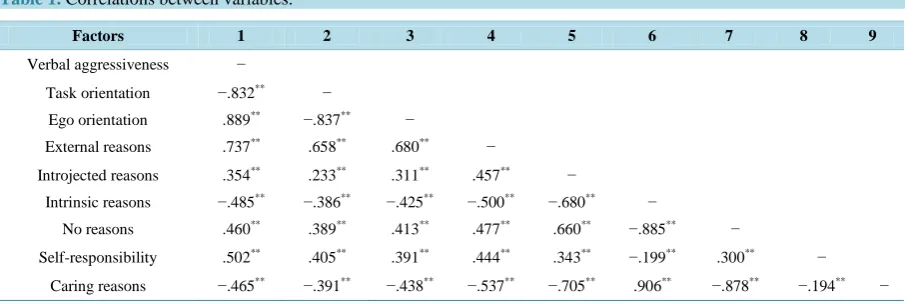
[image:5.595.87.544.559.711.2]In addition, a correlation analysis was conducted, the results of which are presented in “Table 1”. As it can be seen, there was a negative significant relationship between instructors’ verbal aggressiveness and task orienta-tion (r = −.83), intrinsic reasons (r = −.49) and caring reasons for discipline (r = −.86). Moreover, there was a positive significant relationship between instructors’ verbal aggressiveness and ego orientation (r = .89), external reasons (r = .74), indrojected reasons (r = .35), no reasons (r = .46) and self-responsibility reasons for discipline (r = .50).
Table 1.Correlations between variables.
Factors 1 2 3 4 5 6 7 8 9
Verbal aggressiveness −
Task orientation −.832** −
Ego orientation .889** −.837** −
External reasons .737** .658** .680** −
Introjected reasons .354** .233** .311** .457** −
Intrinsic reasons −.485** −.386** −.425** −.500** −.680** −
No reasons .460** .389** .413** .477** .660** −.885** −
Self-responsibility .502** .405** .391** .444** .343** −.199** .300** −
Caring reasons −.465** −.391** −.438** −.537** −.705** .906** −.878** −.194** −
*
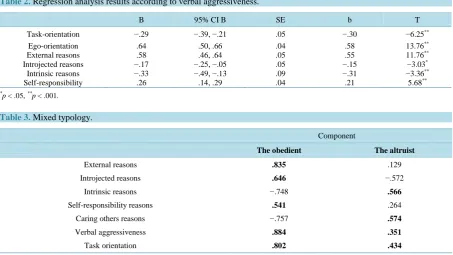
Moreover, linear regression analyses were conducted to examine the extent to which students’ personal orientations and reasons for discipline could be predicted from the ratings of instructors’ verbal aggressiveness. The results indicated that perceived instructor verbal aggressiveness could predict significant variance in per-sonal orientations (F(2,280) = 623.16, p < .001) with an R2 of 81.7%. Perceived verbal aggressiveness explained 2.6% of the variance in students’ task-orientation (β = −.30, t = −6.25, p < .001) and 12.4% of the variance in students’ ego-orientation (β = .58, t = 13.76, p < .001). Another linear regression analysis was conducted to pre-dict student discipline reasons based on teacher verbal aggressiveness. The results indicated that perceived in-structor verbal aggressiveness could predict significant variance in reasons for discipline (F(6,276) = 74.17, p < .001) with an R2 of 61.7%. Verbal aggressiveness explained 19.2% of the variance in students’ external rea-sons (β =. 55, t = 11.76, p < .001), 1.3% of the variance in students’ introjected reasons (β = −.15, t = −3.03, p < .05), 1.6% of the variance in students’ intrinsic reasons (β = −.31, t = −3.36, p < .001) and4.5% of the variance in students’ self-responsibility reasons (β = .21, t = 5.68, p < .001). The results of the regression analyses are presented in “Table 2”.
Moreover, in the “Table 3”, two types may be distinguished, according to the sources of discipline. The “ob-edient” is a student who is extensively disciplined due to a wide variety of discipline factors (external and inter-nal ones as well as responsibility). Simultaneously, such a disciplined student is targeted for verbal aggressive-ness by the instructors and oriented to learning (task). The “altruist” appears not to be very different. He feels also verbally assaulted by the instructors and patiently interested in learning.
5. Discussion
[image:6.595.87.541.455.710.2]The aim of this study was threefold: 1) to explore the relationship between perceived instructors’ verbal aggres-siveness and students’ personal orientations and reasons for discipline, 2) to investigate the influence of instruc-tor verbal aggressiveness on student personal orientations and reasons for discipline and 3) to propose students’ typology. The results of the study indicated that perceived instructors’ verbal aggressiveness was positively re-lated to students’ ego orientation, external reasons, introjected reasons, no reasons, and self-responsibility rea-sons for discipline, but was negatively related to students’ task orientation, intrinsic rearea-sons and caring rearea-sons for discipline. Moreover, perceived instructors’ verbal aggressiveness could significantly predict the variables of students’ personal orientations and external reasons, intrinsic reasons and self-responsibility reasons for discip-line. Distinct types of disciplined students are also proposed: the “obedient” and “altruist”. Furthermore, the 2nd
Table 2. Regression analysis results according to verbal aggressiveness.
B 95% CI B SE b T
Task-orientation −.29 −.39, −.21 .05 −.30 −6.25**
Ego-orientation External reasons Introjected reasons .64 .58 −.17 .50, .66 .46, .64 −.25, −.05 .04 .05 .05 .58 .55 −.15 13.76** 11.76** −3.03* Intrinsic reasons Self-responsibility −.33 .26 −.49, −.13 .14, .29 .09 .04 −.31 .21 −3.36** 5.68** *
p < .05, **p < .001.
Table 3. Mixed typology.
Component
The obedient The altruist
External reasons .835 .129
Introjected reasons .646 −.572
Intrinsic reasons −.748 .566
Self-responsibility reasons .541 .264
Caring others reasons −.757 .574
Verbal aggressiveness .884 .351
Task orientation .802 .434
grade of secondary school proved to have the lower score on verbal aggressiveness, the 2nd grade of secondary school the higher score on ego-orientation, the 1st grade of secondary school the higher score on external reasons of discipline and the 5th grade of primary school the lower score on caring reasons.
Previous study’s findings argued that instructors’ personality plays a determinant role in the interrelationship with their students (Rancer & Avtgis, 2014). In this specific case, students’ personal orientations and discipline reasons were influenced by instructors’ verbal aggressiveness. Instructors’ verbal aggressiveness emerged as the most important negative predictor of students’ task-orientation and intrinsic reasons for discipline. This is in ac-cordance with previous findings which suggested that teachers’ verbal aggressiveness is negatively related with physical education students’ intrinsic motivation and satisfaction (Bekiari, 2012, 2014; Kassing & Infante, 1999). Similarly, the findings of a previous study argued that instructors’ verbal aggressiveness has a negative effect on the students’ satisfaction, intrinsic motivation and discipline factors related to intrinsic and caring reasons (Be-kiari, Kokaridas, & Sakellariou, 2006). A reasonable explanation of this finding could be the fact that task-orien- tated and internal disciplined students prefer to receive positive and encouraging feedback from their instructors (Sinclair & Vealey, 1989; Smith & Smoll, 1990).In any case, instructors’ verbal aggressiveness could be per-ceived by students as negative reinforcement, reporting also lower levels of intrinsic motivation, task orientation and increased stress levels (Digelidis & Papaioannou, 1999).
Moreover, previous studies suggested that learning takes place in a well-organized and peaceful atmosphere (Good & Grouws, 1977; Evertson, Anderson, Anderson, & Brophy, 1980) as most physical education instructors believe that a well-disciplined class is one of the most important indices of successful teaching (Placek, 1983; Placer & Dodds, 1988). It seems that instructors’ verbal aggressiveness guides students to discipline. However, students’ discipline due to verbal aggressiveness is negatively associated with students’ intrinsic reasons and caring reasons for discipline in the classroom. It could be said that the distinctions between students’ discipline which leads to an organized and peaceful atmosphere and instructors’ verbal aggressiveness as a form of disci-pline are not yet clear. It is obvious that verbal aggressiveness is a demotivating force in the classroom (Gorham & Christophel, 1992) leading the students to the forced discipline, negatively affecting their behavior,task ori-entation, intrinsic motivation, learningenvironment and satisfaction (Bekiari, 2014; Bekiari & Syrmpas, 2015; Bekiari, Kokaridas, & Sakellariou, 2006; Myers & Knox, 1999; Myers & Rocca, 2000; Myers, 2002). The study indicates the negative outcomes associated with physical education instructors’ verbal aggressiveness and it is consistent with the findings of other research (Bekiari et al., 2015; Bekiari & Manoli, 2016; Bekiari & Hasana-gas, 2015; Infante & Wigley, 1986; Infante & Rancer, 1996; Syrmpas & Bekiari, 2015).
Moreover, two types may be distinguished, according to the sources of discipline. The “obedient” is a student who is extensively disciplined due to a wide variety of discipline factors (external and internal ones as well as responsibility). Simultaneously, such a disciplined student is targeted for verbal aggressiveness by the instruc-tors and oriented to learning (task). The emergence of the “obedient” type may attribute to the fact that a strong-ly disciplined student easistrong-ly becomes a target of verbal aggressiveness due to his tolerance and no reaction. At the same time, he is so tolerable because he is really oriented to task and not just to obtain degrees and marks. These typology results seem to be complementary to the previous findings (Bekiari & Hasanagas, 2015; Bekiari, Hasanagas, Theoharis, Kefalas, & Vasilou, 2015; Bekiari & Spyropoulou, 2016; Hasanagas & Bekiari, 2015) which have also proposed a connection of interpersonal relationships and verbal aggressiveness measured as a structural phenomenon.
The “altruist” appears not to be very different. He feels also verbally assaulted by the instructors and patiently interested in learning. The slight different in the “altruist” type consists in the sources of discipline seem to be quite different, namely internal factors and caring others. Thus, the two types seem differ from each other re-garding the sources of discipline and similar to each other rere-garding being targeted for verbal aggressiveness and dedication to learning.
6. Conclusion
The study results echo the view of Infante and Rancer (1996), that the effects of verbal aggression are destruc-tive, confirming and reinforcing also a moral attitude which has recently been adopted in education for the need for development of verbal aggressiveness control techniques. However, due to the small number of the results of this study sample should be interpreted carefully. Furthermore, future studies on a larger sample should examine and verify the results of this research on the relations of instructors’ verbal aggressiveness to students’ personal orientations and discipline reasons in physical education.
References
Anderson, C. M., & Martin, M. M. (1995). Why Employees Speak to Coworkers and Bosses: Motives, Gender, and Organi-zational Satisfaction. Journal of Business Communication, 32, 249-265.
http://dx.doi.org/10.1177/002194369503200303
Bekiari, A., & Hasanagas, N. (2015). Sociological Insights in the Education System: “Unlocking” the Power Relations. Thessaloniki: Christodoulidis. (In Greek)
Bekiari, A., & Hasanagas, N. (2016). “Educating” in Physical Education. Theoretical Approaches and Practical Inquiries. Thessaloniki: Christodoulidis. (In Greek)
Bekiari, A. (2012). Perceptions of Instructors’ Verbal Aggressiveness and Physical Education Students’ Affective Learning.
Perceptual and Motor Skills, 115, 325-335. http://dx.doi.org/10.2466/06.11.16.PMS.115.4.325-335
Bekiari, A. (2014). Verbal Aggressiveness and Leadership Style of Sport Instructors and Their Relationship with Athletes’ Intrinsic Motivation. Creative Education, 5, 114-121. http://dx.doi.org/10.4236/ce.2014.52018
Bekiari, A., & Digelidis, N. (2015). Measuring Verbal Aggressiveness in Sport and Education. International Journal of Physical Education, 4, 12-21.
Bekiari, A., & Hasanagas, N. (2015). Verbal Aggressiveness Exploration through Complete Social Network Analysis: Using Physical Education Students’ Class as an Illustration. International Journal of Social Science Studies, 3, 30-49.
http://dx.doi.org/10.11114/ijsss.v3i3.729
Bekiari, A., & Hasanagas, N. (2016). Suggesting Indicators of Superficiality and Purity in Verbal Aggressiveness. An Ap-plication in Adult Education Class Networks of Prisoners. Open Journal of Social Sciences, 4, 279-292.
http://dx.doi.org/10.4236/jss.2016.43035
Bekiari, A., & Sakellariou, K. (2002). Perceived Instructor Verbal Aggressiveness and Student State Learning in Physical Education. Italian Journal of Sport Sciences, 1, 251-256.
Bekiari, A., & Spyropoulou, S. (2016). Exploration of Verbal Aggressiveness and Interpersonal Attraction through Social Network Analysis: Using University Physical Education Class as an Illustration. Open Journal of Social Sciences, 4, 145- 155. http://dx.doi.org/10.4236/jss.2016.46016
Bekiari, A., & Syrmbas, I. (2015). The Influence of Motivational Climate and Coaches’ Verbal Aggression on Athletes’ Sa-tisfaction. British Journal of Education, Society & Behavioural Science, 9, 318-329.
http://dx.doi.org/10.9734/BJESBS/2015/17757
Bekiari, A., & Manoli, P. (2016). EFL Teacher Verbal Aggressiveness and Argumentativeness and Student Socio-Affective Strategy Use and Affective Learning: Exploring Possible Associations. Journal of Teacher Education and Educators, 5. (Forthcoming)
Bekiari, A., Kokaridas, D., & Sakellariou, K. (2005). Verbal Aggressiveness of Physical Education Teachers and Students’ Self-Reports of Behavior. Psychological Reports, 96, 493-498. http://dx.doi.org/10.2466/pr0.96.2.493-498
Bekiari, A., Kokaridas, D., & Sakellariou, K. (2006). Associations of Students’ Self-Report of Their Teacher’s Verbal Ag-gression, Intrinsic Motivation, and Perceptions of Reasons for Discipline in Greek Physical Education Classes.
Psycho-logical Reports, 98, 451-461. http://dx.doi.org/10.2466/pr0.98.2.451-461
Bekiari, A., Koustelios, A., & Sakellariou, K. (2000). Instructors’ Verbal Aggressiveness from Universities in Greece. Studi e Ricerche, 5/6, 225-232.
Bekiari, A., Patsiaouras, A., Kokaridas, D., & Sakellariou, K. (2006). The Relationship between Verbal Aggressiveness and State Anxiety in Volleyball. Perceptual and Motor Skills, 99, 630-634.
Bekiari, A., Perkos, S., & Gerodimos, V. (2015). Verbal Aggression in Basketball: Perceived Coach Use and Athlete Intrin-sic and ExtrinIntrin-sic Motivation. Journal of PhyIntrin-sical Education and Sport, 15, 96-102.
Bredemeier, B. J., Weiss, M. R., Shields, D. L., & Cooper, B. (1986). The Relationship of Sport Involvement with Children’s Moral Reasoning and Aggression Tendencies. Journal of Sport & Exercise Psychology, 8, 304-318.
Butler, R., & Shibaz, L. (2008). Achievement Goals for Teaching as Predictors of Students’ Perceptions of Instructional Practices and Students’ Help Seeking and Cheating. Learning and Instruction, 18, 453-467.
http://dx.doi.org/10.1016/j.learninstruc.2008.06.004
Claus, C. J., Chory, R. M., & Malachowski, C. C. (2011). The Relationship between Instructor Aggressive Communication Traits and Student Antisocial Behavioural Alteration Techniques. In The Annual Meeting of the Eastern Communication Association.
Deci, E. L., & Ryan, R. M. (1985a). Intrinsic Motivation and Self-Determination in Human Behavior. NewYork: Plenum.
http://dx.doi.org/10.1007/978-1-4899-2271-7
Deci, E. L., & Ryan, R. M. (1985b). The General Causality Orientations Scale: Self-Determination in Personality. Journal of
Research in Personality, 19, 109-134. http://dx.doi.org/10.1016/0092-6566(85)90023-6
Digelidis, N., & Papaioannou, A. (1999). Age-Group Differences in Intrinsic Motivation, Goal Orientations and Perceptions of Athletic Competence, Physical Appearance and Motivational Climate in Greek Physical Education. Scandinavian
Journal of Medicine & Science in Sports, 9, 375-380. http://dx.doi.org/10.1111/j.1600-0838.1999.tb00259.x
Duda, J. L. (1989). Relationship between Task and Ego Orientation and the Perceived Purpose of Sport among High School Athletes. Journal of Sport & Exercise Psychology, 11, 318-335.
Duda, J. L., & Nicholls, J. G. (1992). Dimensions of Achievement Motivation in Schoolwork and Sport. Journal of
Educa-tional Psychology, 84, 290-299. http://dx.doi.org/10.1037/0022-0663.84.3.290
Dweck, C. S., & Leggett, E. L. (1988). A Social-Cognitive Approach to Motivation and Personality. Psychological Review,
95, 256-273. http://dx.doi.org/10.1037/0033-295X.95.2.256
Edwards, C., & Myers, S. A. (2007). Perceived Instructor Credibility as a Function of Instructor Aggressive Communication.
Communication Research Reports, 24, 47-53. http://dx.doi.org/10.1080/08824090601128141
Evertson, C. M., Anderson, C. W., Anderson, L. M., & Brophy, J. E. (1980). Relationships between Classroom Behaviors and Student Outcomes in Junior High Mathematics and English Classes. American Educational Research Journal, 17, 43- 60. http://dx.doi.org/10.3102/00028312017001043
Fox, K., Goudas, M., Biddle, S., Duda, J., & Armstrong, N. (1994). Children’s Task and Ego Goal Profiles in Sport. British
Journal of Educational Psychology, 64, 253-261. http://dx.doi.org/10.1111/j.2044-8279.1994.tb01100.x
Giannoudis, G., Digelidis, N., & Papaioannou, A. (2009). The Motivation Climate and Perceived Sport Teachers’ Behavior toward Disciplined-Undisciplined Students. Inquiries in Sport & Physical Education, 7, 10-21.
Good, T. L., & Grouws, D. A. (1977). Teaching Effects: A Process-Product Study in Fourth Grade Mathematics Classrooms.
Journal of Teacher Education, 28, 49-54. http://dx.doi.org/10.1177/002248717702800310
Gorham, J., & Christophel, D. M. (1992). Students’ Perceptions of Teacher Behaviors as Motivating and Demotivating Fac-tors in College Classes. Communication Quarterly, 40, 239-252. http://dx.doi.org/10.1080/01463379209369839
Gråstén, A., Jaakkola, T., Liukkonen, J., Watt, A., & Yli-Piipari, S. (2012). Prediction of Enjoyment in School Physical Education. Journal of Sports Science & Medicine, 11, 260-269.
Hasanagas, N., & Bekiari, A. (2015). Depicting Determinants and Effects of Intimacy and Verbal Aggressiveness Target through Social Network Analysis. Sociology Mind, 5, 162-175. http://dx.doi.org/10.4236/sm.2015.53015
Hassandra, M., Bekiari, A., & Sakellariou, K. (2007). Physical Education Teacher’s Verbal Aggression and Student’s Fair Play Behaviors. The Physical Educator, 64, 94-101.
Hellison, D. R. (1985). Goals and Strategies for Teaching Physical Education. Champaign, IL: Human Kinetics Publishers, Inc.
Huang, D. B., Cherek, D. R., & Lane, S. D. (1999). Laboratory Measurement of Aggression in High School Age Athletes: Provocation in a Nonsporting Context. Psychological Reports, 85, 1251-1262.
http://dx.doi.org/10.2466/pr0.1999.85.3f.1251
Infante, D. A., & Rancer, A. S. (1996). Argumentativeness and Verbal Aggressiveness: A Review of Recent Theory and Re-search. Communication Yearbook, 19, 319-352.
Infante, D. A., & Wigley III, C. J. (1986). Verbal Aggressiveness: An Interpersonal Model and Measure. Communication
Monographs, 53, 61-69. http://dx.doi.org/10.1080/03637758609376126
Infante, D. A., Myers, S. A., & Buerkel, R. A. (1994). Argument and Verbal Aggression in Constructive and Destructive Family and Organizational Disagreements. Western Journal of Communication (Includes Communication Reports), 58, 73-84. http://dx.doi.org/10.1080/10570319409374488
Relation with the Selection of a Specialty. Journal of Human Movement Studies, 48, 181-194.
Lemieux, P., McKelvie, S. J., & Stout, D. (2002). Self-Reported Hostile Aggression in Contact Athletes, No Contact Ath-letes and Non-AthAth-letes. Athletic Insight, 4, 42-56.
Li, F., Harmer, P., Duncan, T. E., Duncan, S. C., Acock, A., & Yamamoto, T. (1998). Confirmatory Factor Analysis of the Task and Ego Orientation in Sport Questionnaire with Cross-Validation. Research Quarterly for Exercise and Sport, 69, 276-283. http://dx.doi.org/10.1080/02701367.1998.10607694
Linnenbrink, E. A., & Pintrich, P. R. (2002). Achievement Goal Theory and Affect: An Asymmetrical Bidirectional Model.
Educational Psychologist, 37, 69-78. http://dx.doi.org/10.1207/S15326985EP3702_2
Manoli, P., & Bekiari, A. (2015). EFL Teachers’ Verbal Aggressiveness and Students’ Intrinsic Motivation and Social- Affective Strategy Use: Investigating Possible Relations. Advances in Research, 5, 1-13.
http://dx.doi.org/10.9734/AIR/2015/19692
Martin, M. M., Weber, K., & Burant, P. A. (1997). Students’ Perceptions of a Teacher’s Use of Slang and Verbal Aggres-siveness in a Lecture: An Experiment.
Mazer, J. P., & Stowe, S. A. (2016). Can Teacher Immediacy Reduce the Impact of Verbal Aggressiveness? Examining Ef-fects on Student Outcomes and Perceptions of Teacher Credibility. Western Journal of Communication, 80, 21-37.
http://dx.doi.org/10.1080/10570314.2014.943421
Mazer, J. P., Barnes, K., Grevious, A., & Boger, C. (2013). Coach Verbal Aggression: A Case Study Examining Effects on Athlete Motivation and Perceptions of Coach Credibility. International Journal of Sport Communication, 6, 203-213.
Myers, S. A., & Knox, R. L. (1999). Verbal Aggression in the College Classroom: Perceived Instructor Use and Student Af-fective Learning. Communication Quarterly, 47, 33-45. http://dx.doi.org/10.1080/01463379909370122
Myers, S. A., & Rocca, K. A. (2001). Perceived Instructor Argumentativeness and Verbal Aggressiveness in the College Classroom: Effects on Student Perceptions of Climate, Apprehension, and State Motivation. Western Journal of
Commu-nication (Includes CommuCommu-nication Reports), 65, 113-137. http://dx.doi.org/10.1080/10570310109374696
Myers, S. A., Edwards, C., Wahl, S. T., & Martin, M. M. (2007). The Relationship between Perceived Instructor Aggressive Communication and College Student Involvement. Communication Education, 56, 495-508.
http://dx.doi.org/10.1080/03634520701466398
Nicholls, J. (1984). Achievement Motivation: Conceptions of Ability, Subjective Experience, Task Choice, and Performance.
Psychological Review, 91, 328-346. http://dx.doi.org/10.1037/0033-295X.91.3.328
Nicholls, J. (1989). The Competitive Ethos and Democratic Education. Cambridge, MA: Harvard University Press.
Papaioannou, A. (1998). Goal Perspectives, Reasons for Being Disciplined and Self-Reported Discipline in the Lesson of Physical Education. Journal of Teaching in Physical Education, 17, 421-441.
Papaioannou, A., & Macdonald, A. I. (1993). Goal Perspectives and Purposes of Physical Education as Perceived by Greek Adolescents. Physical Education Review, 16, 41-48.
Placer, J. H., & Dodds, P. (1988). A Critical Incident Study of Preservice Teachers’ Beliefs about Teaching Success and Nonsuccess. Research Quarterly for Exercise and Sport, 59, 351-358. http://dx.doi.org/10.1080/02701367.1988.10609382 Rancer, A. S., & Avtgis, T. A. (2014). Argumentative and Aggressive Communication (2nd ed.). New York: Peter Lang.
Richmond, V. P., & Gorham, J. (1992). Communication, Learning, and Affect in Instruction. Burgess International Group.
Rocca, K. A., & McCroskey, J. C. (1999). The Interrelationship of Student Ratings of Instructors’ Immediacy, Verbal Ag-gressiveness, Homophily, and Interpersonal Attraction. Communication Education, 48, 308-316.
http://dx.doi.org/10.1080/03634529909379181
Schrodt, P. (2003). Students’ Appraisals of Instructors as a Function of Students’ Perceptions of Instructors’ Aggressive Communication. Communication Education, 52, 106-121. http://dx.doi.org/10.1080/03634520302468
Shim, S. S., Cho, Y., & Cassady, J. (2013). Goal Structures: The Role of Teachers’ Achievement Goals and Theories of In-telligence. The Journal of Experimental Education, 81, 84-104. http://dx.doi.org/10.1080/00220973.2011.635168
Smith, A. L., Balaguer, I., & Duda, J. L. (2006). Goal Orientation Profile Differences on Perceived Motivational Climate, Perceived Peer Relationships, and Motivation-Related Responses of Youth Athletes. Journal of Sports Sciences, 24, 1315- 1327. http://dx.doi.org/10.1080/02640410500520427
Syrmpas, I., & Bekiari, A. (2015). The Relationship between Perceived Physical Education Teacher’s Verbal Aggressiveness and Argumentativeness with Students’ Interpersonal Attraction. Inquiries in Sport & Physical Education, 13, 21-32.
Treasure, D. C., & Roberts, G. C. (1995). Applications of Achievement Goal Theory to Physical Education: Implications for Enhancing Motivation. Quest, 47, 475-489. http://dx.doi.org/10.1080/00336297.1995.10484170
Wang, C. J., Biddle, S. J., & Elliot, A. J. (2007). The 2 × 2 Achievement Goal Framework in a Physical Education Context.
Psychology of Sport and Exercise, 8, 147-168. http://dx.doi.org/10.1016/j.psychsport.2005.08.012
Williams, L., & Gill, D. L. (1995). The Role of Perceived Competence in the Motivation of Physical Activity. Journal of Sport & Exercise Psychology, 17, 363-378.
Wrench, J. S., & Richmond, V. P. (2004). Understanding the Psychometric Properties of the Humor Assessment Instrument through an Analysis of the Relationships between Teacher Humor Assessment and Instructional Communication Variables in the College Classroom. Communication Research Reports, 21, 92-103. http://dx.doi.org/10.1080/08824090409359971
Yli-Piipari, S., Barkoukis, V., Jaakkola, T., & Liukkonen, J. (2013). The Effect of Physical Education Goal Orientations and Enjoyment in Adolescent Physical Activity: A Parallel Process Latent Growth Analysis. Sport, Exercise, and Performance
Psychology, 2, 15-31. http://dx.doi.org/10.1037/a0029806
Submit or recommend next manuscript to SCIRP and we will provide best service for you:
Accepting pre-submission inquiries through Email, Facebook, LinkedIn, Twitter, etc. A wide selection of journals (inclusive of 9 subjects, more than 200 journals) Providing 24-hour high-quality service
User-friendly online submission system Fair and swift peer-review system
Efficient typesetting and proofreading procedure
Display of the result of downloads and visits, as well as the number of cited articles Maximum dissemination of your research work