http://dx.doi.org/10.4236/jqis.2016.62008
How to cite this paper: Zhang, W.-R. (2016) G-CPT Symmetry of Quantum Emergence and Submergence—An Information
G-CPT Symmetry of Quantum Emergence
and Submergence—An Information
Conservational Multiagent Cellular
Automata Unification of CPT Symmetry and
CP Violation for Equilibrium-Based
Many-World Causal Analysis of Quantum
Coherence and Decoherence
Wen-Ran Zhang
Department of Computer Science, Georgia Southern University, Statesboro, GA, USA
Received 3 November 2015; accepted 4 May 2016; published 9 May 2016
Copyright © 2016 by author and Scientific Research Publishing Inc.
This work is licensed under the Creative Commons Attribution International License (CC BY). http://creativecommons.org/licenses/by/4.0/
Abstract
mental worlds are bipolar quantum entangled under G-CPT symmetry. It is contended that G-CPT symmetry constitutes an analytical paradigm of quantum mechanics and quantum gravity—a fundamental departure from “what goes around comes around”. The new paradigm leads to a number of predictions and challenges.
Keywords
Negative-Positive, Energy/Information Unification, Information Conservation, Equilibrium-Based Generalization, Complete Background-Independence, Bipolar Quantum
Geometry, Bipolar Quantum Superposition, Quantum Emergence-Submergence, Quantum Coherence-Decoherence, Classical World and Quantum World, Symmetrical Measurement
1. Introduction
1.1. CPT Symmetry
Charge-Parity-Time (CPT) symmetry is widely regarded as a fundamental property of physical laws that govern the evolution of our universe. It is a common belief that a CPT transformation turns our universe into its “mirror image” and vice versa. It has the implication that a “mirror-image” of our universe—with all objects having their positions reflected by an arbitrary plane (corresponding to a parity inversion), all momenta reversed (cor-responding to a time inversion) and with all matter replaced by antimatter (corresponding to a charge inver-sion)—would evolve under exactly our physical laws. In order to preserve CPT symmetry, every violation of the combined symmetry of two of its components (such as CP) must have a corresponding violation in the third component (such as T); in fact, mathematically, these are the same thing. Thus, violations in T symmetry are of-ten referred to as CP-violations. CP-violation is the violation of the combination of C-symmetry (charge conju-gation symmetry) and P-symmetry (parity symmetry). CP-symmetry states that the laws of physics should be the same if a particle is interchanged with its antiparticle (C symmetry) and when its spatial coordinates are inverted (“mirror” or P symmetry). The discovery of parity non-conservation or P-violation [1][2] in weak interaction resulted in the Nobel Prize in Physics in 1957 for its discoverers Tsung-Dao Lee and Chen-Ning Yang. The dis-covery of CP-violation [3] in the decays of neutral kaons resulted in the Nobel Prize in Physics in 1980 for its discoverers James Cronin and Val Fitch. CP-violation under CPT symmetry plays an important role both in the attempts of cosmology to explain the dominance of matter over antimatter in the present universe and in the study of weak interactions in particle physics.
It can be argued that, without a formal geometrical and logical basis for equilibrium-based bipolar coexistence, CPT symmetry as a truth-based model is an incomplete or even flawed theory. For instance, we know that once antimatter and matter existed in near perfect unitary counterbalance but antimatter vanished without a trace on a cosmic scale. This remains one of the greatest mysteries of the universe. On the other hand, newly discovered particle-antiparticle oscillation [4] and neutrino oscillation [5] show clear evidence of Nature’s bipolar coexis-tence in a dynamic equilibrium, but the bipolar coexiscoexis-tence is missing from CPT symmetry and the role of CP-violation has not been made clear in the theories of quantum coherence and decoherence or collapse. Thus, many questions remain unanswered by CPT symmetry, some of them are posted as the first set of key questions of this paper.
Questions of Group 1. Why “mirror-image”? Isn’t our universe in a dynamic equilibrium of bipolar coexis-tence of particle-antiparticles and negative-positive energies? Is there a unification of energy and information? What is the logic of CPT symmetry? What is the geometry of CPT symmetry? What is the cause of CPT symme-try? What is the role of CP-violation in quantum coherence and decoherence or collapse? Is there a logical un-ification of CPT symmetry and CP violation? Without bipolar dynamic equilibrium can any truth-based model be complete?
1.2.
Emergence and Submergence
Generally speaking, it is the process of coming into being important or prominent. While natural and social emergence is observed everywhere in the classical world, emergence at the quantum level remains a mystery undefined logically and mathematically. Up to this day, we do not have a generally accepted view on how quantum superposition and entanglement emerges, how matter and antimatter emerges, and how spacetime emerges after the Big Bang. Even worse, after decades intensive research, we still don’t know how some impor-tant quantum phenomena can disappear. Besides, the supposedly spacetime disappearance into a black hole, as a bottleneck of quantum mechanics and quantum computing, quantum decoherence and collapse theories asso-ciated with measurements, has been without a major theoretical breakthrough for decades. If quantum coherence is an emergence, could quantum decoherence or collapse be submergence? If so, how can we define quantum emergence and submergence as opposite processes in logical and mathematical terms?
The difficulty with the collapse approach is that, given an initial state with a certain symmetry, one cannot end up with a state that fails to have the symmetry in question. The problem is that Shrödingier’s equation is fully deterministic and the only place where determinism is lost in the context of quantum theory is at the point where one addresses the connection with the measurements. Thus, researchers of dynamical collapse theories seek to modify quantum theory by assuming a fundamental departure from Shrödingier’s deterministic wave function. Roger Penrose has been a strong advocate for such a departure [6] who is recently joint by Steven Weinberg [7] in advocating the incorporation of gravitation into the picture of relativistic quantum field theory. Although this suggestion is sometimes marked as a fancy theory, it cannot be easily dismissed. Unlike electric forces which can be attractive or repulsive, nothing “cancels” gravity because it is only attractive, unless a symmetrical gravitational source is created. All objects having mass are subject to the gravitational force. Therefore, only gravitation matters on the large scale structure of the universe.
Different from quantum collapse, quantum decoherence in quantum mechanics is the loss of coherence or or-dering of the phase angles between the components of a system in a quantum superposition while a total super-position of the global or universal wave function is assumed remain intact (and remains coherent at the global level). Since quantum computers are expected to rely heavily on the undisturbed evolution of quantum cohe-rence, decoherence becomes a bottleneck for the practical realization of quantum computers which require that coherent states be preserved and that decoherence be managed, in order to actually perform quantum computa-tion. Research on decoherence has gained momentum in recent decades since it is proposed in 1970 [8]-[10]. Zurek’s work followed the many worlds interpretation by Everett and Wheeler [11]-[13], the many worlds in this theory has not reached a unifying geometrical and logical basis. The classical and quantum worlds distinc-tion is, however, quite attractive for modeling quantum decoherence associated with the “measurement prob-lem.”
While no major theoretical breakthrough has been reported in this research area, in July 2011, researchers from University of British Columbia, Canada, and University of California, Santa Barbara, were able to reduce environmental decoherence rate “to levels far below the threshold necessary for quantum information process- ing” by applying high magnetic fields in their experiment [14]. The physical breakthrough shows that a causal interpretation of decoherence is possible. But the cause-effect relation remains largely a logical mystery and the cellular nature of the global coherence and local decoherence has never been made clear. Now we post the 2nd set of key questions:
Question of Group 2. Can quantum emergence and submergence be a unifying theory of coherence and de-coherence? Can a quantum cellular automaton be bipolar equilibrium-based? Can the cause of coherence and decoherence be geometrically and logically revealed? Can CP-violation be the cause?
1.3. Coherence and Decoherence of Quantum Cellular Automata
quantum mechanics. We hope to inspire more physicists to do so, to consider seriously the possibility that quantum mechanics as we know it is not a fundamental, mysterious, impenetrable feature of our physical world, but rather an instrument to statistically describe a world where the physical laws, at their most basic roots, are not quantum mechanical at all.” However, ‘t Hooft conceded: “Sure, we do not know how to formulate the most basic laws at present, but we are collecting indications that a classical world underlying quantum mechanics does exist.” He stated: “Not all issues will be resolved, and the suspicion is aired concerning the source of our difficulties: quantum gravitational effects may be of crucial importance, while it is exactly these effects that are still not understood as well as is needed here.”
Notably, ‘t Hooft avoided the quantum coherence and decoherence problem in his CAI interpretation of quantum mechanics. He stated: “Some authors do suspect that gravity is a new elementary source of ‘quantum decoherence’, but such phrases are hardly convincing. …Anyway, decoherence [9] is a vague concept that we completely avoid here.”
While the CAI interpretation by ‘t Hooft can be deemed a truth-based realist approach to quantum mechanics, an equilibrium-based bipolar quantum cellular automata (BQCA) theory is presented in [16]. A distinguishing property of BQCA is its unique philosophical, geometrical and logical basis of YinYang bipolar relativity backed with bipolar quantum geometry (BQG), bipolar dynamic logic (BDL) and bipolar quantum linear algebra (BQLA) that leads to an equilibrium-based interpretation of quantum mechanics and a number of unifications [16]-[26]. Different from particle-wave complementarity and spacetime relativity, YinYang bipolar relativity claims that bipolar quantum interaction and complementarity is the source of causality for the formation and mutation of reality, any other complementarity or relativity is less fundamental. While other background inde-pendent geometries [cf. [27]] so far came short of providing a causal logic, it is shown that causality is logically definable with BDL and BQLA within the background independent geometry BQG. Now we post the 3rd set of key questions:
Questions of Group 3. Could a cellular automaton interpretation of quantum mechanics provide a
funda-mental departure from the established theories and observations? How does the new interpretation relate quan-tum superposition and entanglement to agents in quanquan-tum and classical worlds? Can quanquan-tum emergence and submergence unify quantum coherence, decoherence and collapse theories under a generalized theory of CPT symmetry? Can local BQCAs form a globally coherent BQCA? Can the nature of coherence and decoherence be revealed by multiagent BQCA emergence and submergence?
1.4. Background Independence
Background independence is a desirable property in the quest for quantum gravity. Lee Smolin is best known for advocating background independence in his quest for loop quantum gravity [27]. But so far no formal logical system has been reported for background independent geometrical reasoning with definable causality from any of the three major approaches to quantum gravity, namely, string theory, loop quantum gravity and M-theory. BDL seems to be the only logical system of its kind which is used as a basis for YinYang bipolar quantum grav-ity [16][17].
The crux of the problem is that there is no precise definition for background independence. We need a mini-mum set of necessary and sufficient conditions for complete background independence. Without such a set of conditions, a unique logical foundation for quantum gravity cannot be developed. For instance, until this day, a popular definition of a background independent geometry requires the unnecessary condition of being coordi-nate-free but does not require the imperative condition of supporting both reductionism and emergence. This de-finition failed to realize that some coordinate can be completely background independent. Without any such coordinate, it would be impossible to have background independent logical reasoning on quantum emergence and submergence. The unnecessary and insufficient conditions have inhibited the development of a truly back-ground independent geometry and a new formal logical foundation for quantum gravity. As a result, the quest for quantum gravity has so far failed to find a definitive battleground and quantum superposition and entangle-ment still find no formal logical definition in Hilbert space. Now we post the 4th set of key questions:
1.5. Approach and Organization of This Work
In a search for answers to the four groups of questions, this work presents G-CPT symmetry—a fundamentally different interpretation of quantum mechanics (Note: The notion “G-CPT symmetry” is first coined in [21]). It is argued that particle-wave complementarity is inadequate; an analytical paradigm is needed for addressing the problems identified. Such a new paradigm must reproduce the observations of quantum mechanics but goes beyond the impasse with a new philosophical, geometrical and logical foundation of physics as envisaged by Einstein in last century.
This work is organized in six sections. Section 2 presents a background review and analysis of the basic de-velopment of the theory with scientific support. Section 3 presents G-CPT symmetry as an equilibrium-based quantum cellular generalization of CPT symmetry—a unifying paradigm of quantum emergence and submer-gence for causal analysis of quantum coherence and decoherence or collapse. Section 4 presents a many-world model of quantum emergence and submergence. Section 6 presents a discussion and makes a number of predic-tions based on the theory. Section 5 draws a few conclusions.
2. Background
2.1. From Wave-Particle Duality to YinYang Bipolar Relativity
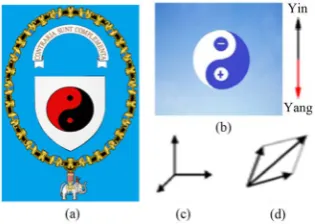
Niels Bohr was the first to bring YinYang into quantum theory for his wave-particle duality principle. When Bohr was awarded the Order of the Elephant by the Danish government, he designed his own coat of arms (Figure 1(a)) which featured in the center a YinYang logo and the Latin motto contrariasuntcomplementa or “opposites are complementary” in English.
It is observed, however, that particle and wave are not direct opposites. While Bohr recognized wave-particle complementarity, he stopped short of identifying the essence of YinYang bipolar coexistence and bipolar com-plementarity (Figure 1(b)).
Theoretically, if bipolar dynamic equilibrium of negative-positive energies and/or input-output information is the most fundamental form of equilibrium, any multidimensional model in spacetime geometry is less funda-mental. A YinYang bipolar complementarity principle is, therefore, imperative for a bipolar equilibrium-based logical interpretation of the quantum world.
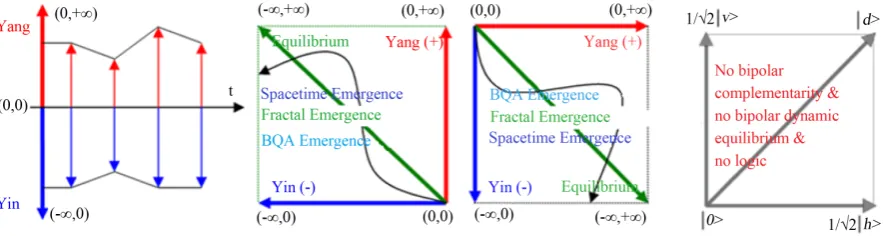
YinYang bipolar complementarity principle claims that action-reaction, particle-antiparticle, input-output, negative-positive energies, or the Yin and the Yang of Nature in general constitute the direct opposites (Figure 1(b)), form the most fundamental complementarity, and provide the source of causality for being and changes [16]. On the other hand, without bipolarity, any complementarity is less fundamental due to the missing “oppo-sites” (Figure 1(c) & Figure 1(d)) (Note: Newtonian action and reaction are equal opposites that are extended to include non-equal opposites to account for modern discoveries such as CP violation or input-output imbal-ance).
[image:5.595.236.394.572.684.2]According to the bipolar complementarity principle, man-woman, space-time, particle-wave, truth-falsity, mind-matter, and imaginary-real complementarities are not exactly bipolar opposites, not bipolar interactive and, thus, less fundamental. For instance, while particle-wave and space-time do not form symmetries and do not in-teract with each other as bipolar opposites, they can be posited the result of particle-antiparticle bipolar interac-tion. It is suggested that this could be the reason why Bohr asserted that a causal description of a quantum
Figure 1. (a) Bohr’s coat of Arms (creative commons file by GJo, 3/8/2010, File: royal coat of Arms of Denmark.svg + File: yinyang.svg); (b) Fundamental bipolar
process cannot be attained and quantum mechanics has to content itself with wave-particle complementary de-scriptions [28]. It can be posited that, due to this limitation, both particle-wave complementarity and space-time relativity theories so far have not evolved to a general purpose logical system for quantum mechanics or quan-tum gravity and, without such a logical system, the nature of quanquan-tum decoherence or collapse has remained a logical mystery.
2.2. Quantum Superposition and Bra-Ket Notation
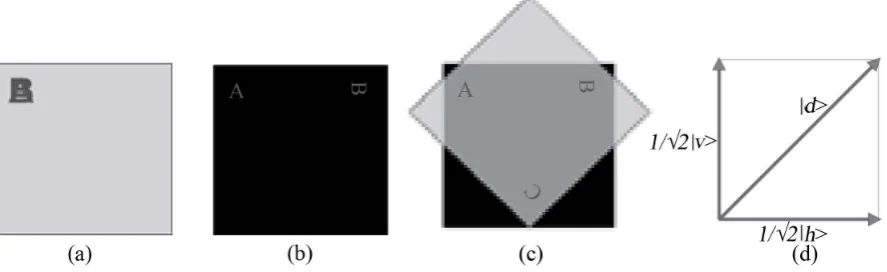
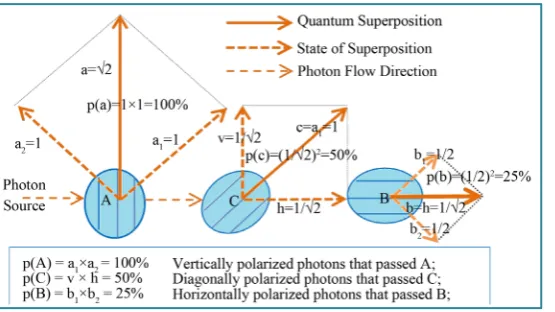
Quantum superposition plays a key role in quantum coherence. In his textbook, Paul Dirac [29] introduced the concepts of quantum superposition and indeterminacy using polarized photons in a 3-polarizer experiment (Figures 2(a)-(d) and Equation (1)). As Dirac stated ([29]: p. 11): “There remains an overall criticism that one may make to the whole scheme, namely, that in departing from the determinacy of the classical theory a great complication is introduced into the description of Nature, which is a highly undesirable feature. This complica-tion is undeniable, but it is offset by a great simplificacomplica-tion, provided by the general principle of superposicomplica-tion of states, which we shall now go on to consider.” Albert Einstein commented on Dirac’s experiment [30]: “Dirac, to whom, in my opinion, we owe the most perfect exposition, logically, of this theory, rightly points out that it would probably be difficult, for example, to give a theoretical description of a photon such as would give enough information to enable one to decide whether it will pass a polarizer placed (obliquely) in its way or not.”
( ) ( )
1 2 1 2d = v + h (1)
Despite the theoretical significance, Dirac’s examples suggest a very simple and inexpensive experiment to demonstrate quantum superposition of polarized photons. Such an experiment is usually performed in high school physics labs. The experiment tells us:
1) Light gets through polarizers (filters) A and B if both are aligned vertically (or horizontally) (Figure 2(a)); 2) If polarizer A remains in vertical polarization and polarizer B is rotated 90˚ to horizontal polarization, no light
gets through (Figure 2(b));
3) Light partially gets through the intersection of polarizer C with polarizer A and polarizer B if C is turned along the diagonal 45˚ and slipped between A (in the rear) and B (in front) (Figure 2(c)).
According to Dirac, with complex number coefficients that represent “probability amplitudes”, the diagonally polarized photon can be represented as a superposition of vertical v and horizontal h states with bra-ket notation in Hilbert space (Figure 2(d), Equation (1)). Local quantum superposition led to the non-local phenomenon of quantum entanglement. Quantum mechanics has never provided a logical definition for quantum superposition and entanglement. No logical exposition of the 3-polarizer experiment was reported in quantum mechanics.
[image:6.595.95.539.549.685.2]Einstein and Schrödinger later attacked the idea of superposition by arguing that it would apply to macros-copic objects like a cat being alive and dead. This quantum phenomenon has been referred to as Schrödinger’s Cat paradox. On the other hand, the quantum mechanical interpretation of entanglement is questioned by the EPR paper [31]. Einstein famously called quantum entanglement “spooky action at a distance” and refused to accept quantum mechanics as a complete theory.
Figure 2. Dirac three polarizer experiment and quantum superposition: (a) Two vertical (or horizontal) polarizers; (b) A ver-tical polarizer and a horizontal one; (c) A diagonal polarizer inserted between a verver-tical and a horizontal polarizer; (d)
2.3. YinYang Bipolar Quantum Superposition
Schrödinger’s Cat has remained a paradox for many decades. An equilibrium-based bipolar quantum geometry (BQG) is proposed based on the YinYang bipolar complementarity principle for resolving the paradox [16]-[18] [22]-[24]. The equilibrium-based axiomatic formulation is revised and introduced as following:
Definition 1. A bipolar dynamic equilibrium is a process of bipolar interaction and state change among bipolar equilibrium, non-equilibrium, and eternal equilibrium states of any action-reaction pair or any collection of such pairs.
Definition 2. A bipolar quantum agent (BQA) is a bipolar dynamic equilibrium. A global bipolar dynamic equilibrium may subsume local ones and a non-elementary BQA may consist of elementary BQAs (Adapted from [16][21]-[24]).
Definition 3. A BQA is said equilibrium-based if it adapts to an equilibrium state under a closed world condi-tion or without external disturbance.
Postulate 1. If an elementary particle or BQA is in a non-equilibrium negative state that can be characterized with the bipolar value (−1,0), its antiparticle must be a BQA in another non-equilibrium state that can be cha-racterized with the bipolar value (0,+1) and the two in a pair without annihilation must be a BQA in an equili-brium state which can be characterized with the bipolar value (−1,+1). The non-existence or annihilation of the particle-antiparticle pair can be characterized with an eternal equilibrium state with the bipolar value (0,0).
Postulate 2. If an elementary particle is its own antiparticle, the BQA must have distinct states that can be characterized as negative (−1,0), positive (0,+1), bipolar equilibrium (−1,+1) and eternal equilibrium (0,0), re-spectively.
Postulate 3. A BQA as a bipolar dynamic equilibrium can emerge from the Yin and Yang of Nature or from other elementary BQAs and can submerge back to the Yin and Yang or other elementary BQAs.
Definition 4. Bipolar quantum geometry (BQG) has three shape-free and quadrant-irrelevant dimensions: the Yin and the Yang dimensions are the two reciprocal and interdependent bipolar opposites from which a third dimension—bipolar dynamic equilibrium as a bipolar quantum superposition of the Yin and Yang dimensions- can emerge and submerge.
Definition 5. A geometry with complete background independence must satisfy the minimum set of condi-tions: 1) it is shape-free, quadrant irrelevant and spacetime transcendent; 2) it supports reductionism, emergence and submergence; 3) it is ubiquitous.
It is proven that BQG satisfies the conditions of complete background independence [22]-[24]. Figures 3(a)-(c) show a sketch of BQG as an extension of YinYang bipolar geometry with a comparison to Dirac’s quantum superposition in Figure 3(d)[29].
[image:7.595.93.536.574.692.2]BQA and BQG provide an ontological and geometrical basis for an equilibrium-based mathematical abstrac-tion for both reducabstrac-tionism and emergence. The equilibrium-based mathematical abstracabstrac-tion have led to bipolar dynamic logic (BDL), bipolar dynamic fuzzy logic (BDFL) and bipolar quantum linear algebra (BQLA) [16]. BDL (seeAppendix) is a bipolar dynamic generalization of Boolean logic (BL) [32]. It is defined on the quan- tum lattice B1= −
{
1, 0} {
× 0, 1+ =} ( ) (
{
0, 0 , −1, 0 , 0, 1 ,) (
+) (
− +1, 1)
}
, where (0,0) characterizes an eternal equili- brium state; (−1,0) characterizes a non-equilibrium (negative) state; (0,+1) characterizes another non-equilibrium (positive) state; (−1,+1) characterizes a bipolar equilibrium state. The four values form a causal set. BDFL can bedeemed a real-valued extension of BDL on one hand or a bipolar dynamic generalization of fuzzy logic (FL) [33] for bipolar probabilistic reasoning on the other hand. BQLA can be deemed an algebraic extension of BDL and BDFL on one hand or a bipolar dynamic generalization of linear algebra (LA) on the other hand. A comparison of the generalizations with the generalized reveals that
BL is truth-based without physical semantics and BDL is equilibrium-based with both logical and physical semantics. BDL generalizes BL from the truth-based domain or Boolean lattice L = {0,1} to the equili-brium-based domain or quantum lattice B1 = {−1,0} 0,+1}. BL is not a causal logic. BDL is a formal causal
logic (see Appendix).
BDFL is a bipolar dynamic generalization of FL from the truth-based domain or fuzzy lattice LF = [0,1] to
the equilibrium-based domain or quantum lattice BF = −
[
1, 0] [
× 0, 1+]
—a bounded real-valued bipolar causal set. BQLA is a bipolar dynamic generalization of linear algebra (LA) from the truth-based domain or lattice L∞ = [−∞,+∞] to the equilibrium-based domain or quantum lattice B∞ = −∞
[
, 0] [
× 0,+∞]
—an unbounded real- valued causal set. Without bipolarity BL, FL and LA are inadequate for the direct representation of a BQA with equilibrium and non-equilibrium states.
Without a shred of dynamics, truth-values cannot form a causal set like B1, BF and B∞.
BDL, BDFL and BQLA subsume BL, FL and LA because any being or truth in spacetime must exist in a bipolar dynamic equilibrium of input-output information or negative-positive energies.
BL, FL and LA can be used together with BDL, BDFL and BQLA as long as equilibrium or non-equilibrium conditions are not violated.
BDL leads to a number of simplifications. Quantum superposition in Dirac’s bra-ket notation (Equation (1)) can be simplified to Equation (2a) in bipolar logical form. Quantum entanglement can be logically defined by Equation (2b). The simplification makes it possible to avoid complex number coefficients. Since BQG is back-ground independent, vertical (v) and horizontal (h) as two direct opposites in a bipolar dynamic equilibrium each can be negative or positive, respectively. Without bipolarity, however, Dirac’s quantum superposition principle does not account for bipolar complementarity, does not support emergence and submergence through bipolar interaction, and stopped short of evolving to a logical definition for quantum superposition and entanglement. BQG and BDL, on the other hand, provides a geometrical and logical basis for both quantum superposition and quantum entanglement.
Bipolar Logical Definition of Generic Quantum Superposition:
(
−1, 0) (
⊕ 0, 1+ = − +) (
1, 1)
; (2a) Bipolar Logical Definition of Generic Quantum Entanglement:(
x y,) ( )
, u v, B1,{
(
x y,) ( )
u v,}
{
(
x y,) ( ) (
u v, or x y,)
( )
u v,}
∀ ∈ Ω ⇒ ⇔ ⇔ − . (2b)
A key element of BDL is bipolar universal modus ponens (BUMP)—a bipolar dynamic generalization of modus ponens (MP) which states that, ∀ψ χ φ ϕ, , , ∈B1,
(
)
(
)
(
(
)
)
(
)
(
(
(
)
)
(
(
)
)
)
(
)
(
)
(
(
)
)
(
)
(
(
(
)
)
(
(
)
)
)
3 2 4
2 3 4
, , & , ,
, , , , ;
x y x y
x x y y
a t p c t p b t p d t p
a t p b t p c t p d t p
ψ χ φ ϕ
ψ φ χ ϕ
⇒ ⇒ ⇒ ∗ ⇒ ∗ (2c)
(
)
(
)
(
(
)
)
(
)
(
(
(
)
)
(
(
)
)
)
(
)
(
)
(
(
)
)
(
)
(
(
(
)
)
(
(
)
)
)
3 2 4
2 3 4
, , & , ,
, , , , .
x y x y
x x y y
a t p c t p b t p d t p
a t p b t p c t p d t p
ψ χ φ ϕ
ψ φ χ ϕ
⇔ ⇔ ⇒ ∗ ⇔ ∗ (2d)
In Equation (2c),
ψ χ φ ϕ
, , ,
are bipolar predicates; ∗ is a bipolar universal operator that can be bound to anybinary operator in BDL; ⇒ is bipolar implication; a(tx,p), b(ty,p2), c(tx,p3), d(ty,p4) are bipolar quantum agents
where a(t,p) stands for “agent a at time t and space p” (tx, ty, px and py can be the same or different points in
spacetime). An agent p without time and space is assumed at any time t and space p. An agent at time t and
implies ϕ
(
d t(
y,p4)
)
, then the bipolar interaction(
ψ(
a t(
x,p)
)
∗φ(
b t(
x,p2)
)
)
implies that of(
)
(
)
(
(
)
)
(
χ
c ty,p3 ∗ϕ
d ty,p4)
. If the bipolar implication operator ⇒ is replaced with the bipolar equivalenceoperator ⇔, BUMP becomes a logical form of quantum entanglement as shown in Equation (3b). The logical form of bipolar quantum entanglement qualifies BDL as a causal logic for equilibrium-based bipolar deduction. On the other hand, BQG and BDL supports the fundamental concept of spacetime emergence as a bipolar quan-tum superposition or entanglement of Nature’s Yin and Yang in a dynamic equilibrium or harmony.
2.4. Logical Exposition of Dirac 3-Polarizer Experiment—A Vindication
It is shown in [22]-[24] that a single incoming polarized photon can be logically channeled through the three polarizers in Dirac’s experiment with BDL in BQG regardless of quantum uncertainty or probability. Since photon is its own antiparticle, following Postulates 1 and 2 we make the background independent and quadrant irrelevant assumptions: 1) a vertically polarized photon state is a positive state (0,+1); 2) a horizontally polarized photon state is a negative state (−1,0); (3) a diagonally polarized photon state is a bipolar equilibrium state (−1,+1); (4) (0,0) stands for no light.
1) Let vertical polarizers A and B be both in state (0,+1) or let two horizontal polarizers be both in state (−1,0), logically, we have A&B=
(
0, 1 & 0, 1+) (
+ =) (
0, 1+)
or A&B= −(
1, 0 &) (
−1, 0) (
= −1, 0)
, respectively. Light gets through A&B in both cases.2) Let vertical polarizer A be in state (0, +1) and horizontal polarizer B in state (−1, 0),
(
) (
) ( )
& 0, 1 & 1, 0 0, 0 .
A B= + − = No light gets through A&B.
3) Let diagonal polarizer C (45˚) be in bipolar equilibrium state (−1,+1), the question is how a single photon can logically get through A, C and B if C is slipped between A and B.
Is there a bipolar conjunctive operator in BDL that allows a single photon to get through the three polarizers in Case (c)? The problem can be formulated as: What is the unknown operator ∗such that
1) A C∗ &B=
(
0, 1+ ∗ − +) (
1, 1 &) (
−1, 0) (
= −1, 0)
or 2) A C∗ &B= −(
1, 0) (
∗ − +1, 1 & 0, 1) (
+ =) (
0, 1+)
?If the Boolean operator & takes effect in the place of ∗, light can only get through the diagonal polarizer C but cannot get through B as we have:
(
) (
) (
) (
) (
) ( )
& & 0, 1 & 1, 1 & 1, 0 0, 1 & 1, 0 0, 0 ;
A C B = + − + − = + − = or (3a)
(
) (
) (
) (
) (
) ( )
& & 1, 0 & 1, 1 & 0, 1 1, 0 & 0, 1 0, 0 .
A C B = − − + + = − + = (3b)
BDL does, however, have another conjunctive &- such that X&−Y = −
(
X&Y)
(see Appendix). Substitute ∗ in 1) and 2) with &- we have:(
) (
) (
) (
) (
) (
)
& & 0, 1 & 1, 1 & 1, 0 1, 0 & 1, 0 1, 0
A −C B= + − − + − = − − = − ; or (3c)
(
) (
) (
) (
) (
) (
)
& & 1, 0 & 1, 1 & 0, 1 0, 1 & 0, 1 0, 1
A −C B = − − − + + = + + = + . (3d)
The results in Equations (3a)-(3d) are supported with well-known experimental results for the quantum su-perposition principle [29]. Thus, the logical exposition constitutes a reconstruction of quantum mechanics with a geometry of light and a logic of polarized photons. The reconstruction is shown to be a point of fundamental departure from quantum mechanics in the remaining sections.
2.5. Bipolar Probability—A Vindication of Bipolar Quantum Superposition
While Dirac tells us that “diagonally polarized photon can be represented as a superposition of vertical and ho-rizontal states, with complex number coefficients that represent probability amplitudes,” the nature of superpo-sition has never been logically clarified. It is shown in [22]-[24] that the nature of quantum superposition is bipolar dynamic equilibrium or bipolar quantum superposition.
Figure 4. Quantum mechanical interpretation of quantum superposition
[image:10.595.178.456.84.240.2]without bipolarity and logically definable causality.
Figure 5. Equilibrium-based logical interpretation of quantum
superposi-tion with bipolarity and logically definable causality in BQG.
mysterious without a unique logical system for equilibrium-based bipolar dynamic reasoning. Thus, the analytical power of the quantum mechanical interpretation of superposition is compromised by the complex number coef-ficients.
Figure 5 provides a picture for the equilibrium-based logical interpretation of quantum superposition. In the new interpretation, all quantum states are represented by bipolar scalar values of the Yin and the Yang in equili-brium or non-equiliequili-brium. The bipolar scalar representation provides a basis for BDL, BDFL and BQLA for logical, probabilistic and algebraic reasoning and computation on quantum superposition, emergence and sub-mergence.
For instance, the probability for a vertically prepared photon to pass the diagonal polarizer C as a square of a
complex number coefficient is
( )
2
1 2 =1 2. But Figure 4 can be easily represented in Figure 5 by an equili- brium-based bipolar logic or probability value (−1/4, +1/4). Evidently, we have
( )
2
1 4 1 4 1 2 1 2
− + = = . In
[image:10.595.174.450.276.490.2]ap-proach leads to an analytical paradigm of quantum superposition.
Furthermore, it is clear from Figure 5 that the diagonally prepared photons C present an emergence from h and v—the Yin and Yang. On the other hand, c submerged to v and h (after polarizer B) in the experiment. It can be argued, however, that the emergence and submergence are also represented in Figure 4 with complex number coefficients. The counter argument is that, without bipolarity, there would be no bipolar interaction, no BDL, no BQG, no logically definable quantum emergence and submergence.
The comparison further confirms that YinYang bipolar complementarity is the most fundamental comple-mentarity which may lead to the emergence and submergence of a bipolar quantum superposition. On the other hand, the real and imaginary dimensions of complex numbers are not most fundamental because they do not support background independent bipolar interaction and emergence.
3. G-CPT Symmetry
3.1. Logical Basis
According to the bipolar complementarity principle, space-time and particle-wave complementarities are less fundamental concepts subject to bipolar complementarity and bipolar dynamic equilibrium. Thus, the 3-D in-formation of particle-wave in Hilbert space are ever changing phenomenon because spacetime is ever changing due to bipolar dynamic equilibrium. We need a point of departure from spacetime relativity and particle-wave duality. While BDL is such a point of logical departure, BQLA extends BDL to a point of mathematical depar-ture from bra-ket notations in Hilbert space. The result is a multidimensional bipolar equilibrium-based unifica-tion of energy and informaunifica-tion for symmetry and regulaunifica-tion of multiple BQAs in the background independent ubiquitous BQG.
Given bipolar quantum agent e=
(
e e−, +)
∈ −∞[
, 0] [
× 0,+∞]
, we have Equations (4a)-(4m) (adapted from [16] [21][33][34]): The Yin or negative energy/information of e:
ε
−( )
e =e−; (4a1) The absolute Yin energy/information of e: ε−( )
e = e− ; (4a2) The Yang or positive energy/information of e:ε
+( )
e =e+; (4b1) The absolute Yang energy/information of e: ε+( )
e = e+ ; (4b2) Equilibrium state of e:(
e−,e+)
when e− = e+ >0; (4c) Non-equilibrium state of e:(
e−,e+)
when e− ≠ e+ ; (4d) Eternal equilibrium state of e:( )
0, 0 ; (4e) Bipolar energy/information of e: ε( )
e =(
ε−( )
e ,ε+( )
e) (
= e e−, +)
; (4f) Imbalance of e: εimb( )
e = e+ −e− =ε+( )
e −ε−( )
e ; (4g) Balance of e:(
ε( )
e εimb( )
e)
2.0 min(
e ,e)
− −
− = ; (4h)
Harmony of e:
(
ε( )
e −εimb( )
e)
ε( )
e ; (4i) Bipolar superposition in scalar form: e
(
e e,)
− +
= ; (4j) Bipolar superposition in vector form: e =
(
e e−, +)
; (4k)
Superposition magnitude: e = e =
(
e−,e+)
=2 e−2+e+2
. (4l)
Equilibrium-Based Unification of energy/information:
( )
e( )
e( )
e e eε = ε− +ε+ = − + + ; (4m)
The unification of energy/information provides a necessary condition for an equilibrium-based energy/infor- mation conservational generalization of CPT symmetry. Elementary energy/information measures can be ex-tended to system energy/information measures with BQLA for bipolar regulation. Each row, column, or a whole bipolar matrix can have negative, positive and bipolar energy/information with absolute total and balance. While BDL is logical but not fully mathematical, BQLA leads to an algebraic unification of bipolar energy/informa- tion that in turn leads to formal algebraic definitions of equilibrium and harmony—a unifying concept for both the classical and quantum worlds.
(
x y, ,) (
u v,)
B∞[
, 0] [
0,]
Bipolar Algebraic Multiplication:
(
x y,) ( ) (
× u v, ≡ xv+yu xu, +yv)
; (5b) Linear multiplication or division: a x y(
,) (
≡ ax ay,) (
;b x y,) (
≡ by bx,)
; (5c) Bipolar Conjunctive Multiplication:(
x y,) ( )
∧ u v, ≡(
max( )
x u, , min( )
y v,)
; (5d)Bipolar Disjunctive Multiplication:
(
x y,) ( )
∨ u v, ≡(
min( )
x u, , max(
y∨v)
)
. (5e) With Equation (5a)-(5b), system level bipolar quantum superposition of multiple BQAs can be mathematical-ly characterized with bipolar matrix addition and multiplication using BQLA similarmathematical-ly as in LA. We prove in what follows that quantum superposition with bipolar addition and multiplication makes it possible to have a fundamental departure from Dirac’s Bra-ket superposition in Hilbert space for systematic analysis of multiple BQA superposition.Theorem 1. With background independence, bipolar addition is essentially bipolar quantum superposition of two BQAs into one in BQG.
Proof. Given BQAs A = (x, y) and B = (u, v), following Equation (4m) and Equation (5) we have:
( ) ( )
(
)
2 2 2 2
2 2
2 2
2
, ,
, ;
A B x y u v x y u v
x u y v x u y v
+ = + = + +
= + + = +
+
+ +
(6)
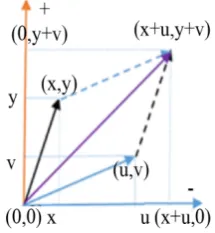
Since A and B are both bipolar vectors in BQG, Hilbert space vector addition is converted to scalar addition in Equation (6) as illustrated in Figure 6 with the same magnitude
2 2 2 2 2 2
2 x + y +2 u +v =2 x+u + +y v
.
Theorem 2. With background independence, bipolar multiplication can, under certain condition, be used to characterize equilibrium-based BQA composition into a new BQA through bipolar interaction and superposition in BQG.
Proof. While composite BQA is discussed later, at the most abstract level a BQA is simply a bipolar dynamic
equilibrium per Definition 2. Given two BQAs A and B, let A = (x,y) and B = (u,v), a new BQA C can be formed where C= × =A B
(
x y,) ( ) (
× u v, = xv+yu xu, +yv)
=(
C−,C+)
. Theorem 3. With background independence, bipolar multiplication converts vector multiplication from Hil-bert space to algebraic computation in BQG with the preservation of vector magnitude and without the preserva-tion of background dependent informapreserva-tion.
Proof. It follows from that
( ) ( ) ( ) ( )
x y, × u v, =(
x, 0 + 0,y)
×(
( ) ( )
u, 0 + 0,v)
(
xv yu xu, yv) (
x y, ) ( ,u v)
= + + = × (see Figure 6).
[image:12.595.258.366.576.693.2]Theorem 4. With background independence, bipolar matrix multiplication can, under certain condition, be used for characterizing the composition of a set of BQAs into another set of BQAs through bipolar interaction and quantum superposition in BQG.
Figure 6. Conversion from Hilbert space to bipolar space with vector
Proof. Given the square bipolar matrix
[
A B]
with two BQAs A and B, let A = (x, y) and B = (u, v); giventhe column bipolar matrix C D
with two BQAs C and D, let C = (o, p) and B = (q, r); a new BQA E can be
formed where
[
]
(
)( )
(
( )
)
(
) (
)
(
)
(
( ) ( )
)
(
) (
)
(
)
(
)
, , , , , , , , , , , , . o p CE A B x y u v
q r D
x y o p u v q r
xp yo xo yp ur vq uq vr
xp yo ur vq xo yp uq vr
E− E+
= × = × = × + × = + + + + + = + + + + + + =
Thus, the multiplication of a row BQA matrix and a column BQA matrix results in a new BQA—an ensemble or composite of component BQAs in a superposition. The result of each such row by column multiplication re-sults in a newly composed BQA. An n × n bipolar square matrix multiplied by an n × 1 bipolar column matrix results in n new column matrix of BQAs which can be deemed a set of BQAs or a single composite BQA.
3.2. Unification of Logical Linearity and Physical Nonlinearity
All agents are input/output (I/O) systems that can be classified as linear or nonlinear. If we apply input x to a dynamic system and obtain output y, scaling input x may give a scaled y such as the input αx leads to αy, where α is a scalar. When this property is true, we say that the I/O system is a linear system. Otherwise, it is nonlinear.
Similarly, a logic is said a linear logic if it satisfies the distributive law such as
(
) (
) (
)
A∧ B∨C = A∧B ∨ A∧C where A, B or C assumes a truth value 0 or 1 which can be deemed a scalar for false or true, respectively. Thus, Boolean logic can be said a linear logic. A generalization of Boolean logic to intuitionistic logic can be achieved by a linear logic [34]-[36].
Logical linearity and physical nonlinearity can be deemed a duality. It is unclear, however, how to unify logi-cal linearity and physilogi-cal nonlinearity for nonlinear dynamic logilogi-cal reasoning of quantum superposition. Is there a dynamic logic that is logically linear but physically nonlinear?
BDL, BDFL and BQLA [16] as equilibrium-based generalizations of BL [32], FL [33] and LA, respectively, are bipolar dynamic in nature due to bipolar interaction. Whether they are linear or nonlinear is a matter of de-bate. While BDL was said a nonlinear bipolar dynamic generalization of BL [16]-[21], it can be argued that it is nothing more than a hyperspatial linear extension of BL. This argument is a strong one because bipolar distribu-tivity of ⊗ and ⊕ as well as & and ⊕, the very definition of linearity, is indeed maintained with BDL (see Ap-pendix Table A2).
A further examination, however, reveals that, due to equilibrium-based bipolar dynamic interaction, BDL presents a unification of logical and physical systems. Since all beings must exist in certain bipolar dynamic equilibrium of input-output (I/O) or negative-positive energies/information, the bipolar operators can character-ize different bipolar dynamic interactions and can change an equilibrium state to a non-equilibrium state with nonlinear bipolar dynamic behaviors. For instance, α(input, output) or α(−pole, +pole) is a linear scaling if α is a scalar; (−1,0) &-( −1,+1) = (0,+1) is logically linear but physically non-linear because a bipolar variable is not a scalar and a bipolar operator does not scale. Thus, logically, the binary operators of BDL are linear or bilinear that provide a basis for the soundness of the logic; physically it has nonlinear dynamics embedded and is inhe-rently nonlinear. This is fundamentally different from truth-based linear or bilinear systems which do not as-sume equilibrium-based physical semantics.
it to be a general purpose logic for bipolar dynamic reasoning on quantum superposition and entanglement. As a matter of fact, if the Dao of YinYang is a holistic bipolar dynamic equilibrium system that subsumes the un-iverse, YinYang BDL is supposed to unify logical linearity and physical nonlinearity. The unification makes nonlinear bipolar dynamic reasoning possible with logical soundness. On the other hand, it provides a logical basis for both reductionism and emergence in bipolar quantum geometry.
With the logical basis, BQLA borrows the forms of classical linear algebra but performs nonlinear bipolar dynamic operations in bipolar dynamic equilibrium domains. As a nonlinear bipolar dynamic generalization of LA, BQLA is to BDL as LA is to BL or BQLA is to LA as BDL is to BL. With the unification of logical linear-ity and physical non-linearlinear-ity, an information conservational unification of CPT symmetry and CP violation un-der bipolar dynamic equilibrium is made possible.
3.3. Information Conservational Multiagent Cellular Automata Unification of Quantum
Emergence and Submergence
The concepts of bipolar elementary energy and information laid a basis for modeling bipolar quantum superpo-sition of multiple BQAs as a multidimensional dynamic equilibrium with BQLA. Figure 7 shows that two or more bipolar variables can be integrated into a multidimensional bipolar quantum superposition.
Electron and positron form a typical bipolar particle-antiparticle pair. It is believed that matter and antimatter once existed in near perfect counterbalance immediately after the big bang but antimatter vanished without a trace on a cosmic scale-one of the greatest mysteries of the universe. Today, antimatter does not exist normally, at least on Earth, but we know that it is real because positron has been discovered [37]. As the most fundamental example of the materialization of energy, electron-positron pair production has been accurately described by quantum electrodynamics (QED)-the jewel of physics [38][39]. Now, positron is applied in nuclear medicine.
Since an electron carries one unit of negative charge (−1), a negative charge is generally deemed an electron. On the other hand, a positron carries one unit of positive charge (+1) but a positive charge is not deemed a posi-tron. This conceptual imbalance can trace its origin to Dirac’s prediction of positron [40]. Before his prediction, he once explored the possibility of proton being an island of positively charged electron [41]. Dirac acknowl-edged the problem that a proton has a much greater mass than an electron, but expressed “hope” that a future theory would resolve the issue. It is said ([42]: p. 46) that Robert Oppenheimer argued strongly against the pro-posal because, in that case, the hydrogen atom would rapidly self-destruct in an annihilation. Persuaded by Op-penheimer’s argument, Dirac predicted the existence of an as-yet unobserved particle that he called an “an-ti-electron” that would have the same mass as an electron and would mutually annihilate upon contact with an electron [40].
[image:14.595.117.548.588.714.2]Now, it is well-known that, in positron emission or beta plus decay (β+ decay), a proton is converted to a neu-tron while releasing a posineu-tron (β+) and an electron neutrino. On the other hand, in beta minus decay (β− decay), a neutron turns into a proton and the nucleus emits an electron (β−) and an antineutrino. To certain extent, posi-tron emission justifies proton being an island of posiposi-tron as Dirac originally suggested. The problem is that pro-ton consists of quarks [43] and does not contain a positron according to the standard model. Here, we have the question whether the quark formation of a proton is Nature’s “encryption” mechanism to conceal a positron within a proton to prevent it from annihilation with an electron—a possible interpretation to the matter-antimatter
asymmetry. According to Richard Feynman, the “encryption” or hidden positron idea was suggested by John Wheeler in 1940 (cf. [44]).
In any case, matter and antimatter atoms are formed with particles and antiparticles in certain combinations. The quarks of a proton do carry a total of one positive charge and a proton does emit a positron in β+ decay. In terms of negative-positive energy/information conservation, the hidden positron hypothesis is logically a valid theory. The theory has led to an equilibrium-based axiomatization of physics with BDL and BQLA in BQG [16] —a minimum but most general solution to Hilbert Problem 6 [45].
Postulate 4. An antiparticle can be logically encrypted and physically concealed or insulated within a particle and vice versa.
Postulate 5. A positron is logically encrypted and physically concealed within a proton to prevent it from an-nihilation with an electron; an electron is logically encrypted and physically concealed within an antiproton to prevent it from annihilation with a positron.
Based on the above postulate, we have
Definition 6 (Matter and Antimatter Emergence and Submergence). A matter or antimatter atom is logically a set of electron-positron pairs or BQAs insulated from annihilation and regulated by the nucleus of the atom. When N electron-positron pair(s) as component BQAs A A1, 2,,AN, N > 0, are organized by its nucleus into a
matter or antimatter atom to form a composite BQA, we have matter or antimatter emergence. When a matter or antimatter atom split or decay into subatomic particles and/or antiparticles, we have matter or antimatter sub-mergence.
Theorem 5. Matter or antimatter emergence can be characterized as a multidimensional quantum superposi-tion with a bipolar quantum cellular automaton interpretasuperposi-tion of quantum mechanics.
Proof. Given N electron-positron pair(s) insulated from annihilation as component BQAs A A1, 2,,AN, N >
0, the nucleus as the organizational center of the atom can be characterized by a bipolar quantum logic gate matrix M and the emergence of an atom can be defined as the self-organization of the component BQAs around the nucleus into a bipolar quantum cellular automaton (BQCA)—a composite BQA E as shown in Equation (7).
BQCA in BQLA: E t
(
+ =1)
M t( )
×E t( )
; (7a)BQCA Power Law: E t
(
+n)
=Mn( )
t ×E t( )
. (7b) In Equation (7), M(t) is an N by N bipolar quantum logic gate matrix that characterizes the nucleus bipolar regulatory energy/information at time t; E is an N by 1 bipolar matrix characterizing the bipolar ener-gy/information of a column matrix of N BQAs such as the electron-positron pairs of an atom at time t. Equation 7(a) is based on Equation (5a)-(5b). It defines system level quantum superposition with BQLA matrix multiplica-tion; Equation 7(b) defines a bipolar quantum power law. Time is introduced into the equations (Note: Although BQG is background independent, it subsumes spacetime, time and/or space can be added as needed). [image:15.595.144.489.579.696.2]Thus, a BQCA characterizes a multidimensional bipolar dynamic equilibrium emerged from bipolar quantum superposition without annihilation due to the concealment (See Postulates 4 and 5).
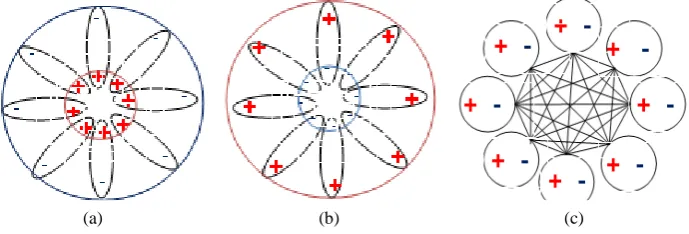
Figure 8 shows a bipolar equilibrium-based unification of matter and antimatter atoms as a BQCA. Matter- antimatter emergence can be deemed a result of BQCA self-organization and unification of multiple BQAs in BQG. The unification is realized in the background independent BQG. It can be posited that spacetime emer-gence is fundamentally matter-antimatter emeremer-gence. It is shown that the BQCA model also leads to the unification
(a) (b) (c)
Figure 8. (a) Matter atom as bipolar quantum agent; (b) Antimatter atom as bipolar quantum agent; (c) Bipolar
of wave and particle [17][21][46]. Thus, not only BQG qualifies to be the geometry of light, it is also qualifies to be the geometry of Nature. It opened a new direction for exploring a number of frontiers in modern science [16]-[26] [47]-[53].
With BQCA, a quantum agent can be regulated to maintain energy/information conservation. When the abso-lute total energy of each row
(
εrow Mi,*( )
t)
and that of each column(
εcol M∗,j( )
t)
of the regulatory matrix M(t) equals 1.0, M(t) is defined as a generalized unitary bipolar quantum logic gate matrix extended from in-teger domain to decimal domain [18][21]. Such a quantum logic gate exhibits energy/information conservation functionality which can also be scaled from logical and physical level to biological, mental and social worlds [16]-[26] [54]-[59].While the condition that the absolute total energy and/or information of each row
(
εrow Mi,*( )
t)
equals 1.0 is necessary for uniform energy/information conservation and distribution at both system and elementary levels in an isotropic quantum world, the condition is unnecessary for non-uniform energy and/or information conser-vation, regeneration, degeneration and distribution. It is therefore not applicable in an anisotropic classical world. For instance, the condition is not applicable for the emergence in a quantum world and submergence to a clas-sical world. Thus, we reserve the original definition for an isotropic quantum world and redefine energy/infor- mation conservation, degeneration and regeneration with a relaxed condition for a more general category of ap-plication domains that entail nuclear decay and fission, biological mutation and evolution, natural degeneration and regeneration, mental fusion and fission, social dynamics and other anisotropic changes [16]-[26] [54]-[59].Definition 7. Given a regulatory bipolar matrix M(t) defined on BF such that E t
(
+ =1)
M t( )
×E t( )
, 1) ifthe absolute total energy/information of each column
(
εcol M∗,j( )
t)
(but not necessarily each row) equals 1.0, M(t) is defined as an energy/information conservational bipolar quantum logic gate matrix; 2) if the absolute total energy/information of each column(
εcol M∗,j( )
t)
(but not necessarily each row) is greater than 1.0, M(t) is defined as an energy/information regeneration bipolar quantum logic gate matrix; if the absolute total ener-gy/information of each column(
εcol M∗,j( )
t)
(but not necessarily each row) is less than 1.0, M(t) is defined as an energy/information degeneration bipolar quantum logic gate matrix.Theorem 6. The law of energy/information conservation/preservation, degeneration and regeneration: 1) An energy/information conservational bipolar quantum logic gate matrix exhibits holistic energy/informa- tion conservation regulatory functionality at the system level. That is, if ∀j, εcol M∗,j
( )
t =1.0, we have(
1)
(
( )
( )
)
( )
E t M t E t E t
ε + =ε × ≡ ε . (8a)
(
)
(
n( )
( )
)
( )
E t n M t E t E t
ε + =ε × ≡ε . (8b)
2) An energy/information regeneration bipolar quantum logic gate matrix exhibits holistic energy/informa- tion regeneration regulatory functionality at the system level. That is, if ∀j, εcol M∗,j
( )
t >1.0, we have(
1)
(
( )
( )
)
( )
E t M t E t E t
ε + =ε × >ε . (8c)
(
)
(
n( )
( )
)
( )
E t n M t E t E t
ε + = ε × > ε . (8d)
3) An energy/information regeneration bipolar quantum logic gate matrix exhibits holistic energy/informa- tion degeneration regulatory functionality at the system level. That is, if ∀j, εcol M∗,j
( )
t <1.0, we have(
1)
(
( )
( )
)
( )
E t M t E t E t
ε + =ε × < ε . (8e)
(
)
(
n( )
( )
)
( )
E t n M t E t E t
ε + =ε × <ε . (8f)
Proof. 1) If ∀i,j, εcol M∗,j
( )
t =1.0, it enables 100% of the energy/information be transferred from E(t) to(
1)
( )
( )
E t+ =M t ×E t . 2) If ∀i,j, εcol M∗,j
( )
t >1.0, it enables more than 100% of the energy/information be transferred from E(t) to E t(
+ =1)
M t( )
×E t( )
. 3) If ∀i,j, εcol M∗,j( )
t <1.0, it enables less than 100% of the energy/information be transferred from E(t) to E t(
+ =1)
M t( )
×E t( )
. (
1)
( )
( ) (
(
0, 0.4) (
) (
0.3, 0.2)
)
(
(
0, 100)
)
(
(
30, 60)
)
0.6, 0 0, 0.5 0, 100 60, 50
E t+ =M t ×E t = − + − − + −= +
− − + − + − +
;
Column energies of M t
( )
:(
)(
)
(
0, 0.4 0.6, 0)
0.4 0.6 1.0ε − + − = + − = ;
(
)(
)
(
0.5, 0.2 0, 0.5)
0.3 0.2 0.5 1.0ε − + − + = − + + = ;
Global energy/information conservation of E t
( )
and E t(
+1)
:( )
100 100 200 E tε = + = ;
(
1)
30 60 60 50 200( )
E t E t
ε + = − + + − + = = ε .
Figures 9(a)-(d) show examples of bipolar energy/information conservation, regeneration, degeneration and oscillation, respectively, with particle-wave unification. Each bipolar wave form is also a BQA = (x,y) or a bipolar subatomic particle.
Theorem 7. Quantum decoherence and collapse can be logically unified under quantumsubmergence of a multidimensional quantum superposition with a bipolar quantum cellular automaton interpretation of quantum mechanics.
Proof. Based on Equation (8), when εcol M∗,j
( )
t <1.0, a BQCA can be regulated for energy/information in-crease. When εcol M∗,j( )
t =1.0, quantum coherence emerges in a delegate bipolar dynamic equilibrium/har- mony. After then, any of the two conditions of εcol M∗,j( )
t >1.0 or εcol M∗,j( )
t <1.0 will cause the sub-mergence of the coherence into decoherence or collapse. 3.4. Bipolar Dynamic Equilibrium—The Essence of Being and Causality
Definition 8. A BQA in the logical form (x,y) is said a primitive BQA. A BQA in the BQCA matrix form
(
1)
( )
( )
E t+ =M t ×E t is said a multiagent or composite BQA.
Definition 9. Given two BQAs A1 and A2, primitive or composite, we say A1 and A2 are in a 2-party quantum
entanglement, denoted A1Ω A2, if A1⇔A2 or A1⇔ −A2, where the bipolar equivalence operator ⇔ is
gene-ralized from its logical equivalence (Appendix Table A1) to matrix equivalence. Formally, we have Equation (9a)-(9c):
{
A1⇔A2}
⇒ ∀{
i j A i j, , ,1[ ]
⇔A i j2[ ]
,}
; (9a){
A1⇔ −A2}
⇒ ∀{
i j A i j, , ,1[ ]
⇔ −A i j2[ ]
,}
; (9b){
A1ΩA2} {
⇒ A1⇔A2} {
or A1ΩA2} {
⇒ A1⇔ −A2}
. (9c)It should be noted that, for any bipolar agent A we have ε A≡ ε
( )
−A . Thus, the negation operation (-) is energy-information conservational—a distinguishing property of BDL, BQLA and BQCA which provide a ma-thematical basis for CP-violation while maintaining energy information conservation. On the other hand, since( )
0, 0(
( )
0, 0)
(
1, 1)
ε ≠ε ¬ = ε − + , the complement operation (¬) is, in general, not energy-information con-servational except for certain symmetrical cases [18].
Theorem 8. Without bipolar coexistence of negative-positive energies/information, bipolar interaction and energy/information conservation would be impossible with CP-violation.
Proof. First, without bipolar coexistence of negative-positive energies/information, bipolar interaction and CP-violation cannot be fully represented. Secondly, without such bipolar coexistence, the absolute total ener-gy/information equality ε A≡ ε
( )
−A would be impossible. While truth has been deemed the essence of being since Aristotle, without bipolarity truth-based logic and li-near algebra are incapable of bipolar causal interaction, self-organization, and dynamic regulation for bipolar emergence and submergence due to bipolar cancelation. For instance,
0.5 0.5 100 0 0.5 0.5 100 0
+ −
=
− +
;
0.6 0.5 100 10 0.6 0.5 100 10
+ − +
=
− + −
;
0.4 0.5 100 10 0.5 0.4 100 10
+ − −
=
− + −
(a)
(b)
(c)
[image:18.595.207.435.80.693.2](d)
Figure 9. (a) energy/information conservation; (b) energy/information increase; (c) energy/information decrease; (d)
![Figure 7. Multidimensional equilibrium of bipolar quantum agents (adapted from [16]).](https://thumb-us.123doks.com/thumbv2/123dok_us/7944690.751258/14.595.117.548.588.714/figure-multidimensional-equilibrium-bipolar-quantum-agents-adapted-from.webp)
![Figure 9. (a) energy/information conservation; (b) energy/information increase; (c) energy/information decrease; (d) ener-gy/information oscillation (adapted from [17])](https://thumb-us.123doks.com/thumbv2/123dok_us/7944690.751258/18.595.207.435.80.693/information-conservation-information-increase-information-decrease-information-oscillation.webp)