http://dx.doi.org/10.4236/jsip.2013.44043
Implementation of Variable Tone Variable Bits Gray-Scale
Image Stegnography Using Discrete Cosine Transform
Sahib Khan1*, Muhammad Nawaz Khan1, Somia Iqbal1, Syed Yaqoob Shah2, Nasir Ahmad2
1
Department of Electrical Engineering, University of Engineering & Technology, Peshawar, Pakistan; 2Department of Computer Sys- tem Engineering, University of Engineering & Technology, Peshawar, Pakistan.
Email: *[email protected]
Received July 23rd, 2013; revised August 24th, 2013; accepted September 1st, 2013
Copyright © 2013 Sahib Khan et al. This is an open access article distributed under the Creative Commons Attribution License, which permits unrestricted use, distribution, and reproduction in any medium, provided the original work is properly cited.
ABSTRACT
Secure exchange of information is the basic need of modern digital world of e-communication which is achieved either by encrypting information or by hiding information in other information called cover media. Concealing information re- quires a well designed technique of Stegnography. This work presents a technique, variable tone variable bits (VTVB) Stegnography, to hide information in a cover image. The VTVB Stegnography hides variable data in discrete cosine transform (DCT) coefficients of the cover image. VTVB Stegnography provides variable data hiding capacity and vari-able distortion. Additional large data hiding this technique provide extra security due to the large key size making VTVB Stegnography technique much more immune to steganalysis. The hiding makes the existence of information imperceptible for steganalysis and the key of keeping a secret makes the recovering of information difficult for an in-truder. The key size is depending on cover image and numbers of bits of discrete cosine transform (DCT) coefficients used for information embedding. This is a very flexible technique and can be used for low payload applications, e.g. watermarking to high payload applications, e.g. network Stegnography.
Keywords: Information Security; Image Processing; Stegnography; Steganalysis; Discrete Cosine Transform (DCT)
1. Introduction
This Stegnography is a method of secure exchange of information; implemented by concealing covert messages in cover-medium like text, digital images [1], audios [2,3] and videos [4]. Stegnography keeps the presence of cret information undetectable and Stego-file having se-cret information looks like the cover-file. But there are some chances of detection. To hide information in an undetectable manner is key feature of a good Steg-nographic method [4]. A method using a cover medium with a large degree of redundancy is considered the most suitable one [5]. The redundant bits are replaced with information resulting trivial change in Stego-Image [4,6]. Crandall for the first time presented a matrix coding technique with improved hiding efficiency [7]. The rela-tion between Stegnographic codes (Stego-codes) and covering codes was studied in [8].
Information can be hidden in the cover file in spatial domain modifying cover elements and transform domain
modifying transform coefficients. This paper presents a Stegnographic technique used for DCT coefficients of a cover image. The proposed technique provides a self encryption and hides variable amount of data in different DCT coefficients. As each coefficient represents a fre- quency component (Tone) and different amounts of data are hidden in different coefficients, that’s why it is named as variable tone variable bits (VTVB) Stegnography.
2. Previous Work
Stegnography like Cryptography is technique for secure communication of information. Various researchers made their efforts and proposed some best technique of that time. A brief description of the developments made in the field of Stegnography is given as:
The mathematical equations of Discrete Cosine Trans- form (DCT) and its uses in image compression [9] and the conversion of a signal to its basic components [10] opened new way for the Stegnography using DCT. A trustworthy and precise procedure has been proposed by Jessica Fridrich et al. for detecting least significant bit
(LSB) non sequential embedding in digital images [11- 13]. The image signature concept has been implemented by Mohesen A shourian, R. C. Jain and Yo-Sung Ho [14]. J. R. Krenn has proposed a pseudo-code algorithm to hide message in LSB of DC coefficients of cover image [15]. Ren-Junn Hwang et al. have proposed data hiding based on JPEG technique [16]. H. W. Tseng and C. C. Chang have proposed a novel high capacity data hiding method based on JPEG [17]. Youngran Park et al. have proposed and implemented a method, in spatial domain, to authenticate whether the hidden message had been deleted, forged or changed by attackers [18]. Neeta Deshpandeet et al. have set in data in least significant bits of cover image [19]. M. Chaumont and W. Puech have proposed a method with secret key to hide the color information in a compressed grey-level image [20]. Aneesh Jain and In-dranil Sengupta have proposed a method, resistant to JPEG compression, of hiding information using bitmap image as cover [21]. KokSheik Wong, Xiaojun Qi, and Kiyoshi Tanaka have proposed Mod4 Stegnography method, capabale of hiding information into both uncompressed and JPEG compressed image, in discrete cosine transform (DCT) domain [22]. Takayuki Ishida et al. have discussed an improved version of JPEG2000 Stegnography, named QIM-JPEG2000 Steg- nography, using quantization index modulation (QIM) [23]. In 2010 Ching-Tsorng Tsai et al. presented a steg- anographic scheme that conceals secret information in image mosaics based on tile [24]. In 2011 Chung-Ming Wang and Peng-Cheng Wang schemes presented two new scheme SSA and ESA, for digital Stegnography of point sampled geometry in the spatial domain image fea- tures [25]. Debnath Bhattacharyya proposed a data hid- ing technique that exploits some features of audio signals that was able to hide data from perception robustly [26]. A distance based algorithm named decreasing distance decreasing bits (DDDB) was proposed and implemented by Sahib Khan et al. in 2011 [27] and in 2013 modular distance technique (MDT) was adopted for the imple-mentation of image Stegnography [28].
3. Proposed Work
Stegnography can be implemented in spatial domain as well as transform domain. In spatial domain data is hid- den directly in cover file pixels by varying the signal intensity while in transform domain the transform coeffi- cients are modified according the message. This work deals with the implementation of Image Stegnography in Discrete Cosine Transform (DCT). As most of the Signal energy lies at low frequency in image; it appears in the upper left corner of the DCT [29]. Due to this distribu-tion of energy the higher frequency were mostly used for data hiding. Almost all the previous work used either fixed data hiding or targeted a specific region of DCT
coefficients for data hiding. This work is presenting a new technique for data hiding i.e. Stegnography by hid-ing varyhid-ing amount of data in different DCT coefficients. Different amount of data is hidden within different fre-quency components i.e. DCT coefficients. As in commu-nication a frequency is also called tone that’s why tech-nique is termed as Varying Tone Varying Bits Stegno- graphy.
In varying tone varying bits (VTVB) Stegnography in-stead of fixed; varying data is hidden in various DCT coefficients. As each DCT coefficient’s value is repre- sented by 16 bits i.e. of type double and any/any number of the bits can be used for data hiding using VTVB Stegnography. The number of bits utilized is determined by the user depending on the requirement i.e. Hiding Capacity, Signal to Noise Ratio (SNR), Peak Signal to Noise Ratio (PSNR) and Mean Square Error (MSE) [30,31]. Using more bits per coefficient for data hiding in cover image, results in increase in data hiding capacity and MSE. The DCT coefficients are subject to varying bits substitution ranging from 0 bits i.e. no hiding to 16 bits. How much number of bits are hidden in which coef- ficient is the key of VTVB Stegnography; making it dis- tinctive and more secure from other Stegnography tech- niques.
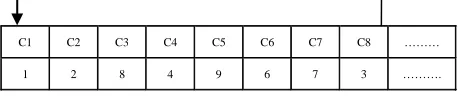
In VTVB Stegnography DCT coefficients are arran- ged in a group of “I” coefficients. The group size de- pends on the number of bits variation i.e. how many different no. of bits are used for data hiding in a group. As in double format each DCT coefficient is represented using 16 bits so using double format there are 17 dif- ferent possible combination of no. of bit and any of the combination/s can be used for data hiding. For example if a group size of 8 coefficients is used for data hiding then there are 8 different no. of bits can be used for data hiding defined by the user as given in Figure1.
In coefficient “C1” of defined group only 1 bit data is hidden, in coefficient “C2 - C8” of the same group are subjected to 2, 8, 4, 9, 6, 7 and 8 bits substitution respectively. The same sequence is followed for the other groups of the same cover file. The group size may be varied depending on application. Any group size of DCT coefficients, 17 at maximum, can be used. As shown in
Figure 2. The process is repeated for the whole cover file.
After hiding information in DCT coefficients the In- verse DCT transform is applied on the modified coeffi-
C1 C2 C3 C4 C5 C6 C7 C8 ………
[image:2.595.309.538.664.712.2]1 2 8 4 9 6 7 3 ……….
C1 C2 C3 C4 C5 C6 C7 C8 C9 C10 C11 C12 C13 C14 C15 C16 C17
[image:3.595.315.539.378.506.2]1 2 3 4 5 6 7 8 4 3 6 10 11 … … … …
Figure 2. Coefficients and no. of bits assignment for group size 13.
coefficients to get Stego file.
3.1. Hiding Capacity Stegnography
In VTVB Stegnography variable amount of data is hid- den in different coefficients of each groups of DCT coefficient of predefined size. The data hiding capacity depends totally on the no. of bits assigned to each coefficient of the group. More bits used for data hiding greater will be the data hiding capacity. Let consider a cover grayscale image of size N × M is transformed us- ing discrete cosine transform (DCT) to get DCT coeffi- cients and DCT coefficients are divided in to “j” number of groups with group size “n” i.e. each group consists of “n” coefficients and let “Bi” number of bits are hidden in ith coefficient of jth group. Then the total data hidden in each group “Dj” will be:
1 n j i D
Bi (1)where Dj is total amount of data hidden in the jth group of DCT coefficients.
Now the total amount of data hidden in the cover “Data” will be:
1 Data N M j j D
(2)The data hiding capacity in bits per pixel (BPP) is of VTVB Stegnography is:
DataCapacity BPP
N M
(3)
The data capacity in percentage will be:
DataCapacity % 100
8
N M
(4)
The data hiding capacity of VTVB can be varied by varying the no. of bits to be embedded in DCT co- efficient/s of the predefined group.
3.2. Key Size of VTVB Stegnography
VTVB Stegnography is a secure technique for data hid- ing in a cover file. As the data hidden in a coefficient vary from coefficient to coefficient according to a prede- fine key. How much number of bits are hidden in which coefficient is the key of VTVB Stegnography; making it distinctive and more secure from other Stegnography techniques.
Consider in image cover image of size N × M. Applying DCT on the cover image N × M no. of DCT coefficients are obtained. As each DCT coefficient is represented by 16 bits and any combination of bits, 0 to 16 bits, can be hidden in a coefficient. So the total possible combination for a single coefficient “kc” is given as:
16 16 16 16 16
0 1 2 3 1
c
k c c c c c6 (5)
16 16 0 c n k c
n (6)As the key there are a total of N × M no. of coefficients then the maximum key size “K” is:
1616
0
n n
K N M c
(7)where K is the maximum key size.
3.3. SNR, MSE and PSNR
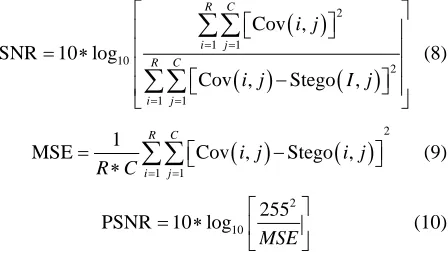
SNR, PSNR and MSE is measurement parameters these parameter used to measure the quality and error between cover image and Stego image these parameter are calcu- lated using the following formulas [Gonzalez, 2ed]:
2 1 1 10 2 1 1 Cov ,SNR 10 log
Cov , Stego ,
R C i j R C i j
i j
i j I j
(8)
21 1
1
MSE Cov , Stego ,
R C i j
i j i j
R C
(9)2 10
255
PSNR 10 log
MSE
(10)
4. Implementation of VTVB Stegnography
Figure 3. Block diagram of VTVB.
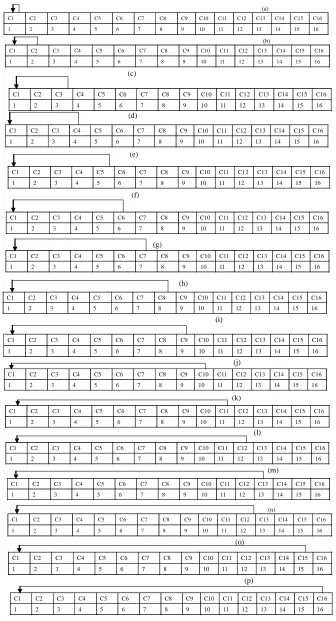
VTVB Stegnography is very flexible technique of data hiding providing the liberty to use any group size and any number of least significant bits of DCT coefficient. In this paper VTVB is implemented different group size i.e. 1 - 3 and so on and in all groups 1 bit is hidden in 1st coefficient, 2 bits in 2nd, and 3 bits in 3rd and so on. The group size and number of bits substituted in each coefficient of each group are shown in Figure4 in detail. For each group size signal to noise ratio (SNR), peak signal to noise ratio (PSNR), mean square error (MSE) and hiding capacity is find out and is given in the results section.
The SNR, PSNR, MSE, hiding capacity and Stego images for each group size are given in results section. Hiding one bit in 1st coefficient, two bits in 2nd coeffi- cient, three bits in 3rd coefficient and so on in each group is not the only way to hide data different number bits may be used in a coefficient of a group for example we may hide two bits in 1st coefficient, eight bits in 2nd coefficient etc as shown in Figure5.
5. Results
Technology Both qualitative and quantitative analysis is
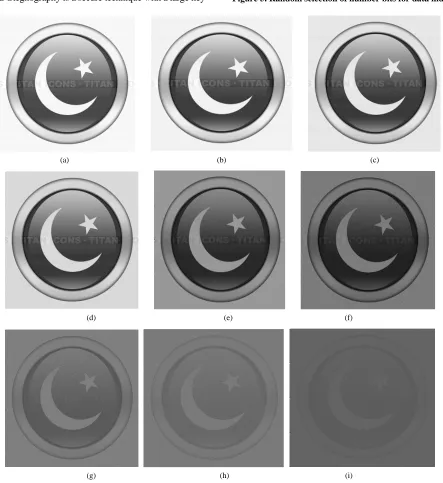
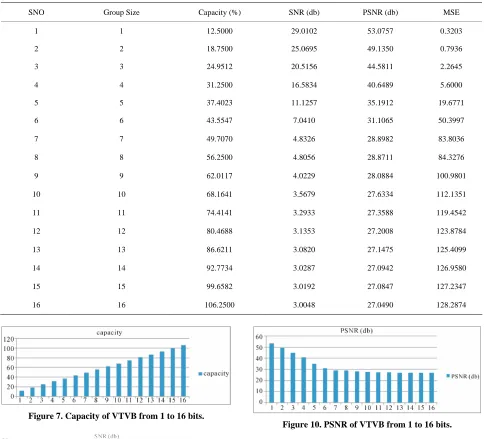
made for different group of DCT coefficients of different sizes i.e. 1 - 16 and for each group different number of bits are substituted in different coefficients. The MSE, SNR, PSNR and hiding capacity are calculated experi- mentally by using the combinations of different bits for different coefficients of different sizes shown in Figures 6(a)-(p). The cover image used for data hiding is shown in Figure6(a) and Stego images obtained for group size 1 to 8 are shown in Figures 6(b)-(i) and for rest of the group size the Stego images are not shown due to sig- nificant distortion and reduction in contrast level. The MSE, SNR, PSNR and hiding capacity for each group size are listed in Table1 and are shown graphically in
Figures7-10 respectively.
(c)
C1 C2 C3 C4 C5 C6 C7 C8 C9 C10 C11 C12 C13 C14 C15 C16 1 2 3 4 5 6 7 8 9 10 11 12 13 14 15 16
(d)
C1 C2 C3 C4 C5 C6 C7 C8 C9 C10 C11 C12 C13 C14 C15 C16 1 2 3 4 5 6 7 8 9 10 11 12 13 14 15 16
(e)
C1 C2 C3 C4 C5 C6 C7 C8 C9 C10 C11 C12 C13 C14 C15 C16 1 2 3 4 5 6 7 8 9 10 11 12 13 14 15 16
(f)
C1 C2 C3 C4 C5 C6 C7 C8 C9 C10 C11 C12 C13 C14 C15 C16 1 2 3 4 5 6 7 8 9 10 11 12 13 14 15 16
(g)
C1 C2 C3 C4 C5 C6 C7 C8 C9 C10 C11 C12 C13 C14 C15 C16 1 2 3 4 5 6 7 8 9 10 11 12 13 14 15 16
(h)
C1 C2 C3 C4 C5 C6 C7 C8 C9 C10 C11 C12 C13 C14 C15 C16 1 2 3 4 5 6 7 8 9 10 11 12 13 14 15 16
(i)
C1 C2 C3 C4 C5 C6 C7 C8 C9 C10 C11 C12 C13 C14 C15 C16 1 2 3 4 5 6 7 8 9 10 11 12 13 14 15 16
(j)
C1 C2 C3 C4 C5 C6 C7 C8 C9 C10 C11 C12 C13 C14 C15 C16 1 2 3 4 5 6 7 8 9 10 11 12 13 14 15 16
(k)
C1 C2 C3 C4 C5 C6 C7 C8 C9 C10 C11 C12 C13 C14 C15 C16 1 2 3 4 5 6 7 8 9 10 11 12 13 14 15 16
(l)
C1 C2 C3 C4 C5 C6 C7 C8 C9 C10 C11 C12 C13 C14 C15 C16 1 2 3 4 5 6 7 8 9 10 11 12 13 14 15 16
(m)
C1 C2 C3 C4 C5 C6 C7 C8 C9 C10 C11 C12 C13 C14 C15 C16 1 2 3 4 5 6 7 8 9 10 11 12 13 14 15 16
(o)
C1 C2 C3 C4 C5 C6 C7 C8 C9 C10 C11 C12 C13 C14 C15 C16 1 2 3 4 5 6 7 8 9 10 11 12 13 14 15 16
(p)
C1 C2 C3 C4 C5 C6 C7 C8 C9 C10 C11 C12 C13 C14 C15 C16 1 2 3 4 5 6 7 8 9 10 11 12 13 14 15 16 C1 C2 C3 C4 C5 C6 C7 C8 C9 C10 C11 C12 C13 C14 C15 C16 1 2 3 4 5 6 7 8 9 10 11 12 13 14 15 16
(n)
C1 C2 C3 C4 C5 C6 C7 C8 C9 C10 C11 C12 C13 C14 C15 C16 1 2 3 4 5 6 7 8 9 10 11 12 13 14 15 16
(a)
C1 C2 C3 C4 C5 C6 C7 C8 C9 C10 C11 C12 C13 C14 C15 C16 1 2 3 4 5 6 7 8 9 10 11 12 13 14 15 16
[image:5.595.130.466.83.704.2](b)
Figure 4. Various group size and bits substation in the coefficients of each group. (a) Group size 1; (b) Group size 2; (c) Group size 3; (d) Group size 4; (e) Group size 5; (f) Group size 6; (g) Group size7; (h) Group size 8; (i) Group size 9; (j)
linear increasing trend of MSE with the increase in group size as shown in Figure9 while the SNR and PSNR de- creases with the increasing group size as shown in Fig- ures8 and 10.
It is clear from the results listed in Table1 and the re- sults presented in graphical form in Figures 7-10 respec- tively that increasing group size increases hiding capacity and MSE while decreasing SNR and PSNR.
6. Conclusion
VTVB Stegnography is a secure technique with a large key
size making the existence of information undetectable at a low payload level and makes the recovering information difficult for any unauthorized third party due to its own encryption mechanism. VTVB has been proven to be much immune to Steganalysis. It is a flexible technique provid- ing variable hiding capacity, SNR, PSNR and MSE and
C1 C2 C3 C4 C5 C6 C7 C8 C9 C10 C11 C12 C13 C14 C15 C16
[image:6.595.78.521.220.703.2]2 8 5 6 1 2 6 10 9 1 2 5 7 9 3 7
Figure 5. Random selection of number bits for data hiding.
(a) (b) (c)
(d) (e) (f)
(g) (h) (i)
Table 1. Hiding capacity, SNR, PSNR and MSE.
SNO Group Size Capacity (%) SNR (db) PSNR (db) MSE
1 1 12.5000 29.0102 53.0757 0.3203
2 2 18.7500 25.0695 49.1350 0.7936
3 3 24.9512 20.5156 44.5811 2.2645
4 4 31.2500 16.5834 40.6489 5.6000
5 5 37.4023 11.1257 35.1912 19.6771
6 6 43.5547 7.0410 31.1065 50.3997
7 7 49.7070 4.8326 28.8982 83.8036
8 8 56.2500 4.8056 28.8711 84.3276
9 9 62.0117 4.0229 28.0884 100.9801
10 10 68.1641 3.5679 27.6334 112.1351
11 11 74.4141 3.2933 27.3588 119.4542
12 12 80.4688 3.1353 27.2008 123.8784
13 13 86.6211 3.0820 27.1475 125.4099
14 14 92.7734 3.0287 27.0942 126.9580
15 15 99.6582 3.0192 27.0847 127.2347
16 16 106.2500 3.0048 27.0490 128.2874
Figure 7. Capacity of VTVB from 1 to 16 bits.
Figure 8. SNR of VTVB from 1 to 16 bits.
[image:7.595.56.540.99.538.2]Figure 9. MSE of VTVB from 1 to 16 bits.
Figure 10. PSNR of VTVB from 1 to 16 bits.
can be used for all types of applications requiring low hiding or large hiding capacity. SNR and PSNR de- crease with an increase in hiding capacity and MSE trade is made between these parameters depending on applica-tion.
REFERENCES
[1] T. Moerland, “Stegnography and Steganalysis,” Leiden Institute of Advanced Computing Science, 2003.
www.liacs.nl/home/ tmoerl/privtech.pdf
[2] D. Artz, “Digital Stegnography: Hiding Data within Da- ta,” IEEE Internet Computing Journal, Vol. 5, No. 3, 2001, pp. 75-80.
23-38. http://dx.doi.org/10.1007/3-540-61996-8_29
[4] K. Solanki, K. Sullivan and U. Madhow, Eds., “Maxi- mizing Steganographic Embedding Efficiency by Com- bining Hamming Codes and Wet Paper Codes,” Lecture Notes in Computer Science, Vol. 5284, 2008, pp. 60-71.
[5] K. Ahsan and D. Kundur, “Practical Data Hiding in TCP/ IP”, Proceedings of the Workshop on Multimedia Security at ACM Multimedia, 2002.
[6] R. J. Anderson and F. A. P. Petitcolas, “On the Limits of Stegnography,” IEEE Journal of Selected Areas in Com- munications, Vol. 16, No. 4, 1998, pp. 474-481. http://dx.doi.org/10.1109/49.668971
[7] R. Crandall, “Some Notes on Stegnography,” Stegano- graphy Mailing List, 1998.
http://os.inf.tu-dresden.de/westfeld/crandall.pdf
[8] F. Galand and G. Kabatiansky, “Information Hiding by Coverings,” Proceedings of the IEEE Information Theory Workshop, 2004, pp. 151-154.
[9] K. Cabeen and P. Gent, “Image Compression and Dis- crete Cosine Transform,” College of Redwoods. http://online.redwoods.cc.ca.us/instruct/darnold/LAPROJ/ Fall98/PKen/dct.pdf
[10] A. B. Watson, “Image Compression Using the Discrete Cosine Transform,” NASA Ames Research Center, Mathe- matica Journal, Vol. 4, No. 1, 1994, pp. 81-88.
[11] J. Fridrich, M. Goljan and R. Du, “Detecting LSB Steg- anography in Color and Gray-Scale Images,” Magazine of IEEE Multimedia, Special Issue on Multimedia and Secu- rity, Vol. 8, No. 4, 2001, pp. 22-28.
[12] J. Bierbrauer and J. Fridrich, “Constructing Good Cover- ing Codes for Applications in Stegnography,” Transac- tions on Data Hiding and Multimedia Security, Springer, Heidelberg, 2007. http://www.math.mtu.edu/jbierbra/
[13] N. Provos and P. Honeyman, “Hide and Seek: An Intro- duction to Stegnography,” IEEE Security & Privacy, Vol. 1, No. 3, 2003, pp. 32-44.
[14] M. A. Shourian, R. C. Jain and Y.-S. Ho, “Dithered Quan- tization for Image Data Hiding in the DCT Domain,” Pro- ceedings of IST 2003, 16-18 August 2003, Isfahan, pp. 171- 175.
[15] J. R. Krenn, “Stegnography and Steganalysis,” 2004. [16] R.-J. Hwang, T. K. Shih and C.-H. Kao, “A Lossy Com-
pression Tolerant Data Hiding Method Based on JPEG and VQ,” Journal of Internet Technology, Vol. 5, No. 3, 2004, pp. 171-178
[17] H.-W. Tseng and C.-C. Chang, “High Capacity Data Hi- ding in JPEG Compressed Images,” Informatica, Vol. 15, No. 1, 2004, pp. 127-142.
[18] Y. Park, H. Kang, K. Yamaguchi and K. Kobayashi, “In- tegrity Verification of Secret Information in Image Steg- anography,” Symposium on Information Theory and Its Applications, Hakodate, 2006.
[19] N. Deshpande, K. Sneha and D. Jacobs, “Implementation of LSB Stegnography and Its Evaluation for Various Bits,” 1st International Conference on Digital Informa- tion Management, Bangalore, 6 December 2006, pp. 173- 178. http://dx.doi.org/10.1109/ICDIM.2007.369349
[20] M. Chaumont and W. Puech, “DCT-Based Data Hiding Method to Embed the Color Information in a JPEG Grey Level Image,” 14th European Signal Processing Confer- ence (EUSIPCO 2006), Florence, 4-8 September, 2006.
[21] A. Jain and I. S. Gupta, “A JPEG Compression Resistant Stegnography Scheme for Raster Graphics Images,” IEEE Region 10 Conference of TENCON, 30 October - 2 No- vember 2007, Taipei, pp. 1-4.
[22] K. Wong, X. J. Qi and K. Tanaka, “A DCT Based Mod4 Stegnography Method,” Signal Processing, Vol. 87, No. 6, 2007, pp. 1251-1263.
http://dx.doi.org/10.1016/j.sigpro.2006.10.014
[23] T. Ishida, K. Yamawaki, H. Noda and M. Niimi, “Per- formance Improvement of JPEG2000 Stegnography Us- ing QIM,” Journal of Communication and Computer, Vol. 6, No. 1, 2009.
[24] C.-T. Tsai, C. Liaw, Y.-H. Liao and C.-H. Ko, “Conceal- ing Information in Image Mosaics Based on Tile Image Features,” Journal of the Chinese Institute of Engineers, Vol. 34, No. 3, 2011, pp. 429-440.
http://dx.doi.org/10.1080/02533839.2011.565618
[25] C.-M. Wang and P.-C. Wang, “Data Hiding on Point- Sampled Geometry,” Journal of the Chinese Institute of Engineers, Vol. 29, No. 3, 2006, pp. 539-542.
[26] D. Bhattacharyya, T.-H. Kim and P. Dutta, “A Method of Data Hiding in Audio Signal,” Journal of the Chinese In- stitute of Engineers, Vol. 35, No. 5, 2012, pp. 523-528. http://dx.doi.org/10.1080/02533839.2012.679054
[27] S. Khan, M. H. Yousaf and M. J. Akram, “Implementa- tion of Variable Least Significant Bits Stegnography Us- ing Decreasing Distance Decreasing Bits Algorithm,” In-ternational Journal of Computer Science Issues, Vol. 8, No. 6, 2011.
[28] S. Khan and M. H. Yousaf, “Implementation of VLSB Stegnography Using Modular Distance Technique,” In- novations and Advances in Computer, Information, Sys- tems Sciences, and Engineering Lecture Notes in Electri- cal Engineering, Vol. 152, 2013, pp. 511-525.
http://dx.doi.org/10.1007/978-1-4614-3535-8_43
[29] E. Walia and P. J. Navdeep, “An Analysis of LSB & DCT Based Stegnography,” Global Journal of Computer Sci- ence and Technology, Vol. 10, No. 1, 2010, pp. 4-8.
[30] E. Neuman, “MATLA B Tutorials,” Department of Ma- thematics, Board of Trustees, Southem Illinois University, Carbondale, 2009.