Published Online October 2014 in SciRes. http://www.scirp.org/journal/jmp http://dx.doi.org/10.4236/jmp.2014.516165
Analyses of Low-Energy
π
−
-
12
C
Elastic
Scattering Data
Zuhair F. Shehadeh
Physics Department, Taif University, Taif, KSA Email: [email protected]
Received 10 August 2014; revised 5 September 2014; accepted 1 October 2014
Copyright © 2014 by author and Scientific Research Publishing Inc.
This work is licensed under the Creative Commons Attribution International License (CC BY). http://creativecommons.org/licenses/by/4.0/
Abstract
A new updated simple local optical potential is proposed for analyzing low-energy π−-12C elastic scattering data at 80 MeV and below. This potential is composed of two real terms and an imagi-nary term. The nature of the real part of the potential is repulsive at smaller radii and attractive at larger ones. In fact, the height of the repulsive term is found to change linearly with the incident pion kinetic energy. On the other hand, the imaginary part of the potential is attractive, shallow and non-monotonic with a dip at about 1.6 fm. Such a nature of the potential makes it feasible to predict π−-12C cross sections at other energies in the energy region considered herein. Coulomb effects are incorporated by following Stricker’s prescription. This study will serve positively in studying both pionic atoms and the role of negative pions in radiotherapy.
Keywords
Pion-Nucleus Potential, Elastic Scattering, Inverse Scattering Theory, Low-Energy Physics
1. Introduction
Pions play a major role in studying the nucleus and, as such, they are crucial in nuclear physics and other discip-lines [1] [2]. For this reason, many pion facilities have been constructed to provide pions with both charges and different energies [3]. In the delta resonance region (Tπ = 200 ± 100 MeV), the pion has a very small mean free
path of less than 1 fm and usually faces a complete absorption at the surface of the nucleus. Such a scattering process of pions from different nuclei is usually described by simple optical potentials [4]. These potentials are usually reevaluated, and other theoretical models are also used to allow for achieving better results [5]. Even though, these potentials are criticized for several drawbacks mainly, not being able to account for large angle data [6].
in explaining the angular distributions of elastically scattered charged pions from different nuclei over the whole angular range in the delta resonance region. This potential relies on extracting potential points from available phase shifts using inverse scattering theory (IST), as a guide, and the full Klein-Gordon (K-G) equation with all necessary relativistic kinematical effects. Such a preferable success forms an inducement to extend the use of this potential in explaining the low-energy pion-nucleus data.
In the low energy region (Tπ < 100 MeV), the pion has a large mean free path of few Fermi which enables it to penetrate deeply in the nucleus. As such, it can be used as a probe for studying the nuclear structure and disco-vering subtler aspects [8] of the pion-nucleus interaction. The accumulation of large amount of reliable low-energy pion-nucleus elastic scattering data compels theoreticians to build theories and formulate theoretical models in order to explain these data. Although the suggested theoretical potentials showed a reasonable success, but indeed it is not complete. In fact, these potentials have been criticized as difficult, impossible to interpret in physical terms, and didn’t provide a completely adequate description of the elastic scattering process [9] [10]. In view of this we’ll address here the use of our new potential, and testing the extent of its success, in analyzing low-energy π−-12C elastic scattering data.
In Section 2, the theory is presented. Section 3 is mainly concerned with results and discussion. The last sec-tion draws the conclusions.
2. Theory
The analytical form of our potential, usually used, has the following form:
( )
3 3
3
0 1 2
2 2
0 1 2 3
2
0 1 3
exp
1 exp
1 exp 1 exp 1 exp
r R
W
a
V V W
V r i i
r R r R r R r R
a
a a a
− = + + + − − + − − + + + (1)
Which consists of Satchler’s potential form [6] supplemented by the second term in Equation (1). In this study, and for the scattering of low-energy negative pions from a light nucleus (12C-nucleus), one may disregard the W2
term, i.e.W2 = 0, in Equation (1). As such, Equation (1) becomes
( )
3 3 3 0 1 2 20 1 2
0 1 2
exp
1 exp 1 exp 1 exp
r R
W
a
V V
V r i
r R r R r R
a a a
− = + + − − − + + + (2)
The parameters in this potential form are determined by implementing the IST outlined in Ref. [11] and will not be repeated here. Then a minimal number of parameters are adjusted to give a general nice fit to the meas-ured cross sections, without losing the good match between the obtained potential points, real and imaginary, using IST from available phase shifts and the analytical forms, real and imaginary, of the potential, respectively. For charged pions, this can theoretically be tested by inserting this spherical symmetric potential in the radial part of K-G equation:
( ) (
)
( )
2 2 2
2
1
d d nl 0
l l
r k U r R r
r
+
+ − − =
(3)
In Equation (3), Rnl
( )
r is the r times the radial part of the wave function, also k2 and U r( )
are given by(
)
2 2 2 4 2 2
k = E −m c c (4)
( )
( )
2( )
2 2
2
2
E
U r V r V r E
c
= −
(5)
effective Coulomb radius Rc= 2.54 fm.
To sustain the possibility of using available standard optical codes, Zemlyanaya et al. [13] have recently summarized the basic equations needed in transforming the true pion mass mπ and the pion bombarding energy in the laboratory system K to the effective mass of the incident pion Mπ and the actual beam energy
(
)
. .
c m T T
E =E Mπ +m m where mT is the target mass. The calculated values using Zemlyanaya et al.’s method
agree very well with the values obtained from Satchler’s treatment. Zemlyanaya et al.’s method can be consi-dered as another version of Satchler’s treatment. Here we adopt Zemlyanaya et al.’s method, and computer codes are modified accordingly. As such, one can start by calculating the pion’s momentum in the laboratory system Pab using the equivalent form of the well-known relativistic energy-momentum relation:
2 2 2 2 4
E = p c +m cπ (6) and obtain
(
2)
ab
P = K K+ mπ (7)
The relativistic momentum of the pion in center-of-mass system Pcm can then be calculated,
(
)
22
T ab cm
T T
m P P
m mπ m K
=
+ +
(8)
So the total energy of the pion in the center-of-mass system E is given by
2 2
cm
E= P +mπ (9) Comparing with Satchler’s treatment, E is Mπ.
Since Mπ =γπmπ, one can find γπ, and then the relativistic wave number of the pion k in the center-of-mass
system,
(
)
20.707447967 1
k= γπ − (10) where the constant (0.707447967) is not more than the ratio between the true rest mass of the pion mπc2 = 139.6
MeV and c = 197.329 MeV∙fm.
One can now easily calculate the pion’s kinetic energy in the center-of-mass system (Ec.m.),
(
)
2 2 2
. . 20.90104704
2
c m
k k
E
µ µ
= = (11)
where the constant (20.90104704) is 2 2c
(
2 931.502×)
; and µ=M mπ T(
Mπ+mT)
is the reduced mass ofthe two interacting particles in atomic mass units (u). In atomic mass units, the mass of the target nucleus mT =
12u for 12C and mπ ≅0.1499u.
3. Results and Discussion
The drawbacks of several theoretical models, as Kisslinger first-order pion-nuclear optical potential, to give a full understanding of π±-nucleus elastic scattering data obliges theoreticians to solve this problem. As an exam-ple, Gmitro et al. [14] have supplemented the first-order pion-nuclear potential by a phenomenological ρ2-de- pendent term to give a reasonable explanation for the data. This was actually hinted by Johnson et al. [15] and embedded in the work of others [16]. Although Gmitro et al.’s full potential showed an improvement in analyz-ing the data, but it is still incomplete. In this work, we’ll continue usanalyz-ing IST, as a guide, to obtain a potential which gives a remarkable consistent description of pion-nucleus interaction from 0 to 80 MeV.
The IST, used in extracting potential points from available phase shifts, has proved to be successful in deter-mining the analytical form of the potential and its parameters. Such a potential has shown a remarkable success in describing nicely the elastic scattering of charged pions from calcium, calcium isotopes, 54Fe [17] [18] and
12
sub-regions, 50 ≤ Tπ < 100 and Tπ < 50, except for the strength of the repulsive real part V1 which is found to
change linearly with the incident pion kinetic energy Tπ. The potential parameters in Equation (2) are: V0 = 37.0
MeV, R0 = 3.75 fm, a0 = 0.324 fm, R1 = 3.00 fm, a1 = 0.333 fm, W3 = 100.0 MeV,R3 = 1.70 fm, a3 = 0.370 fm
forTπ = 80, 69.5, 50 MeV. ForTπ = 40, 30, 20 MeV, all these parameters are kept unchanged except R0 = 3.95
fm and W3 = 70.0 MeV. The parameter V1 is found to change with Tπ as V1 = 18, 35, 70, 90, 110, 140 MeV for
Tπ = 80, 69.5, 50, 40, 30, 20 MeV, respectively. These values were fitted to a linear equation form, as shown in Figure 13, and the following relation is obtained:
1 1.98 172.0
V = − Tπ + (12)
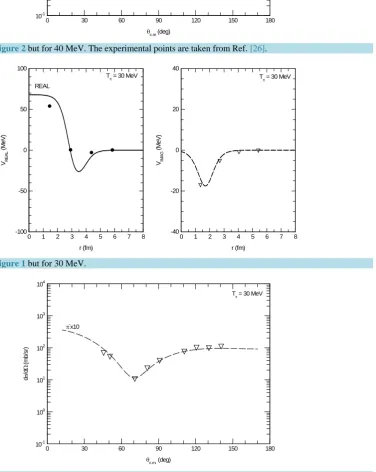
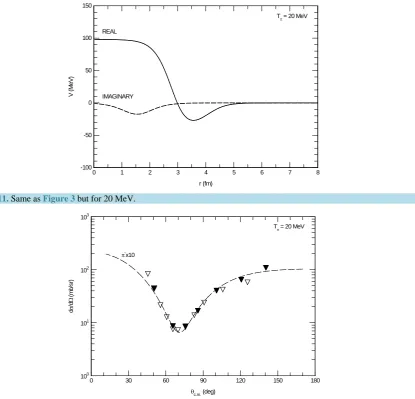
The theoretical predictions of the differential cross sections deduced using our new complex potential defined in Equation (2) are compared with the experimental ones inFigure 2,Figure 4,Figure 6,Figure 8,Figure 10 andFigure 12 at 80, 69.5, 50, 40, 30 and 20, respectively. The potentials used in obtaining the theoretical diffe-rential cross sections are plotted inFigure 1,Figure 3,Figure 5,Figure 7,Figure 9and Figure 11. The ana-lytical forms of these potentials, with their real and imaginary parts, are compared with the potential points ob-tained from available shifts using ISTat 80, 50, 40, and 30 MeV. Nevertheless, the calculated reaction cross sections are 332, 321, 181, 157, 152, and 138 mb at 80, 69.5, 50, 40, 30 and 20 MeV, respectively. They are in good agreements with the experimental ones [21] [22].
The nature of the imaginary part of the potential is the same at all energies. It is non-monotonic and shallow with a minimum at about 1.6 fm. On the other hand, the real part is non-monotonic, shallow with a small repul-sive core at 80 MeV which grows linearly as the pion’s incident kinetic energy decreases. In fact, it is repulrepul-sive at small radii (r ≤ 2.5 fm) and attractive at large ones (r > 2.5 fm). On the other hand,Figure 2,Figure 4, Fig-ure 6,Figure 8and Figure 10 show clearly that the calculated cross sections describe the data reasonably well. A similar nature for the potential, real and imaginary parts, was reported by Friedman [28]. For the 80 and 50 MeV cases, a reasonable number of phase shifts are available [23], and deduced potential points from available phase shifts using IST are compared with the analytical forms of the potentials inFigure 1 andFigure 5. On the other hand, a small number of phase shifts available at 40 and 30 MeV [10] [23] were legitimately used to ex-tract potential points using IST for a light nucleus (12C-nucleus) case with a radius of 2.54 fm. The extracted po-tential points are also compared with the analytical popo-tential forms inFigure 7 andFigure 9. Nevertheless, and asFigure 8 andFigure 10 show, the agreement between calculated and measured angular distributions is ex-cellent. In essence, it is very impressive to see the same potentials in each energy sub-region, except for V1
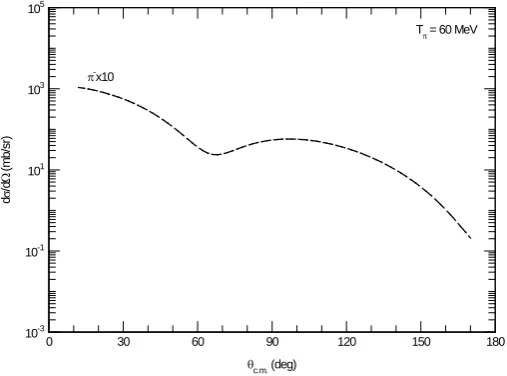
[image:4.595.164.465.504.691.2]pa-rameter approximated from Equation (12), are very successful in accounting nicely for the data at all six energies: 80, 69.5, 50, 40, 30, and 20 MeV. Such a nature of the potential makes it feasible to predict the differential cross sections at other energies in a certain energy sub-region. As an exampleFigure 14 shows the predicted differen-tial cross sections for the 60 MeV case, and the reaction cross section is 301 mb. It is also worthy to mention
Figure 1. Real and imaginary parts of the potential are compared with the extracted potential points from available phase
shifts [23] using inverse scattering theory.
-100 -50 0 50 100
0 1 2 3 4 5 6 7 8
Tπ = 80 MeV
r (fm) VR
E
A
L
(
M
e
V
)
-100 -50 0 50 100
0 1 2 3 4 5 6 7 8
Tπ = 80 MeV
r (fm) VIM
A
G
(
M
e
V
Figure 2. The calculated angular distributions (dashed line) using the potential given by Equation (2) are compared with the
[image:5.595.187.439.308.492.2]experimental data [9] (empty triangles) as a function of center of mass angle (θc.m.) at Tπ = 80 MeV for negative pions.
Figure 3. Real and imaginary parts of the potential are presented. Unfortunately, no phase shifts are available.
Figure 4. Same asFigure 2 but for 69.5 MeV. The experimental data are from Ref. [24].
10-3 10-1 101 103 105
0 30 60 90 120 150 180
π
-x10
Tπ = 80 MeV
θc.m. (deg)
d
σ
/d
Ω
(
m
b
/s
r)
-50 -25 0 25 50
0 1 2 3 4 5 6 7 8 9
Tπ = 69.5 MeV
IMAGINARY REAL
r (fm)
V
(
M
e
V
)
10-1 101
103 105
0 30 60 90 120 150 180
Tπ = 69.5 MeV
π-x10
c.m. (deg)
d
σ
/d
Ω
(
m
b
/s
[image:5.595.186.445.522.705.2]Figure 5. Same asFigure 1 but for 50 MeV.
[image:6.595.160.530.509.705.2]Figure 6. Same asFigure 2 but for 50 MeV. The experimental data are from Ref. [25].
Figure 7. Same asFigure 1 but for 40 MeV. The phase shifts are taken from Ref. [10].
-50 -40 -30 -20 -10 0 10 20
0 1 2 3 4 5 6 7 8
Tπ = 50 MeV
r (fm) VIM A G ( M e V ) -100 -50 0 50 100
0 1 2 3 4 5 6 7 8
Tπ = 50 MeV
r (fm) VR E A L ( M e V ) 10-1 100 101 102 103 104
0 30 60 90 120 150 180
π
-x10
Tπ = 50 MeV
θ c.m.(deg) d σ /d Ω ( m b /s r) -40 -20 0 20 40
0 1 2 3 4 5 6 7 8
Tπ = 40 MeV
r (fm) VIM A G ( M e V ) -40 -20 0 20 40 60 80 100
0 1 2 3 4 5 6 7 8
Tπ = 40 MeV
Figure 8. Same asFigure 2 but for 40 MeV. The experimental points are taken from Ref. [26].
[image:7.595.164.541.235.708.2]Figure 9. Same asFigure 1 but for 30 MeV.
Figure 10. Same asFigure 6 but for 30 MeV.
10-1
100 101
102 103 104
0 30 60 90 120 150 180
π
x 10
Tπ = 40 MeV
θc.m (deg)
d
σ
/d
Ω
(
m
b
/s
r)
-40 -20 0 20 40
0 1 2 3 4 5 6 7 8
Tπ = 30 MeV
r (fm) VIM
A
G
(
M
e
V
)
-100 -50 0 50 100
0 1 2 3 4 5 6 7 8
REAL
Tπ = 30 MeV
r (fm) VR
E
A
L
(
M
e
V
)
10-1 100 101 102 103
104
0 30 60 90 120 150 180
π
-x10
Tπ = 30 MeV
θ
c.m. (deg)
d
σ
/d
Ω
(
m
b
/s
Figure 11. Same asFigure 3 but for 20 MeV.
Figure 12. Same asFigure 2 but for 20 MeV. The solid triangles [26] and the empty triangles [27] are the experimental differential cross sections.
Figure 13. Height of repulsive core versus incident pion kinetic energy.
-100 -50 0 50 100 150
0 1 2 3 4 5 6 7 8
IMAGINARY REAL
Tπ = 20 MeV
r (fm)
V
(
M
e
V
)
100
101 102 103
0 30 60 90 120 150 180
π
-x10
Tπ = 20 MeV
θc.m. (deg)
d
σ
/d
Ω
(
m
b
/s
r)
-30 0 30 60 90 120 150 180
0 20 40 60 80 100
Tπ (MeV) V1
(
M
e
V
Figure 14. The predicted differential cross sections for 60 MeV incident negative pions on 12C-nucleus.
that successful analyses of data at several energies reduces the ambiguity and selects a unique potential. The use of this successful potential can be tested at energies below 20 MeV for explaining pionic atom data, and a rea-sonable link may be established between pionic atom results and the scattering data. In contrast, Friedman et al.
[29] have used optical potentials known from fits to pionic atom data to explain the observed cross sections. As an important application for this investigation, Raju [30] has confirmed that negative pions, with energies considered herein, are of considerable interest and importance in radiotherapy. Low-energy negative pions can be captured by main tissue elements and provide kinetic energy enough to damage hypoxic cells in these tissue elements with no harm to other nearby cells.
4. Conclusion
The new updated potential proves to be successful in explaining low energy π−-12C elastic scattering data. In fact, the calculated differential and reaction cross sections are in nice agreements with the measured ones. It is inter-esting to see that the imaginary part of the potential, in each energy sub-region, is energy independent; and only the strength of the repulsive part V1 of the real part decreases linearly as the incident pion kinetic energy Tπ
in-creases. This, and for the first time, establishes a relation between V1 and Tπgiven by Equation (12). It is worth
noting that when Tπ≈ 0, V1 ≈ 172 MeV; and when Tπ > 87 MeV, V1 becomes negative. The nature of the
poten-tial makes it possible to predict the differenpoten-tial and reaction cross sections at other energy in the energy range of 20 - 80 MeV. Moreover, this investigation emphasizes the strength of IST in predicting our new updated poten-tial which proves to be very successful in explaining low-energy π−-nucleus elastic scattering data. In addition, it will serve positively in both pionic atom studies and radiotherapy applications.
Acknowledgements
The author is very pleased to acknowledge the encouragement and financial support of the Deanship of Scien-tific Research at Taif University for carrying out this investigation. Many thanks go to Prof. F. B. Malik, to whom this paper is dedicated, for fruitful discussions.
References
[1] Krane, K.S. (1988) Introductory Nuclear Physics. Wiley John & Sons, New York.
[2] Ericson, T. and Weise, W. (1988) Pions and Nuclei. Clarendon Press, Oxford.
[3] Lee, T.-S.H. and Redwine, R.P. (2002) Annual Review of Nuclear and Particle Science, 52, 23-63.
http://dx.doi.org/10.1146/annurev.nucl.52.050102.090713
[4] Akhter, Md., Sultana, S., Sen Gupta, H. and Petersen, R. (2001) Journal of Physics G: Nuclear and Particle Physics,
27, 755-771. http://dx.doi.org/10.1088//0954-3899/27/4/302
[5] Begum, L., Haque, S., Nahar, W., Nasmin, R.S. and Rahman, Md.A. (2003) On Pion-Nucleus Scattering, Paper-II. The
10-3 10-1
101
103
105
0 30 60 90 120 150 180
Tπ = 60 MeV
π
-x10
θ
c.m. (deg)
d
σ
/d
Ω
(
m
b
/s
Abdus Salam International Center for Theoretical Physics, IC/2003/40. http://www.ictp.trieste.it/˜pub_off
[6] Satchler, G. (1992) Nuclear Physics A, 540, 533-576.
[7] Shehadeh, Z.F., Sabra, M. and Malik, F.B. (2003) Condensed Matter Theories, 18, 339-346.
[8] Shalaby, A.S., Hassan, M.Y.M. and El-Goary, M.M.H. (2007) Brazilian Journal of Physics, 37, 388-397.
http://www.redalyc.org/pdf/464/46437309.pdf
http://dx.doi.org/10.1590/S0103-97332007000300009
[9] Leitch, M.J., Burman, R.L., Carlini, R., Dam, S., Sandberg, V., Blecher, M., Gotow, K., Ng, R., Auble, R., Bertrand,
F.E., Gross, E.E., Obenshain, F.E., Wu, J., Blanpied, G.S., Preedom, B.M., Ritchie, B.G., Bertozzi, W., Hynes, M.V.,
Kovash, M.A. and Redwine, R.P. (1984) Physical Review C, 29, 561-568. http://dx.doi.org/10.1103/PhysRevC.29.561
[10] Blecher, M., Gotow, K., Jenkins, D., Milder, F., Bertrand, F.E., Cleary, T.P., Gross, E.E., Ludemann, C.A., Moinester,
M.A., Buman, R.L., Hamm, M., Redwine, R.P., Yates-Williams, M., Dam, S., DardenIII, C.W., Edge, R.D.,
Mal-brough, D.J., Marks, T. and Preedom, P.M. (1979) Physical Review C, 20, 1884-1890.
http://dx.doi.org/10.1103/PhysRevC.20.1884
[11] Shehadeh, Z.F., Alam, M.M. and Malik, F.B. (1999) Physical Review C, 59, 826-831.
http://dx.doi.org/10.1103/PhysRevC.59.826
[12] Stricker, K. (1979) A Study of the Pion-Nucleus Optical Potential. Ph.D. Thesis, Department of Physics, Michigan
State University, Michigan.
[13] Zemlyanaya, E.V., Lukyanov, K.V., Lukyanov, V.K. and Hanna, K.M. (2004)Calculations of Differential Elastic and
Total Reaction Cross Sections of K+-Nucleus Scattering in the Framework of Microscopic Model of Optical Potential.
JINR Preprint P4-2004-115, Dubna.
[14] Gmitro, M., Kamalov, S. and Mach, R. (1987) Progress of Theoretical Physics, 91, 60-72.
http://ptps.oxfordjournals.org/10.1143/PTPS.91.60
http://dx.doi.org/10.1143/PTPS.91.60
[15] Johnson, R.R., Masterson, T.G., Erdman, K.L., Thomas, A.W. and Landau, R.H. (1978) Nuclear Physics A, 296,
444-460. http://dx.doi.org/10.1016/0375-9474(78)90084-2
[16] Kerman, A.K., McManus, H. and Thaler, R.M. (1959) Annals of Physics, 8, 551-635.
http://dx.doi.org/10.1016/0003-4916(59)90076-4
[17] Shehadeh, Z.F. (2009) International Journal of Modern Physics E, 18, 1615-1627.
http://dx.doi.org/10.1142/S0218301309012823
[18] Shehadeh, Z.F. (2013) Turkish Journal of Physics, 37, 190-197. http://journals.tubitak.gov.tr/physics/
http://dx.doi.org/10.3906/fiz-1207-5
[19] Shehadeh, Z.F. (2014) Journal of Modern Physics, 5, 341-352. http://dx.doi.org/10.4236/jmp.2014.56044
[20] Shehadeh, Z.F. (2013) Journal of the Association of Arab Universities for Basic and Applied Sciences, 14, 32-37.
http://dx.doi.org/10.1016/j.jaubas.2013.03.003
[21] Stricker, K., McManus, H. and Carr, J.A. (1979) Physical Review C, 19, 929-947.
http://dx.doi.org/10.1103/PhysRevC.19.929
[22] Ion, D.B., Ion, M.L.D., Ion-Mihai, R. and Angelescu, T. (2010) Romanian Journal of Physics, 55, 296-308.
[23] Dumbrajs, O., FrÖhlich, J., Klein, U. and Schlaile, H.G. (1984) Physical Review C, 29, 581-591.
http://dx.doi.org/10.1103/PhysRevC.29.581
[24] Edelstein, R.M., Baker, W.F. and Rainwater, J. (1961) Physical Review, 122, 252-261.
http://dx.doi.org/10.1103/PhysRev.122.252
[25] Seth, K.K., Barlow, D., Iverson, S., Kaletka, M., Nann, H., Smith, D., Artuso, A., Burleson, G., Blanpied, G., Daw, G.,
Burger, W.J., Redwine, R.P., Saghai, B. and Anderson, R. (1990) Physical Review C, 41, 2800-2808.
http://dx.doi.org/10.1103/PhysRevC.41.2800
[26] Burleson, G., Blanpied, G., Gottingame, W., Daw, G., Park, B., Seth, K.K., Barlow, D., Iversen, S., Kaletka, M., Nann,
H., Saha, A., Smith, D., Redwine, R.P., Burger, W., Farkhondeh, M., Saghai, B. and Anderson, R. (1994) Physical
Re-view C, 49, 2226-2229. http://dx.doi.org/10.1103/PhysRevC.49.2226
[27] Hanna, M. (1988) Low Energy Elastic Scattering and the Pionic Atom Anomaly. M.S. Thesis, Department of Physics,
University of British Columbia, Vancouver, Canada.
[28] Friedman, E. (1983) Physical Review C, 28, 1264-1271. http://dx.doi.org/10.1103/PhysRevC.28.1264
[29] Friedman, E., Bauer, M., Breitschopf, J., Clement, H., Denz, H., Doroshkevich, E., Erhardt, A., Hofman, G.J.,
Krit-chman, S., Meier, R., Wagner, G.J. and Yaari, G. (2005) Physical Review C, 72, 034609-(1-8).
[30] Raju, M.R. (1974) Negative Pion Beams for Radiotherapy. Proceedings of the XIth International Cancer Congress,
![Figure 1. Real and imaginary parts of the potential are compared with the extracted potential points from available phase shifts [23] using inverse scattering theory](https://thumb-us.123doks.com/thumbv2/123dok_us/8132966.797419/4.595.164.465.504.691/figure-imaginary-potential-compared-extracted-potential-available-scattering.webp)
![Figure 2. The calculated angular distributions (dashed line) using the potential given by Equation (2) are compared with the experimental data [9] (empty triangles) as a function of center of mass angle (θc.m.) at Tπ = 80 MeV for negative pions](https://thumb-us.123doks.com/thumbv2/123dok_us/8132966.797419/5.595.186.445.522.705/calculated-distributions-potential-equation-experimental-triangles-function-negative.webp)
![Figure 6. Same as Figure 2 but for 50 MeV. The experimental data are from Ref. [25].](https://thumb-us.123doks.com/thumbv2/123dok_us/8132966.797419/6.595.152.538.85.673/figure-same-figure-mev-the-experimental-data-from.webp)