Thomas J. Braciale, Taeg S. Kim
J Clin Invest. 2011;121(12):4636-4639. https://doi.org/10.1172/JCI61367.
Decline in immune function with age has been attributed to defects or alterations in both the innate and the adaptive immune system. In this issue of the JCI, Zhao and coworkers provide evidence for a novel mechanism of immune dysfunction in aging mice. They show that migration of respiratory DCs from the site of virus replication to the draining lymph nodes in response to infection with several different respiratory viruses is markedly diminished with increasing age. The impaired DC migration was a result of increased levels of the lipid mediator prostaglandin D2 (PGD2) in the
respiratory tract with age and could be partially reversed by blockade of PGD2 synthesis or action. Commentary
Find the latest version:
50(2):277–289.
11. Dror AA, Avraham KB. Hearing loss: mechanisms revealed by genetics and cell biology. Annu Rev Genet. 2009;43:411–437.
12. Kurima K, et al. Dominant and recessive deaf-ness caused by mutations of a novel gene, TMC1, required for cochlear hair-cell function. Nat Genet. 2002;30(3):277–284.
13. Hildebrand MS, et al. Mutations in TMC1 are a common cause of DFNB7/11 hearing loss in the Iranian population. Ann Otol Rhinol Laryngol. 2010;119(12):830–835.
14. Duman D, Sirmaci A, Cengiz FB, Ozdag H, Tekin M. Screening of 38 genes identifies mutations in
62% of families with nonsyndromic deafness in Tur-key. Genet Test Mol Biomarkers. 2011;15(1–2):29–33. 15. Brownstein Z, et al. Targeted genomic capture and
massively parallel sequencing to identify genes for hereditary hearing loss in middle eastern families.
Genome Biol. 2011;12(9):R89.
16. Hrabe de Angelis MH, et al. Genome-wide, large- scale production of mutant mice by ENU mutagen-esis. Nat Genet. 2000;25(4):444–447.
17. Vreugde S, et al. Beethoven, a mouse model for dominant, progressive hearing loss DFNA36. Nat Genet. 2002;30(3):257–258. 18. Keresztes G, Mutai H, Heller S. TMC and EVER genes belong to a larger novel family, the TMC gene family encoding transmembrane proteins.
BMC Genomics. 2003;4(1):24.
19. Labay V, Weichert RM, Makishima T, Griffith AJ. Topology of transmembrane channel-like gene 1 protein. Biochemistry. 2010;49(39):8592–8598.
20. Kurima K, Yang Y, Sorber K, Griffith AJ. Character-ization of the transmembrane channel-like (TMC) gene family: functional clues from hearing loss and epidermodysplasia verruciformis. Genomics. 2003;82(3):300–308.
21. de Heer AM, et al. Progressive sensorineural hear-ing loss and normal vestibular function in a Dutch DFNB7/11 family with a novel mutation in TMC1.
Audiol Neurootol. 2011;16(2):93–105.
22. Manor U, Kachar B. Dynamic length regulation of sensory stereocilia. Semin Cell Dev Biol. 2008; 19(6):502–510.
Slowing down with age: lung DCs do it too
Thomas J. Braciale1,2,3 and Taeg S. Kim1,3
1Beirne B. Carter Center for Immunology Research, 2Department of Microbiology, and 3Department of Pathology, University of Virginia, Charlottesville, Virginia, USA.
Decline in immune function with age has been attributed to defects or
alter-ations in both the innate and the adaptive immune system. In this issue of
the
JCI
, Zhao and coworkers provide evidence for a novel mechanism of
immune dysfunction in aging mice. They show that migration of
respira-tory DCs from the site of virus replication to the draining lymph nodes in
response to infection with several different respiratory viruses is markedly
diminished with increasing age. The impaired DC migration was a result of
increased levels of the lipid mediator prostaglandin D
2(PGD
2) in the
respi-ratory tract with age and could be partially reversed by blockade of PGD
2synthesis or action.
Among the many hallmarks of the aging process (in both mice and humans) is a progressive decline in immune function (1, 2). This is demonstrable in the dimin- ished response of the elderly to vaccina-tion against viral and bacterial pathogens (1). This fact compounds the more serious problem of the increased susceptibility of the elderly to infection in general and to serious and frequently life-threatening infection of the respiratory tract with respi-ratory viruses such as influenza A virus (IAV), respiratory syncytial virus, and severe acute respiratory syndrome coronavirus (SARS-CoV). This decline in immune func-tion with age has been attributed to defects or alterations in both the innate and the adaptive immune system (1, 2). In this issue of the JCI, Zhao and coworkers provide compelling evidence for a novel mechanism of immune dysfunction in aging mice (3). They demonstrate that the migration of respiratory DCs (RDCs) from the lungs to the lung draining lymph nodes (DLNs) in response to infection with several different respiratory viruses is markedly diminished with increasing age. Impaired RDC migra-tion is mediated by the arachidonic acid (AA) metabolite prostaglandin D2 (PGD2),
basal expression of which Zhao and cowork-ers show is increased in the respiratory tract with age and is further upregulated in response to infection in a pathogen-depen-dent fashion. They further demonstrate that blockade of either PGD2 synthesis or
action partially reverses the defect in RDC migration, resulting in an enhanced adap-tive immune response to infection and increased survival. These findings have interesting potential implications for both control of respiratory virus infection and vaccine efficacy in the elderly.
RDC response to virus infection DCs are hematopoietic origin cells of the monocytic cell lineage. These cells are gen-erally recognized to be an exclusive cell type, since they have the capacity to initi-ate the primary adaptive immune response (mediated by T and B cells) to foreign antigens, including infectious agents. The importance of these cells is highlighted by the fact that the 2011 Nobel Prize in Physi-ology or Medicine was recently awarded to Ralph Steinman for his role in the identifi-cation and characterization of DCs (4, 5). DCs reside within tissues at body surfaces, such as the skin, gut, and respiratory tract mucosa. At these sites, these actively phago-cytic cells act as sentinels, monitoring the site for the presence of foreign antigens, such as those derived from viruses. The tissue DCs respond to this encounter by capturing for-eign antigen, processing the antigen to a form that can be recognized by T cells, becoming activated, and, importantly, migrating to the DLNs from the body’s surfaces. It is within the DLN that the DCs encounter T cells spe-cific for the antigen/pathogen that they have captured and processed and, thereby, initiate the adaptive immune response (6). Migration of activated tissue DCs from the site of infection, e.g., the lungs, to the DLN is an essential step in the induction of the adaptive immune response to the infec-tious agent. DC migration is chemokine regulated and, in part at least, dependent on the upregulation of expression of and signaling through the chemokine receptor CCR7, whose ligands (CCL19 and CCL21) are expressed by lymphatic endothelium draining the infected tissue (Figure 1 and ref. 7). A variety of stimuli (probably acting in concert) can stimulate tissue DC acti-vation and, as a result, migration. These stimuli include cytokines, chemokines, and certain AA-derived metabolites, such as PGE2 and leukotriene C4 (LTC4) (Figure
1). Of particular relevance to the report of
Zhao and coworkers is the fact that anoth-Conflict of interest: The authors have declared that no conflict of interest exists.
er lipid mediator derived from AA, PGD2,
has been previously shown to inhibit RDC migration out of the lungs (8, 9).
AA metabolites and regulation of RDC migration
PGD2 and PGE2
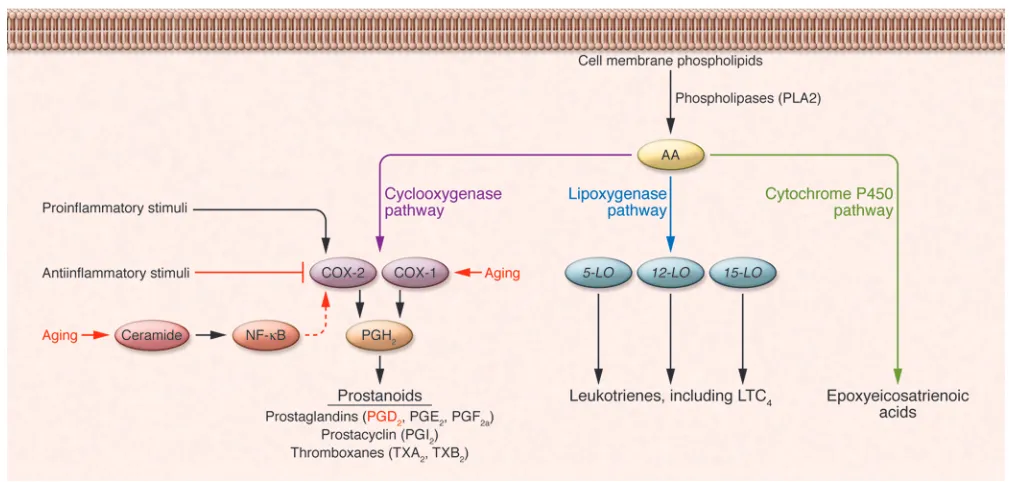
are AA metabolites gener-ated through the action of 2 cyclooxygenase enzymes, the constitutively expressed COX-1
and the inducible COX-2, both of which catalyze the generation of PGH2 (Figure 2).
PGH2
is in turn converted to specific bio-logically active prostanoids such as PGD2
by cell type–specific prostanoid synthases, e.g., PGD2 synthase (10). In the report from
Zhao et al. (3), PGD2 levels were shown to
become progressively elevated with age in the bronchoalveolar lavage fluid (BALF) of
naive mice (i.e., prior to infection), suggest-ing an elevated level or at least activity of the constitutively expressed COX-1 enzyme with increasing age. Alternatively, the great-er amount of PGD2 observed in the lungs
of aged mice could also reflect age-associ-ated upregulation of COX-2 expression. Senescent cells or cells derived from aged mice produce, as a by-product of the hydro-Figure 1
Impact of aging on the induction of adaptive antiviral immunity. (A) Recognition of the invading respiratory virus by innate immune receptors expressed
[image:3.585.47.546.91.502.2]lysis of membrane sphingomyelin, substan-tially more of the intracellular sphingolipid second messenger ceramide than do their younger counterparts (11). The increased levels of ceramide mediate age-associated increases in COX-2 expression and, as a consequence, prostaglandins (i.e., PGD2
and PGE2) levels. The elevated basal level
of PGD2
, detected by Zhao and cowork- ers in lungs of aged mice prior to infec-tion (3), may be of biological significance, although the basal rate of RDC migration to the DLN (i.e., without an inflammatory stimulus) was not examined in these ani- mals (Figure 1). Although it might be logis-tically challenging, an analysis of PGD2
levels in the human lower respiratory tract as a function of age in individuals without preexisting acute or chronic pulmonary inflammation might be warranted to com-plement (and substantiate) the findings of Zhao and coworkers.
Not surprisingly, Zhao et al. report that PGD2 levels increase in the BALF after
respiratory virus infection (3), presumably reflecting upregulation of the inducible
COX-2 enzyme in response to proinflam-matory stimuli. However, it is noteworthy that, in young mice, the effect of infec-tion on PGD2 production was minimal,
whereas, in aged mice, infection produced a greater increase in PGD2 levels.
Fur- thermore, in the two experimental infec-tions investigated in detail (i.e., infection with SARS-CoV and IAV), PGD2 levels in
BALF were highest in mice infected with SARS-CoV, which likewise demonstrated the greatest mortality. The authors raise the possibility that pathogen-dependent differences in PGD2
levels may reflect dif-ferences in the ability of particular viruses and specific viral gene products to regu-late PGD2 levels as part of their replication
strategy. The pathogen sample size stud-ied (n = 2) is too small to make a defini-tive statement concerning this hypothesis, and factors such as virus inoculum dose, target cell types for viral replication, and virus potency in stimulating host innate responses in the respiratory tract need to be further considered. Nevertheless, these findings suggest a possible mechanism to
account for the enhanced susceptibility of elderly humans to severe infection with certain respiratory pathogens.
Reversal of reduced RDC migration and restoration of adaptive antiviral T cell immune responses by blockade of PGD2 action
PGD2 can be produced by a variety of cell
types of nonhematopoietic (i.e., epithelial cells) and hematopoietic origin, with the latter including most prominently mast cells but also tissue DCs, in response to inflammatory stimuli (ref. 10 and Figure 1). Furthermore, PGD2 can engage at least
three classes of receptors: the ubiquitously expressed PGD2 receptor (DP1; also known
as PTGDR), the chemokine-related recep-tor CRTH2 (also known as GPR44), and the nuclear receptor PPAR-g (12, 13). In the report from Zhao and coworkers (3), the analysis of the effect of PGD2
[image:4.585.39.544.82.323.2]antago-nists with DP1 specificity (e.g., BW A868C) directly implicates DP1 as the receptor mediating suppression of RDC migration, interestingly, in aged but not young mice. Figure 2
Although the basis for this differential effect of DP1 antagonism on RDC migra-tion with age remains unclear, this is in keeping with previously published obser-vations (8, 14). Importantly, release of the inhibitory action of PGD2
on RDC migra- tion by treatment with the DP1 antago-nist prior to respiratory virus infection, notably SARS-CoV infection, in the aged mice resulted in the improved induction of virus-specific CD8+ T cells at the priming
site (i.e., the DLN) and, subsequently, the infected lung, which ultimately contrib- uted to the reduced mortality after respira-tory virus infection.
PGD2 controls CCR7 expression on RDCs from aged mice
Mechanistically, Zhao et al. also provide evidence that PGD2 acts to inhibit RDC
migration in aged mice by regulating (reducing) the level of expression of CCR7 on migratory RDCs in lungs as well as the frequency of CCR7+ RDCs accumulating
in inflamed DLNs early in infection (ref. 3 and Figure 1). As the authors suggest, regu- lation of expression of the critical chemo-kine receptor necessary for RDC migration out of the infected lungs is likely to be one of several distinct mechanisms by which a prostanoid, such as PGD2, can act on
RDC maturation and subsequent migra-tion. In this regard, it would have been of considerable interest to evaluate, in the lungs of aged mice, the expression of other AA metabolites, notably PGE2 and LTC4,
which can antagonize the effects of PGD2
(15, 16), and the effect of infection with the various viral pathogens on the production of these proinflammatory AA-derived lipid mediators. In this context, Zhao et al. dem-onstrate that administration of PGE2 to
the respiratory tract of aged mice does not reverse the reduced RDC migration (3).
Boosting mucosal vaccine efficacy in the elderly
The report from Zhao et al. in this issue of the JCI (3) offers a novel explanation for the increased susceptibility of the elderly to respiratory virus infections. Perhaps more importantly, these results may have therapeutic implications, as they suggest a strategy for boosting immune responses in the elderly. Although these findings do not bear on the poor response of the elderly to parenteral immunization, they do provide investigators with a new and potentially important target for investi-gation and manipulation, with the aim of boosting the efficacy of mucosal vac-cination against respiratory viruses in the elderly. A novel mucosal vaccine formula-tion that included an adjuvant capable of enhancing migration of RDCs in the elderly, such as a PGD2 inhibitor, could
result in improvement of the response to mucosal-administered vaccines in the elderly and lead to the use of live-attenu-ated virus vaccines in this population. Acknowledgments We thank members of the Braciale labora-tory for helpful discussions. This work is supported by grants from the NIH (RO1 AI-15608, RO1 AI-37293, RO1 HL-33391, and U-19 AI-83024) to T.J. Braciale.
Address correspondence to: Thomas J. Braciale, Carter Immunology Center, Uni- versity of Virginia, PO Box 801386, Char-lottesville, Virginia 22908, USA. Phone: 434.924.1219; Fax: 434.924.1221; E-mail: [email protected].
1. Ongradi J, Kovesdi V. Factors that may impact on immunosenescence: an appraisal. Immun Ageing. 2010;7:7.
2. Desai A, Grolleau-Julius A, Yung R. Leukocyte function in the aging immune system. J Leukoc Biol.
2010;87(6):1001–1009.
3. Zhao J, Zhao J, Legge K, Perlman S. Age-related increases in PGD2 expression impair
respira-tory DC migration, resulting in diminished T cell responses upon respiratory virus infection in mice.
J Clin Invest. 2011;121(12):4921–4930.
4. Steinman RM, Cohn ZA. Identification of a novel cell type in peripheral lymphoid organs of mice. II. Functional properties in vitro. J Exp Med. 1974;139(2):380–397.
5. Steinman RM, Lustig DS, Cohn ZA. Identification of a novel cell type in peripheral lymphoid organs of mice. 3. Functional properties in vivo. J Exp Med. 1974;139(6):1431–1445.
6. Banchereau J, Steinman RM. Dendritic cells and the control of immunity. Nature. 1998; 392(6673):245–252.
7. Tal O, et al. DC mobilization from the skin requires docking to immobilized CCL21 on lymphatic endothelium and intralymphatic crawling. J Exp Med. 2011;208(10):2141–2153.
8. Hammad H, de Heer HJ, Soullie T, Hoogsteden HC, Trottein F, Lambrecht BN. Prostaglandin D2 inhibits airway dendritic cell migration and func- tion in steady state conditions by selective activa-tion of the D prostanoid receptor 1. J Immunol. 2003;171(8):3936–3940.
9. Hammad H, et al. Activation of the D prostanoid 1 receptor suppresses asthma by modulation of lung dendritic cell function and induction of regulatory T cells. J Exp Med. 2007;204(2):357–367.
10. Harizi H, Corcuff JB, Gualde N. Arachidonic-acid- derived eicosanoids: roles in biology and immuno-pathology. Trends Mol Med. 2008;14(10):461–469. 11. Wu D, Meydani SN. Mechanism of age-associated
up-regulation in macrophage PGE2 synthesis.
Brain Behav Immun. 2004;18(6):487–494.
12. Gualde N, Harizi H. Prostanoids and their recep- tors that modulate dendritic cell-mediated immu-nity. Immunol Cell Biol. 2004;82(4):353–360. 13. Sandig H, Pease JE, Sabroe I. Contrary
prosta-glandins: the opposing roles of PGD2 and its metabolites in leukocyte function. J Leukoc Biol. 2007;81(2):372–382.
14. Angeli V, et al. Role of the parasite-derived prosta- glandin D2 in the inhibition of epidermal Langer- hans cell migration during schistosomiasis infec-tion. J Exp Med. 2001;193(10):1135–1147.
15. Robbiani DF, Finch RA, Jager D, Muller WA, Sar-torelli AC, Randolph GJ. The leukotriene C(4) transporter MRP1 regulates CCL19 (MIP-3beta, ELC)-dependent mobilization of dendritic cells to lymph nodes. Cell. 2000;103(5):757–768. 16. Scandella E, Men Y, Gillessen S, Forster R, Groettrup