© 2017, IRJET | Impact Factor value: 5.181 | ISO 9001:2008 Certified Journal
| Page 364
MAGICNESS IN
EXTENDED DUPLICATE GRAPHS
K.Sutha
1, K.Thirusangu
2, S.Bala
31.2,3
Department of Mathematics
S. I. V. E. T. College, Gowrivakkam, Chennai – 600 073 ,Tamilnadu , India
………***………..
Abstract
-
A graph labeling is a mapping that carries a set of graph elements onto a set of numbers called labels(usually the set of integers). In this paper we prove the existence of graph labeling such as Z3- vertex magic total,Z3- edge magic total labeling and total magic cordial labeling for extended duplicate graph of comb graph and middle graph of extended duplicate graph of path graph. We also provide an algorithm to obtain n- edge magic labeling for extended duplicate graph of comb graph .Keywords: Graph labeling, Comb graph , Path graph, Middle graph, Duplicate graph
.
1 . Introduction
Rosa introduced the notion of Graph labeling in 1967 [1]. In 1970 Kotzig and Rosa defined the concept of edge magic total labeling [2]. A detailed study on graph labeling has been done by Gallian [3 ]. MacDougall et. al introduced the notion of vertex magic total labeling in 1999 [4].
Thirusangu et., al introduced the concept of Extended Duplicate graph [5]. They proved that the Extended duplicate graph of twig graph admits Z3 – vertex magic
total , edge magic total and total magic cordial labeling. In [6] they also proved some results on Extended duplicate graph of comb graph.
In 2012 Jeyapriya and Thirusangu introduced 0- Edge magic labeling and shown the existence of this labeling for some class of graphs [7].Neelam Kumari and Seema Mehra establish the concept of 1- Edge magic and n – Edge magic labeling [8].They proved Pt ,Ct(t is even) and sun graph St(t
is even) are n- Edge magic.
Hamada et. ,al introduced Middle graph [9] and they proved middle graph of the complete graph ( Kn) has (n-1)
forest coloring. Arundhadi and Thirusangu proved some colorings on middle graph of some class of graphs [10].
Definition: 1.1
Let Pm+1 be a path graph .Comb graph is defined as
Pm+1ʘ (m+1)K1. It has 2m+2 vertices and 2m+1 edges
.
Definition :1.2
The middle graph M(G) of a graph G(V,E) is defined with the vertex set as V E and two vertices u, v in M(G) are adjacent if they are incident in G or they are adjacent edges in G
.
.
Definition : 1.3
Let G(V,E) be a Comb graph. A Duplicate graph of G is DG=(V1,E1) where the vertex set V1 = V V' and V V'=
and f: V→V' is bijective (for v V, we write f(v) = v' for convenience) and the edge set E1 of DG is defined as
follows: The edge vivj is in E if and only if both vivj' and vi'vj
are edges in E1.The extended duplicate graph of G is the
graph DG { vivi′}, for some `i’.
Definition : 1.4
A labeling function f : V E → Z3 -{0} is said to be a Z3
– vertex magic total labeling in G(V,E) if there exist a function f*: V → N {0} such that f*(vi) = {f(vi) +∑ f(e)}
(mod 3) , is a constant where e is the edge incident at vi
.
Definition : 1.5
A labeling function f : V E → Z3 -{0} is said to be a
Z3– edge magic total labeling in G(V,E) if there exist a
function f*: E → N {0} such that f*(vivj) ={f(vi+f(vj)+f(vivj)}(mod3) is a constant for all
edges vivj
E .
Definition : 1.6
A graph G(V,E) is said to admit total magic cordial labeling if f : V E → {0,1} such that (i). f(x) + f(y)+f(xy)} (mod 2) is constant for all edges xy E. (ii) for all i,j ϵ {0,1} , { mi(f) + ni(f) } – { mj(f) + nj(f) } ≤ 1, (i ≠ j) where
© 2017, IRJET | Impact Factor value: 5.181 | ISO 9001:2008 Certified Journal
| Page 365
Definition : 1.7
Let G = (V,E) be a graph. Let f : V → {-1,1} and f* : E → {0} such that for all uv E, f*(uv) = f(u) + f(v) = 0 then the labeling is called 0 – Edge magic labeling.
Definition : 1.8
Let G = (V,E) be a graph. Let f : V → {-1,n+1} and f* : E → {n} such that for all uv E , f*(uv) = f(u) + f(v) = n then the labeling is called n – Edge magic labeling
.
In this paper, we prove that, the extended duplicate graph of Comb graph admits Z3 – vertex magic total ,Z3-
edge magic total ,total magic cordial and n – edge magic labeling. We show that the middle graph of extended duplicate graph of path graph is Z3 – vertex magic total ,Z3-
edge magic total and total magic cordial graph.
2. MAIN RESULT
In this section we present the structures of the extended duplicate graph of a comb graph and the middle graph of extended duplicate graph of path graph. We obtain labelings such as Z3 – vertex magic total , Z3 -
edge magic total ,total magic cordial and n – edge magic labeling .
Definition: (Structure of the extended duplicate
graph of a comb graph)
Let G(V,E) be a comb graph. The duplicate graph of comb graph DG(comb)= (V1,E1) has 4m+4 vertices and
4m+2 edges.
Denote the vertex set as V1=
{v1,v2,……….v2m+2,v1′,v2′………..v2m+2′} and the edge set as
E1= {(vivi+1′ vi′vi+1 for 1 ≤ i ≤ m) (vi′vm+i+1
v
ivm+i+1′for 1 ≤ i ≤ m+1)}. The extended duplicate graph of comb EDG(Comb) is obtained from DG(comb) by adding the edges (i) v1vm+1 and vm+2′v2m+2′ if m ≡ 1(mod 2).(ii)
v1vm+1′ and vm+2′v2m+2 if m ≡ 0(mod 2) .
Thus the extended duplicate graph of comb graph has 4m+4 vertices and 4m+4 edges.
Definition: ( Structure of Middle graph of
Extended Duplicate graph of Path(P
m)).
Let EDG(Pm) be a graph with 2m+2 vertices {v1,v2,
……vm+1,v1′,v2′,…….vm+1′} and 2m+1 edges where `m’
represents the length of the path Pm. The middle graph of
EDG(Pm) is obtained by introducing a new vertex wi on
each edge as follows:
vivi+1′wi; 1 ≤ i ≤ m, vivi-1′ wi+m-1 ; 2 ≤ i ≤ m+1 ;
v2v2′ w2m+1.
Thus the middle graph of EDG(Pm) is a (V,E) graph
where
V={vi vi′ wk / 1 ≤ i ≤ m+1 and 1 ≤ k ≤ 2m+1}
E= {viwi ; wivi+1′ for 1 < i m } {viwi+m-1 ; wi+m-1 vi-1′
for 2≤ i ≤ m+1} {v2w2m+1 ; w2m+1v2′} {wiwi+m+1 for1 i
< m } {wiwim+1 for m < i < 2m} {wiw2m+1 for 1 ≤ i ≤ 2
and i=m+1 and i=m+2 }. Thus MEDG(Pm) has 4m+3
vertices and 6m+4 edges.
Algorithm: 1
Procedure :
Z3-vertex magic total labeling forEDG(comb)graph.)
//assignment of labels to the vertices and edges
v1 ,vm+1 , vm+1′ ,vm+2′ , v1′v2 ← 1
v2 ← 2
for i = 3 to m-1 ,
{ vi } ← 1
for i = 1 to m-1,
{ vi′ ← 1 , vivi+1′ ← 2 }
for i = 1 to m ,
{ vm+i+1 ← 2 }
for i = 2 to m ,
{ vm+i+1′ ← 2}
for i =2 to m-1 ,
{ vi′vi+1 ← 2 }
for i = 1 to m+1 ,
{ vivm+i+1′ , vi′vm+i+1 ← 1}
end for
if m ≡ 1 (mod 2)
vm′ , v2m+2′ , vmvm+1′ , vm+2′v2m+2′ ← 1 : vm , vm+2
v1vm+1 , vm′vm+1 ← 2
© 2017, IRJET | Impact Factor value: 5.181 | ISO 9001:2008 Certified Journal
| Page 366
vm , vm+2 , vm′vm+1 , vm+2′v2m+2 ← 1 : vm′ ,
v2m+2′ , v1vm+1 ′ , vmvm+1′ ← 2
end procedure
output :Labeled EDG(comb) graph.
Theorem : 2.1
Extended duplicate graph of Comb graph admits Z3 –
vertex magic total labeling.
Proof :
EDG(comb) (V,E) graph has 4m+4 vertices and 4m+4 edges. The vertices and edges of EDG(comb) graph are labeled by defining a function f : V E → {1 ,2 } as given in algorithm 1. The induced function is defined by f* : V → N {0} such that f*(v) = ( f(v) + ∑ f(uv) ) (mod 3).
Clearly the induced function yields the labels for the vertices as follows:
f*(v) = (f(v) + f(uv) ) (mod 3) = 3 (or 6) (mod 3) = 0, a constant.
Hence EDG(comb) graph admits Z3- vertex magic total
labeling.
Example : 2.1
Z3 - vertex magic total labeling of EDG(comb) graph for m
[image:3.595.44.565.40.653.2]= 5 and m = 6 are given in figure 1 and figure 2 respectively.
Fig . 1:
Z3 - vertex magic total labeling of EDG(comb)graph for m = 5
Fig.2:
Z3 - vertex magic total labeling of EDG(comb)graph for m = 6
Algorithm : 2
Procedure
:(Z3 – vertex magic total labeling forMEDG(Pm), m ≥ 2)
// assignment of labels to the vertices and edges
w1,w2,wm+1,wm+2,w2w2m+1,wm+2w2m+1 ← 1
v1,v2,v1’,v2’,w2m+1,w1w2m+1,wm+1w2m+1,v2w2m+1,v2’w2m+1,vm+1
w2m,vm+1’wm ← 2
for i= 3 to m+1
{vi , vi′ ← 1 }
for i = 3to m
{wi ,wm+i ←2}
for i = 1 to m
{viwi , vi′wm+i ← 1 }
for i = 1 to m-1
{wiwm+i+1 ← 1}
for i = 2 to m
{viwm+i-1 , vi′wi-1 , wiwm+i+1 ← 1 }
end for
end procedure
Output : labeled MEDG(Pm).
Theorem : 2.2
Middle graph of extended duplicate graph of path Pm ,
MEDG(Pm) admits Z3 – vertex magic total labeling , where
[image:3.595.41.499.428.629.2]© 2017, IRJET | Impact Factor value: 5.181 | ISO 9001:2008 Certified Journal
| Page 367
Proof :
MEDG(Pm) be a graph with 4m+3 vertices and 6m+4
edges. The vertices and edges are labeled by defining a function f : V E → {1,2} as given in algorithm 2. Thus all the 4m+3 vertices and 6m+4 edges are labeled .
The induced function is defined by f* : V → N {0} , such that f*(v)=f(v)+∑f(uv))(mod3)=k, a constant for all edges uv E .
The total weight of each vertex is ,
f*(v) = ( f(v) + ∑ f(uv) ) (mod 3) = 3 (or 6) (mod 3) = 0, a constant for all edges uv E .
Thus the induced function yields the weight `0’ to all the vertices.Therefore `f ’ is a Z3- vertex magic total
labeling.
Hence the middle graph of extended duplicate graph of path (Pm) , m ≥ 2 is Z3 – vertex magic total graph.
Example : 2.2
Z3 – vertex magic total labeling for MEDG(P5) is given in
figure 3.
Fig.3
:
Z3 – vertex magic total labeling for MEDG(P5)Algorithm : 3
Procedure :
(Z3-edge magic total labeling forEDG(comb)graph.)
//assignment of labels to the vertices and edges vm+2 ← 2 , vm+2′ ← 1 , v1vm+2′ ← 2
for i = 1 to m+1
{ vi , vi′ ← 1 }
for i =2 to m
{ vm+i+1 , vm+i+1′ ← 2 ; vivm+i+1′ ← 1}
for i =1 to m
{ vivi+1′ , vi′vi+1 ← 2 ; vi′vm+i+1 ← 1}
end for
if m ≡ 1 (mod 2)
v2m+2 ← 2 ,v2m+2′ ← 1 , vm+1′v2m+2 ← 1: v1vm+1 ,
vm+2′v2m+2′ ,vm+1v2m+2′ ← 2
if m ≡ 0(mod 2)
v2m+2 ← 1 ,v2m+2′ ← 2 , vm+1v2m+2′ ← 1 : v1vm+1′ ,
vm+2′v2m+2 ,vm+1′v2m+2 ← 2
end procedure
output : Labeled EDG(comb) graph.
Theorem : 2.3
Extended duplicate graph of Comb graph admits Z3 –
edge magic total labeling.
Proof :
EDG(comb)(V,E) graph has 4m+4 vertices and 4m+4 edges. The vertices and edges of EDG(comb) graph are labeled by defining a function f : V E → {1 ,2 } as given in algorithm 3. The induced function is defined by f* : E → N {0} such that
f*(uv) = (f(u) + f(v) + f(uv) ) (mod 3).
The induced function yields the labels for edges as follows:
f*(uv) = (f(u) + f(v) + f(uv) ) = 1+2+1 (or) 1+1+2 = 4 (mod 3) = 1.
Thus the induced function yields Z3 – edge magic total
labeling with magic constant `1’.
Hence EDG(comb) graph admits Z3 – edge magic total
labeling.
Example : 2.3
Z3 - edge magic total labeling of EDG(comb) graph for m =
5 and m = 6 are given in figure 4 and figure 5 respectively.
Fig . 4:Z3 - edge magic total labeling of EDG(comb) graph
© 2017, IRJET | Impact Factor value: 5.181 | ISO 9001:2008 Certified Journal
| Page 368
Fig.5: Z3 - edge magic total labeling of EDG(comb) graphfor m = 6.
Algorithm : 4
Procedure :
(Z3 – edge magic total labeling forMEDG(Pm), m ≥ 2)
//assignment of labels to the vertices and edges
v2w2m+1 , v2′w2m+1 , w1w2m+1 ,w2w2m+1 ,wm+1w2m+1 ,
wm+2w2m+1 ← 2 : w2m+1 ← 1
for i = 1 to m+1
{vi′ , vi ← 1 }
for i = 1 to m
{wi , wm+I ← 1}
for i = 2 to m
{wiwm+i-1 ← 2 }
for i = 1 to m-1
{wiwm+i+1 ← 2}
for i = 2 to m+1
{viwm+i-1 , vi′ wi-1 ← 2}
endfor
end procedure
Output : labeled MEDG (Pm).
Theorem : 2.4
Middle graph of extended duplicate graph of path Pm ,
MEDG(Pm) admits Z3 – edge magic total labeling , where m
represents the length of the path.
Proof :
MEDG(Pm) be a graph with 4m+3 vertices and 6m+4
edges. The vertices and edges are labeled by defining a
function f : V E → {1,2} as given in algorithm 4.Thus all the 4m+3 vertices and 6m+4 edges are labeled .
The induced function is defined by f* : E → N {0}, such that f*(uv) = (f(u) + f(v) + f(uv)) (mod 3) = k , a constant for all the edges uv E.
We have f*(uv) = (f(u) + f(v) + f(uv)) (mod 3) = 1 , a constant. Thus the induced function yields the weight `1’ to all the edges. Therefore `f’ is a Z3 – edge magic total
labeling .
Hence the middle graph of extended duplicate graph of path (Pm) , m ≥ 2 admits Z3 – edge magic total labeling.
Example : 2.4
[image:5.595.39.284.103.199.2]Z3 – edge magic total labeling for MEDG(P5) is given in
figure 6.
Fig.6: Z3 – edge magic total labeling for MEDG(P5).
Algorithm: 5
Procedure
:(Total magic cordial labeling for EDG(comb)graph , m ≥ 2)
//assignment of labels to the vertices and edges
for i = 1to m
{vivi+1′ , vi′vi+1 ← 1 }
for i = 1 to m+1
{vivm+i+1′ , vi′vm+i+1 ← 0}
end for
if m ≡ 0 (mod 2)
v1vm+1′ , vm+2′v2m+2 ← 1
for i = 1to m+1
[image:5.595.314.555.358.461.2]© 2017, IRJET | Impact Factor value: 5.181 | ISO 9001:2008 Certified Journal
| Page 369
end for
if m ≡ 1 (mod 2)
v1vm+1 , vm+2′v2m+2′ ← 1
for i = 1 to m+1
{vi , vi′ , vm+i+1 , vm+i+1′ ← 1 if i ≡ 0 (mod 2)
} 0 otherwise.
end for
end procedure.
Output : labeled EDG (comb) graph.
Theorem : 2.5
Extended duplicate graph of Comb graph, EDG(comb) graph admits total magic cordial labeling.
Proof :
EDG(comb) be a graph with 4m+4 vertices and 4m+4 edges. The vertices and edges are labeled by defining a function f : V E → {0,1} as given in algorithm 5.
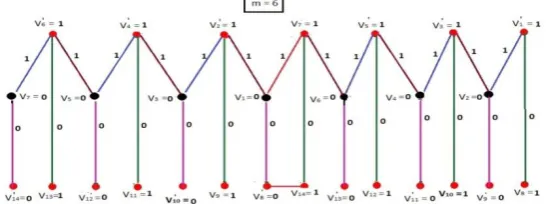
Clearly , the number of edges labeled with `0’ is 2m+2 and `1’ is m+m+2 =2m+2 and the number of vertices labeled with `0’ is m+1+m+1 =2m+2 and `1’ is m+1+m+1 =2m+2
Thus all the 4m+4 vertices and 4m+4 edges are labeled such that the number of vertices labeled with ` 0’ and `1’differ by atmost one . The number of edges labeled with `0’ and `1’ are also differ by atmost one.
The induced function is defined by f* : E → {0,1} such that f*(uv) = (f(u) + f(v) + f(uv) ) (mod 2).
Thus the induced function yields ,
f*(uv)=(f(u)+f(v)+f(uv) ) = 0+0+0 (or) 1+0+1(mod 2) =0 which is a constant `0’.Hence the extended duplicate graph of comb graph is total magic cordial graph.
Example : 2.5
Total magic cordial labeling of EDG(comb) graph for m=5 and m = 6 are given in figure 7 and figure 8 respectively
.
[image:6.595.310.586.251.353.2]Fig . 7: Total magic cordial labeling of EDG(comb) graph for m = 5
Fig.8: Total magic cordial labeling of EDG(comb) graph for m = 6.
Algorithm : 6
Procedure:
Total magic cordial labeling for MEDG(Pm) ,m ≥ 2)
//assignment of labels to the vertices and edges
vm+1′ , w2w2m+1 , wm+1w2m+1 , wm+2w2m+1 ← 1 .
w2m+1 ,w1w2m+1 , v2w2m+1 , v2′w2m+1 ← 0.
vm+1′wm← 0 if m≡ 0 (mod 2)
1 otherwise.
for i = 2 to m
{ vi′wi-1 ← 0 , wiwm+i-1 ← 0 if i ≡ 0(mod 2)
} 1 otherwise.
for i = 1 to m+1
{vi ← 0 }
for i = 1 to m
{wm+i ← 1 , vi′ ← 0 if i ≡ 0 (mod 2)
© 2017, IRJET | Impact Factor value: 5.181 | ISO 9001:2008 Certified Journal
| Page 370
for i = 1 to m
{ wi , viwi , vi′wm+i ← 1 if i ≡ 0(mod 2)
} 0 otherwise.
for i = 2 to m+1
{viwm+i-1 ← 1}
for i = 1 to m-1
{wiwm+i+1 ← 1 if i ≡ 1(mod 2)
} 0 otherwise.
Output :labeled MEDG (Pm).
Theorem : 2.6
Middle graph of extended duplicate graph of path Pm ,
MEDG(Pm) admits total magic cordial labeling , where m
represents the length of the path.
Proof :
The graph MEDG(Pm) has 4m+3 vertices and 6m+4
edges. The vertices and edges are labeled by defining a function f : V E → {0,1} as given in algorithm 6.
Clearly,the number of vertices labeled with 0 is 2m+2 and 1 is 2m+1 and the number of edges labeled with 0 is 3m+2 and 1 is also 3m+2.
Thus all the 4m+3 vertices and 6m+4 edges are labeled such that the number of vertices labeled with ` 0’ and `1’differ by atmost one . The number of edges labeled with `0’ and `1’ are also differ by atmost one.
The induced function is defined by f* : E →N {0} , such that f*(uv) = (f(u) + f(v) + f(uv) ) (mod 2).
Thus we have f*(uv) = (f(u) + f(v) + f(uv)) (mod 2) = 1+1+0 = 2(mod 2) = 0 , a constant. Hence the middle graph of extended duplicate graph of path (Pm) , m ≥ 2 is
total magic cordial graph.
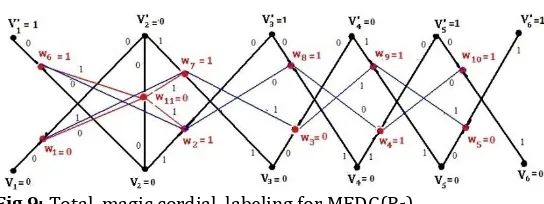
Example : 2.6
Total magic cordial labeling for MEDG(P5) is given in
figure 9.
Fig.9: Total magic cordial labeling for MEDG(P5)
Algorithm :7
Procedure
: ( n- Edge magic labeling for EDG(comb)graph , m ≥ 2).
// assignment of labels to the vertices If m ≡ 1(mod 2)
for i = 1 to m+1
{vi , vi′ ← -1 if i ≡ 1(mod 2)
} n+1 other wise.
for i = 2 to m+2
{vm+i , vm+i′ ← -1 if i ≡ 1(mod 2)
} n+1 other wise.
If m ≡ 0 (mod 2)
for i = 1 to 2m+2
{vi ← n+1 , vi′ ← -1}
end for
Output :Labeled EDG(comb) graph .
Theorem : 2.7
Extended duplicate graph of Comb graph admits n- Edge magic labeling.
Proof :
[image:7.595.311.583.158.260.2]© 2017, IRJET | Impact Factor value: 5.181 | ISO 9001:2008 Certified Journal
| Page 371
f :V → {-1 , n+1 / n ϵ N } as given in algorithm 7.The induced function is defined as f* : E → N such that f* (uv) = f(u) + f(v) .
Thus we have f*(uv) = f(u) + f(v) = -1+n+1= n , a constant for all uv E.
Thus EDG(comb) graph admits n – Edge magic labeling.
Example : 2.7
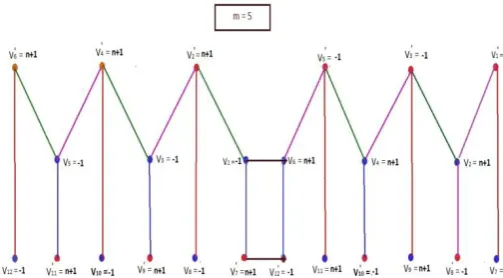
n - Edge magic labeling of EDG(comb) graph for m = 5 and m = 6 are given in figure 10 and figure 11 respectively.
[image:8.595.44.296.295.434.2]Fig . 10:
n - Edge magic labeling of EDG(comb) graph for m = 5Fig. 11: n -Edge magic labeling of EDG(comb) graph for m = 6
CONCLUSION :
In this paper we proved the existence of Z3 – vertex
magic total ,Z3- edge magic total ,total magic cordial , n –
edge magic labeling for the extended duplicate graph of comb graph and Z3 – vertex magic total ,Z3- edge magic
total ,total magic cordial labeling for the middle graph of extended duplicate graph of path graph by presenting algorithms.
REFERENCES :
1. A. Rosa, ``On certain valuations of the vertices of a graph’’, Theory of graphs,International Symposium, Rome, Gordon and Breach. N.Y. at Dunod Paris.1967;127-138.
2.A. Kotzig and A.Rosa, `` Magic valuations of finite graphs’’,Canada Math.Bull.1970;13: 451-461.
3.J.A .Gallian ,`` A Dynamic survey of graph labeling’’ ,The Electronic Journal of Combinatories.2014 ; 17 : #DS6.
4.J.AMacDougall, Mirka Miller, W.DWallis,``Vertex – magic total labeling of wheels and related graphs’’, Utilitas Mathematica.2002; 62: 175-183.
5. B.Selvam, K.Thirusangu and P.P. Ulaganathan, ``Z3-
vertex magic total labeling and Z3- edge magic total
labeling in extended duplicate graph of twig Tm’’, 2012 .
6.K.Sutha,K.Thirusangu.and S.Bala.``Cordial and Mean labelings on Extended Duplicate graph of Comb graph’’,British Journal of Applied Science and Technology,2016; 18(2): 1-13.
7.J.Jayapriya and K. Thirusangu,``0-Edge Magic Labeling for some class of graphs’’,Indian Journal of Computer Sciences and Engineering .2012;3: 425-427.
8.Neelam Kumari and Seema Mehra,``Some graphs with n – Edge magic labeling’’,International Journal of Innovative Research in Science,Engineering
andTechnology.2013:2,issue 10: 5633-5640.
9.J.Akiyama, T.Hamada,``The Decomposition of Line, Total and Middle graph of Complete graphs into Forests’’. Discrete Maths, 1979; 26:203-208.
10.R.Arundhadhi and K.Thirusangu, `` Star Coloring of Middle, Total and Line graph of Flower graph’’.