R E S E A R C H A R T I C L E
Open Access
Brazilian version of the Jefferson Scale of
Empathy: psychometric properties and
factor analysis
Helena BMS Paro
1,2*, Renata M Daud-Gallotti
1, Iolanda C Tibério
1, Rogério MC Pinto
2and Mílton A Martins
1Abstract
Background:Empathy is a central characteristic of medical professionalism and has recently gained attention in medical education research. The Jefferson Scale of Empathy is the most commonly used measure of empathy worldwide, and to date it has been translated in 39 languages. This study aimed to adapt the Jefferson Scale of Empathy to the Brazilian culture and to test its reliability and validity among Brazilian medical students.
Methods:The Portuguese version of the Jefferson Scale of Empathy was adapted to Brazil using back-translation techniques. This version was pretested among 39 fifth-year medical students in September 2010. During the final fifth- and sixth-year Objective Structured Clinical Examination (October 2011), 319 students were invited to respond to the scale anonymously. Cronbach’s alpha, exploratory factor analysis, item-total correlation, and gender
comparisons were performed to check the reliability and validity of the scale.
Results:The student response rate was 93.7% (299 students). Cronbach’s coefficient for the scale was 0.84. A principal component analysis confirmed the construct validity of the scale for three main factors: Compassionate Care (first factor), Ability to Stand in the Patient’s Shoes (second factor), and Perspective Taking (third factor). Gender comparisons did not reveal differences in the scores between female and male students.
Conclusions:The adapted Brazilian version of the Jefferson Scale of Empathy proved to be a valid, reliable instrument for use in national and cross-cultural studies in medical education.
Keywords:Empathy, Students, Medical, Psychometrics
Background
In a significant paradigm shift with respect to health, the World Health Organization proposed in 1946 [1] that empathy be considered a crucial skill to be developed in the context of medical education. In a holistic view of health, empathy is regarded as one of the central characteristics of medical professionalism and is frequently associated with the quality of care in clinical practice [2,3] as well as with improved health outcomes. Not surprisingly, medical schools and international educational councils [4] make constant efforts to foster medical students’empathic skills.
In line with this trend, increasing numbers of studies have focused on empathy in medical education [5]. Such
studies depend on the development of valid, reliable instruments for measuring empathy. The Jefferson Scale of Empathy (JSE) was designed to assess empathy in the context of patient care, and worldwide it is the most widely employed measure of empathy in medical educa-tion. It has been translated into 39 languages [6,7], and its psychometric properties have been confirmed in several countries [8-12].
A Portuguese version of the JSE (JSE-Pt) has been used in Portugal [13]. However, the JSE-Pt has not been tested to date in Brazil. Brazil is in fact the country with the second-largest number of medical schools in the world, with 185 institutions and approximately 15,000 final-year medical students annually. With more than 190 million inhabitants, Brazil is also the largest of the nine Portuguese-speaking countries in the world. Because there are important cultural differences between * Correspondence:[email protected]
1
Center for Development in Medical Education, University of Sao Paulo, Sao Paulo, Brazil
2
Health Sciences, Federal University of Uberlandia, Uberlandia, Brazil
Portugal and Brazil, it is essential that the JSE-Pt be properly adapted for use in Brazil so as to produce an instrument that is as valid and reliable as the original. Such equivalence to the original version of the JSE can be assured through rigorous techniques of back-translation and the adaptation of questionnaires [14-17]. These procedures are especially important for meta-analytic studies that involve international educational commissions and are designed to implement and evalu-ate reform strevalu-ategies in an interdependent world [18].
The aim of this study was to adapt the JSE-Pt to the Brazilian culture; we also aimed to test its reliability and validity so that we could produce a version that closely matched the original scale.
Methods Setting
This study was conducted at the São Paulo University School of Medicine, which admits 180 students annually to a six-year program in undergraduate medical educa-tion, which ranges from primary to tertiary care. Clerk-ship experience occurs during the final two years of undergraduate education, and it involves supervised, hands-on training in two university hospitals of increas-ing complexity: a 258-bed secondary hospital and a 1,200-bed tertiary hospital. Students are divided into small groups and rotate among five main areas: pediatrics, in-ternal medicine, obstetrics and gynecology, surgery, and preventive medicine. The internal medicine clerkship cor-responds to a 12-week program for fifth-year students, during which small groups of students participate in supervised clinical activities in two internal medicine wards and ambulatory clinics. This program includes simulations of medical scenarios, which focus on effective interpersonal communication, invasive procedures, and resuscitation. Student performance is evaluated using the following three complementary tools: a supervisor’s over-all rating, written exams, and an objective structured clin-ical examination (OSCE) with standardized patients.
Participants
During the pretest phase, all fifth-year students taking the internal medicine clerkship OSCE in September 2010 at our institution were eligible for the study (n= 45).
Fifth- and sixth-year students taking the final OSCE in October 2011 were eligible for the validation phase of the study (n= 319).
After approval by the Ethics Committee of our institu-tion, signed consent was obtained from all students. No reward was provided for participation.
Instrument: JSE–student version (JSE-S)
The JSE is a self-administrated 20-item instrument designed to measure empathy in the patient-care context.
Its original version comprises three domains: Perspective Taking (10 items), Compassionate Care (eight items), and Standing in the Patient’s Shoes (two items). The items are answered on a seven-point Likert scale from 1 (strongly disagree) to 7 (strongly agree) for positive items and 1 (strongly agree) to 7 (strongly disagree) for the 10 nega-tive items; scores thus range from 20 to 140, with higher scores signifying greater empathy [3].
Procedures
Phase 1: Cultural adaptation procedures
Because there is a validated Portuguese version of the JSE for use in Portugal (JSE-Pt) [13], we decided to fol-low international recommendations for cultural adapta-tion of quesadapta-tionnaires [17] using this existing version. The JSE-Pt was obtained from the authors and reviewed by three Brazilian translators to identify terms or usages that could be unacceptable or misunderstood in Brazil.
A fourth reviewer analyzed the translators’ comments,
made adjustments in areas of discrepancy, and produced a revised version that reflected the comments of all three translators. The reviewers were advised to pro-duce semantic, idiomatic, experiential, and conceptual equivalence between the new Brazilian (JSE-Br) version and the original (JSE) and Portuguese (JSE-Pt) ver-sions [14,16]. We sent this revised version to a native English translator, who back-translated the document. Both the original and Portuguese authors received the back-translated version so that final changes could be implemented.
Phase 2: Pretesting
After having been proofread, the JSE-Br (see Additional File: 1) was tested on 39 fifth-year medical students (86.7% of the total) during their internal medicine clerk-ship OSCE in September 2010. These 39 students also underwent a cognitive debriefing to confirm their com-prehension of the instrument items.
Phase 3: Validation
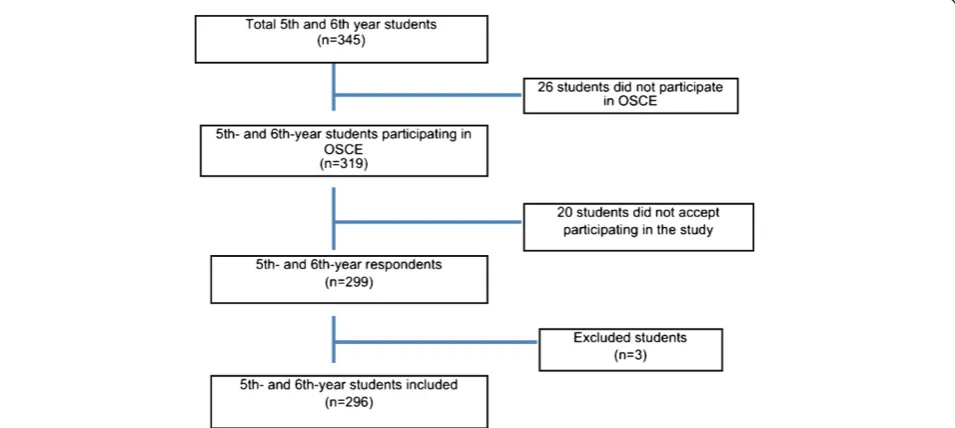
Among the total of 319 fifth- and sixth-year medical stu-dents during the final-year OSCE in October 2011, 299 students participated in the study (93.7%). Three stu-dents (1%) were excluded because they did not respond to more than four items of the JSE [6]. Only 149 (49.83% of respondents) reported their gender: 92 male, 61.75%; 57 female, 38.25%).
Statistical analysis
Internal consistency reliability was determined using Cronbach’s alpha coefficient. Values greater than 0.7 were considered satisfactory [19].
Kaiser-Meyer-Olkin measure of sampling adequacy were used to check for the appropriateness of the factor ana-lysis. We ran a principal component analysis (PCA) with varimax rotation. Eigenvalues greater than 1.5 were required to retain component factors, and factor load-ings of 0.35 or greater were considered satisfactory for the interpretation of the factor structure with a sample size of 250–350 subjects [19]. Communalities (propor-tion of variance of the variable that is accounted for by the common factors) were calculated to assess the factor structure. We performed descriptive analyses on all items and determined the item-total correlation (the degree to which each item correlates to the total score) using Pearson’s coefficient. Gender groups were com-pared (ttest) to check for known-group validity.
Results
As noted above, the student response rate during the validation phase was 93.7% (Figure 1). Cronbach’s alpha coefficient for the scale was 0.84. Alpha values for each factor are shown in Table 1.
Principal component analysis
The Kaiser-Meyer-Olkin analysis yielded an index of 0.88, and Bartlett’s test of sphericity gave X2= 1772.00 (p= 0.00); these indicate the appropriateness of the data
for PCA. Three factors with eigenvalues ≥1.5 were
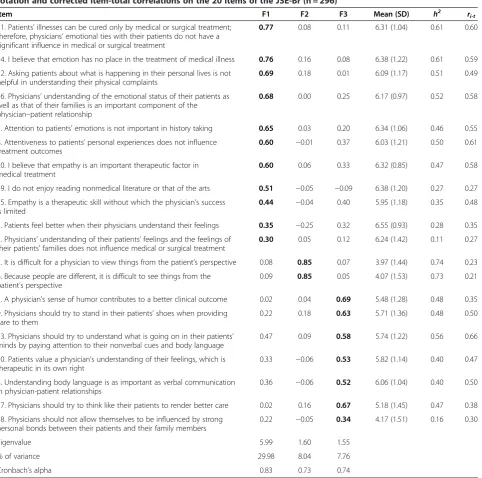
extracted by PCA and accounted for 45.48% of the over-all variance. As shown in Table 1, the first factor (denoted as Compassionate Care) accounted for 29.98% of the total variance, and it included 11 items with factor
loadings ≥0.30. The second factor (Standing in the
Patient’s Shoes) accounted for 8.04% of the variance, and
it consisted of two negative items with factor loadings
≥0.85. The third factor (Perspective Taking) accounted
for 7.76% of the variance, and comprised seven items with factor loadings≥0.30.
Items 1 and 18 had factor loadings≤0.35. Items 2 and 15 had similar factor loadings for factors 1 and 2. Com-munality values were lower than 0.40 for items 1, 2, 15, 18, and 19.
Psychometric properties of the JSE Item descriptive statistics and correlations
The mean total score for the JSE was 114.95 (SD = 12.41). Mean item scores ranged from 3.97 (SD = 1.44) to 6.55 (SD = 0.93) (Table 1). The lowest score was observed for item 3 (“It is difficult for a physician to view things from the patient’s perspective”). Students scored highest on item 2 (“Patients feel better when their physicians under-stand their feelings”).
All items were positively correlated with their corre-sponding factors and subscales. The correlation coeffi-cients were all positive and ranged from 0.50 to 0.89 (p≤0.001; Table 1).
The subscales Compassionate Care and Perspective Taking were strongly correlated (r= 0.61;p≤0.001). The subscale Compassionate Care was also correlated to
Standing in the Patient’s Shoes (r= 0.16; p≤0.05;
Table 2).
Known-group validity
Although female students had higher mean empathy scores than males (116.47 versus 113.79), this difference was not statistically significant (p= 0.21; Table 3).
Discussion
This study aimed to assess the reliability and validity of the Brazilian version of the JSE. Its reliability was sup-ported by a high internal consistency value. Our results confirm the international robustness of the scale: Cron-bach’s coefficients were consistently high [8-12,20,21].
These results also support the construct validity of the JSE-Br because PCA was able to replicate the three factors that emerged in the original sample [3]. Previous studies have also confirmed the construct validity of the JSE as a three-domain measure of empathy (Perspective
Taking, Compassionate Care, and Standing in the Patient’s Shoes) in Mexico [8], Korea [21], Iran [11], and the United Kingdom [12].
Interestingly, the first factor that emerged in the PCA of our study was the Compassionate Care component. This result is in accordance with Iranian findings [11], but it is in contrast with the original scale factor struc-ture, in which the Perspective Taking component was the major dimension [3]. This difference could be attrib-uted not only to cultural issues but also to religious issues. In Brazil, Christianity is the main religion, and Table 1 Factor pattern coefficients, mean and SD, communalities (h2) for principal component analysis with Varimax rotation and corrected item-total correlations on the 20 items of the JSE-Br (n = 296)†
Item F1 F2 F3 Mean (SD) h2 r
i-t
11. Patients’illnesses can be cured only by medical or surgical treatment; therefore, physicians’emotional ties with their patients do not have a significant influence in medical or surgical treatment
0.77 0.08 0.11 6.31 (1.04) 0.61 0.60
14. I believe that emotion has no place in the treatment of medical illness 0.76 0.16 0.08 6.38 (1.22) 0.61 0.59
12. Asking patients about what is happening in their personal lives is not helpful in understanding their physical complaints
0.69 0.18 0.01 6.09 (1.17) 0.51 0.49
16. Physicians’understanding of the emotional status of their patients as well as that of their families is an important component of the physician–patient relationship
0.68 0.00 0.25 6.17 (0.97) 0.52 0.58
7. Attention to patients’emotions is not important in history taking 0.65 0.03 0.20 6.34 (1.06) 0.46 0.55
8. Attentiveness to patients’personal experiences does not influence treatment outcomes
0.60 −0.01 0.37 6.03 (1.21) 0.50 0.61
20. I believe that empathy is an important therapeutic factor in medical treatment
0.60 0.06 0.33 6.32 (0.85) 0.47 0.58
19. I do not enjoy reading nonmedical literature or that of the arts 0.51 −0.05 −0.09 6.38 (1.20) 0.27 0.27
15. Empathy is a therapeutic skill without which the physician’s success is limited
0.44 −0.04 0.40 5.95 (1.18) 0.35 0.48
2. Patients feel better when their physicians understand their feelings 0.35 −0.25 0.32 6.55 (0.93) 0.28 0.35
1. Physicians’understanding of their patients’feelings and the feelings of their patients’families does not influence medical or surgical treatment
0.30 0.05 0.12 6.24 (1.42) 0.11 0.27
3. It is difficult for a physician to view things from the patient’s perspective 0.08 0.85 0.07 3.97 (1.44) 0.74 0.23
6. Because people are different, it is difficult to see things from the patient’s perspective
0.09 0.85 0.05 4.07 (1.53) 0.73 0.21
5. A physician’s sense of humor contributes to a better clinical outcome 0.02 0.04 0.69 5.48 (1.28) 0.48 0.35
9. Physicians should try to stand in their patients’shoes when providing care to them
0.22 0.18 0.63 5.71 (1.36) 0.48 0.50
13. Physicians should try to understand what is going on in their patients’ minds by paying attention to their nonverbal cues and body language
0.47 0.09 0.58 5.74 (1.22) 0.56 0.66
10. Patients value a physician’s understanding of their feelings, which is therapeutic in its own right
0.33 −0.06 0.53 5.82 (1.14) 0.40 0.47
4. Understanding body language is as important as verbal communication in physician-patient relationships
0.36 −0.06 0.52 6.06 (1.04) 0.40 0.50
17. Physicians should try to think like their patients to render better care 0.02 0.16 0.67 5.18 (1.45) 0.47 0.38
18. Physicians should not allow themselves to be influenced by strong personal bonds between their patients and their family members
0.22 −0.05 0.34 4.17 (1.51) 0.16 0.30
Eigenvalue 5.99 1.60 1.55
% of variance 29.98 8.04 7.76
Cronbach’s alpha 0.83 0.73 0.74
such characteristics as compassion and charity are con-sidered fundamental in this country. Another explan-ation for this result may be related to differences between the United States and Brazil concerning bio-ethical issues in doctor-patient relationships. In the United States, discussions on power and the patient’s autonomy have taken place since the 1960s [22]. In Brazil, the Hippocratic paternalism in doctor-patient relationships has been questioned only after fairly recent reforms to the Medical Ethics Code in the late 1990s [23], and paternalistic behavior is still common among Brazilian doctors and students. Such considerations must be taken into account when interpreting the im-portance of compassion in Brazilian culture.
Another possible interpretation of our results relates to the definition of compassion. If compassion is
under-stood to be“an overlap between cognition and emotion”
[3], it may be inferred that in our sample, emotions played the most important role in utilizing humanistic skills in the patient-care setting. Brazilian students seem to consider empathy a largely emotional construct.
Similarly, the Standing in the Patients’ Shoes
compo-nent, the second factor in our results, may also reflect the importance of compassion among Brazilian med-ical students. This component appeared third in the original scale.
However, the Perspective Taking component was the third factor in our analyses. This domain is related to
cognitive skills: information processing, reasoning,
appraisal, and communicating empathy [3]. Cultural dif-ferences may partially explain these results, but curricu-lar issues also have to be taken into account. Brazilian students are rarely exposed to such skills in their med-ical training in most of Brazil’s medmed-ical schools. This area of competence is usually practiced at isolated moments of the medical curriculum related to the
interdisciplinary field of humanities, patient safety [24], and bioethics. This presentation format in the curricu-lum may erroneously suggest to students that empathy is an exclusively inner characteristic or a natural dispos-ition [25] rather than a multidimensional competence to be taught, trained, and assessed [24,26].
Our results showed that item 1 (“Physicians’
under-standing of their patients’ feelings and the feelings of their patients’families does not influence medical or sur-gical treatment”) yielded low factor loading (r= 0.30) and communality (h2= 0.11) values. This pattern was similar to that in the UK study, which was conducted among 853 medical students (r< 0.40; h2= 0.15) [12]. Although low communality values may indicate the need for larger samples, it is unlikely that our result is due to sample size. The number of respondents in our study exceeded the adequate proportion of 10 subjects per observed variable [19]. Interestingly, in the Portuguese validation, item 1 was excluded owing to null variation in the con-firmatory factor analysis [13]. Further studies with the JSE-Br are needed to explain these results.
In our sample, item 18 (“Physicians should not allow themselves to be influenced by strong personal bonds between their patients and their family members”) also presented low values of factor loading and communality (r= 0.34;h2= 0.16) in the Perspective Taking component. Mexican [8] and Japanese [10] validation studies reported similar results for item 18 factor loadings (r= 0.25 and r= 0.36, respectively). In contrast to our study, this item was originally factored in the Compas-sionate Care component in Mexico and Japan [20]. In the Mexican [8] and Japanese [10] samples, item 18 was factored in the Ability to Stand in the Patient’s Shoes component. Scores from these low-communality items must be assessed with caution in Brazilian samples until further studies are conducted.
Table 3 Gender comparisons among Jefferson Scale of Empathy (JSE) subscales (n= 149)†
Male (n= 92) Female (n= 57) t p††
Mean (SD) Mean (SD)
Total score 113.84 (12.68) 116.54 (12.81) −1.26 0.21
Compassionate Care 67.89 (7.67) 69.80 (7.62) −1.49 0.13
Standing in the Patient’s Shoes 7.92 (2.62) 7.78 (2.69) 0.31 0.75
Perspective Taking 38.03 (5.43) 38.95 (6.30) −0.95 0.35
†147 students did not report their gender;††ttest.
Table 2 Pearson’s correlation coefficients among the Jefferson Scale of Empathy (JSE) subscales (n= 296)
Subscale Compassionate care Standing in the patient’s shoes Perspective taking Total score
Compassionate Care 0.16† 0.59† 0.90†
Standing in the Patient’s Shoes 0.16† 0.15† 0.38†
Perspective Taking 0.59†† 0.15† 0.84†
Our results showed that items 2 (“Patients feel better when their physicians understand their feelings”) and 15 (“Empathy is a therapeutic skill without which the physi-cian’s success is limited”) may be considered factorially complex because they showed similar loadings in both the Compassionate Care and Perspective Taking compo-nents. Indeed, these components are strongly associated, as suggested by the significant and large correlation coefficient between these two subscales. In the original validation studies [20], these items were factored in the Perspective Taking subscale. In our context, these items were categorized under Compassionate Care. These results reinforce our hypothesis that Brazilian students seem to understand empathy as an emotional rather than a cognitive construct.
Similar to the results with Italian [9], Korean [21], and Iranian [11] medical students, our data failed to demon-strate higher empathy scores among female students, as measured by the JSE. This result could be due to sam-pling bias because only 49% of the respondents reported their gender in our study. However, gender differences have been reported in several studies among medical trainees, with the results favoring female students in terms of higher empathy [8,10,12]. Such controversies remain to be elucidated: current neuroscience studies investigate not only intrinsic factors related to empathy, such as genetics [27] and brain networks [28,29], but also extrinsic factors, such as social values and culture [30], that could possibly explain gender differences. Are these differences a matter of gender? This question remains unanswered.
There were certain methodological limitations to our study. Although it may have been valuable to our study, we did not test the concurrent validity of the JSE with other measures of empathy. We attempted to mitigate
the students’ response burden during OSCE evaluations
and chose to test validity through factor analysis and known-group validity. Medical students were recruited by convenience, so sampling bias must be taken into account. However, our high response rate may have moderated this limitation, and our sample is probably representative of the study population. We were unable to explain items with low factor coefficients and com-munalities. Further studies with confirmatory factor analyses in different datasets are needed to better under-stand item behavior within the JSE. Additionally, the low rate of respondents reporting gender may have limited our conclusions regarding gender differences.
Conclusions
Our study followed rigorous techniques of adaptation to produce a robust, psychometrically sound measure of empathy that was closely matched to the original instru-ment. The use of a validated measure may help evaluate
strategies for learning empathy and consolidate its asso-ciation with clinical performance in future studies. More-over, the use of the JSE-Br in national and cross-cultural studies is promising: understanding intercultural differ-ences may promote more effective educational interven-tions and transcend boundaries in medical education.
Additional file
Additional file 1:Brazilian version of the Jefferson Scale of Empathy (JSE-Br).Portuguese(Brazil)_S_(HParo).pdf - Escala Jefferson de Empatia Médica–Versão para Estudantes.
Competing interests
The authors declared that they have no competing interests.
Authors’contributions
HBMSP conceived the study, participated in data collection, performed statistical analysis, and drafted and revised the manuscript. RMDG conceived the study, participated in data collection, performed statistical analysis, and revised the manuscript. ICT conceived the study, participated in data collection, and revised the manuscript. RMCP performed statistical analysis, and drafted and revised the manuscript. MAM conceived the study and revised the manuscript. All authors read and approved the final manuscript.
Acknowledgments
The authors thank Prof. Mohammadreza Hojat for granting permission to use the JSE and for his valuable supervision and guidance during the study. We also thank Prof. Manuel J Costa for his help with cultural adaptation of the Portuguese version of the JSE, revisions, and language improvements.
Received: 15 February 2012 Accepted: 30 July 2012 Published: 9 August 2012
References
1. World Health Organization (WHO):Preamble to the Constitution of the World Health Organization as adopted by the International Health Conference, New York, 19–22 June. 1946.
2. Stepien KA, Baernstein A:Educating for empathy. A review.J Gen Intern Med2006,21(5):524–530.
3. Hojat M:Empathy in patient care: antecedents, development, measurement, and outcomes. New York: Springer; 2007.
4. Association of American Medical Colleges (AAMC):Educating doctors to provide high quality medical care. A vision for medical education in the United States. Washington, DC: Report of the Ad Hoc Committee of Deans; 2004. 5. Pendersen R:Empathy development in medical education–A critical
review.Med Teach2010,32:593–600.
6. Hojat M, Gonnella JS, Maxwell L:The Jefferson Scales of Empathy (JSE): Professional Manual & User’s Guide. December 2009 Edition. Philadelphia, Pennsylvania: Jefferson Medical College–Center for Research in Medical Education and Health Care; 2009.
7. Hojat M, Spandorfer J, Louis DZ, Gonella JS:Empathic and sympathetic orientations toward patient care: Conceptualization, measurement, and psychometrics.Acad Med2011,86(8):989–995.
8. Alcorta-Garza A, González-Guerrero JF, Tavitas-Herrera SE, Rodríguez-Lara FJ, Hojat M:Validación de la escala de empatía médica de Jefferson en estudiantes de medicina mexicanos.Salud Mental2005,28(5):57–63. 9. Di Lillo M, Cicchetti A, Scalzo AL, Taroni F, Hojat M:The Jefferson Scale of
Physician Empathy: preliminary psychometrics and group comparisons in Italian physicians.Acad Med2009,84(9):1198–1202.
10. Kataoka HU, Koide N, Ochi K, Hojat M:Measurement of empathy among Japanese medical students: psychometrics and score differences by gender and level of medical education.Acad Med2009,84(9):1192–1197. 11. Rahimi-Madiseh M, Tavakol M, Dennick R, Nasiri J:Empathy in Iranian
12. Tavakol S, Dennick R, Tavakol M:Psychometric properties and
confirmatory factor analysis of the Jefferson Scale of Physician Empathy. BMC Med Educ2011,11:54. doi:10.1186/1472-6920-11-54.
13. Magalhães E, DeChamplain E, Salgueira E, Costa MJ:Empatia Médica: Adaptação e validação de uma escala para estudantes de medicina. InThe National Symposia of Psychology Research; Portugal. Edited by Nogueira C, Silva I, Lima L, Almeida AT, Cabecinhas R, Gomes R, Machado C, Maia A, Sampaio A, Taveira MC.; 2010:77–89. http://www.actassnip2010.com. 14. Beaton DE, Bombardier C, Guillemin F, Ferraz MB:Guidelines for the
process of cross-cultural adaptation of self-report measures.Spine2000,
25(24):3186–3191.
15. Eremenco SL, Cella D, Arnold BJ:A comprehensive method for the translation and cross-cultural validation of health status questionnaires. Eval Health Prof2005,28(2):212–232.
16. Guillemin F, Bombardier C, Beaton D:Cross-cultural adaptation of health-related quality of life measures: literature review and proposed guidelines.J Clin Epidemiol1993,46(12):1417–1432.
17. Wild D, Eremenco S, Mear I, Martin M, Houchin C, Gawlicki M, Hareendran A, Wiklund I, Chong LY, von Maltzahn R, Cohen L, Molsen E:Multinational trials—recommendations on the translations required, approaches to using the same language in different countries, and the approaches to support pooling the data: the ISPOR patient-reported outcomes translation and linguistic validation good research practices task force report.Value Health2009,12(4):430–440.
18. Frenk J, Chen L, Bhutta ZA, Cohen J, Crisp N, Evans T, Fineberg H, Garcia P, Ke Y, Kelley P, Kistnasamy B, Meleis A, Naylor D, Pablos-Mendez A, Reddy S, Scrimshaw S, Sepulveda J, Serwadda D, Zurayk H:Health professionals for a new century: transforming education to strengthen health systems in an interdependent world.Lancet2010,376:1923–1958.
19. Hair JFJ, Anderson RE, Tatham RL, Black WC:Multivariate data analysis. 5th edition. Saddle River, NJ: Prentice Hall; 1998.
20. Hojat M, Mangione S, Nasca TJ, Cohen MJM, Gonnella JS, Erdmann JB, Veloski J, Magee M:The Jefferson Scale of Physician Empathy: Development and preliminary psychometric data.Educ Psychol Measurement2001,61:349–365.
21. Roh M-S, Hahm B-J, Lee DH, Suh DH:Evaluation of empathy among Korean medical students: a cross-sectional study using the Korean version of the Jefferson Scale of Physician Empathy.Teach Learn Med
2010,22(3):167–171.
22. Almeida JLT, Schramm FR:Paradigm shift, metamorphosis of medical ethics, and the rise of bioethics.Cad Saude Publica1999,15(Suppl 1):15–25. 23. Siqueira JE:A bioética e a revisão dos códigos de conduta moral dos
médicos no Brasil.Revista Bioética2008,16(1):85–95.
24. Daud-Gallotti RM, Morinaga CV, Arlindo-Rodrigues M, Velasco IT, Martins MA, Tiberio IC:A new method for the assessment of patient safety competencies during a medical school clerkship using an objective structured clinical examination.Clinics2011,66(7):1209–1215. 25. Chochinov HM:Dignity and the essence of medicine: the A, B, C and D
of dignity conserving care.BMJ2007,335:184–187.
26. Tempski P, Martins MA, Paro HBMS:Teaching and learning resilience: a new agenda in medical education.Med Educ2012,46:345–346. 27. Wu N, Li Z, Su Y:The association between oxytocin receptor gene
polymorphism (OXTR) and trait empathy.J Affect Disord2012,138:468–472. 28. Schulte-Ruther M, Markowitsch HJ, Shah NJ, Fink GR, Piefke M:Gender
differences in brain networks supporting empathy.Neuroimage2008,
42(1):393–403.
29. Cheng Y, Chou KH, Decety J, Cheng IY, Hung D, Tzeng OJL, Lin CP:Sex differences in the neuroanatomy of human mirror-neuron system: a voxel-based morphometric investigation.Neuroscience2009,
158(2):713–720.
30. Zacki J, Ochsner KN:The neuroscience of empathy: progress, pitfalls and promise.Nat Neurosci2012,15(5):675–680.
doi:10.1186/1472-6920-12-73
Cite this article as:Paroet al.:Brazilian version of the Jefferson Scale of
Empathy: psychometric properties and factor analysis.BMC Medical
Education201212:73.
Submit your next manuscript to BioMed Central and take full advantage of:
• Convenient online submission
• Thorough peer review
• No space constraints or color figure charges
• Immediate publication on acceptance
• Inclusion in PubMed, CAS, Scopus and Google Scholar
• Research which is freely available for redistribution