
819
Developing Connection, Aplication, Reflection,
Extension (Care) Learning Model IN Junior High
School Science Learning
Khairul Anwar, Suratno, WachjuSubchan
Abstract: Connection, Application, Reflection, Extention (CARE) learning model is a learning model developed by integrating inquiry learning model and accelerated learning into one combining the strengths and weaknesses of each model. This study aims to: 1) find out the validity of CARE learning model, 2) know the practicality of CARE learning model, 3) find out the effectiveness of CARE learning model. This research is a research development using the stages of development research from Borg & Gall (1983) research stages, namely: (1) research and information collecting, (2) planning, (3) developing preliminary forms of product, (4) preliminary field testing, (5) main product revision, (6) main field testing, (7) operational product revision, (8) operational field testing, (9) final product revision, and (10) dissemination and implementation. Qualitative and quantitative descriptive analysis is used during this research. The validity test results showed the average percentage of product validity reached 93.39% with a very valid category. The results of the effectiveness test on the small group and large group test respectively on the learning outcomes in the aspects of knowledge have a Normalized gain (N-gain) value of 0.61 (moderate) and 0.71 (high) in the aspects of attitudes reaching an average of 87.5% (very good) and 88.9% very good in the aspects of the process skills reached an average of 62.5% (sufficient) and 94.7% (very good) in the aspects of the product skills reached an average of 83.35% (good) and 86.35% (very good ), the average response of student responses has a value of 79.89% (strongly agree) and 87.52% (strongly agree). The practicality test results at each stage of the small group test, large group test and feasibility test are: 90, 60%, 95, 50% and 91, 00% with the category as very well implemented. The description of the results of the study above shows that the CARE learning model (Connection, Application, Reflection, Extension) meets the criteria as a product of development that is valid, practical and effective.
Key Words: CARE Learning Model, Learning, Science
————————————————————
1.
INTRODUCTION
The 2013 curriculum in the implementation of the learning process requires a balance between aspects of knowledge, attitudes and skills. The learning process initially focused on exploration, elaboration and confirmation enhanced by learning that was held interactively, inspiratively, fun, challenging, motivating students, to actively participate, as well as providing sufficient space for initiative, creativity and independence in accordance with their talents, interests and developments physical and psychological learners[6]. Learning that initially focused on student cognitive learning outcomes today emphasizes how the learning process is meaningful for students. The learning process is designed with an orientation on achieving competence and focusing on students (student centered learning). Learning does not only focus on results, but the process [11]. Those 2013 curriculum development demands apply to all subjects including science subjects. The learning process of Sciences refers to the general guidelines for learning the Ministry of Education and Culture Republic of Indonesia No. 103 of 2014, in which the principle of learning activities are processes that provide opportunities for students to develop their potential in the attitudes, knowledge, and skills needed by themselves for life and for society, nation and and contribute to the welfare of human life.
Learning activities are directed to empower all potential learners to achieve the expected competencies. In the learning process, students are encouraged to find information, check new information, link new information with existing knowledge in their memories, and develop it into information or abilities that are appropriate to the environment, place and time of their life[6]. The fact that is often found in schools is that students are accustomed to learning only in the low cognitive domain (Silberman, 2001: 3). Teacher-centered learning patterns are sometimes still found in the learning process, resulting the learning becomes unattractive and dominated by teachers [3]. The learning process that is dominated by the teacher does not provide access for students to develop independently through discovery in their thought processes, and this affects the absorption or learning outcomes of concern [1]. The learning model that emphasizes student activities in the learning process and makes the teacher a guide is defined as the inquiry learning model [7]. The inquiry learning model according to [5] is one of a series of learning activities aimed at all students to search and use systematic, critical, logical and analytical so that students can formulate their own findings with confidence. The objectives to be achieved in learning by using the inquiry model are not only mastery of concepts, but also the process of achieving mastery of knowledge and skills that can provide provisions for students on their adventure journey. According to Dedi et al. (2015: 304), the weaknesses of inquiry learning are the difficulty for learners to understand the learning material without the basis of knowledge and it requires a long time to become independent learners who seek and process information independently. The accelerated learning model (AL) as a learning model can fully arouse the learning abilities of learners, make learning fun and satisfying for them and contribute fully to their intelligence, competence and success as human beings [10]. The accelerated learning model is a learning model that wants students to ________________________________
• Khairul Anwar, Faculty ofTeacher Training and Education, University of Jember, Jember, Indonesia. [email protected]
• Suratno, Faculty of Teacher Training and Education, University of Jember, Jember, Indonesia. [email protected]
experience joy in learning. The joy is in the form of the rise of students' interest in learning, full involvement of students and making learning carried out meaningful. Meier [8], states "Accelerated Learning" is natural learning, which is based on how people learn naturally ". Learning involves the whole body, mind, and all of us by interacting directly with others and with the world. The combination of the Accelerated Learning (AL) learning model by integrating the syntax of the AL model and the Inquiry learning model is expected to provide a maximum learning experience to students. With the AL model can reduce the weakness of the inquiry model, it can make the learning process is more directed in finding concepts while through the AL model, it can provide motivation and provide initial concepts before students conduct investigations. Integrating the Inquiry model syntax and the AL model allows building self concepts by connecting real problems in daily life with student learning experiences, before students conduct an investigation. Furthermore, follow up activity with the syntax of Trigering Your Memory is done to make it easier for students to remember the concepts obtained from the results of the investigation. From the advantages of the two models, a new model is developed, namely CARE (Connection, Application, Reflection, Extension) by combining the advantages of the two syntaxes of the model. The development of CARE learning aims to create constructivist and humanistic learning. Students can learn in a scientific and collaborative environment. The combination of the two learning models is expected to be suitable for application in the 2013 competency-based curriculum and change the learning paradigm from teacher centered to student centered. Internal and external learning factors can be managed properly. In addition, the students can improve their overall learning outcomes. The aim to be achieved in this research is to analyze CARE learning models that are valid, effective and practical.
2. METHOD
This type of research is Research Development (R&D) that produces CARE (Connection, Application, Reflection, Extension) learning model. This development research refers to the development model of Borg and Gall (1983) which consists of ten steps, namely: research and information collecting (research and data collection), planning (preparing research plans), developing preliminary forms of product (developing product drafts), preliminary field testing (main field trial), main product revision (revising the results of the trial), main field testing (operational trial), operational product revision (refining the product from the field trial), operational field testing (final implementation), final product revision (improvement of the final product), and dissemination and implementation (dissemination and implementation). The research subjects were the students of SMP Negeri 3 Situbondo Class IX 2019-2020 Academic Year. The research instrument used to obtain the validity of CARE learning model data consisted of the validation sheet of CARE learning models by experts (Lecturer at Jember University), CARE learning model validation sheets by users (teachers), syllabus validation sheets, teaching plan (RPP) validation sheets. An additional research instrument is also used in the form of a student response questionnaire and an observation sheet of the implementation of learning to obtain practicality data and the effectiveness of the
CARE learning model when it was used in classroom learning activities. The validity and response data of the students as well as the observation sheet of the implementation of learning were changed in the form of a percentage then converted into descriptive qualitative data using the assessment criteria described in Table 1. In addition, qualitative data were obtained from the percentage of each point in the student response questionnaire and the observation sheet of the implementation of the learning in implementing CARE learning models in class.
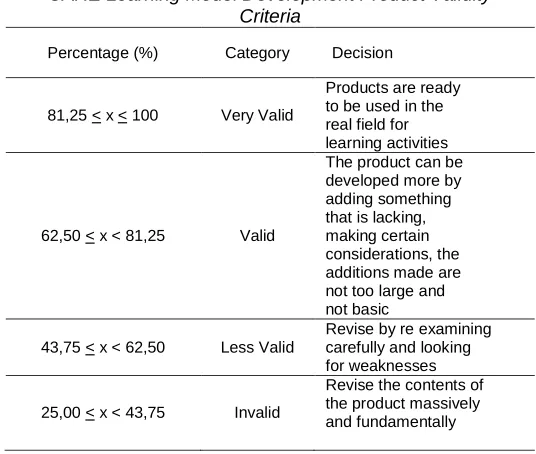
TABLE 1.
CARE Learning Model Development Product Validity Criteria
Percentage (%) Category Decision
81,25 < x < 100 Very Valid
Products are ready to be used in the real field for learning activities
62,50 < x < 81,25 Valid
The product can be developed more by adding something that is lacking, making certain considerations, the additions made are not too large and not basic
43,75 < x < 62,50 Less Valid
Revise by re examining carefully and looking for weaknesses
25,00 < x < 43,75 Invalid
Revise the contents of the product massively and fundamentally
3.RESULT
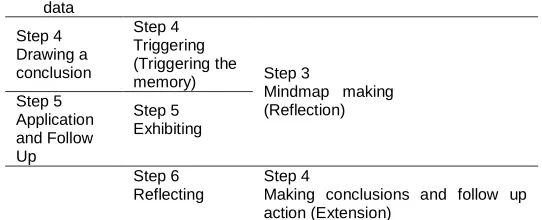
This research is a development research that produces a product in the form of a new learning model that is the learning model CARE (Connection, Application, Refflection, Extention) with reference to the research model development of BORg and Gall (1983). The stages of learning activities in the CARE learning model are a combination of the strengths and weaknesses of the inquiry learning model and accelerated learning (AL). The syntax of CARE learning model which is a combination of inquiry and AL learning models can be seen in Table 2.
Table 2.
The combination of inquiry model and AL model Inquiry
Model Syntax
AL Model
Syntax CARE Model Syntax
Step 1 Formulating questions
Step 1 Mind (Mind Motivation)
Step 1
Linking problems in learning with real problems(Connection)
Step 2 Planning
Step 2 Acquiring (obtaining information)
Step 2 Carrying out an investigation(Aplication) Step 3
Gathering and analyzing
821 data
Step 4 Drawing a conclusion
Step 4 Triggering (Triggering the
memory) Step 3
Mindmap making (Reflection) Step 5
Application and Follow Up
Step 5 Exhibiting
Step 6 Reflecting
Step 4
Making conclusions and follow up action (Extension)
A description of the steps of the CARE learning model can be explained in Table 3.
Table 3.
CARE Learning Model Syntax Syntactic Teacher Activity Student Activity
Step 1 Connecti
on
Motivating students by presenting real-life
problems through questions / pictures /
videos.
Observing, answering questions, and finding problems related to real life.
Formulating questions to solve problems and hypotheses based on students' initial knowledge through the initial concept
sheet.
Step 2 Aplicatio
n
Guiding the student's activities while assessing student
activities.
planing investigations collaboratively and collecting
data and then interpreting them.
Step 3 Reflectio
n
Facilitating discussion and helping students to create mindmaps.
Communicating the results Making note of important
things in the form of mindmaps.
Step 4 Extensio
n
Facilitating and provideing reinforcement as a follow-up to learning
process.
Drawing conclusions and follow up action individually
In accordance with the statement of Joyce, et al. that each learning model must have characteristicsof learning model, then the characteristics of the CARE learning model are explained as follows:
1. Social System
Implementing the CARE learning model requires collaboration in finding concepts. Some interactions that reflect the social system in CARE learning include the formation of student groups, investigations, class discussions. Learners are invited to conduct joint investigations, work together and respect each other's opinions during class discussion activities, and the teacher controls the class so that an effective learning atmosphere is created
2. Reaction Principle
The teacher's task in implementing the CARE learning model is as a learning facilitator in formulating problems and determining hypotheses. The teacher's task is to direct students in the investigation activities. If in these activitiesthe students have difficulty, the teacher can guide them by providing examples or illustrations related to the problem or investigation activity. Not only that, the teacher’s tasks in this model are also to organize the students to discuss the results of the investigation of the problems or
experimental activities they have made, monitor students when students and group members present the results of the discussion in front of the class and the teacher clarifies the material that has been delivered by the group.
3. Support System
The support system for implementing this CARE learning model is that the teacher must provide media in the form of images, videos or PPT containing images related to the problem that will be discussed, student worksheet for investigative activities, LCD Projector to display picture illustrations or video will be presented in front of the class. The tools and materials needed are listed in the RPP (Learning Implementation Plan).
4. Instructional Effect
The instructional effect of CARE's learning model is that students can find concepts through their own discoveries. Besides, another the instructional effects that can emerge is the increase in student learning outcomes that include cognitive, affective, and psychomotor aspects.
5. AdditionalEffect
The additional effect expected by CARE's learning model is the increase ofstudents’ enthusiasm for research, increased understanding of concepts, increased ability to design investigations, and better collaboration skills. These attitudes or skills are included in the indicators of student activity observation instruments to identify and measure the impact of the accompaniment developed in this modelThe product of this development research, which is in the form of CARE learning models, are said to be feasible and of high quality if the learning models are valid, practical and effective (Arends, 2008). The process of developing the CARE learning model used several instruments to obtain data about the validity of the model. The instrument used in the development of CARE learning models is first validated by validator. The results of instrument validation can be seen in Table 4.
Table 4.
Research Instrument Validation Results
No Research Instrument Validation
Result (%) Category
1 CARE
learningmodelguidebook 82,50
Very Valid
2 CARE learning model set 90,00 Very Valid
Average 86,25 Very
Valid
The results of CARE learning model validation can be seen in Table 5.
Table 5.
CARE Learning Model Book and Learning Set Validation Results
No Variable
Expert Validation Resulit
User Validation Result Averag
e Percen
tage (%)
Criteria
Averag ePerce ntage (%)
Criteria
1
CARE Learning Model Guidebook
88,36 Valid Very 94,30 Valid Very
2 Syllabus 94,44 Very
Valid 97,20
Very Valid
3 Lesson Plan 92,00 Very
Valid 93,50
Very Valid
Based on Table 5about the results of the validation of CARE learning model books by experts, it shows the validation results of 88.36% with a very valid category and further strengthened with the results of user validation showing the results of the validation of 94.30% with a very valid category. The average validation results by experts and users of the syllabus are 95.80% with a very valid category. The average validation results by experts and users of the lesson plan are 93.08% with a very valid category. Referring to the criteria, this figure shows that the CARE model developed is in good category and can be used. Furthermore, the model developed was tested on a small scale according to the development steps of Borg and Gall. CARE learning models that have been valid are then tested in the learning process in class. The CARE learning model test was carried out in two stages, namely the small group test and the large group test. The second phase of the model test was conducted in class IX of SMP Negeri 3 Situbondo. In the small group test 9 students were used. Model testing at the large group test stage involved all students in class IX-H. The CARE learning model trial aims to see the practicality and effectiveness of the CARE learning model. In the small group test and large group test the data obtained is about the improvement of learning outcomes aspects of knowledge, aspects of attitude and aspects of skills. The data on improving learning outcomes aspects of knowledge after learning activities using CARE learning models can be seen in Table 6.
Table 6.
Learning Outcomes (Aspect of knowledge)
No Learning Outcome
Small group test Large group test N-gain Category N-gain Category
1 Cycle 1 0,30 low 0,55 average
2 Cycle 2 0,61 average 0,71 high
The data in Table 6 shows consecutive N-gains as follows; In the small group test, in cycle 1, the value of N-gain is 0.3 which is in the low category, in cycle 2, the value of the N-gain is 0.61, which is in the medium category. In the large group test, in cycle 1, the value of N-gain is 0.55, which is in the medium category, in cycle 2, the value of N-gain is 0.71, which is in the high category. The data above shows that there was an increase in the N-gain value consistently in small-scale trials of cycle 1 and cycle 2. Likewise, in
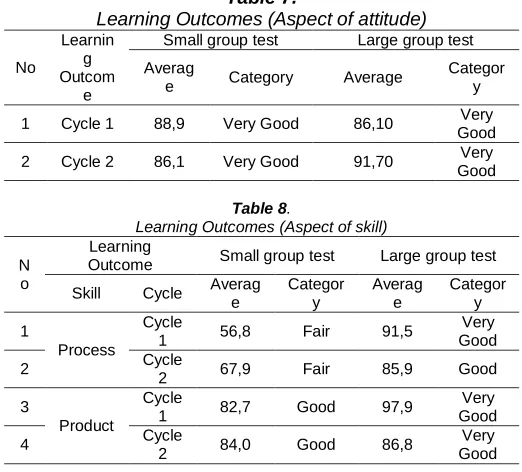
large-scale trials, there was also an increase in N-gain from cycle 1 and cycle 2. This is in line with the results of Ramsey (1995) which shows that there has been a change in science learning than before and requires problems that are integrated with the environment. Improved learning outcomes also occur in aspect of attitude and aspect of skill shown in Table 7. and Table 8.
Table 7.
Learning Outcomes (Aspect of attitude)
No
Learnin g Outcom
e
Small group test Large group test
Averag
e Category Average
Categor y
1 Cycle 1 88,9 Very Good 86,10 Very Good
2 Cycle 2 86,1 Very Good 91,70 Good Very
Table 8.
Learning Outcomes (Aspect of skill)
N o
Learning
Outcome Small group test Large group test
Skill Cycle Averag e
Categor y
Averag e
Categor y
1
Process Cycle
1 56,8 Fair 91,5
Very Good
2 Cycle
2 67,9 Fair 85,9 Good
3
Product Cycle
1 82,7 Good 97,9
Very Good
4 Cycle
2 84,0 Good 86,8
Very Good
The data in Table 7 and Table 8 shows that CARE learning model is able to increase student activity in learning in the excellent category during the small group or large group test. This is shown by the data when testing small groups learning outcomes in the aspect of attitude in cycle 1: 88.9%, in cycle 2: 86.1%, learning outcomes in the aspect of the process skills in cycle 1: 56.8%, in cycle 2: 67.9%, product skill in cycle1: 82.7%, in cycle 2: 84.0%, while the results in large groups are the results of learning attitude aspect in the cycle 1: 86.1%, in cycle 2: 91.7%, learning outcomes in aspect of the process skills in cycle 1: 91, 5%, in cycle 2: 85.9%, in the aspect of product skill in cycle 1: 97.9%, in cycle 2: 84.0%. In addition to the learning outcomes, the effectiveness of the CARE learning model can also be seen from the results of the questionnaire students' responses to the CARE learning model shown in Table 9.
Table 9. Student Response Data
No Learning Outcome
Small group test Large group test Average Category Average Category
1 Interest in
learning 84,17%
Strongly
Agree 88,17%
Strongly Agree
2 Usefulness
in learning 80,50%
Strongly
Agree 86,89%
Strongly Agree
3
Interest in learning the next chapter
75,00% Strongly
Agree 87,50%
Strongly Agree
Average 79,89% Strongly
Agree 87,52%
Strongly Agree
823 model is 79.89% with the category of strongly agree, in the
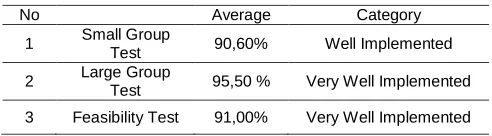
large group test 87.52% with the category of strongly agree. This shows that the implementation of CARE learning models can generate interest, motivation and enthusiasm, and great interest in learning. The product can be concluded practical if the practitioner states that theoretically the product can be applied in the field and the level of product performance is in good category (Nieven, 1999). To find out the practicality of the learning model, the data obtained from observation of the CARE learning model implementation can be shown in table 10.
Table 10. Learning Implementation Data
No Average Category
1 Small Group Test 90,60% Well Implemented
2 Large Group
Test 95,50 % Very Well Implemented
3 Feasibility Test 91,00% Very Well Implemented
The data in Table 10, which is about the learning implementation in the small group test, shows that the average score obtained from observations by the two observers on the implementation of the learning model is 90.60%, while in the large group test is 95.50%, and the result of the feasibility test shows 91.00%. This means that all indicators of implementation including pre-activity, whilst-acitivity, and post-activity are very well implemented. From the description above, it can be concluded that CARE's learning model meets the practicality criteria of an educational development product or it can be said to be a practical model in junior high school science learning because it is easy to apply in the field with the level of very well implemented. This is in line with the opinion of Sutikno [13] which says that effective learning is a learning that allows students to learn easily, fun and can achieve learning objectives in accordance with expectations.
4. CONCLUSION
Based on the research results and discussion described above, it can be concluded that the CARE learning model (Connection, Application, Reflection, Extention) is valid to be used in learning activities. It is supported by a validity value of 88.36% and positive responses from students during the implementation of the learning model. CARE learning model consists of 4 stages, namely formulating problems and making hypotheses, designing investigation and conducting investigation, presenting results and writing concepts to a mindmap, and making conclusions and follow-up action.
5 REFERENCES
[1] Al-Tabany, T. I.B. 2015. “Mendesain Model Pembelajaran Inovatif-Progresifdan Kontekstual”. Jakarta: KencanaPrenada Media Group
[2] Akbar, S. 2015. “Instrumen Perangkat
Pembelajaran”. Bandung: Remaja Rosdakarya [3] Boleng, D.T. dan A.D. Corebima. 2014.
“Cooperative learning models having better potency to improve social attitude of multiethnic senior high school students at Samarinda”,
Indonesia. Journal of Educational Research and Reviews. 2(3): 36-44.
[4] Borg, W.R. dan M.D. Gall. 1983. “Educational Research: AnIntroduction (5th ed.)” New York: Longman.
[5] Gulo, W. 2002. “Strategi Belajar Mengaja”r. Jakarta. Grasindo.
[6] Kementerian Pendidikan dan Kebudayaan. 2014. “Permendikbud No 103 Tahun 2014 TentangPembelajaran pada Dikdasmen”, Jakarta:Kementrian Pendidikan dan Kebudayaan. [7] Liena A, 2015, “Penggunaan Model Inquiry
dengan Metode Eksperimen dalam Pembelajaran IPA di SMPN 10 Probolinggo”, (JurnalKebijakan dan Pengembangan Pendidikan Volume 3, Nomor 1, Januari 2015; 15-20), Universitas Muhammadiyah Malang
[8] Meier, D, 2002, “The Accelerated Learning Handbook”, Bandung: Kaifa
[9] Nieveen, N. 1999. Prototyping to reach product quality. dalam J.V.D Akker et. al (Eds), “Design approaches and tools in Education and Trainning”. Dordsrecht: Springer-Science-Business Media-Kluwer Academic Publisher [10]Rose, Colin, 2012, “Accelerated Learning
forthe21” Century Cara BelajarCepat Abad XXI”, Bandung:Nuansa
[11]Rustaman, N.Y., 2008. “Hasil EvaluasiKegiatan Piloting Biologi di SMP dan SMA”.Makalah disusun untuk disajikan dalam seminar Pendidikan Matematika dan Ilmu Pengetahuan Alam, IMSTEP-JICA, Agustus 2013 di Yogyakarta.
[12]Silberman, Mel. 2002, “Active Learning; 101 Strategi Pembelajaran Aktif”. Yogyakarta; Pustaka Pelajar
![Survey of radiation protection awareness among radiation workers in Shiraz hospitals [Persian]](data:image/gif;base64,R0lGODlhAQABAIAAAP///wAAACH5BAEAAAAALAAAAAABAAEAAAICRAEAOw==)