Licensed under Creative Common Page 175
http://ijecm.co.uk/
ISSN 2348 0386
“ASSESSING THE VALUE OF THE ENTERPRISE”
METHODS AND INSTRUMENTS
Halil Kukaj
Economic Faculty, Prizren University, Kosovo
Faruk B. Ahmeti
Business School, Roehampton University, London, United Kingdom [email protected]
Abstract
Making the right investment decisions regarding sale and purchase of the company, or joining of
any other enterprise, it is necessary that the decisions in question has to be taken based on the
assessment of the value of the enterprise. Assessing the value of the enterprise must be in
accordance with recommendations of the International Standards value assessment of the
enterprise. Enterprise value evaluators must conduct the assessment, in accordance with basic
principles: assessment of the enterprise as general economic and that assessment cannot be
made based on the results achieved, but on the basis of expected results. In this paper will be
discussed modern methods of assessing the value of the target company, and that in:
asset-based methods, methods asset-based on the economic value and combined methods. Many
investments are made based on a detailed investigation and organizational Value Evaluation.
As reviled in the study, the disadvantage of methods based on the accounting value is static
approach. It disregards the principle of generating value for the owner of the purchasing
enterprise, respectively, for merger. Hence, they are not without shortcomings. The main issue
with them is the difficulties to provide the initial offering price. Rather, they provide oriented
information regarding the creative potential of the future values.
Keywords: Enterprise value, enterprise assessment, evaluation methods, principles of
Licensed under Creative Common Page 176 INTRODUCTION
Assessing the investment alternatives is one of the financial management activities. Thus, it represents the foundation for making a quality management decisions. Investment decisions regarding the sale and purchase of the company or joining of any other enterprise, is an inseparable activity from the problems of assessing the value of the target company.
The contemporary paradigm of enterprise management can be characterized as intensifying orientation towards the concepts of flexible management and the maximization of the owner‘s assets (maximizing the value of the enterprise). Flexible management means a
dynamic approach to decision-making processes. Therefore, it is different from the traditional approach, which implies the immutability of made decisions without putting the new circumstances which was created into consideration. On the other hand, the orientation toward maximizing the owner‘s assets (the maximization of enterprise value) foresees the
implementation of the new system of business success measuring. However, this was included within the concept of management based on maximizing the value (Value Based Management - VBM). The concept of management based on maximizing the value suggests the implementation of contemporary performance measures based on the concept of economic profit, rather than on the concept of accounting profit. Therefore, the most important and viable measurer of business success is economic value added.
This aim of this paper is to present the practical application of modern methods of assessing the value of the enterprise which will be illustrated with an appropriate example for the assessment of the value of "Enterprise X". Besides traditional assessment methods, based on the transferred amount, this paper will also apply other methods of assessing the value of the enterprise. These methods include: methods based on the discount flow expected profits; methods based on the discount flow net cash; and combined methods. Subsequently, the involvement of these methods of assessing the value of the enterprise will definitely have a positive impact on the quality of business decisions in general, and the investment decisions in particular.
LITERATURE REVIEW
It is deliberated that one of the most significant decisions, if not the most essential, of many managers is putting values on enterprises. Organizational value is an economic measure reflecting the market value of a company as a whole business. As noted by Throp (2010) ―it is
Licensed under Creative Common Page 177 security holders that are engaged, in one or another way with the evaluated organization (Thorp, 2010). A more simplistic view of enterprise value is as the sum of a company‘s market
capitalization and its net debt.
As argued by many (Gorenak & Košir, 2012; Bradburd & Richards, 2013;Hulten&Hao, 2008; Corrado et al. 2006; Hall, 2001; Black & Lynch, 2005; Hulten & Hao, 2010), an enterprise is a business and therefore the enterprise value is an amount of the whole organization‘s value
and needs to be seen as such. It is assumed by many to have more practices than market capitalization, since it takes into account the value of other elements that may affect the overall value of the organization, such as organization‘s debt(and also adjusts for minorities and
associates) to make it suitable for ratios above the P&L interest line such as EV/sales, EV/EBITDA and EV/EBIT. It is important to emphasis that the corporate value consist of different measurements and elements that constitute the overall value and is calculate by: market capitalization (all share classes) + net debt (and other liabilities, such as pension deficits) + minority interests – associates (both fair value).There are three types of enterprise value: total, core and operating (Suozzo et al,.2001, p.24).
As noted by IMA (1997) enterprise value (EV) is an economic measure reflecting the market value of the whole business‖. It is a sum of claims of all the security holders: debt
holders, preferred shareholders, minority shareholders, common equity holders, and others. Enterprise value is one of the fundamental metrics used in business valuation, financial modeling, accounting, and portfolio analysis. Previous studies implied the conjoint performance measures of the sales level, the overall market value, organization profit, and net margin when comparing companies. It is considered the potential impact of operate/nonoperate decision not just on the companies themselves but on shareholder value; that is, the financial rewards earned by shareholders in these companies. The measures we incorporated in our analysis are described on the next page (IMA, 1997; Advisors, 2009).
Enterprise value (EV) tries to measure the ‗true worth‘ of a business. More comprehensive than the market capitalization, it is often referred to as the takeover value — the
Licensed under Creative Common Page 178 Reasons for value assessment of the enterprise
In market economy conditions, other goods as well as enterprises are the subject of trading. Thus, their sale and purchase is necessary to determine the price for the determination of which is necessary to assess the value of the enterprise. Assessing the value of the enterprise gives answers to the following questions: What the enterprise possesses? What the enterprise wins? What makes it special? The theory and practice have shown that the assessment is more of a "skill" rather than the exact or specific knowledge. So, according to the methods applied, the results obtained may vary and provide different outputs. However, nowadays, the principles for assessing the value of the enterprise are defined with the "international standards for assessing the value of the enterprise." The basic principles which should apply to any evaluator are, first, the assessment of enterprise as a general economy. Secondly, the assessment cannot be made based on the results achieved, but on the basis of the expected results.
The value determined by the assessor has the opportunity to change under the influence of the market, i.e. supply and demand. For this reason, it was stated that the final value of the enterprise consists of objective and subjective values. To the purchaser, the objective value of the enterprise is the value of the pure substance or liquidation value. Consequently, the subjective value will add or subtract something from the value of the pure substance (or the liquidation value). While to the seller, the value of the pure substance or liquidation value will adjust the assessments of development opportunities. It means that there must be a difference between the value of the enterprise assets and the value of the enterprise as a whole. The reason for this is that the value of the enterprise is determined by way of exploitation and the ways of combining of different property components, which the enterprise uses in their business. The enterprise value will vary depending on the applied assessment methods. Also, the sale and purchase price will be determined in the range between the lowest and highest value that is acceptable to the negotiating parties.
THE METHODS OF ASSESSING THE ENTERPRISE VALUE
Licensed under Creative Common Page 179 mentioned above. Therefore, the classification of assessment methods of the enterprise value is given in Figure 1.
Figure 1. The classification methods of assessment of the enterprise value
THE ASSESSMENT METHODS
The methods based
on property
1. The value of net property
1.1. Carrying amount 1.2. The replacement
value
2. The value of the liquidation
The methods based
on the economic
value
1. The present value of expected profits 2. The present value of
cash flow net
The combined
methods
1. The average value methods
2. The integrated methods 3. The indirect
combinated methods
The methods of assessing the value of the enterprise based on asset
Licensed under Creative Common Page 180 Table 1. The Balance sheet according to carrying amounts, the substitution value,
and the liquidation value
No. Elements
The amount Carrying
amount
The substitution value
The liquidation
value
THE ASSET 16,500,000 32,730,800 21,713,500
A Short-term property 7,560,300 6,154,100 6,048,200
I Cash and cash equivalents 75,000 75,000 75,000 II Short-term financial placements 2,500,000 2,500,000 2,500,000 III Receivable accounts 2,300,000 1,688,200 1,688,200
IV Stocks 1,250,000 737,500 631,600
V Prepayments 475,100 475,100 475,100
VI Active time appropriations 960,200 678,300 678,300
B Long-term property 8,939,700 26,576,700 15,665,300
I Long-term property non-material 41,200 41,200 41,200 II Fixed property 8,479,300 26,116,300 15,204,900 III Long-term financial investments 2,500 2,500 2,500 IV Investments in other long-term properties 394,300 394,300 394,300 V Other long-term properties 22,400 22,400 22,400
LIABILITY 16,500,000 32,730,800 21,713,500
A Short-term liabilities 4,620,000 4,620,000 4,661,500
I Liabilities to short-term funding sources 351,200 351,200 351,200 II Payable accounts 3,596,700 3,596,700 3,596,700 III Passive time divisions 672,100 672,100 672,100 III Liabilities to the liquidation costs - - 41,500
B Long-term liabilities 1,485,000 1,485,000 1,485,000
I Liabilities to the long-term funding sources 1,384,000 1,384,000 1,384,000 II Other long-term liabilities 101,000 101,000 101,000
C Capital 10,395,000 26,625,800 15,567,000
I The registered capital 8,050,000 24,280,800 13,222,000
II Other reserves 1,351,300 1,351,300 1,351,300
III Retained earnings 993,700 993,700 993,700
Licensed under Creative Common Page 181 substitution value method which is 26,625,800€, and the liquidation method which is 15,567,000€.
Methods of assessing the value of the enterprise based on economic strength
The methods of assessing the value of the enterprise based on the property value provide the answer to the question: ―What enterprise disposes‖. Thus, nothing debates about what business
results they achieve with the value they have at their disposal. Assessment of the enterprise value methods, which is based on economic strength and value, provides the answer to the question: "What company earns." Therefore, for the economic value concept, the level of financial investment does not matter. However, what matters and what is more important is how much profit it will generate, and what is the cash flow amount that will be generated by engaging the organization‘s property in the future. The methods of assessing the value of the enterprise
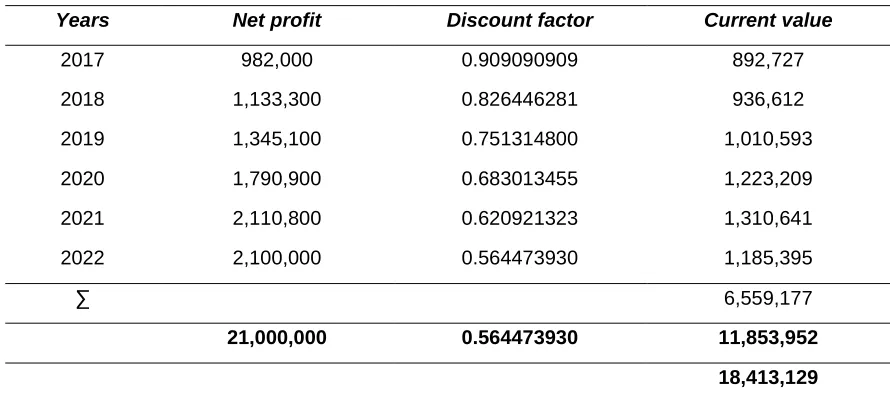
based on economic strength are: a) methods of assessing the value of the enterprise based on the present value of expected profits, and b) methods of assessing the value of the enterprise based on the present value of net cash flow. Assessing the value of the company "X", based on the present value of expected profits method is given in table. 2.
Table 2. Assessing the value of the enterprise based on the present value of expected profits
Years Net profit Discount factor Current value
2017 982,000 0.909090909 892,727
2018 1,133,300 0.826446281 936,612
2019 1,345,100 0.751314800 1,010,593
2020 1,790,900 0.683013455 1,223,209
2021 2,110,800 0.620921323 1,310,641
2022 2,100,000 0.564473930 1,185,395
∑ 6,559,177
21,000,000 0.564473930 11,853,952
18,413,129
As can be seen in Table 2, the value of the company "X" (i.e. the net asset and its capital, respectively) is based on the present value of the expected profits which is 18,413,129 €.
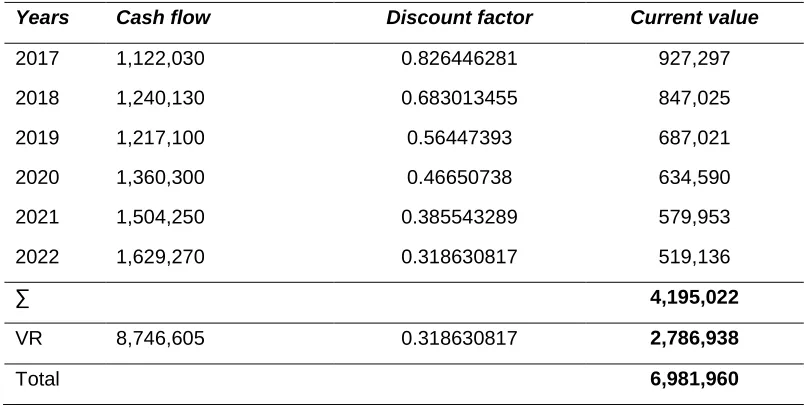
Licensed under Creative Common Page 182 Table 3. Assessing the value of the enterprise based on the present value of cash flow net
Years Cash flow Discount factor Current value
2017 1,122,030 0.826446281 927,297
2018 1,240,130 0.683013455 847,025
2019 1,217,100 0.56447393 687,021
2020 1,360,300 0.46650738 634,590
2021 1,504,250 0.385543289 579,953
2022 1,629,270 0.318630817 519,136
∑ 4,195,022
VR 8,746,605 0.318630817 2,786,938
Total 6,981,960
As can be seen, 6,981,960 € is a profitable value of the company‘s capital "X". However, this
was according to the method of the present value of cash flow net.
Combined Methods
Through combined methods, the link between methods is made based on the enterprise property with the most common method that is used to evaluate the organization‘s value. Thus,
this value is based on its economic strength. Thus, combined methods can be classified into three main groups: 1) the average value methods; 2) integrated methods; and 3) combining indirectly methods.
According to the average value method, the value of the enterprise is defined as the average property value and economic value, e.g. the determined value by the present value method of net cash flow. According to this method, the enterprise value would be determined as follows:
𝐸𝑉 =𝑃𝑉 + 𝑃𝑐
2 =
26,625,800 + 6,981,960
2 = 16,803,880 €
EV= the enterprise value PV = the property value Pc = constant annual profits
Licensed under Creative Common Page 183 the real value of the property plus the present value of goodwill. The goodwill has value only if it provides the highest profitability to the company compared to the average profitability of the industry to which the company belongs and within which the company operates. Only then, the Goodwill provides a higher present enterprise value of net cash. On the other hand, if the value is achieved, the organization would evaluate its property by market value method. According to this method, the enterprise value can be determined as followed:
𝐸𝑉 = 𝑃𝑉 +𝑃𝑐 − (𝑃𝑉. 𝑝𝑖)
𝑐𝑔
pi= industry profitability rate
cg = the capitalism rate of goodwill
CONCLUSIONS
For many enterprises, the process of buying a company represents one of the most important and complicated decision to make. Also, the merging of enterprise with another enterprise as one is an enterprise growth practices which can have a major impact in raising and lowering the image of the enterprise decision-making. The creating of values directly depends on apparent properties and unapparent target enterprise. Therefore, this should be assessed as high precision. Also, the right investment decision or the merging process has to be taken considerably. For this purpose, the management can implement a variety of methods for assessing the value of the enterprise. However, the disadvantage of methods based on the accounting value is static approach. It disregards the principle of generating value for the owner of the purchasing enterprise, respectively, for merger. These shortcomings can significantly be reduced through the application of methods that are based on economic strength of the assessed organization. However, as shown by the indicators presented in this paper, these elaborated methods do not appear to be perfect. Hence, they are not without shortcomings. Their main shortcoming is that they don‘t give the right information to management, which
Licensed under Creative Common Page 184 REFERENCES
Arzac, E.A., (2008); Valuation for Mergers, Buyouts and Restructuring, John Wiley & Sons, Inc., Hoboken Black, S., and Lynch, L. M. (2005) ―Measuring Organizational Capital in the New Economy,― in Measuring Capital in the New Economy, C. Corrado, J. Haltiwanger, and D. Sichel, eds., Studies in Income and Wealth, Vol. 65. Chicago: The University of Chicago Press, 205-234
Bradburd, R. & Richards, C. (2013).Transferable Enterprise Value.Core Value Software .Investment Management and Financial Innovations. Business Perspectives
Bradburd, R., Wells, D. A., & Richards, C. (2015).Transferable Enterprise Value - The Importance of Quantifying Intangible Value Drivers in Small to Medium Size Enterprises (SMEs). Norwich, Vermont: Core Value Software.
Corrado, C., Hulten, C., and Sichel, D. (2006).Intangible Capital and Economic Growth.Finance and Economics Discussion Series.
Equity Research, E. (2012). Basic Valuation and accounting guide. Basic Valuation and Accounting Guide, 1-14. Retrieved June 20, 2016, from http://www.hsbcnet.com/nutshell/attachments/pdf/emea-valuation-and-accounting.pdf
Gorenak, M. &Košir, S. (2012). The Importance Of Organizational Value For Organization. Management Knowledge and Leadership
Hall, R. E. (2001a). Struggling to Understand the Stock Market. American Economic Review Papers and Proceedings 91 (May): 1-11.
Hulten, C. &Hao, J. (2010). What is a Company Really Worth? The Role of Internally-Produced Intangibles.The Conference Board, Inc: Trusted Insights for Business Worldwide
Hulten, C. R. &Hao, J. (2008). What is a Company Really Worth? Intangible Capital and the Market to Book Value Puzzle.NBER Working Paper Series.
IMA (1997).Measuring and Managing Shareholder Value Creation. Institute of Management Accountants. pp 1-41
Koletnik, F., (1991). What is the Value of the Organization, SRFRH, Zagreb
Koller, T., Goedhart, D. W., (2005); Valuation – Measuring and Managing the Value of the Company, John Wiley & Sons INC., New Jersey
Koller,T., Advisors, N. (Ed.). (2009). Business Aviation an Enterprise Value Perspective.NEXA ADVISORS, LLC.Retrieved June 20, 2016, from https://www.nbaa.org/business-aviation/NEXA-Report-Part-1-2009.pdf.
Mun, J., (2002); Real Options Analysis – Tools and Techniques for Valuing Strategic Investments and Decisions, John Wiley & Sons, Inc, New Jersey
Orsag S., (1997). The value of the Organization. Infoinvest, Zagreb,1997, f.143-174.
Pettit, J., (2007). Strategic Corporate Finance – Applications in Valuation and Capital Structure, John Wiley & Sons, Inc., Hoboken
Pratt, P.S., (1989). Valuing a Business, the Analysis and Appraisal of Closely Tied Companies, Dow Jones – Irwin Homewood, Illinois, USA