Structuring Multimedia Data to Capture Design Rationale
and to Support Product Development
Sophie Phillips
Thesis submitted for the degree of Doctor of Philosophy
of the University College London
March 2000
ProQuest Number: U642244
All rights reserved
INFORMATION TO ALL USERS
The quality of this reproduction is dependent upon the quality of the copy submitted. In the unlikely event that the author did not send a complete manuscript and there are missing pages, these will be noted. Also, if material had to be removed,
a note will indicate the deletion.
uest.
ProQuest U642244
Published by ProQuest LLC(2015). Copyright of the Dissertation is held by the Author. All rights reserved.
This work is protected against unauthorized copying under Title 17, United States Code. Microform Edition © ProQuest LLC.
ProQuest LLC
789 East Eisenhower Parkway P.O. Box 1346
ABSTRACT
Companies involved in product design face a major problem in retaining the vast amounts of data collated during the product development process. This thesis investigates how such multimedia design material can be preserved and structured to form a multimedia design rationale knowledge base for future reference or re-use by design teams. The scope of the research and the key issues are established through a study of product design and computer aided design support. The problems of eliciting tacit design knowledge, capturing design rationale and representing the resulting information in a form which is accessible to designers, are identified by a detailed field study of the product design process in a sportswear company.
Existing design rationale representations are critiqued and a design knowledge base implemented and structured using a notation based on Kunz and Rittels' 'Issue Based Information System' (IBIS), (1970) referred to as IBIS^. All the data from a complete product development cycle, collated during the field study, was incorporated into the IBIS^ knowledge maps. These were constructed concurrently as the design cycle progressed. The knowledge base was made available to the design team both during and after the completion of the design cycle. To test and evaluate the IBIS‘S notation the design team used the knowledge base to review their progress throughout the product development process. At the end of the design cycle they used it to reflect on their overall design procedure. Ways are identified in which the design process can be enhanced by capturing product design rationale. The rewards of effectively structuring multimedia product development material are shown to be substantial to design based companies, where data is primarily visual in nature, where design cycles are short, and where brand consistency is important.
ACKNOWLEDGEMENTS
First and foremost I would like to thank my supervisor, Janet McDonnell, for being a constant source of inspiration, for her invaluable help and insightful feedback and for believing I would complete my thesis despite all my trials and tribulations over the past four years. In addition, I would like to thank my second supervisor, Philip Treleaven, not only for his support, but also for being the initial catalyst that encouraged me to embark on this research. I am grateful to EPSRC for providing funding for this work, without which it would not have been possible. I am further indebted to all the members of the product design team who participated in the field studies.
TABLE OF CONTENTS
Chapter One: Introduction
1.1 Research Motivations... 1
1.2 Research Overview...2
1.3 Capturing and Structuring Design Data...3
1.3.1 The Requirement for a Multimedia Platform...4
1.3.2 The Challenges and Benefits of Capturing and Structuring Design Data...5
1.3.3 Existing Work on Structuring Design Rationale...7
1.4 Thesis A im s...8
1.5 Thesis Hypothesis ...9
1.6 Thesis Contributions...9
1.7 Thesis Structure... 10
Chapter Two: Product Design and Development 2.1 The Design and Product Development Process... 14
2.1.1 Design and Product Development... 14
2.1.2 New Product Development and Technological Innovation ... 17
2.1.3 Design Methods... 20
2.1.4 Brand Identity... 22
2.1.5 Design Values and Product Concepts... 23
2.1.6 The Multidisciplinary Nature of Design... 25
2.1.7 Differences Between Engineering and Industrial Product Design...28
2.2 Design Problems and Decision Making...31
2.2.1 Design Problems... 31
2.2.2 Design Decisions... 33
2.3 Representing Design Dialogue and Rationale...35
2.3.1 Tacit Nature of Design Dialogue... 35
2.3.2 Potential Benefits of Structuring Product Design Rationale... 36
2.4 Summary ... 37
Chapter Three: Technology Support for Product Design and Development 3.1 Supporting the Design Process with Technology...42
3.2 Case Study: Supporting Clothing Product Development with Technology...43
3.2.1 The Clothing Design and Manufacture Process...43
3.2.2 Computer Supported Design & Manufacture in the Clothing Industry... 46
3.3 Knowledge Bases to Support Product Design... 50
3.3.1 Case Study: The Impetus for Multimedia Textile Knowledge Bases...51
Chapter Four: Field Study Design Knowledge Elicitation
4.1 Design Knowledge Elicitation... 64
4.2 Field Research Design Knowledge Elicitation... 66
4.2.1 Knowledge Elicitation Methods Used in the Field Study... 70
4.2.2 Repertory Grid Exercises...71
4.2.3 Range Strategy...77
4.2.4 The Design and Marketing Infrastructure...83
4.3 Summary... 89
Chapter Five: Argumentation Based Design Rationale Methodologies 5.1 Representing Design Rationale...91
5.2 Issue Based Information System (IBIS)...95
5.3 Questions Options and Criteria (QOC)... 100
5.4 Decision Representation Language (DRL)... 103
5.5 A Notation for the Knowledge Structure... 106
5.6 Summary... 110
Chapter Six: IBIS^ Design Knowledge Representation 6.1 Constructing the Design Rationale Representation... 112
6.1.1 IBIS'" Maps... 113
6.1.2 The Requirement for a Comprehensive Knowledge Structure... 119
6.2 Problems Encountered with the IBIS'" Representation... 122
6.3 Evaluation of the IBIS'" Representation... 123
6.4 Direct Benefits of the IBIS'" Representation... 129
6.5 Summary... 133
Chapter Seven: Improving the IBIS'" Knowledge Representation 7.1 Enhancing the IBIS'" Design Knowledge Structure... 136
7.1.1 Addressing the Limitations of the IBIS'" Notation... 138
7.1.2 Retrospective Additions to the IBIS'" Notation... 143
7.1.3 Utilising the Design Rationale as a Template and to Support Reflection 146 7.2 The Graphical User Interface Requirements... 150
7.2.1 Graphical User Interfaces Particular to Fashion Product Design... 150
7.2.2 Navigational and General Interface Issues... 154
Chapter Eight: Design Knowledge Representation
8.1 Reconstructing the Multimedia Knowledge Representation...159
8.2 Task Analysis... 162
8.2.1 Results from the Task Analysis... 165
8.3 Evaluation of the Task Analysis... 188
8.3.1 Issues that Pertain to the General Extensions to the IBIS^ Notation to form the I B N o t a t i o n ... 188
8.3.2 Issues that Pertain to the Retrospective Additions to the IBIS^ Notation to form the IBIS^^^ Notation... 190
8.3.3 Issues that Pertain to the Graphical User Interface (GUI) Requirements for the IBIS**^^ Representation, Particular to the Fashion Product Design Process 191 8.3.4 Issues that Pertain to the Navigational and General Interface Requirements for the IBIS^^^ Representation... 192
8.3.5 Issues that Pertain to Using the IBIS^^^ Representation through a Web Browser... 193
8.4 Summary...193
8.5 End Note - The Design Team’s Perspective...195
Chapter Nine: Summary, Conclusions and Future Work 9.1 Thesis Summary...198
9.2 Thesis Assertions and Conclusions... 200
9.3 Thesis Contributions... 202
9.4 Future W ork... 203
References... 205
Bibliography... 211
Appendix A - Review of Computer Supported Clothing Design and Manufacture 222 Appendix B - Computerised Textile Library Development Criteria...233
Appendix C - Textile Library User Manual...240
Appendix D - Range Plan...249
Appendix E - Schedule of Design Meetings...256
Appendix F - Fragments of the IBIS^ Knowledge Maps...260
Appendix G - Illustration of Features of the IBIS^^^ Knowledge M aps...278
Appendix H - IBIS^ Manual...296
LIST OF FIGURES
1.1: Organisational Interactions with a Multimedia Design Knowledge Base...6
2.1: The Spectrum of Design Activities... 15
2.2: The Process of Technological or Industrial Innovation... 18
2.3: Six Stages of the Design Process Positioned within the Problem-Solution Space.... 21
2.4: Product Development Visions... 27
3.1: Multimedia Fabric Knowledge Bases in Relation to Clothing Production...53
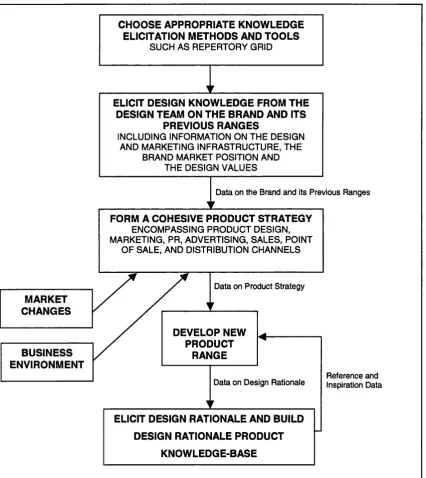
4.1: Eliciting Design Knowledge to Enhance Range Development... 68
4.2: Potential Information Genres to be Incorporated in a Design Knowledge Base... 69
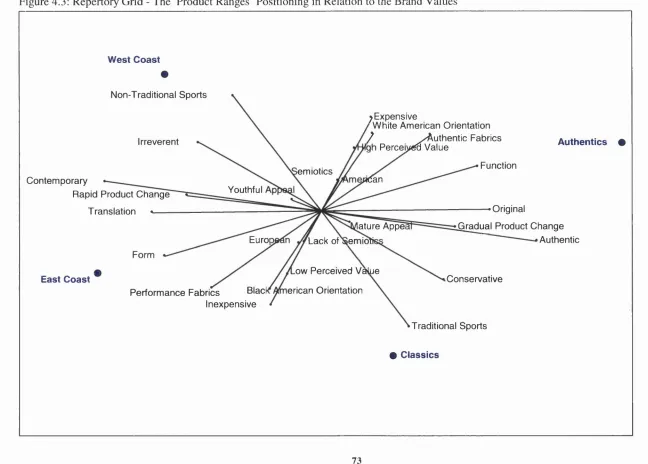
4.3: Repertory Grid: The Product Ranges’ Positioning in Relation to the Brand Values 73 4.4: Eliciting the Positioning of the Product Ranges in Relation to the Brand Values.... 74
4.5: Repertory Grid: The Brand’s Market Position in Relation to its Competitors...75
4.6: Eliciting The Brand’s Market Position in Relation to its Competitors...76
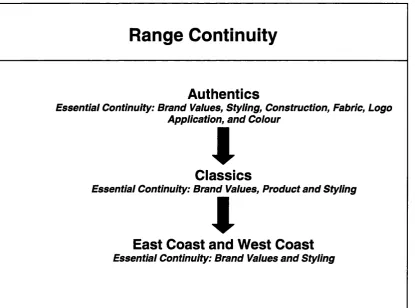
4.7: Range Continuity for the Ranges in the Field Study... 81
4.8: Trend Relationships for the Ranges in the Field Study... 83
4.9: Personnel Involved in Forming the Product and Marketing Strategies... 86
4.10: European Design and Marketing Personnel... 86
5.1: Contributors to and Users of Design Rationale... 92
5.2: Legal moves in IB IS... 96
5.3: A Segment of an IBIS Dialogue... 97
5.4: Legal moves in gEBIS ... 99
5.5: A Segment of a QOC Dialogue... 102
5.6: A Segment of a DRL Dialogue... 105
6.1: Fragment of an IBIS‘S Map Dialogue... 114
6.2: Using an IBIS‘S Map to Explore Issues and Positions... 116
6.3: A Segment of the IBIS^ Knowledge M aps...122
6.4: Visuals of Discarded Designs Contained within the Maps... 127
6.5: A Clip from one of the Inspiration Videos Contained within the Maps... 132
6.6: A Visual Design Story Board within One of the Maps...133
7.1: Linking Decision Nodes to all the Position Nodes in the L.O.R... 140
7.2 : Adding the New Node Type: Resolution... 141
7.3: Colour Coded Decision and Resolution Nodes... 142
7.4: Time and Date Stamped Nodes... 142
7.5: Colour Shaded Position Node Denoting a Hyperlink to the Finished Product... 144
7.6: Adding an 'R' Flag to Retrospective Nodes...145
7.7: Adding the New Retrospective Node Type - Not Actioned... 146
7.8: Retrospective Stage Adjustments Followed by Template Creation... 148
7.9: Linking from One Seasons Knowledge Structure to the Next... 149
7.10: Displays of the Lines of Product Evolution from Final Product to Initial Conceptl51 7.11: Viewing Ranges and Stages of Range Development in Image Galleries... 152
7.12: Viewing a Gallery of a Range Alongside a M ap... 153
7.13: Viewing Images from a Range Alongside a Whiteboard... 154
7.14: Viewing the Decision Structure in a List View ... 154
7.15: Recommended Improvements to the IBIS^ Knowledge Structure... 158
8.1: Stages of Constructing the Multimedia Design Rationale Knowledge Base... 161
8.2: A Section of an IBIS Map... 162
8.3: Zoomed Out View of an Entire Map... 168
8.5: Map Demonstrating Colour Coded Decision and Resolution Nodes... 170
8.6: Map Demonstrating the Addition of Date Stamping to the Nodes... 171
8.7: Hyperlinking Position Nodes to a Visual of the Relevant Final Product... 172
8.8: IBIS^^^ Map Demonstrating the ‘Not Actioned’ Node and the ‘R’ Flag... 173
8.9: Map Demonstrating the Find/Replace Facility... 174
8.10: IBIS^°^ Map Demonstrating the Spell Checker... 175
8.11: IBIS^^^ Map Demonstrating Back and Forward Browse Facility... 176
8.12: Map Demonstrating the Map List View... 177
8.13: Viewing a Section of an IBIS™"^ Map Through a Web Browser... 178
8.14: Viewing Text Contained within Map Nodes Through a Web Browser... 179
8.15: Utilising the Find Facility with Maps Viewed Through a Web Browser... 180
8.16: Displaying the Visual Stages of Product Evolution... 181
8.17: Displaying the Visual Stages of Product Evolution... 181
8.18: Viewing Initial Sketches for a Range in a Gallery... 182
8.19: Viewing Coloured Drawings for a Range in a G allery... 183
8.20: Viewing an Image Gallery of a Range Alongside the IBIS^^^ Map for the Range 184 8.21: Viewing an Image Gallery of a Range Alongside a Whiteboard Screen Area... 185
LIST OF TABLES
1.1: Research Phases...9
4.1: Types of Outside Agencies Used...89
6.1 : IBIS^ Relationship Types... 118
6.2: Totals of the Different Node and Link Types within the Decision Maps... 119
CHAPTER 1:
INTRODUCTION
This chapter presents the motivations fo r researching how multimedia product design knowledge can usefully be structured. An overview o f the research is given and the field study is introduced. The numerous benefits o f design knowledge bases that capture and structure product design rationale are described. The chapter concludes with the goals and contributions o f this work, the thesis hypothesis and an outline o f the thesis structure.
1.1. Research Motivations
One of the major problems faced by companies involved in product design is retaining the immense amount of data collated during the product development process (Phillips and McDonnell, 1998a). This thesis explores the elicitation and structuring of multimedia product design material to create a domain specific knowledge base. Design knowledge bases of this nature would enable design orientated companies to retain and efficiently access the data collated during product range development and preserve the rationale behind the development of their products for future reference or re-use.
There exists great potential for many computer based design support tools to be developed for use within product design related industries. As outlined in chapter 2, there is a wide range of technology already available to product designers and there is also much current work under way that can be directed towards opportunities for new developments. For example, novel intelligent techniques, such as expert systems, neural networks and genetic algorithms and advanced visualisation techniques, such as virtual reality, could be utilised to provide numerous applications in the product design, development, prototyping and manufacturing processes.
structuring the vast amount of product development data created during the design process became apparent and it is this that forms the focus of this thesis.
1.2. Research Overview
An in depth background study of product design and computer aided design support established the scope of the research and identified the key issues. A detailed field study of the product design process in a sportswear company was conducted to examine in depth the problems of eliciting tacit design knowledge, capturing design rationale and representing the resulting information in a form which is accessible to designers and useful for reference in their future work. Existing knowledge elicitation methods were reviewed and an analysis made of how the design critical issues relevant to the products being designed, can be elicited and then represented in a knowledge base. Extensive multimedia design data was captured during the field research using appropriate knowledge elicitation methods and the requirements of a tool to capture design rationale were identified. The potential benefits to the product design process of using computer tools to capture design rationale were explored and existing argumentation based design rationale notations scrutinised. The necessity for a more adequate structure for representing design rationale became clear.
management and the maintenance of brand direction. The ways in which a design team can profit from capturing product design rationale, are demonstrated and consideration given to how the identified limitations can be addressed. The need for efficient access to the underlying data became clear and consideration was given to how design tasks could be supported through the provision of suitable graphical user interfaces (GUI’s) which connect to the knowledge base.
An adapted notation referred to in this thesis as (Issue Based Information System Product Design Rationale), encapsulating the priorities detailed by the product designers, is proposed that extends the IBIS^ notation. The design knowledge base constructed during the field study was restructured using the IBIS^^^ notation. Domain specific interface facilities to streamline the access to the underlying data are also implemented. A task analysis confirms the suitability of an IBIS^^^ structure for capturing product design rationale.
1.3. Capturing and Structuring Design Data
1.3.1. The Requirement for a Multimedia Platform
During the design process product designers often get inspiration by looking through old designs and samples and multiple sources are used to obtain the design reference data. Much of this information forms an inherent part of the design rationale and could ideally be captured in a multimedia knowledge base. As well as including data about previous products, competitors’ products, sales information and marketing directions, there may be video sequences which encapsulate the essence of the product in some way and story-boards containing pictures and samples intended to illustrate the product direction and design proposals. Various formats of data would need to be contained within a design knowledge base, including images, video clips, animation and audio clips, detailing inspirational or relevant material required by the designer during the design process. Any structuring of this knowledge clearly requires a multimedia platform where the information can be arranged in a manner that enables its role in the design decision making process to be represented. Multimedia technology enables diverse file formats to be incorporated and is suited to detailing the varying kinds of design related information required during the design process.
1.3.2. The Challenges and Benefits of Capturing and Structuring Design Data
There are a number of challenges to capturing and structuring design data to form a multimedia design knowledge rationale. They are identified and discussed in the thesis as areas for consideration and they include:
1. The difficulty of eliciting the tacit design knowledge which is often not expressed explicitly in design meetings.
2. The time it takes to elicit and structure comprehensive design data.
3. The financial investment required, i.e. in terms of setting up costs, equipment costs, and training costs.
4. The organisational commitment required which must come from the top down. 5. The changes required within the culture of the organisation in order that
maintaining and using a multimedia design rationale becomes an established part of the design process.
6. The technical challenges of storing such vast quantities of multimedia data and retrieving it with acceptable speed.
7. The selection of a suitable method of structuring the data in order to retain the design critical elements of the rationale behind it.
8. The difficulty of quantifying and forecasting the benefits in financial terms due to their qualitative nature.
9. The problem that many of the potential benefits would not be realised until the knowledge base had been maintained over a number of design cycles.
market place. It is envisaged that if design knowledge bases were to become part of the company culture within design orientated firms, they would grow rapidly and would mature into an increasingly invaluable source of reference and inspiration. Angela Dumas (1994) in her research on the use of metaphor in design, highlights the advantage that can be gained by ensuring that all the personnel in a design based company have a clear understanding of their corporate identity. The use of a design knowledge base should not be restricted to the design department, it should be used by a company to convey their product rationale and design values to all their personnel. The benefits of capturing and structuring design data, expanded on in this thesis, can be summarised as follows:
1. The provision of greater capacity for communication and sharing of information at different stages in the design process and to different departments.
2. The facility for new team members to quickly appraise themselves of the company’s design direction and history. The damage done when key members of the design team leave, taking with them valuable product design knowledge, can be limited allowing changes in membership of the design team to be accommodated with less disruption. This is particularly important when designing branded goods where image consistency is all-important. Branded products, above all must ensure adherence to brand values.
3. The useful retention of design knowledge and expertise that is normally lost when key members leave.
4. The ability to enhance image consistency and adherence to design values, which is particularly important for branded products.
5. The provision of a source of inspiration and reference for future ranges, particularly useful where ‘retro’ products are being designed.
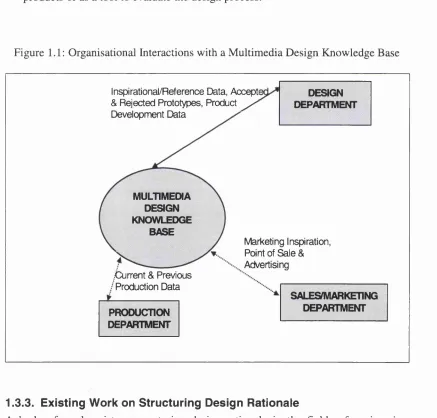
6. The provision of a resource to be tapped into by other departments as shown in figure 1.1, for example as a tool for the marketing department to provide direction for new marketing campaigns.
8. The facility to retain the knowledge used when constructing prototypes and thereby provide the potential to re-use this knowledge.
9. The ability to easily store and usefully access all the data used in a product development cycle, taking advantage of multimedia technology. Due to the difficulty of recording and accessing all the different types of information used during the design process, designers are given little opportunity to refer to the data utilised during their previous design work. If the design knowledge is captured and stored electronically it could be reused in years to come when designing other products or as a tool to evaluate the design process.
Figure 1.1: Organisational Interactions with a Multimedia Design Knowledge Base
MULTIMEDIA DESIGN KNOWLEDGE
BASE
Marketing Inspiration, Point of Sale & Advertising /Current & Previous
Production Data
Inspirational/Reference Data, Accepti & Rejected Prototypes, Product
^
Development DataPRODUCTION DEPARTMENT
SALES/MARKETING DEPARTMENT
DESIGN DEPARTMENT
1.3.3. Existing Work on Structuring Design Rationale
there are also a number of distinctions and this is elaborated in section 2.1.7 of Chapter 2. In particular the focus of product design usually leans heavily towards the ergonomic and aesthetic with much of the data used and referenced during product design being very visual. In many industrial product design domains the design cycles are also much shorter than in engineering design. Due to the fact that the design cycles are rapid, product design rationale from one cycle is more likely to have some relevance to the following development cycle than in domains where the development cycle is very extended and at the close of it most of the development rationale will be outdated. The benefits of capturing design rationale in the domain of product development, where old designs are often referred to for inspiration and design input can sometimes be recycled, are perhaps more promising but have received far less research attention.
1.4. Thesis Aims
1.5. Thesis Hypothesis
The hypothesis being explored is that an appropriately structured multimedia knowledge base, incorporating domain specific graphical user interfaces, is an ideal platform for encapsulating the knowledge and issues raised during the product design process, to store design related material and enabling the capture and retention of product design rationale. Thereby enabling the current limitations faced by design orientated companies in capturing and retaining aspects of the design process to be addressed. Multimedia technology is widely available and it enables varying file formats to be used to detail design related information, such as data on previous ranges, competitors products and marketing directions. It is therefore ideally suited to storing the different types of inspirational and reference data used by product designers during the design process.
1.6. Thesis Contributions
A principal contribution to come from this thesis is the proposed notation, a suitably revised and extended notation underpinned by IBIS, which provides an adequate base from which to structure a useful multimedia knowledge representation of the design rationale and the data collated during product development.
The notation includes some elements which should be used retrospectively to consolidate the design rationale as a useful resource for future reference. It is established how some of the limitations of capturing the entire design rationale can be overcome by a formal review meeting as part of a retrospective stage at the end of the design cycle.
It is further demonstrated how a range of graphical user interfaces, specific to fashion product design, provide access to the underlying design rationale structure to aid specific design tasks.
1.7. Thesis Structure
Table 1.1 demonstrates that the structure of this thesis is closely related to the sequence of work undertaken. Each chapter begins with a short description of the chapter contents and ends with a summary of the critical points.
Table 1.1: Research Phases
PHASE CHAPTER
Literature/Background R esearch 2: Product Design an d D evelopm ent 3: Technology Support for Product
Design an d Developm ent Identify Suitable M ethods for Eliciting
th e Design Knowledge
4: Design Knowledge Elicitation
Identify Suitable Structure for Initial Im plem entation
5: Argum entation B ased Design Rationale M ethodologies Design Rationale Implementation 1 6: IBIS‘S Design Knowledge
R epresentation Analysis, Evaluation and
R eco m m en d ed Im provem ents
7: Improving th e IBIS‘S Knowledge R epresentation
Design Rationale Implementation II Domain Specific Graphical U ser Interfaces
8: IBIS^'^^ Design Knowledge R epresentation
Evaluation 9: Sum m ary, C onclusions and Future
W ork
Chapter One: ‘The Introduction’, this chapter provides an insight into the thesis background and details the motivations for researching how multimedia design knowledge can usefully be structured. The field study and the concept of structuring multimedia product development information are introduced and an overview of the research is given. The numerous benefits of design knowledge bases are described. The research aims, hypothesis and contributions are also outlined and the chapter concludes with an overview of the thesis structure.
Chapter Two: ‘Product Design and Development’, presents an overview of product
design. Important issues about design which are relevant to this thesis are introduced including: product development, product innovation, design methods, brand identity, design values, the multidisciplinary nature of design and the differences between industrial and engineering design. The nature of design problems and decision making are then explored. Consideration is given to the tacit nature of design and the potential benefits of structuring product design rationale are presented.
Chapter Three: ‘Technology Support for Product Design and Development’,
presents an examination of how product design and development is increasingly being supported with the use of technology. A case study describes the clothing design and manufacture process and how computer aided techniques have been deployed in the clothing industry. The case study serves to illustrate the extent to which new technology has been embraced by design based industry. The potential for using multimedia knowledge bases to support product design is explored in more detail with a further case study on the impetus for multimedia textile libraries.
Chapter Four: ‘Design Knowledge Elicitation’, presents a clear shift in emphasis to
importance is emphasised of using appropriate methods to elicit the often tacit design knowledge, such as the design values. The knowledge elicitation methods that were chosen for the field research are described and particular attention is paid to the repertory grid method. An insight is provided into the typical components of a product development range strategy and this is exemplified by the range strategy developed following the initial phase of the knowledge elicitation during the field study. Finally an overview is given of the design and marketing infrastructure elicited from the design team in order to facilitate the later construction of a more accurate representation of the design process.
Chapter Five: ‘Argumentation Based Design Rationale Methodologies’, discusses
the motivations behind capturing and maintaining a design rationale representation. The reasons why there exists greater potential for capturing design rationale in the domain of product design as opposed to engineering design are presented. Argumentation based design rationale methodologies are introduced as a means of initially structuring the elicited design knowledge from the field research. The three predominant notations are examined: Questions, Options and Criteria (QOC), Decision Representation Language (DRL), and the Issue Based Information System (IBIS). The chapter concludes with a critique of the methodologies. IBIS is identified as providing the most suitable notation from which to construct a representation of the design process exemplified in the field study using the data collated during the knowledge elicitation stage of the field research.
Chapter Six: ‘IBIS^ Design Knowledge Representation’, discusses how a hypertext
Chapter Seven: ‘Improving the IBIS‘S Knowledge Representation’, proposes extensions to the IBIS^ knowledge structure detailed in chapter 6. Some of the identified limitations of the IBIS‘S notation used to construct the design rationale representation are addressed and improvements to the notation are presented, forming the adapted notation referred to as IBIS^^^. The critical requirement is emphasised of incorporating a retrospective, reflective stage allowing the knowledge structure to be reviewed, corrected, annotated and updated in order for the design rationale to be a useful and reusable resource. Several further extensions to the IBIS^ notation are proposed to be incorporated into the IBIS^^^ notation as a critical part of this retrospective stage. The second half of the chapter provides an overview of the graphical user interfaces (GUI’s) particular to the fashion product design process studied in the field research, which can be connected to the underlying design knowledge base. It is stressed that when developing GUI’s for an IBIS^^^ structure it would be essential that the domain and the purpose of the underlying data be carefully considered.
Chapter Eight: Design Knowledge Representation’, describes how the
IBIS‘S knowledge structure was entirely reconstructed using the IBIS^^^ notation proposed in chapter 7, to account for the limitations in the IBIS‘S representation discussed in chapter 6. The graphical user interfaces (GUI’s) specific to fashion product design discussed in chapter 7 were implemented to assess their effectiveness. Some of the desired navigational facilities are provided by the interface to the mapping software used to construct the IBIS^^^ representation. In addition the IBIS^^^ maps were made available for viewing through a web browser in order to assess the extent of any benefits that might be reaped from using this alternative environment. A relatively informal task analysis, conducted in order to explore and confirm the success of the alterations to the representation, is described. A synopsis is provided of the task analysis results and a few minor refinements are proposed.
Chapter Nine: ‘Summary, Conclusions and Future Work’, summarises the
CHAPTER 2 :
PRODUCT DESIGN AND DEVELOPMENT
This chapter presents an overview o f product design. Important issues about design which are relevant to this thesis are introduced including: product development, product innovation, design methods, brand identity, design values, the multidisciplinary nature o f design and the differences between industrial and engineering design. The nature o f design problems and decision making are then explored. Consideration is given to the tacit nature o f design and the potential benefits o f structuring product design rationale are presented. The
chapter concludes with a summary o f the critical points.
2.1. The Design and Product Development Process
2.1.1. Design and Product Development
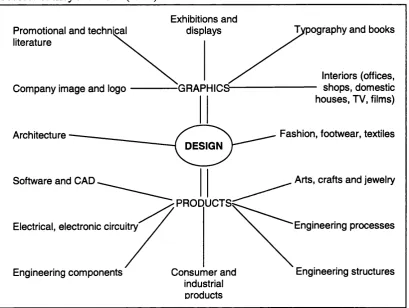
In our day to day lives we are surrounded by consumer goods such as clothes, furniture, cars, household equipment, computers, electrical products - the list is endless. All of these products have been designed by someone, and it is easy to see that design has a vast impact on people’s lives. The word ‘Design’ embraces many different connotations. Often it is considered to be a rather ‘arty’, or ‘trendy’ pastime, undertaken by the likes of fashion or interior designers. However, although people involved in these jobs could certainly be considered to be working with design, there is a much wider spectrum of activities encompassed by ‘design’, as shown in Figure 2.1 (Shirley and Henn, 1988). ‘ ‘Design’ means different things to different people. Depending on their point o f view, it conjures up an image o f women’s fashions,
designer clothing, furniture, fabrics and interior design, or even crafts. To some it
embraces architecture, to others the creative side o f engineering: design engineering.
To very few does it suggest the activity which spans both the form and function of
Figure 2.1 : The Spectrum of Design Activities
Source: Shirley and Henn (1988)
Exhibitions and
dispiays Typography and books
Promotional and technical
literature \
Interiors (offices, - shops, domestic houses, TV, films)
■GRAPHICS-Company image and logo
Fashion, footwear, textiles Architecture
DESIGN
Arts, crafts and jewelry Software and CAD
PRODUCTS;
Engineering processes Electrical, electronic circuitry'
Engineering structures Consum er and
industrial products Engineering components
As well as encompassing ergonomic and aesthetic orientated industrial product development, designing also incorporates the complex technical and engineering aspects of creating products. Sometimes a combination of industrial and engineering designers might be involved in the development of different parts of one product. The differences between industrial and engineering design will be examined in more detail in section 2.1.8.
information from which a product can be made. The output o f the designer has
traditionally been drawings and specifications, but today, these may be to a large
extent replaced by magnetic tapes or discs...from which hardware can be made
directly. ’ (Caldecote, p.54, 1989)
Roozenburg and Eekels claim that product design Hs the process o f devising and laying down the plans that are needed fo r the manufacturing o f a product....Product
design is basically devising and describing the geometry, materials and production
techniques o f a new product. ’ (Roozenburg and Eekels, 1995, p.3) However as Cross (1994) points out designing often does not concern the creation of radically new products, but rather it involves merely modifying and improving existing products. Cross believes that the drive behind the product modifications is to satisfy one of two ends. Either the alterations will seek to increase the value of the product from the consumers’ stand point or they will attempt to reduce the cost of the product to the producer (Cross, 1994). Walsh et al reaffirm that 'designing often involves no technical change at all, but may simply result in a product with a different form, style,
pattern or decoration - fo r example, a ‘new* design o f chair or body styling for a
car Often, designing involves incorporating new components, materials or
manufacturing methods into an existing product - fo r example, a washing machine with micro-electronic controls or a civil airliner with a head-up display originally
developed fo r military aircraft. ’ (Walsh et al, 1992, p.26)
Walsh et al (1992) take their definition of design a stage further. They identified the ‘4 Cs’ of design classification as being creativity, complexity, compromise and choice. 'Creativity: design requires the creation o f something that has not existed before (ranging from a variation on an existing design to a completely new concept).
Complexity: design involves decisions on larger numbers o f parameters and variables
(ranging from overall configuration and performance to components, materials,
appearance and method o f manufacture). Compromise: design requires balancing
multiple and sometimes conflicting requirements (such as performance and cost;
making choices between many possible solutions to a problem at all levels from basic
concept to the smallest detail o f colour or form. ’ (Walsh et al, 1992, p. 52)
There are also widely held opinions about product design and development and how it should be defined. Roozenburg and Eekels (1995) proffer the opinion that product design is just one part of a wider, more comprehensive, umbrella activity of product development. They believe that product development not only encompasses the design of the product, but also the plans that must be produced alongside the design, for the successful production, distribution, marketing and sales of the item. The product design and development activity forming the focus of the field research in this thesis is clothing and footwear design - a dominant sub-class of industrial product design. It is therefore expected that the findings will in the main be relevant to other classes of industrial product design.
2.1.2. New Product Development and Technological Innovation
Walsh et al (1992) differentiate between new product development and technological innovation. 'The difference from technological innovation is that the ‘new product* concerned might involve only changes in form, components, materials, or even just
engineered into the trainers. Additionally once launched into the market place the ‘Air’ technology was marketed in a manner that ensured it became an inherent part of the brand’s personality. Walsh et al (1992) further emphasise that product design sits at the heart of the new product development or innovation process. This is demonstrated in Figure 2.2 (Roy and Bruce, 1984)) showing product design and development as the core of technological or industrial innovation, with manufacturing, engineering and marketing forming part of the wider activity.
Figure 2.2: The Process of Technological or Industrial Innovation
Source: Roy and Bruce (1984)
Manufacturing engineering
Tooling and industrial engineering "4—
I
Manufacturing start-upResearch, design and development
Basic research and
^
inventionC once|5 design
\
Î
Prototype development j
and testing J
t
Final product or design
engineering J
^
design/development activity
Production, marketing
>■ and sales
-4-After-sales service and trouble shooting
New product marketing
Market research and testing
T est marketing
The importance of incorporating appropriate brand identities and design values into new products is elaborated on later in sections 2.1.4 and 2.1.5 and the processes and technology used by design orientated companies to ensure new products are successfully introduced varies greatly from company to company and industry to industry. However the following stages will often be incorporated:
1. The identification of a new market opportunity.
2. An assessment as to its applicability to the current portfolio of products and the brand identity.
3. The development of a commercial brief for:
a) Design - to design the concept; b) Marketing - to position the concept;
c) Operations - to source the appropriate materials and manufacturing capability;
d) Finance - to secure the necessary cash flow;
e) Sales - to open up the appropriate distribution channels for the new products.
of a company’s brand identity, design values and commercial requirements, would be the utopia.
2.1.3. Design Methods
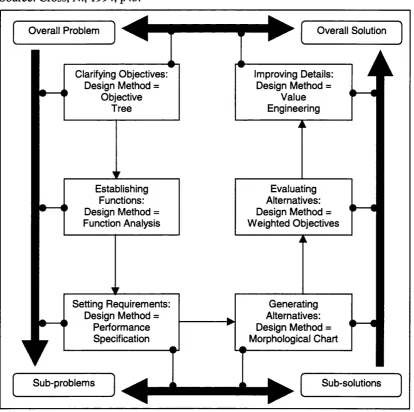
Design methods are processes, tools or techniques intended to support designing and they can be divided into two main subtypes: creative and rational. Creative methods such as brainstorming are aimed at stimulating designers to think in a more innovative manner. Rational methods consist of systematic procedures for the overall management of the design process, and of techniques to be used within such a process which help to externalise and formalise it (Cross, 1984). Some design methods consist simply of the standard traditional design techniques such as drawing. However since the early 1960’s and the onset of the design methods movement many formal rational methods have been developed which do not form part of conventional design techniques. Different combinations of design methods might be used during the course of the design process. Cross (1994) demonstrates this in his design process model shown in figure 2.3, which illustrates six selected stages of the design process, the rational design method suggested as being relevant to each stage and how they relate to the design problem and solution space.
* emphasise investigations into the understanding o f designing as an argumentative
process: i.e. where to begin to develop settings and rules and procedures for the
open-ending o f such an argumentative process; how to understand designing as a
counterplay o f raising issues and dealing with them, which in turn raises new issues,
and so on and so on. ’ (Rittel, 1972, p.320). As discussed in section 5.1 of chapter 5, it therefore seemed appropriate to examine the three dominant argumentation based design rationale notations as a starting point when considering how to structure the design data amassed during the field study.
Figure 2.3 Six Stages of the Design Process Positioned within the Design Problem- Solution Space
Source: Cross, N., 1994, p43.
Overall Problem
t
Setting Requirements: Design Method =
Performance Specification
Sub-problems
Overall Solution
Generating Alternatives: Design Method = Morphological Chart
►
--- *1 Clarifying Objectives:
r # -Improving Details:
Design Method = Design Method =
^ Objective Value ^
Tree Engineering
▲
Establishing Evaluating
Functions: Alternatives:
^ Design Method = Design Method = ^
Function Analysis Weighted Objectives
2.1.4. Brand Identity
When considering the design and product development of branded products, brand identity simply helps position a brand in the market and create the parameters against which that brand may design products, marketing and image. It basically equates to a brand’s personality and is comprised of the design of the brand’s products, its distribution channels, its image and marketing. It may formally be written down in the form of a strap line, brand values or a mission statement. The brand identity is a product of a brand’s positioning in the market place. It should be adhered to in order to ensure the protection of that positioning. An example of a company with a strong brand identity that it utilises to protect its position in the market place is the jeans company, Diesel. In the early 1990’s Levis, Lee and Wrangler dominated the jeans market. They all used the concept of originality and authenticity revolving respectively around the ‘Original Jean’ (Levis), the ‘Original Workwear Jean’ (Lee) or the ‘Original Western Jean’ (Wrangler). Diesel having identified the ‘Original’ ubiquity in the jeans market place, positioned themselves as ‘Irreverent’. They created product and image that underlined their ‘Irreverence’, thereby creating choice and positioning in the market and becoming the fastest growing jeans brand of the early 1990’s.
2.1.5. Design Values and Product Concepts
Design values with regard to branded products form a framework that corresponds to a brand’s identity. For example, BMW uses the brand identity of ‘The Ultimate Driving Machine.’ The design values for a BMW are consistent with the identity: performance, efficiency, reliability, and luxury. Design values are the framework within which a designer may be creative. As long as the designer adheres to the design values then ultimately the brand identity should not be breached. As will be discussed later in chapter 5, it is therefore essential that any notation used to capture design rationale enables the design values to be retained and represented.
In order to be effective design values and product concepts incorporating these values should be defined in the very early, initial concept stages of the development process.
‘Before a customer unpacks a new laptop computer or sets up a high-speed packaging
machine, and long before a new car rolls off the showroom floor, the product (or
some early version o f it) begins as an idea. Next that idea is embodied in
progressively more detailed and concrete forms: ideas turn into designs, designs into
drawings, drawings into blueprints, blueprints into prototypes, and so on until a
finished product emerges from a factory it begins with the creation o f a product
concept.' (Clark et al, 1994, p.280) Various techniques for enhancing the
identification and communication of design values are being researched, many of which involve the use of metaphor to convey the required personality of the product. Angela Dumas’s (1994) work on totem building is a good example of this, but Japanese companies have been aware of the importance of developing clear product concepts for some time (Nonaka, 1991). Clark (1994) highlights the work being under taken at Honda with the development of clear product concepts at the conceptual stages of the design process:
‘By definition product concepts are elusive and equivocal. So it is not
surprising that when key project participants are asked to relate the
concept fo r a new vehicle, four divergent notions o f value emerge. Those
fo r whom the product concept means ‘what the product does' will couch
their description in terms o f performance and technical functions. Others,
fo r whom the concept means ‘what the product is', will describe the car's
packaging, configuration, and main component technologies. Others, for
whom product concept is synonymous with ‘whom the product serves', will
describe target customers. Still others, reflecting their interpretation o f the
concept as ‘what the product means to customers', will respond
thematically, describing the car's character, personality, image and feel.
The most powerful product concepts include all these dimensions. They
are often presented as images or metaphors that can evoke many different
aspects o f the new product's message without compromising its essential
Clark (1994, p.281-282) outlines how Honda emphasise the use of powerful design concepts right from the outset of a design project. ‘A rugby player in a business s u if is the example provided as the concept used by Honda to reposition the Honda Accord with the qualities of contact, sportsmanship and gentlemanly behaviour.
The critical component when using product concepts and design values is that the image conjured up by the concept must be solid enough to enable interpretation into tangible design attributes in a finished product. Successfully shared design concepts encourage the development of products with cohesive design values by providing an enhanced design environment where complementary solutions and decisions can be toyed with. Product concepts help to push the integrity of a brand’s identity and its design values against the rigors of a constantly changing market place. Product concepts allow a business to investigate either new markets or product extensions. They allow for speculation as to whether a market opportunity can be augmented to fit a company’s identity and design values.
As with brand identity, maintaining a multimedia record of product development rationale would capture the design values and product concepts used during the development process, enabling the way in which they had been incorporated into the products to be scrutinsed by the product development team and communicated to future employees.
2.1.6. The Multidisciplinary Nature of Design
production managers, commercial and financial managers as well as external consultants or experts in the domain. Each party will bring with them their own agenda and priorities for the design of the product. Dumas and Mintzberg (1991) categorise design as an activity conducted under a ‘Design Umbrella’. They coin the phrases ‘Seen Design’ and ‘Silent Design’. ‘Seen Design’ encompasses all the very specialised activities at the heart of the design process, carried out by the actual designers. ‘Silent Design’ consists of all the other related functions like marketing and production that connect the design manufacturing and retail processes. In other words ‘Silent Design’ accounts for the decisions taken by those other than the designers who are directly involved in the design process. Clearly designing is not something that takes place solely within the design department. Successful designing relies on interaction with the other departments of an organisation throughout the design process.
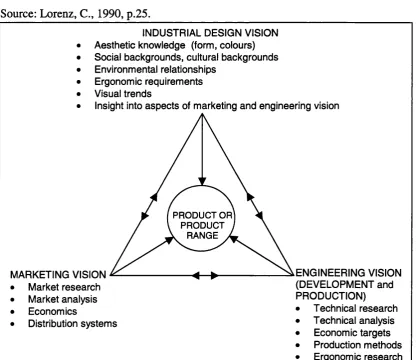
Conversely Lorenz (1990) emphasised that not only should other departments interact with the design department but a fully developed industrial designer should also have a valuable contribution to make to the other areas involved in product development. As shown in Figure 2.4, he identified 3 distinct product development visions: Industrial, Engineering and Marketing into each of which the designers should have a significant input, 'from ergonomics and the design o f new production methods (on the engineering side o f the house), to new ways o f analysing markets and conducting (or
interpreting) market research. It is not the mundane skills o f sketching, shaping and
colouring which make the industrial designer such a valuable resource, but the
multifaceted ability to contribute the work o f other disciplines and to stimulate,
interpret and synthesize it. ’ (Lorenz, p25, 1990)
facilities might serve to enhance the communication of the design and development process and agenda throughout the departments of an organisation and ultimately lead to more focussed product development overall rather than supporting more narrowly only specific tasks that fall under the traditional umbrella of design. This underlines the extent to which a multimedia design rationale knowledge base might be utilised within a company involved in product development. Such a knowledge base could form a central reference point for an organisation to communicate many issues affecting the product development process including the timelines, the design values, the ergonomic requirements, the technical parameters and production methods and the marketing strategy. Clearly a resource of this nature would be of interest to and have an impact on a far wider audience than just the designers and could be contributed to and utilised by members of the many departments in a product development organisation including the marketing, sourcing, production, commercial and finance departments.
Figure 2.4: Product Development Visions
Source: Lorenz, C., 1990, p.25.
INDUSTRIAL DESIGN VISION Aesthetic knowledge (form, colours) Social backgrounds, cultural backgrounds Environmental relationships
Ergonomic requirements Visual trends
Insight into aspects of marketing and engineering vision
• Market analysis
• Economics
PRODUCT OR
PRODUCT i
k RANGE A
ENGINEERING VISION (DEVELOPMENT and MARKETING VISION
• Market research
PRODUCTION)
2.1.7. Differences Between Engineering and industrial Product Design
As previously touched upon, this thesis focuses on capturing design rationale in the industrial product design process. Specifically the field study that underpins this research was conducted in the domain of clothing design. As shown in Shirley and Henn’s (1988) diagram of design types in Figure 2.1, fashion and textiles is an archetypal part of design and it is an important class of industrial design. Section 5.1 of chapter 5 outlines that a number of notations have been developed for representing design rationale. However, in the main, previous empirical studies into the use of these notations document their application in the domain of engineering. It is therefore pertinent to examine some of the differences between the domain of engineering design and industrial product design in order to assess whether capturing industrial product design rationale might be more effective than capturing engineering design rationale.
Product design is commonly thought to encompass both engineering design and industrial design but frequently in industry a distinction is made between an industrial designer and an engineer. (Walsh et al, 1992) Industrial designers are also commonly called product designers. Their function usually envelops the ergonomic and aesthetic aspects of designing. In Moody’s opinion 'Industrial design seeks to relate the hardware to the dimensions, instinctive responses, and emotional needs o f the user
where these are relevant requirements. Through the conscious control o f form,
configuration, overall appearance and detailing, industrial design is capable o f
conveying to the user the abstract characteristics o f a product, e.g. robustness,
precision. ’ (Moody, 1984) Engineering designers on the other hand are thought to be more involved with the technical function of products as opposed to their visual form and aesthetic appeal. In the seminal Fielden report engineering design is defined as
'the use o f scientific principles, technical information and imagination in the
definition o f a mechanical structure, machine or system to perform pre-specified
Caldecote (1989) summarises the differences between the fields of engineering and industrial design succinctly, whilst conceding that there is often a crossover between the two domains when developing products:
'In complex products, such as aircraft, product development is a long and
very expensive process, in which the design team is intimately involved.
As we move along the spectrum o f design through less complex products,
such as machine tools, diesel engines, refrigerators, to toys and textiles,
the paramount importance o f the engineering designer in ensuring
technical excellence gives place to the skills o f the industrial designer,
who is more concerned with ergonomics and aesthetics ....Some products
(e.g. textiles) are almost entirely the prerogative o f an industrial designer
while other products (e.g. a submarine cable) are the sole responsibility o f
an engineering designer. Some products (e.g. a telephone) have
approximately equal industrial and engineering design content. ’
(Caldecote, p.54, 1989)
As Caldecote outlines, the type of design input required will vary considerably between different product groups. Clearly the contribution of industrial or engineering design to a product will depend on the aesthetic, ergonomic and technical requirements of the product. Some products for example may not involve the use of engineering designers and others may not require the input of industrial designers. Some on the other hand may require considerable input from both.
A number of design theorists including Walsh et al (1992), Cross (1994), Pye (1989), and Roy (1989) argue that to a certain extent, regardless of the design domain, design problems are largely similar across a wide range of industries and product types. However Roy goes on to emphasise that although it 'is true to the extent that all designing is iterative, using creativity and compromise to move from a field of
possibilities to one unique solution. Nevertheless, the skill and knowledge required of
The major factors when considering using design rationale capture for industrial product design is that its focus is on ergonomics and aesthetics, the design cycles are often short, and particularly in the case where a product is branded, design consistency and integrity is paramount. In clothing product design for example, a range of similar products are created season after season, there being 2 or 3 seasons each year. The significance of industrial product design cycles being short is that it means that at the start of a development cycle it is still useful for the design team to be able to refer back to the products designed and the decisions made in the previous design cycle since the majority of their aesthetic values will still be current and relevant. The design team may also wish to use the structure of the previous product range as a starting point for the following product range. In certain instances the same products from the previous cycle’s range might be incorporated into the current range with only minimal, incremental changes being instigated to the design of the products. Since the design cycles are short the aesthetic trends and design influences discussed in the previous design cycle could very well still be relevant to the current design cycle, adding further weight to the argument that maintaining a design rationale in industrial product design could prove to be a very useful reference resource.
therefore there is no requirement to hark back to old methods being used in design cycles many years previously.
A final reason indicating that there is greater potential for capturing industrial product development rationale as opposed to engineering, is that due to the aesthetic focus, a design rationale knowledge base could prove particularly useful in maintaining design consistency and brand integrity. The knowledge base could be referred to in order to ensure product ranges in subsequent cycles incorporated the correct and consistent design values and could be used as a reference point for any member of personnel to appraise themselves of the aesthetic personality of the products. Much of the previous research to represent the design process by capturing design rationale using design rationale notations, has not focused on capturing the essence of the ergonomic and aesthetic considerations of industrial product design. It is worth re-examining these design rationale notations previously used mainly with engineering design and applying them to industrial product design. The amount of design re-use prevalent in industrial design suggests that there exists a greater potential benefit to capturing design rationale in industrial product design as opposed to engineering design where the data is not primarily visual in nature, the focus is on technical excellence, design cycles are long and aesthetics are of minimal importance. As will be demonstrated in section 6.4 of chapter 6, the rewards of effectively structured design rationale in industrial product design can be substantial.
2.2 Design Problems and Decision Making
2.2.1. Design Problems
expands on this, talking about the design process in terms of both problem and solution spaces requiring concurrent exploration. He proffers that ‘The designer makes a solution proposal and uses that to help understand what the problem ‘really*
is and what appropriate solutions might be like. The very first conceptualizations and
representations o f problem and solution are therefore critical to the kinds o f searches
and other procedures that will follow, and so to the final solution that will be
designed* (Cross, 1994, p.8). In a similar vein Roozenburg and Eekels (1995) cite design as a ‘goal-directed thinking process by which problems are analysed, objectives are defined and adjusted, proposals fo r solutions are developed and the
quality o f those solutions is assessed* (p.3). To accommodate the inherent complexity of design problems. Cross (1994) recounts that designers have adopted ‘solution focussed’ strategies where by exploring the solution area, the whole “problem” can end up being redefined. ‘In order to cope with the uncertainty o f ill-defined problems, the designer has to have the self confidence to define, redefine and change the
problem as given, in the light o f solutions that emerge in the very process of
designing* (p. 18).
A dominant factor making design so complex is the multifaceted and interactive nature of design problems. ‘Even when the designer has progressed well into the definition o f a solution, difficulties in the problem structure may well come to light.
In particular, sub-solutions can be found to be interconnected with each other in ways
that imply a ‘pernicious* structure to the problem, e.g. a sub-solution that resolves a
particular sub-problem may create irreconcilable conflicts with other sub-problems*
(Cross, 1994, p. 11). The complexity added by this ‘interconnectedness’ characteristic of design is further summarised by Lawson: ‘Enlarging our window may well let in more light and give a better view but this will also result in more heat loss and may
create greater problems o f privacy. It is the very interconnectedness o f all these
factors which is the essence o f design problems rather than the isolated factors
themselves* (Lawson, 1990, p45).
capturing design rationale, whatever method is used clearly needs to be able to account for this complex, non-sequential and ill-defined nature of the design problem space.
2.2.2 Design Decisions
Throughout the many stages of the design process solutions to problems must be chosen from the various alternatives available to the design team. How certain options or solutions come to be chosen over others is the interesting point in question, particularly when considering the interconnected nature of design problems as outlined in the previous section. Clearly with product design the outcome is not apparent at the beginning. A number of potential viable designs could evolve in accordance with the decisions made. A designer may ultimately be faced with choosing the most appropriate design from a number that have been generated for one design situation. Similarly, during the procedure undertaken to arrive at those viable designs, a designer will have to identify and choose from the solutions available to various sub problems arising throughout the design process. ‘Choosing between alternatives is therefore a common feature o f design activity' (Cross, 1994, p. 121). In a real world design setting it is not possible to consider all the variants in turn, since the number of solutions would make an exhaustive search infeasible.
Among others, Davies and Castell (1992), discuss the consequence that taking design decisions at certain points in the design process can have on previous decisions that have been made. They call such situations ‘opportunistic deviations’ and find that they are inevitable considering the complexity and ill-structured nature of design. Starr(1963) in his book on design decision theory, talks about the complexity of design problems and decisions in more detail. ‘Given, a function to be performed, then, in general, a number o f possible ways to achieve this goal becomes apparent.
Using the language o f decision theory, each o f these ways or capabilities is an
alternative strategy. Differences in tolerances, materials used, shape and form are
just a few o f the usual variants that are encountered. The decision problem is to
succeed A design decision is therefore a very complex problem. ’ (Starr, 1963, p. 2)
He highlights that a variety of considerations, including economic, political and social factors can interact with the decision procedures at a given point in time and affect the final form of a design. This explains why product classes emerge. For example chairs constitute a product class containing products with largely similar functions which may be vastly different in their design and form.
‘Over the years, the methods that we employ to reach product design decisions have
remained essentially unchanged. Meanwhile, the decision problems have continually
grown in size. The number o f usable materials, the availability o f alternative
production processes, the requirements for variety in size, shape and colour, the
range o f possible qualities as expressed in tolerance specifications and surface
finishes, the number o f different kinds o f users - these and other factors justify the statement that the size o f the decision problem has been continually increasing. ’