New Physics Models in the Diphoton Final State at CMS
Thesis by
Ann Miao Wang
In Partial Fulfillment of the Requirements
for the Degree of
Bachelor of Science
California Institute of Technology
Pasadena, California
2015
c
2015
Ann Miao Wang
Acknowledgments
First, I want to express my gratitude to Professor Maria Spiropulu for being the most inspirational
leader, mentor, and scientist I could have ever hoped to work for. My deep interest in experimental
high energy physics is a result of her passion and tireless enthusiasm for the subject.
I would also like to express my deep appreciation for Professor Harvey Newman for being a
wonderful teacher and listener. His diligence and love for physics have painted him as a true role
model in my life.
I am extremely grateful to Javier Duarte for always answering my questions and meeting with
me for a countless number of hours over the past three years. His kindness and patience have made
an indescribable impact on my research experience.
I would also like to Cristian Pe˜na, Dustin Anderson, Alex Mott, and Maurizio Pierini, as well as
the entire Caltech CMS group, for their invaluable guidance throughout this thesis.
These past four years at Caltech have truly been life-changing in completely surprising ways.
One was my unexpected passion for studying physics, which I could not have anticipated. I owe that
to the professors and students at this remarkable institution, especially Professor Steven Frautschi
for instilling his enthusiasm in me through Ph 1 recitations. Without his extraordinary teaching, I
would never have switched my major to physics.
Finally, I would like to express my gratitude to my parents and my sister for their love and
Contents
Acknowledgments iii
1 Introduction 1
2 The Razor Variables 2
3 CMS Trigger Studies 4
3.1 The CMS Detector and the Trigger System . . . 4
3.2 Razor High Level Triggers . . . 5
3.2.1 Calorimeter Objects versus PF Objects Investigation . . . 5
3.2.2 Trigger Flow Path . . . 7
3.2.3 Rates of Trigger Menu . . . 7
3.3 H→b¯bHLT Trigger . . . 8
3.4 Motivation . . . 8
3.5 b-tagging . . . 9
3.6 Trigger Flow Path . . . 9
3.7 Rates of H→b¯bTrigger . . . 10
3.7.1 Addition of new HCAL local reconstruction method and ECAL Multifit . . . 11
3.7.2 Discussion . . . 11
4 Investigation of Higgs-Aware Decay Models 12 4.1 The Higgs decay as a tool for new physics searches . . . 12
4.2 Motivation . . . 12
4.3 Bottom squark production model . . . 13
4.4 Selection . . . 14
4.5 Box definitions . . . 15
4.6 Branching Ratio to ˜χ0 2 Study . . . 16
4.7 Mass Splitting Study with Fixed ˜χ0 1 Mass . . . 20
4.9 ˜bMass Study with FixedM∆ . . . 30
4.10 Investigating the CLT2015-AW1 Model . . . 35
4.11 Counting Experiment . . . 36
5 Conclusion 39
A 40
A.1 Samples . . . 40
A.2 Bottom squark production mechanism . . . 41
List of Figures
2.1 A cartoon of a disquark production scenario. . . 2
3.1 Comparisons of the razor variables formed with PF objects versus calorimeter objects. 6
3.2 Comparisons of theE/T distributions formed with PF objects versus calorimeter objects. 6
3.3 Comparisons of theE/T andR2distributions formed with PF objects versus calorimeter
objects, vetoing all events that have muons withpT >30 GeV. . . 6
3.4 Schematic of the H→b¯btrigger flow path. The numbers in parentheses correspond to the more detailed list described in the text. . . 9
4.1 The contour lines forM∆= 450 GeV, whereM∆=m
2 ˜
b−m
2 ˜
χ
m˜b , with±50 GeV as indicated by the dashed lines. . . 14
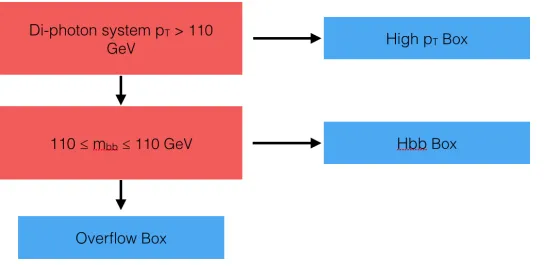
4.2 A schematic for how events are placed into the three boxes. The red rectangles are the
two requirements, and the blue rectangles represent the boxes. . . 15
4.3 Z-axis scale units are such that the total number of events is normalized to 1. m˜b= 600
GeV,mχ˜0
1 = 300 GeV model. (a)R
2 versusM
R for the 50% (to ˜χ02) working model. (b)R2versusM
Rfor the 100% (to ˜χ02) working model. (c)R2versusMRfor the 90%
(to ˜χ0
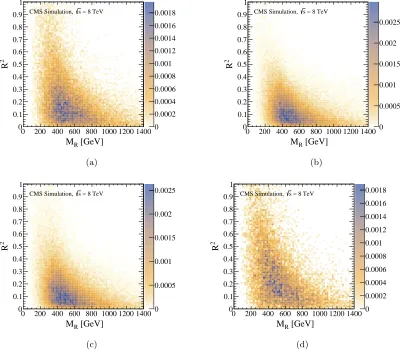
2) working model. (d)R2 versusMR for the 10% (to ˜χ02) working model. . . 17 4.4 Z-axis scale units are such that the total number of events is normalized to 1. m˜b =
600 GeV, mχ˜0
1 = 300 GeV model. (a) R
2 versus E/
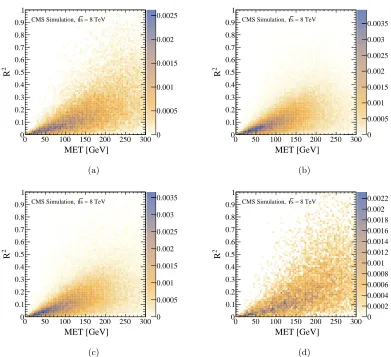
T , for the 50% (to ˜χ02) working model. (b)R2versusE/T , for the 100% (to ˜χ02) working model. (c)R
2versusE/
T , for
the 90% (to ˜χ02) working model. (d)R2 versusE/T , for the 10% (to ˜χ02) working model. 18
4.5 Z-axis scale units are such that the total number of events is normalized to 1. m˜b= 600
GeV,mχ˜0
1 = 300 GeV model. (a) MR versus E/T for the 50% (to ˜χ
0
2) working model.
(b)MR versusE/T , for the 100% (to ˜χ02) working model. (c) MR versus E/T , for the
90% (to ˜χ0
2) working model. (d) MR versusE/T , for the 10% (to ˜χ02) working model. . 19 4.6 Characterization of them˜b= 550 GeV,mχ˜0
1 = 300 GeV model with 90% to ˜χ
0
2. Z-scale
units are such that the total number of events is normalized to 1. (a) R2 versusM
R.
(b) R2 versus E/
T . (c) MR versus E/T . (d) Number of PF jets, clustered with the
4.7 Characterization of them˜b = 450 GeV,mχ˜0
1 = 300 GeV model with 100% to ˜χ
0 2.
Z-scale units are such that the total number of events is normalized to 1. (a)R2 versus
MR. (b)R2 versus E/T . (c) MR versus E/T . (d) Number of PF jets, clustered with
the anti-kT algorithm with ∆R = 0.5. . . 22
4.8 Characterization of them˜b = 530 GeV,mχ˜0
1 = 300 GeV model with 100% to ˜χ
0 2.
Z-scale units are such that the total number of events is normalized to 1. (a)R2 versus
MR. (b)R2 versus E/T . (c) MR versus E/T . (d) Number of PF jets, clustered with
the anti-kT algorithm with ∆R = 0.5. . . 23
4.9 Razor variable distributions for the various mass splitting with fixed ˜χ0
1mass. (a)MR
1D distributions. (b)R2 1D distributions. . . . . 24
4.10 Kinematic distributions for the various mass splitting with fixed ˜χ0
1 mass. (a)E/T 1D
distributions. (b) Leading jetpT 1D distributions (excluding H → b¯bjets). . . 24
4.11 The decay spectrum for them˜b= 450 GeV model. . . 25
4.12 Characterization of them˜b = 600 GeV,mχ˜0
1 = 200 GeV model with 100% to ˜χ
0 2.
Z-scale units are such that the total number of events is normalized to 1. (a)R2 versus
MR. (b)R2 versus E/T . (c) MR versus E/T . (d) Number of PF jets, clustered with
the anti-kT algorithm with ∆R = 0.5. . . 26
4.13 Characterization of them˜b = 600 GeV,mχ˜0
1 = 100 GeV model with 100% to ˜χ
0 2.
Z-scale units are such that the total number of events is normalized to 1. (a)R2 versus
MR. (b)R2 versus E/T . (c) MR versus E/T . (d) Number of PF jets, clustered with
the anti-kT algorithm with ∆R = 0.5. . . 27
4.14 Razor variable distributions for the various mass splitting with fixed ˜b mass. (a) MR
1D distributions. (b)R2 1D distributions. . . . . 28
4.15 Kinematic distributions for the various mass splitting with fixed ˜b mass. (a) E/T 1D
distributions. (b) Leading jetpT 1D distributions (excluding H → b¯bjets). . . 28
4.16 χ˜01kinematic distributions for the various mass splitting with fixed ˜bmass. (a) Leading
˜
χ01 pT 1D distributions. (b) ∆Φ between the two ˜χ01 particles. . . 29
4.17 Bottom squark kinematic distributions for the various mass splitting with fixed ˜bmass.
(a) Leading ˜b pT 1D distributions. (b) ∆Φ between the two bottom squarks particles. 29
4.18 Characterization of them˜b = 470 GeV,mχ˜0
1 = 100 GeV model with 100% to ˜χ
0 2.
Z-scale units are such that the total number of events is normalized to 1. (a)R2 versus
MR. (b)R2 versus E/T . (c) MR versus E/T . (d) Number of PF jets, clustered with
4.19 Characterization of them˜b = 500 GeV,mχ˜0
1 = 160 GeV model with 100% to ˜χ
0 2.
Z-scale units are such that the total number of events is normalized to 1. (a)R2 versus
MR. (b)R2 versus E/T . (c) MR versus E/T . (d) Number of PF jets, clustered with
the anti-kT algorithm with ∆R = 0.5. . . 32
4.20 The decay spectrum for them˜b= 470 GeV model. . . 32
4.21 Razor variable distributions for the various ˜b models with fixed M∆. (a) MR 1D
distributions. (b)R2 1D distributions. . . 33
4.22 Kinematic distributions for the various ˜b models with fixedM∆. (a) Leading jet pT
1D distributions (excluding H → b¯b jets). (b) Subeading jet pT 1D distributions
(excluding H→ b¯b jets). (c) Leading ˜χ0
1 pT 1D distributions. (d) Subeading ˜χ01 pT
1D distributions. . . 33
4.23 Kinematic distributions for the various ˜bmodels with fixedM∆. (a) Leading ˜b pT 1D
distributions. (b) Subleading ˜b pT 1D distributions. (c) ∆Φ between the two bottom
squarks particles. (d) ∆Φ between the two ˜χ0
1 particles. . . 34
4.24 Event populations of the CLT2015-AW1 Model at √s = 8 TeV in each of the boxes, with the total amount of events passing the selection scaled to 100. (a) High pT box
(b) Hbb box (c) Overflow box. . . 35
4.25 Event populations of the SM Higgs production background at√s= 8 TeV in each of the boxes, with the total amount of events passing the selection scaled to 100. (a) High
Chapter 1
Introduction
With the discovery of the Higgs boson as the final particle necessary to complete the standard model
(SM) picture [1, 2], the field of particle physics is looking towards the search for new physics outside
of the SM. One problem with the SM is that it does not include a viable particle candidate for
dark matter [3]. At the Large Hadron Collider (LHC) in Geneva, Switzerland, scientists are looking
for beyond-the-standard-model (BSM) events resulting from proton-proton collisions. One possible
BSM physics scenario is weak-scale supersymmetry (SUSY) which provides a particle candidate for
dark matter and solves the heirarchy problem [4].
A major difficulty in any search for new physics is to characterize what the signatures of the
BSM physics would look like at the detector level. In the search for these events, there are many
components of a physical experiment that must be studied and tuned. This thesis addresses two
of the most important components: (1) trigger studies and (2) model kinematics. The overarching
theme of this thesis is the use of the newly discovered Higgs particle as a probe for searching for
BSM physics. The first half of the thesis focuses on studies related to the Compact Muon Solenoid
(CMS) detector, while the second half of the thesis is more broadly applicable to other experiments.
Chapter 2 gives a short overview of the razor variables, which have been used to distinguish SUSY
from SM background, producing strong limits on SUSY models [5]. The thesis will then employ these
razor variables in the design of the custom hardware and software algorithms for deciding whether
to record a collision event, and will investigate the distribution of these variables for certain SUSY
simplified models.
Chapter 3 focuses on trigger design for BSM searches. It first tackles the study of the
software-level trigger (known as the High Level Trigger) paths using the razor variables. Then, it includes
a proposal of a new trigger path targeting BSM events that include a Higgs boson decaying to a
b¯b pair in the final state. Chapter 4 is motivated by a previous search for supersymmetry with a
Higgs decaying to two photons [6]. It discusses the kinematics of Higgs-aware BSM models, with
particular focus on bottom squark production. This thesis attempts to fully characterize the range
Chapter 2
The Razor Variables
The razor variables,MRandR2, are variables that are useful in searches for supersymmetry (SUSY).
They have been successfully employed in previous searches with the CMS Collaboration to produce
strong limits on SUSY parameter space [7]. These variables are employed to help distinguish SUSY
signal events from the Standard Model (SM) background.
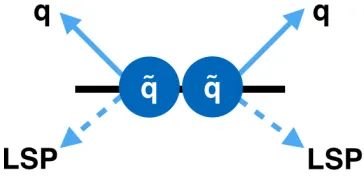
Figure 2.1: A cartoon of a disquark production scenario.
If we consider the scenario where two squarks (supersymmetric partners of quarks) each decay
to a quark and a stable, weakly interacting lightest supersymmetric particle (LSP), the missing
energy carried away by the LSP makes it difficult to reconstruct the kinematic attributes of all the
particles in the decay. Thus, it is a challenge to identify this as a SUSY decay. For an all-hadronic
analysis, we form the two razor variablesMR, R2as follows: first, we cluster the hadronic jets into
two hemispheres using an algorithm in which we minimize the sum in quadrature of the invariant
masses of the two hemispheres. These jets often have some baseline thresholds for certain kinematic
events, such as transverse momentum (pT) or pseudorapidity (η). Then, we defineMR as
MR= q
(|pj1|+|pj2|)2−(pj1
z +pjz2)2,
wherepjiis the momentum of the ith hemisphere. R is defined as
where
MTR=
s / ET(p
j1
T +p j2
T)−E~/T ·(~p j1
T +~p j2
T )
2 ,
andE/T is the missing transverse energy of the event.
MRis contains information about the characteristic SUSY mass scales. It is an estimator, in the
case of the squark, forM∆, which we define to be
M∆=
m2q˜−m2χ˜ m˜q
.
m˜q is the mass of the squark, and mχ˜ is the mass of the LSP. Experimentally, MR peaks higher
for SUSY events. R2 contains information about the missing energy in the event and helps reduce
QCD backgrounds [7]. Because of these advantages, the razor variables have been implemented
successfully for new physics searches.
Chapter 3
CMS Trigger Studies
3.1
The CMS Detector and the Trigger System
The CMS detector is a general purpose detector at the LHC with various sub-detector components.
It includes a lead-tungstate-crystal electromagnetic calorimeter (ECAL), a hadronic calorimeter
(HCAL), a silicon tracker, and a muon drift tube system, cathode strip chambers, and resistive
plate chambers [8]. The next run of the LHC, scheduled to begin in 2015, requires both software
and hardware improvements due to higher energies (13 and 14 TeV) of the proton-proton collisions
as well as increased underlying event activity (known as pileup) [9]. The events detected by CMS
are too large in number to record all of the data, so a trigger system is required to decide which
collision events to record.
This trigger system is composed of two levels; the system results in data reduction from the LHC
collision rate of 15 MHz down to a rate of 400 Hz for Run 1 (and 1 kHz for Run 2). The two levels
are the hardware-based Level-1 (L1) system and the software-based High Level Trigger (HLT). In
order to minimize CPU time, particle and event kinematics are only partially reconstructed since
triggering is conducted in real-time [10, 11].
The L1 system has three main components: global, muon, and calorimeter. The L1 calorimeter
system is based on a set of trigger towers, which are made up of 4×4 regions. These regions are each 20◦ inφ(azimuthal angle), and are also sectioned byη (pseudorapidity). Jets, which are the result
of quark and gluon production in the detector, are calorimeter objects at the L1 level.
One or more L1 filters can feed into an HLT filter. For the HLT system, muons are reconstructed
using isolation algorithms and track fitting, which involves matching inner tracker tracks with outer
muon spectrometer tracks. There are two possible collections of jets andE/T at the HLT: calorimeter
collections and Particle Flow (PF) collections. Calorimeter objets are crude objects reconstructed
from energy deposits in the calorimeters, while PF objects are more sophisticated and rely on the
PF algorithm [12]. The PF algorithm takes information from the multiple sub-detectors to produce
particle information. These particles are then clustered using the anti-kT jet clustering algorithm
to reconstruct the jets [13, 14].
The selected kinematic thresholds for both the L1 and HLT must be thoroughly tested to (1)
ensure sufficient data reduction and to (2) maintain the efficiency of keeping events which are
interesting for our physics analyses. We will focus on the HLT in the following section.
3.2
Razor High Level Triggers
A set of trigger options involving razor variables were implemented for the LHC Run I. Due to higher
energies, increased pileup, and shorter bunch spacing, these triggers need to be modified for Run II.
In addition, PF objects are now available at the HLT, so the option of using PF objects instead of
calorimeter objects must be discussed.
Although PF objects have been shown to have a much improved accuracy [15], they are more
costly in CPU time at the HLT. As a result, one tactic of using PF objects but still minimizing CPU
time is to reduce the number of events that the PF algorithm acts on by imposing loose thresholds
on calorimeter-level objects.
One important detail before implementing this tactic is to study the correlation of PF objects
to calorimeter objects.
3.2.1
Calorimeter Objects versus PF Objects Investigation
Because calorimeter objects and PF objects are constructed differently, we conducted a study of PF
versus calorimeter variables. We conducted this study with a sample oft¯t+jets, common background
to many SUSY signals. This particular sample forcest¯tto decay leptonically, and details are in Table
A.3. The main variables we were concerned with were the razor variables since the HLT triggers
include cutoffs based on these variables. Thus, we studied the razor variables constructed with PF
objects versus calorimeter objects. Examining Figure 3.1, the R2 correspondence is much worse
than theMR correspondence. In addition to using the jet object information, theR2 variables are
constructed using the E/T information. We then investigated the correspondence between PF and
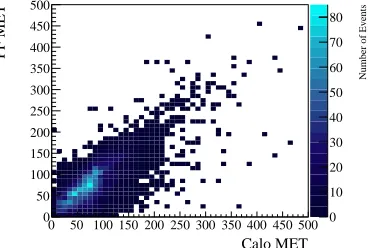
caloE/T, shown in Figure 3.2.
When the HLT E/T is calculated using energy deposit information from the hadronic and
elec-tromagnetic calorimeters [10], the information from the muon chambers is excluded. As a result, we
suspected that the muon energies were not correctly incorporated into the calorimeter-levelE/T. To
investigate this, we replotted the distributions with the additional requirement that muons withpT >
30 GeV be vetoed. A remarkable improvement of the correspondence between PF and calorimeter
/
Number of Events 0 20 40 60 80 100 R Calo M
0 500 1000 1500 2000 2500
R PF M 0 500 1000 1500 2000 2500 (a)
Number of Events
0 20 40 60 80 100 120 140 2 Calo R
0 0.1 0.2 0.3 0.4 0.5 0.6 0.7 0.8
2 PF R 0 0.1 0.2 0.3 0.4 0.5 0.6 0.7 0.8 (b)
Figure 3.1: Comparisons of the razor variables formed with PF objects versus calorimeter objects.
Number of Events
0 10 20 30 40 50 60 70 80 Calo MET
0 50 100 150 200 250 300 350 400 450 500
PF MET 0 50 100 150 200 250 300 350 400 450 500
Figure 3.2: Comparisons of theE/T distributions formed with PF objects versus calorimeter objects.
Number of Events
0 10 20 30 40 50 60 Calo MET
0 50 100 150 200 250 300 350 400 450 500
PF MET 0 50 100 150 200 250 300 350 400 450 500 (a)
Number of Events
0 10 20 30 40 50 60 70 80 90 2 Calo R
0 0.1 0.2 0.3 0.4 0.5 0.6 0.7 0.8
2 PF R 0 0.1 0.2 0.3 0.4 0.5 0.6 0.7 0.8 (b)
Figure 3.3: Comparisons of theE/T andR2distributions formed with PF objects versus calorimeter
objects, vetoing all events that have muons withpT >30 GeV.
Following these studies, recommendations were made for muon information to be incorporated
into the calorimeter level razor variables. Muon information was then added to the hemisphere
3.2.2
Trigger Flow Path
For a trigger involving the razor variables, the trigger path is as follows:
1. Input from the Level 1 CMS Hardware Trigger. For these triggers, a combination of all hadronic
triggers available were used.
2. Algorithms to create calorimeter objects, which use information from the calorimeter [13].
3. Thresholds implemented on the calorimeter jet kinematic properties.
4. Thresholds implemented on the razor variables constructed from calorimeter objects.
5. Algorithms to create Particle Flow (PF) objects, which use an increased amount of available
information from CMS [13].
6. Thresholds implemented on the PF jet kinematic properties.
7. Thresholds implemented on the razor variables.
3.2.3
Rates of Trigger Menu
Various triggers were investigated to optimize the thresholds at the PF level and the calorimeter
level. To calculate these rates, the triggers were evaluated within the CMS HLT software framework
[16] over a weighted average of a set of QCD Monte Carlo samples (see Table A.1) with various jetpT
bins from 30 to 100 GeV, with 40 pile-up (pp collisions per bunch) and bunch-crossings happening
every 25 ns. These samples essentially consisted of jets and pileup events.
The triggers are in part named according to CMS convention. A short code follows:
1. Rsq0pX indicatesR2>0.X.
2. MRX indicates MR>X.
3. RsqMRX indicates (R2−0.25)∗(MR−300)>X. These offsets of 0.25, 300 approximate the
R2∗M
R iso-probability contours observed in the CMS 8 TeV dataset [17].
4. NoRazorCaloCut indicates all calorimeter-level filters on the razor variables are removed.
Trigger Name Rate (Hz)
HLT RsqMR300 Rsq0p09 MR200 12.471±1.244
HLT RsqMR300 Rsq0p09 MR200 Muon 12.472±1.244
Trigger Name Rate (Hz)
HLT RsqMR300 Rsq0p09 MR200 Muon NoRazorCaloCut 12.967±1.249
HLT RsqMR300 Rsq0p09 MR200 Muon CaloRsq0p0196 11.188±1.145
HLT RsqMR300 Rsq0p09 MR200 Muon CaloRsq0p0289 10.761±1.132
Table 3.2: Table of the razor triggers discussed, where the rate is calculated for an instantaneous lu-minosity of 1.4e34 cm−2s−1. These have a calorimeter-level filter of hltRsqMR240RsqXMR100Calo, where X = 0.0196 for the second trigger and X = 0.0289 for the third trigger. All triggers have the muon sequence enabled.
Trigger Name Rate (Hz)
HLT RsqMR300 Rsq0p09 MR200 Muon CaloRsq0p04 9.513±1.025
HLT RsqMR300 Rsq0p09 MR200 Muon CaloRsq0p0576 8.911±1.012
Table 3.3: Table of the razor triggers discussed, where the rate is calculated for an instantaneous lu-minosity of 1.4e34 cm−2s−1. These have a calorimeter-level filter of hltRsqMR260RsqXMR100Calo, where X = 0.04 for the first trigger and X = 0.0576 for the second trigger. All triggers have the muon sequence enabled.
We first investigated the addition of the muon sequence mentioned in the previous section. We
see that the rate increases marginally in Table 3.1. Therefore, adding the muon sequence to the
calorimeter razor variables does not noticeably increase the rate, but would have a beneficial effect
on accuracy for backgrounds and signals with a lot of muons, i.e. t¯t+jets.
We then investigate the effect of the calorimeter-level razor variable thresholds on rate. Ideally,
an increase in calorimeter-level razor variable thresholds would have a minimal effect on the rate
when the thresholds are lower than the following PF thresholds. The PF thresholds implemented
without any calorimeter-level thresholds on the razor variables are given in line 1 of Table 3.2.
As we increase the calorimeter-level razor thresholds, we see the rate slowly decrease to ≈ 10 Hz, which is around the rate that we desire. Note that for Table 3.3, we also raise the R2×M
R
threshold in order to match the increase in R2. This illustrates the fact that there is still a small
mismatch between calorimeter objects and PF objects.
3.3
H
→
b
¯
b
HLT Trigger
3.4
Motivation
Investigation of an H→b¯b trigger has been conducted for possible addition to the Run II trigger menu. This is motivated by the use of Higgs detection as a tool for finding new physics, which will
be further elaborated on in Chapter 3. Since H→b¯bis the dominant decay mode (branching ratio 57.8%) for a 125 GeV Higgs [18], this trigger is ideal for capturing the maximum amount of events.
However, the high SM cross section for bottom production at the LHC poses a problem for the rate
of events passing this trigger [19]. As a result, many kinematic thresholds have to be combined in
3.5
b-tagging
Bottom quarks, or b quarks, are found in many supersymmetric processes [20]. CMS has several
algorithms for b quark identification, or b-tagging. For our study, we will use the Combined
Sec-ondary Vertex (CSV) algorithm. This algorithm assigns a value to each jet which indicates the
probability of misidentification. There are three working points for this algorithm: loose, medium,
and tight, which correspond to ≈10%, ≈1%, and ≈0.1% probabilities for an average jet pT of 60
GeV [21]. These algorithms rely on tracks as well as secondary vertices, which can indicate the
lifetime of quark before decay. This exploits the fact that the b quark has a relatively long lifetime,
≈1 picosecond [22]. CSV loose, medium, and tight points also result in varying b-tag efficiencies.
The loose point corresponds to≈80-90% efficiency, medium to≈60-70% efficiency, and tight to≈
50% efficiency [21].
3.6
Trigger Flow Path
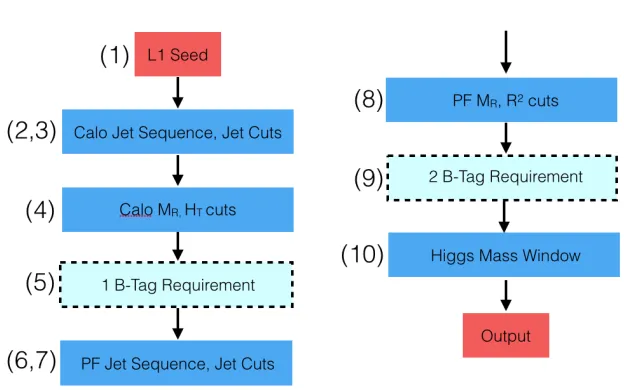
Figure 3.4: Schematic of the H→b¯b trigger flow path. The numbers in parentheses correspond to the more detailed list described in the text.
The trigger flow path is as follows (Figure 3.4):
1. Input from the Level 1 CMS Hardware Trigger. For these triggers, a combination of all hadronic
triggers available were used.
2. Algorithms to create calorimeter objects, which use information from the calorimeter [13].
4. Thresholds implemented on encompassing variables, such as the razor variables orHT, which
is a sum of transverse hadronic energies.
5. At least one b-tagged jet with a specified CSV threshold (see Section 3.5).
6. Algorithms to create Particle Flow (PF) objects, which use an increased amount of available
information from CMS [13].
7. Thresholds implemented on the PF jet kinematic properties.
8. Thresholds implemented on the razor variables.
9. At least two b-tagged jets with specified CSV threshold (see Section 3.5).
10. Higgs mass window filter applied to any two b-tagged jets that pass the specified CSV
require-ments in the previous step.
3.7
Rates of H
→
b
¯
b
Trigger
The naming convention carries from Section 3.2.3. A few more abbreviations are as follows:
1. BTagXCSV0YCSV0Z indicates that there are X b-tags required, with a Combined Secondary
Vertex (CSV) cutoff of 0.Y and 0.Z for two PF jets. For calorimeter jets, there is a CSV cutoff
of 0.Y - 0.1 required for one jet. See Section 3.5 for further information on b-tagging.
2. DiJetX indicates that we require two PF jets with pT >X GeV, and for calorimeter jets we
require the leading jet to have pT >X - 10 GeV and the subleading jet to have pT >X - 20
GeV.
3. TriJetX indicates that we require three PF jets withpT >X GeV.
4. MqqMinXMaxY indicates that we require that there be two PF b-jets (with the b-tagging
CSV requirements from (1)) that have a invariant mass between X and Y GeV.
5. HTX indicatesHT >X GeV.
Trigger Name Rate (Hz)
HLT BTag2CSV05CSV02 DiJet80 Rsq0p01 MR200 MqqMin70Max190 121.770±7.015
HLT BTag2CSV05CSV02 DiJet80 HT200 Rsq0p01 MR300 MqqMin70Max190 93.946±5.791
HLT BTag2CSV05CSV02 DiJet80 CaloMR200 Rsq0p01 MR300 MqqMin70Max190 93.384±5.774
HLT BTag2CSV05CSV02 DiJet80 TriJet40 CaloMR200 Rsq0p0196 MR300 MqqMin70Max190 61.056±5.333
HLT BTag2CSV07CSV04 DiJet80 CaloMR200 Rsq0p01 MR300 MqqMin70Max190 37.483±3.807
HLT BTag2CSV07CSV04 DiJet80 TriJet40 CaloMR200 Rsq0p0196 MR300 MqqMin70Max190 25.827±3.685
3.7.1
Addition of new HCAL local reconstruction method and ECAL
Multifit
An update of the calorimeter local reconstruction methods to handle out-of-time pile-up, which is
pile-up from adjacent bunch-crossing, was released [23]. This improved energy reconstruction in the
hadronic calorimeter endcap and barrel, relies on fitting measured pulses with parameterizations
derived from test pulses, then subtracting the out-of-time pileup contribution from the energy
mea-surement. This technique results in better resolution and measurement [24]. A similar update was
released for the electromagnetic calorimeter to reduce out-of-time pileup by simulating and fitting
the pulse shape from an average of pulses from samples shifted from each other in bunch-crossings
[25]. We applied this technique to two of our proposed triggers and measured their rates.
Trigger Name Rate (Hz)
HLT BTag2CSV05CSV02 DiJet80 TriJet40 CaloMR200 Rsq0p0196 MR300 MqqMin70Max190 59.174±5.156
HLT BTag2CSV07CSV04 DiJet80 TriJet40 CaloMR200 Rsq0p0196 MR300 MqqMin70Max190 24.112±3.550
Table 3.5: Table of theH →b¯btriggers discussed, where the rate is calculated for an instantaneous luminosity of 1.4e34 cm−2s−1.
3.7.2
Discussion
The rates are shown in Table 3.4. We see that the tightening of the CSV thresholds sharply reduces
the rate. The addition of the razor variable orHT cut is also effective at reducing the rate and is
low enough to keep high signal events. We refrain from a highR2threshold in an effort to select for
different events from the regular razor triggers. We also keep a relatively large Higgs mass window
since the main goal of this trigger is to keep events that include a Higgs.
The new ECAL and HCAL methods do not reduce the rates significantly (Table 3.5), but should
Chapter 4
Investigation of Higgs-Aware
Decay Models
4.1
The Higgs decay as a tool for new physics searches
Armed with the discovery of the Higgs Boson, we are able to employ the Higgs as a tool for future
physics studies. We can study its mass and other properties, which have implications for the possible
existence of beyond-the-standard-model (BSM) phenomena including SUSY and dark matter. We
can also use the Higgs boson as a probe for searching for new physics. For example, the Higgs
invisible decay channel has been ideal for BSM studies since the branching fraction of the purely SM
decay,h→ZZ∗→4ν is small [26]. There have already been studies exploiting this channel [27]. Similarly, we can employ the Higgs to look for SUSY by targeting decays that specifically produce
a Higgs, such as those that include a next-to-lightest neutralino decaying to a Higgs and a lightest
neutralino, χ0
2 → hχ01 [28]. The decay of the Higgs to two photons has been observed as a clean, sharp signal [29] and is an ideal decay channel to target. A previous search for supersymmetry with
this decay channel motivates this thesis work [6], but we will examine different SUSY models from
the search.
4.2
Motivation
Many standard SUSY searches rely on missing transverse energy (E/T) in order to separate signal
from Standard Model background. E/T is calculated from energy deposits in the subdetectors [30].
As a result, strong limits have been placed for SUSY models with largeE/T [31]. These standard
searches look for models with signal events at R2 values of greater than 0.2 - 0.3 [28]. Instead, we
would like to investigate models with lowerE/T and lower R2, which may have eluded LHC bounds
but are good candidates for Run II.
background from our analysis. We can then study models with lessE/T and look in areas of the SUSY
phase space that have not been extensively studied. We will focus on bottom squark production
decaying to Higgses, rather than top squark production. In general, since top quarks decay to a W
boson and a bottom quark, top squark models have more complicated topology with higherE/T due
to the W bosons decaying to neutrinos.
Our goal is to study a viable model for a LHC Run II analysis. In order to achieve this, this
thesis will explore the different kinematic parameters in bottom squark production and decay. In
particular, we desire models which have lowE/T, lowR2, and MR values clustered from 400 to 500
GeV. HigherMR values have a higher probability of already being excluded, and at too low ofMR
we lose events from the trigger thresholds.
We can consider a model where we have a bino-like next-to-lightest supersymmetric particle
(NLSP) which would decay predominantly to a Higgs boson and a weakly coupled LSP [32]. The
next-to-lightest neutralino can be considered the NLSP, and the lightest neutralino is the LSP. For
the dominant mode of bottom squark production, the final state particles will be two bottom quarks
and two Higgs bosons.
CMS SUSY searches are interpreted in the context of simplified models [20]. A simplified model
consists of only relevant particles, specifying the particle production and subsequent decay. It is
defined by the model parameters that would influence how an event would look in the detector.
For example, the T2qq model described in [20] is a simplified model that focuses on pair-produced
squarks decaying to two quarks and two LSPs, where the free parameters are masses of the squark
and the LSP. We will use this interpretation for our studies.
4.3
Bottom squark production model
We investigated a bottom squark production model, where the bottom squark has two possible
decays channels: ˜b→bχ˜02→bHχ˜01, and ˜b→bχ˜01.
The bottom squark particle can be produced through several mechanisms, see Section A.2. The
dominant production modes result in pair production.
We wanted to obtainMRpeak values from 400-500 GeV for these events, and we needed to comply
with current exclusion limits [33]. Note that these exclusion limits assume a decay of ˜b →bχ˜0 1. If
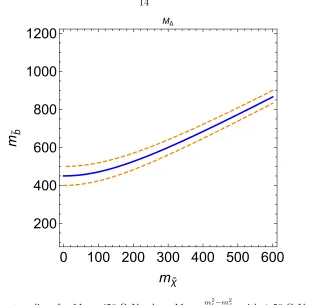
we examine Fig. 4.1, we see that the contour lines forM∆= 450±50 GeV become approximately linear at above ˜χ0
1≈ 200-250 GeV. Referring to the limits in [33], we see thatm˜b = 600 GeV and
mχ˜0
1 = 300 GeV is a good starting point. For all of the follow studies, the mχ˜02 is set at mχ˜01 +
130 GeV to minimize the E/T carried away by the lightest neutralino. After choosing appropriate
mass points, several working points of the branching ratios for the two decay channels of the ˜bwere
0
100 200 300 400 500 600
200
400
600
800
1000
1200
m
χ˜m
b˜
MΔ
Figure 4.1: The contour lines forM∆= 450 GeV, whereM∆=
m2 ˜
b−m
2 ˜
χ
m˜b
, with±50 GeV as indicated by the dashed lines.
Events were produced at 8 TeV center-of-mass energy using PYTHIA 8.1 [34, 35] interfaced with
SUSY Les Houches Accord (SLHA) files [36] and the BSMatLHC package [37]. They were filtered
using a selection process described in Section 4.4. The Higgs boson was forced to decay to two
photons.
4.4
Selection
After events were produced, several requirements were implemented to filter out the events. This
selection was loosely modeled after the aforementioned Higgs to diphoton supersymmetry search [6]
to reduce potential background, with modifications specific to a generator-level study.
1. The event must have a pair of photons that has a diphoton mass of >100 GeV. One of these
photons should have pT >40 GeV, and the other should have pT >25 GeV.
2. Then, if two pairs of photons that satisfy (1) are found, then one of them is randomly set aside
to later be counted as an alternate channel for Higgs decay besides two photons. This is done
to retain the maximum amount of events generated by PYTHIA.
4. The event must have at least one jet with pT >30 GeV and |η|<3.0, and have a ∆R >0.5
with respect to the either of the pair of photons selected. These jets are produced using the
PF algorithm, clustered with an anti-kT algorithm using ∆R = 0.5 [15, 14, 38].
5. We only keep jets withpT >30 GeV and|η|<3.0.
4.5
Box definitions
Figure 4.2: A schematic for how events are placed into the three boxes. The red rectangles are the two requirements, and the blue rectangles represent the boxes.
After selection, the events were further categorized into boxes for further discrimination of
poten-tial signal from background. These boxes are all restricted toMR∈[150,3000] GeV andR2∈[0,1].
The boxes are again motivated by the Higgs to diphoton supersymmetry search and are as follows:
1. High pT Box requirespT of the di-photon system to be>110 GeV.
2. Hbb Box requires 110 ≤ mbb ≤ 140 GeV, with mbb being the invariant mass of any two
b-tagged jets.
3. Overflow Box
The events are grouped into the boxes in a hierarchal system. So, if an event passes the requirements
for box 1, then it is grouped into box 1. If it fails and passes the requirements for box 2, then it
goes in box 2. Else, it goes into the Overflow Box (see Figure 4.2). These boxes are constructed to
characterize a potential SUSY signal from background events. The HighpT box selects for boosted
Higgs bosons (with high momentum), while the Hbb box allows us to select for diHiggs production.
For the Hbb box, we assume that the second Higgs produced would decay to two b quarks because
of the high branching ratio [18].
photon pairs is randomly set aside to be counted as an alternate channel. We apply a 57.8% chance
that this pair should be counted as a H →b¯b decay channel to simulate the branching ratio [18]. Then, with every b-jet in the event, we emulate the b-tagging efficiency by randomly tagging 60%
of generator level b-jets. This approximately corresponds to the efficiency of a CSV medium b-tag
requirement (see Section 3.5). The reason this artificial handling of bottom quarks is necessary so
we do not overestimate the number of events that would fall in the Hbb box. These box definitions
are important for future inclusive analyses and will be used in the later statistical study in Section
4.11.
4.6
Branching Ratio to
χ
˜
02Study
m
˜bm
χ˜02
m
χ˜01BR (to ˜
χ
0 2
)
600 GeV
430 GeV
300 GeV
10%
600 GeV
430 GeV
300 GeV
50%
600 GeV
430 GeV
300 GeV
90%
600 GeV
430 GeV
300 GeV
100%
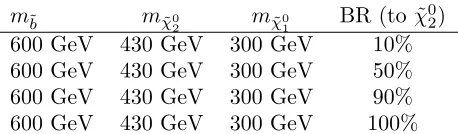
Table 4.1: Table of the models investigated in the branching ratio study, with their associated values ofM∆andMsplit.
In the following section we will examine the effect of the branching ratios listed in Table 4.1
on the kinematics of the m˜b = 600 GeV, mχ˜0
1 = 300 GeV model. If we examine Fig. 4.3, we see
that we obtain the MR shape in the desired range as predicted by M∆, as well asR2 peak values
in the desired range. As the branching ratio to ˜χ0
2 decreases, we see that the peak region is less
defined. Fig. 4.3d shows that theR2versusM
Rdistribution with the loosest clustering in the events
corresponds to the smallest branching ratio. This can be understood through the chance that the
event we capture is asymmetric.
With an 100% branching ratio to ˜χ02, we see a marked decrease in events at highR2. Because of
howR2 is defined withE/T dependence, largerE/T in general should result in a largerE/T if theMR
is fixed. The 2D distribution shrinks to lowerR2, although theM
R distribution, as expected, shifts
very little. However, regardless of the branching ratio, the plots still maintain a significant portion
of events above R2 ≈0.1. With Fig. 4.4, we see a similar phenomenon as the branching ratio to ˜
χ0
2 increases. The plot shows the strong dependence of R2 on the E/T distribution. Although the
distribution becomes more defined, the rough slope of the R2 vsE/
T 2D distribution remains the
same.
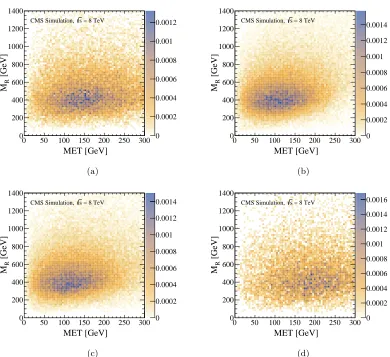
The MR versus E/T 2D plots reveal the robustness of the MR variable with varying branching
ratios. Comparing Fig. 4.4a and b shows that increasing the branching ratio clusters the events
0 0.0002 0.0004 0.0006 0.0008 0.001 0.0012 0.0014 0.0016 0.0018 [GeV] R M
0 200 400 600 800 1000 1200 1400
2 R 0 0.1 0.2 0.3 0.4 0.5 0.6 0.7 0.8 0.9 1
= 8 TeV s CMS Simulation, (a) 0 0.0005 0.001 0.0015 0.002 0.0025 [GeV] R M
0 200 400 600 800 1000 1200 1400
2 R 0 0.1 0.2 0.3 0.4 0.5 0.6 0.7 0.8 0.9 1
= 8 TeV s CMS Simulation, (b) 0 0.0005 0.001 0.0015 0.002 0.0025 [GeV] R M
0 200 400 600 800 1000 1200 1400
2 R 0 0.1 0.2 0.3 0.4 0.5 0.6 0.7 0.8 0.9 1
= 8 TeV s CMS Simulation, (c) 0 0.0002 0.0004 0.0006 0.0008 0.001 0.0012 0.0014 0.0016 0.0018 [GeV] R M
0 200 400 600 800 1000 1200 1400
2 R 0 0.1 0.2 0.3 0.4 0.5 0.6 0.7 0.8 0.9 1
= 8 TeV s CMS Simulation,
(d)
Figure 4.3: Z-axis scale units are such that the total number of events is normalized to 1. m˜b= 600 GeV,mχ˜0
1 = 300 GeV model. (a)R
2 versusM
R for the 50% (to ˜χ02) working model. (b) R
2 versus
MR for the 100% (to ˜χ02) working model. (c)R2versusMR for the 90% (to ˜χ02) working model. (d) R2 versusMRfor the 10% (to ˜χ02) working model.
also lose the nicely clustered peak since the decay of the ˜bpair is now mostly asymmetric. However,
theMR spread seems to change minimally.
The conclusion from this study of the branching ratios with this one mass working point is that
an increase in branching ratio to ˜χ02 is beneficial for anR2distribution that evades the current LHC
bounds. Varying the branching ratio has little effect on the MR. Furthermore, standard bottom
squark searches assume that the bottom squark decays directly to ˜χ01[33], so increasing the branching
ratio to ˜χ0
0 0.0005 0.001 0.0015 0.002 0.0025 MET [GeV]
0 50 100 150 200 250 300
2 R 0 0.1 0.2 0.3 0.4 0.5 0.6 0.7 0.8 0.9 1
= 8 TeV s CMS Simulation, (a) 0 0.0005 0.001 0.0015 0.002 0.0025 0.003 0.0035 MET [GeV]
0 50 100 150 200 250 300
2 R 0 0.1 0.2 0.3 0.4 0.5 0.6 0.7 0.8 0.9 1
= 8 TeV s CMS Simulation, (b) 0 0.0005 0.001 0.0015 0.002 0.0025 0.003 0.0035 MET [GeV]
0 50 100 150 200 250 300
2 R 0 0.1 0.2 0.3 0.4 0.5 0.6 0.7 0.8 0.9 1
= 8 TeV s CMS Simulation, (c) 0 0.0002 0.0004 0.0006 0.0008 0.001 0.0012 0.0014 0.0016 0.0018 0.002 0.0022 MET [GeV]
0 50 100 150 200 250 300
2 R 0 0.1 0.2 0.3 0.4 0.5 0.6 0.7 0.8 0.9 1
= 8 TeV s CMS Simulation,
(d)
Figure 4.4: Z-axis scale units are such that the total number of events is normalized to 1. m˜b= 600 GeV,mχ˜0
1 = 300 GeV model. (a)R
2 versusE/
T , for the 50% (to ˜χ02) working model. (b)R2versus /
ET , for the 100% (to ˜χ02) working model. (c)R2 versusE/T , for the 90% (to ˜χ02) working model. (d)R2 versusE/
0 0.0002 0.0004 0.0006 0.0008 0.001 0.0012 MET [GeV]
0 50 100 150 200 250 300
[GeV] R M 0 200 400 600 800 1000 1200 1400
= 8 TeV s CMS Simulation, (a) 0 0.0002 0.0004 0.0006 0.0008 0.001 0.0012 0.0014 MET [GeV]
0 50 100 150 200 250 300
[GeV] R M 0 200 400 600 800 1000 1200 1400
= 8 TeV s CMS Simulation, (b) 0 0.0002 0.0004 0.0006 0.0008 0.001 0.0012 0.0014 MET [GeV]
0 50 100 150 200 250 300
[GeV] R M 0 200 400 600 800 1000 1200 1400
= 8 TeV s CMS Simulation, (c) 0 0.0002 0.0004 0.0006 0.0008 0.001 0.0012 0.0014 0.0016 MET [GeV]
0 50 100 150 200 250 300
[GeV] R M 0 200 400 600 800 1000 1200 1400
= 8 TeV s CMS Simulation,
(d)
Figure 4.5: Z-axis scale units are such that the total number of events is normalized to 1. m˜b= 600 GeV,mχ˜0
1 = 300 GeV model. (a)MR versusE/T for the 50% (to ˜χ
0
2) working model. (b)MRversus
/
4.7
Mass Splitting Study with Fixed
χ
˜
01Mass
The next parameter that would affect the kinematics is the mass splitting of the system, i.e. the
difference in mass between the bottom squark and lightest neutralino. We can classify this in two
ways: usingM∆, or simplyMsplit=m˜b−mχ˜0
1. The following subsections investigate the kinematics
of models with the characteristics listed in Table 4.2. Notice the caveat that these effects would not
necessarily be decoupled from the effects of changing the bottom squark mass.
m
˜bm
χ˜02
m
χ˜0
1
M
∆M
splitBR (to ˜
χ
0 2
)
550 GeV
430 GeV
300 GeV
386.36 GeV
250 GeV
90%
450 GeV
430 GeV
300 GeV
250 GeV
150 GeV
100%
530 GeV
430 GeV
300 GeV
360.19 GeV
230 GeV
100%
Table 4.2: Table of the models investigated in the mass splitting study, with their associated values ofM∆andMsplit.
The 1DE/T distributions have a strong dependence on mass splitting since with a smaller mass
splitting there is likely less energy available for the decay particles (Fig. 4.10a. With Figures 4.6,
4.7, 4.8, we can also see a strong dependence of MR on M∆. This is in line with the principle
that MR is an estimator of M∆. If we compare Figure 4.6b to Figure 4.4c, theR2 versus E/T 2D
distributions are roughly the same, indicating that the decrease in mass splitting from them˜b= 600
GeV model to the m˜b = 550 GeV has a relatively small effect on these variables. However, when
we look at Figure 4.7b, we notice a large difference not only in a tighter clustering at smallE/T,R2,
but also a change in the slope for them˜b = 450 GeV model. From Figure 4.7c, we also notice that
theMRclusters at a center of less than 200 GeV, which is lower than we would expect. There is an
unexpected shift of the peaks of the MR distributions if we compare the various models in Figure
0 0.0005 0.001 0.0015 0.002 0.0025 0.003 [GeV] R M
0 200 400 600 800 1000 1200 1400
2 R 0 0.1 0.2 0.3 0.4 0.5 0.6 0.7 0.8 0.9 1
= 8 TeV s CMS Simulation, (a) 0 0.0005 0.001 0.0015 0.002 0.0025 0.003 0.0035 0.004 MET [GeV]
0 50 100 150 200 250 300
2 R 0 0.1 0.2 0.3 0.4 0.5 0.6 0.7 0.8 0.9 1
= 8 TeV s CMS Simulation, (b) 0 0.0002 0.0004 0.0006 0.0008 0.001 0.0012 0.0014 0.0016 0.0018 MET [GeV]
0 50 100 150 200 250 300
[GeV] R M 0 200 400 600 800 1000 1200 1400
= 8 TeV s CMS Simulation,
(c)
Number of Jets
0 1 2 3 4 5 6 7 8 9
a.u 0 0.05 0.1 0.15 0.2 0.25 0.3
= 8 TeV s CMS Simulation,
(d)
Figure 4.6: Characterization of them˜b= 550 GeV,mχ˜0
1 = 300 GeV model with 90% to ˜χ
0
2. Z-scale units are such that the total number of events is normalized to 1. (a)R2versusM
R. (b)R2 versus
/
ET . (c)MR versusE/T . (d) Number of PF jets, clustered with the anti-kT algorithm with ∆R =
0 0.0005 0.001 0.0015 0.002 0.0025 0.003 0.0035 0.004 0.0045 [GeV] R M
0 200 400 600 800 1000 1200 1400
2 R 0 0.1 0.2 0.3 0.4 0.5 0.6 0.7 0.8 0.9 1
= 8 TeV s CMS Simulation, (a) 0 0.001 0.002 0.003 0.004 0.005 0.006 0.007 MET [GeV]
0 50 100 150 200 250 300
2 R 0 0.1 0.2 0.3 0.4 0.5 0.6 0.7 0.8 0.9 1
= 8 TeV s CMS Simulation, (b) 0 0.0005 0.001 0.0015 0.002 0.0025 0.003 0.0035 0.004 MET [GeV]
0 50 100 150 200 250 300
[GeV] R M 0 200 400 600 800 1000 1200 1400
= 8 TeV s CMS Simulation,
(c)
Number of Jets
0 1 2 3 4 5 6 7 8 9
a.u 0 0.05 0.1 0.15 0.2 0.25 0.3 0.35
= 8 TeV s CMS Simulation,
(d)
Figure 4.7: Characterization of them˜b= 450 GeV,mχ˜0
1 = 300 GeV model with 100% to ˜χ
0
2. Z-scale units are such that the total number of events is normalized to 1. (a)R2versusM
R. (b)R2 versus
/
ET . (c)MR versusE/T . (d) Number of PF jets, clustered with the anti-kT algorithm with ∆R =
0 0.0005 0.001 0.0015 0.002 0.0025 0.003 0.0035 [GeV] R M
0 200 400 600 800 1000 1200 1400
2 R 0 0.1 0.2 0.3 0.4 0.5 0.6 0.7 0.8 0.9 1
= 8 TeV s CMS Simulation, (a) 0 0.001 0.002 0.003 0.004 0.005 MET [GeV]
0 50 100 150 200 250 300
2 R 0 0.1 0.2 0.3 0.4 0.5 0.6 0.7 0.8 0.9 1
= 8 TeV s CMS Simulation, (b) 0 0.0002 0.0004 0.0006 0.0008 0.001 0.0012 0.0014 0.0016 0.0018 0.002 0.0022 MET [GeV]
0 50 100 150 200 250 300
[GeV] R M 0 200 400 600 800 1000 1200 1400
= 8 TeV s CMS Simulation,
(c)
Number of Jets
0 1 2 3 4 5 6 7 8 9
a.u 0 0.05 0.1 0.15 0.2 0.25
0.3 CMS Simulation, s = 8 TeV
(d)
Figure 4.8: Characterization of them˜b= 530 GeV,mχ˜0
1 = 300 GeV model with 100% to ˜χ
0
2. Z-scale units are such that the total number of events is normalized to 1. (a)R2versusM
R. (b)R2 versus
/
ET . (c)MR versusE/T . (d) Number of PF jets, clustered with the anti-kT algorithm with ∆R =
0.5.
In an effort to decipher these effects, we can think of howMRis defined. SinceMRis constructed
from jets and particles that must have a minimum pT, soft particles will be excluded. In Figure
4.11, we see that the available energy to impart to the bottom quark is only 20 GeV; thus, these
b-jets are likely very soft. As a result, they are not clustered in the hemispheres that go into the
calculation ofMR, andM∆is not being constructed accurately. SinceR=MTR/MR, this also affects
the distribution of R2. A smallerMR than expected thus increases the slope of theR2 versus E/T
plot.
This explanation is further supported by the plot of the distribution of PF jets that enter the
hemispheres (see Figure 4.7d), which has a mode of only two jets. We expect on average four jets
for a model with BR = 100% to ˜χ0
2, with two from the direct decay of the bottom squark particle
[GeV]
R
M
0 200 400 600 800 10001200140016001800
a.u 0 0.01 0.02 0.03 0.04 0.05 0.06 0.07
0.08 = 300
χ∼ = 450 m
b ~
m
= 300 χ∼ = 550 m
b ~
m
= 300 χ∼ = 530 m
b ~
m = 8 TeV s CMS Simulation,
(a)
2
R
0 0.2 0.4 0.6 0.8 1 1.2 1.4
a.u -4 10 -3 10 -2 10 -1 10 = 300 χ∼ = 450 m
b ~
m
= 300 χ∼ = 550 m
b ~
m
= 300 χ∼ = 530 m
b ~
m = 8 TeV s CMS Simulation,
(b)
Figure 4.9: Razor variable distributions for the various mass splitting with fixed ˜χ01 mass. (a)MR
1D distributions. (b)R2 1D distributions.
MET [GeV]
0 100 200 300 400 500 600 700 800
a.u 0 0.02 0.04 0.06 0.08 0.1 = 300 χ∼ = 450 m
b ~
m
= 300 χ∼ = 550 m
b ~
m
= 300 χ∼ = 530 m
b ~
m = 8 TeV s CMS Simulation,
(a)
[GeV]
T
Leading Jet p
0 100 200 300 400 500 600 700 800 900 1000
a.u 0 0.02 0.04 0.06 0.08
0.1 mb~ = 450 mχ∼ = 300
= 300 χ∼ = 550 m
b ~
m
= 300 χ∼ = 530 m
b ~
m = 8 TeV s CMS Simulation,
(b)
Figure 4.10: Kinematic distributions for the various mass splitting with fixed ˜χ0
1 mass. (a)E/T 1D
distributions. (b) Leading jetpT 1D distributions (excluding H→ b¯bjets).
them˜b= 450 GeV model is shown to be very soft in Figure 4.10b.
Following the m˜b = 450 GeV model, the m˜b = 530 GeV model was investigated. Here, we see
that although the mass splitting is smaller, the slope of the R2 versus E/
T plot does not increase
dramatically (Figure 4.8b). Thus, we can conclude that there is a threshold of mass splitting in
between 530 GeV and 450 GeV, mostly likely around≈460 GeV, in which the b-jets are too soft to be included in the calculation of MR. The number of jets in Figure 4.8d is also as expected, and
MR returns to being a good probe forM∆(Figure 4.8c).
In conclusion, decreasing the mass splitting changes the MR as expected, but has little effect on
theR2 up to a certain threshold. After the b-jets are too soft to be included in the calculation of
Figure 4.11: The decay spectrum for them˜b= 450 GeV model.
4.8
Mass Splitting Study with Fixed
˜
b
Mass
m
˜bm
χ˜02
m
χ˜0
1
M
∆M
splitBR (to ˜
χ
0 2
)
600 GeV
230 GeV
100 GeV
583.33 GeV
500 GeV
100%
600 GeV
330 GeV
200 GeV
533.33 GeV
400 GeV
100%
600 GeV
430 GeV
300 GeV
450 GeV
300 GeV
100%
Table 4.3: Table of the models investigated in the mass splitting study with fixed ˜b mass, and their associated values ofM∆ andMsplit.
Varying the mass splitting by changing the ˜χ01mass has a different effect than varying the ˜bmass.
We see that larger mass splitting corresponds to largerMRvalues, as expected, but causesR2to fall
faster (Fig. 4.14). The 2DR2versusM
Rdistribution is also clustered more tightly around the peak
values (Fig. 4.13a, 4.12a). This is due to an increasing MR accompanied by a relatively constant
/
ET distribution in Figure 4.15a. Although the larger mass splitting correlates with a larger leading
jetpT (Fig. 4.15b), which we expect is the b quark directly decaying from the bottom squark, the
˜ χ0
1 pT decreases with larger mass splitting. Furthermore, we can see a dependence of the azimuthal
angle, ∆Φ, between the two ˜χ0
1 particles. The 2DMR versusE/T distribution becomes more spread
out with larger mass splitting (Fig. 4.13c, 4.12c).
We note that the original squarks are almost always produced back-to-back in ∆Φ, regardless
of the mass splitting (Fig. 4.17b). Also note that as the leading jetpT increases, the ˜χ01 particles
will most likely deviate more from the path of the original bottom squark due to the recoil of the
˜ χ0
1 from the Higgs, which are produced from ˜χ02 particles recoiling against the b quarks. The larger
the mass splitting, the larger the leading jet pT, and the more the ˜χ01 particles deviate from the
original path of the bottom squark. This is illustrated in the ˜χ0
1 ∆Φ distributions in Figure 4.16b.
The smaller mass splitting correlates with the ˜χ0
1particles being produced more often back-to-back
0 0.0005 0.001 0.0015 0.002 0.0025 [GeV] R M
0 200 400 600 800 1000 1200 1400
2 R 0 0.1 0.2 0.3 0.4 0.5 0.6 0.7 0.8 0.9 1
= 8 TeV s CMS Simulation, (a) 0 0.0005 0.001 0.0015 0.002 0.0025 0.003 0.0035 0.004 MET [GeV]
0 50 100 150 200 250 300
2 R 0 0.1 0.2 0.3 0.4 0.5 0.6 0.7 0.8 0.9 1
= 8 TeV s CMS Simulation, (b) 0 0.0002 0.0004 0.0006 0.0008 0.001 0.0012 MET [GeV]
0 50 100 150 200 250 300
[GeV] R M 0 200 400 600 800 1000 1200 1400
= 8 TeV s CMS Simulation,
(c)
Number of Jets
0 1 2 3 4 5 6 7 8 9
a.u 0 0.05 0.1 0.15 0.2 0.25
0.3 CMS Simulation, s = 8 TeV
(d)
Figure 4.12: Characterization of them˜b= 600 GeV,mχ˜0
1= 200 GeV model with 100% to ˜χ
0
2. Z-scale units are such that the total number of events is normalized to 1. (a)R2versusM
R. (b)R2 versus
/
ET . (c)MR versusE/T . (d) Number of PF jets, clustered with the anti-kT algorithm with ∆R =
0.5.
Even though a smaller mass splitting has less energy available to the ˜χ0
1, its effect is overshadowed
by the explanation that the ˜χ0
1particles likely have morepT if they remain on the path of the original
bottom squark. Examining Figure 4.16a, we see that a smaller mass splitting results in higher leading
˜
χ01pT. However, this higher leading ˜χ01pT is balanced by the effect that the ˜χ01particles are produced
more often back-to-back in ∆Φ with a smaller mass splitting. As a result, theE/T distribution stays
roughly constant due to the two ˜χ01momentum vectors canceling each other. Overall, this effect can
be attributed to the two-step decay chain.
This phenomena was not present in Section 4.7. In the previous section, any effects from variable
sampling the √s distribution due to the production of bottom squarks of different masses were not removed. This likely counteracted the effect of the particle decay angles, resulting in a E/T
0 0.0005 0.001 0.0015 0.002 0.0025 0.003 0.0035 [GeV] R M
0 200 400 600 800 1000 1200 1400
2 R 0 0.1 0.2 0.3 0.4 0.5 0.6 0.7 0.8 0.9 1
= 8 TeV s CMS Simulation, (a) 0 0.001 0.002 0.003 0.004 0.005 0.006 MET [GeV]
0 50 100 150 200 250 300
2 R 0 0.1 0.2 0.3 0.4 0.5 0.6 0.7 0.8 0.9 1
= 8 TeV s CMS Simulation, (b) 0 0.0002 0.0004 0.0006 0.0008 0.001 0.0012 MET [GeV]
0 50 100 150 200 250 300
[GeV] R M 0 200 400 600 800 1000 1200 1400
= 8 TeV s CMS Simulation,
(c)
Number of Jets
0 1 2 3 4 5 6 7 8 9
a.u 0 0.05 0.1 0.15 0.2 0.25
0.3 CMS Simulation, s = 8 TeV
(d)
Figure 4.13: Characterization of them˜b= 600 GeV,mχ˜0
1= 100 GeV model with 100% to ˜χ
0
2. Z-scale units are such that the total number of events is normalized to 1. (a)R2versusM
R. (b)R2 versus
/
ET . (c)MR versusE/T . (d) Number of PF jets, clustered with the anti-kT algorithm with ∆R =
0.5.
soft due to the relatively smaller mass splittings, which also minimizes the effect of the particle decay
angles.
In summary: for the larger mass splitting models, the R2 distribution is desirable but the M
R
[GeV]
R
M
0 200 400 600 800 10001200140016001800
a.u 0 0.01 0.02 0.03 0.04 0.05 = 300 χ∼ = 600 m
b ~
m
= 200 χ∼ = 600 m
b ~
m
= 100 χ∼ = 600 m
b ~
m = 8 TeV s CMS Simulation,
(a)
2
R
0 0.2 0.4 0.6 0.8 1 1.2 1.4
a.u -5 10 -4 10 -3 10 -2 10 -1 10 = 300 χ∼ = 600 m
b ~
m
= 200 χ∼ = 600 m
b ~
m
= 100 χ∼ = 600 m
b ~
m = 8 TeV s CMS Simulation,
(b)
Figure 4.14: Razor variable distributions for the various mass splitting with fixed ˜b mass. (a) MR
1D distributions. (b)R2 1D distributions.
MET [GeV]
0 100 200 300 400 500 600 700 800
a.u 0 0.01 0.02 0.03 0.04 0.05 0.06 = 300 χ∼ = 600 m
b ~
m
= 200 χ∼ = 600 m
b ~
m
= 100 χ∼ = 600 m
b ~
m = 8 TeV s CMS Simulation,
(a)
[GeV]
T
Leading Jet p
0 100 200 300 400 500 600 700 800 900 1000
a.u 0 0.01 0.02 0.03 0.04 0.05 0.06 0.07
0.08 mb~ = 600 mχ∼ = 300
= 200 χ∼ = 600 m
b ~
m
= 100 χ∼ = 600 m
b ~
m = 8 TeV s CMS Simulation,
(b)
Figure 4.15: Kinematic distributions for the various mass splitting with fixed ˜b mass. (a) E/T 1D
[GeV]
T
Leading LSP p
0 100 200 300 400 500 600 700 800 900 1000
a.u 0 0.01 0.02 0.03 0.04 0.05 0.06 0.07 0.08 = 300 χ∼ = 600 m
b ~
m
= 200 χ∼ = 600 m
b ~
m
= 100 χ∼ = 600 m
b ~
m = 8 TeV s CMS Simulation, (a) Φ ∆ LSP
-3 -2 -1 0 1 2 3
a.u 0 0.01 0.02 0.03 0.04 0.05
0.06 = 300
χ∼ = 600 m
b ~
m
= 200 χ∼ = 600 m
b ~
m
= 100 χ∼ = 600 m
b ~
m = 8 TeV s CMS Simulation,
(b)
Figure 4.16: ˜χ01kinematic distributions for the various mass splitting with fixed ˜bmass. (a) Leading ˜
χ01 pT 1D distributions. (b) ∆Φ between the two ˜χ01 particles.
[GeV] T p b ~ Leading
0 100 200 300 400 500 600 700 800 900 1000
a.u 0 0.005 0.01 0.015 0.02 0.025 0.03 = 300 χ∼ = 600 m
b ~
m
= 200 χ∼ = 600 m
b ~
m
= 100 χ∼ = 600 m
b ~
m = 8 TeV s CMS Simulation, (a) Φ ∆ b ~
-3 -2 -1 0 1 2 3
a.u 0 0.02 0.04 0.06 0.08 0.1 0.12 0.14 0.16 0.18
0.2 = 300
χ∼ = 600 m
b ~
m
= 200 χ∼ = 600 m
b ~
m
= 100 χ∼ = 600 m
b ~
m = 8 TeV s CMS Simulation,
(b)
4.9
˜
b
Mass Study with Fixed
M
∆In the following models, we instead vary the bottom squark mass while keeping M∆ roughly the
same. The model characteristics are given in Table 4.4.
Name
m
˜bm
χ˜02
m
χ˜01M
∆M
splitBR (to ˜
χ
0 2
)
CLT2015-AW1
470 GeV
230 GeV
100 GeV
448.72 GeV
370 GeV
100%
CLT2015-AW2
500 GeV
290 GeV
160 GeV
448.8 GeV
340 GeV
100%
CLT2015-AW3
600 GeV
430 GeV
300 GeV
450 GeV
300 GeV
100%
Table 4.4: Table of the models investigated in the bottom squark mass study, with their associated values ofM∆ andMsplit.
We see an deficit of events in the R2 tail in the smaller ˜b mass samples (Figures 4.18a, 4.19a,
4.21), as compared to the m˜b = 600 GeV model. TheR2 versus M
R distribution for the ˜b = 470
model exhibits very low, clusteredR2events, as well as a tightly clusteredR2versusE/
T distribution
(see Figure 4.18b). As a result, this model is promising for our desired constraints. From this point,
we will refer to it as theCLT2015-AW1model for convenience. The other two models,m˜b= 500
GeV andm˜b= 600 GeV, will be calledCLT2015-AW2andCLT2015-AW3, respectively.
This small R2 tail is likely a mixture of the phenomena from the previous two studies, since we
have neither fixed ˜bnor fixed ˜χ01 masses. However, the deficit ofR2events seems to be more similar
to the fixed ˜bmass study. More energy is available for the b quark (Figure 4.20), which is exhibited
in the higher leading jetpT if we compare Figures 4.23a and 4.10b, which increases the role of the
angles of decay in the kinematics. We again have a ˜χ0
1 ∆Φ distribution that varies greatly between
the different models (Figure 4.23d). The model with the smallest mass splitting, CLT2015-AW3,
again has the most back-to-back ˜χ0
0 0.0005 0.001 0.0015 0.002 0.0025 0.003 0.0035 0.004 0.0045 [GeV] R M
0 200 400 600 800 1000 1200 1400
2 R 0 0.1 0.2 0.3 0.4 0.5 0.6 0.7 0.8 0.9 1
= 8 TeV s CMS Simulation, (a) 0 0.001 0.002 0.003 0.004 0.005 0.006 0.007 0.008 MET [GeV]
0 50 100 150 200 250 300
2 R 0 0.1 0.2 0.3 0.4 0.5 0.6 0.7 0.8 0.9 1
= 8 TeV s CMS Simulation, (b) 0 0.0002 0.0004 0.0006 0.0008 0.001 0.0012 0.0014 0.0016 0.0018 MET [GeV]
0 50 100 150 200 250 300
[GeV] R M 0 200 400 600 800 1000 1200 1400
= 8 TeV s CMS Simulation,
(c)
Number of Jets
0 1 2 3 4 5 6 7 8 9
a.u 0 0.05 0.1 0.15 0.2 0.25
0.3 CMS Simulation, s = 8 TeV
(d)
Figure 4.18: Characterization of them˜b= 470 GeV,mχ˜0
1= 100 GeV model with 100% to ˜χ
0
2. Z-scale units are such that the total number of events is normalized to 1. (a)R2versusM
R. (b)R2 versus
/
ET . (c)MR versusE/T . (d) Number of PF jets, clustered with the anti-kT algorithm with ∆R =
0 0.0005 0.001 0.0015 0.002 0.0025 0.003 0.0035 [GeV] R M
0 200 400 600 800 1000 1200 1400
2 R 0 0.1 0.2 0.3 0.4 0.5 0.6 0.7 0.8 0.9 1
= 8 TeV s CMS Simulation, (a) 0 0.001 0.002 0.003 0.004 0.005 0.006 MET [GeV]
0 50 100 150 200 250 300
2 R 0 0.1 0.2 0.3 0.4 0.5 0.6 0.7 0.8 0.9 1
= 8 TeV s CMS Simulation, (b) 0 0.0002 0.0004 0.0006 0.0008 0.001 0.0012 0.0014 0.0016 MET [GeV]
0 50 100 150 200 250 300
[GeV] R M 0 200 400 600 800 1000 1200 1400
= 8 TeV s CMS Simulation,
(c)
Number of Jets
0 1 2 3 4 5 6 7 8 9
a.u 0 0.05 0.1 0.15 0.2 0.25
0.3 CMS Simulation, s = 8 TeV
(d)
Figure 4.19: Characterization of them˜b= 500 GeV,mχ˜0
1= 160 GeV model with 100% to ˜χ
0
2. Z-scale units are such that the total number of events is normalized to 1. (a)R2versusM
R. (b)R2 versus
/
ET . (c)MR versusE/T . (d) Number of PF jets, clustered with the anti-kT algorithm with ∆R =
0.5.
[GeV]
R
M
0 200 400 600 800 10001200140016001800
a.u 0 0.01 0.02 0.03 0.04 0.05
= 470 GeV
b ~
m
= 500 GeV
b ~
m
= 600 GeV
b ~
m
= 8 TeV s CMS Simulation,
(a)
2
R
0 0.2 0.4 0.6 0.8 1 1.2 1.4
a.u -5 10 -4 10 -3 10 -2 10 -1 10
= 470 GeV
b ~
m
= 500 GeV
b ~
m
= 600 GeV
b ~
m
= 8 TeV s CMS Simulation,
(b)
Figure 4.21: Razor variable distributions for the various ˜b models with fixed M∆. (a) MR 1D
distributions. (b)R21D distributions.
[GeV]
T
Leading Jet p
0 100 200 300 400 500 600 700 800 900 1000
a.u 0 0.01 0.02 0.03 0.04 0.05 0.06 0.07
0.08 mb~ = 470 GeV
= 500 GeV
b ~
m
= 600 GeV
b ~
m
= 8 TeV s CMS Simulation,
(a)
[GeV]
T
Subleading Jet p
0 100 200 300 400 500 600 700 800 900 1000
a.u 0 0.02 0.04 0.06 0.08 0.1 0.12
= 470 GeV
b ~
m
= 500 GeV
b ~
m
= 600 GeV
b ~
m
= 8 TeV s CMS Simulation,
(b)
[GeV]
T
Leading LSP p
0 100 200 300 400 500 600 700 800 900 1000
a.u 0 0.02 0.04 0.06 0.08
0.1 mb~ = 470 GeV
= 500 GeV
b ~
m
= 600 GeV
b ~
m
= 8 TeV s CMS Simulation,
(c)
[GeV]
T
Subleading LSP p
0 100 200 300 400 500 600 700 800 900 1000
a.u 0 0.02 0.04 0.06 0.08 0.1
= 470 GeV
b ~
m
= 500 GeV
b ~
m
= 600 GeV
b ~
m
= 8 TeV s CMS Simulation,
(d)
Figure 4.22: Kinematic distributions for the various ˜bmodels with fixedM∆. (a) Leading jetpT 1D
distributions (excluding H→ b¯b jets). (b) Subeading jetpT 1D distributions (excluding H → b¯b
[GeV] T p b ~ Leading
0 100 200 300 400 500 600 700 800 900 1000
a.u 0 0.005 0.01 0.015 0.02 0.025 0.03 0.035 0.04
= 470 GeV
b ~
m
= 500 GeV
b ~
m
= 600 GeV
b ~
m
= 8 TeV s CMS Simulation, (a) [GeV] T p b ~ Subleading
0 100 200 300 400 500 600 700 800 900 1000
a.u 0 0.01 0.02 0.03 0.04
0.05 mb~ = 470 GeV
= 500 GeV
b ~
m
= 600 GeV
b ~
m
= 8 TeV s CMS Simulation, (b) Φ ∆ b ~
-3 -2 -1 0 1 2 3
a.u 0 0.02 0.04 0.06 0.08 0.1 0.12 0.14 0.16 0.18
0.2 = 470 GeV
b ~
m
= 500 GeV
b ~
m
= 600 GeV
b ~
m
= 8 TeV s CMS Simulation, (c) Φ ∆ LSP
-3 -2 -1 0 1 2 3
a.u 0 0.01 0.02 0.03 0.04 0.05
0.06 = 470 GeV
b ~
m
= 500 GeV
b ~
m
= 600 GeV
b ~
m
= 8 TeV s CMS Simulation,
(d)
Figure 4.23: Kinematic distributions for the various ˜b models with fixed M∆. (a) Leading ˜b pT
1D distributions. (b) Subleading ˜b pT 1D distributions. (c) ∆Φ between the two bottom squarks