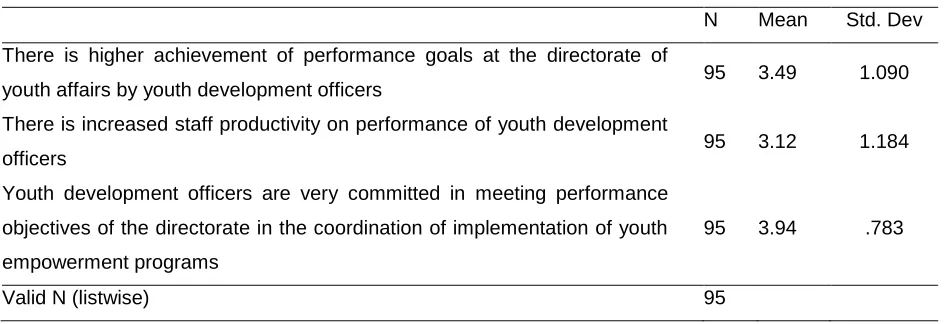
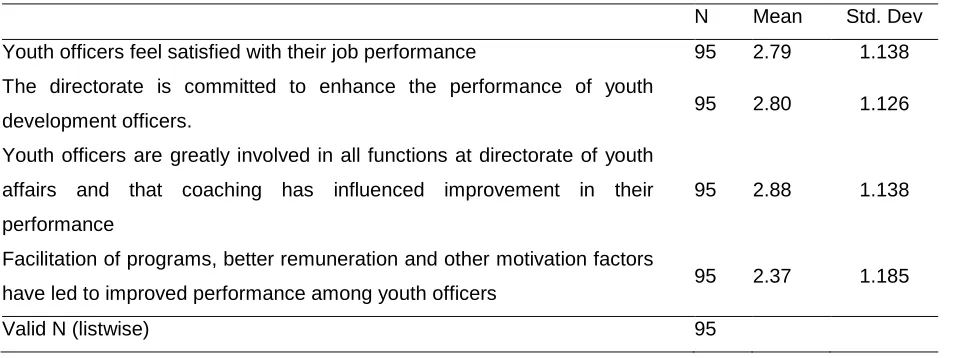
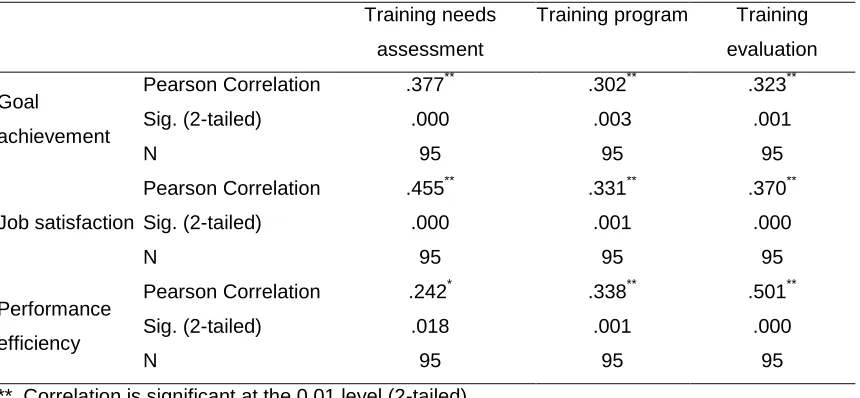
Licensed under Creative Common Page 376
http://ijecm.co.uk/
ISSN 2348 0386
PERCEIVED INFLUENCE OF STRATEGIC HUMAN RESOURCE
DEVELOPMENT PRACTICES ON PERFORMANCE OF
YOUTH DEVELOPMENT OFFICERS IN KENYA
William Githua Migwe
PhD Candidate, School of Human Resource Development
Jomo Kenyatta University of Agriculture and Technology, Kenya
Hazel G. Gachunga
School of Human Resource Development,
Jomo Kenyatta University of Agriculture and Technology, Kenya
Mike A. Iravo
School of Human Resource Development
Jomo Kenyatta University of Agriculture and Technology, Kenya
Abstract
Organizations’ success or failure entirely depends on employee performance. Many
organizations are therefore, investing huge amount of money on development of human capital
through SHRD practices in order to achieve competitive advantage. This study therefore
investigated the influence of employee training on performance of youth development officers in
Kenya. The study employed a descriptive survey research design. The target population was
therefore 195 youth development officers in selected 12 counties. A sample size of 105 youth
development officers were sampled from selected counties. Primary data was collected using
questionnaires while secondary data was obtained from literature in books, scholarly articles,
magazines and journals. Data collected was edited, coded and then analyzed using descriptive
Licensed under Creative Common Page 377 study established that there were positive relationships between employee training components
and the components regarding the performance of youth development officers. In addition, all
the components of employee training were found to significantly account for the total variance in
the performance of youth development officers. It was concluded that employee training is
paramount in determining the performance of youth development officers.
Keywords: Employee Training, Performance, Youth Development Officers, Training Program,
Training Needs Assessment
INTRODUCTION
The origins of HRD can be traced to apprenticeship programs in the eighteen century. During
this time, small shops operated by skilled artisans produced virtually all household goods, such
as furniture, clothing and shoes. The shop owners had to train their new workers. This model of
training was later adopted by other professionals for example Physicians, Educators, Attorneys
or Lawyers, Social development workers among others. Emergence of HRD in the 1960 and
1970s extended beyond the classroom training toward employee involvement that many
organizations required trainer to coach and counsel employees. The concept of HRD is to
develop skills, competencies, knowledge and attitudes of employees and ensuring they are
competent to achieve organization’s desired goals and objectives. HRD impacts the required
knowledge through effective training programs. It is also the integral part of HRM that is more
concern with management development, training, career development and employee
counseling. HRD is conscious and proactive approach applied by employers which seeks to
empower them and to give their maximum and fully utilize their potential to develop themselves
(Keshav, 2014). HRD field is therefore large and recognized to provide capacity building in firms
and it draws heavily from behavioral sciences (Kuchinke, 2010).
Strategic business priorities involving operations processes and services remain critical
issues for senior leadership (Haggerty & Wright, 2009). The strategic role in leveraging
employee-related skills, abilities and knowledge, as a source of competitive advantage, remains
an aspirational goal for many organisation (Alagaraja, 2013). Success or failure of the
organization depends on employee performance. Many organizations are therefore, investing
huge amount of money on employee development (Hameed, 2011). Employee development is
directly related to employee performance (Hameed, 2011). Employees, who are developed,
would be more satisfied and committed, hence increasing job performance. When employee
Licensed under Creative Common Page 378
SHRD argue that it contributes to achievement of goals, helps to sustain long-term firm’s
success and to transform people as most valued firm assets (Garavan, 2007). SHRD arises
from a clear vision about people’s abilities and operates within overall firm’s strategic framework
(Harrison, 2005).
Strategic HRD aims to produce a coherent and comprehensive framework for developing
people through the creation of a learning culture and formulation of organizational and individual
learning strategies. It therefore develops the intellectual capital required by organization as well
as ensuring that the right qualities of people are available to meet present and future needs.
The main impact of SHRD is to provide an environment in which people are encouraged to learn
and develop (Armstrong, 2006). Knowledge and skills of employees are to be constantly
developed in order to be in line with changes and new technologies (Vilmantė, 2010). Strategic
HRD is increasingly recognized as pivotal to alignment in supporting organizational
transformation and change (Alagaraja, 2013) and is well placed to stimulate, support, and
sustain creativity and innovation. SHRD is well placed to address intervention in personal,
professional, and firms’ development. Strengthening effective HRD strategies and policy
decisions will ensure high quality care for de-motivated staff is addressed to (Hongoro, 2006).
Strategic Human Resource Development Practices
Employee training is a very important part of SHRD practices or activity that ensures officers
acquire relevant skills, knowledge, values, attitudes and competencies as well as understand
their organization’s culture to carry out their duties more effectively and efficiently. Realization
that management competence can be developed has created and sustained the demand for
excellence in employee training (Sharma, 2014). More often, newly employed do not have all
the competencies usually required for successful or excellent performance on their jobs.
Employees also need to be updated through training to acquire competencies they didn’t have
at the time of appointment. Workforce training is therefore essential to equip employees with the
skills required to make themselves more productive and adaptable (Antonios, 2011).Training is
one of the most important and reliable HD techniques to enhance organizational and employee
productivity (Bhatti & Kaur, 2009). Training should be designed in such a way that they create a
win-win situation for both organization and employees may achieve their goals if learning skills
are transferred effectively to the workplace (Kanfield & Lehmann, 2010).
HRD is vital in sustaining effective performance and achievement of firm’s objectives
through training. Training ensures an adequate supply of employees that are technically
competent for management positions (Mullins, 2007). Trainings conducted at the right time
Licensed under Creative Common Page 379
2012). Modern employee has to learn throughout their lives because of permanent changes in
requirements for professional competence (Mimina & Nikitina, 2012). The trend in business
education world deals with the implementation of developing and problem-based approaches in
professional training (Mimina & Nikitina, 2012). Training focuses on the progress of logical
thinking, the ability of deep vision of every day routines and seemingly simple events
(Bordovskaya & Rean, 2004). The central issue on training is to engage employee in effective
learning to the maximum utility of training (Nikeandrou et al, 2009).
Training transfer at work evaluation model is aimed to measure the outcome of training
that Kirk model is widely accepted (Al-Eison et al 2000) come up with four levels: Reaction,
learners, transfer and results. Allieger et al (1997) extended Kirkpatrick work and individual
reaction outcome in to two categories utility reactions and affective reaction. Employees value
continuous learning as concern for employability, which is linked to demands of knowledge
economy (Kuijpers & Scheerens, 2006). Proper training program design and delivery is a major
contributor to the transfer of learning that meets the needs of the learner and organization
(Montesino, 2002). Program design should therefore include a needs assessment, clear
program goals that align training with strategic direction of the organization (Harry, 2010).
Programs properly designed have greater success in transferring learning to workplace (Colquitt
et al., 2000). Trainees with a high degree of self-efficacy tend to be more motivated learners
and can accomplish more (Chiaburu & Marinova, 2005). Assessing individual performance and
providing feedback prior to training can also have a positive impact on motivation (Harry, 2010).
Supervisors play a key role in post-training by giving feedback (Kraiger et al., 2004).
Career development is a lifelong series of activities (workshops) that contribute to a
person’s career exploitation, establishment, success and fulfillment. Many employers today
have strengthened career focus of their HRD activities. The focus is no longer just, how best
can you serve our company. The reality is that, most people will have to change employers
several times during their work lives especially among Y-generation. Career development
involves concerted efforts directed towards assessing employees’ potentials identifying likely
career paths for them and designing and implementing various forms of training and experience
to prepare that person for job advanced. Career management is a process for enabling
employees to develop their career skills and interest and to use these skills and interests most
effectively both within the firm and after they leave (Armstrong, 2009).
In today’s more competitive business world, it is not only important for the firms to earn
profit but most important to satisfy competitive employees. Retention of employees is not so
easy, until an organization provide them with opportunities for career progression through
Licensed under Creative Common Page 380
new things, applying new knowledge and taking advantage of opportunities and taking risks in
order to make your company more effective and productive and also achieving personal and
organizational goals (Shujaat, Saira, Faisal & Ishtiaq, 2013).
The purpose of career development is to enhance employees’ performance, take
advantage of future jobs and to fulfill their career goals (Shujaat, Saira, Faisal & Ishtiaq, 2013).
Organizations provide time; benefits and funds according to their requirement support them for
their goals and use knowledge, skills and abilities of each employee in achieving organizational
goals (Nameroff, 2009). Career development is directly linked to employee satisfaction in a way
they feel value from their supervisors and firm (Duggan, 2011). It is obvious today that
employees are no longer satisfied with having just a job and the usual fringe benefits (Agba,
Nkpoyen & Ushie, 2010). Their firms’ loyalty depends upon the degree to which employees
satisfy their wants. Today consensus has been building on the need for firms to take a
prominent role in initiating, managing and enhancing career development process. Employees
are also demanding organizational fulfillment and personal satisfaction (Manyasi, Kibas &
Chepkilot, 2013).
Performance of Youth Development Officers
Kenya is a youthful nation, with 75 % of its population being under the age of 30 years and 22 %
being between the ages of 15 to 24 years. Youth is a critical transition stage from childhood to
young adulthood is delicate and challenging and is dependent on support and guidance from
the family, community, school, and society at large. Poverty remains a critical and widespread
development challenge in Kenya. Young people are particularly affected by unemployment, lack
of proper housing (particularly in the urban areas) and heath challenges. Lack of opportunity
can lead to crime. Youths living in poverty are also more likely to be diagnosed with
psychological problems. Additional negative factors affecting the youth include marginalization;
lack of voice in the family, the community and the national arena; poor representation in
decision making and limited recreational facilities (MOYAS, 2009).
To avert and overcome these challenges, the ministry of state for youth affairs (MOYA)
was established in December 2005 to give special focus to the concern of the Kenyan youth
and especially to assist in producing a responsible and empowered youth who would throw
his/her weight behind building a better Kenya(MOYA Magazine,2007). Before then, issues
pertaining to youth were addressed by many different Government Ministries. In 2007, the
Government committed itself to fully address youth concerns through “Sessional Paper No. 3 of
2007 on national youth policy and youth development. Initially the ministry comprised four
Licensed under Creative Common Page 381
youth service (MOYAS, 2013). In order to integrate and harmonize issues affecting youth in
sports related activities, the Government through circular No. 1/2008 reorganized the ministry to
include the department of sports, hence changed the name to ministry of youth affairs and
sports (MOYAS).
The Department of Youth Development was established in January 2007 with an aim of
spear heading the general empowerment of the youths in Kenya in order to reduce risk factors
and promote positive factors. The Department coordinates and mainstream youth issues in all
aspects of national development as stipulated in the National Youth Policy. The Department of
youth development visualizes an innovative, creative and vibrant youth building a better Kenya.
It was mandated to develop programs to address strategic issues in the areas of employment,
empowerment, youth crime and drugs, leisure, recreation and community services, youth and
health, youth and environment among others. The department promotes youth development by
designing various policies and programs that build the young people’s capacity to resist risk
factors and enhance protective factors. To execute the above mandate, Youth Development
Officers (YDOs) were recruited at various levels (national and counties) to carry out the
functions of the Department that include: coordination, designing and implementation of youth
development programs at local, national and regional levels (MOYAS, 2013). They are currently
employees in the ministry of devolution and planning since 2013. Activities of youth
development officers are coordinated from directorate of youth affairs. Directorate is headed by
a director and has 463 youth development officers deployed at the headquarters, counties and
sub-counties. Therefore the recruitment, selection, training and development of youth
development officers is the responsibility of the PSC of Kenya through the ministry (MODP).
In summary, the department is founded on national aspirations as contained in the
Vision 2030, Millennium development goals, the Kenya national youth policy of 2007 and the
ministry’s strategic plan. Successful implementation of the department’s programs and activities
is expected to improve efficiency in resource allocation, improve quality of life of young people,
create opportunities for youth development and consequently empower the youth economically,
socially and politically. The department of youth development was guided by this vision “To be a leader in developing and empowering youth for active participation in national development.”
YDOs also mainstream youth issues at all levels and undertake research and
dissemination of information on youth issues. According to ECOSOC youth mainstreaming is a
strategy for making (youth) concerns and experiences an integral dimension of the design,
implementation, monitoring and evaluation of policies and programs, in all political, economic
Licensed under Creative Common Page 382
the department undertakes research and consultancy in youth development work and promotes
linkages and strategic partnerships among stakeholders (MOYAS, 2013).
Youth development is both an approach and a philosophy to policies and programs that
serve young people. Its underlying philosophy is holistic, positive and preventive. It mainly
focuses on development of assets and competencies in the development in all young people.
Youth development provides a framework of programs and services that addresses human
needs for the healthy growth of young people including necessary competencies for adult
success. In an attempt to cope with the complex changes and challenges of development, they
may engage in behavior considered to be experimental and risky. Due to this, young people
tend to experience a number of social problems including homicide, suicide, substance use and
abuse, sexually transmitted infectious diseases and teenage and unplanned pregnancies.
Therefore the role of youth development officers is to assist in addressing the positive
development of young people to decrease these problems by facilitating their adoption of
healthy behaviors and helping to ensure a healthy transition into adulthood (MOYAS, 2013).
Youth development officers were expected to coordinate the implementation of youth
empowerment programs aimed at alleviating the enormous challenges affecting them.
Therefore performance indicators for youth development officers is measured on the following
youth development programs: Achievement of goals at directorate of youth affairs that includes:
Youth empowerment through training on necessary skills for national development
(entrepreneurship, leadership, life skills & ICT skills) and ensuring youth own their enterprises,
gender mainstreaming, sensitization and achievement of 30% affirmative action to youth and
women in accessing (YEDF,UWEZO,WEF & Government procurement opportunities), youth
empowerment and participation (national youth council, national youth policy, national
cohesion/peace building, vision 2030, Constitution) among others. This study will therefore
investigate the perceived influence of strategic HRD on performance of youth development
officers in Kenya. Study focus area (variables) will include: Management development,
employee training, career development and employee counseling and its perceived influence on
performance of youth development officers.
Statement of the Problem
In the recent past, there have been great concerns towards challenges related to youth
unemployment, reinforcing policy debate on various issues affecting youth development. Apart
from unemployment, youth also encounter challenges in accessing finance, entrepreneurial
skills and government procurement opportunities. According to Kenya national census (2009),
Licensed under Creative Common Page 383
are the largest source of human resource for national development (NYP, 2007). Economic
growth rate has not been sufficient enough to employ the increasing labor force of about
800,000 annually leaving 75% unemployed youth (MOYAS, 2009). The unfortunate thing is that
the government is unable to absorb the majority into employment (Mzungu, 2007).
Directorate of Youth Affairs have prioritized youth development work as a major avenue
through which issues affecting youth of Kenya can be addressed. In view of this, national youth
policy was developed to serve as a road map for youth development through training officers
(NYP, 2007). Unfortunately, youth challenges are increasingly reported on daily basis. This
could imply that performance of youth officers is lacking in actualizing the dream of youth
empowerment as stipulated in Kenyan vision 2030.
Training Needs Assessment (TNA) conducted by the ministry in 2010 revealed that
YDOs lacked the technical skills to competently deliver on the youth development mandate.
This is because YDOs recruited to the ministry are drawn from an array of disciplines with
different approaches and delivery mechanisms. Further, youth development discipline has so far
not received prominence in academia. This means there is no pool of youth development
professionals in Kenya. Scheme of service for YDOs also requires that they undertake a youth
development course for their career progression and advancement.
Strategic HRD practices therefore have a major contribution to development of both DYA
and youth development officers. There is limited scholarly work done on the effect of SHRD
practices on performance of youth development officers in Kenya civil service as it is with many
developing countries (Wachira, et.al, 2012). Yet there is still little empirical evidence that SHRD
practices actually contributes significantly to superior firm performance (Mabey & Gooderham,
2005). Therefore this study will build on the foregoing to investigate the perceived influence of
SHRD practices on the performance of Youth development officers in Kenya. The plough back
effect is that, they will therefore be expected to empower the youth in addressing those critical
challenges affecting them.
Objective of the study
To assess how employee training affects performance of youth development officers in Kenya.
Hypothesis of the Study
H0: Employee training has no significant effect on performance of youth development officers in
Kenya.
HA: Employee training has a significant effect on performance of youth development officers in
Licensed under Creative Common Page 384
Conceptual Framework
The conceptual framework explains the relationship between the independent variables, the
dependent variables and moderating variables. The former is presumed to be the cause of the
changes that influence the latter (Kothari, 2005).The conceptual framework for this study will be
as in figure 1.
Figure 1: Conceptual Framework
THEORETICAL REVIEW
The study will be guided by the human capital theory as the basis for its arguments and
research. The theory is discussed in the following subsection.
Human Capital Theory
The Human Capital Theory (HCP) was advanced by Theodore Shutz and Gary Becker in the
early 1960’s. It state that investment in staff training increases an individual’s skills and abilities
obtained can potentially increase productivity and performance of individuals work. Human
Capital represents the combined intelligence, skills and expertise that give the organization its
distinctive character. The human elements of the organizations are those that are capable of
learning, changing, innovating and providing the creative thrust which if properly motivated can
ensure that long term survival of the organizations. Employee training is one of the variables in
this study that, its main aim is to investigate how the following sub variables: Training needs
assessment, training program and evaluation, affect performance of youth development officers.
Through training program officers, will be equipped with necessary skills, knowledge and
aptitude that will influence their performance positively. Budget is evidence that DYA invests in
Training. Total human capital investments are illustrated by this model: Effective Performance =
(Ability+Behaviour) × (Effort×Time).
Human Capital can also contribute to organizational performance. HRD policy and
practice should be aligned with organizational strategy and objectives. This system, if effectively
Employee Training
Conducting training need
assessment
Training program
Training evaluation
Performance of Youth
Development Officers
Achievement of goals at
directorate of youth affairs
Effectiveness and efficiency in
service delivery
Licensed under Creative Common Page 385
designed, leads to both additive and synergistic outcomes. Despite arguments that people are
the most valuable resource for the organization, human capital developers do not enjoy much
by way of power and respect (Bierema, 2009) often seen as simply “supporting or dependent on” rather than driving the organizations goals, objectives, and success (Fenwick, 2005). The
study findings will enable directorate of youth affairs to make training policies that are relevant in
the acquisition of necessary skills for national development. Hence development of human
capital (Youth development officers) will effectively and efficiently achieve DYA goals.
EMPIRICAL REVIEW
Organizations to survive today, they need to take advantage of the strategic potential and
competencies of employees for the benefit of the organization (Ruona & Gibson, 2004). A key
concern of strategic HRD is to ensure that HRD activities align with corporate strategies
(Garavan, 2007). Strategic HRD has a major role to play in managing organizational change
and in preparing organizations to engage in socially responsible activities. This role involves
incorporating societal issues into the HRD vision, mission, and strategies and demonstrating a
strong commitment to such issues in practice. For organizations to have a good reputation
socially, they must be consistent in how they manage their employees as well as stakeholders.
Employee Training
Training and development are functions of HRD activities in broader spectrum which
commences with employee entry into the organization and continuous throughout his/her career
regardless of whether employee is an executive or worker. It respond to changes and integrate
long term plans and strategies of the organization to ensure efficient and effective utilization of
human and other resources (Cole, 2002 & Armstrong, 2009). They are designed to equip
employees with knowledge and skills so that they can perform well. This can be done by
formally developing Training programs or informally on job training can be offered (Qaisar &
Yaqoob, 2009). The decisions involved on whether to offer (by organizations) or to take up (by
individual employees) training, where, what, and who to train are complex and often are based
on several factors (Zheng & Hyland, 2007). The education level of employees is one factor that
determines whether training should be provided or not. Mullins (2007) asserts that, the purpose
of training and development is to improve knowledge and skills and to change trainees’ attitude.
Training aids an employee to continue making the necessary positive contribution to the
success of organization in good job performance (Degraft-Otoo, 2012).
Training needs analysis could be conducted first before a training program is designed.
Licensed under Creative Common Page 386
that the presence of management training and development systems can potentially make a
material difference to an organization’s performance. The first system or indication of best
practice, in this arena is the formulation of some kind of management development policy,
signifying its strategic importance for the organization (Garavan, 1991). According to study
conducted by (Wachira, Gakure & Orwa, 2012) that majority of the managers did not think the
HRD professionals were very skilful in implementation of HRD activities. Only 26.6% thought
they had effective communication skills, only 15.7% thought them very proficient in designing
and conducting training needs assessments and 27.2% thought them very good in planning
training targeted at identified needs. 31.5% rated HRD professionals very good in planning
activities to foster development for effective performance but majority said they did not
frequently use work-based development strategies like networking, dialogue, career counseling
and internal benchmarking.
Although the literature strongly suggests a direct relationship between job training and
job performance as well as job training and employee attitudes, there is little empirical support
for this suggestion. Clearly, there is a need to provide such empirical support (Debra, 2011).
The empirical data suggest a perceived gap by the employees between training attitudes and
job proficiencies. The research findings align with that of Umer (2011), when organizations
provide opportunities for growth and development such as different courses and educational
sponsorships then employees are more satisfied with their jobs. Also when employees are
trained they perform better and get appreciations for the work done that ultimately leads to job
satisfaction. Lack of empirical evidence on profitability is probably inhibiting small firms from
investing in the development of training issues in their organizations (Sadler-Smith et al. 2000).
Empirical study conducted by Black et al. (1999) argued that large firms have scale of
economy in the provision of formal and informal training (Laia, 2010). Baldwin et al. (1995)
contend that large firms are encouraged to invest more in training since they enjoy a higher
pay-off from their investment. To promote employability, the skills should not be narrowly defined on
the basis of current needs in the organization, but more generally on the basis of future needs in
the wider industry or sector. Employees should be constantly being aware of training and
learning opportunities available. In aggregate, the concern for quality and relevance of programs
offered externally was particularly strong (Jacobson & Attridge, 2010). A study by Shujaat,
Saira, Faisal & Ishtiaq (2013), found out that lack of training and lack of knowledge sharing is
the main cultural barrier among knowledge management and information overloaded is a big
problem for the retention of knowledge. According to (Vlachos, 2009) empirical evidence
high-Licensed under Creative Common Page 387
performance HR practices in order to improve financial performance and sustain a competitive
advantage (Xixogianns et al & Namasivayam et al, 2007).
Although there is consensus that training and development is an important HR practice
only recently there is empirical attempts is to investigate its relation to organizational
performance (Guidettia & Mazzant, 2007, Stovey, 2002). Training program increase the firm
specificity in employee skills, increases employee productivity and reduces job dissatisfaction
that results in employee turnover (Merrath, 1996). Patton et al, (2000) studies suggest there is
causal relationship between training provision and employee growth where training is persistent
in HR practices in (Siokako, 2011). Boxall and Purcell say that the opportunity to use training
powerfully arises when organizations have invested more comprehensively in recruitment and
has thus built a labour pool with greater long–run potential and consequently greater
aspirations. Robbins and Judge (2007), asserts competent employees do not remain competent
forever. Training can therefore be linked to the following strategic goals of the organization:
change management as Gold and Smith (2003), highlights the various ways in which senior
managers can respond to external pressure for change.
According to Monappa & Saiyadain (2008), different methods for training needs
identification and analysis have been proposed. They quote a survey that was conducted by
Sinha (1974) in which the under listed methods have been identified: Views of the line manager
performance appraisal, organization and developmental plans, views of the training manager
and Analysis of job difficulties and job description. In the Thayer and McGhee model the above
methods seem to have been summarized into only three broad areas for consideration:
Organizational analysis, Task analysis and Individual/Man analysis. There are three levels of
analysis for determining the need that training can fulfill for the organization (Cascio, 1992).
Cascio explains there is the need to analyze the external environment (PEST analysis) and the
internal climate (Strength Weakness Opportunity Threats-SWOT analysis) of the organization.
According to study by Kennard, (2010) has shown that, for any significant impact at
organizational level, there has to have been individual impact. Impacts on employee could be
broadly categorized as follows: increase in confidence; increase in teamwork and collaboration;
and increase in individual responsibility and awareness of their roles. Involvement in leadership
and management development allowed a great number to enhance their own workplace
performance. Most developing countries are responding to many challenges of industrial
development by implementing new programs, which calls for new expertise and new orientation
of work. This usually means changes in specific knowledge, skills attitudes and behaviors
Licensed under Creative Common Page 388
that they are meeting their objectives and achieving their intended results. Monitoring and
evaluation systems need to be built in programs and projects during the planning stage.
A study conducted by Kenya school of government (KSOG, 2012) that reveal that
monitoring is intended to provide a comprehensive picture on progress towards achieving
targets or goals and provide an early indication of emerging issues that may require remedial
action. Evaluation is the final stage of the whole training program. Evaluation therefore gives an
opportunity to take a look and make a cost-benefit analysis of training program and also intends
to establish if training objectives were achieved at the end of training program (Ivancevich,
2010).
Researchers and training professional have focused in the factors affecting the transfer
of training to the workplace such as content, validity, transfer design the employee’s reaction
toward training and transfer motivation (Bhatti & Kaur, 2009). Islam and Sieng, (2010) found that
training has momentous and positive impact on firm performance. Latest studies provide that
organizations heavily invest in Strategic HRD interventions to update and skill the employees in
order to attain job performance, job satisfaction and job involvement. These skills can be
imparted through providing necessary technical or non-technical training and coaching (Rowold,
2008).
Study by Rowland and training needs analysis was the most frequently cited function of
appraisal. There was some evidence of appraisals focusing on skills and competences and
recognizing the need for continuous development. Few managers seemed committed to
appraisals. Both they and workers identified tensions between multiple purposes such as
developing individuals, analyzing training needs, determining reward and planning careers and
promotions. Research in the human resource strategy area that has attempted to link training
expenditures or learning organization strategies with financial performance across many
organizations (Ellinger et al., 2002) is sometimes viewed as lacking attention to intervening
constructs to help explain why the relationships exist (Baldwin & Danielson, 2002). Maurer et al.
(2003) suggested that HRD may impact competitive advantage not only through developing
employees into a more competent work force, but also through affecting cost savings by
reducing things such as absenteeism and turnover rates (Kaye and Jordan-Evans, 2000).
Study by Sharma, (2014) insignificant interaction impact shows that in multinational
national company (MCN) perceived importance of training is higher both in service companies
as well as in manufacturing companies compared to Indian origin organizations. This implies
that training professionals are perceived to be equally important in MNC and Indian origin
organization and also no significant difference is visible between service and manufacturing
Licensed under Creative Common Page 389
information and feedback during instruction allows learners to make adjustments in their
behavior and gain insight into changes required (Burke et al., 2006).
Research has shown that removing barriers to application in the work environment is so
important that training opportunities should be turned down by employees if proper follow-up
support is not available (Harry, 2010). Numerous studies have identified follow-up assessment
and evaluation as important aids to promoting transfer of learning (Yorks et al., 2007). Some
advocate a strong emphasis on outcome measurement to guide the design and conduct of
training programs. Substantial research confirms the importance of post-training activities to
training transfer. However, many employers are uncertain how to accomplish this and practices
vary widely (Hutchins, 2009). Research by Harry, (2010) has shown that learners who
participate in follow-up meetings with instructors and peers after training are more likely to use
the training effectively. The influence of program design, trainee characteristics, and workplace
environment on transfer should be evaluated and strategies developed to improve transfer.
Emergence of training as an important aspect of organizational functioning is evident by
looking at the increase in financial resources committed by organizations for training. Recent
studies have suggested that amount spent on training is progressively increasing. It is estimated
that US organizations have spent $134.39 billion on employee learning and development in
2007 and the average direct learning expenditure per employee has risen to $1,103 per
employee in 2007, an increase of 6 % from 2006 (Paradise, 2008). Every indication is that need
for employee development will continue given increasing demands on firms to boost
productivity, meet competitive pressures, problem-solving and retain talent (Harry, 2010). Firms
with a high proportion of temporary workers are feared to invest less in fear to lose them (Laia,
2010). According to research by Savery & Luks, (2004) shows that organizations involved in
training appear to use all sources of training available. There is a relationship which indicates
that training is reduced as the organizations intend to reduce their production (Savery & Luks,
2004). Investment in training is seen by owners/managers of organizations as beneficial for the
well-being of the organization and for the future support of the productivity level of the firm.
Employee performance
Employee performance is an important building block of an organization and factors which lay
the foundation for high performance must be analyzed. Since every firm cannot progress by one
or two individual’s effort, it is collective effort of all the members (Qaisar &Yaqoob, 2009).
Management Development as an integral component of HRD is premised on organizational
performance improvement mediated through human expertise and human effort. Profitability is
Licensed under Creative Common Page 390
performance (Edwinah & Ahiauzu, 2013). Productivity is basic to organizational effectiveness
that is combination of performance and economic use of resources. High productivity indicates
that resources are efficiently and effectively utilized and waste is minimized (Amah, 2006).
Productivity improves, when quantity of output increased relative to quantity of input. Efficiency
among officers may include time, cost and waste minimization in service delivery.
Firm’s growth and survival in today’s globally competitive and fast changing environment
requires organizations to come up with interventions to provide employees with the required
technical, managerial and personality competencies. This would help the employees achieve
and sustain a high level of performance. Adoption of this position in Directorate of youth affairs
would be the way to achieve competitive position in the global scheme. Thus Degraft-Otoo,
(2012) provides a performance (mathematical) model that must be considered:
Performance = (Ability) × (Motivation). According to study by Richard et al, (2009)
organizational performance encompasses three specific areas of firm outcomes: 1, Financial
performance (profits, return on assets, return on investment, etc.); 2, Product market
performance (sales, market share, etc.) and 3, Shareholder return (total shareholder return,
economic value added, etc.). The term Organizational effectivenessis broader. To enhance job
performance, training skills and behaviors have to be transferred to the workplace, maintained
over time, and generalized across contexts (Holton & Baldwin, 2000), job training is a complex
matter (Chiaburu & Teklab, 2005).
Training aids an employee to continue making the necessary positive contribution to the
success of organization in good job performance (Degraft-Otoo, 2012). Study by Luoma, (2005)
MD can be used strategically, as a factor affecting the performance of an organization. Study by
Sharma, (2014) concludes that Indian origin organizations fall short in terms of importance given
and performance of training function compared to multinational companies. Further, it is found
that service companies have an edge over manufacturing companies in terms of importance
and performance of training. Study by Manyasi, Kibasa and Chepkilot, (2013) sought to
examine the effect of university support for career development on lecturers' performance in
public universities. The results indicated that organizational support for career development of
employees positively affected their performance in public universities. This support in terms of
study leave, financial support for further studies as well as incentives such as salary increases
and promotions on programs completion enhanced employee performance.
Study by Dierendonck et al, (2007) performance improvements after receiving upward
feedback could have been influenced by, for example, other events occurring within the
organization. Study by Edwinah and Ahiauzu, (2013) found that employee involvement is
Licensed under Creative Common Page 391
involvement is associated with increase in firms’ productivity. There is significant relationship
between employee involvement and productivity in the banks studied. So when employees are
involved they tend to develop and implement better ways of achieving organizational goals.
Employee tends to be interested in taking part in decision making, deriving solution to urgent
problems and receiving assignments that are challenging and/or involving indicating that
managerial qualifications can be an important process in improving profitability of an
organization.
According to a study by (Mimina & Nikitina, 2012) the higher the intelligence of the
individual, the more unexpected and original solution he can find to any performance problem.
Management development is concerned with improving manager’s performance in their present
roles and preparing them for greater responsibilities in the future. It involves coaching, human
resource planning to assess their demand for managers, appraisal of manager abilities,
effectiveness and efficiency. It is also the structured process by which managers enhance their
skills, competencies or knowledge, via formal or informal learning methods, to the benefit of
both individual and organizational performance (Luke, 2011). A UK study of 500 firms found
HRD managers were twice as likely to rate management development as having high firm
impact on performance where fast-track development was used (Thomson et al, 2001).
According to a study conducted by Qaisai and Yaqoob, (2009), the rest of the 50 percent
contribution towards employee performance other than development factors was attributed to
other factor such as: attitude, commitment, motivational factors, and trust in the organization,
and other factors such as compensation, reward and bonuses can also increase employee
performance. Training needs to have an impact on the professional skills of that employee will
improve performance that is a source of competitive advantage driven on human capital
development (McKeown and Teicher, 2006). According to study by Roger (2014), genuine
integration of individual and organizational goals or transfer of learning from the individual to the
organization is not evident. Few qualitative measures of organizational performance are
employed Motivation is increased not only because assessment signals to the participants that
the organization takes the training seriously, it also helps the trainee to see skill acquisition as a
developmental tool that will benefit them personally (Tyson & Ward, 2004).
In a study of organizational effectiveness, it was found that providing career
development opportunities has a marked positive impact on employee engagement and a range
of other factors directly related to organizational performance (Scales, 2010). Walia and Bajaj,
(2012) examined the impact of HRM practices on employee satisfaction. It was concluded that
retention is very important and could be done through employee job satisfaction, better
Licensed under Creative Common Page 392
also analyzed that career development and working environment show the highest relationship
with the satisfaction that means employees want to work at that organization where they get
support from peers and colleagues and development of their careers.
According to the studies by Podsakoff et al. (2000), organizational citizenship behavior
consists of categories like courtesy and working time flexibility. Courtesy is referred as
discretionary behavior on the part of an individual, which involves helping others by minimizing
work-related problems to occur. Behaving courteously will allow employees to get well among
themselves which in turn prevent conflicts. This will decrease the amount of time and energy
spent by the supervisor in negotiating conflicts which otherwise would have occurred. Courteous
behavior therefore enhances organization’s ability to quickly adapt to environmental changes,
thus having a positive impact on organizational performance (Podsakoff, 2000).
Significant relationship between organizational fit and organizational performance
underscores the value of firms taking the responsibility for management development, focusing
on long-term development, seeking to develop an individual’s potential, promoting managers
internally where possible and expecting to retain them, and linking their training and
development to a competency framework. In contrast, the regression analysis shows that the
Management Development Systems variable, incorporating a number of systems conventionally
viewed as best practice, does not have a significant impact on organizational performance
(Mabey, 2005). Studies tracking the performance impact of progressive HRM practices have
invariably included management training as key element. By definition such research explains
much about the collective impact of HRM practices but does not allow us to assess the specific
contribution of management training and development practices (Mabey, 2005).
According to Champathes (2006), coaching has become an important technique to
improve performance. It is not a one way communication and proves to be a two way
communications where coaches identify what can be improved and how it can be improved.
Further coaching addresses the beliefs and behaviors that hinder performance (Toit, 2007). It
can be further seen that coaching is all about helping someone else to improve performance
(Starr, 2004). Study by Vilmantė, (2008) development process has the potential to make a
strong positive impact on performance of individuals, teams and organizations as a whole.
RESEARCH METHODOLOGY
Research Design
A research design is the total strategy for the investigation, connecting theoretical perspective
and problem identification with data collection and analysis (Fain, 1999). Hence the most
Licensed under Creative Common Page 393
design expresses both the structure of the research problem and the plan of investigation used
to obtain empirical evidence on the relations of the problem. This study therefore seeks to
highlight the effects of strategic HRD practices, specifically employee training on performance of
youth development officers in Kenya. Descriptive studies are designed to gain more information
about characteristics of groups in a study (Majumdar, 2005) and data for study will be collected
using pre-tested questionnaires.
Target Population
The study population will include all youth development officer in Kenya. The total number of
youth development officer is 463 as at August 2015. The target population will therefore be the
195 youth development officers drawn from selected counties where the study sample will be
drawn from. Distribution of youth development officers across the country are relatively not
homogeneous in terms of population and geographical location in the 47 Counties in Kenya.
Sample Size
Churchill and Brown (2004) noted that the correct sample size in a study is dependent on the
nature of the population and the purpose of the study. The sample size usually depends on the
population to be sampled, although there are no general rules. Generally, sample sizes larger
than 30 and less than 500 are appropriate for most research. However, in multivariate study, the
sample size should be several times as large as the number of variables in the study in order to
achieve good results. Nevertheless, the determination of the sample size is usually a balance
between the margin of error and the confidence level. To arrive at a sample size, the study will
adopt a formula by Nassiuma, (2000) for estimating a sample size, n, from a known population
size, N, a coefficient of variation (V.C) of 30% and a standard error of 2%.
2 22
1
e
N
C
NC
n
Where
n = sample size;
N = population size;
C = coefficient of variation and e is error margin.
Substituting these values in the equation, estimated sample size (n) was:
n= 195*0.32 / {0.32 + (195-1)0.022}
Licensed under Creative Common Page 394
Sampling Procedure
To arrive at the above sample size, the study will adopt a multistage sampling design in three
stages. In the first stage, Purposive sampling technique with a maximum variation technique will
be used to select 12 counties out the 47 counties in the country. These counties will be drawn
from the 8 regions of Kenya based on high population of the youth and officers. Therefore the
12 counties to be selected will include: Nairobi (Nairobi region), Kiambu and Nyeri (Central
region), Kakamega and Bungoma (Western region), Uasin Gishu, Nakuru and Narok (Rift valley
region), Kisumu (Nyanza region), Meru (Eastern region), Mombasa (Coast region) and Garissa
(Northeastern region) counties respectively since they meet the criteria for selection.
According to Cochran, (1977), multi stage sampling is useful when the population
sampled is divided in subsets which may be considered exchangeable and which have a role of
some administrative nature. Small number of units or cases that maximize the diversity relevant
to the research question can be used in the sample selection. Financial, accessibility and time
constraints can be taken into consideration in the selection of the first-stage sample. Cohen,
Manion, & Morrison (2001), state that the whole population should be shared into homogenous
groups, each group having comparable features. In this respect, it is assumed that youth
development officers have similar characteristics.
Lee, Forthofer and Lorimer (1989), considered random sampling technique as a more
practical approach because it offers no biasness by providing every element with equal chance
of being selected. In the second stage simple proportionate random sampling technique
suggested by Vuuren and Maree (2002) will be adopted to select the portion of the sample by
dividing the total number of youth development officers in that county by the total number of all
youth development officers in the twelve selected counties and then multiplied by the sample
size (105). Finally in the third stage simple random sampling will then used to select the specific
number of individual youth development officers allocated to each selected county as
respondent for the study.
Data Collection Instruments
The study will employ the use of both primary and secondary data. Primary data will be
collected through the use of questionnaires. The questionnaires will be administered to the 105
youth development officers. Questionnaires will include closed ended statements formulated on
a five point likert scale (1-SD, 2-D, 3-U, 4-A, 5-SA). The questionnaires will seek responses
relevant to the study variables. The variables on those questionnaires items will be drawn from
Licensed under Creative Common Page 395
counselling and performance of employee (youth development officers). The secondary data will
be obtained from literature in books, scholarly articles, magazines and journals.
Pilot testing
The instruments will be pilot tested in two Counties(that shall not be included in the study) to
establish the duration required by respondent to respond to the items and to find out whether
there are any problems with the administration of the instruments. The purpose of the pilot is to
determine the characteristics of the instruments i.e. readability, discrimination index, index of
difficulty and the readability level. Data from the pilot will be used to modify the instruments.
Validation of research Instruments
Validity is the degree to which results obtained from the analysis of the data represent the
phenomenon under study (Mugenda & Mugenda, 2003). Validity is also the extent to which
research findings accurately represent what is really happening in the situation (Cant et al.,
2011). Validity is the accuracy and meaningful of inferences which are based on the research
results. For the purpose of this study, validity will be achieved through expert judgements of the
research supervisor will check and approved that analysis of the data actually represented the
phenomena under study. Validity also relates to the extent to which the research data and the
methods for obtaining the data are accurate, honest and on target (Denscombe, 2003).
According to Cooper and Schindler (2006) the researcher may choose to do it alone or
may use a panel of experts to judge how well the instrument meets standards. The
questionnaire which will be used in this study will be given to a statistician to evaluate it for face
and content validity as well as for conceptual clarity and investigative bias. Mugenda and
Mugenda state that there are five types of validity namely, construct validity, content validity,
face validity, predictive validity and criterion related validity. Content validity will be considered in
this study so as to modify the instruments to maximize the information gathered. Content validity
refers to the extent to which a test covers the various objectives of the study while construct
validity is the accuracy with which a test measures some characteristics or constructs in the
individual respondents (Majumdar, 2005).
Supervisors will validate instruments. The content validity of items in the questionnaire
will be obtained by determining the extent to which the raters agree with the test developer
assignment of the test items to respective objective. The raters also will provide answers to the
test items to verify the accuracy and objectivity of the scoring key. The items on which the raters
will disagree on correct answer or with the developer’s assignment of the test items to the
Licensed under Creative Common Page 396
the questionnaire a lecturer in communications skills from JKUAT Nakuru CBD Campus will
check the language of the instruments in terms of item faults, spelling mistakes and sentence
length.
Reliability of Research Instruments
Reliability is the instrument which measures the repetition of the research findings. This study
will use Cronbach’s alpha as a measure of reliability. Cronbach’s alpha is a test for survey’s
internal consistency. It is also called scale reliability test. It is a measure of how well each
individual items in a scale correlates with the remaining items. The reliability co-efficient reflects
consistency with which an instrument measures whatever it is supposed to measure (Fain,
1999). According to Mugenda and Mugenda, a reliability coefficient of 0.7 and above is
considered suitable to make inferences that are accurate enough. The questionnaire is
pre-tested among a few counties before being used to the rest of the population to check for
reliability and validity of the questionnaire. The reliability of the study will therefore be assessed
by conducting a pilot study using 11 youth officers from two counties (Baringo and Nyandarua)
which are not included in the study. This is for the purpose of modifying the content in the
questionnaire.
Data Processing and Analysis
Data analysis consists of running various statistical procedures and tests on the data (Cooper &
Schindler, 2006). The purpose of any research is not simply having data, but to deduce
information from the data gathered. Both descriptive and inferential statistics will be used to
analyze the research data. The data collected from the close ended items will be assigned
numerical values (coded) and analyzed by use of a computer package- Statistical Package for
Social Scientists (SPSS) version 21. Quantitative data will be analyzed using descriptive
statistics tabulated in percentages, and frequencies to describe the categories formed from the
data. The data will be tabulated to permit interpretation. Descriptive (frequencies and
percentages) will therefore be used to portray the sets of categories formed from the data.
Descriptive statistics enable the researcher to meaningfully describe a distribution of
measurements and summarize data (Mugenda & Mugenda, 2003 and Fain, 1999).
The performance of Youth Development Officers will be effected using the following
strategic HRD: management development, employee training, career development and
employee counseling. The mean will be used to indicate the performance of youth development
officers based on performance achievement. According to Fain (1999), the mean is the most
Licensed under Creative Common Page 397
Fain asserts that the mean takes into account each score in the distribution. The standard
deviation (SD) will further be used to indicate how strategic HRD influences performances of
youth officers in the selected counties spreads out around the mean, that is, whether the scores
are relatively homogeneous or heterogeneous around the mean.
Fain further indicate that the SD is the most commonly used measure of dispersion and
like mean SD is the most stable measure of variability and takes into account each score in the
distribution. Inferential statistical procedure used to determine whether there is any correlation
between counseling and performance of youth development officers. Pearson correlation
coefficient will be used for testing associations between the independent and the dependent
variables. Correlation usually refers to the degree to which a linear predictive relationship exists
between random variables, as measured by a correlation coefficient (Churchill & Brown, 2004).
According to Fain, inferential statistics uses information from a sample to make generalizations
to a population.
RESEARCH FINDINGS AND DISCUSSION
Response Rate
The response rate for this study was 90.5% which can be characterized as very good and thus
a good indicator that the results are externally valid and therefore can be generalized.
Essentially the response rate that every researcher would pursue would be 100%. In reality
however this is not possible due to sampling measurement and coverage errors. A response
rate below 51% is considered inadequate in social sciences (Pinsonneault & Kraemer, 1993).
Babbie (1990) suggested that a response rate of 60% is good; 70% is very good.
Factor Analysis for Employee Training
Principal component analysis was done on 12 of employee training items of the questionnaire.
Table 1: KMO and Bartlett's Test
Kaiser-Meyer-Olkin Measure of Sampling Adequacy. .827
Bartlett's Test of Sphericity Approx. Chi-Square 435.376
df 66
Sig. .000
The table indicated a sampling adequacy of 0.827 of employee training items which exceeded
Licensed under Creative Common Page 398
significant at p < 0.01 which supports the factorability of the correlation matrix. Eigen value
criterion was employed in PCA to examine the variance explained by each of the employee
training items. The findings from the analysis was as presented in table 2.
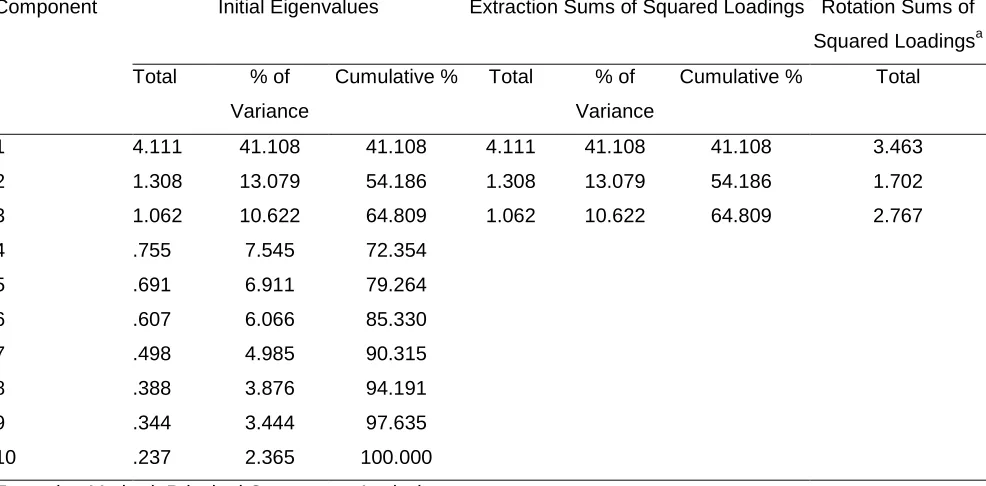
Table 2: Total Variance Explained
Component Initial Eigenvalues Extraction Sums of Squared Loadings Rotation Sums of Squared Loadingsa Total % of
Variance
Cumulative % Total % of Variance
Cumulative % Total
1 4.111 41.108 41.108 4.111 41.108 41.108 3.463
2 1.308 13.079 54.186 1.308 13.079 54.186 1.702
3 1.062 10.622 64.809 1.062 10.622 64.809 2.767
4 .755 7.545 72.354
5 .691 6.911 79.264
6 .607 6.066 85.330
7 .498 4.985 90.315
8 .388 3.876 94.191
9 .344 3.444 97.635
10 .237 2.365 100.000
Extraction Method: Principal Component Analysis.
a. When components are correlated, sums of squared loadings cannot be added to obtain a total variance.
Principal component analysis revealed the presence of 3 components with Eigen values greater
than 1 explaining 64.809% of the total variance. As such a clear factor solution was obtained by
10 of the employee training components. Consequently, the redundant variables were removed.
The pattern matrix for employee training was as shown in table 3.
Table 3: Pattern Matrixa
Component
1 2 3
1. Directorate of youth affairs is very proficient in designing and
conducting training needs assessments .815
2. Employee training increases directorate specificity in officers skills
and increased productivity .608
3. Employee training have proved to be a strategic means of
Licensed under Creative Common Page 399 4. Directorate keeps track of training programs to ensure they are
meeting their objectives and achieving intended results .851 5. Participation in follow up meetings after training enables youth
officers implement their learnt skills effectively .558 6. Training has an effect on strategic formulation as well as vision
and mission development .832
7. Training offered enables officers embrace ICT and innovation .810 8. Following training methods are effective in learning skills: in-job
training and out-job training .822
9. Training has helped improve the organizational productivity .640 10. Knowledge and skills from training improves officers job
satisfaction .684
Extraction Method: Principal Component Analysis. Rotation Method: Oblimin with Kaiser Normalization. a. Rotation converged in 9 iterations.
From the pattern matrix, it was established that four items loaded on the first component, three
items loaded on the second and the third component. The three components were training
needs assessment, training program and training evaluation.
Employee Training
The researcher sought to establish the respondents’ perceptions towards employee training.
Three sub-variables were extracted which included training needs assessment, training program
and training evaluation. The means and standard deviation values for each of the sub-variables
were established to aid in making pertinent inferences. The findings were as presented
hereafter.
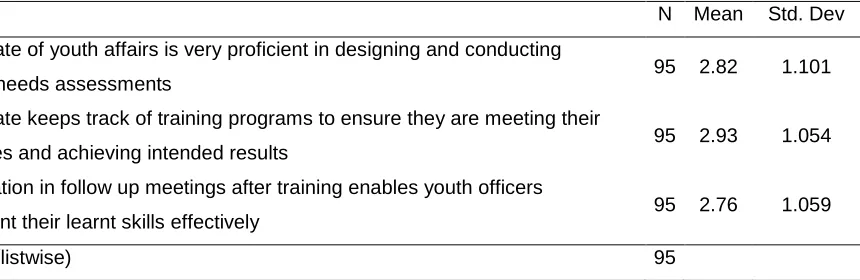
Table 4: Respondents Perceptions on Training Needs Assessment
N Mean Std. Dev Directorate of youth affairs is very proficient in designing and conducting
training needs assessments 95 2.82 1.101
Directorate keeps track of training programs to ensure they are meeting their
objectives and achieving intended results 95 2.93 1.054 Participation in follow up meetings after training enables youth officers
implement their learnt skills effectively 95 2.76 1.059