R E S E A R C H
Open Access
An automatic approach for constructing a
knowledge base of symptoms in Chinese
Tong Ruan
1*, Mengjie Wang
1, Jian Sun
1, Ting Wang
1, Lu Zeng
1, Yichao Yin
2and Ju Gao
2FromBiological Ontologies and Knowledge bases workshop on IEEE BIBM 2016 Shenzhen, China. 16 December 2016
Abstract
Background: While a large number of well-known knowledge bases (KBs) in life science have been published as Linked Open Data, there are few KBs in Chinese. However, KBs in Chinese are necessary when we want to
automatically process and analyze electronic medical records (EMRs) in Chinese. Of all, the symptom KB in Chinese is the most seriously in need, since symptoms are the starting point of clinical diagnosis.
Results: We publish a public KB of symptoms in Chinese, including symptoms, departments, diseases, medicines, and examinations as well as relations between symptoms and the above related entities. To the best of our
knowledge, there is no such KB focusing on symptoms in Chinese, and the KB is an important supplement to existing medical resources. Our KB is constructed by fusing data automatically extracted from eight mainstream healthcare websites, three Chinese encyclopedia sites, and symptoms extracted from a larger number of EMRs as supplements. Methods: Firstly, we design data schema manually by reference to the Unified Medical Language System (UMLS). Secondly, we extract entities from eight mainstream healthcare websites, which are fed as seeds to train a multi-class classifier and classify entities from encyclopedia sites and train a Conditional Random Field (CRF) model to extract symptoms from EMRs. Thirdly, we fuse data to solve the large-scale duplication between different data sources according to entity type alignment, entity mapping, and attribute mapping. Finally, we link our KB to UMLS to investigate similarities and differences between symptoms in Chinese and English.
Conclusions: As a result, the KB has more than 26,000 distinct symptoms in Chinese including 3968 symptoms in traditional Chinese medicine and 1029 synonym pairs for symptoms. The KB also includes concepts such as diseases and medicines as well as relations between symptoms and the above related entities. We also link our KB to the Unified Medical Language System and analyze the differences between symptoms in the two KBs. We released the KB as Linked Open Data and a demo at https://datahub.io/dataset/symptoms-in-chinese.
Keywords: Knowledge base, Symptoms in Chinese, Linked data, Information extraction
Background
Medical knowledge bases (KBs) play an important role in healthcare research. Existing KBs vary from coding sys-tems such as ICD10 [1], terminology syssys-tems such as UMLS [2], clinical ontology systems such as SNOMED CT [3] to medical databases such as DrugBank [4]. The major objectives for these KBs are to provide knowl-edge to medical workers and to promote standardization
*Correspondence: [email protected]
1East China University of Science and Technology, Shanghai, China Full list of author information is available at the end of the article
and interoperability for biomedical information systems and services. Besides, there exist many different types of biomedical KBs. For example, SIDER [5], and AMDD [6] contain drug-related information. Diseasome [7], ParkDB [8], and ChemProt [9] describe disease and disease-related gene information. These KBs are necessary in automatically processing and analyzing electronic medi-cal records (EMRs) and then form the basis of the upper information applications such as clinical decision support systems.
Currently there are many general-purpose KBs built by automatic approaches. The DBpedia project [10] extracted structured information from Wikipedia and published them on the Web. YAGO [11] was derived from Wikipedia, WordNet, and GeoNames. NELL [12], SOFIE [13], and PROSPERA [14] extracted data from the Web. The input data for NELL consisted of an ini-tial ontology as well as a small number of instances. SOFIE extracted ontological facts from natural language texts and linked the facts into an ontology. PROSPERA relied on the iterative harvesting of n-gram-itemset pat-terns to generalize natural language patpat-terns found in texts.
There are also some studies in the medical field which construct KBs automatically. Ayvaz et al. [15] built a dataset of drug-drug interaction information from exist-ing datasets includexist-ing DrugBank, KEGG, NDF-RT, and so on. Ernst et al. [16] constructed a knowledge graph for biomedical science which extracted and fused data from scientific publications, encyclopedic healthcare por-tals and online communities. They used distant supervi-sion in the extraction step, and used logical reasoning for consistency checking.
However, most KBs are in English. The KBs in Chinese are necessary in order to process the large amount of EMRs in Chinese, which has been accumulated since the wide adoption of hospital information systems a decade ago. Of all KBs, the symptom KB in Chinese is mostly required, since symptoms are the starting point of clin-ical diagnosis and reflect the evolution of diseases. We focus on symptoms and symptom-related entity extrac-tion. Data sources and methods in the construction of our KB are different from previous work, and the exper-iments show that our KB gains roughly a higher preci-sion than similar results in [16]. Our KB is constructed
by fusing data automatically extracted from eight main-stream healthcare websites, three Chinese encyclopedia sites, and symptoms extracted from a lager number of EMRs as supplement. This automatic approach not only avoids a large amount of manual work, but also keeps up with changes when new entities and relations appear.
Methods
Data schema
The schema of our KB can be regarded as a simplified ver-sion of UMLS. UMLS contains complex taxonomy includ-ing physical objects, events, or even intellectual products. Since our KB focuses on symptoms, we only choose parts of UMLS related to our work, such as, “Finding”, “Sign or Symptom”, and “Disease or Syndrome”.
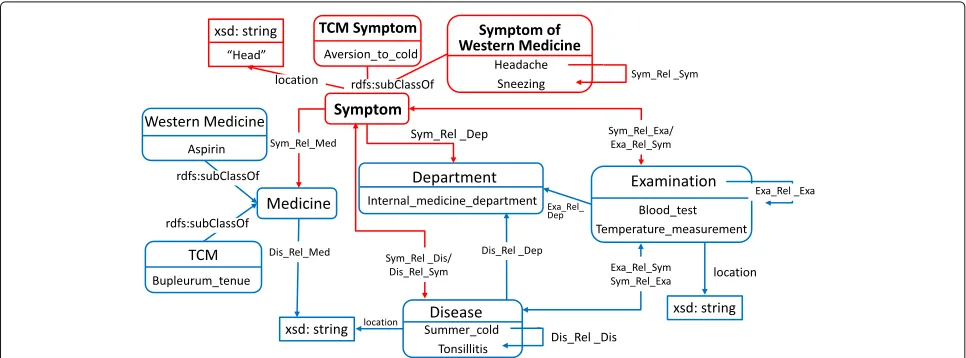
We have summarized five concepts for our KB driven by the requirements of processing and analyz-ing EMRs. Besides Symptom, we add four concepts directly related to symptom, namely, Disease, Medicine, Department, and Examination. Traditional Chinese medicine (TCM) describes symptoms that is different from Western medicine. For example, “Yin_deficiency” and“Qi_stagnation” are TCM symptoms which have no direct connection with Western medicine. In addition, TCM diagnosis and Western medicine diagnosis are two independent parts in EMR systems. TCM symptoms are included in the part of TCM diagnosis. Taking the above factors into consideration, Symptom is further divided into TCM Symptom and Symptom of Western Medicine, and Medicine is divided into TCM and Western Medicine similarly.
The schema graph is shown in Fig. 1. The center of the graph is the concept Symptom. Symptom links to other concepts with relations such as relevant_disease, and has datatype properties such as location. The
instances in Fig. 1 form a virtual scenario in clini-cal practice. A person has “Headache”, “Sneezing” and “Aversion_to_cold” which is a TCM symptom. Perhaps he goes to the “Internal_medicine_department”, and has the “Blood_test” and “Temperature_measurement”. Finally, he is diagnosed with “Summer_cold” complicat-ing with Tonsillitis and is suggested to take some “Aspirin” and “Bupleurum_tenue”. Chinese usually take TCM and Western medicine together.
Data extraction
Figure 2 presents the overall workflow of constructing our KB. In the data extraction step, we first use specific HTML wrappers [17] to extract entities and attributes from semi-structured information in eight mainstream healthcare websites. Then, we extract entities from three Chinese encyclopedia sites. Entities obtained from healthcare web-sites are fed as seeds to train a multi-class classifier and classify entities from encyclopedia sites. Finally, we train a Conditional Random Field (CRF) model to extract symp-toms from EMRs. The details are described below.
Data extraction from healthcare websites
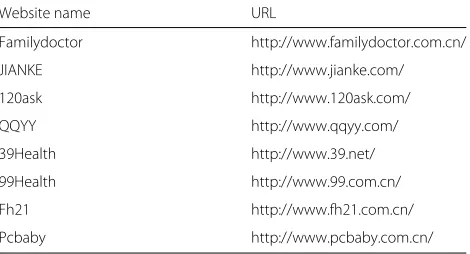
We collect eight mainstream healthcare websites (See in Table 1). There are normally two kinds of web pages for each website. One is the list page containing a list of enti-ties. The other is the detail page containing the detail description of a particular entity. All the above websites contain list pages of symptoms, diseases and medicines. However, list pages of department do not exist inJIANKE, PCbaby, or fh21, and list pages of examinations only appear inJIANKE, 120ask, and 39Health.
We take the symptom extraction as an example. All the detail pages of symptoms in a website share similar layouts. There is a portion called “property box” in the detail page containing attribute-value pairs of an entity. We map the “property box” to properties in schema graph
Table 1Basic information of eight healthcare websites
Website name URL
Familydoctor http://www.familydoctor.com.cn/
JIANKE http://www.jianke.com/
120ask http://www.120ask.com/
QQYY http://www.qqyy.com/
39Health http://www.39.net/
99Health http://www.99.com.cn/
Fh21 http://www.fh21.com.cn/
Pcbaby http://www.pcbaby.com.cn/
manually and extract attribute-value pairs with HTML wrappers. Since symptom may be a TCM Symptom or Symptom of Western Medicine, we use the “relevant department” attribute to classify. Specifically, if a symp-tom is related with a department containing “TCM” (e.g, Traditional Chinese Orthopedics, it will be labeled as TCM Symptom. The symptom will be tagged as Symp-tom of Western Medicine if it is related with a department without “TCM”. An entity can be labeled as both TCM Symptom and Symptom of Western Medicine. Finally, synonymous relations are crawled from the abstracts of entity pages with Hearst patterns described in [18]. For example, when applying a pattern “[entity1] is known as [entity2]” to sentence “hyperpyrexia is known as fever”, a “sameAs” relation between “hyperpyrexia” and “fever” is extracted.
We apply similar steps to other types of entities. We use heuristic information in the detail page of a medicine to distinguish TCM and Western medicine. If its descrip-tion in detail page contains keywords such as “Chinese patent medicine” and “herbal medicine”, and it is Western medicine if its description contains “pharmaceuticals”, “chemicals”, and so on.
Data extraction from Chinese encyclopedia sites
We extract and classify entities from three largest Chinese encyclopedia sites (i.e. Baidu Baike, Hudong Baike, and Chinese Wikipedia).
Algorithm 1 shows the extraction process. First, we take entities from healthcare websites as seeds (denote as EntityList), and extract their categories in Chinese encyclopedia sites (denote as SeedCateSet).
Algorithm 1Extract Entities from Encyclopedia Sites
Input: EntityList, Baike EntitySet, k
Output: target EntitySet 1: for eacheli∈EntityList
2: ifeliexists in Baike EntitySet then
3: SeedCateSet←eli.getcategory()
4: SeedCateList←eli.getcategory()
5: for eachcatei∈SeedCateSet
6: frei←the number ofcateiin SeedCateList 7: iffrei< k then
8: low-confidence CS←catei
9: for eachei∈Baike EntitySet
10: ifei.getcategory()∩SeedCateSet= ∅&&
11: ei.getcategory()∩low-confidence CS =∅then
12: target EntitySet←ei
13: return target EntitySet
Then we crawl entities belonging to SeedCateSet. Sec-ond, we classify SeedCateSet into low-confidence and high-confidence by calculating the ratio of seeds in these categories. Thirdly, for each entity in encyclopedia site, if its categories contain low-confidence categories, it will be regarded as noise and removed. We eventually col-lect 62,013 entities from Baidu Baike, 59,704 entities from Hudong Baike, and 2220 entities from Chinese Wikipedia.
In the classification step, we take entities extracted from healthcare websites as positive examples and entities from list pages of “health preservation”, “facial” and “psychol-ogy” in healthcare websites as negative examples. Then train a Decision Tree [19] classifier with seven labels: department, TCM, western medicine, symptom, disease, examination and other.
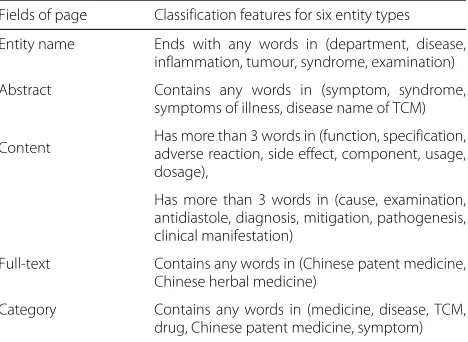
The classifier uses two types of features, namely, word formation and word distribution. The features are obtained from five fields, namely, entity name, abstract, content, full-text, and category of entity page, as shown in Fig. 3 and Table 2. If an entity is classified as Symptom, we will use heuristic rules to further determine whether it is a TCM Symptom or Symptom of Western Medicine.
Data extraction from EMRs
Due to variations of symptoms in clinical practice, we incorporate clinical vocabularies into our KB by extracting
Fig. 3Five Fields of Entity Page in Encyclopedia Sites
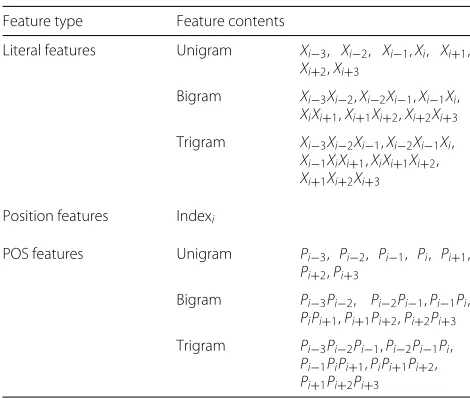
symptoms from a large number of EMRs. In order to learn symptoms of Western medicine, we extract texts from the “Physical Examination” and “Antidiastole_Western medicine” fields of EMRs. Texts within “Disease Analy-sis” and “Antidiastole TCM” fields are selected for TCM symptoms. Since data duplication takes place frequently in the texts of EMRs, we remove the sentences appearing more than once in the same record. We manually anno-tate TCM symptoms and symptoms of Western medicine in EMRs. Then we train a CRF [20] classifier to recog-nize new symptoms. The features are classified as literal features , position features, and part-of-speech (POS) fea-tures as shown in Table 3. The literal feafea-tures and position features are adopted from [21]. We set the context window size to 3 since it achieves best results in [21].
Data fusion
Data fusion consists of three steps: entity type alignment, entity mapping, and attribute mapping.
Table 2Classification features for six entity types
Fields of page Classification features for six entity types
Entity name Ends with any words in (department, disease, inflammation, tumour, syndrome, examination)
Abstract Contains any words in (symptom, syndrome, symptoms of illness, disease name of TCM)
Content Has more than 3 words in (function, specification,adverse reaction, side effect, component, usage, dosage),
Has more than 3 words in (cause, examination, antidiastole, diagnosis, mitigation, pathogenesis, clinical manifestation)
Full-text Contains any words in (Chinese patent medicine, Chinese herbal medicine)
Table 3Features of CRF
Feature type Feature contents
Literal features Unigram Xi−3, Xi−2, Xi−1,Xi, Xi+1,
Xi+2,Xi+3
Bigram Xi−3Xi−2,Xi−2Xi−1,Xi−1Xi,
XiXi+1,Xi+1Xi+2,Xi+2Xi+3
Trigram Xi−3Xi−2Xi−1,Xi−2Xi−1Xi,
Xi−1XiXi+1,XiXi+1Xi+2,
Xi+1Xi+2Xi+3
Position features Indexi
POS features Unigram Pi−3, Pi−2, Pi−1, Pi, Pi+1,
Pi+2,Pi+3
Bigram Pi−3Pi−2, Pi−2Pi−1,Pi−1Pi,
PiPi+1,Pi+1Pi+2,Pi+2Pi+3
Trigram Pi−3Pi−2Pi−1,Pi−2Pi−1Pi,
Pi−1PiPi+1,PiPi+1Pi+2,
Pi+1Pi+2Pi+3
Firstly, We align entity types with a voting method, i.e., the entity type receiving the most votes wins. When two types have the same top votes,the entity type with the higher priority wins. Priorities are determined by the resources’ rankings in Alexa.
Secondly, we use the idea of Wang et al. [22] to map entities. They used two variables, namely, commonness and relatedness in combination to calculate similari-ties between entisimilari-ties. In this paper, the commonness is obtained by calculating string similarities between entity names, while therelatednessis calculated with string sim-ilarities of attribute values. For example, entityEAandEB have the same type and share two attributesA1andA2.
Thecommonnessis defined as
StringSimilarity(EA,EB)= |
LCS(EA,EB)|
Max(|EA|,|EB|) (1)
where|LCS(EA,EB)|is the length of the longest common subsequence betweenEA andEB. The relatednessis the ratio of the number of similar facts. If the product of com-monnessandrelatednessis higher than a threshold, we will mapEAtoEB.
Finally, we map attribute from the extraction results to our ontology. Since property boxes of each healthcare website share the same attribute names, we manually map attribute names in healthcare websites to our ontology. However, in Chinese encyclopedia sites, the infoboxes of entity pages exist lots of attribute names that are similar in semantics but different in names. We map attributes to our ontology according to type information of entities and attribute values. For example, attribute “symptom” of triple <vertigo of heat stroke, symptom, thirsty> is mapped into “symptom related symptom”, because entity “vertigo of heat stroke” and attribute value “ thirsty” are both symptoms.
Link to UMLS
To investigate similarities and differences between symp-toms in Chinese and English, we link our KB to UMLS, a medical KB widely used in clinical practice and medical informatics research. Xu et al. [23] used context simi-larities to link phrases in “English discharge summary” to “Chinese discharge summary”. However, there are no such contexts in our situation. We first call the API of Baidu Translate [24] to translate symptoms in our KB into English phrases. Second, each phrase is transformed into a bag of words (denote asBWCS), and the same opera-tion is done to concepts in UMLS (denote asBWUMLS). Third, the JaccardSimilarity [25] between elements in BWCSandBWUMLS is calculated. Only when the value of JaccardSimilarityis 1, do we make a linkage.
Results and discussion
Classification results
We apply Decision Tree algorithm to train a multi-class multi-classifier. Twenty-six features from five fields of entity pages in encyclopedia sites are utilized in this paper. We use ten fold cross-validation. Figure 4 shows the results of our classifier in three encyclopedia sites, and indicates that our classifier has high accuracy and recall.
EMR data extraction results
We have collected 250,000 EMRs from Shanghai Shuguang Hospital as our corpora. Two TCM experts annotate symptoms mentioned in 1000 EMRs, which are randomly divided into two parts. One containing 660 EMRs form the training set, and the rest form the test set. Then we train a CRF model. The precision of TCM symp-tom is 93.26%, and the precision of sympsymp-tom of Western medicine is 95.37%. Finally, we use the model to recognize new symptoms from 249,000 EMRs. We have extracted 2376 symptoms, 387 of which are TCM symptoms and 1989 of which are symptom of Western medicine.
Statistic
Fig. 4Classification Results for Encyclopedia Sites. The result for Examination is obviously lower than those for the other classifications, because some entity pages in encyclopedia sites are irregular, leading to few features being used. Besides, Chinese Wikipedia has a few seed entities of examination, so its result is worse than those for other encyclopedias
2376 new symptoms to our KB, showing the differ-ences between symptoms used in websites and in clinical practice.
For correctness evaluation, we use “correctness ratio of facts” [26] to evaluate symptom-related facts. Each sam-pled triple is evaluated by seven persons according to their knowledge. We integrate the evaluating results by voting. Since our KB is large, we use simple random sampling method to draw samples.
Based on [26], we sampled 417 triples from 26,821 rdf:type triples whose objects are Symptom to calculate the correctness of symptoms. Itscorrectness ratiois 98.1%. Then, we sampled 423 triples from 295,946 symptom related triples. Thecorrectness ratioof symptom-related facts is 95.9%.
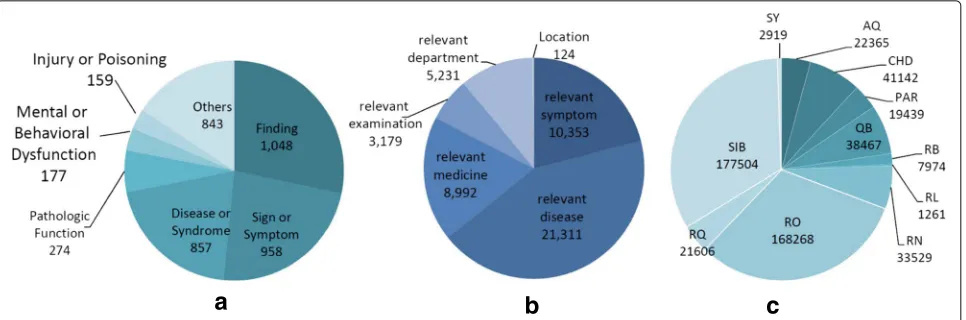
We have collected 4298 links between symptoms in our KB and concepts in UMLS (abbreviate as symp-tom links). We sampled 385 triples to evaluate the correctness of the links, and the correctness ratio is 92.0%. We calculate the semantic type distribution on the symptom links in UMLS, shown in Fig. 6a. Nor-mally, symptoms in our KB are expected to link to concepts in Sign or Symptom or Finding. But 53.3% of symptoms are linked to other semantic types in UMLS. For example, “Icterus (C0022346)” and “infectious jaun-dice (C0241954)” are common symptoms in Chinese,
while the semantic type of the former one is “Patho-logic Function” and the latter one is Disease or Syn-drome. This shows the range of symptom in life is much broader than that in medical science. Attribute distri-bution on symptom links in the two KBs are shown in Fig. 6b and c. We define six attributes for symp-toms in our KB, and UMLS defines 13 attributes for the linked concepts. However, most properties in UMLS do not have fixed domains and ranges. Thus, these attributes can not be interpreted uniformly. For example, “RO” in UMLS refers to an uncertain relation. In con-trast, our KB provides relations with definite syntax and semantics.
Conclusions and future work
The KB is constructed by fusing data automatically extracted from eight mainstream healthcare websites, three Chinese encyclopedia sites, and symptoms extracted from a lager number of EMRs as supplement. Finally, we obtain 135,484 entities to our KB, among them, the num-ber of symptom entities is 26,821. The KB can be used to annotate symptoms in EMRs. It can also be embed-ded into EMR systems to help therapists with symptom recommendations. In the future, we will try to construct a whole KB of commonly used medical vocabularies in Chinese, linking them to UMLS concepts.
a
b
a
b
c
Fig. 6Data Distribution on the Linked Results.aSemantic Type Distribution on Linked Concepts in UMLS,bProperty Distribution on Linked Symptom in our KB,cProperty Distribution on Linked Concepts in UMLS
Abbreviations
CRF: Conditional random field; EMR: Electronic medical record; KB: Knowledge base; POS: Part-of-speech; TCM: Traditional Chinese medicine; UMLS: Unified medical language system
Acknowledgements
We would like to thank three medical experts from Shanghai Shuguang Hospital for helping evaluate correctness of our data.
Funding
This work and the publication cost of this paper was supported by the 863 plan of China Ministry of Science and Technology (project No: 2015AA020107), “Action Plan for Innovation on Science and Technology” Projects of
Shanghai(project No:16511101000), Research on the Construction Technology of the Healthy and Aged Knowledge Base Based on the Combination of Medical and Care (project No: 2015BAH12F01-05), and Research on Efficient Query Algorithm for Large Scale Annotated Semantic Knowledge (project No: 61402173).
Availability of data and materials
We released the KB as Linked Open Data and a demo at https://datahub.io/ dataset/symptoms-in-chinese.
About this supplement
This article has been published as part ofJournal of Biomedical Semantics
Volume 8 Supplement 1, 2017: Selected articles from the Biological Ontologies and Knowledge bases workshop. The full contents of the supplement are available online at https://jbiomedsem.biomedcentral.com/articles/ supplements/volume-8-supplement-1.
Authors’ contributions
TR designed the schema of our KB and gave professional technical guidance at each step, namely, data extraction, data fusion, and linkage. LZ used specific HTML wrappers to extract entities and attributes from semi-structured information in eight mainstream healthcare websites. JS extracted and classified entities and attributes from three encyclopedia sites. TW trained a CRF model to extract symptoms from ERMs. MW fused data from different sources, including entity type alignment, entity mapping, and attribute mapping. And she linked our KB to UMLS. As experts in healthcare, JG and YY provided help and guidance in the process of data evaluation. All authors read and approved the final manuscript.
Ethics approval and consent to participate Not applicable.
Consent for publication Not applicable.
Competing interests
The authors declare that they have no competing interests.
Author details
1East China University of Science and Technology, Shanghai, China.2Shanghai Shuguang Hospital, 200025 Shanghai, China.
Published: 20 September 2017
References
1. Möller M, Sintek M, Biedert R, et al. Representing the International Classification of Diseases Version 10 in OWL. In: KEOD 2010 - Proceedings of the International Conference on Knowledge Engineering and Ontology Development. DBLP; 2010. p. 50–9.
2. Bodenreider O. The unified medical language system (umls): integrating biomedical terminology. Nucleic Acids Res. 2004;32(suppl 1):267–70. 3. Donnelly K. Snomed-ct: The advanced terminology and coding system
for ehealth. Stud Health Tech Inform. 2006;121:279.
4. Law V, Knox C, Djoumbou Y, Jewison T, Guo AC, Liu Y, Maciejewski A, Arndt D, Wilson M, Neveu V, et al. Drugbank 4.0: shedding new light on drug metabolism. Nucleic Acids Res. 2014;42(D1):1091–7.
5. Kuhn M, Letunic I, Jensen LJ, et al. The SIDER database of drugs and side effects. Nucleic Acids Res. 2016;44(D1):D1075.
6. Danishuddin M, Kaushal L, Baig MH, Khan AU. Amdd: Antimicrobial drug database. Genomics Proteom Bioinforma. 2012;10(6):360–3.
7. Urbach D, Moore JH. Mining the diseasome. BioData mining. 2011;4(1):1. 8. Taccioli C, Maselli V, Tegnér J, Gomez-Cabrero D, Altobelli G, Emmett W,
Lescai F, Gustincich S, Stupka E. Parkdb: a parkinson’s disease gene expression database. Database. 2011;2011:007.
9. Kringelum J, Kjaerulff SK, Brunak S, Lund O, Oprea TI, Taboureau O. Chemprot-3.0: a global chemical biology diseases mapping. Database. 2016;2016:123.
10. Bizer C, Lehmann J, Kobilarov G, Auer S, Becker C, Cyganiak R, Hellmann S. Dbpedia-a crystallization point for the web of data. Web Semantics Sci Serv Agents World Wide Web. 2009;7(3):154–65. 11. Weikum G, Weikum G, Weikum G. Yago: a core of semantic knowledge.
In: International Conference on World Wide Web. ACM; 2007. p. 697–706. 12. Carlson A, Betteridge J, Kisiel B, et al. Toward an architecture for
never-ending language learning. In: Twenty-Fourth AAAI Conference on Artificial Intelligence. AAAI Press; 2010. p. 1306–13.
13. Suchanek FM, Sozio M, Weikum G. Sofie: a self-organizing framework for information extraction. In: the 18th International Conference on World Wide Web. ACM; 2009. p. 631–40.
14. Nakashole N, Theobald M, Weikum G. Scalable knowledge harvesting with high precision and high recall. 2011227–36.
complete dataset of drug–drug interaction information from publicly available sources. J Biomed Inform. 2015;55:206–17.
16. Ernst P, Siu A, Weikum G. Knowlife: a versatile approach for constructing a large knowledge graph for biomedical sciences. BMC Bioinforma. 2015;16(1):1.
17. Dalvi N, Kumar R, Soliman M. Automatic wrappers for large scale web extraction. Proc Vldb Endowment. 2011;4(4):230.
18. Ritter A, Soderland S, Etzioni O. What is this, anyway: Automatic hypernym discovery. In: Learning by Reading and Learning to Read, Papers from the 2009 AAAI Spring Symposium, Technical Report SS-09-07, Stanford, California, USA, March 23-25, 2009. 2009. p. 88–93. 19. Quinlan JR. Induction of decision trees. Mach Learn. 1986;1(1):81–106. 20. Lafferty JD, Mccallum A, Pereira FCN. Conditional random fields:
Probabilistic models for segmenting and labeling sequence data. 2002. p. 282–9.
21. Wang Y, Liu Y, Yu Z, et al. A preliminary work on symptom name recognition from free-text clinical records of traditional chinese medicine using conditional random fields and reasonable features. In: The Workshop on Biomedical Natural Language Processing; 2012. p. 223–30. 22. Wang H, Fang Z, Zhang L, et al. Effective Online Knowledge Graph Fusion,
The Semantic Web - ISWC 2015: Springer International Publishing; 2015. 23. Xu Y, Chen L, Wei J, Ananiadou S, Fan Y, Qian Y, Chang IC, Tsujii J.
Bilingual term alignment from comparable corpora in english discharge summary and chinese discharge summary. BMC Bioinforma. 2014;16(1): 1–10.
24. He Z. Baidu translate: Research and products. In: The Workshop on Hybrid Approaches To Translation; 2015. p. 61–2.
25. Santisteban J, Tejada-Cárcamo J. Unilateral Jaccard Similarity Coefficient. In: GSB@ SIGIR; 2015. p. 23–7.
26. Ruan T, Dong X, Wang H, et al. Evaluating and Comparing Web-Scale Extracted Knowledge Bases in Chinese and English, Semantic Technology: Springer International Publishing; 2015.
• We accept pre-submission inquiries
• Our selector tool helps you to find the most relevant journal
• We provide round the clock customer support
• Convenient online submission
• Thorough peer review
• Inclusion in PubMed and all major indexing services
• Maximum visibility for your research
Submit your manuscript at www.biomedcentral.com/submit