R E S E A R C H
Open Access
Levels and building blocks
—
toward a
domain granularity framework for the life
sciences
Lars Vogt
Abstract
Background:With the emergence of high-throughput technologies, Big Data and eScience, the use of online data repositories and the establishment of new data standards that require data to be computer-parsable become increasingly important. As a consequence, there is an increasing need for an integrated system of hierarchies of levels of different types of material entities that helps with organizing, structuring and integrating data from disparate sources to facilitate data exploration, data comparison and analysis. Theories of granularity provide such integrated systems.
Results:On the basis of formal approaches to theories of granularity authored by information scientists and ontology researchers, I discuss the shortcomings of some applications of the concept of levels and argue that the general theory of granularity proposed by Keet circumvents these problems. I introduce the concept of building blocks, which gives rise to a hierarchy of levels that can be formally characterized by Keet’s theory. This hierarchy functions as an organizational backbone for integrating various other hierarchies that I briefly discuss, resulting in a domain granularity framework for the life sciences. I also discuss the consequences of this granularity framework for the structure of the top-level category of‘material entity’in Basic Formal Ontology.
Conclusions:The domain granularity framework suggested here is meant to provide the basis on which a more comprehensive information framework for the life sciences can be developed, which would provide the much needed conceptual framework for representing domains that cover multiple granularity levels. This framework can be used for intuitively structuring data in the life sciences, facilitating data exploration, and it can be employed for reasoning over different granularity levels across different hierarchies. It would provide a methodological basis for establishing comparability between data sets and for quantitatively measuring their degree of semantic similarity.
Keywords:Building block, Level, Hierarchy, Domain granularity framework, SEMANTICS, Ontology, Granularity, Knowledge management
Background
Arranging a heterogeneous collection of entities into a set of different levels (layers or strata) that are organized in a linear hierarchy from a fundamental level at the bot-tom to some higher level at the top is a general ordering scheme that dates back at least as far as to ancient times [1]. In biology, attempts to answer the question of how molecules make up cells and cells make up organisms
have led to various proposals of compositional
hierarchies of different levels of biological organization
of living systems and their component parts [2–22].
The underlying levels idea is simple and elegant. It can be flexibly used in many different contexts [23], ranging from descriptions to explanations and the provision of ontological inventories [24]. It is not only frequently
used in textbooks [25–27], but also provides an
import-ant conceptual framework in various scientific and philosophical debates, including debates on downward causation, mechanistic explanation, complexity,
reduc-tion, and emergence [28–32].
Various applications of the levels idea have been
pro-posed in science and philosophy [4, 29, 33–43].
Correspondence:[email protected]
Rheinische Friedrich-Wilhelms-Universität Bonn, Institut für Evolutionsbiologie und Ökologie, An der Immenburg 1, 53121 Bonn, Germany
Although distinct from each other, many of them also relate to one another and take subtly different forms when applied in related contexts, which often results in
conceptual problems [23]. Oppenheim and Putnam’s
[33] theory of reduction, for instance, attempts to ex-plain phenomena of a higher-level science through the-ories that refer to entities and to thethe-ories from the more
fundamental science, with the goal of achieving theunity
of science. As a consequence, however, levels of material entities are associated with levels of broad scientific dis-ciplines (e.g., physical, chemical) and of their corre-sponding theories and this is a problem, because it leaves the question unspecified, why objects of, for ex-ample, physics, which range from sub-atomic particles to entire planets and the universe as a whole, comprise a single level (Bechtel and Hamilton [44]).
Many philosophers have made attempts to establish criteria for the validity or usefulness of the levels idea, sometimes expressed in form of necessary and sufficient formal criteria, but no commonly accepted consensus has been reached for any particular set of criteria [23, 32]. Instead of having to decide and stick with a specific account of levels, Craver ([23], p.2) therefore suggests
descriptive pluralism about levels, claiming that “the
world contains many distinct, legitimate applications of the levels metaphor that are either unrelated or that
have only indirect relations with one another.”
Irrespective of the lack of commonly accepted formal criteria, the different accounts of levels suggested so far usually all have in common that each level must repre-sent an increase in organizational complexity, with each entity of a higher level being directly composed of en-tities belonging to the next lower level [45], resulting in a linear hierarchy of levels from a bottom level to a top level. Moreover, the idea presupposes that entities exist for which it makes sense to understand them as being at the same level.
The idea of levels and of hierarchies based on levels has also been discussed in information science and ontology research. Here, it has become increasingly im-portant due to the continuously growing need of
re-searchers to manage large amounts of data (i.e., Big
Data) with the help of computers and software applica-tions, resulting in a new driving force for scientific
ex-ploration, called data exploration or eScience [46]. Big
Data and eScience bring about the necessity for re-searchers to communicate biological data via the World Wide Web and to use databases and online repositories to store, document, archive, and disseminate their data. They also require data to be standardized accordingly and to be computer-parsable. All this can be facilitated
by the use of ontologies [47–52]. As a consequence,
ontology researchers have developed their own
ap-proaches to levels, which they callgranularity levels, and
to different types of hierarchies based on levels, which
they call granular perspectives. Ontology researchers
provide explicit criteria for identifying and demarcating different levels and different hierarchies. These criteria
specify what is called agranularity framework.
In the following, I develop a domain granularity frame-work for the life sciences that ranges from the atomic level to the level of multi-cellular organisms. The frame-work attempts to reflect the hierarchical anatomical organization of organisms, marking an important step towards developing a general overarching information framework for the life sciences. Since morphology takes a central role in all attempts of developing a hierarchical system of levels of biological entities, because unambigu-ously modeling the various granularity relations across morphological entities in a consistent way has been chal-lenging, I focus mainly on morphology. Morphology is
also “... one of the covering disciplines that spans
[al-most] every single entity in any biological organism”
([53], p. 65). It provides diagnostic knowledge and data
for many disciplines within the life sciences [54, 55].
And morphological terminology provides thebasic
refer-ence system and descriptive framework for the
supra-molecular domain in the life sciences. It is central to all efforts of biological inventorying and to biological knowledge representation in general; and it provides a common backbone for the integration of all kinds of
dif-ferent biological information [47,48,56–58].
The paper is divided into two sections. In the first sec-tion I briefly discuss a formal approach to levels and hier-archies proposed by ontology researchers, which is based on granular partitions. I compare the notion of a cumula-tive organization, which most theories of granularity as-sume for the anatomical organization of biological entities, with the cumulative-constitutive organization and discuss some of the conceptual problems that the latter brings about. I take a brief look at the granularity scheme implicit in the Basic Formal Ontology (BFO), before I
introduce the general theory of granularity proposed by
Keet [59–61] that allows the integration of various
differ-ent granular perspectives (i.e., hierarchies).
In the other section I discuss BFO’s characterization of
bona fide objects based on the identification of different types of causal unity. I suggest adding two more types of causal unity for characterizing functional and historical/ evolutionary bona fide entities. I also introduce the
con-cept ofbuilding blocks, which gives rise to a hierarchy of
top-level category of ‘material entity’in BFO. I conclude by discussing the suitability of the domain granularity framework here suggested for providing the basis on which an overarching information framework for the life sciences [62] can be developed.
Methods
Ontologies and granularity
Information scientists and ontology researchers devel-oped an account of levels that follows a formal approach allowing for computer-parsability and automated reason-ing over hierarchies of different levels of granularity, with each hierarchy being understood as a distinct granular perspective. Ontologies play an essential role in this approach. Ontologies, together with other Semantic Web technologies, also play a significant role in reliably communicating and managing data within and between databases and online repositories, providing hierarchies a practical field of application with commercial significance.
Anontology consists of a set of terms with commonly
accepted definitions that are formulated in a highly for-malized canonical syntax and standardized format, with the goal to yield a lexical or taxonomical framework for knowledge representation [63]. The terms are organized into a nested hierarchy of classes and subclasses, form-ing a tree of increasform-ingly specialized terms that is called
a taxonomy [64]. However, when ontology researchers
need to refer to hierarchies other than taxonomies, for
example, a partonomy (i.e., a hierarchy based on
part-whole relations), they usually do that in reference to some (external) granularity framework. Such parto-nomies, however, are usually only expressed indirectly through formalized descriptions specifying particular part-hood relations between resources within the taxonomy of an ontology. This often results in the respective ontology containing several disconnected partonomies that provide
only locally applicable parthood-based granularity
schemes, as opposed to a single globally and universally applicable scheme.
Whereas the number of biomedical ontologies is con-tinuously increasing [65], they often differ considerably, and their taxonomies as well as their implicit parto-nomies and even some of their term definitions are often
inconsistent across each other [66–68]. As a
conse-quence, if databases and online repositories differ with respect to the ontologies they use, their contents are likely to be incomparable, which significantly hampers data exploration and integration. A solution to this
problem involves two distinct approaches: using formal
top-level ontologies[66,69] such as BFO [70,71] and
ap-plying ageneral formal theory of granularityfor
develop-ing a domain granularity framework that can be applied as a meta-layer across various ontologies.
Partial order, granular partition, and granularity tree Key to the development of any formal theory of granu-larity is the formal characterization of the relation that holds between entities belonging to different levels of granularity. A first step is to identify partial order
rela-tions. In mathematics and logics, apartial orderis a
bin-ary relation‘R’ that istransitive(if b has relation R toc
and c has relation R to d, than b has relation R to d:
(Rbc) (Rcd)→Rbd), reflexive (b has relation R to itself:
Rbb), and antisymmetric (if b has relation R to cand c
has relation R to b, than b and c are identical: (Rbc)
(Rcb)→b=c) [72]. An example of a partial order
rela-tion is the parthood relarela-tion.
Granular partitions are based on partial order
rela-tions [73–76]. Granular partitions are involved in all
kinds of listing, sorting, cataloging and mapping activ-ities. A granular partition is a hierarchical partition that consists of cells (here used in the general non-biological meaning of cell) that contain subcells. It requires a spe-cific theory of the relation between its cells and subcells: (i) the subcell relation is a partial ordering relation; (ii) a unique maximal cell exists that can be called the root cell; (iii) chains of nested cells have a finite length; and (iv) if two cells overlap, then one is a subcell of the
other, therewith excluding partial overlap [73–76]. An
empirically meaningful theory of granular partition also requires a theory of the relations between cells of the partition and entities in reality (i.e., projective relation to reality [73–75]).
Depending on what is partitioned and the ontological nature of the parts, one can distinguish a bona fide granular partition from a fiat granular partition. A bona
fide granular partitionpartitions a bona fide object (i.e.,
an entity that is demarcated by a bona fide boundary and thus exists independent of any human partitioning
activities) into its bona fide object parts. Afiat granular
partitionpartitions any material entity into its fiat entity
parts (i.e., entities that are demarcated by a fiat
bound-ary and thus exist as a consequence of human partition-ing activities) (for a distinction of bona fide and fiat
entities see discussion below and [70,71,77]).
A granular partition can be represented as a tree, with the nodes and leaves of the tree being the granular parts. This tree is called agranularity tree[69,76,78]. Every fi-nite granular partition can be represented as a rooted tree of finite length [74,75,79–81]. In a granularity tree,
a granularity level is acut(sensu [82]; see Fig.2b) in the
tree structure. Within a granularity tree, different levels of granularity can be distinguished, with the root being a level itself, and all immediate children of the root an-other level, etc. The elements forming a granularity level
are pairwise disjoint, and each level is exhaustive,
be-cause for every entity b of the partition exists some
another level of granularity, andbstands in a partial
or-dering relation toc, or vice versa [76]. If the partitioning
relation is a mereological relation such as the part-whole relation, all entities belonging to one granularity level in a granularity tree exhaustively sum to the whole (i.e., the root cell) that is partitioned [76].
Partitioning relations possess constrains regarding the type of entities that they partition. The primitive part-whole relation, for instance, exists only between
in-stances (particulars/individuals) [23, 83–85] (for a
trans-lation to a class expression of parthood see [83,86]). As
a consequence, parthood-based granular partitions can
be represented as instance granularity trees. The
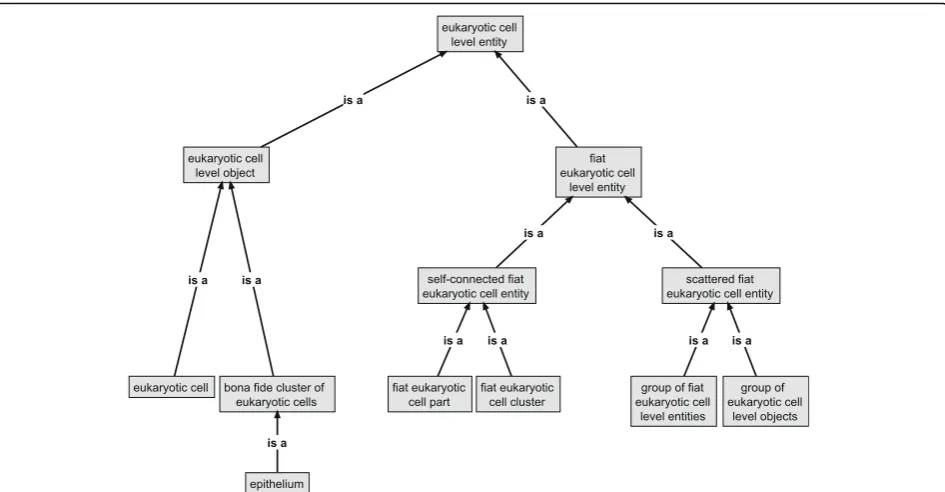
class-subclass relation is also a partial ordering relation. However, it exists only between types (classes, univer-sals). Granular partitions based on a class-subclass
rela-tion therefore can be represented as type granularity
trees. The taxonomy of terms of an ontology represents such a type granularity tree. (see also instance and type granularity tree in [58,87]).
Hierarchies are based on strict partial ordering
rela-tions, which representirreflexive(bcannot stand in
rela-tion R to itself: ¬Rbb) partial ordering relarela-tions. As a consequence, hierarchies represent a specific case of granular partitions and granularity trees. The direct proper parthood relation is a strict partial ordering rela-tion. This complies with any formal system of minimal mereology, including pure spatiotemporal parthood.
Biological reality: the problem with the cumulative constitutive hierarchy
On the basis of the characterization of hierarchies men-tioned above one can distinguish four basic types of
hierarchical systems [17, 21, 88]: (i) constitutive
hier-archies, (ii) cumulative constitutive hierhier-archies, (iii) ag-gregative hierarchies, and (iv) cumulative agag-gregative
hierarchies (Fig. 1), of which only the former two
hier-archies are of interest in the here discussed context. Interestingly, constitutive hierarchies are commonly used by philosophers and ontology researchers to model granularity, whereas biologists use cumulative constitu-tive hierarchies.
In a constitutive hierarchy [38], all material entities of
a given level of granularity constitute the entities of the next coarser level. For instance, aggregates of all atoms that exist constitute all molecules that exist and aggre-gates of all molecules constitute all cells [17]. In other words, coarser level entities consist of physically joined entities of the next finer level of granularity [88]. A con-stitutive hierarchy is thus based on partonomic inclusion
resulting from an irreflexive proper part-whole relation,
with bona fide entities of different levels of granularity being mereologically nested within one another, thus
representing amereological granularity tree[76].
Most granularity schemes suggested in the ontology literature so far presuppose a constitutive organization
of material entities [78, 89] (for an exception see [58]),
and many bio-ontologies, although often not accompan-ied by an explicit representation of formally defined levels of granularity, also follow this scheme. This is problematic given that constitutive hierarchies not only assume that coarser level entities always exclusively con-sist of aggregates of entities of the next finer level, but also that every entity belonging to one level of granular-ity is part of some entgranular-ity of the next coarser level of
granularity (Fig. 1a). Unfortunately, this is not the case
for many material entities: ions or chlorine radicals dem-onstrate that not every atom necessarily is part of a
mol-ecule; in humans, extracellular matrix (ECM; a
macromolecular formation that is not a component of
cells, but a component of tissues and therefore also or-gans and multi-cellular organisms) and blood plasma demonstrate that not every molecule is part of a cell; protozoa, protophyta, erythrocytes, coelomocytes, or leukocytes demonstrate that not every cell necessarily is
part of an organ [87]. Obviously, not allthe entities
be-longing to one level of granularity necessarily form parts of entities of the next coarser level.
Moreover, constitutive hierarchies also assume that all parts of any given level of granularity exhaustively sum
to their complex whole (Fig. 1a). Regarding biological
material entities this implies that the sum of all cells of a human individual would have to yield the human indi-vidual as a whole. The totality of cells of any given hu-man being, however, does not sum to the body as a whole, since this mereological sum would not include the ECM in which the cells are embedded and which provides the topological grid that determines the relative position of the cells to one another. The aggregation of cells would disintegrate without the ECM and could not constitute the body as a bona fide whole. Moreover, since not all atoms are part of a molecule and not all subatomic particles are part of an atom, neither the sum of all mole-cules, nor the sum of all atoms that exist in the universe at a given point in time exhaustively sum to the universe as a whole [87]. As a consequence, not all parts that share the same granularity level necessarily exhaustively sum to
the maximal whole (contradicting [76,78]).
Instead of employing a constitutive hierarchy, biologists have argued that typical biological material entities such as multi-cellular organisms are organized according to a
cumulative constitutive hierarchy [17, 21, 88] (Fig. 1b).
hierarchy. When partitioning a particular multi-cellular
organism (i.e., unpartitioned whole, Fig.2b) into its direct
proper bona fide parts according to a constitutive
hier-archy,allthe parts belonging to a cut, and thus to an
in-stance level, instantiate the same basic type of anatomical
entity (Fig. 2b, left). Therefore, each cut in the instance
granularity tree can be associated with a specific basic type of anatomical entity. As a consequence, instead of talking about‘Cut I’, one could just as well talk about the‘organ’ granularity level. Translating or mapping the topology of an instance granularity tree to its corresponding type granularity tree is thus straight forward and poses no
con-ceptual problems—if one applies a constitutive hierarchy
for partitioning the multi-cellular organism that is (Fig.2c, left). One could even derive a globally applicable, linear compositional levels hierarchy for the life sciences. One would only have to apply the constitutive hierarchy model
and compare the type granularity trees of several multi-cellular organisms across various taxa.
However, when applying the cumulative constitutive hierarchy model, the entire process becomes more
com-plex and conceptually more challenging [58, 87].
Ac-cording to the cumulative constitutive hierarchy, the parts of a multi-cellular organism that belong to a cut of
an instance granularity tree do not all instantiate the
same basic type of anatomical entity (Fig.2b, right). For
instance, the parts that belong to the first cut in the
ex-ample shown in Fig. 2b instantiate organs, cells, and
molecules. As a consequence, the mereological sum of all entities belonging to one instance granularity level
does not necessarily sum to the unpartitioned whole
(see, e.g.,‘Cut III’in Fig.2b, right). Thus, one must
con-clude that Kumar et al.’s [78] theory of granularity and
one of Reitsma and Bittner’s [76] criteria for
A
B
C
D
mereological granularity trees are not conformant with anatomical reality [58].
Moreover, the topology of the resulting instance granularity tree cannot be easily translated into its
corresponding type granularity tree, because each in-stance level comprises different types of entities (except for the root and the finest level). A consequence of
cu-mulative constitutive hierarchies is that, when
A
B
C
partitioning a multi-cellular organism, different instances of the same basic type of anatomical entity can belong to different instance granularity levels. In other words, when conceiving types of anatomical entities as classes,
the extension of a class such as ‘bio-molecule’ crosses
the boundaries of different levels of instance granularity when applying the cumulative constitutive hierarchy. Therefore, mapping types directly to instance levels would result in some types being associated with more than one level.
This poses a fundamental problem, because ontologies are dealing with types (i.e., classes) and not with individ-uals (i.e., instances), and thus require a type-based granularity framework. I have proposed an intuitive
solu-tion, i.e., sortation-by-type, in which a type granularity
tree is derived from an instance granularity tree by rank-ing types accordrank-ing to the lowest level of granularity of their corresponding instances [58]. Sortation-by-type
can be seen as a sort ofgranular sedimentationof all
in-stances of one type to the lowest level they occupy (see
large transparent arrows in Fig. 2c, right). Whereas this
approach seems to be intuitive, the downside is that in the type granularity tree, the entities belonging to a granularity level neither exhaustively sum to their re-spective whole (except for the lowest level), nor do all of them form parts of the entities belonging to the next higher granularity level [58].
The granularity scheme implicit in the basic formal ontology
Formal top-level ontologies such as BFO [70, 71] play a
key role in establishing standards across different ontol-ogies. BFO provides a genuine upper ontology upon which all ontologies of the Open Biomedical Ontologies
Foundry (OBO Foundry [57, 90]) are built. Together
with the OBO Relations Ontology it is one of the guar-antors for the interoperability of the ontologies within OBO Foundry.
Because BFO is an upper ontology, its taxonomy is comparably flat and does not include any distinction of different granularity levels of material entities. However, BFO’s distinction of ‘object’, ‘object aggregate’, and ‘fiat
object part’ as top-level categories of ‘material entity’
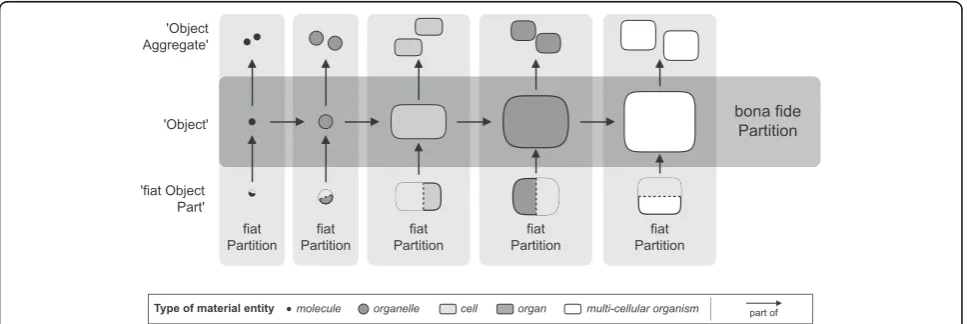
[70,71] can be interpreted as a basic granularity scheme applied for modeling the granularity within a given level of object granularity. The underlying basic idea is that a certain domain first must be partitioned into its top-level object categories, resulting in a domain-specific bona fide granularity tree (i.e., a granularity tree that is based on bona fide granular partitions; see [76]), e.g.,‘ bio-macromo-lecule’<‘organelle’<‘cell’<‘organ’<‘organism’. According to BFO, in order to comprehensively cover the domain, each level of this bona fide granularity tree must be mod-eled by its own level-specific domain reference ontology, with cross-ontology relations managing the relationships between entities of different levels. Therefore, in a next step, the distinction of ‘object’,‘fiat object part’, and‘object
aggregate’indicates within each such ontology a simplified
model for fiat partitions and fiat granularity trees (see Fig.3). Of course, object aggregates can be parts of larger object aggregates and fiat object parts can be further parti-tioned to smaller fiat object parts, thereby extending the
basic scheme shown in Fig.3with additional levels.
This approach to modularizing granularity, however, does not seem to be very practicable, because it implies that instead of developing a single anatomy ontology of a specific taxon of multi-cellular organisms, one would
have to (i) develop several granularity-specific ontol-ogies, ranging from an ontology for molecules, to an ontology for organelles, for cells, for tissues, for organs and for body parts for this specific taxon, and (ii) one would have to develop an additional layer of axioms and relationships to define the granularity relations between entities across these different ontologies.
Because BFO does not provide a formal granularity
framework, applying the sub-categories of ‘material
en-tity’ (i.e.,‘object’,‘fiat object part’, and ‘object aggregate’) can be ambiguous. As a consequence, many of the cur-rently available biomedical ontologies within OBO
Foun-dry significantly vary regarding their underlying
granularity assumptions and their top-level class-struc-ture for‘material entity’(see subclasses of, e.g.,‘material
anatomical entity’ of CARO, ‘anatomical structure’ of
HAO,‘material entity’ of OBI,‘plant structure’ of PO,
‘anatomical structure’ of ZFA,‘independent continuant’
of CL,‘cellular component’of GO). One could argue that
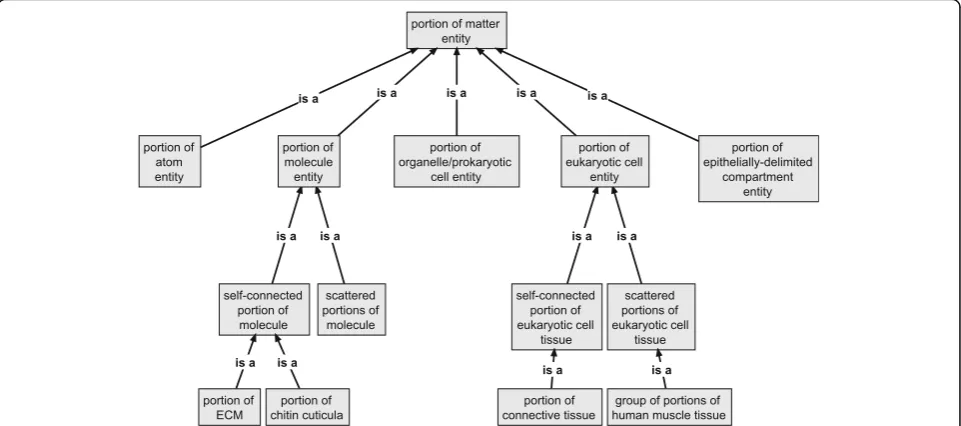
BFO fails to provide a top-level structure for ‘material
entity’that can be applied for modeling the various
do-mains covered by OBO Foundry ontologies. This causes problems with the comparability of biomedical ontol-ogies and substantially limits the comparability of data across databases and online repositories that reference these ontologies. The life sciences in general and
com-parative morphology in particular, but also the
compos-itional biology style of biological theorizing [91], would
benefit from a consistent granularity framework that is
grounded in reality and that accounts for the
organizational complexity of anatomy. In order to allow algorithm-based reasoning and inferencing, such a framework requires an underlying formal theory of granularity that explicitly states formal granularity rela-tions and explicitly ranks levels of granularity. Unfortu-nately, most anatomy ontologies are only based on implicit assumptions regarding granularity.
Keet’s formal theory of granularity
Keet [59–61] has developed a formal theory of
granular-ity that is agnostic regarding cumulative or cumulative constitutive hierarchies and thus circumvents some of the problems of theories of granularity that have been proposed by others (e.g., [78]; problems discussed in [58]). Keet [61] argues that granularity always involves modeling something according to certain criteria, with
each model together with its criteria defining agranular
perspective. Finer levels within a perspective contain knowledge or data that are more detailed than the next coarser level, and coarser levels of granularity simplify or make indistinguishable finer-grained details. A particular granularity level, however, must be contained in one and only one granular perspective, whereas a particular en-tity (individual or type) may reside in more than one
level of granularity, but all levels in which it is contained must belong to distinct granular perspectives [92]. Moreover, a granular perspective has at least two levels of granularity and there has to be a strict total order be-tween the entities of different levels of a given perspec-tive. And if there is more than one granular perspective for a subject domain, then these perspectives must have some relation between each other. This way, several dif-ferent perspectives of granularity, each with its granular-ity tree and its corresponding set of granulargranular-ity levels, can coexist within the same granularity framework. For instance, a granular perspective of relative location that is based on fiat granular partitions, alongside with a granular perspective of structural composition that is based on bona fide partitions, a perspective of biological processes that is based on temporal parthood relations (i.e., processes partitioned into their sub-processes), a perspective of functional units that is based on func-tional parthood relations (i.e., funcfunc-tional units parti-tioned into their functional sub-units), and a granular perspective based on developmental relations [58].
The idea that a domain can be modeled by different
granular perspectives is not new [69, 88, 91, 93, 94], but
Keet [61] provides the first formal theory of granularity that incorporates different granular perspectives within a
single domain granularity framework. Therefore, Keet’s
theory can be understood as an attempt to accept de-scriptive pluralism about the idea of levels [23]. How-ever, it also represents an attempt to integrate the resulting set of diverse hierarchies within an integrated
and strictly formalized framework, her general formal
theory of granularity.
A granular perspective can be specified by the
combin-ation of agranulation criterion(what to granulate) and a
specific type of granularity (how to granulate) (for a
de-tailed discussion see [61]). When applied to a correspond-ing object, a granular perspective partitions the object resulting in a specific type of granularity tree. Each per-spective has exactly one granulation criterion and exactly one type of granulation. This combination determines the uniqueness of each granular perspective. All granular per-spectives contained in a domain are thus disjoint. Keet [61] presumes that a domain of reality can be granulated according to different types of granularity (mechanisms of granulation), requiring the existence of a certain type of
granulation relationthat must be specific to each
particu-lar granuparticu-lar perspective. The entities (individuals or types) granulated by a type of granularity are disjoint.
Various different types of granulation relations can be applied, which can be classified into (i) scale-dependent (e.g., resolution, size) and (ii) non-scale-dependent types
of granularity (e.g., mereological parthood: structural
parthood, functional parthood, spatial parthood,
sub-quality relations, participation) [61, 95]. Within a given perspective, the granulation relation relates entities of adjacent granularity levels with one another. If a granular perspective has more than two levels of
granu-larity, the granulation relation must be transitive. If a
granulation relation is intransitive, then the respective perspective has only 2 levels.
The granulation criterion delimits the kind or category of properties according to which the domain is parti-tioned, the levels identified, and the subject domain granulated (i.e., data, information, or knowledge). It spe-cifies an aspect that all entities in a granular level must have in common, whereas the contents of a level can be either entity individuals (i.e., instances) or types (i.e., uni-versals, classes), but not both. It comprises either (i) at least two properties, none of which is a quality property (for non-scale-dependent types of granularity) or (ii) at least one property that is not a quality property together with exactly one quality property that has a measurable region (for scale-dependent types of granularity) [61].
Keet’s [61] formal theory of granularity thus provides
the respective formal definitions, axioms, and theorems that allow the formal representation of granular parti-tions based on parthood relaparti-tions (i.e., mereology) as well as on taxonomic inclusion (i.e., class-subsumption hierarchies based on set theory) and other types of granulation relations [60]. It even accommodates both quantitative (i.e., arbitrary scale) and qualitative (i.e., non-scale-dependent) aspects of granularity.
Keet’s theory of granularity also provides a well suited
framework for analyzing and identifying some of the problems of some of the granularity schemes that have
been proposed earlier, taking Eldredge’s somatic
hier-archy [9] as an example—this criticism applies to many
of the published levels schemes, even including Kumar
et al.’s [78] scheme: The somatic hierarchy comprises an
‘atom’,‘molecule’, and‘cell’level together with an ‘ organ-elle’,‘organ’, and‘individual organism’level of granularity. An obvious problem of this hierarchy is that its under-lying granulation criterion has been conflated between levels, because spatio-structural entities have been mixed with functional entities. As a consequence, the under-lying granulation relation varies depending on the level between spatio-structural parthood and functional
part-hood. Moreover, the ‘tissue’ level seems to involve a
scale-dependent granularity type, because it concerns
resolution—a tissue is the representation of a cell
aggre-gate at a coarser level of resolution, in which the finer-grained details of the cell aggregate that enable the individuation of individual cells are simplified or made indistinguishable. This mixing of criteria and types of
granularity results in inconsistent granulation: a
mono-cellular organism is an entity that belongs to both the ‘cell’and the ‘individual organism’ level of the same
perspective, but according to Keet [61] an entity can only reside in more than one level if these levels belongs to different granularity perspectives.
Results
Developing a domain granularity framework for the life sciences
The increase in formalism coupled with the increase in generality compared to other theories of granularity re-sults in more flexibility and therefore a broader
applic-ability of Keet’s theory. Her theory allows for detailed
and sophisticated modeling of a domain by assigning specific types or individuals of entities to specific types of granular perspectives (i.e., hierarchies) that are inter-connected and integrated in a common domain granu-larity framework. This framework can be used (i) as template for the organization of top-level categories of different domain ontologies and (ii) to provide an inde-pendent overarching information framework that func-tions like an additional organizational layer, i.e., a meta-layer, to which terms/resources of different ontol-ogies can be mapped. This meta-layer would provide a consistent and integrated system of well integrated granular perspectives that allows for modeling not only parthood-based hierarchies, but all kinds of other rele-vant hierarchies, for instance, hierarchies based on de-velopmental or evolutionary relations. It can be formally added onto an existent knowledge base to facilitate the construction of a realism-based and more detailed model of the biological domain (see also [58]).
In order to be broadly applicable throughout many existing bio-medical ontologies, such a domain granularity framework for the life sciences would have to be devel-oped in reference to BFO and its implicit granularity
scheme using a compositional bona fide‘object’granular
perspective that granulates bona fide ‘object’ entities
ac-cording to a direct proper parthood granulation relation
(see Fig.3). All additional granular perspectives can be dir-ectly or indirdir-ectly related to this compositional perspec-tive, which functions as an organizational backbone for the entire framework, because each additional perspective possesses some level that shares entities with some level of this compositional perspective. The development of such a domain granularity framework, however, may re-sult in new demands that BFO (or some intermediate do-main reference ontology) must meet, which could result in the necessity to adapt or extend BFO accordingly.
Integrating BFO and frames of reference in a domain granularity framework
Frames of reference and BFO’s‘object’category of‘material entity’
Smith et al. [71] (see also [70]) characterize BFO’s bona
independent of human partitioning activities as causally
relatively isolated [96, 97] entities that are both
struc-tured through and maximal relative to a certain type of
causal unity. They distinguish three types of causal unity:
1)Causal unityviainternal physical forces, which
uni-fies an entity through physical forces (e.g., fundamental forces of strong and weak interaction, covalent bonds, ionic bonds, metallic bonding) that are strong enough as to maintain the structural integrity of the entity against the strength of attractive or destructive forces from its ordinary neighborhood. Whereas Smith et al. [71] men-tion only examples of physical forces that apply to the atomic and molecular scale (atoms, molecules, portions of solid matter such as grains of sand and lumps of iron), I would explicitly include all kinds of physical con-nections between material component parts, independ-ent of their scale, including cell-cell connections, but also screws, glues, and bolts. Ultimately, they all go back to the physical forces discussed in Smith et al. [71].
2) Causal unity via physical coveringunifies an entity
through a common physical covering, for instance, a membrane. This covering may have holes, but must be completely connected (in the sense that a continuous path can be traced between any two points on the surface and that path has no gaps and does not leave the surface) and must still serve as a barrier for entities from inside and en-tities from outside that are above a certain size threshold. Examples: organelles, cells, tissues, organs.
3)Causal unityviaengineered assembly of components
unifies an entity through screws, glues and other fas-teners. Often, the parts are reciprocally engineered to fit together (e.g., dovetail joints, nuts and bolts). Examples: cars, ballpoint pens, houses, shoes, power grids.
These three types of causal unity are ontologically not independent from one another, because the latter two
existentially depend and thus supervene on causal unity
via internal physical forces [98]. Moreover, they do not cover all cases of causal unity relevant in the life sciences (BFO does not claim completeness regarding the list of
cases of causal unity; see [70,71]), but are confined to a
synchronic approach to causal unity that is associated with a spatio-structural frame of reference (see below). Functional units and historical/evolutionary units are not covered, although they are bona fide entities in their own right that exist independent of any human parti-tioning activities [77]. In this context it is important to note that functional and historical/evolutionary units are not associated with a spatio-structural frame of reference and are thus not necessarily also spatio-structural units. Moreover historical/evolutionary units are not confined to a diachronic instead of a synchronic causal unity. Dia-chronic causal unity identifies natural units based on shared historical/evolutionary origin (for a detailed dis-cussion see [77]). Therefore, I suggest two additional
types of causal unity that are suited to cover the missing cases:
Causal unity via bearing a specific functionunifies an
entity through the function that the entity bears, with its functional component parts bearing sub-functions [98]. This type of causal unity is more general than causal unity via engineered assembly of components and thus includes it.
Causal unityviacommon historical/evolutionary origin
unifies an entity through the common
historical/evolu-tionary origin of the entity’s component parts. A
histor-ical/evolutionary unit is demarcated so that all of its component parts share the same historical/evolutionary origin, with no material entity not belonging to it shar-ing the same origin [98]. As a consequence, historical/ evolutionary units can be spatio-structurally scattered entities such as twins living in different cities or apples from the same tree sold in different supermarkets.
Moreover, because a given material entity can depend on several different types of causal unity at the same time, of which not all are relevant in every context, each type of causal unity is connected to a specific basic frame of reference [98]. Both causal unity via internal physical forces and causal unity via physical covering, at least as conceived by Smith et al. [71] (see also [70]), are
associated with a spatio-structural frame of reference. A
motivation for applying a spatio-structural frame of
ref-erence lies in inventorying what is givenin a particular
point in time by focusing on the spatio-structural prop-erties of a given entity (spatio-structural perspective [77]). Causal unity via bearing a specific function, on the
other hand, is associated with afunctional frame of
refer-ence, which may be applied for making reliable
predic-tions of what can happenin the future by focusing on
dispositional/functional aspects of reality (predictive per-spective [77]). And causal unity via common historical/
evolutionary origin is associated with a
historical/evolu-tionary frame of reference, which may be applied for
making reliable retrodictions of what has happened in
the past by focusing on using a set of known types of re-peatable processes to reconstruct the sequence of events that may have lead to the currently observable situation (retrodictive (diachronic) perspective [77]).
Because BFO’s general granularity scheme associates
to each top-level category of ‘object’ a corresponding
‘fiat object part’ and ‘object aggregate’ category (e.g.,
‘molecule’with‘fiat molecule part’and ‘molecule
aggre-gate’) and because we can distinguish different
spatio-structural categories of ‘object’ (e.g.,‘atom’,‘
mol-ecule’, ‘organelle’), we can differentiate additional
spatio-structural sub-frames of reference, one for each
spatio-structural top-level category of ‘object’ that we
can distinguish (e.g.,‘atomic frame’,‘molecular frame’,‘
not only the entities of the respective ‘object’category, but all entities of corresponding‘fiat object part’and‘
ob-ject aggregate’categories. One of the reasons for
distin-guishing different spatio-structural frames of reference lies in enabling the identification of what is comparable in a particular point in time by focusing on entities belonging
to a particular top-level ‘object’ category and its
corre-sponding fiat object part and object aggregates entities. As a consequence, the number of spatio-structural frames of reference directly depends on the number of top-level spatio-structural‘object’categories we can distinguish.
The basic Organization of a Domain Granularity Framework for the life sciences
As a consequence of the relevance of the different cases of causal unity for the life sciences, a domain granularity framework for the life sciences would have to cover three basic categories of granular perspectives: granular perspectives relating to (i) spatio-structural, (ii) to func-tional, and (iii) to historical/evolutionary material
en-tities. In analogy to BFO’s general granularity scheme
discussed above, each such basic category will include one or more corresponding bona fide granular tives, with each granularity level of a bona fide
perspec-tive having associated ‘fiat object part’ and ‘object
aggregate’fiat perspectives. As a consequence, the
num-ber of granular perspectives for each such category de-pends on the number of granularity levels of its corresponding bona fide perspectives, with each bona fide level requiring some additional associated fiat perspectives. However, since each of the three basic categories of perspectives corresponds with one of the three basic frames of reference relevant to the life sciences, any
given material entity always belongs toat leastthree
dif-ferent granular perspectives—one for each basic frame
of reference (i.e., spatio-structural, functional, historical/ evolutionary). Moreover, when considering that at least the basic spatio-structural frame of reference actually consists of a set of several distinct spatio-structural frames of reference, one for each identified spatio-struc-tural top-level‘object’category, any given material entity
actually belongs to more than three granular
perspec-tives. In other words, an entity belonging to some level of functional granular perspective will always also belong to some level of historical/evolutionary granular per-spective and some level of each of the different spatio-structural granular perspectives, and vice versa. And because all the different granular perspectives of one category overlap in the sense that no granular per-spective exists that does not overlap directly or indirectly with the bona fide perspective of this category, the per-spectives of the three categories overlap each other as well, thus integrating all the different perspectives of the domain granularity framework. As a consequence,
assuming that only one bona fide perspective exists for each basic frame of reference, the bona fide perspectives function as the organizational backbone of the entire framework. Ideally, these bona fide perspectives would directly overlap with each other, which would substan-tially increase the overall integration of the framework.
1st step: Identifying the organizational backbone granular perspective for the life sciences based on building blocks
Building block systems: An evolutionary systems-theoretical perspective
Are hierarchies artifactual and thus mind-dependent constructs? If we use the levels idea merely because it takes a central role in our representations of reality, why should we bother to ask nature which hierarchy is most realistic? Whereas these questions are legitimate, evi-dence exists that suggests that evolution (including cos-mic evolution [99]) leads to modularization. If evolution has the tendency to aggregate material entities to larger compositions with a significant increase in complexity, robustness, and stability, resulting in a modularization of matter, then hierarchy is a necessary consequence of
evolution. Ifbuilding block systemsevolve, which become
parts of larger building block systems, then a hierarchical composition of building block systems must result that has lower-level building block systems as its parts. The resulting compositional hierarchy of building block sys-tems is the product of natural processes and thus exists independent of any human partitioning activities.
The idea that evolution has the tendency to evolve such building block systems is not new. Simon [29] ar-gued for the evolution of complex forms from simple ones through purely random processes, with the direc-tion towards complex forms being provided by their sta-bility (“survival of the fittest—i.e., of the stable”, [29], p.
471). Simon argued that“[t]he time required for the
evo-lution of a complex form from simple elements depends critically on the numbers and distribution of potential
intermediate stable forms” ([29], p. 471). Hierarchy
would thus emerge almost inevitably through evolution-ary processes for the simple reason that hierarchical structures are stable [29].
Our understanding of how morphological structures evolve and how they develop during morphogenesis has substantially improved since Simon proposed the idea of building block systems and it seems to support his idea. Especially with the newly emerged field of evo-devo and the discovery of hox genes, we start to understand how regulatory gene networks function like modular
struc-tures [100–102] that can recombine with other modules
in the course of evolution to form new networks [103], and how they strongly affect development of morpho-logical structures, their evolutionary stability, and their
have been identified that have the role of individualizing parts of the body during development, and it seems to
be the case that these Character Identity Networks
(ChINs, [105]) are more conserved than are other as-pects of character development and thus represent prime candidates for building block systems.
Building blocks as Spatio-structural bona fide objects
Taking the idea of building block systems as a starting
point, I provide a specific characterization of building
block as a Lego-brick-like entity that evolves, diversifies,
and provides reality’s inventory of basic categories of
material entities. The concept of building blocks then provides the basis for a specific account of levels. According to this account, various types of building blocks emerged during evolution, starting when there were only elementary particles present, to a universe that has gradually evolved with the emergence of more and
more new types of building blocks [18, 29, 108–112].
This evolutionary systems-theoretical account of levels based on building blocks seems to provide a promising framework for developing a globally and universally ap-plicable hierarchy of levels of material composition. The concept of building blocks is insofar relevant to the de-velopment of a domain granularity framework for the life sciences, as I argue that it gives rise to a compos-itional granular perspective of building blocks that represents the abovementioned ideal bona fide
spatio-structural granular perspective that functions as
organizational backbone for the granularity framework. I characterize a building block as follows:
A building block possesses aphysical coveringthat is comparable to what Jagers op Akkerhuis and Van Straalen [18] have referred to as aninterface. The physical covering not only demarcates the building block from its environment, making it a
spatio-structurallybona fideentity, but also functions as a
physical barrierthat protects a specificinside milieu
from theoutside milieuthat surrounds the building block, establishing a micro-ecosystem within the building block that follows different functional vec-tors than the outside macro-ecosystem. The physical covering relates also to Smith et al.’s [71] account of causal unity via physical covering (see above). It is, however, on the one hand more general, because it treats also electron shells as a physical covering (see below), and on the other hand more specific, be-cause it includes also functional aspects of the phys-ical covering. Moreover, contrary to the
mathematical account of boundary followed by Smith et al. [71,113–116], the physical covering of a building block is itself a three-dimensional material entity and is therefore rather aboundary region[98].
This is an important aspect, as it provides building blocks with what Wimsatt calledrobustness(“Things are robust if they are accessible (detectable, measur-able, derivmeasur-able, definmeasur-able, producible, or the like) in a variety of independent ways”, [117], p. 210f; see also [118]). The physical covering not only determines the boundary region of a building block, but is itself a bona fide functional unit that not only provides the surface of the boundary of the building block, but also bears the dispositions with which the building block interacts and communicates with its environment.
A building block is not only a spatio-structurally bona fide entity, but also a bona fidefunctional unit
that possesses its own regulatory machinery with feedback mechanisms, so that to a certain degree it is self-organized and self-maintained. Building blocks represent localized islands of order that have astable
internal organizationand maintain their integrity
during typical interactions. A building block usually lives/exists longer than its constituent parts and its behavior is predictable for the situations typically found in its environment.
New types of building blocks come into being as a result of (cosmic) evolution.
A building block is able to interact with other building blocks to form aggregates and more complex building blocks (Simon’sassemblies[29]). Building blocks of a coarser level are composed of building blocks of finer level(s). As a consequence, a building block of a coarser level is necessarily
existentially dependenton a building block of some
finer level, resulting in ahierarchy of irreducible
levels. Building blocks of coarser levels can only
evolve after finer level building blocks have evolved.
Building blocks thus provide nature with its universal inventory of matter, just like lego-bricks with which in-creasingly complex structures can be built. The evolution of a new type of building block that constitutes a new and coarser level always corresponds with a substantial in-crease in material diversity and adds a new dimension to the spatio-structural space for evolution to explore. Build-ing blocks are spatio-structurally, functionally, develop-mentally and evolutionarily both integrated and stable, but at the same time increase nature’s overall evolvability.
Non-biological building blocks
According to the characterization above, the electron
shellis a unit of physical covering of a building block (cf.
[18]). There are two types of material entities that are covered by electron shells: atoms and molecules. In an
atom, a cloud of electron‘waves’surrounds the nucleus.
environment. Electromagnetically, one can clearly iden-tify a stable inside milieu that is protected from an out-side milieu via the electron shell.
Electron shells from several atoms can bind to form a molecule. In a molecule, several atoms share a common electron shell, forming the building blocks of the next coarser level of granularity. This also applies to lumps of metal, in which several atomic nuclei share a common electron shell. In metals, however, the sharing of elec-trons is not localized between two atoms (i.e., covalent
bond), but insteadfreeelectrons are shared among a
lat-tice of positively charged ions (i.e., metallic bonding). Therefore, causal unity via physical covering in the here proposed concept of building blocks would include
atoms, lumps of metal and molecules as bona fide
ob-jectsin the sense of Smith et al. [71] (for the sake of
sim-plicity, from here on I include metals in molecules and also treat ionic compounds as molecules; in other words, I include all compositions of atoms in molecules that are based on intramolecular forces).
Molecules can further combine to form bona fide ob-jects based on intermolecular forces such as a portion of water that consists of several water molecules that be-come aggregated due to hydrogen bonds. These objects, however, do not constitute building blocks themselves, because they lack a common physical covering. Instead,
they are bona fideaggregates of molecule building blocks.
Biological building blocks delimited by a plasma membrane
Biological building blocks are building blocks that are biological material entities that can be found universally across a wide range of taxonomic groups. Their proto-typical forms have evolved during biological evolution and have been very successful in combining and recom-bining finer level building blocks to built building blocks of the next coarser level. Because biological building blocks continue to evolve, a variety of different forms exist, all of which, however, share some common charac-teristics so that they can be referred to as instances of the same set of prototypical building block categories. As a consequence, biological building blocks can consid-erably vary in size, in particular across different taxa. Correlating biological building block levels with scale levels across different taxa is therefore often impossible.
In order to identify a biological building block, we
must identify, which types of biological physical
coverings meet the criteria discussed above for physical
covering of a building block. The biological plasma
membranequalifies as such a physical covering. Various
biological material entities are surrounded and naturally demarcated by a biological plasma membrane, with its most important component being amphipathic mole-cules. Amphipathic molecules such as phospholipids possess both a hydrophobic and a hydrophilic region.
According to the fluid mosaic model, the membrane is a fluid structure that is arranged in a mosaic-like fashion with different kinds of proteins embedded in or attached to a phospholipid bilayer [27]. This supramolecular
structure is thus an aggregate of molecules that is
pri-marily held together by hydrophobic interactions, which are significantly weaker than covalent bonds, but never-theless strong enough to maintain its structural integrity.
Therefore, following Smith et al.’s [71] definition of bona
fide objects, each bio-membrane is a bona fide object that is a molecule aggregate that is causally unified via internal physical forces, i.e., hydrophobic interactions.
A specific degree of fluidity is essential for the proper functioning of the membrane as a semi-permeable barrier and for its embedded enzymatic proteins, many of which require being able to move within the membrane for their activity [27]. Whereas the phospholipids provide the spatio-structural skeleton of the membrane, its various types of proteins determine most of its functions, ranging from selective transport across the membrane, to various enzymatic activities, signal transduction, cell-cell recogni-tion, intercellular joining such as gap junctions or tight junctions, and attachment to the cytoskeleton and the ECM. Each type of plasma membrane can be character-ized by its set of membrane proteins.
There are two types of biological material entities that
are covered by plasma membranes: cells (prokaryotic as
well as eukaryotic cells) andorganelles, the latter of which
are membrane-enclosed structures within eukaryotic cells, including nucleus, endoplasmatic reticulum, lysosome, mitochondrion, peroxisome, cisternae of the Golgi appar-atus, central vacuole, chloroplast, and all vesicles and
vac-uoles. In the here suggested strict sense of organelleas a
membrane-enclosed material entity within eukaryotic cells, the Golgi apparatus itself is not an organelle, but an aggregate of organelles, because its cisternae are physically disconnected organelles themselves.
Cells and organelles are thus biological building blocks and therefore spatio-structural as well as functional bona fide entities. When only considering the topology of the membranes, one must, however, distinguish a building
block‘single-membrane-enclosed entity’that comprises all
organelles and prokaryotic cells, from a building block
‘membrane-within-membrane entity’ that comprises
eukaryotic cells, which are membrane-enclosed entities that have membrane-enclosed entities as their parts.
topologically substantially different to eukaryotic cells with a single nucleus, syncytia and coenocytes are nevertheless membrane-within-membrane entities.
Prokaryotic cells as well as eukaryotic cells can be-come aggregated such as can be seen in bacterial col-onies or in epithelia of multi-cellular animals, forming bona fide objects in the sense of Smith et al. [71] based on causal unity via internal physical forces. These ob-jects, however, do not constitute building blocks them-selves, because they lack a common physical covering.
Instead, they are bona fide aggregates of molecule and
cell building blocks.
Biological building blocks delimited by an epithelium
An epithelium is another type of biological physical cov-ering that qualifies as a covcov-ering of a building block. An
epithelium is composed of polarized cells that form a
tightly packed continuous single-layered sheet of cells. Every epithelium has an apical surface and a lower basal surface, the latter of which is attached to a basal lamina that is a layer of ECM secreted by the epithelial cells. The basal lamina acts as a filter for any molecules attempting to pass into the space covered by the epithe-lium. Many epithelial cells possess microvilli at their ap-ical side, increasing the surface area of this side of the epithelium, which is important for functions of secre-tion, absorpsecre-tion, and sensory functions. The apical side can also possess a motile cilium for pushing substances along the apical surface of the epithelium. Tight junc-tions in case of vertebrates and septate juncjunc-tions in case of invertebrates connect the plasma membranes of adja-cent epithelial cells through specific proteins in the membranes, forming a continuous semi-permeable seal around the epithelial cells that prevents fluids from moving through the intercellular spaces of the epithelial cells and thus across the epithelium. According to Smith
et al.’s [71] definition of bona fide objects, each
epithe-lium as such is thus a cell aggregate that forms a bona fide object that is causally unified via internal physical forces, i.e., tight junctions or septate junctions respect-ively. The epithelium functions as a diffusion barrier. The epithelium lining the blood vessels of Tetrapoda, for example, functions as a hemato-encephalic barrier that prevents some substances in the blood (e.g., some toxins and pathogens) to come in contact with brain tis-sue. This protects a specific inside milieu within the brain from its outside milieu. Epithelia can have various additional functions, ranging from selective absorption of water and nutrients, protection, elimination of waste products, secretion of enzymes and hormones, transcel-lular transport, to sensory functions. All animal glands, for instance, are made of epithelial cells.
There are two types of anatomical entities that are
covered by epithelia: organisms with an epidermis, and
epithelially-delimited compartments, the latter of which are epithelium-enclosed structures within multi-cellular animals, including, for instance, the circulatory system in humans, lungs in vertebrates, and the intestine in
ani-mals. Therefore,‘epithelially-delimited compartment’and
‘epithelially-delimited multi-cellular organism’ are both
biological building blocks, the latter of which are epithelium-within-epithelium entities.
Epithelially-delimited compartments can aggregate such as the digestive system in humans, which consists of the gastrointestinal tract together with all accessory organs of digestion (tongue, salivary glands, pancreas, liver, and gallbladder). Although one can argue that such an aggregate forms a functional bona fide unit, it does not constitute a building block, because it lacks a
com-mon physical covering. Instead, it is anaggregate of
mol-ecules, cells and epithelially-delimited compartment
building blocks(see discussion below).
Results I: Spatio-structural granular perspectives
Compositional building block (CBB) granular perspective
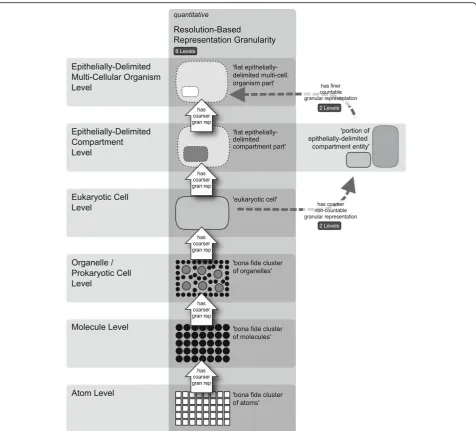
On the basis of the abovementioned characterization of building blocks one can identify the following prototyp-ical building blocks:‘atom’<‘molecule’(including metals
and ionic compounds) <‘single-membrane-enclosed
en-tity’ (i.e., most organelles and all prokaryotic cells)
<‘membrane-within-membrane entity’ (i.e., eukaryotic
cell) <‘epithelially-delimited compartment’ (i.e., some, but not all of the entities that are commonly referred to as organs) < ‘epithelially-delimited multi-cellular
organ-ism’(i.e., organisms with an epidermis).
Comparable to the hierarchy proposed by Jagers op Akkerhuis and Van Straalen [18], the resulting hierarchy of levels of building blocks ranks complexity solely in a
strict layer-by-layer fashion—it is a robust hierarchy that
does not allow for bypasses, such as the sequence‘sand’
<‘stone’<‘planet’ allows bypassing the ‘stone’ level by constructing a planet from sand alone [18]. Levels in an aggregate hierarchy on the other hand allow such bypassing (see also distinction of aggregates and levels of organization in [35]). The hierarchy of levels of building
blocks provides what Craver [23] would call monolithic
levels that reach across all material domains of reality
and that areglobally and universally applicable.Because
the concept of a building block is based on an evolution-ary interpretation, it explicitly predicts the diversification of newly evolved building blocks of a given level, with each higher level exhibiting the possibility of an expo-nentially larger number of different types of entities
as-sociated with a building block to be evolved—the
(i.e., aggregates) of those building blocks, comparable to constructions made from lego-bricks, the diversity of possible types of material entities increases even more with each newly evolved building block.
On the basis of this concept of building blocks and the implicit hierarchy of building blocks, a granular perspec-tive of levels of building blocks can be characterized using
Keet’s general formal theory of granularity [61]. The
sub-ject domainin all granularity perspectives discussed in the
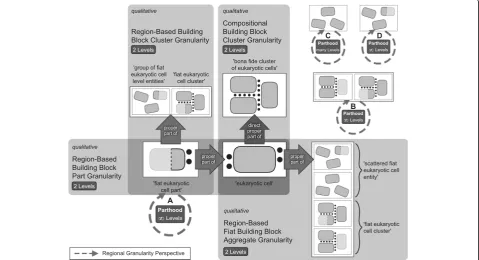
following is restricted to cumulative-constitutively orga-nized material entities. The bona fide partition of a given building block entity into its building block components represents a qualitative compositional partition (as op-posed to a qualitative regional partition or a quantitative
resolution-based partition). This compositional building
block (CBB) granular perspective is based on a direct
proper parthood relation between instances of different
top-level categories of building blocks (see discussion
below), and thus has thegranulation criterion(Fig.4):
According to Keet’s formal theory of granularity, this
perspective has a granulation of the non-scale dependent
single-relation-type granularity type (nrG [61]; also
called non-scale dependent primitive granularity type,
npG[60]). It is based on the direct proper parthood
rela-tion as itsgranulation relation. Entities residing in
adja-cent CBB granularity levels are thus related through the direct proper parthood relation. In order to constitute a CBB granular perspective, instances of at least two dif-ferent categories of building block must exist, of which instances of one category are direct proper parts of in-stances of the other. In other words, the levels of the CBB granular perspective are demarcated from one an-other according to the properties of the top-level cat-egories of building block and they are ordered from
finest to coarsest granularity level according to the direct proper parthood relation. The number of levels within the CBB granular perspective directly depends on the number of top level categories of building blocks identi-fied (Fig.4).
According to the underlying cumulative constitutive organization, for all instances of building block holds
(compositional object granularity perspective[58]):
1. An instance of a building block is not necessarily a proper part of an instance of some building block of the adjacent coarser CBB granularity level.
2. Every instance of a building block, except for those belonging to the finest CBB granularity level, has at least two instances of building blocks of finer levels as its proper parts.
3. The instance of the building block that is granulated is the maximum entity that belongs to the coarsest CBB granularity level, and every other instance of a building block belonging to this granulation is a proper part of this maximum entity. However, because this maximum entity is cumulative-constitutively organized, its direct proper parts not necessarily all belong to the second coarsest CBB granularity level.
Because each entity belonging to a specific CBB
granu-larity level represents a BFO ‘object’, we can distinguish
six different spatio-structural frames of reference, which can be ordered according to the associate CBB granu-larity levels from finer to coarser spatio-structural frames of reference: an atom, a molecule, an organelle/ prokaryotic cell, a eukaryotic cell, an
epithelially-delim-ited compartment and an epithelially-delimited
multi-cellular organism frame of reference. Each such spatio-structural frame of reference has its own set of granular perspectives. As a consequence, whereas any given material entity can belong to six different spatio-structural granular perspectives, it can belong to maximally one CBB granularity level.
Fig. 4Compositional Building Block (CBB) Granular Perspective. The different building blocks are granulated according to the direct proper parthood granulation relation (the large dark arrows). The granulation is of the non-scale dependent single-relation-type granularity type (nrG
[61]), and uses the combination of the granulation relation together with the common properties of all categories of the building block type as its granulation criterion. Due to the cumulative constitutive organization, finer-level building block entities can be considered to be parts associated with coarser-level building block entities, for instance, ECM being an associated part of a eukaryotic cell
building block directProperPartOf building block;