University of Pennsylvania
ScholarlyCommons
Publicly Accessible Penn Dissertations
1-1-2016
Common Ground: Discursive Practices and the
Building of Trust Among Participants of Executive
Training Program
Christopher Thomas
University of Pennsylvania, [email protected]
Follow this and additional works at:http://repository.upenn.edu/edissertations
Part of theAdult and Continuing Education Administration Commons,Adult and Continuing Education and Teaching Commons,Anthropological Linguistics and Sociolinguistics Commons, Higher Education Administration Commons, and theHigher Education and Teaching Commons
This paper is posted at ScholarlyCommons.http://repository.upenn.edu/edissertations/2056
For more information, please [email protected].
Recommended Citation
Thomas, Christopher, "Common Ground: Discursive Practices and the Building of Trust Among Participants of Executive Training Program" (2016).Publicly Accessible Penn Dissertations. 2056.
Common Ground: Discursive Practices and the Building of Trust Among
Participants of Executive Training Program
Abstract
In traditional academic instruction, the classroom may be viewed as a kind of speech community composed of an expert (the teacher) and those who are at various stages of socializing into the cultural models and norms of that community (students), although this is an overly simplistic and unilinear view. In executive
development programs, students are already socialized into a professional community of importance to them, and many are pursuing learning to further develop skills to be applied in the organizational contexts in which they are already embedded and deeply invested. This dissertation begins with the conceptualization that a classroom is essentially a transient social network with multiple functions, and one of these functions is to create or facilitate student access to resources that generate social capital in other networks. Additionally, a classroom is structurally a type of organization and socially a type of community. As an organization, the classroom confers identities to its participants. As a social network, the classroom can be characterized as a type of speech community. Trust is “an extensive co-belonging in a social category” (Agha, December 6, 2010, personal communication)—or community—that is represented linguistically through co-constructed and mutually-enforced social and professional registers. This dissertation argues that trust and the co-construction of a classroom register are in a reflexive relationship. Together, they form the dynamic processes of social positioning and interactional footing, ideally leading to register-mediated alignment among students and instructors. It is this register-mediated alignment that I refer to as “common ground.” Thus, the overarching question this dissertation has sought to answer is: How does the enactment of certain practices move a classroom from being simply a transient social network of diverse individuals to becoming also a speech community? Findings indicate that training and development professionals facilitate the co-construction of a learning community first by dedicating an extended period of time to get to know participants. This period of building the learning community also introduces and establishes a communicative norm of recontextualizing participant speech and reframing contexts over an extended period.
Degree Type Dissertation
Degree Name
Doctor of Philosophy (PhD)
Graduate Group Education
First Advisor Marybeth Gasman
Keywords
Subject Categories
Adult and Continuing Education Administration | Adult and Continuing Education and Teaching |
COMMON GROUND: DISCURSIVE PRACTICES AND THE BUILDING OF TRUST
AMONG PARTICIPANTS OF EXECUTIVE TRAINING PROGRAMS
Christopher Allen Thomas
A DISSERTATION
in
Education
Presented to the Faculties of the University of Pennsylvania
in
Partial Fulfillment of the Requirements for the
Degree of Doctor of Philosophy
2016
Supervisor of Dissertation:
_______________________________________ Marybeth Gasman, Professor of Education
Graduate Group Chairperson:
______________________________________ J. Matthew Hartley, Professor of Education
Dissertation Committee:
Marybeth Gasman, Professor of Education
Eric Kaplan, Senior Fellow
Dedication
I dedicate my dissertation work to my family and friends. A special feeling of
gratitude goes out to my wife, Erika, and two daughters, Emily and Kaylee. It is their
Acknowledgements
This dissertation would never have been completed without the help, support, and advice of several people. Dr. Charles E. Dwyer has been my mentor and inspiration since my first day of class at the University of Pennsylvania. His counsel has kept me going through this process.
ABSTRACT
COMMON GROUND: DISCURSIVE PRACTICES AND THE BUILDING OF TRUST
AMONG PARTICIPANTS OF EXECUTIVE TRAINING PROGRAMS
Christopher Allen Thomas
Marybeth Gasman
In traditional academic instruction, the classroom may be viewed as a kind of speech
community composed of an expert (the teacher) and those who are at various stages of
socializing into the cultural models and norms of that community (students), although
this is an overly simplistic and unilinear view. In executive development programs,
students are already socialized into a professional community of importance to them, and
many are pursuing learning to further develop skills to be applied in the organizational
contexts in which they are already embedded and deeply invested. This dissertation
begins with the conceptualization that a classroom is essentially a transient social
network with multiple functions, and one of these functions is to create or facilitate
student access to resources that generate social capital in other networks. Additionally, a
classroom is structurally a type of organization and socially a type of community. As an
organization, the classroom confers identities to its participants. As a social network, the
classroom can be characterized as a type of speech community. Trust is “an extensive
co-belonging in a social category” (Agha, December 6, 2010, personal communication)—or
community—that is represented linguistically through co-constructed and
mutually-enforced social and professional registers. This dissertation argues that trust and the
co-construction of a classroom register are in a reflexive relationship. Together, they form
register-mediated alignment among students and instructors. It is this register-mediated
alignment that I refer to as “common ground.” Thus, the overarching question this
dissertation has sought to answer is: How does the enactment of certain practices move a
classroom from being simply a transient social network of diverse individuals to
becoming also a speech community? Findings indicate that training and development
professionals facilitate the co-construction of a learning community first by dedicating an
extended period of time to get to know participants. This period of building the learning
community also introduces and establishes a communicative norm of recontextualizing
Contents
Dedication ... ii
Acknowledgements ... iii
ABSTRACT ... iv
List of Tables ... x
List of Illustrations ... xi
Chapter 1 ... 1
SIGNIFICANCE OF THE STUDY... 1
Introduction ... 1
The Classroom: A Diversity of Motives... 2
About the Executive Education Format ... 3
Cultural Barriers ... 4
Multiple Stakeholders ... 5
A Brief Note on Evaluation ... 6
Chapter 2 ... 8
A MODEL OF THE CLASSROOM ... 8
Social Networks ... 8
Social Networks and Social Capital ... 9
Language and Social Capital ... 10
Social Capital as Communicative Competence ... 12
Social Networks Can Act As Amplifiers of Perceptions ... 16
An Interactional Space ... 17
Registers and Footing ... 17
Code Switching... 21
Register-Mediated Alignment and Footing ... 22
Participant Ratification ... 27
A Semiotic Space ... 29
Registers As Ideological Phenomena ... 29
Stereotypes of Indexicality ... 31
Entextualized Effects ... 33
Text-Level Indexicality and Interactional Tropes ... 34
Register Tropes ... 35
Institutional Space ... 39
Substantive Engagement... 40
Social Institutions and Normalization ... 41
Major Constructs of the Dissertation ... 42
Power ... 42
Identity ... 45
Chapter 3 ... 51
METHODOLOGY ... 51
Classroom Discourse Analysis ... 51
Context... 52
Observable Behaviors ... 53
Genres ... 56
Intertextuality ... 57
Critical Classroom Discourse Analysis ... 59
Power and CDA ... 59
Procedural Display and Substantive Engagement ... 60
Qualitative Interviews ... 64
Identifying “Codable Moments” ... 66
Interpreting Data and Themes ... 67
Data Collection ... 67
Research Sites and Questions ... 68
Chapter 4 ... 70
FINDINGS AND ANALYSIS ... 70
Description of the Sites ... 71
Quality Healthcare ... 71
Theme 1: Establishing Valid Identities ... 77
Name Tent Cards ... 77
What’s in an Introduction? Getting to Know All about You. ... 78
What’s Family Got to Do with It? ... 86
Theme 2: Reframing, Recontextualizing, and Register-Mediated Alignment ... 94
The Role of Flipcharts ... 94
Reframe, Reframe, Reframe ... 95
Theme 3: Intentionality ... 99
Intentional Choices ... 99
Ratifying Participant Knowledge ... 101
Chapter 5 ... 103
CONCLUSIONS AND RECOMMENDATIONS ... 103
Recommendations for Research ... 106
Suggestions for Practice ... 107
List of Tables
TABLE Page
List of Illustrations
FIGURE Page
1. Model of the Classroom……….. 8
Chapter 1
SIGNIFICANCE OF THE STUDY
Introduction
In traditional academic instruction, the classroom may be viewed as a kind of
speech community composed of an expert (the teacher) and those who are at various
stages of socializing into the cultural models and norms of that community (students),
although this is an overly simplistic and unilinear view. Moreover, not just one relevant
set of norms exists. There exist many potentially relevant ones, both in the traditional
classroom and in executive training programs. However, a number of important
differences between traditional and executive students are worth considering. Traditional
students are pre-service; few have ever worked in their intended profession. They have
little or no access to a professional community or its norms save through teachers and
textbooks. In executive training, students are already socialized into a professional
community of importance to them, and many are pursuing learning to further develop
skills to be applied in the organizational contexts in which they are already embedded and
deeply invested.
This dissertation begins with the conceptualization that a classroom (physical or
virtual) is essentially a transient social network with multiple functions, and one of these
functions is to create or facilitate student access to resources that generate social capital
in other networks. Additionally, a classroom is structurally a type of organization and
participants. As a social network, the classroom can be characterized as a type of speech
community.
Trust, as it is used in this dissertation, can be understood as “an extensive
co-belonging in a social category” (Agha, December 6, 2010, personal communication)—or
community—that is represented linguistically through co-constructed and mutually
enforced social and professional registers. I will argue that trust and the co-construction
of a classroom register are in a reflexive relationship. Together, they form the dynamic
processes of social positioning and interactional footing, ideally leading to
register-mediated alignment among students and instructors. It is this register-register-mediated alignment
that I refer to as “common ground.” Thus, the overarching question this dissertation seeks
to answer is: How does the enactment of certain practices move a classroom from being
simply a transient social network of diverse individuals to become also a speech
community?
The Classroom: A Diversity of Motives
While an idealistic approach to education views the process as serving the specific
function of learning, one cannot expect that all students and faculty in any particular
program or classroom are actually dedicated to that purpose. There are many motives and
goals that have little to do with education. A student may be working towards a certificate
or degree to obtain status, especially when the training is offered at a prestigious
university such as an Ivy League school. Another goal is increased pay, and the student
may have very little desire to learn new skills—for instance, when a particular promotion
requires the employee to hold a master’s or a doctorate degree. Students may be focused
pays tuition, the student’s goal may simply be to take advantage of a high dollar value
perk. Or, as the case may be, the student does not even have a choice and must attend as
part of a corporate initiative. Students may be motivated to enroll in and attend a program
to use it as an ostensibly legitimate holiday from work and family. In short, the motives
are many and diverse. One cannot assume “We all came here to learn.” Even in the case
that all the students are highly motivated to learn, the value each places on that learning is
likely to be different. Similarly, professors may not be so idealistically motivated by a
calling to teach. Teachers of executive education courses are often compensated
handsomely for work that occurs over shorter periods of time and less likely than
traditional teachers to be rigorously evaluated. On the other hand, many professors find
executive education highly rewarding for other than financial reasons. On many
occasions, professors have told me that they find delivering education to working
professionals who have a desire to learn and apply that learning to their work lives the
most rewarding aspect of their teaching careers.
Executive students are typically much older—often a similar age to the instructors
teaching them. Because they are mid-career and have selected the education format to
facilitate career development but not to interfere with work, executive students (or their
companies) pay a premium for their education and have some well-formed, specific, and
often expectations of what they and their companies will get out of the investment that
differ from traditional students.
About the Executive Education Format
The executive format of education is designed for delivery of education to
a private training program. Although the structure of executive training varies
considerably from program to program, many utilize blended learning formats that
include synchronous and asynchronous computer-mediated communication, educational
contexts that have been understudied in terms of discourse analysis yet lend themselves
easily to data collection. Face-to-face instruction in traditional classroom settings occurs
over short periods of time, often one or two weeks per block—or less—so as not to
interfere with students’ professional work. During these short periods when students meet
in the physical classroom, the classes (or modules) are often led by many different faculty
members from a variety of academic or professional traditions.
While traditional sources of money have been through the government, research
and program grants, gifts, and income generated from university endowments, these may
not be sufficient to cover all costs. Traditional students take up a lot of resources. Many
traditional students attend on scholarships and don’t pay tuition. In short, traditional
students and programs may cost the school money. To help bring in revenue, many
schools have turned to executive programs. The brevity of programs, coupled with the
fact that top dollar is paid for attendance, means that such programs are drivers of profit
for schools that are often strapped for cash.
Cultural Barriers
As a teaching assistant (TA) and as a researcher in executive education formats, I
have had the opportunity to interact with students and faculty over three years. During
that time, I have often heard it said in various ways by students that they and the faculty
seem to speak two different languages and see the world very differently from one
time as a TA has been spent in looking for ways to translate and explain instructor and
academic requirements to students who were professional learning leaders in their own
right—people who felt that the views of learning of instructors did not fit the day-to-day
exigencies of organizational life. Furthermore, while I noticed camaraderie among most
of the students, I also noticed that they also tended to group together in predictable
gender, occupational, and cohort-oriented patterns. I also noted a salient lack of trust
between students and instructors, and it seemed that these patterns influenced the
affective and empirical stances that participants in the learning environment adopted, and
negative stances (attitudes) seemed to be associated with student and instructor levels of
involvement, as well as a decrease of ability to absorb information from others. For these
reasons, I believe that a qualitative, discourse-analytic approach would be useful to
understanding language, trust, and classroom dynamics.
Multiple Stakeholders
To further complicate matters, executive training tends to have multiple
stakeholders, many of whom function at cross-purposes. Two of these stakeholders are,
of course, the individual students and the instructors. As mentioned above, students may
have a variety of reasons—or a combination of reasons—for their participation. For the
instructors, this may also be the case. A typical executive development program is often
led by one lead instructor, and other instructors are called upon to teach or facilitate
individual modules. Ideally, the selection of instructors for these modules might be based
upon ability and specific interest in the particular topic, students, and program. The
reality tends to be less idealistic, and instructors are tapped for the role based on
time and effort that it requires. Depending on how instructors are chosen, those who teach
the different modules may not interact with one another in the planning or delivery of the
executive training.
In addition to instructors and students, organizations are important stakeholders.
Companies may have sent the student or paid for attendance. In the former case, the
leaders of the company who have sent the employee or paid for attendance may have
specific expectations about the work to be done and the outcome of the training. Even if
this is not the case, the student may have specific expectations as to how the program is
to influence his or her work situation, whether this is through the additional status that
comes with program completion or through application of knowledge gained from the
program. Other organizations that are stakeholders include the administration of the
college offering the program as well as the university within which the college is situated.
A Brief Note on Evaluation
Evaluation of the quality of executive development programs may be lacking for a
number of reasons. These include the brief duration of programs; the fact that there are
multiple stakeholders with different academic, professional, and personal expectations;
and the use of instructors on the basis of availability. Additionally, because students
come from professional backgrounds and are not socialized into academic life, an
intensely rigorous academic program may result in a high failure rate, leading potential
students to avoid the program. If the program fails to meet students’ expectations or
needs, there may be a threat to the program’s long-term viability. For instance, during
economic downturns such as the one experienced beginning in 2007, if the return on
may be less willing to lay out cash for attendance. In sum, evaluation of the quality and
effectiveness of executive programs may be difficult, but it is necessary to ensure that the
Chapter 2
A MODEL OF THE CLASSROOM
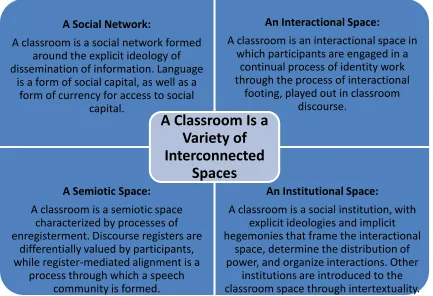
This chapter creates a model of the executive education classroom as a series of
four interconnected spaces: a social network, an interactional space, a semiotic space, and
an institutional space. These four spaces are captured in Figure 1:
Figure 1: Model of the Classroom
Social Networks
A classroom can be understood as a transient social network that begins at a
defined start point with the group of students and instructors coming together for the
transfer of information through instruction. Similarly, the social network of the classroom
can be perceived as ending after the instruction has terminated. It may be the case that A Social Network:
A classroom is a social network formed around the explicit ideology of dissemination of information. Language
is a form of social capital, as well as a form of currency for access to social
capital.
An Interactional Space:
A classroom is an interactional space in which participants are engaged in a
continual process of identity work through the process of interactional
footing, played out in classroom discourse.
A Semiotic Space:
A classroom is a semiotic space characterized by processes of enregisterment. Discourse registers are
differentially valued by participants, while register-mediated alignment is a
process through which a speech community is formed.
An Institutional Space:
A classroom is a social institution, with explicit ideologies and implicit hegemonies that frame the interactional
space, determine the distribution of power, and organize interactions. Other
institutions are introduced to the classroom space through intertextuality.
A Classroom Is a
Variety of
Interconnected
connections developed in the classroom are absorbed in the personal and professional
networks of the individuals and developed long after instruction is over. Furthermore, as
participants are socialized into new ways of thinking, communicating, and interacting,
they are introduced into the social network of a speech community, where they develop
relationships and assimilate into and reinforce communicative norms. Underlying all this
is a form of trust—a collective sense of responsibility for maintaining and enforcing the
norms that structure cooperative communication.
Social Networks and Social Capital
A classroom can be understood as a transient social network designed for the
purpose of granting accelerated access to information to be used elsewhere. Executive
training programs differ from traditional classroom environments in that in most cases the
networks tend to be more temporary. Additionally, in executive programs, learners have a
specific business network in which to build social capital via the acquisition of resources
in the learning network.
Social capital can be understood as the resources embedded in a social network to
which an individual has access. Nan Lin (2001) offers perhaps the most straightforward
and succinct explanation of the core premise behind theories of social capital:
“investment in social relations with expected returns” (Lin, 2001: 6). “Investment”
presupposes an expectation of return. Lin offers four explanations as to why investment
in social relations results in an expectation of returns:
1. It facilitates the flow of information.
3. It can enhance an individual’s standing within a network, and hence the social
capital the individual has to offer to others.
4. It reinforces identity and recognition.
Points 2–4 can be subsumed under the first point, as each represents effects of the useful
flow of information. Knowledge creation is the process of assimilating information.
Taking this view, one can say that information is a resource external to the individual and
knowledge is a resource internal to the individual. Access to information that exists as
knowledge in the minds of others requires a connection to that person in a network. Such
a network can connect the recipient to the source via language artifacts (e.g., books,
scrolls, etc.), via communication media (e.g., videos, telephones, mail), or through direct
contact. All three require a common language form for successful transmission of
information to occur, but the first two forms of information transfer do not require the
knowledge source to be part of the individual’s social network. In fact, the knowledge
source could be dead centuries or millennia before the information is transferred to a
particular person. Here, it is social networks I am concerned with. Investment in social
relations can facilitate the flow of information through increased communicative contact
with others who provide access to that information. As Lin (2001) notes, some people are
better positioned location-wise and hierarchically to be better informed about a wide
range of things that may be of use to others, as in the case of instructors or facilitators of
training programs.
Language and Social Capital
Pool (1991), arguing an economics-based approach to understanding language
speak it. A person’s language reach is equivalent to the proportion of a population with
whom one shares a language repertoire. Translated into the language of social capital,
each person has a language benefit that is an increasing function of the individual’s
language reach (Pool, 1991). As more people speak a language, the pool of knowledge
one has access to through use of that language as a communicative medium also increases.
Furthermore, projects such as socialized education become more feasible as the supply of
teachers increases and the cost of textbooks decreases. Perhaps even more importantly, a
language with a large body of speakers very easily accommodates innovation, allowing it
to be expressed explicitly because language and thought reflexively interact (Whorf,
1956). The more speakers, the more reflexive interaction there is between the language
and various ideas. In short, the more speakers there are, the more communication occurs.
Although the cognitive costs of learning a language do not decrease, the potential
benefits increase as the population of speakers grows. However, this does not mean that a
single, world-dominant “language” is an inevitable outcome, because language
repertoires are arguably always context dependent (Agha, 2007); broader contexts, by
definition, are not locally embedded ones.
Language as Social Capital and As Access to Social Capital
Building on the relationship between communication and information and on
Bourdieu’s (1984) idea of cultural capital, Thomas Clark (2004) proposes the idea of
language as social capital. Clark goes on to explore six major themes in social capital
theory, each of which relies on language. However, Clark does not make a clear
distinction between social capital and human capital, as does Burt (2001). Following Burt,
a set of communicative skills only would contribute to human capital. However, language
is not simply an individual skill or talent—it is a social construct. Language itself
provides the most complete access to social norms, conventions, and cultural information,
as well as providing access to other information possessed by its speakers.
In his discussion of register formation (register here refers to a particular style of
language usage by a subpopulation within a wider language community), Agha (2007)
identifies three ways in which using the “right” language can increase social capital:
It allows the speaker access to social practices.
Registers (or varieties of languages) provide the speaker with the ability to judge
the appropriateness of certain types of activities.
Some registers are institutionally more valued than others.
English may be more valued as a language of global communication in the wider
organization, but the language(s) and registers in a localized community, such as a
classroom, are more highly valued in that particular locale for a variety of social and
work-related activities. Agha’s ideas here are substantively identical to Lin’s (2001) list
of the value of social capital.
Social Capital as Communicative Competence
To “hear” a message or “see” information in ways consistent with speakers, a
hearer must be acculturated to the network, be it a social, business, or classroom network,
in which a unique set of communicative norms are dominant. This process takes time, as
does any process of acculturation.
Language proficiency is a blend of linguistic and communicative skills. The set of
literature is termed communicative competence (Hymes, 1972). Communicative skills
necessary for competency in any language variety include tacit knowledge of a wide
range of cultural and interactive norms shared by the community of speakers. Hymes
(1972) notes that communicative competence is not merely grammatical competence. It
also includes knowledge of appropriateness of speech, how much to speak, when not to
speak, what to speak about, and in what manner. Such skills are more familiarly
mentioned in organizational learning literature as schemas or mental maps, which consist
of tacit knowledge individuals acquire regarding how to conduct themselves in social and
communicative interactions, as well as how to encode and interpret verbal and nonverbal
behavior in culturally meaningful ways. Hymes’ (1972) description of the acquisition of
communicative competence is of a learning spiral: “The acquisition of such competency
is, of course, fed by social experience, needs, and motives, and issues in action that is
itself a renewed source of motives, needs, experience” (278).
In general, the development of new communicative competencies requires one to
develop intercultural communication strategies (Gumperz, 1972) and to have prolonged
interaction in a community, which shares a set of communicative norms, or schema. In
sociolinguistic literature, these communities are called speech communities, while in
management literature they may be termed social or business networks. Individuals
belong to multiple speech communities, or networks, and each community is defined by
norms, which are the tacitly understood rules that drive the schemas community members
use to guide their verbal and nonverbal behavior in interactions. Hymes (1972), drawing
interaction in these networks and how that interaction builds the communicative schema
necessary for building competence:
From a finite experience of speech acts and their interdependence with
sociocultural features, [speakers] develop a general theory of the speaking
appropriate in their community, which they employ, like other forms of tacit
cultural knowledge (competence) in conducting and interpreting social life
(Hymes, 1972: 279).
Hymes (1972) was concerned with making the distinction between linguistic and
communicative competence. Linguistic competence has to do with knowledge of syntax,
semantics, and phonology. One could have perfect knowledge of these topics as they
pertain to a language, yet still fail to be able to effectively communicate—to express
oneself and accurately interpret the self-expression of others. To give an example,
thousands of people worldwide have an expert knowledge of Latin. They can read the
texts written in Latin, can conjugate verbs properly, and have no problem with
articulation. However, this is a far cry from actually carrying on a conversation in the
ancient tongue with a native speaker, a Roman who used it for all his or her daily
activities. For these things, one would need to be immersed in the culture, to know
firsthand the unwritten conventions, to participate in social discourse, to understand how
the language can be bent to the will of the speaker, to create devices such as metaphor,
irony, and hyperbole—in short, one would have to be acculturated. But one does not have
to use dead languages to make this point. The same is true of any language, and indeed,
different varieties of a single language, or registers. In fact, Agha (2007) argues that it is
organization of its register(s): “Attempts to do so tend to conflate ‘grammaticality’ with
pragmatic infelicity, and, more to the point, tend to obscure the system of social relations
embedded in the denotational norms of the language” (Agha, 2007: 143).
In the context of executive development, without a sufficiently high level of
interaction in the classroom network of a training program, executive learners may not be
capable of developing a general theory of the communicative behavior, and may not be
able to fully produce and interpret the cultural behavior appropriate to the environment.
Without this tacit knowledge, learners may continue to have limited linguistic, cultural,
and semiotic awareness, finding themselves not only incapable of absorbing relevant
knowledge available in the learning program, but also engaging in avoidable
miscommunications that can lead to conflict and open hostility. For example, in
intercultural relations within global business networks, Beechler and Bird (1999)
document numerous examples of miscommunications between Japanese expatriates and
non-Japanese employees. Such miscommunications had little to do with linguistic
competence and typically stemmed from one or more participants’ lack of
communicative competence in the particular setting. If executive students are to be
effective knowledge transfer agents between the training program and their respective
companies, the development of communicative competence as it pertains to the
classroom is crucial.
While there is a lack of research on acculturation processes in executive training
programs, a direct analogy can be drawn from the business practice of expatriation, in
which an employee is transferred temporarily to a foreign subsidiary. An expatriate
organization may take considerable time to become acculturated to the organization’s
context and may never acquire a level of acculturation needed to operate successfully in
the assignment. Although some expatriates’ linguistic competence is, of necessity,
well-developed, they often may have difficulty developing the communicative competence
necessary for interaction in the new culture. For instance, acculturation brings with it tacit
knowledge of semiotic forms, which are largely unconscious, and define and limit much
of one’s social and psychological experiences (Mertz & Parmentier, 1985). According to
Lucy, “limits to linguistic and semiotic awareness have much broader significance in
accounting for human action, and the general limitations to semiotic awareness will
interact with other factors limiting consciousness to produce complex outcomes” (Lucy,
1993: 28). In other words, much of the knowledge one has access to from one’s
environment is restricted by limits imposed due to a lack of semiotic and linguistic
awareness. The knowledge is available, yet remains invisible to the expatriate without a
clear comprehension of the local culture. Expatriates have difficulty accessing local
knowledge and consequently may be unable to act in ways that they perceive are in the
best interests of their organizations.
Social Networks Can Act As Amplifiers of Perceptions
One characteristic of social networks is their ability to amplify or dampen the
power of individual perceptions such as trust. For instance, if a student has some small
amount of trust in an instructor or facilitator, by itself that amount may have no power to
change the relationship. But by drawing on the perceptions of others, an individual’s
perception of trust can be amplified to the point of changing his or her affective stance
same can go for other affective stances such as respect. Of course, negative emotions can
be amplified by drawing on the collective perceptions of others in the network as well,
resulting in a decrease in attentiveness, receptiveness, and cooperation. Additionally, an
individual’s perception may be met with the perceptions of others in the network that
contradict it. In this case, the effect may result in a dampening of a particular perception.
This quality of social networks can be linked to the social nature of learning. It can also
be linked to the concept of social capital.
An Interactional Space
A classroom is an interactional space where participants enact a variety of
communicative registers and engage in interactional footing. Interactional footing is like
a dance, where interaction is grounded in a complex series of expectations. Underlying
this interactional dance of meaning making and interpreting is trust, or expectations based
on more than mere probability. Furthermore, these expectations can only partially be
pre-determined. Much of meaning making occurs in the moment, as behaviors and their
interpretations add layers of meaning and influence subsequent behaviors. If this process
of meaning making were based purely on an interpretation of the current state, it could be
interpreted as a Markov process—a process in which the probability of the next state (or
behavior) is determined solely on the properties of the current state. As the following
section will show, this is not the case.
Registers and Footing
Halliday and Hasan argue that function is a fundamental principle, not simply a
use, of language. Their analysis identifies the four components of the semantic system of
describe as “strands of meaning…interwoven in the fabric of discourse” (Halliday &
Hasan, 1989: 23). Agha uses the metaphor of “lamination” to indicate that each layer of
meaning is not only additive but essentially inseparable once applied (Agha, 2007). Every
instance of language use from this perspective is inherently multifunctional.
Ways of speaking among groups can vary in terms of prosodic features (e.g., pitch,
intonation), syntactic features (e.g., tense formation), lexical repertoire, and such things
as timing and volume. A register is, broadly speaking, a subset of language used by
people who share communicative norms, often for a particular purpose or within
particular social, regional, or functional contexts. The social functions of language,
according to Halliday (1973), determine the forms that ‘diatypic’ language varieties, or
registers, take. A community’s register range, then, is determined by the variety of uses to
which language is put. Uses more commonly enacted within a community will be present
in the register repertoires of most, if not all, individuals. Some registers are ‘rarified’ and
are ‘designed’ for highly specific uses allowed by a select few people. Registers may not
‘confer’ identity, but they do act as badges or emblems that signify the validity of a
particular social identity (Agha, 2007). For example, secret and semi-secret societies rely
on a restricted set of linguistic and nonlinguistic signs to delineate a boundary between
them and outsiders. Another example is the so-called “gay-dar” that allows homosexuals
to identify potential partners. The display of these signs, or a combination of them, at the
right time and in the right order signals membership within the group. The use and
recognition of these signs also explains how group members who have never met
In his discussion of register formation, Agha (2007) identifies three ways in
which using the “right” language can increase an individual’s access to social power.
First, it allows the speaker access to social practices. Second, registers provide the
speaker with the ability to judge the appropriateness of certain types of activities. Finally,
some registers are institutionally more valued than others. A person’s register range
“equips a person with portable emblems of identity, sometimes permitting distinctive
modes of access to particular zones of social life” (Agha, 2007: 146). Thus, this range
influences what activities one is legitimately able to participate in, as well as social
positioning. Social positioning is a process in which recognizable categories of identity
become applied to an individual, either through implicit or explicit means (Wortham
2004). “The social positioning of self and others” is identity (Bucholtz & Hall, 2005:
586). However, the use of a particular register is not necessarily felicitous. The con artist
or the actor might spend considerable time perfecting a register in order to appear to have
legitimate access to a particular activity or social positioning. Alternatively, a register
could be mocked, explicitly violated, or accentuated for a variety of reasons, such as
rejecting a social position or making fun of others (Agha, 2007). Distinct registers may
also be mixed in cases where emblems of two or more identities serve useful functions.
Biber and Finegan (1994) argue that the term register “entails text and implies a
relationship between text and context” (p. 7). In order for a register to be a salient
manifestation of a language variety, there must exist samples of text, whether written or
spoken, in which unique constructions are present. In addition, these constructions are
linked to particular contexts in which they communicate, as Agha (2007) points out,
participants and things, ideas, activities, etc. Insomuch as an individual speaker has
access to a repertoire of registers, or ways of speaking, she also has a variety of ways of
enacting and presenting different identities, depending on the context of communication,
the topic, and the communicative intent. To the extent that the selection of a register
contributes to the identity and the ideology that one wishes to present, the choice of
register and the form it takes is listener directed. For example, many medical doctors to
communicate their knowledge and expertise use vastly different ways of speaking and
behaving. One of these is reserved for patients and is described in phrases such as
“bedside manner,” while others are used with other medical professionals—perhaps one
way of speaking with general practitioners, another for communication with nurses, and
still another for interaction with colleagues in the same specialty.
Hymes’ (1984) preferred term for register variation is “verbal repertoire,” but the
concept remains essentially the same: “No human being talks the same way all the time”
(p. 44). He goes on to argue that verbal repertoire must be the focus of inquiry if one is to
understand the abilities of individuals and of communities. Such an undertaking would
focus on a cross-section of standard linguistic features, as well as include ethnographic
inquiry to connect registers to roles, statuses, activities, settings, “and other characteristic
features of voice and discourse” (Hymes 1984: 44). Such an enterprise is, in essence, a
sociolinguistic inquiry into the division of labor in society. Ure (1982) argues: “Each
language community has its own system of registers…corresponding to the range of
activities in which its members normally engage” (p. 5). A shared register between
co-communicants would indicate a shared identity in relation to an activity, while the use of
different activities. In other words, the differential use of language is indicative of
engagement in different types of labor. This is very much in line with the views of
Charles Goodwin over the years (e.g., 1994, 1996, 2000, 2007), who has argued that
language and the meanings it indexes can only be understood as a situated practice.
Code Switching
Blom and Gumperz (1986) identify two different types of code switching in their
research. The first type they termed situational switching, and it involved alteration in
dialect in an individual’s speech that correlated with contextual features in the social
situation. Context here referred to the people, the social setting, and the temporal
boundaries of the event. For example, a code switch might indicate changes in
participants, where a new participant has an outsider status. In other words, changes in
the context might result in the introduction of people who are not ratified users of a
particular register. Ratification includes more than the ability to speak or understand the
language variety, it also includes implicit permissions to participate, which are given or
withheld by other in-group members. In other cases, switching indicates a shift between
home and workplace. Bringing one’s work home includes more than doing work at home,
it also includes the thought and speech patterns that accompany work. Leaving work at
work, then, means switching to a different register outside of the work environment. In
the Japanese language, these kinds of switches are part of a system referred to as
omote/ura (roughly translated as outside/inside). Certain words, behaviors, and entire
registers are used only in specific company and settings (Bachnik, 1992; Maynard, 1997).
The other kind of switching that Blom and Gumperz (1986) refer to is
opposed to the social situation. Agha (2007) disagrees with this division of situational
and metaphorical switching because it is based on the assumption that “social and
referential features of talk” are independent—that they are not linked in some way. Agha
argues that they are “intimately linked” in many ways (p. 141). Shifts in talk that involve
the same people, contexts, and temporal bounding are endemic of the process of
interactional footing. These shifts, Goffman (1974, 1981) would attribute to changes in
frame. Agha (2007) notes that these shifts in referential stances are displays that create
different levels of alignment among participants:
“A register exists as a bounded object only to a degree set by sociohistorical
processes of enregisterment, processes whereby its forms and values become
differentiable from the rest of the language (i.e., recognizable as distinct, linked to
typifiable social personae or practices) for a given population of speakers” (p.
168).
Hence, shifts in register would indicate shifts in context in the sense that different
sociohistorical processes, ideologies, and, as a result, communicative norms and
interaction patterns come to bear on the talk.
Register-Mediated Alignment and Footing
Registers are dynamic; they are reflexive cultural models of communication
(Agha, 2002, 2005). Encounters with registers allow individuals to establish footing with
co-communicants and to develop alignment through the establishment and reproduction
of communicative norms, the sharing of information, and the strengthening of social ties.
Register-mediated alignment is a process of group homophilization centered on the
(1974) proposes, is a process that results in speaker-hearer alignment. The process is
reflexive, and changes in footing occur continually throughout any communicative event.
Not only do speakers and hearers align to each other, they do so in a way that is mediated
by a continually changing context. These changes in footing, inasmuch as they are
successful in developing and maintaining speaker-hearer alignment, are processes of
enregisterment in which communicative norms are identified, established, and
maintained.
Goffman (1981) tells a story of an encounter in the early 1970s between President
Nixon and a young White House press journalist named Helen Thomas. At the end of the
press conference, the president spoke directly to Ms. Thomas about the fact that she was
wearing pants and how it reminded him of being in China. Nixon, a conservative,
preferred women in dresses, and he ordered her in a friendly way that that was the attire
he expected from her in the future. Goffman’s point in the recounting of this story is that
certain people, by virtue of their position, have the power to change the entire nature of
an encounter. In this case, President Nixon was, without effort, able to take Helen
Thomas out of her professional role (that of a journalist covering the news) and recast her
in a sexual, domestic one. The president had the power to choose the discourse—to
change the current one to another that suited his values.
What President Nixon did was change the footing. One of the reasons he could do
this is because of the power he held. But another reason was that he was indexing a social
definition that women must always be ready to receive comments on their “appearance”
(Goffman, 1981: 125). While social changes over the past few decades have taken much
need look no further than the 2008 presidential primary and general election, when both
Hilary Clinton and Sarah Palin both received daily commentaries on many of the news
channels regarding what they wore and how they looked. Their clothes became part of
the campaign. While they were talking about policies, all somebody from a newspaper,
magazine, or television show had to do to change the footing from one of politics to one
of trifles was to mention Hilary’s pantsuit or Sarah’s wardrobe—to change them from
being participants in a discourse to being the object of it. Is it not surprising, given this
fact, that neither made it to the office they were seeking?
The ability to choose discourses is a form of power. The other person in an
encounter must constantly be on the ready to accommodate the shift in discourse—to find
their footing—while at the same time may have no power to rebel from it. While frames
are “the mental structures that shape the way we see the world” (Lakoff, 2004), footing is
the public stance we, as participants in a communicative interaction, take with regard to
others, to how the discourse is framed, and to the semantic and emotional content of an
utterance (Levinson, 1988). Within a particular frame, footing is the “relationship
between the objects and/or elements within the frame, their footing vis-à-vis one another”
(Wine, 2008: 2).
Goffman (1981) explains that when a person changes footing, it is also implied
that along with it is a change in the alignment the person takes with regard to themselves,
others, and the management in “the production or reception of an utterance” (p. 128).
These changes in alignment can be seen in code switches—the switch from one variety of
language to another—which Goffman argues is a constant feature of just about any
from one major language to another, such as from French to English. It includes
switching from a professional register to small talk, or when signaling movement from
one type of participation structure to another, such as from a lecture to a discussion, even
though both might utilize a particular academic register. Gumperz (1976) found code
switching everywhere he looked. What’s more, in most cases, participants seldom pay
any attention to the fact that they are making these sometimes significant switches in
code and changes in footing, each keeping up with the other as if absolutely nothing were
amiss. Taking this perspective, then, I argue that register-mediated alignment occurs both
within and across the different registers appropriated into a discourse. It involves keeping
up with code switches as they occur. It is a skill participants bring with them to
communicative encounters, but it is also a skill that participants learn during the course of
each individual encounter as they make sense of the unfolding discourse.
Central to Goffman’s (1981) discussion to footing is the recognition that the
traditional speaker/hearer dichotomy is insufficient to understand participation structures.
For instance, recipients of speech can fall into multiple categories. They can be official or
unofficial. An official recipient is one who has been, through some form of interactional
mechanism, “ratified,” as an intended recipient—as someone who is being addressed.
Furthermore, in talk that occurs in groups, there may be a host of addressees constituting
an audience. Even then, there are times where a speaker selects one or two persons as an
intended focused recipient, such as when a professor singles out a student in class. The
other participants retain their ratified status, but are being indirectly addressed. A
bystander or overhearer may also be indirectly addressed, as when a communication is
or visual range who are not privy to the communication but nevertheless can overhear or
eavesdrop, especially in a public sphere. In many cases, these unratified participants have
an effect on the communication.
A common characteristic of certain types of groups (and to some degree a
description of all groups) is the tendency for them to bifurcate, to divide into subgroups,
each with their own talk occurring. Another possibility is for there to be sideplay,
crossplay, and byplay. These are “subordinated” forms of communication of particular
types. Sideplay is when bystanders talk with each other, often in quiet tones, in order to
avoid breaking into the talk of ratified participants. Crossplay occurs when there is
communication between ratified participants and bystanders. Byplay occurs when
communication involves a subset of those participants who are ratified. These forms of
subordinated communication may occur openly or may be surreptitious, in which case
Goffman (1981) terms it as “collusion.” Various mechanisms can be employed here,
including loading words, phrases, and gestures with multiple meanings that may be
interpreted differently by the different ratified and unratified participants, as in the case
with innuendo.
Goffman (1981) offers a framework for the study of footing in this dynamic
scenario of communication that he has presented. The first step is to take a metaphorical
“cross-section” of the communicative interaction. Then, each member of the interaction
is identified in terms of his or her ratified or unratified participation status in relation to
the particular utterance. The grouping of all the participants and their individual statuses
is a “participation framework” for the cross-section of speech. To this can be added
discourse and by the talk at that particular moment within the discourse, as well as the
institutions that give structure to the whole interaction.
Participant Ratification
Goffman (1981), lecturing on the topic of lecture as a form of talk, begins by
calling attention to the institutional frame that links speaker and audience, and then he
notes that certain topics are not typically permissible. Violating these permissions is a
breach of contract, in Goffman’s view. In other words, ratified participants in a talk that
occurs within a particular institutional frame are bound by a contract. I suggest that this
contract, if it exists, is akin to what Searle (1969) terms “felicity conditions.” These
felicity conditions are restrictions that require users of particular speech acts to meet
certain criteria, such as having authority to perform the act. For instance, only a restricted
set of professionals (e.g., clergy, justices of the peace) are allowed to proclaim two
individuals married, and even then, other contextual conditions must be met, such as
willingness on the part of the two people getting married, submission to applicable laws
(e.g., a marriage license, blood tests), the presence of witnesses, and so forth. When these
conditions are met, institutional authority exists and the utterance has power.
However, breaking frame, or violating the institutionally-ratified contract, carries
with it important functions and meanings. It calls attention to the frame itself, allowing
participants to examine and potentially call into question the validity of the frame, the
power for which the institution is a place marker, and the organization of the institution
itself. For these reasons, breaking frame—violating the “contract”—can become a
instructor and the students with the means to collectively work toward development of
alternative ways of interacting that may be better suited to the learning context.
Institutions bear on the participation structure and the communication in an
interaction. The classroom is an organization designed for the purpose of serving the
values and meeting the needs of the participants. This organization takes place within
different levels or layers of institution, such as the particular education or training
program, the school, and the social institution of education. I argue that to a certain
degree, each of these layers of institution has a hand in ratifying participation in the
organization called a classroom. Indeed, their effect in ratifying participants and
participation structures is so powerful that the participants themselves may end up doing
very little work to ratify themselves or others in the ensuing talk, slipping easily into the
roles that have been preordained for them as students and instructors. However, it is my
contention that in adult learning such as executive development programs, the different
institutions brought to bear on the organization can be a source of conflict. This is
especially true because the institutions themselves may be in conflict. When this occurs,
neither professors nor students can afford to rely on these institutions to ratify
participation. Rather, the classroom should be seen as necessarily co-constructed by the
participants in recognition of the different institutions that may be in conflict. The need
for a mindful process of ratification can be seen in the relative presence or absence of
certain types of interactions in classrooms. In particular, the use of extended introductions
is something that is often used in the introductory phase of graduate-level courses and
adult learning programs, but is relatively less used in undergraduate courses, and is
activity is reflective of a need to acknowledge the identities, motivations, values, and
other facets of the different participants, and is itself an explicit means of self- and
other-ratification—an “onboarding” process to the classroom organization, if you will.
Program instructors use different methods of ratifying participants. One program
in Wharton Executive Education has a five-hour introduction process for a three-week
course. Other programs merely have a round robin of introductions, where participants
state their names, their organizations, and their reasons for being in the class. But what is
relatively certain is that instructors can ill afford to rely on institutional ratification and
forgo some method of explicitly bringing participants in executive development programs
into the discourse. Additionally, participants can and often do selectively “unratify”
themselves in the participation structure. They may do so surreptitiously, such as by
excusing themselves from the classroom to take a phone call or by absorbing themselves
in work via computer or other technologies. They may infrequently openly engage in
protesting the discourse and participation structure. In such cases, some might say that
the organization itself is in crisis. Whether this is the case or not, the result may be that
very little learning actually occurs when the institution that organizes participation breaks
down. Such an organization is no longer serving the values of the members. It can hardly
be said to be a classroom at all.
A Semiotic Space
Registers As Ideological Phenomena
An institution is, broadly speaking, a network or collection of rules, norms,
processes, and beliefs that serves to unify a group and differentiate it from others. The
language is, in this sense, an institution. Inasmuch as institutions are evaluable, they act
as unifying ideologies, whereas a non-evaluable institution is hegemonic in nature. The
building and maintenance of register-mediated social identities is made possible through
the evaluative behavior of a register’s users and of others. Ideologies are also power
structures, which is to say that the system of normative values serves the interests of
some more effectively than of others, resulting in inequality.
Register formations are under constant pressure (both from within and without)
that results in diachronic changes of the register system as layers of sociohistorical
context are “laminated” onto the formations. The impetus for reanalysis comes from
within the register as the lack of equality leads to competing valorizations of semiotic
forms. The products of competing reanalyses synchronously co-exist within a register as
proponents of each vie for its supremacy. This may (and often does) lead to rifts that
often occur along predictable lines, resulting in polarization. During the 2008 election
cycle, there was increasing evidence of polarization along generational, geographic,
racial, economic, sexual, and educational lines among those self-identifying as
Democrats. Functional re-analyses and counter-valorizations have been ongoing among
Republicans, as well, where there has developed a rift between traditional conservatives
and neoconservatives. When such rifts continue to widen, a schism may occur within the
ideological registers named after the two political parties. Evidence of such a potential
schism can be found in the emergent “Tea Party” movement and the recently emerged
“Green Party,” to name two salient examples.
Registers are bounded objects only to the degree set by sociohistorical processes
and from the language as a whole. Dimensions along which registers are organized and
may change are:
Repertoire characteristics (size, grammatical range, and semiotic range)
Social range (indexical focus, icons, and the positive and negative values
associated with the register)
Social domain (domains of recognition and fluency)
Stereotypes of Indexicality
Communication transmission is a process that is dependent upon linkages
between semiotic events for a group of co-communicants. A stereotype exists where
linkages between semiotic events are commonly understood before any application of
contextual effects. When these stereotypes occur for one particular classification of
people often enough to differentiate the classification from other classifications, the
system of linkages constitutes a unique register.
Indexical stereotypes provide a framework for normalizing the usage of register
forms. Metapragmatic stereotypes, or indexical stereotypes, set defaults for the construal
of relevant social contexts of speaking. They exist socially; their defaults are set by
institutional processes that link figures of personhood and relationship to specific,
performable signs. Furthermore, they exist for a social domain of users who, through
socialization (i.e., through shared sociohistorical contexts), come to construe particular
signs in relatively similar ways. The indexical stereotypes of a register are evidence of
the relative stability of the register. A register’s social existence must be confirmed by the
evaluative acts of others. When others’ apparent or expressed “construals” conform to
A group identity develops. The use of the register acts as a social passport, allowing
“entry into a range of social practices” (Agha, 2007: 147). The conventions of a register
allow for users to make judgments of appropriateness regarding various behaviors and the
activities made up of them. Additionally, users of the register signal their awareness of
and ability to act within these conventions.
Stereotypes of indexicality allow for the metapragmatic activity of talking about
signs (i.e., meaning), an important aspect of the reflexive nature of register formations.
One genre in which this becomes quite obvious is in the discussion of the norms of
etiquette. Whether she realizes it or not, Miss Manners (nee Judith Martin) is one of
America’s top experts on social registers—especially registers of high-status social
identities. One excerpt I recall from her Guide to Excruciatingly Correct Behavior
discussed the difference between old and new money, or the dynastically wealthy and the
nouveau riche (Martin, 1979). Miss Manners argues that the semiotic registers of these
two groups differ in subtle but important ways, one of which is whether one’s silver is
bought or passed down. New silver (or furniture, or jewelry), therefore, becomes a sign of
someone having been poor (“poor” being anyone who is not independently wealthy), and
thus a “social climber.”
To provide another example, forensic profilers are experts of register analysis.
Given a set of behaviors, it is their job to identify the possible registers to which an
individual lays claim by determining what metapragmatic stereotypes the behavioral
signs index. Through this process, they attempt to build a comprehensive identity, called
a profile, of the person under investigation. Behavioral signs may provide information as
background, geohistorical background, work background, interests, religious and political
views, sexual orientation, and any number of other identities. All this may be available,
provided that one has the ability to recognize the linguistic and non-linguistic signs that
pertain to each type of identity enactment.
A sign out of place calls attention to itself. If it is egregiously out of place, it
becomes a fatal error, drawing a clear and often insurmountable distinction between the
person’s identity and that of the group. For instance, a lawyer must not only have a
command of legalese, he must also know when, where, in what order, and how often to
use legal jargon. In addition, non-linguistic behaviors, including gesture, posture, and
dress, round out the picture. The ability to do so allows one to differentiate lawyers from
legal-drama fans, but it can also allow one to differentiate courtroom lawyers from office
lawyers, criminal lawyers from civil lawyers, and prosecutors from defense lawyers.
Entextualized Effects
The term textuality refers to the co-occurrence of a register “token” with other
signs to form co-textual context. Registers also have a sociohistorical context that is
enacted simply through the use of the register. Indexical stereotypes are default settings
for construal that exist before entextualized effects are factored in during the process of
construal. The standing-for relationship is always susceptible to change in what
significance is assigned to the cultural form. In short, this is because context is “sticky.”
Textual effects are applied to each new construal, and some residual of prior textual
effects becomes part of each new construal as well. A cultural form does not have to take