Engineering Research And Development (R&D)
Infrastructure For Developing Economy
Ebhota, Williams S
Abstract: A healthy and effective R&D in engineering will guarantee large, strong, diversified, sustainable and competitive economy that will effectively harness the talents and energies of its people and responsibly exploits its natural endowments for a high standard of living and quality of life. This work discusses applied, fundamental, descriptive, analytical, qualitative, quantitative, conceptual and empirical research as various categories of research and takes a look at the relevance and the role R&D in engineering plays in national economic growth. It considers tertiary institutions, specialised research institutions and industries as the primary areas where R&D activities take place and pointed out inadequate funding, government‘s insensitivity and lack of political will and inadequate R&D human capacity as the factors that have bedevilled R&D in Nigeria with consequence of low source of new product and processes, improved products and source of new market. The paper went further to discuss capacity building in reverse engineering, emerging technologies in manufacturing, R&D personnel, research facility and pro R&D government policies and concluded that the nation‘s future global competitiveness depends on R&D in engineering.
Key words: R&D, Infrastructure, Engineering, technology, Research
————————————————————
1.0 Introduction
R&D means investigation into new or improved products: in business and industry, the work of investigating improved processes, products, and services and of developing new ones (Microsoft Encarta, 2009). Research may be defined as systematic gathering of data and information and its analysis for advancement of knowledge in any subject. Research attempts to find answer to intellectual and practical questions through application of systematic methods. Research seeks to make basic discoveries and uncover new principles or facts so far unknown or unrecognized. Industry is aware that tomorrow‘s profit depends to a large extent on today‘s research and the fact that money invested now in R&D probably will not generate income for several years to come. One thing for sure is that without R&D effort, there may not be any future for the company. In the same way, socio-economic strength of a nation depends largely on R&D. United Nations Educational, Scientific and Cultural Organization (UNESCO) Institute for Statistics, (2010), in a study ―Measuring R&D: Challenges Faced by Developing Countries‖ (Technical Paper 5) states ‗‘Innovation is now universally regarded as an engine of economic growth in developing as well as developed countries – it is therefore an important driver of poverty alleviation‘‘. A national healthy and effective R&D will guarantee large, strong, diversified, sustainable and competitive economy that effectively harnesses the talents and energies of its people and responsibly exploits its natural endowments for a high standard of living and quality of life to its citizens‖ (Otive, 2010, Nigeria Vision 2020, 2010)
The Nigeria Vision 2020 economic transformation blueprint is a ten year plan for stimulating Nigeria‘s economic growth, which is anchored on the Nigerian Economic Empowerment and Development Strategy (NEEDS II), has the following measuring parameters:
i. Macro Economy ii. Polity
iii. Education iv. Agriculture
v. Health vi. Infrastructure vii. Manufacturing
The above key parameters are Science, Engineering and Technology (SET) dependent. Advancement in SET depends on R&D. This means that, there will be no meaningful mark in the key measuring parameters of Nigeria Vision 2020 if we fail to increase the rate and the importance of R&D in SET. R&D is the driver that moves and nurture national technological advancement. Once R&D fails, innovation comes to a halt and technological advancement becomes a mirage. To move to the next level, we must consciously aimed at discovering solutions to problems or creating new products and knowledge, through systematic and logical activities, geared towards national economic development. It is through this means that countries can experience future growth and be able to expand their economies. This transformation can be considered as Technological Advancement.
2.0 Types of R&D
Research types can be classified in many different ways. Some major ways of classifying research include the following.
Applied versus Fundamental Research Descriptive versus Analytical Research Qualitative versus Quantitative Research Conceptual versus Empirical Research
2.1 Fundamental Research versus Applied: Pure or Fundamental Research and Applied Research
Fundamental research is carried out as more to satisfy intellectual curiosity, than with the intention of using the research findings for any immediate practical application. It _____________________
Ebhota, Williams S is a staff National Engineering Design Development Institute (NEDDI), and he is currently pursuing Doctorate degree program in design and production engineering in a Anambra State University, Uli, Nigeria.
is an investigation undertaken primarily of the sake of knowledge itself. In this type of research, there is no consideration of commercial gains. The effort is directed towards learning the laws of nature or the detailed study of accepted theory in the light of development of new knowledge. The direction of any pure research is not specified in advance but is determined as the work progresses. Traditionally, Pure Research has resulted in ‗Breakthroughs‘ which have been recognized by coveted awards like the Nobel Prize. Applied research is carried out to find answers to practical problems to be solved and as an aid in decision making in different areas including product design, process design and policy making. Typically, applied research finds uses for results of fundamental or pure research. This is primarily directed towards solving some specific problem which has a practical purpose rather than to acquire knowledge for knowledge's sake. One might say that the goal of the applied researcher is to improve the human condition. Several researchers feel that the time has come for a shift in emphasis away from purely basic research toward applied research. This trend, they feel, is necessitated by the problems resulting from global overpopulation, pollution, and the overuse of the earth's natural resources, global warming, etc.
Fundamental or Applied research can be carried out in the following research forms:
Product Research Manufacturing Research Materials Research Market Research Operations Research
2.1.1 Product Research
This is an attempt to uncover new product ideas which will meet the requirements of current as well as prospective customers. In expanding product research, efforts may be directed toward new and different products, new uses for present products or utilization of a by-product. The stimulation for product research may come from results of some pure research effort, some ideas from customers, needs to utilize special technical skills available in a company, desire to expand product line in a feasible direction, etc.
2.1.2 Manufacturing Research
The development of tools and equipment, handling devices, and methods of manufacture which can result in costs reduction and increase productivity is termed manufacturing research. Manufacturing research is carried out parallel with product research as the feasibility of product research depends on the feasible outcome of manufacturing research. Fiber optics, Robotics, Humanoids, Just in Time (JIT) manufacturing, etc. have added new focus in the area of manufacturing research.
2.1.3 Materials Research
This is linked with both product research and manufacturing research as the discovery of new materials has impact on both. The jet and missile age has put great emphasis on materials research leading to success of many space programs. Superplastic steel has made possibility of casting complex shapes such as precision gears by eliminating the
need of costly final machining and joining commonly required with very hard forged steels.
2.1.4 Market Research
Market research is a systematic, objective collection and analysis of data about a particular target market, competition, and environment. It always incorporates some form of data collection whether it is secondary research (often referred to as desk research) or primary research which is collected direct from a respondent. The purpose of any market research project is to achieve an increased understanding of the subject matter.
2.2 Descriptive and Analytical Research
Descriptive research concentrates on finding facts to ascertain the nature of something as it exists. In contrast analytical research is concerned with determining validity of hypothesis based on analysis of facts collected.
2.3 Qualitative and Quantitative Research
Qualitative research is research undertaken to gain insights concerning attitudes, beliefs, motivations and behaviours of individuals to explore a social or human problem and include methods such as focus groups, in-depth interviews, observation research and case studies. This is research concerned with the measurement of attitudes, behaviours and perceptions and includes interviewing methods such as telephone, intercept and door-to-door interviews as well as self-completion methods such as mail outs and online surveys.
2.4 Conceptual and Empirical Research
Conceptual research is involves in investigation of thoughts and ideas and developing new ideas or interpreting the old ones based on logical reasoning. In contrast empirical research is based on firm verifiable data collected by either observation of facts under natural condition or obtained through experimentation.
3.0
The
status
of
R&D
in
Nigeria:
Contemporary R&D Issues in Nigeria
Basically R&D is associated with the following activities: Source of new product and processes
Improved products and processes Source of new market
The aforementioned activities are pivots to product development and innovation which provide a pedestal for industrialisation. Industrialisation gives room for global stratification into underdeveloped, developing and developed economies. Subsequently, the level of these activities places igeria in the category of developing economy. New product development (NPD) is widely recognized as a key to corporate prosperity (Musa, 2008). In recent years, innovation has taken the centre stage as the main driver of economic growth – be it incremental or radical innovation. Innovation activities include
Knowledge generation and transfer, The purchase of technologies,
As such, the ability to perform, commission, measure and manage R&D is an important facet of economic competitiveness and national development (UNESCO Institute for Statistics, 2010). Innovation has been recognised universally ‗as an engine of economic growth in developing as well as developed countries‘ – it is therefore an important driver of poverty alleviation. From a global perspective, R&D is concentrated in the triad countries of the United States, the European Union and Japan. In the developing world, R&D expenditure and output are also concentrated in a relatively small group of countries in each region (UNESCO Institute for Statistics, 2010). In many developing and emerging economies, the business sector performs much less R&D than the government and higher education (public) sectors. This is particularly evident in agricultural and natural environment research where there may be strong links between local research institutions established before independence with parent institutions
abroad. At the macroscopic level, the following geographic regions are dominant as the main locus of R&D activity:
Western Europe (particularly Germany and the UK),
USA (with a focus on the Northeast and the West coast),
Japan (agglomeration around Tokyo and Osaka), Southeast Asia (in particular the ‗‗tiger‘‘ countries,
as well as India and China).
3.1 R&D in Engineering
Primarily, R&D in engineering activities are expected to be carried out in these three places tertiary institutions (university and polytechnic), specialised research institutes and industries. Contrarily, these areas have bedevilled by several inhibiting factors to the level that R&D in the country is totally gross. This has affected the growth of science and engineering in Nigeria. Technology never thrived in a country where science and engineering are starved of ‗Effective R&D‘. The latest development demonstrates the Federal Government‘s sloppy handling of tertiary education. Speaking recently at the Ahmadu Bello University, Zaria, Kaduna State, President Goodluck Jonathan admitted that his administration was incapable of fully funding its universities (Punch Newspaper, 2011). There was consternation when the Nigerian University Commission (NUC) reported that no Nigerian university (or other tertiary institution) was listed among the top 1,000 schools around the world in terms of publication of research output (Chiemeke, Longe, Longe, and Shaib, 2009). This is just the situation in Nigeria; very pathetic! The two of the core areas (Tertiary and Specialised Research Institutes) for R&D as identified above, have similar limitations; inadequate funding, inadequate qualified R&D personnel, overloaded teaching and administration schedules, difficulty in accessing the little available research funds and diminishing of seasoned and senior researchers in the country due to brain drain.
3.2 Funding
The landscape of R&D expenditure is changing, which affects the collection of data. R&D used to be largely funded by the government but now new sources of funds are emerging – foundations, non-governmental organizations (NGOs) and especially foreign organizations play an important role.
3.3 R&D in Nigerian Universities
It has been said that no nation can develop beyond the level of its education. In other words, education is the livewire of any serious nation which aspires to attain the highest level of development (Adewale, 2011). The innovation systems in emerging economies and developing countries like Nigeria are more fluid and, in some cases, depend on a relatively small number of very disparate institutions. But developed countries with a strong national scientific function have a critical mass of relatively stable, well-resourced research and higher education institutes, and well established science governance systems. While universities enjoy adequate subsidy and support in advanced nations, in Nigeria, budgetary allocations to tertiary education have been depleting. While world-class universities are adequately funded through endowments and grants, Nigeria‘s university system remains grossly underfunded Most Universities and Research Institutes carrying out research in science and engineering do not have strong incentives or the facilities to conduct further development or apply research results to practical development. In Nigeria, one might not be too wrong to saying that the policy of the successive government in the country is that the goose that lays the developmental golden egg must be killed so that it does not turn around to criticize the misappropriation and looting of its resources.
Or how else does one explain the continuous neglect of the education sector whereby students, who are the nation‘s assets and bridge to the future, are made to bear the brunt of our government‘s insensitivity while the lecturers and other workers, who train the future wealth of the country, are made to wallow in abject poverty (Adewale, 2011).
4.0 Way Forward: R&D Needs in Nigeria
4.1 Manufacturing
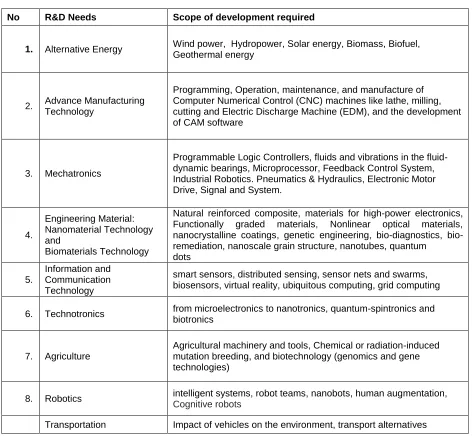
To be competitive in the global economy, manufacturers will need to focus their research and development efforts in areas that are most likely to deliver economic benefits. Specific developments are needed to efficiently and rapidly stimulate the national economy and to promote the transition to a new manufacturing paradigm. There are seven areas of R&D needs that will provide the foundation for manufacturing success towards actualisation of vision 2020:20 in 2020. The priority areas in Nigeria should be focused on global emerging technologies:
Renewable/Alternative Energy
Advance Manufacturing Technology (AMT) Information Technology
Mechatronics
Engineering Material-Nanomaterial, Biomaterial and other knowledge based materials
Table 1: Areas of R&D need and scopes.
No R&D Needs Scope of development required
1. Alternative Energy Wind power, Hydropower, Solar energy, Biomass, Biofuel, Geothermal energy
2. Advance Manufacturing Technology
Programming, Operation, maintenance, and manufacture of Computer Numerical Control (CNC) machines like lathe, milling, cutting and Electric Discharge Machine (EDM), and the development of CAM software
3. Mechatronics
Programmable Logic Controllers, fluids and vibrations in the fluid-dynamic bearings, Microprocessor, Feedback Control System, Industrial Robotics. Pneumatics & Hydraulics, Electronic Motor Drive, Signal and System.
4.
Engineering Material: Nanomaterial Technology and
Biomaterials Technology
Natural reinforced composite, materials for high-power electronics, Functionally graded materials, Nonlinear optical materials, nanocrystalline coatings, genetic engineering, bio-diagnostics, bio- remediation, nanoscale grain structure, nanotubes, quantum
dots
5.
Information and Communication Technology
smart sensors, distributed sensing, sensor nets and swarms, biosensors, virtual reality, ubiquitous computing, grid computing
6. Technotronics from microelectronics to nanotronics, quantum-spintronics and biotronics
7. Agriculture
Agricultural machinery and tools, Chemical or radiation-induced mutation breeding, and biotechnology (genomics and gene technologies)
8. Robotics intelligent systems, robot teams, nanobots, human augmentation, Cognitive robots
Transportation Impact of vehicles on the environment, transport alternatives
4.2 Future and Emerging Technologies (FET)
FET is the incubator and pathfinder for new ideas and themes for long-term research across all disciplines. FET aims to (European Commission, 2012): Empower researchers to jointly explore radical directions that may not fit within current academic research agendas. Likewise, high-tech, research-intensive SMEs are instrumental for pushing forward alternative visions and for turning novel research results into a competitive advantage for creating new markets. Emerging technologies do not ―just emerge‖—they are made to emerge through purposive action. This why European Commission classified FET approach into three (CORDIS, 2011):
FET-Open is a 'roots-up' approach for exploring promising visionary ideas that can contribute to challenges of long term importance for Europe. The scheme stimulates non-conventional targeted exploratory research cutting across all disciplines and acts as a harbour for exploring and
nurturing new research trends and helping them mature in emerging research communities.
FET-Proactive is a 'top-down' approach fostering novel non-conventional approaches and foundational research in selected themes in response to emerging societal and industrial needs. The scheme supports initial developments on long-term research and technological innovation, and helps related research communities to develop and mature.
4.3 Tertiary Institutions and Research Institutes
4.3.1. R&D
Education and training are necessary prerequisites for creating a favourable R&D environment. Another important condition for favourable R&D and innovation is the establishment of research and development institutions responsible for the generation of technological knowledge. For R&D to be viable in the aforementioned institutes, the following must be put in place:
4.3.2 Synergizing and Education Networking
Collaboration in R&D among tertiary institutions, manufacturing/productive sector and research institutes should be encouraged. This synergy is vital in optimizing opportunities and efforts and it is essential in keeping up with the ever shorter technology and innovation cycles (Thomas and Steffen, 2011). During graduate and postgraduate project/Thesis defence, major stakeholders in R&D (Research institute and manufacturing/productive sector) should be inclusive to assess and recognize application of the research results and commercialisable academic research (Ebhota, 2012). A National Research and Education Network (NREN) specialised internet service provider dedicated to supporting the needs of the research and education communities within a country should be established in Nigeria to serve as a hub for screened research data exchange. This internet service facility should have a high-speed backbone network, dedicated channels for individual research projects. Apart from data exchange through the internet, schools and specialised research institutes should be .networked in the use of specialised equipment either for research test or for production purposes.
4.2.3 Research Funding through Internally Generated Revenue (IGR).
Universities and Research Institutes should be encouraged to build pilot industries for development and commercialisation of R&D results and 30% of the annual profit should be made research grant. Research laboratories and workshops in our universities and Research Institutes should be adequately equipped with modern facilities and commercialised for IGR. Such revenue should be plugged back for acquisition of new equipment, training and maintenance. The Federal Government should set aside 3% of National GDP and the private sector should be directed by the Federal Government to set aside 1% of their annual profit to promote R&D in schools and research institutes. These institutions should not be allowed to depend solely on foreign sources of funds as this may lead to volatility and inconsistency in statistics as the resources available to these establishments rise or fall and their focus shifts between projects and disciplines (Maximilian, Oliver, and Roman, 2004).
4.3.4 Research Facility and Personnel
Developed countries with a strong national scientific function have a critical mass of relatively stable, well-resourced research and higher education institutes, and well established science governance systems. But the innovation systems in emerging economies and developing
countries are more fluid, and, in some cases, depend on a relatively small number of very disparate institutions (Maximilian, Oliver, and Roman, 2004). Sufficient fund and prudent management of allocated funds should be provided. R&D programmes are to generate new ideas, products and processes. Production industries (especially multinationals) should give research grants to research institutions and should be regulated through government policy. Research laboratories and workshops in Nigerian universities should be adequately equipped with modern facilities as provided by NUC regulations and this should not be compromised during assessment for accreditation. R&D personnel should be specially and adequately trained on the operation, maintenance and installation of laboratories and workshops equipment. All Nigerian Universities and Research Institutes should develop programmes to build capacity of staff in research proposal writing to tap into local and international competitive research funds.
4.3.5 Industrial activities: Reverse Engineering and Incremental Changes
Reverse engineering can be defined as ―the process of extracting the knowledge or design blueprints from anything man-made‖ (Eilam, 2005). In developing countries R&D projects are weak and slow. The objectives of reverse engineering are usually to understand the structure and functioning of an object in order to make a new device or program. Thus, a similar object is created in a different way by copying it or improving on it. The makes the process faster. Application of Reverse engineering approach will be the fastest rout for technological advancement in Nigeria.
4.3.6 The Role of Government in R&D
The role of government in supporting R&D is invaluably substantial. The federal government play a critical role in maintaining and growing a healthy manufacturing sector in Nigeria as governments in Europe and US do. This is because today‘s revolutionary technologies and many of our most popular consumer products have roots deep in basic and applied researches, therefore, much of it should be funded through Federal investment. The federal government must play this role in R&D in other to protect and promote future competitiveness of Nigeria.
Conclusion
References
[1]. Adewale Stephen, 2011. Political Change and the Funding of Education in Nigeria, Global Research, 2011.
http://www.globalresearch.ca/index.php?context=v a&aid=26946
[2]. Chiemeke S., Longe O. B., Longe F.A., Shaib I.O. Library Philosophy and Practice 2009 ISSN 1522-0222
[3]. CORDIS (2011). Future and Emerging
Technologies. Research Eu Focus — No 9 — May
2011
[4]. Ebhota W. S. (2012). Research and Development in Science and Engineering: Problems and Prospect. 1st International Conference on Engineering Adaptation and Policy Reforms for Industrial Development, Anambra State University, Uli.
[5]. European Commission (2012). FP7 – ICT - Future and Emerging Technologies. Retrieved on 10/11/2013: http://cordis.europa.eu/fp7/ict/fet-proactive/docs/usef-48_en.pdf Microsoft Encarta, 2009
[6]. Musa Alabe, 2008. Engineering Education in Nigeria. IEEE Nigeria Section Technical Meeting Held on June 14, 2008 in Port Harcourt.
[7]. Nigeria Vision 2020, 2010. The Abridged Version
of Nigerian Vision 2020,
http://www.npc.gov.ng/vault/Abridged_Version_of_ Vision2020.pdf
[8]. Nigeria‘s Vision 2020, 2009. Economic transformation Blueprint, National Technical Working Groups Induction Programme, 2009, http://www.npc.gov.ng/vault/files/ntwginductionpres entationfinal.pdf
[9]. Otive Igbuzor, 2010. Nigeria Vision 20:2020-Progress, Challenges and the Way Forward. Www.Foresightfordevelopment.Org/Index2.Php?O ption=Com_Sobi2&Sobi2task=Dd_Download&Fid= 202&Format=Html&Itemid=
[10]. Punch Newspaper. FG and university education funding Thursday, December 8, 2011.
[11]. Thomas Meyer and Steffen Dyck, 2011. Research follows Production Deutsche Bank Research Frankfurt am Main Germany, February 3, 2011, http://www.dbresearch.de/PROD/DBR_INTERNET _DE-PROD/PROD0000000000269346.pdf
[12]. UNESCO Institute for Statistics, 2010. Measuring R&D: Challenges Faced by Developing Countries (Technical Paper 5)
[13]. UNESCO Institute for Statistics, 2010. Measuring R&D: Challenges Faced by Developing Countries, Technical paper No 5, UNESCO Institute for
Statistics Canada, 2010,