Research article Available online www.ijsrr.org
ISSN: 2279–0543
International Journal of Scientific Research and Reviews
Partial Replacement of Course Aggregate by Expanded Polystyrene
Beads in Concrete
Punitha P
Department of Civil and Structural Engineering, SCSVMV University, Kanchipuram,
Tamil nadu India Email: [email protected] mobile 9566771253
ABSTRACT
With the increase in demand for construction materials, there is a strong need to utilize
alternative materials for sustainable development. The main objective of this investigation is to study
the properties, such as compressive strength and tensile strengths of lightweight concrete containing
Expanded Polystyrene (EPS) beads. Its properties are compared with those of the normal concrete
i.e., without EPS beads. EPS beads are used as partial replacement to coarse aggregates. The results
showed that the amount of polystyrene beads incorporated in concrete influences the properties of
hardened concrete. At 28 days, it was found that compressive strength of 0%, 10%, 20% and 25%
EPS incorporated concrete strengths were 100%, 96.2%, 62.3% and 45% respectively when
compared to concrete with EPS case.
KEYWORDS
:
Expanded polystyrene beads (EPS); Workability; Compressive strength; Split tensile strength and Flexural strength.*Corresponding author
Punitha P
Department of Civil and Structural Engineering
SCSVMV University Kanchipuram
1. INTRODUCTION
1.1 General:
Increase in the developmental activities world over, the demand for constructionmaterials is increasing exponentially. This trend will have certainly greater impact on the economic
system of any country. India also is aiming at a high developmental rate compared to other nations in
Asia. There is heavy demand for the building materials in the domestic market, which is becoming
scarce day by day. At this point researches and engineers who have the foresight to keep the
developmental activities abreast and curtail the cost factor should look out for other alternative
building materials.
In this work, an attempt is made to address the possibility of utilizing Expanded Polystyrene
(EPS), a packing material in the form of beads in concrete, which otherwise is posing a threat to
waste disposal as well as for waste management. This material is a cause of concern to
environmentalists. In this study, it is attempted to partially replace coarse aggregates by means of
EPS beads. A general discussion on EPS, its production and its application along with environmental
concerns are being discussed. Expanded polystyrene (EPS) is a lightweight cellular plastics material
consisting of fine spherical shaped particles which are comprised of about 98% air and 2%
polystyrene. It has a closed cell structure and cannot absorb water. It has a good sound and thermal
insulation characteristics as well as impact resistance. Polystyrene foam is a non-biodegradable
material.It is a waste material from packaging industry. It creates disposal problem. Utilizing crushed
polystyrene granules in concrete is a valuable waste disposal method.
There are many advantages to be gained from the use of lightweight concrete. These include
lighter loads during construction, reduced self-weight in structures, and increased thermal resistance.
Lightweight concrete is generally accepted as concrete having a density of about 1800 kg/m3 or less. The present investigation was taken up, keeping two targets in view, disposal of the polystyrene
waste from the point of view of environment and for the replacement of aggregate from the point of
view of construction industry. The present study aims at utilization and the suitability of polystyrene
beads as coarse aggregate. A comparative study on strength parameters is also done against
conventional concrete to study the behavior of the polystyrene aggregate. For this 10%, 20%, and
25% replacement of coarse aggregate by expanded polystyrene beads is attempted in this work.
1.2 Material Collection
1.2.1 Cement (portland pozzolana cement 53 grade)
proportions or grinding the OPC clinker, gypsum and pozzolanic materials separately or thoroughly
blending them in certain proportions.
PPC is made up of 75 -77% cement clinkers, 20% flyash and 3-5% gypsum.
It has low percentage of sulphate alkalies, chlorides, magnesia and free lime in its
composition,which makes the concrete durable.
Slower rate of heat of hydration and is prone to less cracks and reduced shrinkage.
Better workability and finishing (as flyash based cement are =spherical in shape and finer in size).
1.2.2 Fine Aggregate
Fine aggregate means sand which is a mixture of small particles of grains and minerals which
passes under 9mm sieve. Those fractions from 4.75 mm to 150 microns are termed as fine aggregate.
it is used for construction purposes like concrete work and farming works etc.
1.2.3 Coarse Aggregate
Coarse aggregate means which is broke from rocks using explosives and crushed into pieces
using machine and course aggregate size 10mm, 12mm, 20mm, 40mm and 60mm are divided using
big sieves in machines and coarse aggregate like 10, 12 and 20mm is used to mix in concrete for
construction purposes and 40mm is used for
Railway Works, Road Works.
1.2.4 Eps (Expanded Polystyrene Sphear)
Expanded polystyrene sphere (EPS) is a rigid and tough closed cell foam. It is usually white
and made of pre-expanded polystyrene beads. It offers a non-hydroscopic,odourless,rigid,closed cell.
Application is made possible because of thermocole lightweight, water resistance, dimensional
stability and inert nature.
Expanded polystyrene (EPS) is a lightweight cellular plastics material consisting fine
spherical shaped particles which are comprised of about 98% air and 2% polystyrene. It has a closed
cell structure and cannot absorb water. It has a good sound and thermal insulation characteristics as
well as impact resistance. Polystyrene foam is a none a non-biodegradable material.
1.2.5 Water
Water is the most important material for construction, especially for making concrete. It is
2. EXPERIMENTAL INVESTIGATIONS
2.1 Concrete Mixing
Proper mixing of concrete ingredient is very much necessary as it affects the quality of
concrete in its fresh state as well as in hardened state. A concrete is said to be well mixed if it fulfills
the following requirements.
Concrete mix should be uniform in color
Concrete should achieve proper consistency for which it is designed
Complete blending of all concrete ingredients
Cement paste should cover all the surface of the aggregate
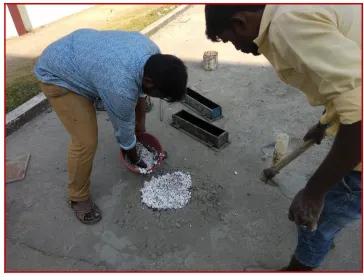
Fig 2.1. Concrete Mixing
2.2 Casting of Specimen
Specimens are cast on as per design mix tested after appropriate curing, tests taken are
compressive strength or cubs (150x150x150mm) and split tensile strength of cylinders
(150x300mm).from the studies, optimum results are found out and compared with conventional
Fig.2.2 Casting of Specimen
2.3 Compaction
Compaction of concrete is one of the important site operations that together enable the fresh
concrete to reach its potential design strength, density and low permeability. Properly carried out it
ensures that concrete fully surrounds and protects the reinforcement, tendons and cast-in inserts. It
Fig.2.3 Compaction
2.4 Curing
Cubes must be cured before they are tested. Unless required for test at 24 hours, the cube
should be placed immediately after demoulding in the curing tank or mist room.
The curing temperature of the water in the curing tank should be maintained at 27-30 . If
curing is in a mist room, the relative humidity should be maintained at no less than 95%. Curing
should be continued as long as possible up to the time of testing.
In order to provide adequate circulation of water, adequate space should be provided between
the cubes, and between the cubes and the side of the curing tank. If curing is in a mist room, there
2.5 Weight of the concrete cube
Normally the weight of the concrete cube (150X150X150) is 8.1KG. By adding 10% of EPS in the place of course aggregate then the weight of the concrete cube is 7.29KG. This is light weight
concrete.
Fig.2.5 Weight of Eps Concrete Cube
3. RESULTS AND DISCUSSION RESULT AND DISCUSSIONS
3.1 Compressive Test
Compressive strength of cement concrete cube and various ratio of EPS in the concrete cubes
obtained from the test are given below.
Table[ 1] Compressive strength of cement concrete cube
Specimen Name
Percentage of mixing
Curing Days
Compressive Strength of Concrete (N/mm2)
Average Compressive Strength of Concrete EPS % Coarse Aggregate
(%)
CC 0 100
3 4.8 4.3 5.1 4.7
7 11.8 12.7 13.1 12.5
14 20.8 19.6 21.2 20.5
28 28.2 30.6 29.8 29.5
C- 10 10 90
3 4.1 4.3 4.2 4.2
7 10.4 10.9 10.2 10.5
14 18.9 19.8 19.3 19.3
28 28.2 29.4 28.6 28.7
C -20 20 80
3 2.9 3.2 3.6 3.2
7 8.0 7.1 7.5 7.5
14 11.9 12.3 12.8 12.3
28 18.6 17.8 18.8 18.4
C- 25 25 75
3 1.8 1.75 1.8 1.78
7 4.2 4.8 4.3 4.6
Graph(1) Compressive strength of concrete for 7days
Graph(2) Compressive strength of concrete for 28days
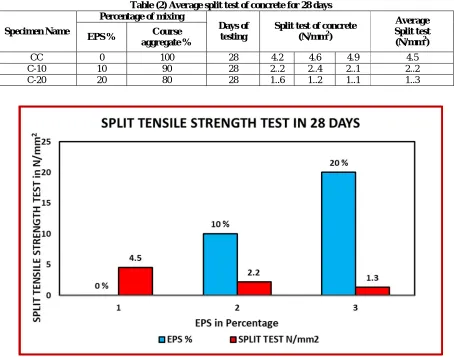
3.2 Split Tensile Strength Test
Table (2) Average split test of concrete for 28 days
Specimen Name
Percentage of mixing
Days of testing
Split test of concrete (N/mm2)
Average Split test (N/mm2)
EPS % Course
aggregate %
CC 0 100 28 4.2 4.6 4.9 4.5
C-10 10 90 28 2..2 2..4 2..1 2..2
C-20 20 80 28 1..6 1..2 1..1 1..3
Graph(3) Split Tensile Strength of concrete for 28days
3.3 Flexural Strength Test
Flexural test evaluates the tensile strength of concrete indirectly. It tests the ability of
unreinforced concrete beams or slabs to withstands failure in bending at 10% of EPS.
Table (3) Average flexural test values for three samples
Number of Sample Weight (Kg) Load (KN/m3) Average (KN/m3)
Sample 1 10.322 450
420
Sample 2 10.283 360
Sample 3 10.364 450
5. CONCLUSION
Increase in the EPS beads content in concrete mixes reduces the compressive and tensile
strength of concrete.Workability increases with increase in EPS beads content.All the EPS concrete
without any special bonding agent show good Workability and could easily be compacted and
performance.The replacement by using EPS has shown a positive application as an alternate material
in building for only non-structural members, and it is also serves as a solution for EPS disposal.
REFERENCES
1. Abhijit Mandlik
, Tarun
Sarthak Sood, Shekhar Karade, Sangran Naik, Amruta Kulkarni.Lightweight Concrete Using EPS, Int. Jour. of Sci and Res.2015; 4(3): 2007-2010.
2. FetraVenny R, KhairulNizar I, Mohd Mustafa Al Bakri A. Properties of Modified
Polystyrene lightweight Aggregate in Concrete, Environ. Eng. Dept. University Malaysia
Perli. 2010; 1: 2180-3811.
3. Thomas Tamut, Prabhu Rajendra, Katta Venkataramana, Yaragal Subhash. Partial
Replacement of Coarse Aggregates by Expanded Polystyrene Beads in Concrete. Int. Jour. of
Res. in Engg and Tech.2014; 3(2): 238-246.
4. Thermal and Mechanical Properties of Concretes with Styropor. Department of Chemical
Engineering, Firat University, Elazing, Turkey. 2: 310-315.
5. Chowdary P L. Strength Properties of Expanded Polystyrene Beads in Concrete. Jour of
Environ. Sci., Comp.Sci. and Eng. & Tech. 2015; 4(3): 734-742.
6. Saulius Vaitkus, Viktor Granev, Ivan Gnip, Sigitas Vejelis, Agnė Kairyte. Stress Relaxation
in Expanded Polystyrene (EPS) Under Uniaxial Loading Conditions. 11th International Conference on Modern Building Materials, Structures and Techniques. 2013; 1213 – 1222.
7. Juan Bosco Hernandez-Zaragoz et.al. Cellular Concrete Bricks with Recyclar Expanded
Polystyrene Aggregate. Universidad Autonoma de Queretaro, Facultad de Ingenieria, Cerro
de las Campanas S/N, Col. Las Companas, 76010, QRO, Mexico. Etc. Article ID 2013;
160162: 5.
8. Miled K, Sab K, LeRoy R. Particle size eff ect on EPS lightweight concrete compressive
strength: Experimental investigation and modeling. Mechanics of Materials: 2006; 39; 222 –
240.
9. Abdulkadir Kan, Ramazan Demirboga. A novel material for lightweight concrete production.