© 2017 IJSRST | Volume 3 | Issue 1 | Print ISSN: 2395-6011 | Online ISSN: 2395-602X Themed Section: Science and Technology
A Study on Effect of Sulphates on Compressive Strength of Blended Cement
Mortar
1Regati Anjaneyulu,
2P. Radhakrishna Murthy
1
M.Tech Student in Department of Civil Engineering, Intell Engineering College, Anantapur, Andra Pradesh, India 2
Associate Professor & HOD, Department of Civil Engineering, Intell Engineering College, Anantapur, Andra Pradesh, India
ABSTRACT
Sulphate attack is considered one of the major deteriorative problems occurred when the cement based materials, such as concrete, mortars and buildings exposed to the acidic environment. Water borne sulphates react with hydration products of the tri-calcium aluminate (C3A) phase of Portland cement, and with calcium hydroxide
(Ca(OH)2) to form an expansive crystalline product called ettringite. Sulphates also cause chemical disintegration of
some of the cement hydration products. The present paper focuses on the effect of sulphates on the compressive strength properties of the fly ash blended cement. In this investigation the work is carried out to examine sodium, magnesium, ammonium, ferrous, calcium sulphates particularly affecting the strength parameter which are added in different proportions (2000, 2500 and 3000 mg/l) to cement and its effect is studied on cement mortars at different curing ages (7, 28, 90, 180 days). Deionised water was used for mixing the cement mortar specimens and curing. These properties were compared to the control mortar mixes which were cast using deionised water and with no sulphate concentration. From this investigation, it is observed that, compressive strength values of mortar mixes were reduced at all curing periods with the increase of sulphate concentration for all the combinations of sulphate. These values were lower than those of control mortar mixes. It is concluded that proper preventive measures should be taken against these sulphate attacks to control the deterioration of mortar mixes.
Keywords : Blended Cement, Deionized Water, Sulphates
I.
INTRODUCTION
The quality of mixing water plays an important role in the chemical behavior of hardened mortar and concrete. Presence of some impurities in mixing water may influence the chemical reactions between water and cement and affects the strength of hardened material.
Cement is the most widely used building material due to its satisfying performance in strength requirements. But when one deals with the durability aspects, the chemical attack which results in volume change, cracking and the consequent deterioration becomes an important part of discussion. The reaction of Sulphate ions (SO4-) with hydrated cement products is a volume increasing reaction and denoted as Sulphate attack on concrete.
Most soil contains some Sulphates in the form of Calcium, Magnesium, Sodium, and Potassium. Ammonium sulphate is frequently present in agricultural soil and water. Decay of organic matter in the marshes,
shallow lakes, mining pit and sewer pipes often lead to the formation of H2S.It has long been recognized that sulphate attack usually results in the formation of expansive products, such as ettringite, gypsum and thaumasite, which are produced by sulphate ions reacting with hydration products in cement, resulting in expansion, cracking, spalling, and concrete strength loss.
Cement based products like mortar and concrete durability is defined as its resistance to weathering action, chemical attack, abrasion and other degradation processes. A durable product helps the environment by conserving resources and reducing wastes and the environmental impacts of repair and replacement. Let us know about sulphate attack on durability of concrete.
concrete structures by provoking expansion and cracking due to factors such as type of cement, sulphate cation type, sulphate concentration and the period of exposure. Many structures affected by sulphate degradation often need to be repaired or, in most severe cases, they need to be reconstructed. Three main factors are reported: properties, aggressive medium and environmental atmosphere.
In this experimental study, blended cement mortar specimens were produced by using deionised water including known sulphate concentration in mixing water and in curing water by which the scope of this research is to focus on compressive strength characteristics.
II.
METHODS AND MATERIAL
1. Literature Survey
Use of the first blended cements dates back to Roman times, when volcanic ash was used in a crude blend with slaked lime to give the user a product that developed higher early strength than the usual slaked lime as well as significant durability. Evidence of this can be seen in the Aqueducts and the Colosseum in Rome.
Replacing a portion of Portland cement with fly ash reduces the amount of reactive aluminates (tricalcium aluminate) available for sulphate. Fly ash chemically binds free lime in cementitious compounds, rendering it unavailable for sulphate reaction. Fly ash activity reduces concrete permeability, keeping sulphates from penetrating concrete (Naik, 1992).
From previous studies, a suggestion is drawn on effect of w/c Ratio. With low w/c ratio is more vulnerable to damage by physical sulphate attack since lowering the w/c ratio reduces the pore size diameter, which can behave similar to rocks with fine pores (Hime, 2003).
A study by Nehdi and Hayek (2005) showed that cement mortars with an intermediate w/c had an extensive efflorescence formation compared with other w/c. Therefore, more research is needed to investigate the main role of the w/c in cement based products exposed to physical sulphate attack.
F. M. Lee (1971) described that, water which is acidic owing to the presences of uncombined carbon dioxide, of organic or inorganic acids are more aggressive in their action, the degree and rate of attack increases as the acidity increase. Acid solutions which attack cement mortars by dissolving part of the hard cement paste do not cause any expansion but weaken the material by removal of the cementing constituent and eventually soft and mushy mass is remains.
Aye and Oguchi (2011) when they examined mortar specimens under four different exposure conditions of sodium sulphate (i.e. continuous full immersion at constant temperature, full immersion under cyclic wetting and drying, continuous partial immersion at constant temperature, and partial immersion under cyclic wetting and drying). Extensive damage occurred when specimens were partially immersed and exposed to cyclic wetting and drying.
Concrete deterioration due to sulphate attack is the second major durability problem after reinforcement corrosion (Al-Dulaijan et al., 2003).
2. Materials Used in the Experiment and Its
Properties
Blended Cement
Portland pozzolana cement (Fly Ash based) conforming to IS: 1489-1991(PART-1) was used.
Fine Aggregate
Locally available river sand passing through 2 mm IS sieve conforming to IS: 650-1991 standard requirements for Standard sand is used in testing of cement. The standard sand shall (100 percent) pass through 2 mm IS sieve and shall be (100 percent) retained on 90-micron IS Sieve.
Sulphates
Various Sulphates in the powdered form used for the present investigation are calcium sulphate, magnesium sulphate, sodium sulphate, ammonium sulphate and ferrous sulphate.
Deionized water is also called as demineralized water. Demineralization is the removal of mineral ions such as cations (Na+, Ca2+, etc.,) and anions (Cl-, SO4 2-, etc.)
3. Preparation of Specimens
A. Casting
The cubes were cast in the moulds of 70.6 mm size conforming to IS: 10080-1982. All the materials are weighed for each sample in the mix ratio of 1:3 and mixed with the quantity of water obtained by (P/4+3.0) percent of combined mass of cement and sand, where P is the percentage of water required to produce a paste of standard consistency determined as described in IS: 4031 ( Part4 ) – 1988.
B. Curing
The filled moulds are kept in moist closet or moist room for 24 hours after the completion of vibration. At the end of that period, they are removed from the moulds and immediately submerged in deionized water.
III.
RESULTS AND DISCUSSION
A. Influence of Chemicals on Compressive Strength
The compressive strength test results of cement mortar cubes cured in the sulphate environment (Calcium sulphate, Magnesium sulphate, Sodium sulphate, Ammonium sulphate and Ferrous sulphate) for a curing period of 7days, 28days, 90 days and 180 days in double combinations and individual concentration of 2000 mg/l, 2500 mg/l and 3000 mg/l of sulphate solutions are shown in Table 1 to 15 and graphical represented in graph 1 to 15 below.
B. Compressive Strength of Cement Mortar cubes with CaSO4 Concentration
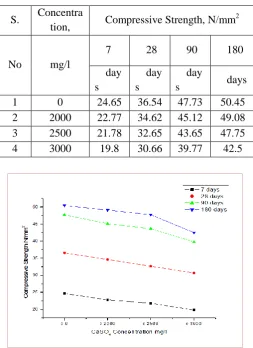
The compressive strength values of cement mortar cubes cured in the individual sulphate environment of CaSO4
for a period of 7days, 28 days, 90 days and 180 days are presented in the following table 1 and depicted in graph 1. From the graph and table, it is observed that strength value decreases as the sulphate concentration increases for all curing days.
Table 1: Compressive strength of Blended cement
mortar corresponding to CaSO4 concentrations
S. Concentra
tion, Compressive Strength, N/mm
2
No mg/l
7 28 90 180
day s
day s
day
s days 1 0 24.65 36.54 47.73 50.45 2 2000 22.77 34.62 45.12 49.08 3 2500 21.78 32.65 43.65 47.75 4 3000 19.8 30.66 39.77 42.5
Figure 1. Compressive strength of Blended cement
mortar vs CaSO4 concentrations
C. Compressive Strength of Cement Mortar Cubes with MgSO4 Concentration
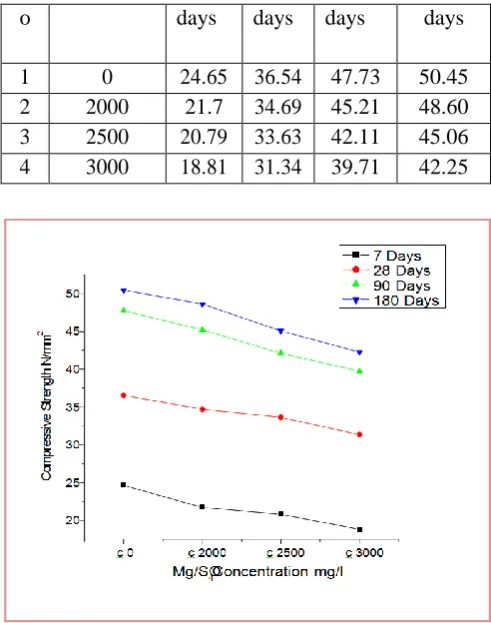
The compressive strength values of cement mortar cubes cured in the individual sulphate environment of MgSO4for a period of 7days, 28 days, 90 days and 180 days are presented in the following table 2 and depicted in graph 2. From the graph and table, it is observed that strength value decreases as the sulphate concentration increases for all curing days.
Table 2: Compressive strength of Blended cement
mortar vs MgSO4 concentrations
S. Concentra tion,
o days days days days
1 0 24.65 36.54 47.73 50.45 2 2000 21.7 34.69 45.21 48.60 3 2500 20.79 33.63 42.11 45.06 4 3000 18.81 31.34 39.71 42.25
Figure 2. Compressive strength of Blended cement
mortar vs MgSO4 concentrations
D. Compressive Strength of Cement Mortar cubes with Na2SO4 Concentration
The compressive strength values of cement mortar cubes cured in the individual sulphate environment of Na2SO4 for a period of 7days, 28 days, 90 days and 180 days are presented in the following table 3 and depicted in graph 3. From the graph and table, it is observed that strength value decreases as the sulphate concentration increases for all curing days.
Table 3: Compressive strength of Blended cement
mortar vs Na2SO4 concentrations
S. Concentration Compressive Strength, N/mm2
No mg/l 7 28 90 180
days days days days 1 0 24.65 36.54 47.73 50.45 2 2000 22.77 34.62 45.12 49.08 3 2500 21.78 32.65 43.65 47.75 4 3000 19.8 30.66 39.77 42.5
Figure 3. Compressive strength of Blended cement
mortar vs Na2SO4 concentrations
E. Compressive Strength of Cement Mortar cubes with (NH4)2SO4 Concentration:
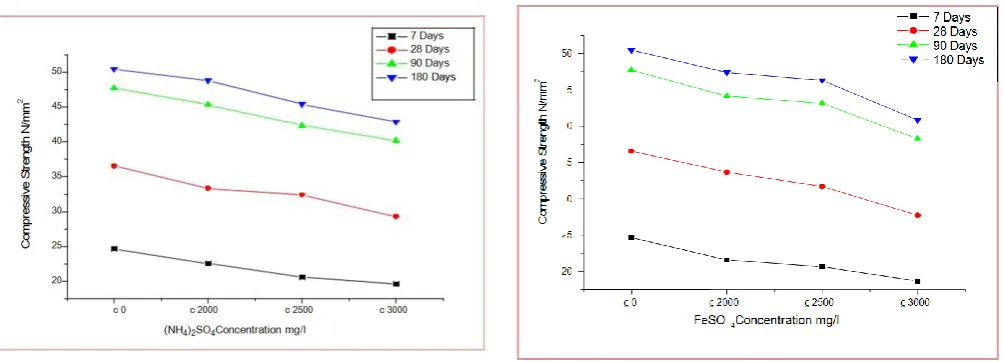
The compressive strength values of cement mortar cubes cured in the individual sulphate environment of (NH4)2SO4 for a period of 7days, 28 days, 90 days and 180 days are presented in the following table 4 and depicted in graph 4. From the graph and table, it is observed that strength value decreases as the sulphate concentration increases for all curing days.
Table 4: Compressive strength of Blended cement
mortar vs (NH4)2SO4 concentrations
S. Concentration Compressive Strength, N/mm2
Figure. Compressive strength of Blended cement mortar vs (NH4)2SO4 concentrations
F. Compressive Strength of Cement Mortar cubes with FeSO4 Concentration:
The compressive strength values of cement mortar cubes cured in the individual sulphate environment of FeSO4for a period of 7days, 28 days, 90 days and 180 days are presented in the following table 5 and depicted in graph 5. From the graph and table, it is observed that strength value decreases as the sulphate concentration increases for all curing days.
Table 5: Compressive strength of Blended cement
mortar vs FeSO4 concentrations
S Concentr ation
Compressive Strength, N/mm2
mg/l
7 28 90 180
No
day s
day s
days days
1 0 24.65 36.54 47.73 50.45 2 2000 21.57 33.66 44.12 47.38 3 2500 20.63 31.68 43.14 46.29 4 3000 18.63 27.72 38.24 40.8
Figure 5. Compressive strength of Blended cement
mortar vs FeSO4 concentrations
G. Compressive Strength of Cement Mortar cubes with CaSO4+MgSO4 Concentration:
The compressive strength values of cement mortar cubes cured in the double sulphate environment of CaSO4+MgSO4 for a period of 7days, 28 days, 90 days and 180 days are presented in the following table 6 and depicted in graph 6. From the graph and table, it is observed that strength value decreases as the sulphate concentration increases for all curing days.
Table 6 : Compressive strength of Blended cement
mortar vs CaSO4+MgSO4 concentrations
S. Concentr ation
Compressive Strength, N/mm2
7 28 90 180
No. mg/l
days day s
Day
s days
1 0 24.65 36.54 47.73 50.45 2 2000 22.77 32.67 43.56 46.7
Figure 6. Compressive strength of Blended cement mortar vs CaSO4+MgSO4 concentrations
H. Compressive Strength of Cement Mortar cubes with CaSO4+Na2SO4 Concentration:
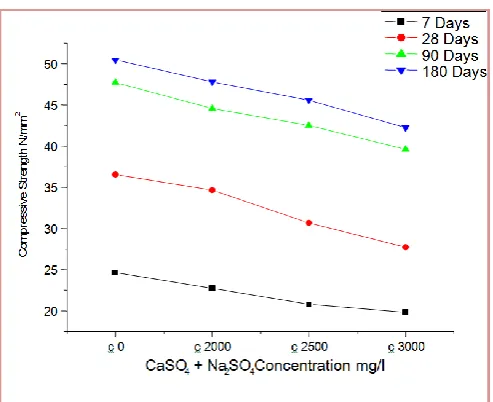
The compressive strength values of cement mortar cubes cured in the double sulphate environment of CaSO4+Na2SO4 for a period of 7days, 28 days, 90 days and 180 days are presented in the following table 7 and depicted in graph7. From the graph and table, it is observed that strength value decreases as the sulphate concentration increases for all curing days.
Table 7: Compressive strength of Blended cement
mortar vs CaSO4+Na2SO4 concentrations
S. Concen
tration Compressive Strength,
No. mg/l N/mm
2
7 28 90 180 days days Days days
1 0 24.65 36.54 47.73 50.45 2 2000 22.73 34.65 44.55 47.8 3 2500 20.79 30.69 42.5 45.56 4 3000 19.84 27.72 39.6 42.25
Figure 7. Compressive strength of Blended cement
mortar vs CaSO4+Na2SO4 concentrations
I. Compressive strength of cement mortar cubes with CaSO4 + (NH4)2SO4 Concentration:
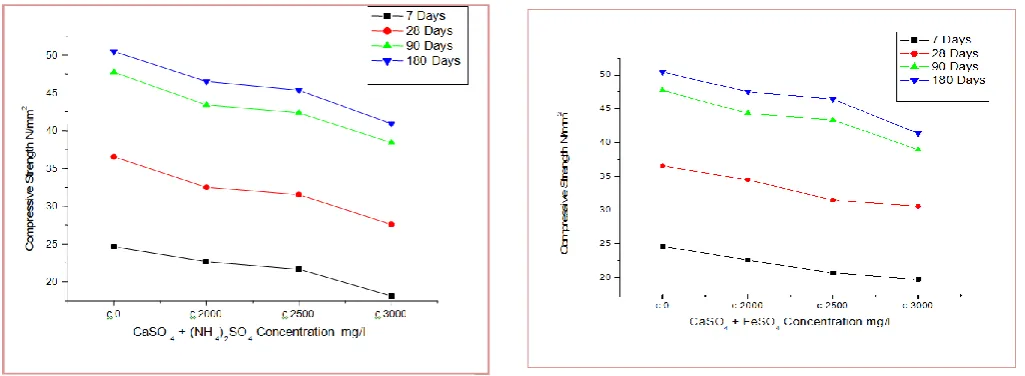
The compressive strength values of cement mortar cubes cured in the double sulphate environment of CaSO4 + (NH4)2SO4 for a period of 7days, 28 days, 90 days and 180 days are presented in the following table 8 and depicted in graph 8. From the graph and table, it is observed that strength value decreases as the sulphate concentration increases for all curing days
Table 8 : Compressive strength of Blended cement
mortar vs CaSO4 + (NH4)2SO4 concentrations
S. Conce ntratio n,
Compressive Strength, N/mm2
7 28 90 180
No. mg/l
days days days days
Figure 8. Compressive strength of Blended cement mortar vs CaSO4 + (NH4)2SO4 concentrations
J. Compressive Strength of Cement Mortar cubes with CaSO4+FeSO4 concentration:
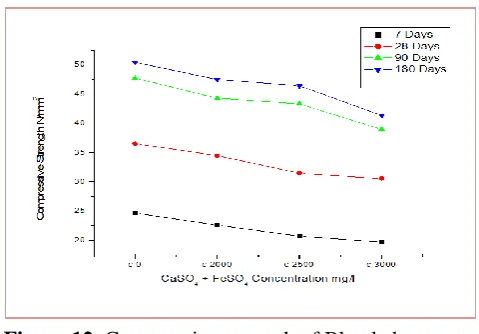
The compressive strength values of cement mortar cubes cured in the double sulphate environment of CaSO4+FeSO4 for a period of 7days, 28 days, 90 days and 180 days are presented in the following table 9 and depicted in graph 9. From the graph and table, it is observed that strength value decreases as the sulphate concentration increases for all curing day
Table 9 : Compressive strength of Blended cement
mortar vs CaSO4+FeSO4 Concentratons
S. Concent ration,
Compressive Strength, N/mm2
7 28 90 180
No mg/l
days days days days
1 0 24.65 36.54 47.73 50.45 2 2000 22.61 34.48 44.33 47.52 3 2500 20.69 31.49 43.35 46.43 4 3000 19.7 30.54 38.95 41.36
Figure 9. Compressive strength of Blended cement
mortar vs CaSO4+FeSO4 concentrations
K. Compressive Strength of Cement Mortar cubes with MgSO4+Na2SO4 concentration
The compressive strength values of cement mortar cubes cured in the double sulphate environment of MgSO4+Na2SO4 for a period of 7days, 28 days, 90 days and 180 days are presented in the following table 10 and depicted in graph 10. From the graph and table, it is observed that strength value decreases as the sulphate concentration increases for all curing days
Table 10 : Compressive strength of Blended cement
mortar vs MgSO4+Na2SO4 concentrations
S. Concentr ation
Compressive Strength, N/mm2
7 28 90 180
No.
mg/l
days days days days
Figure 10. Compressive strength of Blended cement mortar vs MgSO4+Na2SO4 concentrations
L. Compressive Strength of Cement Mortar cubes with MgSO4+ (NH4)2SO4 concentration
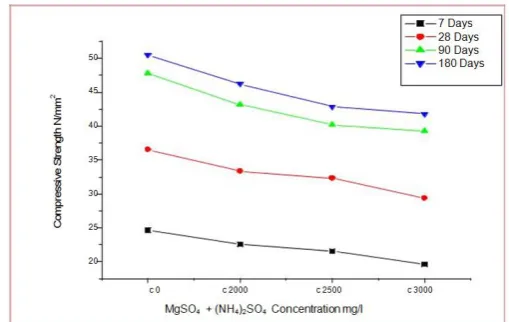
The compressive strength values of cement mortar cubes cured in the double sulphate environment of MgSO4+(NH4)2SO4 for a period of 7days, 28 days, 90 days and 180 days are presented in the following table 11 and depicted in graph 11. From the graph and table, it is observed that strength value decreases as the sulphate concentration increases for all curing days
Table 11: Compressive strength of Blended cement
mortar vs MgSO4+(NH4)2SO4 concentrations
S. Conce ntratio
n
Compressive Strength, N/mm2
7 28 90 180
No.
mg/l
days days days days
1 0 24.65 36.54 47.73 50.45 2 2000 22.55 33.33 43.14 46.2 3 2500 21.57 32.35 40.2 42.85 4 3000 19.61 29.41 39.22 41.81
Figure 11. Compressive strength of Blended cement
mortar vs MgSO4+(NH4)2SO4 concentrations
M. Compressive Strength of Cement Mortar cubes with MgSO4+FeSO4 concentration:
The compressive strength values of cement mortar cubes cured in the double sulphate environment of MgSO4+FeSO4 for a period of 7days, 28 days, 90 days and 180 days are presented in the following table12and depicted in graph 12. From the graph and table, it is observed that strength value decreases as the sulphate concentration increases for all curing days
Table 12: Compressive strength of Blended cement
mortar vs MgSO4+FeSO4 concentrations
S. Conce ntratio
n
Compressive Strength, N/mm2
7 28 90 180
No. mg/l
Figure 12. Compressive strength of Blended cement mortar vs MgSO4+FeSO4 concentrations
N. Compressive Strength of Cement Mortar cubes with Na2SO4+(NH4)2SO4 concentration
The compressive strength values of cement mortar cubes cured in the double sulphate environment of Na2SO4+(NH4)2SO4 for a period of 7days, 28 days, 90 days and 180 days are presented in the following table13 and depicted in graph 13. From the graph and table, it is observed that strength value decreases as the sulphate concentration increases for all curing days
Table 13: Compressive strength of Blended cement
mortar vs Na2SO4+(NH4)2SO4 concentrations
S. Conce ntratio n,
Compressive Strength, N/mm2
7 28 90 180
No. mg/l
days days days days
1 0 24.65 36.54 47.73 50.45 2 2000 21.59 34.31 45.1 48.26 3 2500 19.88 33.33 42.16 45.03 4 3000 18.98 31.37 40.2 42.81
Figure 12. Compressive strength of Blended cement
mortar vs Na2SO4+(NH4)2SO4 concentrations
O. Compressive Strength of Cement Mortar cubes with Na2SO4+FeSO4concentration:
The compressive strength values of cement mortar cubes cured in the double sulphate environment of Na2SO4+FeSO4for a period of 7days, 28 days, 90 days and 180 days are presented in the following table14 and depicted in graph 14. From the graph and table, it is observed that strength value decreases as the sulphate concentration increases for all curing days
Table 14: Compressive strength of Blended cement
mortar vs Na2SO4+FeSO4 concentrations
S. Conce ntratio n,
Compressive Strength, N/mm2
7 28 90 180
No.
mg/l
days days days days
Figure 14. Compressive strength of Blended cement mortar vs Na2SO4+FeSO4 concentrations
P. Compressive Strength of Cement Mortar cubes with (NH4)2SO4+FeSO4 concentration:
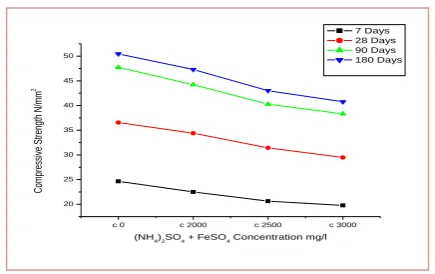
The compressive strength values of cement mortar cubes cured in the double sulphate environment of (NH4)2SO4+FeSO4 for a period of 7days, 28 days, 90 days and 180 days are presented in the following table 15 and depicted in graph 15. From the graph and table, it is observed that strength value decreases as the sulphate concentration increases for all curing days
Table 15 : Compressive strength of Blended cement mortar vs (NH4)2SO4+FeSO4 concentrations
S. Conce ntratio
n
Compressive Strength, N/mm2
7 28 90 180
No. mg/l
days days days days
1 0 24.65 36.54 47.73 50.45 2 2000 22.51 34.38 44.2 47.29 3 2500 20.63 31.43 40.27 43.01 4 3000 19.78 29.47 38.31 40.76
Figure 15. Compressive strength of Blended cement
mortar vs (NH4)2SO4+FeSO4 concentrations
IV.
CONCLUSION
Compressive Strength: As the concentration of CaSO4, MgSO4, Na2SO4, FeSO4 and (NH4)2SO4 increases
individual concentrations, the compressive strength decreases at all curing periods which is lower than 0% sulphate concentration cement mortar. As the concentration of double combination sulphates increases, the compressive strength decreases at all curing age compared to 0% sulphate concentration cement mortar. The compressive strength of the cement mortar cubes increases with the increase of curing age.
V.
REFERENCES
[1]. Al-Dulaijan, S.U., Maslehuddin, M., Al-Zahrani, M.M., Sharif, A.M., Shameen, M., and Ibrahim, M., Sulphate resistance of plain and blended cements exposed to varying concentrations of sodium sulphate, Cement Concrete Composites, 25(2003) 429-437.
[2]. Aydin, E, Pekrioglu, A, Uygar, E, Atak, C.E. &Doven, A.G. 2004. 6th International Congress on Advances inCivil Engineering, Istanbul, Turkey, 6–8 October 2004. Bogazici University: 898–908.
[3]. Aye, T., Oguchi, C. T., (2011), "Resistance of plain and blended cement mortars exposed to severe sulphate attacks", Construction and Building Materials, Vol.25, No.6, PP.2989-2996. [4]. F.M.Lee, The chemistry of cement and concrete,
Longman scientific & Technical publication, 3rd edition1971,pp223-256.
c 0 c 2000 c 2500 c 3000 20
25 30 35 40 45 50
C
om
pre
ssi
ve
St
re
ng
th
N
/m
m
2
(NH4)2SO4 + FeSO4 Concentration mg/l
[5]. IS 3025: 1964, Methods of sampling and Tests (physical and Chemical) for Water Used in Industry.
[6]. IS: 456 – (2000) (Fourth Revision) "Indian Standard Plain and Reinforced Concrete" Code of Practice.
[7]. IS: 650 (1991): Specification for Standard Sand for Testing of Cement.
[8]. IS 1489 (Part 1): 1991 Specification for Portland pozzolana cement, Part 1: Fly ash based.
[9]. Naik, T.R. 1992. The State of Art Report: High-Volume Fly Ash Concrete Technology. Report on CBU-1992– 15.