February, 22nd and 23rd, 2019
313 | P a g e
IoT and Artificial Intelligence
Ms. Archana Rajendra Mane1, Dr. Anita Keshav Patil2 Department of Electronics and Telecommunication,
Dr. Vithalrao Vikhe Patil College of Engineering, Ahmednagar, Maharashtra
[email protected], [email protected]
Abstract—Communication is the basic required thing to transmit the information, feelings etc. to converse, human being in many types of languages in different part of the world people use different languages, even deaf and dumb can communicate through sign language. Communication is the basic thing to share the information and knowledge and in today’s world information is the key to success. Internet of things is a new concept in communication which supports the non-living things can communicate to each other and can do many things automatically. The concept of Internet of Things appeared several years ago and in that time has evolved into one of pillars o fthe new technologies sector. The next step is to add the artificial intelligence to Internet of Things systems. Artificial intelligence is increasingly used in everyday life. It is a concept of a wide range and applies in practice in many fields of science. In this paper the author is trying to blend the communication, technology and artificial intelligence to make the world faster connected and automated. In this paper Internet of things and artificial intelligence blends into a new product and give rise to the new shape to the technological front of the world.
I. INTRODUCTION
The Internet is a powerful tool used in all kinds of the information systems. The network is available almost anywhere, at home, at work, also on mobile devices (phones, watches). People start to think to connect the Internet to almost all devices of everyday use, so they can communicate with each other by taking simple decisions for people and helping them in their life. Such idea is called the Internet of Things
(IoT). It is estimated that currently about 15 billion devices are connected to the Internet, but this number is still less than 1% of things that in fact could be connected to the network .
The next step is to add the artificial intelligence to Internet of Things systems.
The Internet of Things (IoT) is the network of physical objects or "things" embedded with electronics, software, sensors and connectivity to enable it to achieve greater value and service by exchanging data with the manufacturer, operator and/or other connected devices. Each thing is uniquely identifiable through its embedded
computing system but is able to interoperate within the existing Internet infrastructure.
As the IoT is defined in the above two definition form different sources, whether it is machine 2 machine or human to human or human to computer the information or data will be communicated over the internet each devices with their unique identifier number will be connected to internet to send or receive some valuable data or to respond for some service.
“Things” will be smart electronics devices which are able to send or receive the signal. In this concept we are trying to make the things intelligent, intelligent enough to take the decision to respond or to send the signal say medical help signal or inventory stock refill signal etc. here comes the concept of AI [Artificial Intelligence], the concept of AI is not new to the today’s scenario many “things” are made on this concept, when this AI concept will blend with IoT which will give rise to the “Intelligent things” which are more capable in doing effective communication.
Artificial intelligence is increasingly used in everyday life. It is a concept of a wide range and applies in practice to many fields of science. It is used in applications such as prompting videos to watch, having regard to the history of the watch (service netflix) or recognize people on the recordings of the monitoring. Its great advantage is the elements related to machine learning, through which different methods of artificial intelligence are able to interpret a lot of data and present some of their summary. This is definitely a big amenity for a man who no longer has to statically analyse all the data coming from the specified system, for example view a recording of the monitoring in the context of searching for a particular person.
II. IOT BLENDS WITH ARTIFICIAL INTELLIGENCE
February, 22nd and 23rd, 2019
314 | P a g e
enable it to achieve greater value and service by exchanging data with the manufacturer,
operator and/or other connected devices. Each thing is uniquely identifiable through its embedded computing system but is able to interoperate within the existing Internet infrastructure.
As per the above definition proposed by Wikipedia about Internet of Things [IoT] clearly states that in the new scenario the communication in between “things” could be possible with the Internet as backbone for making communication. We are having IPv4 already and our electronics devices such as laptops and personal computers are becoming more sophisticated to communicate on IPv6, with IPv6 we would be able to take care of the IP addresses to almost for everyone. The big difference between it andIPv4 is the increase in address space. IPv4 addresses are 32 bits; IPv6 addresses are 128 bits. We can get a rough estimate based on the fact that it uses 128bits. So 2 to the power of 128 ends up being
340,282,366,920,938,000,000,000,000,000,000,000,0 00 unique IP addresses.[5.]
By using IPv6, we are having a huge number of IP addresses to cater the need for IoT kind of upcoming technology. The next thing is that is our present electronic devices which we are using right now are compatible to support IPv6, here is the test for the same. The following figure represents that the current configuration will work smoothly with the IPv6 enabled websites. This represents a great future in front of us. From this we can see that we are in capacity to transfer a large amount of data and we can provide a large number of IP address to the “things”. The next big thing is the blending of IoT with AI. IoT will produce a treasure trove of big data – data that can help cities predict accidents and crimes, give doctors realtime insight into information from pacemakers or biochips, enable optimized productivity across industries through predictive maintenance on equipment and machinery, create truly smart homes with connected appliances and provide critical communication between self-driving cars. The possibilities that IoT brings to the table are endless. AI - Wikipedia defines machine learning as “a subfield of computer science (CS) and artificial intelligence (AI) that deals with the construction and study of systems that can learn from data, rather than follow only explicitly programmed instructions.” [6] AI – Artificial intelligence (AI) is the intelligence exhibited by machines or software. It is an academic field of study which studies the goal of creating intelligence. Major AI researchers and textbooks define this field as "the study and design of intelligent agents", in which an intelligent agent is a system that perceives its environment and takes actions that
maximize its chances of success. John McCarthy, who coined the term in 1955, defines it as "the science and engineering of making intelligent machines". [7.]
AI is the programming that learns by events and reprogramming the devices according to the last seen pattern and not by already programmed instructions it is a kind of learning by experience, it advances time by time and event by event and, recognizing the pattern of the events etc. machine will improvise and work for human beings, but when they follow similar pattern of doing monotonous things and while continuous up gradation in the learning pattern of AI could be threat for human beings it is somewhat shown in science fiction movies. AI is the continuous learning process in which machine learns the pattern of the events and upgrade itself for the future events. In nature “attacking” is one form of defending itself or self - defense from the upcoming danger or threat. Human being or animal will attack due to fear of being destroyed or considering the other object is one of the potential threat in future. It is a natural process, very soon machines with artificial intelligence will learn this pattern this will or may become threat for mankind. If we look at the brighter side of the blend as each coin has two sides, selfcommunicating, self-learning “things” will going to help the mankind in a never imagine hi-tech help in many sectors like space, medical, pharmacy, manufacturing etc..
III. INTERNET OF THINGS SYSTEMS USING ARTIFICIAL INTELLIGENCE
February, 22nd and 23rd, 2019
315 | P a g e
completely, but equally important is the lack of monotonous supervision of these applications from the point of use. It is better to be able to communicate with the system in a way natural for humans than for machines – based on the example with temperature – while overheating of the room, it’s better to make the interaction with the device using command "is too hot" than reduce the temperature of 0.432 Celsius degree. The main element associated with the
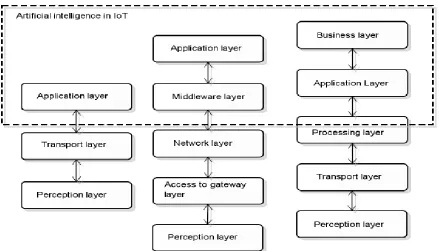
operation of IoT system with the artificial intelligence is its location in the architecture. An important aspect is the performance and the appropriate amount of place for data, which is a knowledge of the system, so the AI methods can not be placed at each level. Figure 1 shows the general idea of placing the artificial intelligence methods in the context of major IoT architectures.
Fig. 1 Placing the artificial intelligence in the background of IoT architectures
February, 22nd and 23rd, 2019
316 | P a g e
The most natural places for AI methods are all kinds of servers because of their computing power. Such location has
a positive effect on another aspect too. It is about the fact of reuse.
The place of operation of different artificial intelligence methods can be compared to the human brain. The fact that all the knowledge and the associated inference and learning are placed in the server rooms, it is possible to use it in a larger perspective. Figure 2 presents our idea of general scheme of information flow in the IoT systems, using artificial intelligence. There are three main elements in the flow of information:
Preliminary communication – data sent from the real world for a variety of systems.
Context communication – data processed by systems that already have the appropriate context and make the IoT systems and devices can respond accordingly (take appropriate decisions).
Internal communication – understood as an additional channel of communication between intelligent objects.
The first stage can be called a preliminary communication. At the beginning, in accordance with the concept of Internetof Things, the data from the environment (real world) is collected by the IoT devices. They can be the external sensors,as well as those built into the device. Then, data is preprocessed to be clear for the rest of the system. Depending on the particular case, the data is further transmitted over the Internet to the main IoT systems or between other devices to gather all relevant information from the real world (internal communication elements). In the context of mobile devices, it is important to assure the temporary storage of information in things during the lack of access to the Web. When all the data in the context of a particular cycle, is already in the main IoT systems, respectively, it is prepared for external artificial intelligence systems. This process may involve selecting an appropriate specific information to get to a particular method of artificial intelligence (for example the ambient temperature and the number of people as inputs to the neural network in the system controlling the temperature). The next communication step is a context communication. Its main purpose is to provide the concrete system answers to the IoT devices and to the subsystems that are designed to take concrete actions in the context of the relevant decisions. When the artificial intelligence methods have exited and give a reply, it should be properly interpreted. This task should address the main IoT systems. Very often the
AI answer include digits that do not make much sense without the proper context. Therefore, an important step is to link them with the knowledge located in the system to be able to conclude the overall response of the system to a particular problem. In this way the system can properly react, so take the decision. This idea can be seen as smart making of autonomous decision. Properly processed data, which are located in the main IoT systems should usually be further sent to certain IoT devices so that they can properly respond. A situation where the processed data must be sent to other IoT devices than those which are derived from the original data can be imagined. The monitoring system can be an example. Devices with cameras may send data to the main IoT systems, that after detecting of a specific threat (AI systems use object recognition) can send data to the other Internet of Things devices which may in some way respond to such a threat. The last
extra communication is called internal
communication. It can be placed both at the initial communication, as well as at the contextual one in the proposed model. In the first case it can be used to gather enough data from multiple devices and simultaneously to send them to the upper layers of the system. In the second case, having a concrete answer from the system, it can be used the multiple devices work simultaneously together. This approach is combined with additional AI elements contained in the devices – it can enter into intelligent objects more aspects of their autonomy.
IV. APPLICATIONS OF AI IN IOT Some applications of IoT using AI are discussed below.
Industrial Internet of Things (IIoT)
The widespread use of IoT devices with industrial equipment provides a plethora of data. With AI algorithms applied to the gathered data, business owners can detect potential issues, fix them in advance and apply these insights to other cases. The system is gradually taught to recognize external and internal factors that have an impact on the operation of the machines. By optimizing resources and increasing industrial safety, the entire production process is streamlined.
Healthcare
February, 22nd and 23rd, 2019
317 | P a g e When it comes to health protection or disease
control, patients and hospitals would welcome the benefits that come with the AI and IoT approach.
Smart Home
The idea of a fridge “communicating” with a smartwatch is still just a concept. Even so, “intelligent” vacuum cleaners, doorbells and lightning systems are found on the market in good supply. According to IDC, consumers will make more investments in smart home ecosystems to the tune of $63 billion by 2020. Will there be a place for artificial intelligence at home which is “smart” enough already? We bet it will.
Artificial intelligence means even bigger automation in a smart home. Since the entire idea of connected objects is to make a life easier, more automation sounds great. On top of that, AI can make life in smart homes even more pleasant. AI systems can “learn” your mood and preferences, as well as analyze your interaction with home objects. With such knowledge, it can adjust temperature for both heating and cooling, adjust lighting, put on the music you like and close or open windows depending on the weather. IoT and machine learning can also water plants when sensors state the dry soil and start a vacuum cleaner every Saturday at 1 PM.
Autonomous Vehicles
Cars are actively trying to outpace human intelligence on the roads. With complex sensors, cameras and other hard- and software, self-driving vehicles become less futuristic and more real. A self-driving car can gather tons of information about roads and their conditions, navigation, traffic and other factors. When an autonomous car is driving, an IoT-based system in the vehicle can share information about the road and the moving vehicle itself. This information is then accumulated and processed by a car’s computer. Using its AI, a vehicle learns and reacts to what the data has shown.One more remarkable feature of autonomous vehicles is their massive learning ability that’s steering the driverless car concept to greater safety. The way in which vehicles will communicate with each other will determine how much users will trust the artificial intelligence behind a self-driving car.
V. CHALLENGES OF IOT & AI IN IMPLEMENTATION
There are some key challenges that are faced by various organisations.
Determining how to manage, analyse and create meaningful insights from all this data.
Maintaining the accuracy and speed of analysis.
Balancing centralisation and localisation of intelligence—how smart or dumb do you want the sensors and devices to be?
Balancing personalization with the need to maintain the privacy and confidentiality of data.
Maintaining security in the face of growing cyber risks and threats [16].
understanding the relative maturity of enterprise capabilities in the realms of product technology and IT;
understanding the types of IoT functionality that can be incorporated and where new capabilities will impact customer value
VI. OPPORTUNITIES OF IOT & AI After exploring all the challenges that are faced in IoT and AI implementation, in this section we will highlight the key facts that will revolutionise the opportunities that are available for customers and the industry to know the future of IoT and AI. AI-powered IoT can do more than help avoid unplanned downtime. It can also help improve operational efficiency. This is due in part to the power of machine learning to generate fast and precise
predictions and deep insights—and to AI
technologies’ ability to automate a growing variety of tasks.
The growth of the IoT market in recent years is hard to ignore. According to Forbes, the global IoT market will grow from $157 billion to $457 billion between the year 2016 and 2020. The major contributors to the investment include leading industries like manufacturing, logistics, and transportation. When it comes to sectors that dominate this investment, smart city initiatives and industrial IoT top the chart by owning more than 50 percent of the market. Gartner predicts that more than 65 percent of enterprises will adopt IoT products by the year 2020.
February, 22nd and 23rd, 2019
318 | P a g e
being swept by a tsunami of data, which continues to surge as connected people and devices produce ever more. According to IDC’s Digital Universe update, the number of connected devices is projected to expand from less than 20 billion today to 30 billion by 2020 to 80 billion by 2025, when more than 150,000 new devices will connect per minute. IDC also estimates that the amount of data created and copied annually will reach 180 Zettabytes (180 trillion gigabytes) in 2025, up from less than 10 Zettabytes in 2015.
VII. CONCLUSIONS
The Internet of Things is a technological revolution that represents the future of computing and communication. This concept is characterized by heterogeneous technologies and devices and assumes that all devices will be connected to the Internet. The next step is to add the artificial intelligence to IoT systems. Thanks to this, devices become intelligent and can make autonomous decisions. These smart devices have the ability to interact with humans and other smart devices. These devices should have a certain autonomy in the context of decision-making process. In building of IoT systems an important element is its architecture and its scalability and flexibility. Their key action aspect is the exchange and analysis of data. Joining of this type of systems with artificial intelligence is not a trivial task. AI methods typically use a lot of processing power, therefore, using them directly in devices often becomes impossible. They are usually placed on external servers, so a user can use them in the context of multiple devices at the same time.
AI and IoT is like brothers if put together we can achieve many things in future. Only thing is we need to take preventive measures in knowing the security and legal aspects of it and improve our skills, infrastructure.
There are benefits and dark sides to every disruptive technology, and AI is no exception to the rule. What is important is that we identify the challenges that lie before us and acknowledge our responsibility to make sure that we can take full advantage of the benefits while minimizing the tradeoffs.
According to Gartner, at present, there are only 10 percent enterprise IoT projects that include an AI component. It predicts that by 2022, this figure will rise to 80 percentage. Almost every industry vertical’s operations have been redefined by the combination of IoT and AI. IDC predicts that by 2019, IoT deployed data without AI supporting its efforts will have a limited value. Enabling better offerings, productivity, and operations, AI will only
boost the value created by IoT deployments thereby providing a competitive edge to companies.
AI and IoT are two different trends which IS used together to get the best results in business and daily life. While IoT will create a large amount of data, AI will help you track and get an in-depth analysis of the data.
REFERENCES
[1] A. McEwen and H. Cassimally, "Designing the Internet of Things",Wiley, 2014,
[2] D. Uckelmann and M. Harrison and F. Michahelles, "Architecting the Internet of Things", Springer, 2011 [3] C-W. Tsai and C.-F. Lai and A. V. Vasilakos, "Future
Internet of Things:open issues and challenge", Springer Science, New York, 2014
[4] Cisco,http://www.cisco.com/web/about/ ac79/docs/innov/IoE.pdf
[5] Aneta Poniszewska-Maranda, Daniel Kaczmarek, “Selected methods of artificial intelligence forInternet of Things conception”, Proceedings of the Federated Conference on Computer Science and Information Systems pp. 1343–1348 [6] Dr. Venkatesh Naganathan, Prof. Rajesh Rao K, “The
Evolution of Internet of Things:Bringing the power of Artificial Intelligence to IoT, its Opportunities and Challenges”, International Journal of Computer Science Trends and Technology (IJCST) – Volume 6 Issue 3, May - June 2018