Essay
SLUDGE AND ORDEALS
CASS R.SUNSTEIN†
ABSTRACT
Is there an argument for behaviorally informed deregulation? In 2015, the United States government imposed 9.78 billion hours of paperwork burdens on the American people. Many of these hours are best categorized as “sludge,” understood as friction, reducing access to important licenses, programs, and benefits. Because of the sheer costs of sludge, rational people are effectively denied life-changing goods and services. The problem is compounded by the existence of behavioral biases, including inertia, present bias, and unrealistic optimism. A serious deregulatory effort should be undertaken to reduce sludge through automatic enrollment, greatly simplified forms, and reminders. At the same time, sludge can promote legitimate goals. First, it can protect program integrity, which means that policymakers might have to make difficult tradeoffs between (1) granting benefits to people who are not entitled to them and (2) denying benefits to people who are entitled to them. Second, it can overcome impulsivity, recklessness, and self-control problems. Third, it can prevent intrusions on privacy. Fourth, it can serve as a rationing device, ensuring that benefits go to people who most need them. Fifth, it can help public officials to acquire valuable information, which they can use for important purposes. In most cases, however, these defenses of sludge turn out to be far more attractive in principle than in practice. For sludge, a form of cost-benefit analysis is essential, and it will often demonstrate the need for a neglected form of deregulation: sludge reduction. For both public and private institutions, “Sludge Audits” should become routine, and they should provide a foundation for behaviorally informed deregulation. Various suggestions are offered for new action by the Office of Information and Regulatory Affairs,
Copyright © Cass R. Sunstein 2019.
which oversees the Paperwork Reduction Act; for courts; and for Congress.
TABLE OF CONTENTS
I. 9.78 Billion Hours ... 1844
II. Sludge Hurts (and Can Kill) ... 1853
A. “Everyone Believes In Redemption” ... 1854
B. Behavioral Biases and Sludge ... 1856
C. Cognition and Scarcity ... 1858
III. A Very Quick Tour of the Horizon ... 1860
IV. Justifying Sludge ... 1865
A. Program Integrity ... 1865
B. Self-Control Problems ... 1868
C. Privacy and Security ... 1869
D. Targeting and WTPT ... 1870
E. Acquiring Useful Data ... 1872
V. Sludge Reduction as Behaviorally Informed Deregulation ... 1873
A. The Office of Information and Regulatory Affairs ... 1875
B. Courts ... 1878
C. Congress ... 1879
D. Sludge Audits ... 1881
Conclusion ... 1882
I. 9.78BILLION HOURS
Enacted in 1979, the Paperwork Reduction Act (“PRA”)1 was
meant to be a deregulatory statute. It was designed to minimize the paperwork burden imposed on the American people and to maximize the benefit of the information obtained. Its key provision states:
With respect to the collection of information and the control of paperwork, the Director [of the Office of Management and Budget] shall—
(1) review and approve proposed agency collections of information
(2) coordinate the review of the collection of information associated with Federal procurement and acquisition by the Office of Information and Regulatory Affairs with the Office of
Federal Procurement Policy, with particular emphasis on applying information technology to improve the efficiency and
effectiveness of Federal procurement, acquisition and payment, and to reduce information collection burdens on the public;
(3) minimize the Federal information collection burden, with particular emphasis on those individuals and entities most adversely affected;
(4) maximize the practical utility of and public benefit
from information collected by or for the Federal Government; and (5) establish and oversee standards and guidelines by
which agencies are to estimate the burden to comply with a proposed collection of information.2
For present purposes, the most important provisions are (3) and (4). The word “minimize” suggests that paperwork burdens should be no greater than necessary to promote the agency’s goals. The central idea seems to be one of cost-effectiveness: as between two approaches to promoting those goals, the least burdensome must be chosen.3
Taking the word “minimize” together with the phrase “maximize the practical utility and public benefit,” we can plausibly understand the PRA to suggest a kind of cost-benefit test as well: the costs of paperwork burdens must justify their benefits. And yet there is no systematic effort, to date, to see which burdens pass that test. Nor is there an opportunity for judicial review of arbitrary or capricious collection of information. If an agency is imposing highly burdensome information collection without good reason, courts appear to be unavailable, notwithstanding the general rule in favor of review for arbitrariness.
All this creates serious problems. The idea of “deregulation” is usually taken to refer to elimination or reduction of the kinds of burdens imposed through notice-and-comment rulemaking, as with repeal of rules on the books.4 Elimination or reduction of paperwork
2. 44 U.S.C. § 3504(c) (emphasis added).
3. For discussion of some of the complexities with this concept, see COST-EFFECTIVENESS IN HEALTH AND MEDICINE (Marthe R. Gold, Louise B. Russell, Joanna E. Siegel & Milton C. Weinstein eds., 1996).
4. See PAUL L. JOSKOW & RICHARD SCHMALENSEE, MARKETS FOR POWER: AN
is not generally understood as deregulation.5 But in view of its costs,
material and otherwise, paperwork reduction should be considered a high priority.
Over the last decades, the United States has experienced a cost-benefit revolution, in which the cost-benefits of regulations are generally required to justify their costs.6 To a significant extent, the revolution
has bypassed paperwork burdens. This is a major omission. Whenever the government imposes such burdens, it should ask the cost-benefit question. Crucially, it should ask distributional questions as well. Who is helped by paperwork burdens? Who is hurt? The disabled? The poor? The elderly? By how much? As we shall see, the most plausible answers are instructive.
There is an additional point. In recent years, behavioral science has played a significant role in thinking about regulation, leading not merely to academic pleas for behaviorally informed initiatives of various kinds but also to actual initiatives in multiple domains, often producing large benefits at low cost.7 But if we put a spotlight on
sludge, we will be interested in something different and insufficiently explored: behaviorally informed deregulation.8 To be sure, fully
rational people, unaffected by behavioral biases, might be, and are, adversely affected by sludge. As we shall see, however, behavioral biases of various sorts make sludge especially harmful and sometimes devastating.
5. For an example of efforts to deregulate in this way, see Memorandum from Cass R. Sunstein, Admin., OIRA, to the Heads of Exec. Dep’ts & Agencies, and Indep. Reg. Commissions (Aug. 9, 2012), https://obamawhitehouse.archives.gov/sites/default/files/ omb/inforeg/memos/testing-and-simplifying-federal-forms.pdf [https://perma.cc/X9QY-TVUU] [hereinafter Memorandum from Cass R. Sunstein (Aug. 9, 2012)]; Memorandum from Cass R. Sunstein, Admin., OIRA, to the Heads of Exec. Dep’ts & Agencies (June 22, 2012), https://www.dol.gov/sites/default/files/oira-reducing-rep-paperwork-burdens-2012.pdf [https:// perma.cc/FRA5-M5P2] [hereinafter Memorandum from Cass R. Sunstein (June 22, 2012)] (providing direction to agencies consistent with the PRA and Executive Order 13610, Identifying and Reducing Regulatory Burdens).
6. For a description of this revolution, see CASS R. SUNSTEIN, THE COST-BENEFIT
REVOLUTION (2018) (describing the rise of cost-benefit balancing in government).
7. Examples of such initiatives can be found in DAVID HALPERN,INSIDE THE NUDGE
UNIT (2015); PETE LUNN, REGULATORY POLICY AND BEHAVIOURAL ECONOMICS (2014); RHYS JONES,JESSICA PYKETT &MARK WHITEHEAD,CHANGING BEHAVIOURS (201); George Loewenstein & Nick Chater, Putting Nudges in Perspective, 1 BEHAVIOURAL PUB.POL’Y 26 (2017); Mark Whitehead, Rhys Jones, Rachel Lilley, Rachel Howell & Jessica Pykett,
Neuroliberalism: Cognition, Context, and the Geographical Bounding of Rationality, 42 PROGRESS IN HUM.GEOGRAPHY 325 (2018).
Even in a highly polarized time, it should be possible to obtain a working consensus for many forms of sludge reduction, which can be sought and enthusiastically approved by people with diverse political convictions. Whatever one’s convictions, one might support sludge reduction for small businesses and startups, in the healthcare system, in transportation, in education, in occupational licensing, and in many other domains. To be sure, political differences might break out in some contexts—involving, for example, abortion and divorce—where differing moral judgments may lead to radically different evaluations of sludge. But in many contexts, sludge reduction ought to have broad appeal. And even when disagreements do break out, an improved understanding of the importance of sludge, and its concrete effects, can help people to understand where they differ, and exactly why.
The PRA requires the Office of Management and Budget (“OMB”) to produce an annual report, called the Information Collection Budget of the United States Government (“ICB”).9 The
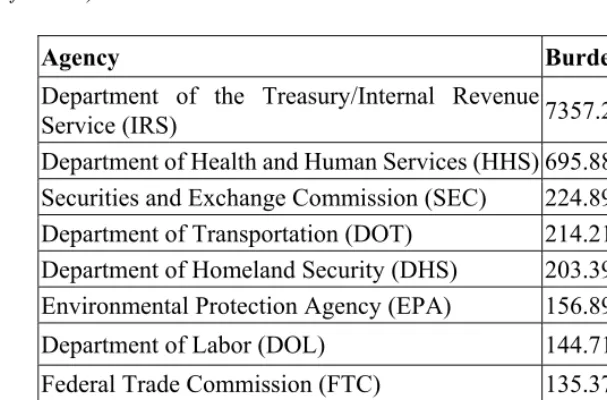
ICB quantifies the annual paperwork burden that the U.S. government imposes on its citizens. The most recent official report finds that in 2015, Americans spent 9.78 billion hours on federal paperwork.10
In early 2019, an official running count had the number at 11.25 billion hours;11
that number is almost certainly more accurate than the 2015 figure, but because it has not been subject to the same level of internal and external scrutiny, I will rely on the 9.78-billion-hour figure here. In spite of significant shifts,12 the burden has been high for a long time:
9. 44 U.S.C. § 3514(a) (2012).
10. OFF. OF MGMT.&BUDGET,INFORMATION COLLECTION BUDGET OF THE UNITED
STATES GOVERNMENT 2 (2016) https://www.whitehouse.gov/sites/whitehouse.gov/ files/omb/inforeg/inforeg/icb/icb_2016.pdf [https://perma.cc/3FYG-M93W] [hereinafter INFORMATION COLLECTION BUDGET 2016]. Puzzlingly, the Trump administration has failed to produce the annual report, though it is required by law. See Office of Management and Budget Reports, WHITE HOUSE.GOV, https://www.whitehouse.gov/omb/information-regulatory-affairs/reports [https://perma.cc/B75H-FAL3] (listing the 2016 Information Collection Budget as the most recent).
11. Government-Wide Totals for Active Information Collections, OIRA, https://www.reginfo.gov/public/do/PRAReport?operation=11 [https://perma.cc/H9K2-J424].
It is worth pausing over those 9.78 billion hours. Suppose that we assembled every resident of Chicago and insisted that for the entirety of 2019, each one must work 40 hours a week engaged in just one task: filling out federal forms. By the end of 2019, the 2.7 million citizens of Chicago13 will not have come within four billion hours of the annual
paperwork burden placed on Americans.
The 9.78 billion hours take a significant toll.14
The Office of Information and Regulatory Affairs (“OIRA”) has not attempted to monetize those hours, though in 2010, it asked for public comments on
13. QuickFacts: Chicago City, Illinois, U.S. CENSUS BUREAU, https://www.census.gov/quickfacts/chicagocityillinois [https://perma.cc/R7UR-D89B].
whether and how to do so.15 If we value an hour of work at $20,16 9.78
billion hours is the equivalent of $195.6 billion—more than double the budget of the Department of State17 and the Department of
Transportation,18
about triple the budget of the Department of Education,19 and about eight times the budget of the Department of
Energy.20
The monetary figures greatly understate the problem. Administrative burdens can make it difficult or impossible for people to enjoy fundamental rights (such as the right to vote and the right to free speech), to obtain licenses and permits, to obtain life-changing benefits, or to avoid crushing hardship.21
With respect to the right to
15. See Request for Comments on Implementation of the Paperwork Reduction Act, 74 Fed. Reg. 55,269 (Oct. 27, 2009). I served as Administrator of OIRA at the time. OMB and OIRA asked similar questions in 1999. See Notice of Reevaluation of OMB Guidance on Estimating Paperwork Burden, 64 Fed. Reg. 55,788 (Oct. 14, 1999). For a valuable relevant discussion, see generally Adam M. Samaha, Death and Paperwork Reduction, 65 DUKEL.J.279 (2015).
16. The $20 figure is used to simplify the illustration. The federal government does not have a standard number, but in Regulatory Impact Analyses it has used numbers from the Bureau of Labor Statistics, which reports an average in the vicinity of $27. See, e.g.,DEP’T OF HEALTH AND
HUM. SERV. & FOOD AND DRUG ADMIN., TOBACCO PRODUCT STANDARD FOR N-NITROSONORNICOTINE LEVEL IN FINISHED SMOKELESS TOBACCO PRODUCTS 78 (Jan. 2017), https://www.fda.gov/downloads/aboutfda/reportsmanualsforms/reports/economicanalyses/ucm5 37872.pdf [https://perma.cc/46HT-25RZ] (“Labor hours are valued at the current market wage as reported by the May 2015 Occupational Employment Statistics published by the Bureau of Labor Statistics (US Bureau of Labor Statistics, 2015).”); Average Hourly and Weekly Earnings of All Employees on Private Nonfarm Payrolls by Industry Sector, Seasonally Adjusted, BUREAU OF
LAB. STAT., https://www.bls.gov/news.release/empsit.t19.htm [https://perma.cc/42WN-8CDG] (listing the average hourly wage across private industries in January 2019 as $27.56); see also
Samaha, supra note 15, at 298 (“Not knowing who would be randomly selected for the survey, the [Institute of Museum and Library Services] used the national average per capita income of about $20 per hour to convert respondent time into dollar cost.”).
17. DEP’T OF STATE, CONGRESSIONAL BUDGET JUSTIFICATION 1 (2018), https://www.state.gov/documents/organization/277155.pdf [https://perma.cc/9DM2-EYGR] (requesting a budget of $37.8 billion for the 2019 fiscal year).
18. DEP’T. OF TRANSP., BUDGET HIGHLIGHTS FISCAL YEAR 2019 2 (2018), https://www.transportation.gov/sites/dot.gov/files/docs/mission/budget/304476/508dotbh2019-b.pdf [https://perma.cc/MDC8-8F93] (requesting a budget of $76.5 billion for the 2019 fiscal year). 19. DEP’T. OF EDUC.,FACT SHEET:PRESIDENT TRUMP’S FY2019BUDGET 1 (2018), https://www2.ed.gov/about/overview/budget/budget19/budget-factsheet.pdf [https://perma.cc/ 5A8J-X4U9] (requesting a budget of $63.2 billion for the 2019 fiscal year).
choose abortion, such burdens can be decisive impediments.22 They can
also make it difficult for people to receive the Earned Income Tax Credit, which is one of the nation’s most beneficial antipoverty programs.23
In short, paperwork burdens have massive negative effects on people’s lives.
Professor Richard H. Thaler has coined a helpful term for such burdens: sludge.24
The term should be taken to refer to the kind of friction, large or small, that people face when they want to go in one or another direction.25
For their own reasons, whether self-interested or altruistic, private and public institutions might impose or increase sludge. In the private sector, companies can use sludge to increase profits. For example, people might want to cancel a subscription to a magazine in which they no longer have the slightest interest, but to do that, they might have to wade through a great deal of sludge.26 In the
public sector, sludge may be an accident, but it might also be a political choice. People might want to sign their child up for some beneficial program, such as free transportation or free school meals, but the
HOW ILEARNED TO DO LESS,DO BETTER, AND LIVE MORE (2019) (illustrating the impact of administrative burdens in life and offering advice to mitigate it).
22. See HERD &MOYNIHAN, supra note 21, at 71–72. 23. Id. at 195–96.
24. Richard H. Thaler, Nudge, Not Sludge, 361 SCIENCE 431 (2018).
25. I am bracketing here the precise relationship between nudge and sludge. It is most useful to see both terms as descriptive rather than normative. It should be clear that nudges can be for good or for bad; on the bad, see GEORGE AKERLOF &ROBERT SHILLER,PHISHING FOR PHOOLS
(2015) (describing, among other examples, the strategies that Cinnabon founder Rich and Greg Komen developed to push people to making the “unhealthy” decision to eat a Cinnabon). It should also be clear that sludge can be for good or for bad. It is reasonable to see sludge as a kind of nudge, in the form of increased friction, which can nudge people in a helpful or unhelpful way. If people are nudged to choose healthy over unhealthy food, through good choice architecture, they might face sludge when they seek unhealthy food. To be sure, more work remains to be done on definitional issues. My hope is that the examples will be sufficient for purposes of the current discussion.
sludge might defeat them.27 To obtain financial aid for college, students
are required to fill out the Free Application for Federal Student Aid (“FAFSA”).28 It is long and complicated, and it requires young people
to provide information that they might not have (some of it is on their parents’ tax returns).29 Many students give up.30 The right to vote may
be the most fundamental of all, but a sludge-filled registration process may disenfranchise many millions of people.31 A sludge-reduction
initiative be a Voting Rights Act.
A great deal of evidence establishes that reducing administrative burdens can have a large impact on people’s lives. Millions of people are now benefiting from the Global Entry Program, which reduces time, trouble, and stress in security lines at airports.32 For free school
27. A corrective is the direct certification program, discussed below. See DEP’T OF AGRIC., DIRECT CERTIFICATION IN THE NATIONAL SCHOOL LUNCH PROGRAM: STATE
IMPLEMENTATION PROGRESS, SCHOOL YEAR 2014–2015, at 2 (2015), https://www.fns.usda.gov/direct-certification-national-school-lunch-program-report-congress-state-implementation-progress-0 [https://perma.cc/D6PP-X4GL].
28. See Eric Bettinger, Bridget Terry Long, Philip Oreopoulos & Lisa Sanbonmatsu, The Role of Simplification and Information in College Decisions: Results from the H&R Block FAFSA
Experiment 1 (Nat’l Bureau of Econ. Research, Working Paper No. 15361, 2009),
https://www.nber.org/papers/w15361 [https://perma.cc/66EG-VQXD] (“To determine eligibility, students and their families must fill out an eight-page, detailed application called the Free Application for Federal Student Aid (FAFSA), which has over 100 questions.”).
29. See Susan Dynarski & Mark Wiederspan, Student Aid Simplification: Looking Back and Looking Ahead 8–11 (Nat’l Bureau of Econ. Research, Working Paper No. 17834, 2012), https://www.nber.org/papers/w17834 [https://perma.cc/5VTH-682V].
30. Id. at 5 (“Millions of students and adult learners who aspire to college are overwhelmed by the complexity of student aid. Uncertainty and confusion robs them of its significant benefits.” (quoting ADVISORY COMMITTEE ON STUDENT FIN. ASSISTANCE, THE STUDENT AID
GAUNTLET: MAKING ACCESS TO COLLEGE SIMPLE AND CERTAIN i (2005), https://files.eric.ed.gov/fulltext/ED496648.pdf [https://perma.cc/788M-DFZ8]).
31. See, e.g., HERD &MOYNIHAN, supra note 21, at 47–60; LA.ADVISORY COMMITTEE FOR THE U.S.COMMISSION ON CIVIL RIGHTS, BARRIERS TO VOTING IN LOUISIANA 25–26 (2018), https://www.usccr.gov/pubs/2018/08-20-LA-Voting-Barriers.pdf [https://perma.cc/VCV4-BVQB] (recommending reduction in paperwork associated with voter registration to increase access to the polls); JONATHAN BRATER,KEVIN MORRIS,MYRNA PÉREZ &CHRISTOPHER DELUZIO, BRENNAN CTR. FOR JUSTICE,PURGES:AGROWING THREAT TO THE RIGHT TO VOTE (2018), http://www.brennancenter.org/publication/purges-growing-threat-right-vote [https://perma.cc/ 74YE-P6ZP]; THE LEADERSHIP CONF. EDUC. FUND, THE GREAT POLL CLOSURE (2016), http://civilrightsdocs.info/pdf/reports/2016/poll-closure-report-web.pdf [https://perma.cc/GRS7-953K].
meals, the U.S. Department of Agriculture has adopted a “Direct Certification“ program, which means that parents do not have to take the trouble to enroll their children at all.33 If the school district has
enough information to know that they are eligible, they are automatically enrolled.34 In the 2014–15 school year, more than 11
million children benefited from the program (about 91 percent of the eligible population).35
Simplification of FAFSA dramatically increases the likelihood that low-income people will apply for aid and eventually enroll in college.36 A number of states have adopted automatic voter
registration, which means that if eligible citizens interact with a state agency (say, by receiving a driver’s license), they are registered as voters.37
In less than a year, Oregon’s automatic registration program produced more than 250,000 new voters, and almost 100,000 of them actually voted.38
The private sector can do a great deal more to reduce sludge—to help workers choose from among healthcare plans, to make life easier for consumers and employees with ideas or complaints, and to help people avoid serious risks.39
Entry Members (Apr. 3, 2018), https://www.cbp.gov/newsroom/national-media-release/cbp-announces-5-million-global-entry-members [https://perma.cc/S5VF-HV87].
33. See NATIONAL SCHOOL LUNCH PROGRAM,supra note 27, at 2 (“Direct certification typically involves matching SNAP, TANF, and FDPIR records against student enrollment lists, at either the State or the LEA level.”).
34. Id. at 4. 35. Id. at 15, 24.
36. See Dynarski & Wiederspan, supra note 29, at 19; Bettinger et al., supra note 28, at 23. 37. See Automatic Voter Registration, BRENNAN CTR. FOR JUSTICE (Nov. 7, 2018), https://www.brennancenter.org/analysis/automatic-voter-registration [https://perma.cc/6EPA-GD5T]. As of 2018, thirteen states and the District of Columbia have approved automatic voter-registration policies. These states are: Alaska, California, Colorado, Georgia, Illinois, Maryland, Massachusetts, New Jersey, Oregon, Rhode Island, Vermont, Washington, and West Virginia.
SeeHistory of AVR & Implementation Dates, BRENNAN CTR. FOR JUSTICE (Nov. 7, 2018), https://www.brennancenter.org/analysis/history-avr-implementation-dates [https://perma.cc/ VXY8-RKQB].
38. ROB GRIFFIN,PAUL GRONKE,TOVA WANG &LIZ KENNEDY,CTR. FOR AM.PROG., WHO VOTES WITH AUTOMATIC VOTER REGISTRATION?IMPACT ANALYSIS OF OREGON’S
FIRST-IN-THE-NATION PROGRAM (2017), https://www.americanprogress.org/issues/democracy/ reports/2017/06/07/433677/votes-automatic-voter-registration/#fn-433677-2 [https://perma.cc/ 9L7K-YPWX].
II. SLUDGE HURTS (AND CAN KILL)
Sludge can make it difficult or impossible for people to enjoy or exercise constitutional rights. For freedom of speech, licensing schemes are the most obvious example; they are a form of sludge and are usually unconstitutional for that reason.40 The ban on prior restraints can be
seen as a ban on sludge.41
In the domain of healthcare, the sludge imposed on doctors and patients can literally kill.42 In emergency
rooms, for example, sludge has made it unnecessarily difficult for doctors to prescribe medicines that help patients overcome opioid addiction.43
Efforts to reduce that sludge, through private initiative and through law, can save lives.44
To understand why sludge matters, let us begin with the assumption that people are fully rational and that in deciding whether to navigate forms, they make some calculation about costs and benefits. Even if the benefits are high, the relevant costs might prove overwhelming. These costs can take qualitatively different forms.45
They might involve acquisition of information, which might be difficult and costly. They might involve time, which people might not have. They might be psychological, in the sense that they involve frustration, stigma, and humiliation. For any of those reasons, it might be very difficult to navigate or overcome the sludge. In some cases, doing the relevant paperwork might be literally impossible; it simply may not be feasible for people to fill out the forms. By themselves, these points help explain low take-up rates for many federal and state programs,46
40. Cf. Cox v. New Hampshire, 312 U.S. 569, 575, 576 (1941) (upholding a licensing scheme that regulated only the “time, place and manner” of speech).
41. Cf. Thomas Emerson, The Doctrine of Prior Restraint, 20 LAW &CONTEMP.PROBS. 648, 670 (1955) (describing prior restraint as a “particular method of control which experience has taught tends to create a potent and unnecessary mechanism of government that can smother free communication”).
42. See Felice J. Freyer, Emergency Rooms Once Offered Little for Drug Users. That’s
Starting to Change, BOS. GLOBE (Dec. 10, 2018),
https://www.bostonglobe.com/metro/2018/12/09/emergency-rooms-once-had-little-offer-addicted-people-that-starting-change/guX2LGPqG1UdAf9xUV9rXI/story.html [https:// perma.cc/FH6P-C2UF].
43. See id.
44. See id. (describing Massachusetts General Hospital’s efforts to increase emergency-room resources for patients addicted to opioids).
45. See HERD &MOYNIHAN, supra note 21, at 23; Donald Moynihan, Pamela Herd & Hope Harvey Administrative Burden: Learning, Psychological, and Compliance Costs in Citizen-State Interactions, 25 J.PUB.ADMIN.RES.&THEORY 43, 45–46 (2014) .
as well as the immense difficulty that people often have in obtaining permits or licenses of various sorts.47
We can even see sludge as an obstacle to freedom, especially insofar as it reduces or impairs navigability.48
A. “Everyone Believes In Redemption”
An assortment of human biases, emphasized by behavioral economists, amplify the real-world effects of administrative burdens. For many people, inertia is a powerful force,49
and people tend to procrastinate.50 If people suffer from inertia and if they procrastinate,
they might never do the necessary paperwork. The problem is compounded by “present bias.”51 The future often seems like a foreign
country—Laterland—and people are not sure that they will ever visit. It is often tempting to put off administrative tasks until another day. That day may never come, even if the consequences of delay are quite serious.
the United States and United Kingdom); see generally Katherine Baicker, William J. Congdon, & Sendhil Mullainathan, Health Insurance Coverage and Take-Up: Lessons from Behavioral Economics, 90 MILBANK Q. 107 (2012) (examining low health-insurance take-up rates from a behavioral-economic perspective);Carole Roan Gresenz, Sarah E. Edgington, Miriam Laugesen, & José J. Escarce, Take-Up of Public Insurance and Crowd-Out of Private Insurance Under Recent CHIP Expansions to Higher Income Children, 47 HEALTH SERVS.RES. 1999 (2012) (analyzing the effect of expanding CHIP eligibility on health-insurance take-up rates); Saurabh Bhargava & Dayanand Manoli, Improving Take-Up of Tax Benefits in the United States, ABDUL LATIF
JAMEEL POVERTY ACTION LAB (2015), https://www.povertyactionlab.org/evaluation/improving-take-tax-benefits-united-states [https://perma.cc/TPW8-XDHU] (noting that “many people who are eligible for social and economic benefits do not claim those benefits” in the United States). 47. REGULATORY REFORM TEAM, Case Study: Chicago Licensing and Permitting Reform, DATA-SMART CITY SOLUTIONS (Mar. 19, 2015), https://datasmart.ash.harvard.edu/news/ article/case-study-chicago-licensing-and-permitting-reform-647 [https://perma.cc/X3YJ-JSLM] (assessing the regulatory landscape of the city of Chicago, and finding, among other things, that “[a]pproximately 17% of zoning licenses were not being processed and sent back due to insufficient information”).
48. On this theme, see CASS R.SUNSTEIN,ON FREEDOM (2019).
49. Brigitte C. Madrian & Dennis F. Shea, The Power of Suggestion: Inertia in 401(k) Participation and Savings Behavior, 116Q.J.ECON 1149, 1185 (2001) (identifying inertia as a force working against participation in 401(k) plans); see also John Pottow & Omri Ben-Shahar, On the Stickiness of Default Rules, 33 FLA.ST.U.L.REV. 651, 651 (2006) (“It is by now recognized that factors beyond drafting costs might also cause parties to stick with an undesirable default rule . . . .”).
50. George Akerlof, Procrastination and Obedience, 81AM.ECON.REV. 1, 1–17 (1991) (examining several “behavioral patholog[ies],” including procrastination).
Mail-in forms impose a type of sludge.52 They provide people with
an opportunity to obtain a nontrivial gain, often in the form of a check, but they require people to overcome inertia. As an illustration of the relationship between behavioral biases and sludge, consider a study of people’s failure to redeem such forms, with a memorably precise name:
Everyone Believes In Redemption.53
Across various markets, redemption rates usually range between 10 percent and 40 percent, which means that a strong majority of customers forget or simply do not bother.54 Because of the power of inertia, that might not be terribly
surprising. What is more striking is the finding that people are
unrealistically optimistic about the likelihood that they will ever redeem forms.55
In the relevant study, people thought that there was about an 80 percent chance that they would do so within the 30 days they were given.56
The actual redemption rate was 31 percent.57
It is an overstatement to say that everyone believes in redemption—but most people certainly do.
In the same study, the researchers made three efforts (with different groups of people) to reduce the massive difference between the predicted and actual redemption rates. First, they informed participants, very clearly, that in previous groups with similar people, redemption rates were below one-third.58
Second, they issued two clear reminders, one soon after purchase and another when the deadline for redemption was near.59
Third, they made redemption far simpler by eliminating the requirement that people must print out and sign a certification page.60
As it turned out, not one of the three interventions reduced people’s optimism. In all conditions, people thought there was about an 80 percent chance that they would mail in the forms.61
Moreover, and somewhat surprisingly, the first two interventions had no effect on
52. See Matthew Edwards, The Law, Marketing and Behavioral Economics of Consumer Rebates, 12STAN.J.L.BUS.&FIN. 362, 419–21 (2007).
53. Joshua Tasoff & Robert Letzler, Everyone Believes in Redemption: Nudges and Overoptimism in Costly Task Completion, 107J.ECON.BEHAV.&ORG. 107, 115 (2014). 54. Id. at 108.
55. Id.
56. Id. 57. Id.
what people actually did. When hearing about the behavior of other groups, people apparently thought, “Well, those are other groups. What do they have to do with us?” In other contexts, reminders often work because they focus people’s attention and reduce the power of inertia. But in this case, reminders turned out to be useless.62
The only effective intervention was simplification, which had a strong impact on what people actually did.63
By making it easier to mail in the form and thus reducing sludge, simplification significantly increased people’s willingness to act. The redemption rate rose to about 54 percent, which means that the disparity between belief and behavior was cut in half.64
B. Behavioral Biases and Sludge
The relevant study is of course relatively narrow, but it has large implications. Recall that inertia is a powerful force and that, because of inertia, people might not fill out necessary forms.65
That is one reason that participation rates are often much lower with opt-in designs than with opt-out designs.66
Recall too that inertia is aggravated by present bias, leading people to focus on the short term and neglect the future.67
Suppose in this light that under federal regulations, individuals, small businesses, and startups must fill out certain forms in order to be eligible for important benefits or to avoid significant penalties. They might intend to do exactly that, but if the task can be put off, or if it is burdensome or difficult, their behavior might not match their intentions. The actual costs might turn out to be very high; the perceived costs might be far higher. To get slightly ahead of the story:
62. Id.
63. Id. 64. Id.
65. See Madrian & Shea, supra note 49, at 1185; see generally William Samuelson & Richard Zeckhauser, Status Quo Bias in Decision Making, 1 J.RISK &UNCERTAINTY 7 (1988) (finding that status quo bias influences students’ decisions about healthcare plans and retirement programs).
66. For an especially dramatic illustration, see Peter Bergman, Jessica Lasky-Fink & Todd Rogers, Simplification and Defaults Affect Adoption and Impact of Technology, But Decision Makers Do Not Realize This (Harvard Kennedy Sch. Faculty Research Working Paper Series, Working Paper No. RWP17-021, 2018), https://ssrn.com/abstract=3233874 [https://perma.cc/ YWN6-BBCJ].
it would make sense for federal regulators to “scrub” existing paperwork burdens to make sure that they are not doing unintended or inadvertent harm. That is the idea of a “Sludge Audit.”
The right to vote may be the most fundamental of all, and federal law requires states to send mail-in forms (“return cards”) before purging voters from electoral rolls on change-of-residence grounds (if a voter has not already confirmed a move).68
Each state is allowed to choose its own trigger for sending the return card. Some states use change-of-address information provided by the United States Postal Service,69 but others use methods that can very foreseeably flag voters
who have in fact not moved and thus remain eligible.70
A qualified voter can be struck for failing to mail the return card back and not voting for four years.71
Voters—along with Congress72
and the Supreme Court73—may be optimistic that they will do that, but their optimism
might be misplaced.
More generally, sludge has a significant impact that many people do not foresee. As the redemption study shows, people are unrealistically optimistic about the likelihood that they will overcome inertia. Even specialists might be surprised at the extent to which apparently promising strategies fail. In addition, sludge can be used
68. National Voter Registration Act of 1993, 52 U.S.C. § 20507(d) (2012). This provision of the National Voter Registration Act, among other purposes, is aimed to “ensure that accurate and current voter registration rolls are maintained.” 52 U.S.C. § 20501(b)(4).
69. This is the practice suggested by federal law. See 52 U.S.C. § 20507(c)(1). Thirty-six states do at least this. See NAT’L ASSN. OF SECRETARIES OF STATE, NASS REPORT: MAINTENANCE OF STATE VOTER REGISTRATION LISTS 5–6 (2017) (Dec. 2017), https://www.nass.org/sites/default/files/reports/nass-report-voter-reg-maintenance-final-dec17.pdf [https://perma.cc/FXJ6-RPXK].
70. See, e.g., IOWA CODE § 48A.28.3 (2018) (permitting the sending of notice each year); GA.CODE ANN. § 21-2-234(a)(1)–(2) (2018) (notice sent to registrants with whom there has been “no contact” for three years); PA.STAT.ANN., tit. 25, § 1901(b)(3) (2018) (notice sent to voters who have not voted in five years); OHIO REV.CODE ANN. § 3503.21(B)(2) (2018) (notice sent to those who fail to vote in two consecutive federal elections). Note also that some states trigger notices based on dubious interstate databases. See, e.g., OKLA.ADMIN.CODE § 230:15–11– 19(a)(3) (2018) (notice sent to those who have not voted since the “second previous General Election” and those who fail references to interstate databases); WIS.STAT.ANN. § 6.50(1) (2018) (notice sent to voters who have not voted in four years); see also JONATHAN BRATER, ET AL.,
supra note 31, at 7–8 (explaining how the system used by Oklahoma, “Crosscheck,” is unreliable and inaccurate).
71. See 52 U.S.C. § 20507(d)(1)(ii).
72. 52 U.S.C. § 20507(d) makes failure to send the return card back one of the two sufficient conditions for removing a registered voter from the rolls on change-of-address grounds.
opportunistically by clever marketers who seek to give consumers the impression that they will receive an excellent deal but who know that consumers will not take advantage of the opportunity.74 In many cases,
government officials are not seeking to act opportunistically; they are responding to political values and commitments, which is not the same thing.75
At the same time, sludge might have a damaging effect that they do not anticipate. In particular, officials might not understand the extent to which sludge will adversely affect a population that they are seeking to help.
C. Cognition and Scarcity
With respect to redemption, the power of simplification puts a spotlight on the large consequences of seemingly modest administrative burdens—on the effects of “choice architecture” in determining outcomes.76
I have noted that in many domains, participation rates can be dramatically increased with a mere shift from requiring people to apply in) to automatically enrolling them (opt-out).77 In an especially dramatic study, Professors Peter Bergman of
Columbia University and Todd Rogers of Harvard University found that if parents are asked whether they want to sign up to receive text-message alerts about the academic progress of their children, participation rates are tiny—around 1 percent.78 If the signup process
is simplified, participation rates increase significantly, to about 8 percent.79 But if parents are automatically signed up, participation rates
jump to 96 percent.80
To be sure, most changes in choice architecture
74. For relevant discussion, see Petra Persson, Attention Manipulation and Information Overload, 2 BEHAVIOURAL PUB. POL’Y 78 (2018); Thomas Blake, Sarah Moshary, Kane Sweeney & Steven Tadelis, Price Salience and Product Choice (NAT’L BUREAU OF ECON. RESEARCH, Working Paper No. 25186, 2018), https://www.nber.org/papers/w25186?sy=186 [https://perma.cc/Y54U-9K9S].
75. See Moynihan et al., supra note 45, at 65 (outlining how burdens may be imposed to serve legitimate political values).
76. See generally RICHARD H.THALER &CASS R. SUNSTEIN,NUDGE 83–105 (2008) (describing choice architecture).
77. See Eric Johnson & Daniel Goldstein, Do Defaults Save Lives?, 302 SCIENCE 1338, 1338–39 (2003) (explaining that organ donation increases when it is opt-out rather than opt-in).
78. Peter Bergman & Todd Rogers, The Impact of Defaults on Technology Adoption 5 (Harvard Kennedy Sch. Faculty Research Working Paper Series, Working Paper No. RWP17-021, 2018), https://scholar.harvard.edu/files/todd_rogers/files/bergman_and_rogers_the _impact_of_defaults.pdf [https://perma.cc/N7GF-BCY9].
79. Id.
do not have effects of that magnitude.81 But simplification and burden
reduction do not merely reduce frustration; they can change people’s lives.
An underlying reason is that our cognitive resources are limited.82
Inevitably, we are able to focus on only a small subset of life’s challenges. For those who are busy, poor, disabled, or elderly, the problem of cognitive scarcity is especially serious.83
For that reason, it is important to focus on the distributional effects of administrative burdens—on whom they are most likely to hurt.84
As a practical matter, the answer is often the poorest among us. A central reason is that if you are poor, you have to focus on a wide range of immediately pressing problems.85
If the government is asking poor people to navigate a complex system or to fill out a lot of forms, they might give up. But the problem is hardly limited to the poor. When programs are designed to benefit the elderly, sludge might be especially damaging, at least if the population suffers from reduced cognitive capacity. For different reasons, the problem of sex equality deserves particular attention.86
Because women do a disproportionate amount of administrative work—running the household, arranging meals, taking care of children—a significant reduction in sludge could address a pervasive source of social inequality, with ramifying effects on other areas of life.
81. See, e.g., Madrian & Shea, supra note 49, at 1184 (summarizing behavioral changes resulting from 401(k) participation and savings behavior as a result of changing default options). For a discussion of the effect of inertia on choice of travel modes, see Alessandro Innocenti, Patrizia Lattarulo & Maria Grazia Pazienza, Heuristics and Biases in Travel Mode Choice 20 (LabSi, Working Paper No. 27/2009, 2009), http://www.labsi.org/wp/labsi27.pdf [https:// perma.cc/P23F-42UL].
82. See Xavier Gabaix, Behavioral Inattention (Nat’l Bureau of Econ. Research, Working Paper No. 24096, 2018), https://www.nber.org/papers/w24096 [https://perma.cc/FQ2L-M3VN]. 83. See SENDHIL MULLAINATHAN &ELDAR SHAFIR,SCARCITY:WHY HAVING TOO
LITTLE MEANS SO MUCH 147–66 (2013).
84. See HERD &MOYNIHAN, supra note 21. For helpful related discussion, see Jessica Roberts, Nudge-Proof: Distributive Justice and the Ethics of Nudging, 116 MICH.L.REV. 1045 (2018). The idea has support in the PRA, which requires “particular emphasis on those individuals and entities most adversely affected.” 44 U.S.C. § 3504(c)(3) (2012).
III. AVERY QUICK TOUR OF THE HORIZON
It would be valuable to catalogue an assortment of programs that have been adversely affected, to varying degrees, by sludge.87 A book could easily be written on that topic. Instead of venturing that, I will borrow heavily from a superb treatment by Professors Pamela Herd and Donald Moynihan, who offer a series of case studies. Herd and Moynihan demonstrate that in some programs, burdens are a serious problem, but in others, the government has ensured that they are negligible. With respect to sludge, a model program is Social Security, which is simple and in many ways automatic. As Herd and Moynihan put it, “the biggest bookkeeping organization in the world banished burdens.”88
The U.S. government bears the relevant administrative burdens, and it generally requires citizens to do very little. The Social Security Administration (“SSA”) tracks people’s earnings and determines eligibility and benefit levels automatically. If you are eligible, you can enroll online or go to one of the nation’s 1200 field offices.89 After you do that, you are likely to receive direct deposits into
your bank account within a month.90
As a matter of history, there is a large irony here. In the 1930s, the supposed administrative challenge was taken as a serious objection to the very idea of Social Security.91
But the federal government succeeded it meeting that challenge. It did so in part through the creation and use of Social Security numbers, which make it much simpler to track people’s earnings over their entire working lives.92 The
SSA has worked hard and mostly successfully to cut sludge and thus to make things easy for beneficiaries, replacing lost Social Security cards, taking applications, updating records, and ensuring the accuracy of payments.93 For beneficiaries, the program is working. The poverty
rate among older adults is now just 9 percent; if Social Security were not included in their income, it would be 40 percent.94 Almost one-third
87. For a valuable discussion of sludge in the context of medical education, see generally Joel Yager & Jeffrey E. Katzman, Bureaucrapathologies: Galloping Regulosis, Assessment Degradosis, and Other Unintended Organizational Maladies in Post-Graduate Medical Education, 39 ACAD.PSYCHIATRY 678 (2015).
of beneficiaries rely on the program for at least 90 percent of their income.95
The level of sludge is also relatively low for the Earned Income Tax Credit (“EITC”), a wage subsidy for low-income workers.96 Most
programs designed to benefit poor people have dispiriting take-up rates of between 30 and 60 percent; for the EITC, the rate is about 80 percent.97
That is excellent news, for the EITC ranks among the most effective of U.S. antipoverty programs. Because it makes work more remunerative, it significantly increases labor-force participation.98
The EITC also makes a major dent in the national poverty rate and helps children in particular, with beneficial effects on their health, their cognitive abilities, and their long-term educational prospects.99
For the EITC, the relatively high take-up rate is a product of relatively low levels of sludge. The paperwork requirements are modest; a standard tax return is all that is necessary. The Internal Revenue Service (“IRS”) sends simple, clear reminders to people who appear to be eligible, and the reminders significantly increase participation rates.100
It also runs voluntary programs that provide free tax help. Because participation involves little in the way of frustration or stigma, the psychological costs are low. True, the EITC is not as simple or automatic as Social Security, and sludge reduction thus remains a priority. If 20 percent of eligible people are not receiving the benefit, there is a serious problem. The IRS almost certainly knows enough to enroll people automatically and send a refund to eligible taxpayers.101 Nonetheless, the administrative burdens for recipients are
much lower than they might be, partly because of an unlikely coalition between business interests and those seeking to help the working poor.102
95. Id.
96. For a general discussion, see MAKING WORK PAY (Bruce Meyer & Douglas Holtz-Eakin eds. 2002).
97. HERD &MOYNIHAN, supra note 21, at 191. 98. Id. at 196.
99. Id. at 194. 100. Id. at 196.
101. Surprisingly, there appears to be no literature on automatic enrollment and the EITC. This area deserves sustained study.
Herd and Moynihan contrast benefits programs that impose far more daunting burdens. For the Affordable Care Act,103
federalism has turned out to be a major challenge. Opposed to the very idea of Obamacare, twenty-seven states simply refused to adopt exchanges, which were supposed to provide people with a simple, relatively sludge-free way to buy health insurance.104
Citizens in those states have had to apply through federal exchanges, and that is far more cumbersome. Successful applicants initially receive a notice from the federal government that they are eligible for the state Medicaid program. The federal government then transfers the file to the state. After that, the state determines eligibility.105 This process can take
months, and it has left millions of people in limbo. The Obama administration reduced burdens by publicizing the program and by simplifying coordination. But the Trump administration reduced funding for publicity and shortened the signup period.106
Medicare is a nearly universal program aimed at older people.107
Those who are eligible for Social Security are usually eligible for Medicare too. The sludge comes from the astonishingly complex process faced by Medicare enrollees when choosing among services. What is the right supplemental insurance plan? What is the right prescription drug plan? Is a Medicare Advantage Plan a good idea? These are difficult questions, and as Herd and Moynihan emphasize, older adults often suffer from cognitive decline.108
They quote a Medicare beneficiary who notes, “That’s what gets me, they wait until we retire to make it complicated.”109
A great deal of behavioral evidence finds that Medicare beneficiaries are making poor choices and losing money in the process.110
For that reason, there is a good
103. Patient Protection and Affordable Care Act of 2010, Pub. L. No. 111-148, 124 Stat. 119 (codified as amended in scattered sections of 42 U.S.C. § 18001 (2012)).
104. HERD &MOYNIHAN, supra note 21, at 98. 105. Id. at 99.
106. Id. at 118.
107. Social Security Amendments of 1965, Pub. L. 89-97, 79 Stat. 286 (codified as amended in scattered sections at 25, 26, 29 & 42 U.S.C. (2012)). Medicare is understood in four parts. Hospital insurance in Part A, 42 U.S.C. § 1395c; supplemental medical insurance in Part B, 42 U.S.C. § 1395j; managed care in Part C, 42 U.S.C. § 1395w-21; and drug benefits in Part D, 42 U.S.C. § 1395w-101.
108. HERD &MOYNIHAN, supra note 21, at 134–35. 109. Id. at 134.
argument that the government should simplify the process with the use of online tools, telephone assistance (with shorter waiting times), and customized recommendations.111
Under current law, states are allowed to regulate the abortion right so long as their regulations do not impose an “undue burden.”112
Because that standard has a degree of elasticity, it invites states to take steps to discourage abortion. They have enthusiastically taken up the invitation.113 For example, states have required pregnant women to
engage in mandatory counselling, which includes descriptions not only of the procedure but also of fetal pain. They have required women to take and see an ultrasound, to make multiple visits to clinics, and to undergo significant waiting periods.114 These requirements impose
evident costs in terms of learning, compliance, and psychology.
To capture those costs, Herd and Moynihan offer an extensive quotation from a thirty-five-year-old woman, describing her experience of navigating administrative burdens in Wisconsin. Here is an excerpt:
I am shaken. I am embarrassed. I am tired of waiting. I am now called into a room. I can bring Hubby this time. We are told to watch a video, again required by state law. The video talks about adoption, foster parenthood, the dangers of abortion, my rights. It drags on. I feel like a small child. Husband looks concerned and helpless. I sign a form indicating my understanding of the information presented on the video. We wait. A nurse finally comes back in. Time to go back to the waiting room. We’ll call you in a short while.115
These administrative burdens have had an impact. According to one study, they increase the cost of abortion by 19 percent and decrease the number of abortions by between 13 and 15 percent.116 One
consequence appears to be an increase in the incidence of self-administered abortions.117
111. HERD &MOYNIHAN, supra note 21, at 138.
112. Planned Parenthood of Se. Pa. v. Casey, 505 U.S. 833, 874 (1992).
113. See HERD &MOYNIHAN, supra note 21, at 90–92; Kate L. Fetrow, Note, Taking Abortion Rights Seriously: Toward a Holistic Undue Burden Jurisprudence, 70STAN.L.REV. 319, 322 (2018) (noting that the “undue burden” standard allows states to chip away at the right to an abortion).
114. Id. at 71.
115. HERD &MOYNIHAN, supra note 21, at 78–79. 116. Id. at 82.
The Fifteenth Amendment to the U.S. Constitution, forbidding denial of the vote “on account of race, color, or previous condition of servitude,” was ratified in 1870,118 but administrative burdens have long
been used to disenfranchise African Americans. For decades, literacy tests were a favorite instrument; they were eventually forbidden by the Voting Rights Act of 1965.119
In recent years, administrative burdens have become less onerous, in the sense that voting is more convenient, and registration is generally easier.120
But such burdens continue to exist, and in some states, they are mounting. They are plainly being used as a political weapon, most prominently by Republican leaders seeking to impose sludge so as to increase their electoral prospects.121
Some states are purging from the voter rolls people who have not voted for a specified number of years or responded to a notice, thus requiring them to register again.122 Other states are purging voters on
the basis of flawed technologies designed to prevent noncitizens or felons from voting.123 Some states require state-issued photo
identification.124
That might not seem so onerous, but according to some estimates, about 11 percent of Americans do not have a state-issued photo identification (including about 25 percent of African Americans).125 States have also increased residency requirements and
required proof of citizenship.126
With respect to the right to vote, administrative burdens of multiple kinds are working to disenfranchise African Americans, the elderly, and low-income individuals.127
118. U.S.CONST. amend. XV.
119. Voting Rights Act of 1965, Pub. L. 89-110, 79 Stat. 437 (codified at 52 U.S.C. §§ 10101, 10301–10314, 10501–10508, 10701–10702 (2012)). Literacy tests are prohibited under 52 U.S.C. § 10101(a)(2)(C).
120. HERD &MOYNIHAN, supra note 21, at 47.
121. Id. at 63–64 (noting the correlation between Republican states and voter ID laws and explaining the correlation with party policies).
122. See text accompanying supra, note 71; see also HERD &MOYNIHAN, supra note 21, at 53
123. See BRATER ET AL., supra note 31, at 5–10.
124. See Voter Identification Requirements: Voter ID Laws, NAT’L CONF. OF ST. LEGISLATURES, http://www.ncsl.org/research/elections-and-campaigns/voter-id.aspx [https:// perma.cc/QF6Z-VAKK] (noting that 34 states have laws requesting or requiring voters to show some form of identification to vote, and seven of those require state-issued photo identification). 125. Denise Lieberman, Barriers to the Ballot Box: New Restrictions Underscore the Need for Voting Laws Enforcement, 39 HUM.RTS. 2, 3 (2012).
IV. JUSTIFYING SLUDGE
Notwithstanding these points, paperwork burdens often serve important goals. Sometimes they are indispensable. As the examples suggest, we can readily imagine five possible justifications for sludge: (1) program integrity, (2) self-control problems, (3) privacy, (4) targeting, and (5) data collection.
A. Program Integrity
When agencies impose paperwork burdens, it is often because of a desire to ensure that programs work in the way that the law requires. One reason involves eligibility restrictions; another involves record-keeping. What is true for the private sector is true for the public sector as well. Those who seek a loan, private or public, face sludge. The central reason is to ensure that they actually qualify. People should not receive Medicare, Medicaid, the EITC, or Social Security unless they are entitled to the relevant benefits, and sludge is often a way of collecting necessary information. Even in the context of voting rights, burdens of various sorts can be and often are justified as a means of ensuring that would-be voters meet existing legal requirements. For spending programs, a usual justification for paperwork burdens points to “fraud, waste, and abuse”;128
sludge can be an effort to reduce all three.
It is true that with the increasing availability of information and with machine learning, private and public institutions might be able to find the relevant information on their own. In the private sector, some companies use the idea of “prequalification,” which means that they have enough information to know, in advance, that some people are already qualified for goods or services.129
Sometimes forms can be
128. See 6 U.S.C. § 795 (2012) (“The Administrator shall ensure that all programs within the Agency administering Federal disaster relief assistance develop and maintain proper internal management controls to prevent and detect fraud, waste, and abuse.”); Jerry L. Mashaw & Theodore R. Marmor, Conceptualizing, Estimating, and Reforming Fraud, Waste, and Abuse in Healthcare Spending, 11 YALE J. ON REG. 455 (1994); Julie K. Taitsman, Educating Physicians to Prevent Fraud, Waste, and Abuse, 364 NEW ENG.J.MED. 102, 102 (2011); 6 U.S.C. § 795 (“The Administrator shall ensure that all programs within the Agency administering Federal disaster relief assistance develop and maintain proper internal management controls to prevent and detect fraud, waste, and abuse.”).
“prepopulated”; as a result, forms might not be necessary.130 In the
domain of taxation, one example is the idea of return-free filing, which eliminates the need for taxpayers to fill out forms at all.131 In the
fullness of time, we should see significant movements in this direction.132
But those movements remain incipient. For the present and the near future, the most obvious justifications for sludge go by the name of “program integrity.”133 Suppose that the IRS decided to send the
EITC to apparently eligible taxpayers. If it could do so at low cost, and if the apparently eligible taxpayers are in fact eligible, there would be little ground for objection. The problem, of course, is the word “apparently.” It is possible that some of the recipients will not in fact be eligible. Whenever people are automatically enrolled in a program, some of them may not meet the legal criteria.
When this is so, regulators must choose between (1) a design ensuring that some eligible people will not receive a benefit and (2) a design ensuring that some ineligible people will receive a benefit. If the idea of program integrity is meant to refer to the number of errors, the
130. Note the emphasis on prepopulation in Memorandum from Neomi Rao, Admin., OIRA, to Chief Information Officers 8 (Aug. 6, 2018), https://www.whitehouse.gov/wp- content/uploads/2018/08/Minimizing-Paperwork-and-Reporting-Burdens-Data-Call-for-the-2018-ICB.pdf [https://perma.cc/KF9L-N6NZ] [hereinafter Memorandum from Neomi Rao (Aug. 6, 2018)] (“Sometimes agencies collect data that are unchanged from prior applications; in such circumstances, they may be able to use, or to give people the option to use, pre-populated electronic forms.”).
131. See AUSTAN GOOLSBEE, BROOKINGS INST., THE ‘SIMPLE RETURN’: REDUCING
AMERICA’S TAX BURDEN THROUGH RETURN-FREE FILING 2 (2006), https:// www.brookings.edu/wp-content/uploads/2016/06/200607goolsbee.pdf [https://perma.cc/C695-5YQL] (“For the millions of taxpayers who could use the Simple Return, however, filing a tax return would entail nothing more than checking the numbers, signing the return, and then either sending a check or getting a refund.”).
132. See Memorandum from Neomi Rao (Aug. 6, 2018) supra note 130, at 8 (“Also worth considering is whether, in some circumstances, to dispense with forms entirely and to rely on more automatic, generic, or direct approval of participation.”)
133. See Protecting Americans from Tax Hikes (PATH) Act, Pub. L. No. 114-113, 129 Stat. 2242 (2015) (referring to Title II as “Program Integrity” and specifically intending to reduce fraudulent and improper payments in the EITC and other programs); Leslie Book, David Williams & Krista Holub, Insights from Behavioral Economics Can Improve Administration of the EITC, 37 VA.TAX REV. 177, 180 (2018) (noting that “[p]rogram integrity” of the EITC was an important topic among employees of the IRS because 43 to 50 percent of all EITC returns are incorrect, with most errors benefitting claimants); CTRS. FOR MEDICARE &MEDICAID SERVS.,
Program Integrity, https://www.medicaid.gov/medicaid/program-integrity/index.html
choice between (1) and (2) might turn purely on arithmetic. Which group is larger? If automatic enrollment means that 500,000 eligible people receive the benefit who otherwise would not, and if a degree of sludge means that 499,999 ineligible people receive the benefit who otherwise would not, automatic enrollment is justified.
But it would be possible to see things differently. Suppose that automatic enrollment gives benefits to 200,000 eligible people but also to 200,001 ineligible people. Some people might think that if the 200,001 people are nearly eligible—if they are relatively poor—it is not so terrible if they receive some economic help. But other people might insist that taxpayer money is accompanied by clear restrictions and argue that if it is given out in violation of those restrictions, a grave wrong has been committed. On this view, even a modest breach of program integrity, for the advantage of those who are not eligible, is unacceptable.
The most extreme version of this view would be that a grant of benefits to a very large number of eligibles would not outweigh the grant of benefits to a very small number of ineligibles. From a welfarist standpoint, the most extreme version is hard or perhaps impossible to defend: a grant of benefits to a hundred people who are almost (but not) eligible would seem to be a price worth paying in exchange for a grant of benefits to a million people who are in fact eligible. But the correct tradeoff is not self-evident, and reasonable people might differ. We can generalize this example. In the direct-certification program for school lunches, the level of accuracy appears to be very high; few ineligible children are allowed to qualify.134 When sludge is
eliminated through automaticity, objections are weakened when benefits are not conferred on the ineligible. To the extent that they are, tradeoffs are inevitable, and different people can make different judgments. Consider the question of voter registration. Sludge has been defended as a way of combatting the risk of fraud and thus ensuring the integrity of the voting process.135 On imaginable
134. See NATIONAL SCHOOL LUNCH PROGRAM, supra note 27, at xiii (noting that states are required by federal law to “establish a system of direct certification of school-age SNAP participants”). To identify eligible students, most states compare SNAP files to enrolled student files and match them with varying criteria. Massachusetts uses first and last name along with date of birth as primary matching criteria, but the other states surveyed use multiple criteria that make an improper match unlikely. Id. at 28–33.
assumptions, sludge reduction could ensure that eligible people are allowed to vote while also ensuring that the same is true of (some) ineligible voters. The size of the two categories surely matters.
B. Self-Control Problems
Administrative burdens of diverse kinds might be designed to promote better decisions—to counteract self-control problems, recklessness, and impulsivity. Sludge can be a way of protecting people against their own errors. For that reason, sludge can easily be judged as a cure for a behavioral problem. Behavioral scientists sometimes contrast System 1 with System 2, where System 1 is rapid, intuitive, and often emotional, and System 2 is deliberative and reflective.136 Sludge
is a way to strengthen the hand of System 2.
For mundane decisions, small administrative burdens are frequently imposed online, with questions asking whether you are “sure you want to” send an email without a subject line, activate a ticket, cancel a recent order, or delete a file. Those burdens can be an excellent idea.
A degree of sludge, imposed by private and public institutions, might make sense for life-altering decisions, such as marriage and divorce.137
“Cooling-off periods” can be a blessing.138
If System 1 is leading people to make rash decisions, a mandatory waiting time might be useful as a way of allowing System 2 to have its say.139
Some sludge
vote during the period covering the next two general federal elections, is significant evidence that the addressee has moved.”).
136. See DANIEL KAHNEMAN, THINKING,FAST AND SLOW 13–15 (2011).
137. See, e.g., FLA.STAT.ANN. § 741.04 (2018) (making the effective date of marriage licenses three days after application unless both partners take a premarital education course); MASS.ANN. LAWS ch. 208, § 21 (2018) (allowing divorce to become absolute 90 days after the initial judgment).
138. See Pamaria Rekaiti & Roger Van den Bergh, Cooling-Off Periods in the Consumer Laws of the EC Member States: A Comparative Law and Economics Approach, 23 J.CONSUMER
POL’Y 371, 397 (2000) (“Cooling-off periods are potential remedies for the problems of irrational behaviour, situational monopoly, and informational asymmetry.”); Dainn Wie & Hyoungjong Kim, Between Calm and Passion: The Cooling-Off Period and Divorce Decisions in Korea, 21 FEMINIST ECON. 187, 209 (2015) (“The cooling-off period has no significant impact on divorce rates when the cause of divorce is . . . dishonesty, abuse, or discord with other family members. . . . [C]ouples reporting the cause of divorce as personality difference or financial distress responded to the cooling-off periods.”).
might also make sense before the purchase of guns, partly as a way of promoting deliberation.140
The abortion right is highly controversial, of course, but for that very reason, it is an especially interesting example. For example, some people think that counseling requirements and mandatory 24-hour waiting periods are legitimate ways of protecting women from making decisions that they will regret, or of protecting fetal life. Other people think that the burdens are simply an effort to discourage the exercise of a constitutional right.141
But even if we bracket the deepest issues, it is hardly impossible, in light of the stakes of the decision, to defend some administrative burdens as efforts to promote reflection and to provide valuable information.
C. Privacy and Security
Administrative burdens are often imposed in order to obtain information about people’s backgrounds—their employment history, their income, their criminal history (if any), their credit rating, their family history, their places of residence. Those who seek to work in government, certainly at levels that involve national security, are required to provide a great deal of information of that sort.142
It is at least reasonable to think that if private and public institutions are to receive some or all of that information, it must be with people’s explicit consent. If so, the question is whether to ask people to face administrative burdens or instead to intrude on their privacy. Perhaps it is not so terrible if the government chooses the former.
At one period, of course, officials had no real option. They could not intrude on privacy, because they lacked the means to do so. Increasingly, however, private and public institutions actually have independent access to that information, or they might be able to obtain it with a little effort. As a result, they are in a position to reduce sludge. Return, as a simple example, to the Direct Certification program of the U.S. Department of Agriculture.143 Officials know who is poor, and so
140. See, e.g.,CAL.PENAL CODE § 26815(a) (2018) (requiring a waiting period of ten days for all firearm purchases).
141. Planned Parenthood of Se. Pa. v. Casey, 505 U.S. 833, 918–21 (1992) (Stevens, J., concurring in part and dissenting in part) (discussing these potential justifications but concluding that the 24-hour waiting period is unconstitutional).
142. For an example, see U.S. OFFICE OF PERS. MGMT., STANDARD FORM 86: QUESTIONNAIRE FOR NATIONAL SECURITY POSITIONS (2010), https://www.opm.gov/forms/ pdf_fill/sf86-non508.pdf [https://perma.cc/KB9P-JJ8D].
they can directly certify them. In countless other cases, available data can enable private or public institutions to announce, very simply, that certain people are eligible, and on what terms. They might be able to prepopulate forms. They might be able to share data.144
To that extent, sludge can be a thing of the past.
But would that be desirable? Not necessarily. Automatic enrollment might well depend on a great deal of information gathering by institutions that people distrust. In some cases, there is a trade-off between irritating burdens on the one hand and potential invasions of privacy on the other. Consider, for example, the question of how much information credit-card companies should acquire before offering cards to customers. We might welcome situations in which such companies can learn what is required and simply send people offers or even cards. Whether we should do so depends in part of what information they have and whether it might be misused. If government has or acquires the relevant information, the risks might be thought unacceptable.
The question of security is closely related. To set up an online account, people might be asked to provide, and might be willing to provide, sensitive information—involving, for example, their bank account or their credit card. Sludge might be designed to ensure against security violations. People might have to answer questions about their address, their Social Security number, or their mother’s maiden name. These questions are not exactly fun, but they might be justified as a means of ensuring against some kind of breach. Ideally, of course, we would have some clarity about the benefits and costs of obtaining the relevant information. But if costs and benefits are difficult to specify, it might make sense to have a rough-and-ready sense that a degree of not-especially-onerous sludge is desirable to prevent the worst-case scenarios.145
D. Targeting and WTPT
A growing literature on “hassles” and “ordeals” explores how administrative burdens might operate as a rationing device, ensuring
144. On some of the relevant tradeoffs, see generally Memorandum from Jeffrey D. Zients, Dep. Dir. for Mgmt., & Cass R. Sunstein, Admin., OIRA, to Heads of Executive Departments and Agencies (Nov. 3, 2010), https://obamawhitehouse.archives.gov/sites/default/files/ omb/memoranda/2011/m11-02.pdf [https://perma.cc/56QK-7HCR] (encouraging federal agencies to share data to improve program implementation while complying with privacy laws).