Int. J. of Engg. Sci. & Mgmt. (IJESM), Vol. 2, Issue 2: April-June: 2012, 282 -286
INTERNATIONAL JOURNAL OF ENGINEERING SCIENCES
&
MANAGEMENT
NOVEL METHOD FOR IMAGE COMPRESSION USING DWT (HAAR
WAVELET) & DCT CASCADING
Manisha Singh*1, Agam Das Goswami2
Department of Electrical & Electronics , Shri Shankaracharya Group of Institutions, Bhilai
Abstract
As per the present scenario, the increasing growth of technology and the entrance into the digital age, we have to handle a vast amount of information every time which often presents difficulties. So, the digital information must be stored and retrieved in an efficient and effective manner, in order for it to be put to practical use. Compressing an image is significantly different than compressing raw binary data. General purpose compression programs can be used to compress images, but the result is less than optimal. In this paper, a novel scheme that combines the Discrete Wavelet Transform (DWT) and Discrete Cosine Transform (DCT) is proposed. DCT has high energy compaction property and requires less computational resources. On the other hand, DWT is multi-resolution transformation.
Keywords — compressing, Discrete Wavelet Transform, Discrete Cosine Transform
Introduction
Our computer is becoming more and more powerful day by day, and it results the use of digital images is increasing rapidly. Along with this increasing use of digital images comes the serious issue of storing and transferring the huge volume of data representing the images because the uncompressed multimedia (graphics, audio and video) data requires considerable storage capacity and transmission bandwidth. One of the important factors for image storage or transmission over any communication media is the image compression. Compression makes it possible for creating file sizes of manageable, storable and transmittable dimensions. A 4 MB image will take more than a minute to download using a 64kbps channel, whereas, if the image is compressed with a ratio of 10:1, it will have a size of 400KB and will take about 6 seconds to download. In other words we can say that compression is minimizing the size of bytes of a graphic file without degrading the quality of image.
* Corresponding Author
E. mail: [email protected]
The image is actually a kind of redundant data i.e. it contains the same information from certain perspective of view. By using data compression techniques, it is possible to remove some of the redundant information contained in images. Image compression minimizes the size in bytes of a graphics file without degrading the quality of the image to an unacceptable level. The reduction in file size allows more images to be stored in a certain amount of disk or memory space. It also reduces the time necessary for images to be sent over the Internet or downloaded from web pages. The scheme of image compression is not new at all. The discovery of Discrete Cosine Transform (DCT) in 1974 [10] is really an important achievement for those who work on image compression. The DCT can be regarded as a discrete time version of the Fourier Cosine series. It is a close relative of Discrete Fourier Transform (DFT), a technique for converting a signal into elementary frequency components. Thus DCT can be computed with a Fast Fourier Transform (FFT) like algorithm of complexity O (nlog2 n). Unlike DFT, DCT is real-valued and provides a better approximation of a signal with fewer coefficients.
Int. J. of Engg. Sci. & Mgmt. (IJESM), Vol. 2, Issue 2: April-June: 2012, 282 -286
(International Standards Organization) and IEC (International Electro-Technical Commission) is more often used for photographs, while the GIF method is commonly used for line art and other images in which geometric shapes are relatively simple.
The basic idea behind the image compression is that in most of the images we find that their neighbouring pixels are highly correlated and have redundant information [11]. Since the Haar Transform is memory efficient, exactly reversible without the edge effects, it is fast and simple. As such the Haar Transform technique is widely used these days in wavelet analysis. Fast Haar Transform is one of the algorithms which can reduce the tedious work of calculations. One of the earliest versions of FHT is included in HT [5]. In section 2, the Haar Transform has been explained. In section 3, Discrete Cosine Transform is presented with the proposed algorithm for 2D images. Results and simulation are given in section 4 followed by conclusion in 5.
Haar Wavelet Transform
Wavelets are mathematical functions that were developed for sorting the data by frequencies. A Wavelet transformation converts data from the spatial into the frequency domain and then stores each component with a corresponding matching resolution scale. The word ``wavelet’’ stands for an orthogonal basis of a certain vector space. Haar wavelet is discontinuous, and resembles a step function.
The Haar function is
Ψ (t) =
And,
= (2jt - i)
Where j=0, 1….. And i=0, 1,….., 2j - 1
Haar Transform is nothing but averaging and differencing. This can be explained with a simple 1D image with eight pixels
[3 2 -1 -2 3 0 4 1]
By applying the Haar wavelet transform we can represent this image in terms of a low-resolution image and a set of detail coefficients. So the image after one Haar Wavelet Transform is:
Transformed coefficient
= [2.5 -1.5 1.5 2.5]
Detail Coefficients
= [0.5 0.5 1.5 1.5]
The detail coefficients are used in reconstruction of the image. Recursive iterations will reduce the image by a factor of two for every cycle. In 2D wavelet transformation, structures are defined in 2-D and the transformation algorithm is applied for row first, and then for column. The array sizes are expressed in powers of two. Mathematically, the original resolution of the images is converted into the next larger power of two, and the array sizes are initialized accordingly. The Haar transform separates the image into high frequency and low frequency components.
Discrete Cosine Transform
The discrete cosine transform (DCT) helps separate the image into parts (or spectral sub-bands) of differing importance (with respect to the image's visual quality). The DCT is similar to the discrete Fourier transform: it transforms a signal or image from the spatial domain to the frequency domain (Fig 1)
Fig.1 Transformation of function into DCT
A discrete cosine transform (DCT) expresses a sequence of finitely many data points in terms of a sum of cosine functions oscillating at different frequencies. DCTs are important to numerous applications in science and engineering, from lossy compression of audio (e.g. MP3) and images (e.g. JPEG) (where small high-frequency components can be discarded), to spectral for the numerical solution of partial differential equations. The use of cosine rather than sine functions is critical in these applications: for compression, it turns out that cosine functions are much more efficient (as described below, fewer are needed to approximate a typical signal), whereas for differential equations the cosines express a particular choice of boundary conditions.
Int. J. of Engg. Sci. & Mgmt. (IJESM), Vol. 2, Issue 2: April-June: 2012, 282 -286
COMPRESION
DECOMPRESION
data with even symmetry (since the Fourier transform of a real and even function is real and even), where in some variants the input and/or output data are shifted by half a sample. There are eight standard DCT variants, of which four are common.
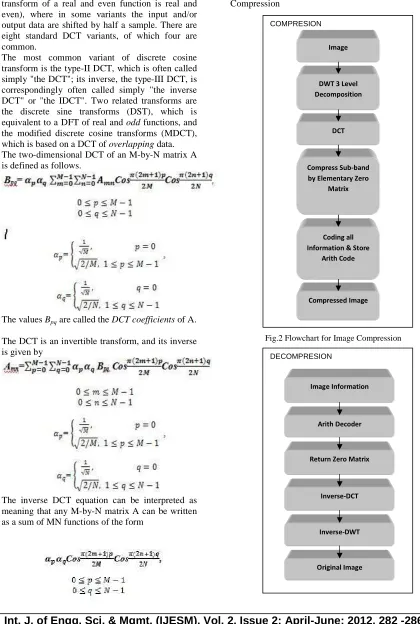
The most common variant of discrete cosine transform is the type-II DCT, which is often called simply "the DCT"; its inverse, the type-III DCT, is correspondingly often called simply "the inverse DCT" or "the IDCT". Two related transforms are the discrete sine transforms (DST), which is equivalent to a DFT of real and odd functions, and the modified discrete cosine transforms (MDCT), which is based on a DCT of overlapping data. The two-dimensional DCT of an M-by-N matrix A is defined as follows.
The values Bpq are called the DCT coefficients of A.
The DCT is an invertible transform, and its inverse is given by
The inverse DCT equation can be interpreted as meaning that any M-by-N matrix A can be written as a sum of MN functions of the form
Figure shows the basic flow for Compression and Compression
Fig.2 Flowchart for Image Compression
Image
DWT 3 Level Decomposition
DCT
Compress Sub-band by Elementary Zero
Matrix
Coding all Information & Store
Arith Code
Compressed Image
Image Information
Arith Decoder
Return Zero Matrix
Inverse-DCT
Inverse-DWT
Int. J. of Engg. Sci. & Mgmt. (IJESM), Vol. 2, Issue 2: April-June: 2012, 282 -286
Fig.3 Flowchart for Decompression Of CompressedImage
Simulations And Result
This section evaluates the performance of the proposed hybrid DWT-DCT algorithm. The proposed hybrid algorithm is applied on several types of images: natural images, medical images, benchmark images such that the performance of proposed algorithm can be verified for various applications. The retrieve image is also shown.
Original image Compressed image
2-norm rec.: 98.8666 % -- zero cfs: 98.3265 % Reconstructed image
Fig.4 Compression and Decompression of an image using
DWT (HAAR Wavelet)
Fig.5 Hybrid compression using DWT (HAAR wavelet) & DCT
Fig.6 Hybrid Decompression using DWT (HAAR wavelet) & DCT
TABLEI
COMPRESSION RATIO
Method CR (Hard Threshold)
CR (Soft Threshold) DWT
(HAAR Wavelet)
15.74 14.1
DCT 17.11 15.87 HYBRID
(DWT-DCT)
18.17 16.95
This table shows that, the proposed method gives a better compression ratio i.e. hybrid (DWT-DCT) method is better than the other stand alone methods.
Conclusions
In this paper, a hybrid scheme combing the DWT and the DCT algorithms under high compression ratio constraint for image has been presented. It was observed that the proposed algorithm has better performance as compared to the other stand alone algorithms. Moreover, the proposed algorithm was also compared with some standards and already developed hybrid algorithms. It was observed that the proposed hybrid algorithm performs better than the existing algorithms. The proposed scheme is intended to be used as the image compressor applications where high compression is required.
References
Int. J. of Engg. Sci. & Mgmt. (IJESM), Vol. 2, Issue 2: April-June: 2012, 282 -286
2. A. H. Ali, “Combined DWT-DCT digital image water marking,” Computer science, vol. 3, no. 9, pp. 740–746, 2007.
3. S. Singh, V. Kumar, and H. K. Verma, “DWT-DCT hybrid scheme for medical image compression.” J Med Eng Technol, vol. 31, no. 2, pp. 109–122, 2007.
4. Talukder, K.H. and Harada, K., A Scheme
of Wavelet Based Compression of 2D Image, Proc. IMECS, Hong Kong, pp.
531-536, June 2006.
5. Taubman, D., Marcellin, M.: JPEG 2000: Image Compression Fundamentals, Standards and Practice. In: Boston: Kluwer (2002).
6. T.-H. Yu and S. K. Mitra, “Wavelet based hybrid image coding scheme,” in Proc. IEEE Int Circuits and Systems Symp, vol. 1, 1997, pp. 377–380.
7. Pennebaker, W. B. and Mitchell, J. L. JPEG, Still Image Data Compression
Standards, Van Nostrand Reinhold, 1993. 8. Roeser, P.R. and M.E. Jernigan, 1982.
Fast Haar Transform Algorithm. IEEE Transactions on Computer, C-31: 175-177.
9. Ahmed, N., Natarajan, T., and Rao, K. R.,
Discrete Cosine Transform, IEEE Trans.
Computers, vol. C-23, Jan. 1974, pp. 90-93.
10. Saha S., 2000. Image Compression-from DCT to Wavelets: A Review. ACM Cross Words Students Magazine, 6(3).
11. Colm Mulcahy, Image compression using
the Haar Wavelet transforms, Internal