ISSN (e): 2250-3021, ISSN (p): 2278-8719
Vol. 04, Issue 01 (January. 2014), ||V4|| PP 46-50
Game Application Using Orientation Sensor
Soon-kak Kwon, Won-serk Jang
Dept. of Computer Software Engineering, Dongeui University
Abstract: - There are many mobile operating systems such as Android, ios, Tizen and many other smart phones
are highly developed then the various features of each device was to be needed. As a result, each smart phone has Accelerometer Sensor, Ambient Temperature Sensor, Gravity Sensor, Gyroscope Sensor, Light Sensor, Magnetic Field Sensor, Orientation Sensor, Pressure Sensor, etc, which are used as an input device for smart phones. This paper presents an implementation method for the game application by using the orientation sensor. The proposed method utilizes three data, azimuth, pitch, roll from orientation sensor and then implements the App game which moves the character to the event to avoid the enemy and is scored according to collected events.
Keywords: - Orientation Sensor, App Game, Smart Phone
I.
INTRODUCTION
Sensors of smart phone are miniaturized size and reduced cost by the development of MEMS (Micro-Electro Mechanical Systems) technology[1,2]. Camera, a microphone, as well as acceleration, gravity, proximity, and geomagnetic sensors started to become exponentially equip smart phones.
The smart phone has recently mounted a gyroscope sensor, then through highly integration various sensors the features trend to more extension. Capable of sensing, as well as smell, taste sensors are expected to be equipped[3,4]. In addition, the sensors of smart phones that increase recognition accuracy of motion compensation are intimately under development.
Future smart phone sensors will be evolved as a key mediator of DigiSensus which shares and feels like human in addition to the original function that recognizes and responds to the stimulus. The sensors also will be evolved from the detection sensor of the user's physical environment change to the consideration sensor of the user's emotional state. Even smart phone sensors are being concentrated on organic by new areas beyond the five senses of the human senses, emotional human interaction will become possible[5].
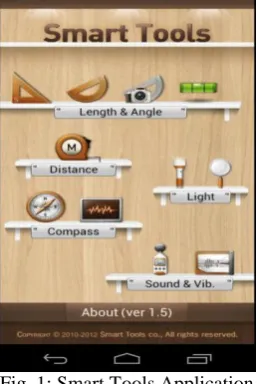
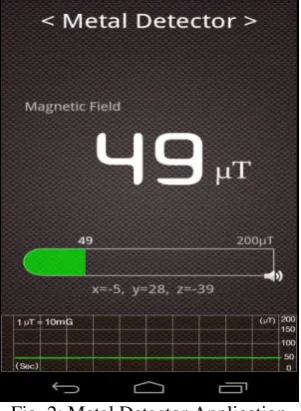
There are conventional some applications using various sensors. 'Smart Tools' application puts together various tools and can be used once. Utilizing direction sensors, length, angle, tilt, height, width, area, etc. can be measured. In addition, utilizing multiple sensors it contains various functions necessary for life products for ease of application.
Fig. 1: Smart Tools Application
Fig. 2: Metal Detector Application
'iStehthoscope' application measures heart rate by recognizing heartbeat if the smart phone is facing chest. The heartbeat is directly heard or seen on graph after the completion of measurement, and even e-mail transmission of the measurement results is possible as medical assistance application.
Fig. 3: Stehthoscope Application
In this paper, we present an implementation method for the game application by using the orientation sensor. The proposed method utilizes three data, azimuth, pitch, roll from orientation sensor and then implements the App game which moves the character to the event to avoid the enemy and is scored according to collected events.
II.
PROPOSED
GAME
APPLICATION
UTILIZING
ORIENTATION
SENSOR
The orientation sensor measures the total of three data, azimuth, pitch, and roll. Azimuth represents numeric value which direction the head of a device is pointing when a device placed at horizontal direction. When the data range is 0 to 359 degrees, when the data value in each direction is indicated plus 90 degrees in a clockwise direction starting from the north.
Pitch refers to the vertical tilt of the device. The value is 0 when lower and head parts of the device have the equilibrium level. If the height of the head increases then the numerical value is gradually lowered, and the lower height of the head increases gradually the numerical value.
Fig. 5: Pitch data
Roll refers to the device's horizontal tilt. The value is 0 when the device's display part points towards the sky and the left and right sides of the device are the equilibrium. If the left side is upward then numerical value becomes increasing and upward right side becomes decreasing of numerical value.
Fig. 6: Roll data
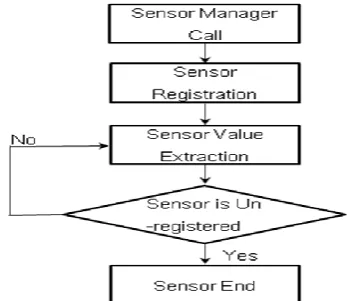
The proposed algorithm for game application is shown in Fig. 7. The three kinds of actual value of the orientation sensor are extracted by calling the sensor manager and registering the sensor. In values [0] (0 <= azimuth <360), the rotation value by origin of Z axis of rotation is outputted. 0 = North, 90 = East, 180 = South, 270 = West's direction. In values [1] (-180 <= pitch <= 180), the rotation value by origin of X axis of rotation is outputted. If the Z axis is directed to the Y axis, the value is outputted greater than 0. The value is outputted to 0 when the display part is facing the sky and lies flat on the table, -180 or 180 when the display part is downward, -90 when you put it straight, and +90 when you put it upside down. In values [2] (-90 <= roll <= 90), the rotation value by origin of Y axis of rotation is outputted. If the Z axis is directed to the X axis, the value is outputted greater than 0.
III.
IMPLEMENT
OF
PROPOSED
APP
GAME
USING
ORIENTATION
SENSOR
The implementation environment is Eclipse_Juno, Android 4.0.3. Taking the respective values of thee components of orientation sensor, azimuth, pitch, roll, the state of the smart phone is measured. Through the sensor manager the measured value of each parameter is processed to the variable type. This value is reflected in the direction of movement of the character. The game start screen is as follows.
Fig. 8: Start screen of proposed game
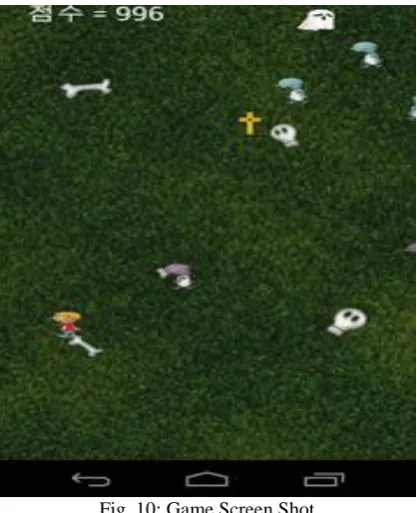
A character, enemies, events are presented in the game. Character avoids enemies and catches a lot of events, the score goes up according to the catch events. Scores for each kind of event is different, and when you catch any event then the enemy is not affected during a few seconds. Finally, while all of the characters are alive the score is calculated. The only way to change the moving the character affects from detection of the sensor value. Considering the values of the orientation sensor class diagram is as follows.
Fig. 10 shows a screen of the proposed application. Further, the game is added many features in order to increase the game efficiency. Utilizing Canvas to real-time the game screen, the character was moving smoothly, taking into account the resolution of the smart phone is compatible with the device to be implemented by the resolution.
Fig. 10: Game Screen Shot
Through the distance measurement between the character and the enemy, the adjustment of character’s moving direction keeps clean tracking of the enemy. By storing data of utilizing the preference the game is implemented to induce a competition.
IV.
CONCLUSION
In this paper, the game application was proposed by using the orientation sensor was proposed. The App application was implemented by utilizing the three values, azimuth, pitch, roll of orientation sensor to be freely controlled the movement of a character. This orientation sensor is fused with another sensors, it is expected to be utilized in many applications.
ACKNOWLEDGMENT
The authors would like to thank The FIX, Ltd for providing game software. Corresponding author : Soon-kak Kwon ([email protected]).
REFERENCES
[1] C. Kendell and E. D. Lemaire, Effect of mobility devices on orientation sensors that contain magnetometers, Journal of Rehabilitation Research & Development, 46( 7), 2009, 957-962.
[2] D. Gebre-Egziabher, R.C. Hayward, and J.D. Powell. Design of multi-sensor attitude determination systems, IEEE Transactions on Aerospace and Electronic Systems, 40(2), 2004. 627-649.
[3] N.H.Q. Phuong, H.-J. Kang, Y.-S. Suh, and Y.-S. Ro. A DCM based orientation estimation algorithm with an inertial measurement unit and a magnetic compass, Journal of Universal Computer Science, 15(4), 2009, 859-876.
[4] R. A. Hyde, L. P. Ketteringham, S. A. Neild, and R. J. S. Jones. Estimation of upper-limb orientation based on accelerometer and gyroscope measurements, IEEE Transactions Biomedical Engineering, 55(2), 2008, 746-754.