University of South Carolina
Scholar Commons
Theses and Dissertations
1-1-2013
The Meaning and Purpose of Quotation and
Stylistic Reference In Hans Werner Henze's
Requiem: Nine Sacred Concertos For Piano Solo,
Trumpet Concertante, and Large Chamber
Orchestra (1990-92)
Daniel C. Pappas
University of South Carolina
Follow this and additional works at:https://scholarcommons.sc.edu/etd
Part of theComposition Commons
This Open Access Thesis is brought to you by Scholar Commons. It has been accepted for inclusion in Theses and Dissertations by an authorized administrator of Scholar Commons. For more information, please [email protected].
Recommended Citation
Pappas, D. C.(2013).The Meaning and Purpose of Quotation and Stylistic Reference In Hans Werner Henze's Requiem: Nine Sacred Concertos For Piano Solo, Trumpet Concertante, and Large Chamber Orchestra (1990-92).(Master's thesis). Retrieved from
T
HEM
EANING ANDP
URPOSE OFQ
UOTATION ANDS
TYLISTICR
EFERENCE INH
ANSW
ERNERH
ENZE’
S REQUIEM:
N
INES
ACREDC
ONCERTOS FOR PIANO SOLO,
TRUMPET CONCERTANTE,
AND LARGE CHAMBER ORCHESTRA(1990-92)
by
Daniel Pappas
Bachelor of Arts Grace College, 2003
Master of Music
University of North Carolina at Greensboro, 2006
Submitted in Partial Fulfillment of the Requirements
For the Degree of Doctor of Musical Arts in
Composition
School of Music
University of South Carolina
2013
Accepted by:
Reginald Bain, Major Professor Chairman, Examining Committee
Samuel Douglas, Committee Member
John Fitz Rogers, Committee Member
Gregory Stuart, Committee Member
ii
iii
D
EDICATIONTo my wife Elizabeth for her continued support and patience and to my parents
iv
A
CKNOWLEDGEMENTSFirst I would like to thank Dr. Bain who not only served as the director of this
document, but has been instrumental in my development as a composer and educator.
Thank you for the many concrete and helpful suggestions without which this document
would not have attained its level of scholarship. Thank you also for working tirelessly on
my behalf in securing any necessary documents and signatures along the way.
I have been fortunate enough to have two committee chairs for the two parts of
my dissertation. Thank you, Dr. Rogers, for the long phone calls regarding my
composition. I am very grateful for your detailed summaries that not only made the
composition better, but helped me develop as a composer.
My thanks also go out to Dr. Douglas and Dr. Stuart for serving on my
committee. Thank you, Dr. Douglas, for continuing to serve even after retiring, and thank
you, Dr. Stuart, for being so willing to be added rather late in the process.
I greatly appreciate the publisher Schott giving me the rights to reproduce the
many score excerpts in this document.
Finally, I must thank my family for their continued support and words of
encouragement. Your confidence in me allowed me to continue to believe this process
would be over some day. Special thanks go to Thomas and Gina for the many hours of
v
A
BSTRACTQuotation and stylistic reference are important communicative devices in the
musical language of Hans Werner Henze that serve as a means of expression in his
multilayered approach to composition. This study examines the central role that quotation
and reference play in Hans Werner Henze’s Requiem: Nine Sacred Concertos for piano
solo, trumpet concertante, and large chamber orchestra (1990-92). While some studies
have identified selected references, their primary focus has been on the work’s pitch
organization and formal plan. This study instead considers Henze’s unique approach to
quotation and reference. In addition to interviews with the composer, Henze’s own
writings are used to shed light on his thoughts about music, events in his life, and
socio-political ideas that were important in the shaping of the work. The result is a Requiem
without words that is nonetheless a highly personal, distinctly humanistic interpretation
vi
T
ABLE OFC
ONTENTSDEDICATION ... iii
ACKNOWLEDGEMENTS ... iv
ABSTRACT ...v
LIST OF TABLES ... vii
LIST OF FIGURES ... viii
CHAPTER I 1.0INTRODUCTION ...1
1.1BACKGROUND ...6
1.2AREQUIEM WITHOUT A TEXT ...7
CHAPTER II 2.0INTROITUS ...9
2.1DIES IRAE ...14
2.2AVE VERUM ...26
2.3LUX AETERNA ...30
2.4REX TREMENDAE ...31
2.5AGNUS DEI ...40
2.6TUBA MIRUM ...43
2.7LACRIMOSA ...52
2.8SANCTUS ...57
CHAPTER III 3.0CONCLUSION ...61
BIBLIOGRAPHY ...63
vii
L
IST OFT
ABLESTable 2.1. Full Dies irae sequence and translation ...15
Table 2.2. Ave verum sequence and translation ...26
Table 2.3. Lux aeterna sequence and translation ...30
Table 2.4. Verse 8 of the Dies irae sequence and translation ...32
Table 2.5. Agnus Dei sequence and translation ...40
Table 2.6. Tuba mirum sequence and translation ...43
Table 2.7. Verse 18 of the Dies irae sequence and translation ...52
Table 2.8. Sanctus sequence and translation ...57
viii
L
IST OFF
IGURESFigure 2.1. Ancient Dies irae chant and its appearance in the Introitus ...12
Figure 2.2. Introitus, mm. 62-64 and Dies irae, mm. 153-158 ...13
Figure 2.3. Signal motives in the Dies irae concerto, m. 18 and m. 26 ...17
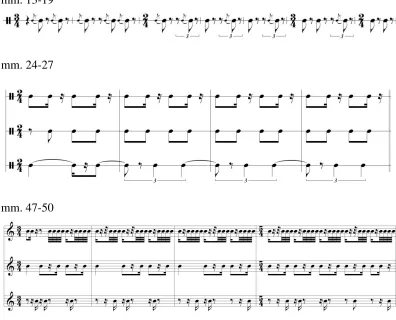
Figure 2.4. Execution rhythms (minus definite pitches) at mm. 13-19, mm. 24-27, and mm. 47-50 ...19
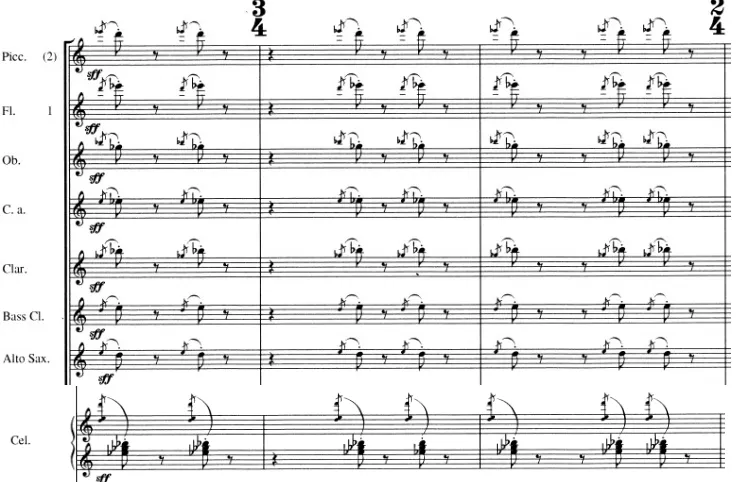
Figure 2.5. Cluster chords and rhythms; Dies irae, mm. 12-14 ...20
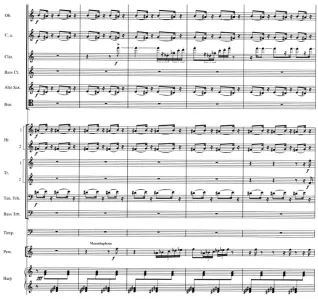
Figure 2.6. Cluster chords and rhythms; Dies irae, mm. 24-28 ...21
Figure 2.7. Orchestration of the Dies irae motive, mm. 153-154 ...22
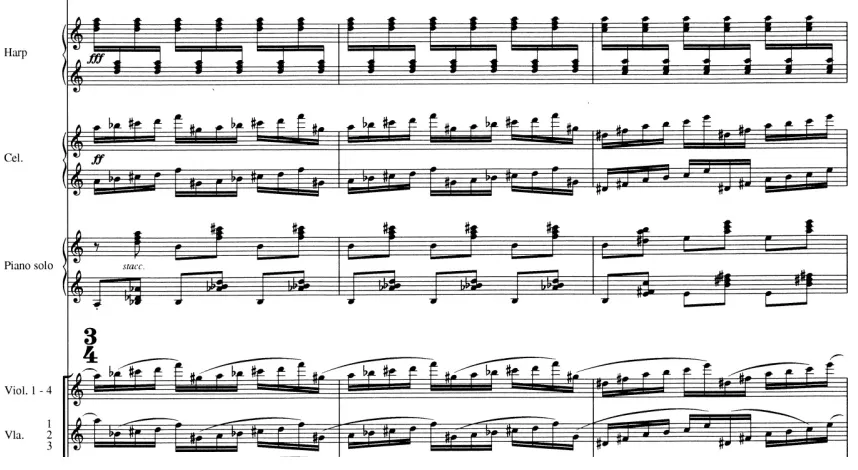
Figure 2.8. Dies irae, mm. 193-195 ...24
Figure 2.9. Textural reduction of the accompaniment, mm. 193-195 ...25
Figure 2.10. First handbell entrance; Ave verum, mm. 1-5 ...28
Figure 2.11. Table 22 in Peter Petersen’s analysis of Henze’s Requiem ...29
Figure 2.12. First trumpet entrance; Rex tremendae, mm. 13-17 ... 33
Figure 2.13. Second trumpet entrance; Rex tremendae, mm. 69-73 ...34
Figure 2.14. Opening measures to Schubert’s First Military March ...35
ix
Figure 2.16. Opening melody to the Badenweiler March ...36
Figure 2.17. Badenweiler March quotation in the tenor trombone of Rex tremendae, mm. 264-268 ...36
Figure 2.18. Piano and celesta chords obscuring the march quotation in Rex tremendae, mm. 267-268 ...37
Figure 2.19. Bass clarinet and bassoon melody; Rex tremendae, mm. 64-68 ...39
Figure 2.20. Opening accompaniment to Beethoven’s Agnus Dei from Missa solemnis ..41
Figure 2.21. Opening measures of Henze’s Agnus Dei, mm. 1-5 ...42
Figure 2.22. Rhythmic layering in Tuba mirum, mm.18-20 ...44
Figure 2.23. First march appearance; Tuba mirum, mm.102-106 ...46
Figure 2.24. Second march appearance; Tuba mirum, mm.111-113 ...48
Figure 2.25. Third march appearance; Tuba mirum, mm.222-225 ...50
Figure 2.26. Tuba mirum mm.223-225 re-barred in 4/4 and their original form ...51
Figure 2.27. Berg’s Wozzeck mm. 363-365 and Henze’s Lacrimosa, mm. 56-59 ...54
Figure 2.28. First phrase of Bach’s choral “Wenn ich einmal soll scheiden” ...55
Figure 2.29. Melodic contour of the trumpets; Lacrimosa,mm. 72-78 ...56
Figure 2.30. Rhythmic map of canon in the trumpets; Sanctus, mm. 66-76 ...58
1
CHAPTER
I
1.0
I
NTRODUCTIONFollowing the death of the German composer Hans Werner Henze (1926-2012) in
Dresden, Germany on October 27, 2012, his longtime publisher Schott Music released a
statement hailing him as “one of the most important and influential composers of our
time.”1 Notable in Henze’s prolific output are his many symphonic works (including ten
symphonies) and works for the stage that he composed over the course of his lifetime.
Henze remained active as a composer until his death at the age of eighty-six, having
traveled to Dresden for a ballet performance that was set to his work Das Vokaltuch der
Kammersängerin Rosa Silber for small wind ensemble (1950, rev. 1990).
Henze’s life and music were profoundly shaped by his experiences as a youth in
Nazi Germany. His father was a registered party member who re-enlisted into the army in
1943 and never returned from the Eastern front. Henze himself was a German soldier in
World War II. After joining the Hitler Youth and attending music school, he was
assigned to an armored tank division as a radio operator at age seventeen. Henze’s father
had wanted him to attend a Schutzstaffel “(SS)” music academy, but sent him to the State
Music School at Brunswick instead.
1
2
There in Brunswick, the anti-fascist views Henze already held, were further shaped by his
interactions with like-minded fellow students and teachers.
Several of Henze’s works deal directly with the atrocities committed by the Nazis:
for example, works such as Jüdische Chronik (1960), Die Weise Rose (1965), and his
Ninth Symphony (1995-97).2 Henze additionally confronts issues such as the rejection of
war–and misuse of power in capitalist societies–in his later music. In 1953 he would
eventually leave Germany and emigrate to Italy where he settled in Marino, outside of
Rome, and become a card carrying member of Italy’s Communist Party.
Henze’s life is not without controversy. His political views have at times led to
his isolation as an artist, and his commitment to communist beliefs have also been called
into question. The most notable incident came in 1968 during the first performance of his
oratorio Das Floß der ‘Medusa’ (1968) in Hamburg. Henze describes the concert and
events surrounding the performance in his autobiography Bohemian Fifths: An
Autobiography (1996). Unbeknownst to the composer, a “scrap of red material” had been
attached to the conductor’s podium. When Henze was made aware of it and was asked to
remove it, he refused.3 What followed was a refusal of the orchestra to perform and a
brawl in the concert hall that was eventually broken up by police. Seen as a public
declaration of his political allegiance, it would be many years before prominent German
orchestras were willing to work with the composer again.
2
Amy Lynn Wlodarski, “The Sounds of Memory: German Musical Representations of the Holocaust, 1945-1965” (PhD diss., University of Rochester, Eastman School of Music, 2006).
3
3
Henze has also been criticized for his open support of Fidel Castro’s communist
regime in Cuba, traveling there himself in solidarity with Castro in November of 1969.
Henze later became disillusioned with Castro and his oppressive rule. Following the
suicides of Cuban political and cultural leaders Alberto Mora, Celia Sanchez, and Haydee
Santamaria, and the executions of General Ochoa and his colleagues, Henze noted that “a
philanthropic autocrat suddenly seemed to have been replaced by a bloodthirsty murderer
– how is one to cope with that? How is one to bear it?”4 Henze’s war,
anti-totalitarian, and anti-capitalist stance is clear from his own writings, which are gathered
together in a collection of essays entitled Music and Politics: Collected Writings
1953-81. Clearly, Henze’s politics must be put into an appropriate perspective if we are to gain
a deeper understanding of his music.
Henze describes his music as “fixed points in musical lines that overlap.”5 He
elaborates on this further by suggesting that “the impression of a cluster may
momentarily arise, even though we are dealing here with nothing more than a massive
overlap between lines and layers in a state of constant flux.” This type of polyphony is
what leads to dissonant cluster sonorities that permeate much of his music. Another
aspect of Henze’s musical language is, by his own account, a dualism of dodecaphony
and traditional harmony.
4
Ibid.,301.
5
4
For the purpose of the following discussion quotation is defined as a brief
fragment of previously composed music that is inserted into a new composition. Henze
often expects the listener to identify the quoted fragment, and draw connections between
the new work and the quoted one. Quotations are not always easily identifiable by the
listener. Rather, the composer may purposefully use instrumentation, register, dynamics,
or other means to veil the quotation. A composer may quote from music of the past or
present, his/her own music, or even create a work that is solely comprised of quotations.
The term reference is used here to describe a more veiled type of quotation –
where the fragment of music is no longer identifiable as a direct quote. However this
should not be confused with the term stylistic reference. Stylistic reference is used here to
refer to the imitation of the stylistic elements of a particular composer, composition,
genre, time period, and so forth.6
Although Hans Werner Henze often makes use of quotation in his music, he, like
Alban Berg, also makes more subtle use of referential materials in his music.7 Henze
writes, “Quotations play a definite role in my music, but they don’t appear in quotation
marks as the music quoted and remembered is assimilated into my own musical
language.”8
6
Jan LaRue, Guidelines for Style Analysis, 2nd ed. (Warren, MI: Harmonie Park Press, 1992)
7
Ulrich Krämer, “Quotation and Self-Borrowing in the Music of Alban Berg,” Journal of Musicological Research 12 (1992): 53-82.
8
5
Providing us with valuable insight into his deliberate use of quotation, Henze states:
[One’s] approach to the composers of the past and to one’s own particular experience must always remain an integral part of some dialectic, living process. . . . He [the composer] must draw on the archetypes of his culture, for only by reference to their presence can he make clear in what way his own music diverges from that of other composers of his own generation and of the past.9
Direct evidence of Henze’s attempts to infuse foreign material into his original
works is found in a discussion of the conception of his Sixth Symphony for two chamber
orchestras (1969). Here he claims to have taken the step from quotation to integration.10
In an interview with Klaus Schultz on the occasion of the Frankfurt production of the one
act opera The Bassarids (1966), Henze seeks to clarify the role quotation plays in his
work:
Let me begin with the quotation from the St. Matthew Passion in The Bassarids. This is one that Auden had asked me to make. . . . Auden presumably wanted to do what I have also often done in my instrumental music: to employ quotations at certain points as signposts, as guides for thought, which make the listener hear and think in the right direction. Quotation is a factor in the strategy of my work; my point of departure is that music is a language.11
Henze’s deep understanding of language and text setting comes to the forefront
here, based not only on an affinity for poetry (and close relationship with many
influential writers), but also shaped by his knowledge of the theatre. It should be
mentioned that Henze has written over 26 operas and 12 ballets, and has written 50 works
for accompanied and unaccompanied vocal forces.
9
Ibid., 32-33.
10
Ibid., 260.
11
6
Henze’s relationship to language is of great importance as it finds itself manifested in the
creation of a purely instrumental Requiem. This will be examined in section 1.2
1.1
B
ACKGROUNDBefore delving into the discussion of Henze’s use of quotation and reference in
his Requiem, it is necessary to gain a better understanding of the circumstances
surrounding its composition. The Requiem was written in memory of Michael Vyner, the
late musical director of the London Sinfonietta, who died at the age of forty-six on
October 19, 1989. Vyner’s health had been slowly deteriorating for several years, and
when he lost his battle with AIDS, Henze was deeply moved by the death of his good
friend and champion. Michael Vyner and the London Sinfonietta had been instrumental
in spreading Henze’s music throughout Great Britain with many celebrated
performances.
In the process of planning a memorial concert, the Royal Opera contacted several
composers, soliciting new works of music to be premiered on May 6, 1990 in honor of
the late Michael Vyner. Among the many composers that responded positively to the
request–including Luciano Berio, Harrison Birtwistle, Henryk Gorecki, Oliver Knussen,
Peter Maxwell Davies, Nigel Osborne, and Toru Takemitsu–was Hans Werner Henze,
who was happy to contribute what was to become the first concerto of his Requiem
Mass.12 Henze’s Requiem consists of nine sacred concertos written over the course of two
years. The first concerto Introitus was certainly meant exclusively as a tribute and
memorial to Michael Vyner, but other socio-political events during those two years of
12
7
writing the piece influence the later movements. In his press conference at the premiere
of the full work, Henze acknowledged that the tragedy of the First Gulf War served as a
present-day example to some of the issues worked out in the Dies irae, Rex tremendae
and Tuba mirum.13
1.2
A
R
EQUIEMW
ITHOUT AT
EXTHenze’s thoughts on the relationship between music and language prove useful in
gaining a better understanding of the inner workings of the Requiem. As previously
mentioned Henze sees music as a language. He thinks of quotation as a device for
communication beyond the words or notes themselves. In the Requiem he takes this
notion one step further. Here Henze replaces the spoken text altogether resulting in a
purely instrumental work,14 though formally still based on the liturgy:
Whereas Masses for the Dead normally rely for their effectiveness, at least in part, on the human voice and their Latin words, it is now the instrumentalists who are entrusted with that task: they are expected to think the words and assume the function of the singers, empathizing with that role and imitating it on their instruments. One might say that in this work my theory and my ideal of the interchangeability of vocal and instrumental music has found its most extensive realization to date.15
Earlier applications of the above mentioned interchangeability of vocal and
instrumental music can be found in Henze’s Liebeslieder (1984), his Seventh Symphony
(1983-84), and even in his first cello concerto Ode to the West Wind (1953).16 His aim in
13
Peter Petersen, Hans Werner Henze: Werke der Jahre 1984-1993 (Mainz: Schott, 1995), 53.
14
In his article “A Pagan Looks at the Mass” Werner Grimmel explores some other interesting reasons for the purely instrumental treatment of the Requiem, which fall outside the scope of this analysis.
15
Henze, Bohemian Fifths, 470-471.
16
8
Liebeslieder, for cello and orchestra, was “to compose a set of songs without words”
where “a poetic formal model would be turned into a musical formal model; and musical
shapes would have to be found to correspond to this or that poetic object or idea, to this
or that image or emotion or figure of effect.”17 Henze admits a need to spell out these
connections–between words and music–in his earlier scores. Beginning with Liebeslieder
however, he aims to free the listener from any need of finding intended parallels between
his source material and the resultant music by concealing it altogether.18
Similarly, when discussing the Requiem, he states, “It is as though I am
introducing words from earlier centuries into my spoken language: one recalls them, even
though they are no longer used. They mean something–but precisely what that meaning is
seems to have slipped from our grasp.”19 Henze expects listeners to only later make the
connections implied by quotations–“as the music reverberates in their inner ear.” He
relies on their abilities to “draw all necessary comparisons” based on a shared knowledge
of the music of the past and present. Henze insists that only the more knowledgeable
listener will “experience the desired interconnections for themselves.”20
17
Ibid., 414.
18
Ibid., 415.
19
Ibid., 58.
20
9
CHAPTER
II
2.0
I
NTROITUSThe Introitus is the first of the nine concertos that make up the Requiem. It is
scored for solo piano and large chamber orchestra including three percussionists playing
a variety of pitched and non-pitched instruments as well as celesta and harp. It was
chronologically the first movement to be composed and was premiered at the memorial
concert for Michael Vyner on May 6, 1990 at Covent Garden. Although at the time of the
premiere the Introitus was the only completed concerto, solitary performances of
movements are very much in line with the composer’s wishes, as he notes in the score.21
Further evidence of the flexibility in performance is the existence of separate entries in
his 1996 published catalogue of works (Hans Werner Henze: A Catalogue of Works
1946-1996). For example, the solo trumpet movements also exist as the Three Sacred
Concertos for concertante trumpet and large chamber orchestra (1990-92), and several
compositional exercises are published as the Quintetto for piano, two violins, viola, and
violoncello (1990-91).
Commissioned and premiered by the Guarneri String Quartet, the Quintetto was
not only composed concurrently with the Requiem, but the movements appear as though
they are variations of concertos two, three, and four. In his analysis of the Requiem, Peter
Petersen carefully compares the Quintetto and the corresponding Requiem movements
21
10
pointing out their many similarities. Petersen additionally suggests that Henze’s objective
for the Requiem was to compose a set of concertos similar to J.S. Bach’s Brandenburg
Concertos (1721).22
Henze calls the Introitus “a much-improved and much-revised version of the
Concerto per il Marigny (1956), now worked out in every last detail.”23 His motivation
for reworking this composition of 1956 is noteworthy. This concerto for piano and
orchestra had originally been meant for a performance in a concert series organized by
the French composer Pierre Boulez (b. 1925) at the Parisian theatre Marigny, but due to
extenuating circumstances Henze could not find the time to complete the work. When he
reached out to Boulez asking for more time, Boulez suggested performing the completed
fragment only.24 The work was finished in 1990.
Henze’s account of the conception of the Introitus creates some uncertainty about
the compositional chronology. He writes, “During the early part of 1990 I took out an old
reprint of my Concerto per il Marigny and had just started to expand it and make changes
to it in different colored crayons when I received a call from Covent Garden.”25 This, of
course, was the call for scores for the memorial concert for Michael Vyner. Further
obscuring the exact order of events, Henze continues, “as soon as I had done so [accepted
the invitation], [I] knew what it was that I had to do with my old Concerto per il
Marigny: it would serve as the basic material for a cyclical work, lasting an entire
22
Petersen, Hans Werner Henze, 55.
23
Henze, Bohemian Fifths, 469.
24
Petersen, Hans Werner Henze, 63.
25
11
evening, that I had been planning for years.”26 It is this last revelation that gives weight to
the search for deeper meaning behind the use of the Marigny material.
In the published recollections of his life, Henze muses about a Sunday in August
of 1987 with Fausto Marino, his life partner, and Michael Vyner. Henze recounts his
conversations with Vyner and notes that they consisted mostly of memories and private
matters, which was unusual. He remembers exchanging stories of their shared past and
the beginnings of their friendship, “yes, and how frivolous and yet how sophisticated we
had been during those carefree years in the late fifties and early sixties . . . .”27 At the end
of this account Henze is struck by the fact that, as he would later learn, Michael Vyner
had been intent on revealing his contraction of the AIDS virus, but could not at that time.
Perhaps the composer is drawing on material from his past, this carefree time, as a nod to
his friendship with Vyner. Although the timeline and Henze’s own statements leave some
room for doubt, he makes it clear what the Requiem, and this reimagined Marigny
Concerto, should become, namely “an epitaph for Michael Vyner, a full-length piece
about a particular friendship, about life and suffering, about hope and love and fate,”28
just as their conversations had been on that day in the summer of 1987.
Henze envisioned the soloist to be the pianist Paul Crossley, a close friend to
Vyner and later musical director of the Sinfonietta. The composer asks the instrumentalist
to “think the words” and feel the “shared memories” underlying the material itself. To
this effect he states, “The music of these piano solos expresses something of a private
26
Ibid., 468.
27
Ibid., 451.
28
12
background…as well as shared memories bound up with that background, memories that
stretch back over several decades and that are full of enchantment and blessed with
understanding. Paul knew all this and could express his own feelings on the matter in
playing of powerful instrumental eloquence.”29
A quotation of note in the Introitus is the ancient Dies irae motive found in mm.
62-64. The Dies irae motive is not found in the Marigny Concerto and would virtually go
unnoticed if it were not for the extreme high register of the violins in which Henze places
it. Figure 2.1 shows first the Gregorian chant melody and then the four-note motive
quoted in the unison violins of the Introitus.
Figure 2.1. Ancient Dies irae chant and its appearance in the Introitus
Henze quotes the first four notes of the Dies irae chant melody in fff octaves. This
quotation coincides with a sudden change in orchestration. The fortissimo tutti (with
exception of the piano) of mm. 58-62 gives way to the solo piano and Dies irae quotation
with all but the horns dropping out. The piano entrance draws the attention of the listener
29
13
away from the high violins and makes it quite difficult for the listener to identify the
quotation on first listening. Solidifying the four-note sequence E –D–E –C as the opening
Dies irae sequence is its appearance in the same octave in the next movement, where it is
extended beyond the first initial four notes. Figure 2.2 shows both instances as they
appear in the violins, first in the Introitus and later in the following Dies irae concerto. A
closer look at the Dies irae concerto follows in section 2.1.
Figure 2.2. Introitus mm. 62-64 and Dies irae mm. 153-159
The Dies irae motive is tied to the memories of Vyner’s suffering and serves as a
reminder of his passing. Henze in fact had seen Vyner’s suffering first hand on their final
visit with one another. This had taken place at Henze’s residence in Marino. On the
weeklong stay “to say a goodbye – ‘it is finished,’ he told us,”30 Vyner’s pain led to
“outbursts of crying or the exaggerated reactions of every kind – only the emotion of
delight and calm were denied him.”31 Henze’s most telling admission also gives us the
clearest insight into the purpose of the inclusion of the Dies irae quotation: “It was
30
Ibid., 460-61.
31
Ibid., 461.
14
inevitable that I should keep thinking of Michael while working on the score, since my
music for this Requiem expresses my own developing involvement with the dead and
dying and also with horror tout court.”32 Although the appearance of the Dies irae
plainchant melody is not uncommon in requiem masses or as a symbol of death in
musical works, its appearance here and in the following concerto is evidence of the
intentions for a large-cycle Requiem from the very beginning.
2.1
D
IESI
RAEThe second concerto is scored similarly to the first with changes limited to the
percussion section. The premiere took place on December 11, 1991 in London and
included the first performances of the Ave verum and Lux aeterna as well. Henze himself
conducted the London Sinfonietta, and once again pianist Paul Crossley served as the
soloist. When writing about the Dies irae, Henze makes the following statement that
indicates a broader approach to the liturgical text being taken by the composer:
The day of wrath is not necessarily or exclusively about the Last Judgment, but could also be the worst day in a person’s life or the sum total of such days, when everything of value and substance collapses around you and everything that could once have offered you guidance and support is lost forever.33
Table 2.1 shows the full Dies irae text with English translation. Composers
typically choose to only set a selection of the nineteen verses that make up the full Dies
irae liturgical text. Henze focuseson those verses that speak of the impending wrath,
judgment, destruction, and mourning.
32
Ibid., 469.
33
15
These verses are highlighted using bold type in Table 2.1.34
Table 2.1. Full Dies irae sequence and translation
1. Dies iræ! dies illa
Solvet sæclum in favilla: Teste David cum Sibylla!
Day of wrath! O day of mourning! See fulfilled the prophets’ warning, Heaven and earth in ashes burning!
2. Quantus tremor est futurus, Quando iudex est venturus, Cuncta stricte discussurus!
Oh, what fear man’s bosom rendeth, when from heaven the Judge descendeth, on whose sentence all dependeth.
3. Tuba, mirum spargens sonum
Per sepulchra regionum, Coget omnes ante thronum.
Wondrous sound the trumpet flingeth; through earth’s sepulchers it ringeth; all before the throne it bringeth.
4. Mors stupebit, et natura, Cum resurget creatura, Iudicanti responsura.
Death is struck, and nature quaking, all creation is awaking,
to its Judge an answer making. 5. Liber scriptus proferetur,
In quo totum continetur, Unde mundus iudicetur.
Lo! the book, exactly worded, wherein all hath been recorded: thence shall judgment be awarded. 6. Iudex ergo cum sedebit,
Quidquid latet, apparebit: Nil inultum remanebit.
When the Judge his seat attaineth, and each hidden deed arraigneth, nothing unavenged remaineth. 7. Quid sum miser tunc dicturus?
Quem patronum rogaturus, Cum vix iustus sit securus?
What shall I, frail man, be pleading? Who for me be interceding,
when the just are mercy needing?
8. Rex tremendæ maiestatis,
Qui salvandos salvas gratis, Salva me, fons pietatis.
King of Majesty tremendous, who dost free salvation send us, Fount of pity, then befriend us!
9. Recordare, Iesu pie, Quod sum causa tuæ viæ: Ne me perdas illa die.
Think, good Jesus, my salvation cost thy wondrous Incarnation; leave me not to reprobation! 10 Quærens me, sedisti lassus:
Redemisti Crucem passus: Tantus labor non sit cassus.
Faint and weary, thou hast sought me, on the cross of suffering bought me. shall such grace be vainly brought me? 12. Ingemisco, tamquam reus:
Culpa rubet vultus meus: Supplicanti parce, Deus.
Guilty, now I pour my moaning, all my shame with anguish owning; spare, O God, thy suppliant groaning! 13. Qui Mariam absolvisti,
Et latronem exaudisti, Mihi quoque spem dedisti.
Thou the sinful woman savedst; thou the dying thief forgavest; and to me a hope vouchsafest.
34
16 14. Preces meæ non sunt dignæ:
Sed tu bonus fac benigne, Ne perenni cremer igne.
Worthless are my prayers and sighing, yet, good Lord, in grace complying, rescue me from fires undying! 15. Inter oves locum præsta,
Et ab hædis me sequestra, Statuens in parte dextra.
With thy favored sheep O place me; nor among the goats abase me; but to thy right hand upraise me. 16. Confutatis maledictis,
Flammis acribus addictis: Voca me cum benedictis.
While the wicked are confounded, doomed to flames of woe unbounded call me with thy saints surrounded. 17. Oro supplex et acclinis,
Cor contritum quasi cinis: Gere curam mei finis.
Low I kneel, with heart submission, see, like ashes, my contrition; help me in my last condition.
18. Lacrimosa dies illa,
Qua resurget ex favilla Judicandus homo reus. Huic ergo parce, Deus:
Ah! that day of tears and mourning! From the dust of earth returning man for judgment must prepare him; Spare, O God, in mercy spare him!
19. Pie Jesu Domine,
Dona eis requiem. Amen.
Lord, all pitying, Jesus blest,
grant them thine eternal rest. Amen.
In an interview meant to complement a recent commercial release of a CD box set
of the Requiem (2010),35 Henze reveals his personal “day of wrath” set to music. He
explains that the destruction of Dresden by Allied bombers, and the aftermath he
witnessed, is depicted in the Dies irae. Shortly after the bombing raids that took place on
February 13th and 15th (1945), Henze passed through the city on his regiment’s retreat
towards Berlin.36 In the Dies irae he views wrath, “as a wrath of men” that the German
people elicited, and the terrible results that ensued. Henze draws a comparison to Sodom
and Gomorra, two cities whose inhabitants’ behavior famously brought on the wrath of
God. He establishes these connections to war and the terror mankind causes in several
35
Hans Werner Henze, Requiem: Neun Geistliche Konzerte, 1990-92, Bochumer Symphoniker, conducted by Steven Sloane, Cybele Records 3SACD KiG 003, CD, 2010.
36
17
different ways, including “alarm signals,” “execution rhythms,” the Dies irae quotation,
and indirect references to “brass music of the worst kind.”37
It is important to remember that several of the movements of Henze’s Requiem
found themselves first scored for piano quintet. These quintet movements survive in their
own right as the aforementioned Quintetto, but are, according to Henze, compositional
exercises that were later realized in the full orchestral score.38 It is easy to imagine the
alarm signals or sirens going off during the bomb raids on the city of Dresden when
listening to the Dies irae concerto. The initial appearance of the alarm signals in the
Requiem is found in the trumpets beginning with the pickup to m. 18 (the same musical
material is marked “alarm signals” in the quintet setting of the eventual Dies irae
movement). Figure 2.3 shows the initial trumpet signal and an example in the clarinet in
m. 26.
Figure 2.3. Signal motives in the Dies irae Concerto, m. 18 and m. 2639
The trumpet sounds a pickup of two thirty-second note G s followed by a half
note on the same pitch (flutter tongue) and an eighth. This pickup of successive short note
37
Klaus Oehl, liner notes to, Henze, Requiem: Neun Geistliche Konzerte, 1990-92, Bochumer Symphoniker, conducted by Steven Sloane, Cybele Records 3SACD KiG 003, CD, 2010.
38
Recorded interview found on CD 2 of Ibid.
39
Hans Werner Henze REQUIEM © 1990/1992 by Schott Music GmbH & Co. KG, Mainz, Germany. All Rights Reserved. Used by permission of European American Music Distributors Company, sole U.S. and Canadian agent for Schott Music GmbH & Co. KG, Mainz, Germany.
18
values followed by a longer note and/or the addition of rests is what all signal motives
share in common. The pitch content changes, as well as the instrumentation, even the
contour of these signals changes throughout the movement.
In sketches for the Dies irae, collected and analyzed by Peter Petersen, Henze
adds the words “execution rhythms” above particular rhythmic figures.40 These execution
rhythms serve as a reference to war and to specific experiences Henze had as a German
soldier during World War II. The composer sees the act of bombing itself as an execution
of the innocent. He mentioned of this in his press conference leading up to the premiere
of the complete work, and lamented Iraqi civilians falling victim to the bombing attacks
of the First Gulf War. On a more personal level, he may have been reminded of
executions he himself had witnessed.41 These execution rhythms begin in m. 12 and
continue for varying lengths as they reappear throughout the movement. It is not the
exact rhythms that link these sections, but their repetitive ostinato-like clusters. The first
appearance is in mm. 12-22 after which the ostinato rhythm changes. Figure 2.4 shows
several different rhythmic figures that accompany the demarcation of the cluster chords.
40
Petersen, Hans Werner Henze, 69.
41
19 mm. 13-19
mm. 24-27
mm. 47-50
Figure 2.4. Execution rhythms (minus definite pitches) at mm. 13-19, mm. 24-27, and mm. 47-50
Figures 2.5 and 2.6 show several other cluster chords and accompanying rhythmic figures
as they appear in the score. In addition to the repeated harmonic and rhythmic elements,
Henze marks these sections with similar articulations and loud dynamics.
20
Figure 2.5. Cluster chords and rhythms; Dies irae, mm. 12-1442
42
21
Figure 2.6. Cluster chords and rhythms; Dies irae, mm. 24-2843
In m. 153, following a tutti crescendo from pp to fff over the course of two
measures (mm. 151-152), the listener is assailed with the Dies irae melody. Instead of
veiling the Dies irae motive like in the Introitus,Henze not only expands the melody by
presenting the first full eight-note phrase, he draws attention to it through its
orchestration. Where the solo piano had previously overshadowed the motive in the
Introitus, it now performs the opening chant melody in a forceful manner over the course
of seven measures, along with unison violins, celesta, and accented vibraphones and
marimbas. In the mid to lower registers the accompanying texture is made up of both
43
22
signal motives and execution rhythms. The first two measures of the seven-measure
entrance are shown in Figure 2.7.
Figure 2.7. Orchestration of the Dies irae motive, mm. 153-15444
Leading up to the Dies irae quotation are repeated rising signal motives in the
piano and woodwinds along with brass that introduce an ostinato rhythm. In m. 153 the
roles are slightly changed; the woodwinds, violas, and cellos trade off the execution
rhythms, and the brass now perform rising signal motives. Measure 153 also marks the
reappearance of the Dies irae, enhancing an already jarring texture and aggressive tone.
Not only is the listener reminded of the original literal meaning of this movement’s text,
but a formal link is established to the Introitus as discussed in the previous subchapter.
The question of what to make of Henze’s statement that “this is brass music of the
worst kind” remains.45 Although his statement will be revisited in the discussion of the
44
23
movements Rex tremendae and Tuba mirum, it is nevertheless appropriate to explore its
meaning for this movement as well. This requires a further examination of some of
Henze’s thoughts about music expressed over his lifetime. The composer’s
autobiography contains an account of the winter of 1945-46, a time when Henze was
working as a ballet rehearsal pianist. In it he professes an aversion to “schmaltzy numbers
and cancans” along with choruses and army songs. Henze considers this “noise” both
brutal and threatening, and exclaims that “any moment now, and the whole thing may
change – light music can turn into something deadly serious.”46
Such “ghastly” music can briefly be found woven into the texture of the Dies irae
concerto. The execution rhythms and ostinato-like cluster chords are interrupted,
beginning in m. 193, with signal motives in the strings shown in Figure 2.8.
45
Klaus Oehl, liner notes to Henze, Requiem: Neun Geistliche Konzerte, 1990-92, Bochumer Symphoniker, conducted by Steven Sloane, Cybele Records 3SACD KiG 003, CD, 2010.
46
24
Figure 2.8. Dies irae, mm. 193-19547
Unlike previous signal motives, these consist of steady sixteenth-note sequences circling
around the same pitches for two measures, and then restarting at a lower pitch. Figure 2.9
is a textural reduction of the mostly triadic accompaniment, of these same three
measures, of the harp and piano. It is heard clearly, and serves as a relief from the
dissonant clusters just preceding and immediately following mm. 193-196.
47
25
Figure 2.9. Textural reduction of accompaniment, mm. 193-195
Against the piano’s lighthearted duple accompaniment, the melodic sequence in the
strings of mm. 193-196 sounds like a syncopated melody reminiscent of the “schmaltzy
numbers” alluded to previously. More specifically Henze mentions Emmerich Kálmán’s
Gypsy Princess (1915) and the “ritornellos and dance routines that accompanied these
ghastly songs.”48 This reference lasts for only four short measures. In subsequent
movements Henze includes more “terrible brass music” that will be discussed shortly.
48
26
2.2
A
VEV
ERUMAve verum, the Requiem’s third piano concerto, is scored similarly to the Introitus
and Dies irae with the exception of reduced percussion that features only handbells and
vibraphones. The Latin text and its translation are shown in Table 2.2.
Table 2.2. Ave verum sequence and translation
Ave Verum Corpus natum de Maria Virgine.
Vere passum immolatum in cruce pro homine: cuius latum perforatum aqua fluxit et sanguine.
Esto nobis praegustatum in mortis examine.
O Iesu dulcis! O Iesu pie! O Iesu Fili Mariae. Amen.
Hail, true Body, truly born of the Virgin Mary mild.
Truly offered, wracked and torn, on the Cross for all defiled, from Whose love-pierced, sacred side flowed Thy true Blood's saving tide: be a foretaste sweet to me in my death's great agony. O my loving, Gentle One, Sweetest Jesus, Mary’s Son. Amen.
The appearance of an Ave verum is surprising as the Ave verum hymn is not
typically associated with or traditionally included in a requiem mass. However, Henze
has special reasons for including this movement that relate back to his initial reasons for
writing the Requiem. On more than one occasion Henze points to his interpretation of the
Ave verum text as inspiration for the music. His summation of the Latin text is, “the
greeting of beautiful male bodies.”49 In an interview with Mirjam Wiesemann, Henze
elaborates on this summation and recalls the tenderness of a man’s final moments as he
experienced them with the passing of Fausto’s father.50 As is tradition, the father was
held in his bed by his sons until he died, greeting death communally. Since Henze’s
49
Henze, Requiem: Neun Geistliche Konzerte, 1990-92, Bochumer Symphoniker, conducted by Steven Sloane, Cybele Records 3SACD KiG 003, CD, 2010.
50
27
Requiem is dedicated to Michael Vyner, it is safe to assume that this concerto represents a
“greeting” of Vyner’s beautiful body, one Henze helped care for in the final months
before Vyner’s death. To this effect the composer writes, “I wonder if it was the image of
a beautiful human body covered with Hölderlin’s freckles and with ultramodern sores
that inspired me to write this music.”51
Handbells ring out of the silences between phrases throughout Henze’s Ave
verum, transporting the listener to a religious service where these sounds would be
traditionally encountered. The ringing of bells during the Catholic Mass occurs during the
consecration where the body and blood of Christ are presented. Henze may be trying to
create another link to the body of another man: Christ.52 Figure 2.10 shows the first
handbell entrance.
51
Ibid., 469.
52
Their pitch content remains the same
the collection
dynamic markings
they are placed in and are clearly meant to be hea
verum
written in 1791 (the year of Mozart’s untimely death).
53
Hans Werner Henze REQUIEM © 1990/1992 by Schott Music GmbH & Co. KG, Mainz, Germany. All
Their pitch content remains the same
the collection
dynamic markings
they are placed in and are clearly meant to be hea
verum
written in 1791 (the year of Mozart’s untimely death).
Hans Werner Henze REQUIEM © 1990/1992 by Schott Music GmbH & Co. KG, Mainz, Germany. All
Their pitch content remains the same
the collection
dynamic markings
they are placed in and are clearly meant to be hea
Figure 2
verum, shows
written in 1791 (the year of Mozart’s untimely death).
Hans Werner Henze REQUIEM © 1990/1992 by Schott Music GmbH & Co. KG, Mainz, Germany. All Rights Reserved. Used by permission of European
U.S. and Canadian agent for Schott Music GmbH & Co. KG, Mainz, Germany.
Their pitch content remains the same
the collection
dynamic markings
they are placed in and are clearly meant to be hea
Figure 2
shows
written in 1791 (the year of Mozart’s untimely death).
Hans Werner Henze REQUIEM © 1990/1992 by Schott Music GmbH & Co. KG, Mainz, Germany. All Rights Reserved. Used by permission of European
U.S. and Canadian agent for Schott Music GmbH & Co. KG, Mainz, Germany.
Their pitch content remains the same
the collection
dynamic markings
they are placed in and are clearly meant to be hea
Figure 2
shows
written in 1791 (the year of Mozart’s untimely death).
Hans Werner Henze REQUIEM © 1990/1992 by Schott Music GmbH & Co. KG, Mainz, Germany. All Rights Reserved. Used by permission of European
U.S. and Canadian agent for Schott Music GmbH & Co. KG, Mainz, Germany.
Figure
Their pitch content remains the same
of every chromatic pitch from C
dynamic markings
they are placed in and are clearly meant to be hea
Figure 2.11, a reprint of Table
shows a veiled reference
written in 1791 (the year of Mozart’s untimely death).
Hans Werner Henze REQUIEM © 1990/1992 by Schott Music GmbH & Co. KG, Mainz, Germany. All Rights Reserved. Used by permission of European
U.S. and Canadian agent for Schott Music GmbH & Co. KG, Mainz, Germany.
Figure
Their pitch content remains the same
of every chromatic pitch from C
dynamic markings, ranging from
they are placed in and are clearly meant to be hea
.11, a reprint of Table
veiled reference
written in 1791 (the year of Mozart’s untimely death).
Hans Werner Henze REQUIEM © 1990/1992 by Schott Music GmbH & Co. KG, Mainz, Germany. All Rights Reserved. Used by permission of European
U.S. and Canadian agent for Schott Music GmbH & Co. KG, Mainz, Germany.
Figure 2
Their pitch content remains the same
of every chromatic pitch from C
ranging from
they are placed in and are clearly meant to be hea
.11, a reprint of Table
veiled reference
written in 1791 (the year of Mozart’s untimely death).
Hans Werner Henze REQUIEM © 1990/1992 by Schott Music GmbH & Co. KG, Mainz, Germany. All Rights Reserved. Used by permission of European
U.S. and Canadian agent for Schott Music GmbH & Co. KG, Mainz, Germany.
2.10.
Their pitch content remains the same
of every chromatic pitch from C
ranging from
they are placed in and are clearly meant to be hea
.11, a reprint of Table
veiled reference
written in 1791 (the year of Mozart’s untimely death).
Hans Werner Henze REQUIEM © 1990/1992 by Schott Music GmbH & Co. KG, Mainz, Germany. All Rights Reserved. Used by permission of European
U.S. and Canadian agent for Schott Music GmbH & Co. KG, Mainz, Germany.
10. First handbell e
Their pitch content remains the same
of every chromatic pitch from C
ranging from
they are placed in and are clearly meant to be hea
.11, a reprint of Table
veiled reference
written in 1791 (the year of Mozart’s untimely death).
Hans Werner Henze REQUIEM © 1990/1992 by Schott Music GmbH & Co. KG, Mainz, Germany. All Rights Reserved. Used by permission of European
U.S. and Canadian agent for Schott Music GmbH & Co. KG, Mainz, Germany.
First handbell e
Their pitch content remains the same
of every chromatic pitch from C
ranging from
they are placed in and are clearly meant to be hea
.11, a reprint of Table
veiled reference
written in 1791 (the year of Mozart’s untimely death).
Hans Werner Henze REQUIEM © 1990/1992 by Schott Music GmbH & Co. KG, Mainz, Germany. All Rights Reserved. Used by permission of European
U.S. and Canadian agent for Schott Music GmbH & Co. KG, Mainz, Germany.
First handbell e
Their pitch content remains the same
of every chromatic pitch from C
ranging from pianissimo
they are placed in and are clearly meant to be hea
.11, a reprint of Table
veiled reference to Mozart’s
written in 1791 (the year of Mozart’s untimely death).
Hans Werner Henze REQUIEM © 1990/1992 by Schott Music GmbH & Co. KG, Mainz, Germany. All Rights Reserved. Used by permission of European
U.S. and Canadian agent for Schott Music GmbH & Co. KG, Mainz, Germany.
First handbell e
Their pitch content remains the same at every appearance. The h
of every chromatic pitch from C
pianissimo
they are placed in and are clearly meant to be hea
.11, a reprint of Table
to Mozart’s
written in 1791 (the year of Mozart’s untimely death).
Hans Werner Henze REQUIEM © 1990/1992 by Schott Music GmbH & Co. KG, Mainz, Germany. All Rights Reserved. Used by permission of European
U.S. and Canadian agent for Schott Music GmbH & Co. KG, Mainz, Germany.
First handbell e
at every appearance. The h
of every chromatic pitch from C
pianissimo
they are placed in and are clearly meant to be hea
22 of Peter Petersen’s analysis of Henze’s
to Mozart’s
written in 1791 (the year of Mozart’s untimely death).
Hans Werner Henze REQUIEM © 1990/1992 by Schott Music GmbH & Co. KG, Mainz, Germany. All Rights Reserved. Used by permission of European
U.S. and Canadian agent for Schott Music GmbH & Co. KG, Mainz, Germany.
First handbell e
at every appearance. The h
of every chromatic pitch from C
pianissimo
they are placed in and are clearly meant to be hea
22 of Peter Petersen’s analysis of Henze’s
to Mozart’s
written in 1791 (the year of Mozart’s untimely death).
Hans Werner Henze REQUIEM © 1990/1992 by Schott Music GmbH & Co. KG, Mainz, Germany. All Rights Reserved. Used by permission of European
U.S. and Canadian agent for Schott Music GmbH & Co. KG, Mainz, Germany.
28 First handbell entrance;
at every appearance. The h
of every chromatic pitch from C
pianissimoto
they are placed in and are clearly meant to be hea
22 of Peter Petersen’s analysis of Henze’s
to Mozart’s motet
written in 1791 (the year of Mozart’s untimely death).
Hans Werner Henze REQUIEM © 1990/1992 by Schott Music GmbH & Co. KG, Mainz, Germany. All Rights Reserved. Used by permission of European
U.S. and Canadian agent for Schott Music GmbH & Co. KG, Mainz, Germany.
# ntrance;
at every appearance. The h
to F
to fortissimo
they are placed in and are clearly meant to be heard every time th
22 of Peter Petersen’s analysis of Henze’s
motet
written in 1791 (the year of Mozart’s untimely death).
Hans Werner Henze REQUIEM © 1990/1992 by Schott Music GmbH & Co. KG, Mainz, Germany. All Rights Reserved. Used by permission of European
U.S. and Canadian agent for Schott Music GmbH & Co. KG, Mainz, Germany.
#
ntrance; Ave verum
at every appearance. The h
to F
fortissimo
rd every time th
22 of Peter Petersen’s analysis of Henze’s
motet Ave Verum Corpus
written in 1791 (the year of Mozart’s untimely death).
Hans Werner Henze REQUIEM © 1990/1992 by Schott Music GmbH & Co. KG, Mainz, Germany. All Rights Reserved. Used by permission of European American Music Distributors Company, sole U.S. and Canadian agent for Schott Music GmbH & Co. KG, Mainz, Germany.
#
Ave verum
at every appearance. The h
struck
fortissimo
rd every time th
22 of Peter Petersen’s analysis of Henze’s
Ave Verum Corpus
written in 1791 (the year of Mozart’s untimely death).
Hans Werner Henze REQUIEM © 1990/1992 by Schott Music GmbH & Co. KG, Mainz, Germany. All American Music Distributors Company, sole U.S. and Canadian agent for Schott Music GmbH & Co. KG, Mainz, Germany.
Ave verum
at every appearance. The h
struck
fortissimo,
rd every time th
22 of Peter Petersen’s analysis of Henze’s
Ave Verum Corpus
Hans Werner Henze REQUIEM © 1990/1992 by Schott Music GmbH & Co. KG, Mainz, Germany. All American Music Distributors Company, sole U.S. and Canadian agent for Schott Music GmbH & Co. KG, Mainz, Germany.
Ave verum
at every appearance. The h
struck simultaneously. Their
consistently
rd every time th
22 of Peter Petersen’s analysis of Henze’s
Ave Verum Corpus
Hans Werner Henze REQUIEM © 1990/1992 by Schott Music GmbH & Co. KG, Mainz, Germany. All American Music Distributors Company, sole U.S. and Canadian agent for Schott Music GmbH & Co. KG, Mainz, Germany.
Ave verum, mm. 1
at every appearance. The handbell
simultaneously. Their
consistently
rd every time th
22 of Peter Petersen’s analysis of Henze’s
Ave Verum Corpus
Hans Werner Henze REQUIEM © 1990/1992 by Schott Music GmbH & Co. KG, Mainz, Germany. All American Music Distributors Company, sole U.S. and Canadian agent for Schott Music GmbH & Co. KG, Mainz, Germany.
mm. 1
andbell
simultaneously. Their
consistently
rd every time they play
22 of Peter Petersen’s analysis of Henze’s
Ave Verum Corpus
Hans Werner Henze REQUIEM © 1990/1992 by Schott Music GmbH & Co. KG, Mainz, Germany. All American Music Distributors Company, sole U.S. and Canadian agent for Schott Music GmbH & Co. KG, Mainz, Germany.
mm. 1
andbell
simultaneously. Their
consistently
ey play
22 of Peter Petersen’s analysis of Henze’s
Ave Verum Corpus
Hans Werner Henze REQUIEM © 1990/1992 by Schott Music GmbH & Co. KG, Mainz, Germany. All American Music Distributors Company, sole U.S. and Canadian agent for Schott Music GmbH & Co. KG, Mainz, Germany.
mm. 1-553
andbell chords consist of
simultaneously. Their
consistently match the texture
ey play.
22 of Peter Petersen’s analysis of Henze’s
in D major, K. 618
Hans Werner Henze REQUIEM © 1990/1992 by Schott Music GmbH & Co. KG, Mainz, Germany. All American Music Distributors Company, sole U.S. and Canadian agent for Schott Music GmbH & Co. KG, Mainz, Germany.
53
chords consist of
simultaneously. Their
match the texture
22 of Peter Petersen’s analysis of Henze’s
in D major, K. 618
Hans Werner Henze REQUIEM © 1990/1992 by Schott Music GmbH & Co. KG, Mainz, Germany. All American Music Distributors Company, sole U.S. and Canadian agent for Schott Music GmbH & Co. KG, Mainz, Germany.
chords consist of
simultaneously. Their
match the texture
22 of Peter Petersen’s analysis of Henze’s
in D major, K. 618
Hans Werner Henze REQUIEM © 1990/1992 by Schott Music GmbH & Co. KG, Mainz, Germany. All American Music Distributors Company, sole
chords consist of
simultaneously. Their
match the texture
22 of Peter Petersen’s analysis of Henze’s Ave
in D major, K. 618
Hans Werner Henze REQUIEM © 1990/1992 by Schott Music GmbH & Co. KG, Mainz, Germany. All American Music Distributors Company, sole
chords consist of
match the texture
Ave
in D major, K. 618
Hans Werner Henze REQUIEM © 1990/1992 by Schott Music GmbH & Co. KG, Mainz, Germany. All American Music Distributors Company, sole
chords consist of
match the texture
Ave
in D major, K. 618
Hans Werner Henze REQUIEM © 1990/1992 by Schott Music GmbH & Co. KG, Mainz, Germany. All American Music Distributors Company, sole
chords consist of
match the texture
in D major, K. 618
29
Figure 2.11. Table 22 in Peter Petersen’s analysis of Henze’s Requiem 54
Here Petersen aims to show how Henze references the bass part of Mozart’s Ave Verum,
beginning in m. 35. He adds the musical line by Henze below the Mozart excerpt as it
aligns with the reference. It is important to note that this reference is found exclusively in
the orchestral reworking of this movement and not in the Quintetto,of which the second
movement served as inspiration. Even Petersen considers the link between the two
composers’ works a stretch on a purely notational level. However, Henze’s writings
reveal his personal affinity for the music of Mozart, which bolsters the case for a
connection.
When Henze writes about Mozart he inevitably returns to the element of beauty
found in Mozart’s music:
Towards the end of his life, Mozart’s music became increasingly beautiful and warm, more earthly and inwardly lit by a generous, humanistic view of the world. Its naturalness has something of the mysterious perfection of plants and the musculature of beautiful animals, or else it reminds one of particularly perfect examples of Apollian beauty in humans.55
54
Peter Petersen HANS WERNER HENZE – Werke der Jahre 1984-1993. Used by permission of European American Music Distributors Company, sole U.S. and Canadian agent for Schott Music GmbH & Co. KG, Mainz, Germany.
55
30
Henze’s compositional style relies on the contrast between his own dissonances and
Mozart’s tonal language. While reminiscing about the winter of 1945, he writes:
With my dissonance I stress the distance between the modern world and
Mozartian reality. Dissonance is not an empirical fact of life but an expression of pain. It is, as it were, a gauge that registers the absence of the potential for beauty and of the living presence and impact that I find in Mozart’s restful, free and songlike composure and in his sense of human scale.56
By referencing Mozart’s Ave Verum then,Henze adds another element to this movement:
an expression of pain.
2.3
L
UXA
ETERNAThe fourth movement of the Requiem is also a piano concerto. It shares a close
connection to the previously mentioned Quintetto, as much of its third movement is
carried over to the Lux aeterna. The Latin and English translation of the liturgy are
shown in Table 2.3.
Table 2.3. Lux aeterna sequence and translation
Lux æterna luceat eis, Domine,
cum sanctis tuis in æternum, quia pius es.
Requiem æternam dona eis, Domine; et lux perpetua luceat eis;
cum Sanctis tuis in æternum, quia pius es.
May everlasting light shine upon them, O Lord,
with your Saints forever, for you are kind.
Grant them eternal rest, O Lord,
and may everlasting light shine upon them. with your Saints forever,
for you are merciful.
At a press conference in 1993, in an interview with Mirjam Wiesemann, and in
his autobiography, Henze speaks of “the light of day in its constant and endless interplay
of phenomena and colours and atmospheres, the sparkle and glitter of silent sheet
56
31
lightning on a summer’s night and the redemptive, heart-warming sunlight of Marino.”57
Henze’s reinterpretation of the liturgical text is influenced by his humanistic view of the
world. In that respect he is not setting the light of God to music, but the light of nature.
In keeping with his desire for the instrumentalist to think the words and feel the
emotions, Henze guided the performers with visual references at a rehearsal of the
Requiem in 1993. He advised the Ensemble Modern to imagine the warm light in
October. He also asked them to envision the silent lightning storms visible from his
residence in Marino, and urged the ensemble to think of this music as more impressionist
and pointillist than expressionist.58 Other hints to this “program” are notations made in
compositional sketches obtained and referenced by Peter Petersen. They include images
of “summer light in childhood,” “cicadas,” and “moonlight.” A further analysis of the
Lux aeterna can be found in some detail by Peter Petersen.59
2.4
R
EXT
REMENDAEThe first trumpet concerto, Rex tremendae,premiered on November 26, 1992 in
Tokyo performed by the NHK Symphony Orchestra with Hakan Hardenberger as the
soloist. It was presented alongside the other trumpet concertos Lacrimosa and Sanctus.
These concertos make up the Three Sacred Concertos for trumpet and piano or trumpet
and orchestra, listed as a separate entry in Henze’s works catalogue of 1996. The
Requiem had been originally conceived as a collection of concertos for piano and
57
Ibid., 469-470.
58
Petersen, Hans Werner Henze, 87.
59
32
chamber orchestra, but, when Hardenberger requested a trumpet concerto, Henze decided
to score three Requiem movements for trumpet and orchestra. The Latin text and English
translation are presented in the following table.
Table 2.4. Verse 8 of the Dies irae sequence and translation
Rex tremendæ maiestatis, Qui salvandos salvas gratis, Salva me, fons pietatis.
King of Majesty tremendous, who dost free salvation send us, Fount of pity, then befriend us!
In order to grasp the full intent of Henze’s use of quotation in this concerto, it is
useful to follow the timeline of the conception of the Rex tremendae. Henze began his
work on the concerto in March of 1991, completing it the following November. That
same year the First Gulf War broke out. Henze is surprisingly candid about the
programmatic content of this movement, not only referring to the atrocities of past wars,
but also condemning the actions of the American General Norman Schwartzkopf.60
Conceiving this movement as musical theater, Henze assigns the role of the
dictator to the trumpet.61 When questioned in an interview at his villa in 2010 about the
Rex tremendae, he once again centers the drama around the trumpet, calling it “Führer
Reden – Dictatorial speeches; terrible.” The interviewer additionally confirms Henze’s
association between the trumpet and the human voice.62 Henze’s notion about the
interchangeability of voices and instrumental forces facilitates the dramatization of the
soloist. It is not a stretch to assume that the “Führer” is Hitler. Another Nazi leader
60
Footnote, Ibid., 98.
61
Ibid., 99.
62
33
notorious for his speeches was the former Reich Minister of Propaganda Joseph
Goebbels. Henze remembers one of Goebbels speeches vividly: “I can still recall
Goebbels’ speech to mark the Führer’s birthday on 20 April, which we were forced to
listen to on the radio together, effortlessly comparing the truth of his claims with the
reality that we could see all around us.”63
Henze allows the trumpet to “speak” by assigning it disconnected phrases of
music. They each contain a great number of articulations and a heavy emphasis on the
phrase endings. There are harsh and threatening gestures, soft and calming phrases, as
well as lighthearted moments. Figure 2.12 shows the opening measures of the trumpet’s
first entry.
Figure 2.12. First trumpet entrance; Rex tremendae, mm. 13-1764
63
Henze, Bohemian Fifths, 46.
64