Correlation of Microstructural Evolution in V-4Cr-4Ti by Heavy
Ion and Neutron Irradiations
∗
)
Takeo MUROGA, Takeshi MIYAZAWA
a), Takuya NAGASAKA and Hideo WATANABE
1)National Institute for Fusion Science, Toki, Gifu 509-5292, Japan
1)Research Institute for Applied Mechanics, Kyushu University, Kasuga, Fukuoka 816-8580, Japan
(Received 19 November 2015/Accepted 28 December 2015)
The evolution of interstitial dislocation loops in V-4Cr-4Ti during heavy ion and neutron irradiation was investigated in comparison with that during electron irradiation at temperature ranging from 407 K to 673 K. Temperature and damage rate dependence of the loop number density by heavy ion and neutron irradiations agreed well with those by electron irradiation obeying Sink and Recombination Dominant kinetics at low and high temperature, respectively. Heavy ion and neutron irradiations induced higher loop number density than that of electron irradiation at 563 - 673 K. The difference may be attributed to cascade-enhanced vacancy loop formation.
c
2016 The Japan Society of Plasma Science and Nuclear Fusion Research
Keywords: vanadium alloy, irradiation embrittlement, dislocation loop, irradiation correlation DOI: 10.1585/pfr.11.2405007
1. Introduction
Vanadium based alloys are promising candidate ma-terials for structural components of blankets because of their low activation characteristics and high temperature strength. Especially V-4Cr-4Ti has been regarded as the leading candidate because of its balanced high tempera-ture strength, low temperatempera-ture ductility, workability and so on [1, 2]. However, this material has a severe low tem-perature operation limit caused by irradiation embrittle-ments. At present the limit is regarded as being not less than 673 K.
The radiation embrittlement is known to be originated from the formation of high density defect clusters during irradiation, which can cause hardening, flow localization during plastic deformation and reduction of fracture resis-tance [3].
Defect clusters formed in V-4Cr-4Ti by irradiation were identified to be dislocation loops, Ti-rich precipitates and their complexes, whose fraction is dependent on tem-perature. Extensive researches on dislocation loop evolu-tion have been carried out using electron beams in HVEM (High Voltage Electron Microscope) for vanadium alloys [4–6]. However, electrons cannot cause displacement cas-cade which is the characteristic of fusion neutron irradia-tion effects.
The purpose of this study is to investigate disloca-tion loop evoludisloca-tion processes of V-4Cr-4Ti under heavy ion and neutron irradiations, which produce cascade damage, and correlate with those obtained by the past studies using author’s e-mail: [email protected]
a)Present address : JAEA Rokkasho, Aomori, Japan
∗)This article is based on the presentation at the 25th International Toki
Conference (ITC25).
HVEM. The understanding on the kinetics of microstruc-tural evolution under irradiation with various species is ex-pected to enhance predictability of radiation embrittlement of V-4Cr-4Ti in fusion conditions.
2. Experimental Procedure
The material used is a high purity V-4Cr-4Ti alloy des-ignated as NIFS-HEAT-2 [7], heat treated at 1273 K for 2 hr.
Ion irradiation was carried out with 2.4 MeV Cu2+
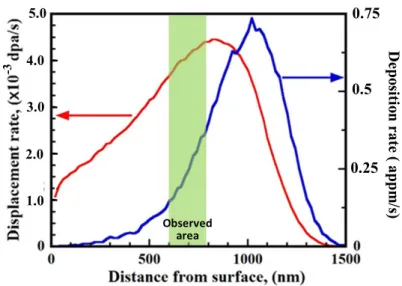
ions using Tandem Accelerator at RIAM, Kyushu Uni-versity, with the current of 8.0 nA/mm2. Figure 1 shows
SRIM code calculation of depth profile of displacement and Cu atom deposition rates. After irradiation, the sur-face of∼600 nm were removed by electro-polishing fol-lower by back-thinning to perforation. The observed area
Fig. 1 Depth profile of displacement rate and ion deposition rate by 2.4 MeV Cu2+on V-4Cr-4Ti in the present condition.
c
2016 The Japan Society of Plasma
Table 1 Summary of irradiation conditions.
is schematically shown in Fig. 1. The result shows that∼30 appm Cu deposited at the observed area after irradiation to 1 dpa. Transmission Electron Microscope (TEM) ob-servations of microstructures were carried out with JEM-2000FX at RIAM, Kyushu University.
The irradiation conditions are summarized in Table 1. The temperature varied between 403 and 413 K in the case denoted as 403 - 413 K for irradiation temperature in Ta-ble 1.
Neutron irradiations were carried out in JMTR and BR2 with disc specimens of 3 mm diameter and 0.15 -0.25 mm thick. The specimen was electropolished from the both sides to perforation. TEM microstructural obser-vations were carried out with JEM-2000FX at Oarai Center of IMR Tohoku University. Some of the results of JMTR irradiation was already reported elsewhere [8].
3. Results
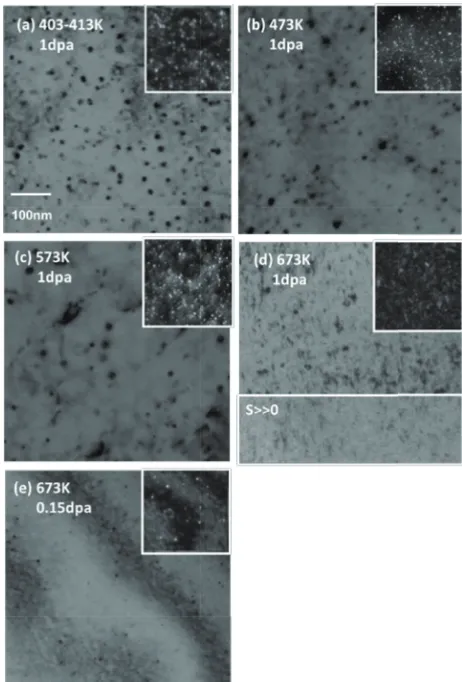
Figure 2 shows microstructure after irradiation with 2.4 MeV Cu2+ ions to 1 dpa. At 403 - 413 K, 473 K, and
573 K, high density of dot images, which are known to represent small dislocation loops, were observed as well as loops. Weak beam dark field (WBDF) images, shown at the upper right corners, clearly show dot and loop images. At 673 K and 1 dpa, loops and precipitates were mixed. In this case, an imaging in a diffraction condi-tion far removed from Bragg condicondi-tions (s0 : sis the deviation from Bragg condition) was also carried out and shown in lower area of Fig. 2 (d). Because the images in the conditions far removed from Bragg condition only ex-hibit the precipitates, comparison of the two images allows identification of dislocation loops. Also carried out was an irradiation to 0.15 dpa, when only dislocation loops were observed as shown in Fig. 2 (e). By these two ways, esti-mation of the loop number density was possible at 673 K. The loop number density derived by the two methods were close with each other. The loop number density data will be shown in the next section, comparing with those by neu-tron and elecneu-tron irradiations.
Figure 3 shows irradiation dose dependence of mi-crostructural evolution at 473 K. At 1 and 2.5 dpa, dislo-cation loops are observed predominantly. WBDF images, shown at the upper right corner, clearly shows dot and loop images. At 10 dpa tangled dislocation network are formed with lower density of loops. No evidence of precipitation
Fig. 2 Microstructural evolution by 2.4 MeV Cu2+ion
irradia-tion. Upper right corners show WBDF images.
Fig. 3 Microstructural evolution versus dose at 473 K by 2.4 MeV Cu2+ion irradiation. Upper right corners show
Fig. 4 Microstructural parameters as a function of dose (dpa) by 2.4 MeV Cu2+ion irradiation at 473 K.
Fig. 5 Microstructural evolution by neutron irradiation. (a) Ir-radiation in BR2. (b) IrIr-radiation in JMTR. Upper right corners show WBDF images.
was observed.
Figure 4 summarizes microstructural parameters. The loop number density is highest at 1 dpa, showing that the loop nucleation was completed before 1 dpa. Loops grow and coalesce and tangles with dose, decreasing their num-ber density. The dislocation density, which is defined as a total dislocation length per volume, continues to increase because of formation and evolution of tangled dislocation network. The change shown in Fig. 4 is a typical initial microstructural evolution in irradiated metallic materials.
Figure 5 are microstructures of neutron-irradiated V-4Cr-4Ti (a) at 363 K and 0.2 dpa by BR2 and (b) at 563 K and 0.08 dpa by JMTR. The microstructure of the two cases are composed of dislocation loops. No evidence of precipitate formation was seen. The quantitative date will be shown in the following section with ion and electron irradiation data.
4. Discussion
Figures 6 and 7 summarize loop number density as a function of temperature and damage rate, respectively. The data by electron irradiations [4, 6] were also indicated for comparison. Figure 6 shows that the temperature depen-dence of the loop number density is very weak to∼473 K for electron irradiation and to∼573 K for ion irradiation, both followed by significant negative temperature depen-dence. A datum for neutron irradiation at 363 K, is close to those for electron and ion irradiations in the similar tem-perature range.
Fig. 6 Temperature dependence of dislocation loop number density. Data by electron irradiation for V-4Cr-4Ti (0.8∼1.3×10⁻²dpa/s) [6] and V-20Ti and V-3Ti-1Si (1.6 ×10⁻⁴dpa/s) [4] are also shown for comparison.
Figure 6 shows that all the loop number density data within the temperature range of 363 K to 473 K lie between 0.3 to 3×10²³m−3, showing weak temperature and irradi-ation species dependence. On the other hand, data at the temperature higher than 523 K have clear negative temper-ature dependence. However the loop number density by ion irradiation is significantly higher than that of electrons in this temperature range in spite of similar damage rate. The low loop number density by neutrons at 563 K can be explained by its very low dose rate and is correlated in Fig. 7 using damage rate as a parameter.
A comparison of loop number density taking the dam-age rate effects into account is possible by Fig. 7. The data at temperature ranging from 363 K to 473 K lie between 0.3 to 3×10²³m−3, showing weak damage rate
depen-dence. Data at 523 K to 673 K show clear damage rate dependence, but data by ions at 573 K and 673 K and neu-tron at 563 K show significantly higher loop number den-sity than those by electrons in the same temperature range. Therefore the dislocation data for ion, neutron and electron irradiations can be summarized as follows.
(1) At 473 K and below, the loop number density by ion, neutron and electron irradiations are close with each other and have weak dependence on temperature and damage rate.
(2) Significant temperature and damage rate dependence appear at 563 K and above.
(3) At 563 K and above the loop number density by ion and neutron irradiation is significantly higher than those of electron irradiation.
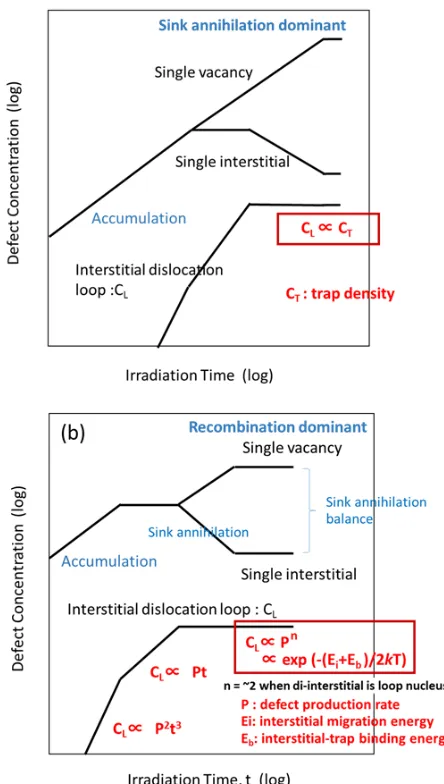
The electron irradiation data have been analyzed using chemical rate equations and the following two analytical expressions were derived which can be applied to many metals and alloys [9, 10].
(a) Loops are preferentially formed at a limited num-ber of interstitial trapping sites (heterogeneous nucle-ation), referred as Sink Dominant regime. In this case the loop number density is equal to the effective in-terstitial trap number density, without having temper-ature and damage rate dependence.
(b) Loops are formed by mutual clustering of interstitials (homogeneous nucleation), referred as Recombina-tion Dominant regime. In this case the loop number density is a negative function of temperature and pos-itive function of damage rate. The meaning of the ac-tivation energy derived by the slope of Arrhenius plot of the loop number density is shown in Fig. 8 (b). Comparing these pictures with the present results shown in Figs. 6 and 7 and summarized in this section, the defect processes at 473 K and below and at 563 K and above cor-responds to the Sink Dominant and Recombination Domi-nant regimes, respectively. However, these pictures cannot explain high loop number density by ion and neutron irra-diations only at 563 K and above.
Fig. 8 Schematic representations of time dependence of defect cluster evolution derived by chemical rate equation mod-els [9]. Also shown is the evolution of interstitial clus-ters with time derived by analytical and numerical analy-sis [10]. (a) Sink Dominant regime, and (b) Recombina-tion Dominant regime.
A comparison of loop number density by electron and neutron irradiation was carried out for Fe-Cr-Ni austenitic ternaries [11], which also showed higher loop number den-sity by neutrons relative to that by electrons considering the temperature and damage rate dependence of the den-sity. Among the possible reasons pointed out in the paper is an enhancement of interstitial clustering and thus loop nu-cleation by cascade damage. This may explain the results shown in Fig. 6 that the loop number density by ion and neutron irradiations was slightly higher than that by elec-tron irradiation in the temperature range of 363 - 473 K, but cannot explain significantly larger loop number density by ion irradiation than that of electron at 573 and 673 K be-cause the cascade induced enhancement of interstitial loop nucleation should have weak temperature dependence.
that vacancy loops, induced by depleted zones of cascade damage, were also formed because vacancies are mobile in this temperature range. Unfortunately it is difficult to iden-tify the type of small dislocation loops (vacancy type or interstitial type) by TEM observations. However, this idea is supported by a positron annihilation lifetime measure-ments [12] in which vacancy-Ti complexes were detected in V-4Cr-4Ti as a result of vacancy migration in the tem-perature range of 493 K to 623 K. The migration energy of vacancies can be obtained also by the temperature depen-dence of loop growth rate by HVEM [13]. The estimated vacancy migration energy for V-20Ti and V-3Ti-1Si were 1.36 eV and 1.22 eV, respectively [4]. Assuming 1 to 10 jumps per second is necessary for the clustering, the tem-perature where the vacancy clustering starts to occur, i.e. minimum temperature of vacancy clustering, is expected to be between 473 K to 573 K [4].
By heavy ion irradiation at 673 K and 1 dpa, a mix-ture of loops and precipitates was observed as shown in Fig. 2 (d). This means that the loop formation and pre-cipitation progress simultaneously at this relatively high temperature range, which was more systematically shown in [14]. The two processes will influence with each other but the interaction will be dependent on temperature and damage rate. Modeling of microstructural evolution in-cluding point defects-solute interaction is essential for the prediction of microstructural changes under irradiation in the temperature range.
Microstructure-mechanical property correlation is a crucial study to apply the present data to the estimate of radiation hardening and embrittlement. An effort to evalu-ate mechanical properties using the irradievalu-ated specimens in common with the present study is in progress using nano-indentation techniques [15].
The mechanistic understanding on the difference of the irradiation effects by fission-neutron, ion and electron irradiations will enhance accuracy of the prediction of D-T fusion neutron irradiation effects to be established based on the surrogate irradiation means. In this case, the valida-tion of the predicvalida-tion is foreseen by the irradiavalida-tion facilities of neutrons whose spectrum closely resembles that of D-T fusion neutrons, such as IFMIF (International Fusion Ma-terials Irradiation Facility) [16].
5. Conclusion
The temperature and damage rate dependence of the interstitial dislocation loops number density in V-4Cr-4Ti produced by heavy ions, fission neutrons and electrons
were well correlated with each other based on the con-ventional rate equation-based kinetic models in the tem-perature range of 403 - 493 K. However, effects of cas-cade damage, enhancing vacancy clustering, need to be taken into account at 573 K and 673 K where vacancies are highly mobile for the case of heavy ion and neutron irradia-tions. In this temperature range, where loop nucleation and precipitation proceeds simultaneously, defect-solute inter-action will also be the key process and must be included in the modeling.
Acknowledgements
The authors are thankful to Oarai Center of IMR To-hoku University for TEM observation of neutron-irradiated samples. This work was supported by Grant-in-Aid for Scientific Research (C) 25420889.
[1] T. Muroga, J.M. Chen, V.M. Chernov, R.J. Kurtz and M. Le Flem, J. Nucl. Mater.455, 263 (2014).
[2] J.M. Chen, V.M. Chernov, R.J. Kurtz and T. Muroga, J. Nucl. Mater.417, 289 (2011).
[3] S.J. Zinkle, H. Matsui, D.L. Smith, A.F. Rowcliffe, E. van Osch, K. Abe and V.A. Kazakov, J. Nucl. Mater.258-263, 205 (1998).
[4] T. Muroga, K. Araki and N. Yoshida, ASTM-STP1047, 199 (1990).
[5] T. Hayashi, K. Fukumoto and H. Matsui, J. Nucl. Mater.
307-311, 951 (2002).
[6] Q. Xu, T. Yoshiie and H. Mori, J. Nucl. Mater.307-311, 886 (2002).
[7] T. Muroga, T. Nagasaka, K. Abe, V.M. Chernov, H. Matsui, D.L. Smith, Z.Y. Xu and S.J. Zinkle, J. Nucl. Mater. 307-311, 547 (2002).
[8] T. Nagasaka, T. Muroga, H. Watanabe, K. Yamasaki, N. Heo, K. Shinozaki and M. Narui, Mater. Trans. 46, 498 (2005).
[9] R. Sitzmann, J. Nucl. Mater.69-70, 386 (1978).
[10] N. Yoshida, M. Kiritani and F.E. Fujita, J. Phys. Soc. Japan
39, 170 (1975).
[11] T. Muroga, H. Watanabe and N. Yoshida, J. Nucl. Mater.
174, 282 (1990).
[12] K. Fukumoto, H. Matsui, H. Ohkubo, Z. Tang, Y. Nagai and M. Hasegawa, J. Nucl. Mater.373, 289 (2008). [13] M. Kiritani, N. Yoshida, H. Takata and Y. Maehara, J. Phys.
Soc. Japan38, 1677 (1975).
[14] H. Watanabe, M. Suda, T. Muroga and N. Yoshida, J. Nucl. Mater.307-311, 408 (2002).
[15] T. Miyazawa, T. Nagasaka, R. Kasada, Y. Hishinuma, T. Muroga, H. Watanabe, T. Yamamoto, S. Nogami and M. Hatakeyama, J. Nucl. Mater.455, 440 (2014).
![Fig. 7Damage rate dependence of dislocation loop number den-sity. Data by electron irradiation for V-4Cr-4Ti at 373 Kand 523 K [6] and V-20Ti and V-3Ti-1Si at 473 K and∼573 K [4] are also shown for comparison.](https://thumb-us.123doks.com/thumbv2/123dok_us/8439011.1700633/3.595.72.254.65.256/damage-dependence-dislocation-number-electron-irradiation-kand-comparison.webp)