CORRESPONDING AUTHOR: Dr. Vasudha Devi, Associate professor and Head Department of Pharmacology, Melaka Manipal Medical College, Manipal University, Manipal, India 576104.
Tel: 918971494100, Fax: 918202571905, Email: [email protected]
© Medical Education Department, School of Medical Sciences, Universiti Sains Malaysia. All rights reserved. ABSTRACT
Objective: In PBL, interaction in tutorial group plays a role in stimulating student learning. However, quality of group interactions need not be always in a desired level which will later affect group success. Hence the aim of this study was to ascertain the quality of group interactions during PBL sessions. Method: In this prospective, observational study, to obtain the perceptions of students and faculty (n = 32), a preformed questionnaire was used. Students from 1st (n = 129) and 2nd year (n = 106) of Bachelors of Medicine and Bachelors of Surgery (MBBS) program and faculty were asked to respond in the questionnaire during a PBL brain-storming session. To explore reasons for adequate and inadequate interactions, focus group (n
= 10) discussions were conducted. Results: There was no difference in
perceptions regarding interactions between 1st year and 2nd year students. But there was significant difference between students and faculty perceptions regarding posing critical questions (p = 0.002), counter argument (p = 0.001) and handling conflicts. Factors that drove interactions were the prior knowledge, assessment and motivation and the hindering factor was case scenarios which were not designed based on students’ prior
knowledge. Conclusion: Faculty expectations regarding PBL group
interaction is different from the students’ understanding of PBL interaction. This study helps us to bridge the gap between the faculty expectations and students’ performance by orienting them regarding an ideal PBL interaction.
Perceptions regarding the quality of group interactions during brainstorming session
of problem based learning (PBL) at Melaka Manipal Medical College (Manipal
Campus), India
Vasudha Devi1, Vinod Pallath2, Benny Lim3, Chia Wue3, Cheng Kok Mun3, Jacinta Agnes Adward3, Law De Zhi3
1
Associate Professor and Head of Pharmacology, 2Assistance Professor of Microbiology, 3Students of Bachelor of Medicine and Bachelor of Surgery (MBBS), Melaka Manipal Medical College (Manipal Campus), Manipal University, Manipal, India.
Volume 4 Issue 2 2012
DOI:10.5959/eimj.v4i2.11 www.eduimed.com
ARTICLE INFO
Received : 23/01/2012
Accepted : 07/05/2012
Published : 01/12/2012
KEYWORD
Introduction
Collaborative learning situations like problem based learning (PBL) assign students an active and constructive role in their own learning [1]. In collaborative learning, construction of knowledge takes place through cognitive interaction processes, i.e. elaboration or co-construction processes (or both) [2-4]. The interactions that are manifestation of elaboration and /or co-construction processes are called as learning-oriented interactions. Elaboration is the process of considering a piece of knowledge in a richer and wider context [5], whereas co-construction is a special case of an elaboration, a collaborative elaboration where students develop shared understanding of the problem by interacting with each other [3]. The lack of elaboration is an important contributor to the students’ perception of an unproductive tutorial group [6].
Problem-based learning enhances higher-order thinking skills, such as applying, evaluation and synthesizing knowledge [7]. Brainstorming phase of PBL is an effective procedure to activate knowledge and to elaborate on knowledge and acquire comprehension of relevant new information [4]. In this phase learning takes place through interactions and elaborations [4,8]. There is a positive relationship between interactions and tutorial group productivity as well as a positive relationship between interactions and elaborations [9, 10]. However, when the interactions are not at the desired level [9, 11] and in pseudo interactions [12] synthesizing the knowledge by elaborations does not take place. Hence the low quality interactions may be responsible for unsuccessful tutorial group [11]. When quality of interaction is measured it can be used for giving feedback on tutorial group and students’ performance and also to train students on good quality interactions.
The research question in the present study was to find out whether the quality of students’ interactions during brainstorming session of PBL at Melaka Manipal Medical College (MMMC), (Manipal Campus), India was reasonable or not.
In this study researchers’ intention was to ascertain the quality of group interactions during PBL by two ways: (1). Assessing the perceptions of students and faculty on quality of group interactions during brainstorming session at MMMC. (2). Comparing students’ and faculty perceptions on quality of group interactions. Comparison of students’ and faculty perception is important as faculty perceptions are the indicators of faculty expectations. Hence it was hypothesised that there could be discrepancies in students’ and faculty perceptions on quality of group interactions.
Method
Educational context
In our medical program, students admitted are initially placed in Manipal, India (Phase I of the program) and after successfully completing two and a half years of pre-clinical training, they return to Melaka, Malaysia for the clinical training (Phase II of the program). MMMC follows a hybrid curriculum where 30% of the curriculum is covered through PBL, and PBL sessions are conducted modelled on the Maastricht ‘seven jump’ approach.
Questionnaires and subjects
To assess the quality of PBL group interaction, a pre-formed questionnaire (scale 1 to 5) designed by Visschers-Pleijers et al, 2005 [13] was used. The questionnaire had 11 items belonging to three different dimensions to distinguish three types of learning oriented interactions: exploratory question, cumulative reasoning and handling conflicts [13].The questionnaire was given to Ist (n = 129) and 2nd year (n = 106) medical students during one of the PBL brainstorming sessions. The same questionnaire was also given to MMMC faculty.
conducted with 6 groups of students each from both the batches. The questions to be used during focus group discussion were developed after extensive literature review [2, 4, 6, 8-13]. Content validity of the questionnaire was assessed by taking the opinions from the experts in medical education. The present cross sectional study was approved by the Institutional Research Committee of MMMC. Informed consent was obtained from the subjects before responding in the questionnaire.
Analysis
Statistical analysis was performed using the Statistical Package for the Social Sciences (SPSS) version 11.5. The categorical variables were described as median and interquartile range. Comparison of responses between the groups was done using Kruskal-Wallis test and Mann-Whitney test for pair-wise comparison. Comparison of factors within the groups was done using Friedman test followed by Wilcoxon Signed Rank Test. p value of < 0.017 was considered as statistically significant.
The students response to different questions asked during focus group discussion were tabulated in the decreasing order of frequency of their appearance. Later two authors independently grouped the responses into three categories. Finally the categories and responses were finalized by consensus among authors.
Result
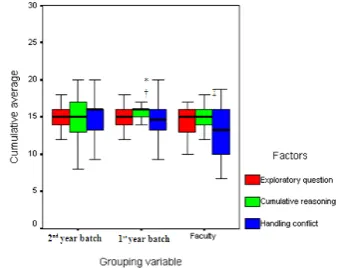
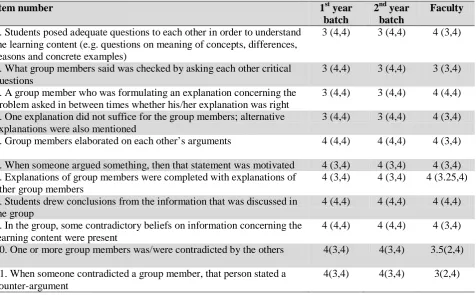
Table 1 shows the average median score for perception regarding occurrence of each item in the questionnaire in 1st year, 2nd year student groups and faculty groups. The cumulative average score of the three factors in different groups is shown in Figure 1. Table 2 shows students’ responses obtained during focus group discussion.
The response rate was 100% in faculty and students groups. The cumulative average of factor handling conflict had the highest median score of 16 (13.3, 16: scale 1-5) in 2nd year batch compared to exploratory questions [15(14, 16)]
and cumulative reasoning [15(13, 17)] factors. The factor cumulative reasoning scored highest [16(14.5, 16)] on occurrence in 1st year batch and handling conflict factor scored lowest [14.7 (13.3, 16)].
In faculty group handling conflict factor scored lowest on occurrence [13.3 (9.66, 16)] (Figure 1). At item level, there was no significant difference in the perception regarding occurrence of different types of interactions between 1st year
and 2nd year student groups. There was
significant difference in the opinion regarding
the occurrence of item 2 between 1st year
students’ and faculty group (p = 0.002). There was also significant differences between student
groups and faculty regarding item 11 (2nd year
student vs faculty; 0.001 and 1st year student vs faculty; 0.001). More number of students agreed that critical questions were asked and counter arguments happened during group discussion but less number of faculties agreed for that (Table 1).
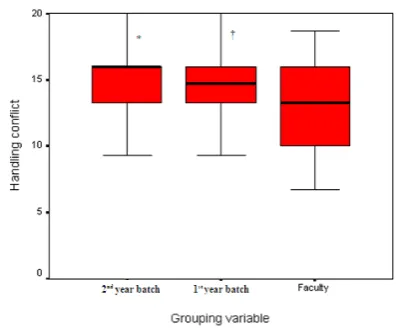
Factor level analysis yielded significant differences in the opinion regarding occurrence of handling conflict factor between student groups and faculty (Figure 2). Faculty felt that interactions related to handling conflict occurred less frequently.
According to students’ opinion the main factors that drove interaction were the assessment and motivation. The main hindering factor for the
1st year batch:
*p = 0.007, Cumulative reasoning vs Exploratory questions †p = 0.004, Cumulative reasoning vs Handling conflicts
Faculty group:
‡p = 0.013, Cumulative reasoning vs Handling conflicts
group interaction was the case scenarios which were not designed based on students’ prior knowledge.
Table 1: Students’ and faculty perceptions (median with inter-quartile range) regarding group interactions
Item number 1st year
batch
2nd year batch
Faculty
1. Students posed adequate questions to each other in order to understand the learning content (e.g. questions on meaning of concepts, differences, reasons and concrete examples)
3 (4,4) 3 (4,4) 4 (3,4)
2. What group members said was checked by asking each other critical questions
3 (4,4) 3 (4,4) 3 (3,4)
3. A group member who was formulating an explanation concerning the problem asked in between times whether his/her explanation was right
3 (4,4) 3 (4,4) 4 (4,4)
4. One explanation did not suffice for the group members; alternative explanations were also mentioned
3 (4,4) 3 (4,4) 4 (3,4)
5. Group members elaborated on each other’s arguments 4 (4,4) 4 (4,4) 4 (3,4)
6. When someone argued something, then that statement was motivated 4 (3,4) 4 (3,4) 4 (3,4)
7. Explanations of group members were completed with explanations of other group members
4 (3,4) 4 (3,4) 4 (3.25,4)
8. Students drew conclusions from the information that was discussed in the group
4 (4,4) 4 (4,4) 4 (4,4)
9. In the group, some contradictory beliefs on information concerning the learning content were present
4 (4,4) 4 (4,4) 4 (3,4)
10. One or more group members was/were contradicted by the others 4(3,4) 4(3,4) 3.5(2,4)
11. When someone contradicted a group member, that person stated a counter-argument
4(3,4) 4(3,4) 3(2,4)
Table 2: Student responses for various questions asked during focus group discussion
Driving factors for interaction Hindering factors for interaction Suggestions to improve interaction Student related Facultyrelated Student related Faculty related
1. Prior knowledge/ experience 2. Motivation 3. Confidence 4. Familiarity
among peers 5. Effective
leader
1. Guidance 2. Clues
3. Encouragement 4. Non
interference 5. Assessment
1. No prior knowledge 2. Fear of giving
wrong information 3. Language barriers 4. Talkative group
members
1. Difficult case scenarios 2. Tutor’s sarcasm
1. Cases based on prior knowledge 2. Effective
leaders and trained facilitators 3. Assessment
Discussion
The questionnaire used in this study had 11 items belonging to 3 different factors: exploratory questions, cumulative reasoning and handling conflicts [13]. These three factors were derived from three types of talk and thought in groups during PBL process, as described by Mercer, 1995, 1996 [14, 15] and three types of interaction as specified by Van Boxtel, 2000 [3]. Exploratory talk occurs when group members engage critically but constructively with each other’s ideas. Exploratory talk has been found to be most effective for learning through collaborative activity. In cumulative talk, speakers build positively but uncritically on what the others have said. In this type of talk, students construct a ‘common knowledge’ by accumulation [15].
The present study explored students’ and faculty perceptions of the occurrence of learning-oriented group interaction during brainstorming session of PBL. The study also investigated discrepancies in the perception between student groups and faculty in order to indicate where the improvement was desirable. The median score for the occurrence of all interactions was more than 3 (Table 1) which indicates that at MMMC, students construct knowledge through elaboration during PBL session. Moreover, at
our institute, the quality of student interaction during brainstorming session of PBL could be considered as reasonable which is supported by similar study done by Visschers-Pleijers et al, 2005 [13]. The average score of factors did not differ significantly between student groups which mean that students’ understanding / expectations regarding group interaction did not
change when they proceeded from 1st year to 2nd
year of the course. Highest score of cumulative
reasoning factor in 1st year students group
compared to 2nd year group indicates that the
emphasis in PBL sessions shifts from problem solving to learning from the process of PBL when students proceed to 2nd year.
Occurrence of productive conflicts and open
arguments were more in 2nd year students
compared to 1st year which was supported by
qualitative data in which 2nd year students opined that familiarity among peers and less fear of judgment drives interaction during PBL sessions (Table 2).
Though the results showed that understanding regarding the process and expectations of PBL between MMMC faculty and students were similar, significant differences were observed between faculty and students groups on items related to critical questions (Item 2) and counter-arguments (Item 11) (Table 1). This difference showed that faculty expectations regarding asking critical questions and counter-arguments were more than students’ perceptions and faculty expectations were not clear to the students. Hence at MMMC, during PBL training, more emphasis has to be given to interactions that occur during PBL process. Thus evaluation of student interactions during PBL can be used for quality control of PBL process and to give feedback to students.
According to students’ perspectives the main hindering factor for appropriate group discussion was the quality of case scenarios. Students felt that adequate discussion did not take place as case scenarios were not designed based on their prior knowledge (Table 2). Students actively construct explanatory models based on prior knowledge, which in turn facilitate the processing and comprehension of new *p = 0.003, 2nd year batch vs faculty; †p = 0.004, 1st year batch vs
faculty
information [4]. Therefore, at MMMC, there is a need to revise or design PBL cases based on students’ prior knowledge. In this regard, a preliminary work was done at MMMC to find out students’ perceptions regarding an ideal PBL case [16] which was considered while designing case scenarios.
The present study has some limitations. Lack of awareness of an ideal productive PBL interaction in the study population might have affected the study result. Moreover, a clear quality of students’ interactions could have been assessed using observational method instead of perceptions. The second limitation is that, the tutors’ score took an account of students’ group interactions during all brainstorming sessions of that academic year, whereas students’ scores included only the particular brain-storming session in which students were asked to respond. So students’ score might have been influenced by case scenarios, tutor and by group members as at MMMC reshuffling of students takes place before each PBL sessions.
This study looked into the learning process, more specifically, learning through group interaction during PBL. At MMMC, only 30% of the curriculum is covered through PBL. Hence this study looked into only 30% of the curriculum. The impact of 70% of traditional curriculum on PBL process was not explored in this study. It seems worthwhile to study the role of case scenarios in promoting quality interactions. Measured quality of interactions needs to be correlated with outcomes of PBL to see whether the perceived quality interaction is really the expected quality interaction that drives learning during PBL sessions. The students and faculty perceptions could be compared with tutorial group productivity. The quality of group interactions could be assessed during reporting phase of PBL session also. The tutor role on quality of interactions could also be explored.
Conclusion
Students’ understanding / expectations regarding PBL interaction did not change much during their course. Faculty expectations regarding
asking critical questions and counter argument are different from the students’ understanding of PBL interaction. This study helped us to understand and bridge the gap between faculty expectations and students’ performance by orientating students regarding an ideal / model PBL interaction. Furthermore, designing the PBL cases based on prior knowledge may bring out a productive group discussion during PBL sessions.
Acknowledgement
The authors thank faculty and students of Melaka Manipal Medical College for participating in the study. We are grateful to Visschers-Pleijers et al (2005) for permitting us to use the questionnaire. We also would like to thank Dr.Reem Rachel Abraham (Associate Professor, Dept. of Physiology) for helpful comments on aspects of this project.
Reference
1. Biggs JB. Teaching for quality learning at
university 2nd ed. Buckingham: Open
University Press. 2003
2. DeGrave, WS, Boshuizen HPA, Schmidt
HG. Problem-based learning: Cognitive and metacognitive processes during problem analysis. Instructional Science 1996:24:321-41.
3. Van Boxtel C. Collaborative Concept
Learning: Collaborative learning tasks, student interaction, and the learning of physics concepts. [Unpublished PhD thesis]. Utrecht: Utrecht University. 2000 (cross reference)
4. Schmidt HG, De Volder ML, De Grave WS,
Moust JHC, Patel VL. Explanatory models in the processing of science text: The role of prior knowledge activation through small-group discussion. J Educ Psychol 1989:81:610-19.
5. Regehr G, Norman GR. Issues in cognitive
psychology: implications for professional education. Acad Med 1996:71:988-1001.
6. De Grave WS, Schmidt HG, Boshuizen
HPA. Effects of problem-based discussion on studying a subsequent text: A randomized trial among first-year medical students. Instructional Science 2001;29:33-44.
7. Johnson DW, Johnson RT, Smith KA.
classroom. Edina: Interaction Book Company. 1991
8. Norman GR, Schmidt HG. The
Psychological Basis of Problem-based Learning: A Review of the Evidence. Acad Med 1992;67:557-565.
9. Dolmans DHJM, Wolfhagen HAP, Van der
Vleuten CPM. Motivational and cognitive processes influencing tutorial groups. Acad Med 1998;73: S22-S24.
10. Das Carlo M, Swadi H, Mpofu D. Medical
Student Perceptions of Factors Affecting Productivity of Problem-Based Learning Tutorial Groups: Does Culture Influence the Outcome? Teach Learn Med 2003;15:59-64.
11. De Grave WS, Dolmans DHJM, Van der
Vleuten CPM. Student Perspectives on Critical Incidents in the Tutorial Group. Adv Health Sci Educ 2002;7:201-209.
12. Dolmans DHJM, Wolfhagen HAP, Van der
Vleuten CPM, Wijnen WHFW. Solving problems with group work in problem-based learning: hold on to the philosophy. Med Educ 2001;35: 884-889.
13. Visschers-Pleijers JSFA, Dolmans HJMD,
Wolfhagena HAPI, Van der Vleuten PMC. Development and validation of a questionnaire to identify learning-oriented group interactions in PBL. Med Teach 2005;27:375-381.
14. Mercer N. The guided construction of
knowledge: Talk amongst teachers and learners. Clevedon: Multilingual Matters. 1995.
15. Mercer N. (1996). The quality of talk in
children’s collaborative activity in the classroom. Learning and Instruction 1996:6:359-377.
16. Devi V, Abraham RR, Pallath V,