www.atmos-meas-tech.net/3/249/2010/
© Author(s) 2010. This work is distributed under the Creative Commons Attribution 3.0 License.
Measurement
Techniques
Development of an autonomous sea ice tethered buoy for the study
of ocean-atmosphere-sea ice-snow pack interactions: the O-buoy
T. N. Knepp1, J. Bottenheim2, M. Carlsen3, D. Carlson4, D. Donohoue4, G. Friederich5, P. A. Matrai6, S. Netcheva2, D. K. Perovich7, R. Santini3, P. B. Shepson1,8,9, W. Simpson4, T. Valentic10, C. Williams8, and P. J. Wyss3
1Purdue University, Department of Chemistry, 560 Oval Dr., West Lafayette, IN 47907, USA 2Environment Canada, Toronto, Canada, 4905 Dufferin Street, Toronto, Ontario M3H 5T4, Canada
3Jonathan Amy Facility for Chemical Instrumentation, Purdue University, 560 Oval Dr., West Lafayette, IN 47907, USA 4University of Alaska Fairbanks, Department of Chemistry & Biochemistry, University of Alaska Fairbanks, AK 99775-6160, USA
5Monterey Bay Aquarium Research Institute, 7700 Sandholdt Rd., Moss Landing, CA 95039, USA 6Bigelow Laboratory for Ocean Sciences, 180 McKown Pt., West Boothbay Harbor, ME 04575, USA
7US Army Corps of Engineers Cold Regions Research and Engineering Laboratory, 72 Lyme Rd., Hanover, NH 03755, USA 8Purdue University, Department of Earth and Atmospheric Sciences, West Lafayette, IN 47907, USA
9Purdue Climate Change Research Center, Purdue University, West Lafayette, IN 47909, USA 10SRI International, 333 Ravenswood Ave., Menlo Park, CA 94025, USA
Received: 31 July 2009 – Published in Atmos. Meas. Tech. Discuss.: 2 September 2009 Revised: 5 February 2010 – Accepted: 5 February 2010 – Published: 17 February 2010
Abstract. A buoy based instrument platform (the “O-buoy”) was designed, constructed, and field tested for year-round measurement of ozone, bromine monoxide, carbon dioxide, and meteorological variables over Arctic sea ice. The O-buoy operated in an autonomous manner with daily, bi-directional data transmissions using Iridium satellite communication. The O-buoy was equipped with three power sources: primary lithium-ion battery packs, rechargeable lead acid packs, and solar panels that recharge the lead acid packs, and can fully power the O-buoy during summer operation. This system was designed to operate under the harsh conditions present in the Arctic, with minimal direct human interaction, to aid in our understanding of the atmospheric chemistry that occurs in this remote region of the world. The current design re-quires approximately yearly maintenance limited by the life-time of the primary power supply. The O-buoy system was field tested in Elson Lagoon, Barrow, Alaska from February to May 2009, and deployed in the Beaufort Sea in October 2009. Here, we describe the design and present preliminary data.
Correspondence to: P. A. Matrai
1 Introduction
The Arctic has been a source of fascination and study since the time of Aristotle (Strabo, 1966), with significant scien-tific interest and discovery beginning in the early twentieth century (Whitfield, 1900; Warren, 1911). Polar regions are unique in that atmosphere/surface interactions, which deter-mine the composition of the troposphere, are significantly impacted by air-ice (e.g. aerosol, gas, snow) heterogeneous physical and chemical processes.
exhibit halogen chemistry and ozone depletion, leading to the conclusion that sea salt is the primary halogen source (Fan and Jacob, 1992; Tang and McConnell, 1996; Simp-son et al., 2007b). However, the mechanism by which sea salts are converted to reactive halogen gases is unclear, and a number of theories exist. Frost flower surfaces have been proposed to be involved (Rankin et al., 2000), and a num-ber of studies have investigated this hypothesis (Kaleschke et al., 2004; Domin´e et al., 2005; Kalnajs and Avallone, 2006). Snow contaminated with sea salts may also hold a key role (Impey et al., 1997; Domin´e and Shepson, 2002; Simpson et al., 2005, 2007a). Direct production of halogen gases from a salt-contaminated snowpack has been observed (Foster et al., 2001), as well as indirect observations of halo-gen losses from snowpack (Simpson et al., 2007b; Alvarez-Aviles et al., 2008). Aerosol surfaces, possibly from the dis-persal of frost flowers, are also a candidate (Fan and Jacob, 1992; Kaleschke et al., 2004). Modeling studies have also at-tempted to simulate halogen activation and ozone depletion. Global atmospheric CO2mole fractions are at the highest levels of the past 25 million years. Current levels of CO2 have increased by 35% from 280 parts per million (ppm) in pre-industrial times to∼387 ppm today, and they continue to rise. For the decade of the 1990s, an average of about 6.3 Pg C per year as CO2 was released to the atmosphere from the burning of fossil fuels (Ding et al., 2001). Only half, on average, of the CO2from anthropogenic emissions has re-mained until now in the atmosphere (Ciais et al., 1995; Keel-ing et al., 1996; Battle et al., 2000). Analyses of the decreas-ing13C/12C and O2/N2ratios in the atmosphere have shown that land and oceans have sequestered the other half, in ap-proximately equal proportions but with temporal and spa-tial variations. The Arctic Ocean is usually not included in these calculations as models presume a sea-ice capped region without much ocean/sea ice/atmosphere exchange. Because global climate models show large deviations in their simula-tions of current condisimula-tions in the Arctic region (Proshutinsky et al., 2005), the effect of changing ice cover (at∼7% de-crease/decade; Comiso, 2002) and thickness onpCO2fluxes in the Arctic Ocean is not clear. Furthermore, the role of sea ice as a barrier to, or an integral player of, CO2air/sea and/or air/ice fluxes (Papakyriakou et al., 2004; Semiletov et al., 2004) is least understood, with both the direction and amount of CO2 transfer between air and sea/ice varying in the thaw/freeze and open water seasons due to sea-ice melt ponds, open brine channels, leads and photosynthesis.
It is important to note that the Arctic has changed rapidly over the past fifty years (Holland et al., 2006; Lindsay and Zhang, 2006), with large increases in first year sea-ice. This will likely induce significant changes in the surface interac-tions with respect to ODEs, and the extent to which the Arc-tic Ocean will become a more important sink for CO2. Cli-mate models predict a predominantly ice-free Arctic Ocean in summer by the end of the century (Johannessen et al., 2004; Holland et al., 2006; Stroeve et al., 2007), implying
a change in the sea-air fluxes of CO2. Validation of such models will require independent information on spatial and temporal patterns of CO2 sources and sinks in the Arctic Ocean in order to improve our ability to predict future re-gional and global CO2fluxes.
Though there have been many land-based measurements throughout the Arctic, these measurements have been spa-tially limited (e.g. no measurements from the Siberian side of the Arctic Ocean), with the majority of campaigns tak-ing place in the sprtak-ing. Additionally, there have been sev-eral late-spring and summer ice breaker cruises (Weller and Schrems, 1996; Jacobi et al., 2006) to study a variety of at-mospheric and oceanic phenomena over the sea ice; how-ever, such cruises are relatively short, often spatially lim-ited, and expensive due to the cost of ice breaker operation. Such limited efforts, though extremely useful, fail to pro-vide a full picture of atmospheric chemical processes over the Arctic Ocean as a function of time and space, especially in the more remote northern latitudes and during the dark winter/early spring months. Acquisition of year-round mea-surements of atmospherically relevant chemical species and meteorological parameters will be highly elucidative for the purpose of understanding chemical mechanisms, transport pathways/processes, and understanding the necessary condi-tions for Arctic unique chemistry.
2.4m
B
u
o
y
H
u
ll
Buoy Hull
25cm
Lithium Ion
C
O
2
C
y
lin
d
e
r
O
z
o
n
e
P
o
w
e
r
C
o
n
tr
o
l/
S
C
C
a
m
p
b
e
ll
Ir
id
iu
m
CO2 Instrument
DOAS Instrument Tray
Battery Support
Lithium Ion Lithium Ion
Spectrometer
Fig. 1. Schematic drawing of the O-buoy hull and instrumentation
placement on the instrument panel.
2 Instrumentation 2.1 O-buoy hull and mast
An autonomous O-buoy system capable of year-round mea-surement of O3, CO2, and BrO, while deployed in sea-ice, was designed and constructed. A critical design objective for the O-buoy was to operate the instruments with (necessary) temperature control, but at minimal power cost, since winter operation is powered via on-board batteries. Thus, the design put the three main instruments at the bottom of the O-buoy, which was immersed in the sea-water below the ice, to main-tain near constant temperature (i.e.−1.5◦C).
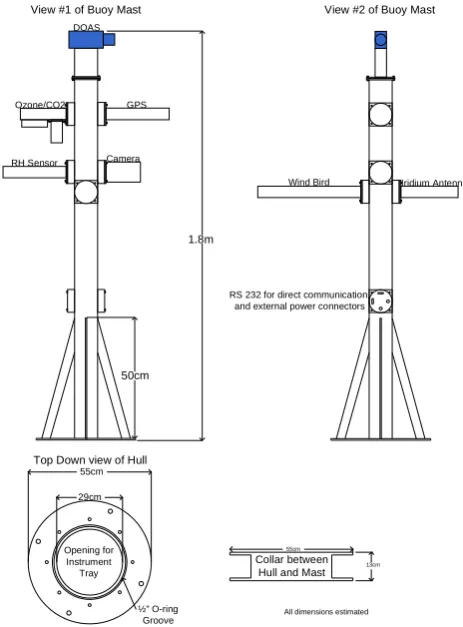
The O-buoy hull was constructed from quarter-inch (6 mm) aluminum at the US Army Corps of Engineers Cold Regions Research and Engineering Laboratory (CR-REL) in New Hampshire, and is represented schematically in Figs. 1–2. The main O-buoy housing was an aluminum cylinder 2.4 m long and 0.3 m in diameter. Three primary lithium battery packs, two cylinders containing CO2 cali-bration gases (at 368.6 ppm and 396.6 ppm), Iridium com-munication equipment, the O3 instrument, power control
All dimensions estimated
50cm 1.8m
RH Sensor Camera Ozone/CO2 GPS
DOAS
View #1 of Buoy Mast
RS 232 for direct communication, and external power connectors
Wind Bird Iridium Antenna
View #2 of Buoy Mast
29cm 55cm
½” O-ring Groove Opening for
Instrument Tray
Top Down view of Hull
13cm 55cm
Collar between Hull and Mast
Fig. 2. A schematic representation of the O-buoy’s mast and
hull-to-mast connecting collar. View 2 is a rotation of view 1 about the
y-axis by 90◦to allow visualization of all instrument/inlet mounts
on the mast.
and supervisory computer, data logger (CR1000 Campbell Scientific Instruments), Iridium modem, CO2, and Multi-AXis Differential Optical Absorption Spectroscopy (MAX-DOAS) instrument were placed inside the main housing. A 2 m high tower was placed on top of the hull, from which meteorological sensors, camera, global positioning system (GPS), and the MAX-DOAS’s scan head were mounted (Fig. 2). Connections were made between the tower and the main housing using Amphenol Class E Environmental con-nectors. A flotation collar (Gilman Corporation Type 1000) provided buoyancy in case the O-buoy melted free of the ice. The collar was 1.1 m OD×0.64 m H and provided 482 kg of buoyancy. The instruments, computer, and lithium-ion bat-teries were secured to an aluminum tray (Fig. 1) that could be slid into, and out of, the hull. The tray was constructed of eighth-inch (3 mm) aluminum with aluminum supports. The overall dimensions of the O-buoy were 4.2 m tall, 1.1 m wide, and 280 kg.
Current and Power Measurement of 205 2-15-08 Spike Levels are Maximum Values
0.20 0.40 0.60 0.80 1.00 1.20 1.40 1.60 0 1 8. 2 3 6. 5 5 4. 7 7 2. 9 9 1. 1 10 9 12 8 14 6 16 4 18 2 20 0 21 9 23 7 25 5 27 3 29 2 31 0 32 8 34 6 36 5 38 3 40 1 41 9 43 7 45 6 47 4 49 2 51 0 52 9 Time (s) C ur rent (A) 2.76 5.52 8.28 11.04 13.80 16.56 19.32 22.08 P ow er ( W ) Instrument On 0.53 A; 7.32 W
Heater On 0.66 A; 9.11 W
O3 generator on: level 2 0.59 A; 8.16 W O3 generator on: level 12 0.63 A; 8.69
O3 generator on: level 15 0.68 A; 9.45 W
O3 generator on: level 20 0.70 A; 9.60 W
O3 generator off
Pump Changes
Pump #2 0.56 A; 7.95 W
Lamp Test 0.45 A; 6.22 W
Lamp On 1.08 A; 14.90 W;
O3 generator lamp on: 0.59 A; 8.07 W; 12.06s
O3 generator lamp off: 0.58 A; 8.06 W
15.9s
Scrubber Change 1.53 A; 21.12 W; 0.08s (for both peaks)
1.15 A; 15.87 W; 0.02s 1.08 A; 14.90 W; 0.02s
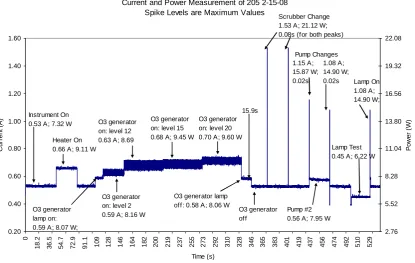
Fig. 3. Power plot of the ozone instrument in its various states of operation. In its baseline operation state the instrument draws approximately
7.3 W. Such a power measurement was done for all instruments on the O-buoy.
this time, and the subsequent deployment in the Beaufort Sea, we believe the system to be capable of surviving a full annual cycle.
2.2 Ozone instrument
Ozone was measured with a 2B Technologies model 205 dual-beam UV-absorption sensor that was specially con-structed for this endeavor. The ozone instrument provides a limit of detection of approximately 1 parts per million (ppb) (i.e. better than that necessary to observe depletion events, from background levels of∼35 ppb). It functions by UV-absorption at 254 nm, with one flow path scrubbed of O3for the I0measurement of a Beer-Lambert calculation. The ozone instrument’s modifications involved addition of a lamp heater, a back-up pump, back-up ozone scrubber, an ozone generator, and the ability to remotely control the in-strument’s state, the ozone generator’s output, the state of the lamp heater, and the ability to switch the pump and scrubber. The ozone instrument was housed in an aluminum case (po-sitioned approximately 0.5 m from the bottom of the O-buoy, Fig. 1), with the lid acting as the bottom of the power control board and supervisory computer case. The electrical connec-tors between the inside and outside of the ozone instrument’s case were Amphenol connectors, and the plumbing connec-tions were PTFE Teflon Swagelok. The sample inlet line was 4 mm PTFE Teflon (4 m long), and the exhaust line was 8 mm PTFE Teflon (4 m long). The inlet line was inserted into the exhaust line to make a coaxial configuration, which allowed
the outlet gas to warm the inlet gas, thus reducing the chance of condensation on the lines. The sample lines were con-nected between the mast and hull using a custom built bulk-head which maintained the coaxial configuration. The lines were configured in such a way that the exhaust exited the mast at a distance of approximately one meter from the inlet. The ozone instrument’s inlet was approximately 1.5 m up on the mast, and had a 90 mm quartz fiber filter (Pall Life Sci-ences Membrane Filter) held in place by a machined stainless steel filter holder.
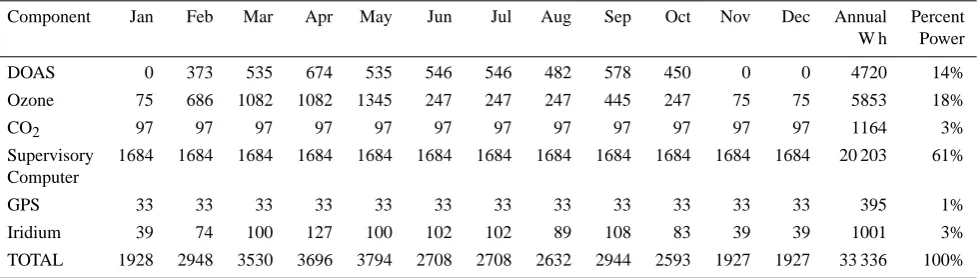
Table 1. Monthly energy consumption (W h) for each instrument/component of the O-buoy. Each monthly value accounts for each
instru-ment’s power draw and duty cycle in normal deployment mode.
Component Jan Feb Mar Apr May Jun Jul Aug Sep Oct Nov Dec Annual Percent
W h Power
DOAS 0 373 535 674 535 546 546 482 578 450 0 0 4720 14%
Ozone 75 686 1082 1082 1345 247 247 247 445 247 75 75 5853 18%
CO2 97 97 97 97 97 97 97 97 97 97 97 97 1164 3%
Supervisory 1684 1684 1684 1684 1684 1684 1684 1684 1684 1684 1684 1684 20 203 61%
Computer
GPS 33 33 33 33 33 33 33 33 33 33 33 33 395 1%
Iridium 39 74 100 127 100 102 102 89 108 83 39 39 1001 3%
TOTAL 1928 2948 3530 3696 3794 2708 2708 2632 2944 2593 1927 1927 33 336 100%
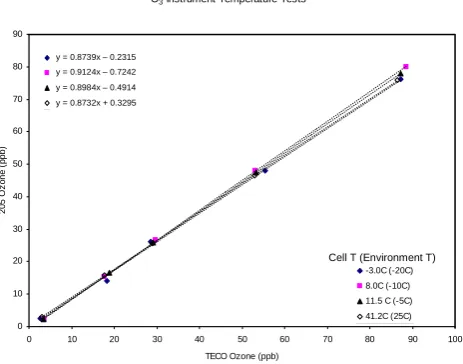
Calibration: Though the ozone instrument’s internal pro-cessor accounts for cell temperature and pressure fluctua-tions in the calculation of ozone mole fraction, verification of the accuracy/precision of this calculation was performed. The ozone instrument was calibrated as a function of envi-ronment/cell temperature by placing it in a temperature con-trolled freezer (Fig. 4) at Purdue University before deploy-ment. The ozone instrument was controlled through a serial connection to a Linux box, and supplied with ozone from a TECO-49 ozone generator. The TECO’s ozone generation was self-monitored to allow subtraction of any fluctuations in its production from the 205’s signal. The slopes and in-tercepts for the different temperatures were not statistically significantly different (<2σ; i.e. there was no temperature dependence of instrument sensitivity over the range of pos-sible operating temperatures during deployment). Addition-ally, changing the pump or scrubber had no affect on the re-ported O3mole fraction.
The ozone instrument underwent a one-time field cali-bration at the time of deployment using a 2B Technologies model 306 ozone generator (output flow rate 2.5 L min−1). The ozone generator required an internal temperature of 40◦C (±1◦C) to produce consistent mole fractions of ozone. Since the ambient temperature was−30◦C the ozone gener-ator was operated in a heated tent next to the O-buoy with ad-ditional heating from heat tape that was wrapped around the instrument with the applied voltage controlled by a variac, with power supplied by a generator. The ozone generator was programmed to produce 0 ppb, 5 ppb, 15 ppb, 30 ppb, 55 ppb, and 95 ppb ozone for five minutes for each standard sample. The ozone generator’s outlet (1/400 PTFE Teflon tube; 7 m long) was connected to the ozone filter inlet on the O-buoy. The filter inlet was covered tightly with aluminum foil, and this volume was swept (at 2.5 L min−1), with the ozone gen-erator standard gas flow, via a hole in the foil, allowing all air in this volume to be purged with the standard gas. We are confident that there was no mixing of outside air that would alter the calibration gas for the O-buoy’s ozone instrument as
that instrument sampled at a rate of 750 mL min−1as com-pared to the generator’s flow rate of 2.5 L min−1.
The lab-based cold chamber calibrations and the field cali-bration immediately prior to deployment had statistically in-different slopes and intercepts at the 95% confidence level. These calibrations were separated by more than a year, indi-cating both the sensitivity and accuracy to be invariant over that time period. During deployment the ozone monitor can perform zero and span measurements to test the instrument’s functionality. Further, during the test phase deployment, the ozone data were compared to data collected at NOAA’s Bar-row site. The agreement of these data was within 1.6 ppb over the entire deployment test phase.
2.3 CO2instrument
O3 Instrument Temperature Tests
0 10 20 30 40 50 60 70 80 90
0 10 20 30 40 50 60 70 80 90 100
TECO Ozone (ppb)
2
0
5
O
z
o
n
e
(
p
p
b
)
-3.0C (-20C) 8.0C (-10C) 11.5 C (-5C) 41.2C (25C)
Cell T (Environment T)
y = 0.8739x – 0.2315 y = 0.9124x – 0.7242 y = 0.8984x – 0.4914 y = 0.8732x + 0.3295
O3 Instrument Temperature Tests
0 10 20 30 40 50 60 70 80 90
0 10 20 30 40 50 60 70 80 90 100
TECO Ozone (ppb)
2
0
5
O
z
o
n
e
(
p
p
b
)
-3.0C (-20C) 8.0C (-10C) 11.5 C (-5C) 41.2C (25C)
Cell T (Environment T)
y = 0.8739x – 0.2315 y = 0.9124x – 0.7242 y = 0.8984x – 0.4914 y = 0.8732x + 0.3295
Fig. 4. Temperature dependent calibration of the ozone instrument.
temperature and pressure corrections. Operational details are given below.
The CO2system was controlled by a low power controller (ONSET TT8v2) equipped with a set of custom made inter-face boards that scheduled the analyzer, pumps, and valves, collected and formatted the data, and stored all information in flash memory before passing it on to the supervisory com-puter for transmission. A sampling frequency of 8 measure-ments per day was selected; this frequency allowed the reso-lution of significant events while conserving power. A com-plete sampling cycle took 6 min and had a mean power con-sumption of 3.5 W. The standby power concon-sumption was less than 0.04 W. Power requirements were kept low by operating the infrared analyzer at ambient temperature without stabi-lization. Temperature of the measurement cell was moni-tored at all phases of the sample cycle and data were cor-rected to a common temperature using laboratory and field derived calibrations. Another factor that kept power con-sumption low was the choice of gas switching and distri-bution valves (ASCO Series AM33) that were magnetically latching and only required a 100 ms pulse to change position. Gas aspiration and circulation were achieved with a small di-aphragm pump (KNF Neuberger UNMP015M) operated at reduced voltage with additional flow restriction to limit gas flows to about 100 mL min−1. Prior to entering the infrared analyzer all gases were dried and filtered through 0.22 mi-cron hydrophobic filters. Drying was accomplished in se-quential sections of Nafion (Permapure) tubing embedded in molecular sieve 4A. Nafion allows the passage of water va-por but has no effect on CO2or major components of air and these dryers work especially well at low temperatures (Leck-rone and Hayes, 1997). The capacity of these dryers was de-signed to provide drying of water saturated samples at 0◦C for several years of sampling. Laboratory tests indicate that the absolute water vapor dilution of the samples was equiva-lent to less than 0.1 ppm CO2and that the difference between
the water vapor pressure of the standards and the samples was on the order of 0.005 kPa, thus generating uncertainties on the order of 0.02 ppm in the final CO2results. Water va-por changes in the gas stream were estimated with a humidity sensor designed for measurement of low humidity (Humirel HM1520LF) mounted in the outlet of the infrared analyzer.
A complete sampling cycle consisted of several distinct operations that are described below:
Zero (power up): Power is applied to the infrared ana-lyzer which has a “warm up” time of one minute. While waiting for the analyzer to stabilize, the valves in the gas manifold are switched to form a closed loop with the ana-lyzer, pump, a soda lime (mostly Ca(OH)2)cartridge and the Nafion dryers. The pump is started up and the trapped gas is circulated for one minute until all CO2 has reacted with the soda lime and removed from the gas stream. A reading of all parameters (CO2, cell temperature, pressure and wa-ter vapor) is made immediately before turning the circulation pump off. A second reading is taken 10 s later; those read-ings are used in the final calculations of pCO2 since they occur in a more noise-free environment and at a cell pressure that is closer to the ambient atmospheric pressure. Compar-ison of the two measurements allowed an estimate of pump effectiveness and the condition of the in-line filters. The zero values had a predictable offset of−1.2 ppm◦C−1and had a long-term drift of about−0.3 ppm per month.
Air Sampling: Following the standard gas analysis, the valve manifold is switched into air sampling mode. In this mode, air is aspirated from the external inlet located on the buoy mast and then passes through the Nafion dryers before entering the infrared analyzer. The exhaust gases exit via the outer shell of the coaxial inlet line. The sample is actively pumped for one minute to flush the analytical manifold. Data were collected before turning the pump off and again after a 10 s relaxation period. Air enters the inlet system near the top of the buoy mast through a protected hydrophobic 0.45 micron pore size membrane (Pall Supor-450R). The air then enters a length of Nafion tubing in a small chamber which contains the exhaust gas. Since the exhaust gas is always drier than ambient air, the freshly sampled air will have some of its moisture removed and is less likely to form ice in the inlet line while traveling down the mast. The inlet line from the top of the mast to the instrumentation consists of coaxial FEP tubing with the incoming air flowing down in the center and the warmer exhaust gas flowing up in the sheath. This arrangement aids in the temperature equilibration of the in-coming air and may decrease the possibility of ice formation in the incoming gas stream; an additional benefit is better or-ganization of tubing inside the mast. Data from the pressure sensor while the system was being pumped indicate that the intake filter and gas path remained unobstructed during the entire deployment.
Zero (power down): Before removing power from the an-alytical system, a final zero CO2measurement is obtained in a manner identical to the zero obtained at the start. This pro-cedure put the system in an identical rest state between sam-ples and also provides another temperature calibration point since the final temperature is about one degree higher than the starting temperature.
Calibration: Prior to deployment the instrument was placed in an environmental chamber and subjected to tem-peratures as low as−35◦C to examine the limits of opera-tion. At temperatures below−25◦C the gas switching valves became unreliable and power consumption of the gas circu-lation pump increased; the infrared analyzer continued to op-erate reliably at all temperatures. Since it was expected that the internal buoy temperature would remain near the freez-ing point of seawater (∼ −1.9◦C), we limited the testing and calibration to temperatures between−20◦C and 5◦C. Dur-ing the Barrow deployment the temperature of the CO2 in-strument ranged from−0.5◦C to−2.8◦C. Laboratory cali-bration consisted of operating the instrument at a variety of temperatures (−20◦C to 5◦C) and supplying it with up to six standard gases ranging from 200 ppm to 600 ppm CO2in air. The gases were obtained from the National Oceanic and Atmospheric Administration’s (NOAA) Earth Systems Re-search Laboratory (ESRL). The calibration obtained in the laboratory was augmented in the field with a 3-point calibra-tion done via a soda lime chamber to generate a zero stan-dard and two small, high pressure CO2 gas standards con-tained in the buoy housing. The two gas standards (368.6
and 396.6 ppm supplied by ESRL) spanned the annual range ofpCO2that has been observed at the NOAA Barrow Ob-servatory in recent years. Standard gas calibrations were performed 4 times per day throughout the campaign and a 24 h running mean was utilized to make final adjustments to the data stream. Deployment data also indicated that there was a small residual pressure correction that was not im-plemented in the original infrared analyzer firmware. The pressure correction adjustment was derived empirically from the analysis of the standards during the deployment and then applied to the entire record. These data were compared to CO2 data collected at NOAA’s Barrow observatory. The agreement between the two data sets was consistently within 2 ppm.
2.4 MAX-DOAS (BrO instrument)
The MAX-DOAS instrument used in this study is described in detail in Carlson et al. (2009), and was tested extensively in Barrow, AK; we provide a brief description here. The MAX-DOAS instrument observes scattered light spectra and derives the slant column abundance of UV-absorbing gases in the observation path (e.g. BrO, IO, O3, NO2, HONO, etc.) as a function of view elevation angle in the atmo-sphere (H¨onninger et al., 2004). These “elevation scans” can be inverted to give vertical profiles of the absorbers. The technique is analogous to satellite remote-sensing tech-niques, but with enhanced sensitivity to boundary-layer gases and vertical profiling capabilities; therefore, the system may provide insight into satellite measurements of BrO. Similar MAX-DOAS instruments have been used at fixed ground-based locations in the Arctic to observe halogen chemistry (H¨onninger and Platt, 2002; H¨onninger et al., 2004; Simp-son et al., 2007b).
The instrument consisted of two portions, the scan head, which resided above the sea ice to receive skylight, and the computer/spectrometer, which resided below the ice for better temperature stability, with the two being connected by a fiber optic cable. The scan head oriented a narrow-field telescope to scan the sky for scattered radiation and then this skylight was coupled into the fiber optic con-nected to the spectrometer for spectral analysis. The com-puter/spectrometer module consisted of a low-power single-board computer (Technologic Systems TS-7260), a stepper motor driver (Stepperboard BC2D15), interface electronics, and a miniature charge-coupled device based spectrometer (Ocean Optics HR2000, 318–455 nm).
difference of light detected by the spectrometer at the LED wavelength with the LED on minus LED off, we quantified the degree of frost coverage and turned on a heater if the frost signal exceeded a user-defined threshold. The tilt sensing system used a digital inclinometer (Smart Tool Technologies ISU-S) to measure the tilt of the scan head housing. We used this housing tilt to correct the horizon setting of the stepper motor to maintain accurate alignment of the view directions with respect to the true horizon. If the O-buoy’s tilt were to have changed due to ice deformation or a curious polar bear, the instrument was capable of adjusting up to 20 degrees of tilt. Further, the MAX-DOAS was constructed with no exter-nal moving parts that could freeze, and the sealed scan head was packed with desiccant to keep it dry and prevent internal freezing. The stepper motor has 36:1 reduction gearing and can be run at higher current to increase torque if there was a problem with a frozen gear train, although we have never needed this feature. A prototype instrument at Barrow has been operational since winter 2007 and has never had any problems with getting frozen, so we expect that the O-Buoy MAX-DOAS will move after the winter. For details on the MAX-DOAS instrument, see Carlson et al. (2009).
The instrument operated on a schedule set by the supervi-sory computer. When the MAX-DOAS was switched on, its computer booted and began data acquisition, typically on a half-hourly schedule. During a half-hour measurement pe-riod, the instrument performed a number of cycles (typically four) of elevation scans from horizon to zenith. A typical scan pattern observed light at 2, 5, 10, 20, and 90 degrees ele-vation angle on the side of the instrument away from the sun. The sun’s location with reference to the MAX-DOAS instru-ment’s view direction was calculated from the GPS location, orientation, and coordinated universal time (UTC). The tilt, frost signal, various temperatures, and raw spectra were com-piled in half-hourly data “records”. When the supervisory computer (SC) decided to shut down the MAX-DOAS, the SC requested the instrument to complete the current acqui-sition, archive the data to internal storage within the MAX-DOAS, and pass the data to the supervisory computer to be uploaded to the satellite communications system.
The MAX-DOAS instrument consumed an average of 2.7 W when operating. The spectrometer consumed 0.54 W, the stepper motor driver required 0.9 W, and the computer used 1.3 W. The window heater consumed around 3.8 W at times when the frost sensor indicated snow or frost on the window, which was typically the first two hours of daily operation.
The O-buoy MAX-DOAS system was compared to sim-ilar modules operated by University of Alaska Fairbanks, and Institute of Environmental Physics, both of which were mounted in Barrow. By comparing differential slant col-umn density (dSCD) measurements from these three sepa-rate instruments we find that the RMS difference between the various instruments is less than 2×10¹³molec cm−2and the slope of the regressions are all within 20% of 1:1. Peak
values of BrO are on the order of 4×10¹⁴molec cm−2, so the RMS variability is less than 5% of maximal values. The data also show evidence that visibility differences along each instrumental view paths increases the slope error, so we ex-pect that further analysis of the data will lead to increased accuracy. Further details regarding the MAX-DOAS calibra-tion are discussed in a separate paper (Carlson et al., 2009). 2.5 Meteorological sensors and data logger
A suite of meteorological sensors consisting of a wind mon-itor (RM Young Model 05103), a humidity and temperature probe (Vaisala HMP45C), and a barometer (Vaisala PTB110) were housed on the O-buoy mast. A GPS (Garmin 16HVS) was also included to determine the position of the O-buoy. For the testing phase, the ice flow did not rotate, so the ori-entation of the buoy was static. However, for future deploy-ment, a solid-state compass (Ocean Server OS 5000-US) has been integrated. A Campbell data logger (CR-1000) per-formed five minute averages on these data, and reported the most recent five minute average to the supervisory computer on an hourly basis.
2.6 Control systems
2.6.1 Supervisory computer
The Supervisory Computer (SC) was based on a Technologic Systems TS-7260 single board computer (SBC) and addi-tional peripheral components. The SBC had two character-buffered, flow-controlled (16C550 type) serial communica-tion ports, two USB 2.0 ports, a 10/100 MBps Ethernet port, an integral SPI interface, 64 MB of RAM memory, 128 MB of Flash memory, an SD card socket, a battery backed-up real time clock, a 16 bit PC-104 expansion interface, an on-board temperature sensor and user selectable capability for RS-232 or RS485/422 compatibility on its COM 2 serial port. Each of the above capabilities was used to operate the buoy. Its ARM9 processor was pre-specified to operate at a clock rate of 200 MHz. The software operating system was the De-bian Linux distribution as adapted for the TS-7260 SBC. The SBC was fitted with an additional four-port 16C550 type se-rial expansion card and a second Ethernet port (these features were connected via a PC-104 expansion interface). The SBC and its options were specified at the time of purchase for op-eration to−40◦C. Typical power consumption on the buoy was observed to be approximately 2.3 W while running a de-manding computation benchmark with all ports operating at high data rates. This value may be regarded as the high end limit for SC power consumption.
AGM/Solar Battery Array 14.5 Volts
Lithium Battery Array 14.5 Volts
Li Current Sense Resistor 0.015 Ohm
Li Array On/Off CPU Controlled Solid-State Switch
Li Current Steering And Isolation Diode AGM Current Steering
And Isolation Diode
Li Array Current To CPU
To Supervisory Computer
To Met Devices
To Sat Communications Met On/Off
CPU Controlled S-S Switch
Sat On/Off CPU Controlled S-S Switch
Science Instruments On/Off CPU Controlled
S-S Switch
To Science Instrument, One each for O3,
CO2 and MAX-DOAS
Science Instruments Current Monitor to
CPU Current Sense
0.02 Ohm Current Sense
0.02 Ohm Current Sense
0.02 Ohm
Met Devices Current Monitor to CPU
Sat Communications
Current Monitor To CPU AGM Voltage Monitor
To CPU
Li Voltage Monitor To CPU
Simplified Power Control and Monitoring System
AGM/Solar Battery Array 14.5 Volts
Lithium Battery Array 14.5 Volts
Li Current Sense Resistor 0.015 Ohm
Li Array On/Off CPU Controlled Solid-State Switch
Li Current Steering And Isolation Diode AGM Current Steering
And Isolation Diode
Li Array Current To CPU
To Supervisory Computer
To Met Devices
To Sat Communications Met On/Off
CPU Controlled S-S Switch
Sat On/Off CPU Controlled S-S Switch
Science Instruments On/Off CPU Controlled
S-S Switch
To Science Instrument, One each for O3,
CO2 and MAX-DOAS
Science Instruments Current Monitor to
CPU Current Sense
0.02 Ohm Current Sense
0.02 Ohm Current Sense
0.02 Ohm
Met Devices Current Monitor to CPU
Sat Communications
Current Monitor To CPU AGM Voltage Monitor
To CPU
Li Voltage Monitor To CPU
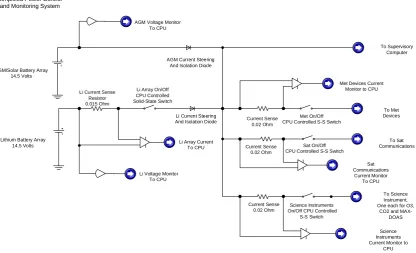
Fig. 5. Schematic representation of the power control board used on the buoy. For a full diagram see supplementary material (http://www.
atmos-meas-tech.net/3/249/2010/amt-3-249-2010-supplement.pdf).
“memory stick” was installed to provide an on-board archive of all data that were obtained from every instrument and sensor.
In the event of a temporary power failure, the SC will re-boot itself from firmware upon restoration of power. The SC goes through a series of system checks to ensure the in-tegrity of its file structure on its solid-state “disk drive” be-fore it performs a full reboot of its Linux operating system. Upon restoration of the operating system it uses the buoy’s GPS device to update the day-date clock on the SC. This da-tum is used to restore the data acquisition and power man-agement schedule for each instrument. Each instrument is re-initialized as it is returned to its default experimental sta-tus. Further, if the operating system can reboot as described above, the system can go into an emergency mode. It will re-port this state via its satellite link. Most operational software and experimental scripts can be reloaded via the satellite link by direct intervention. The link operates at 2400 bits per sec-ond, thus this process could require several days to complete and verify. In the event of loss of satellite communication the buoy will likely not be recoverable.
The SC was in continuous operation; therefore it repre-sents the baseline power demand of the O-Buoy system. This device was the only subsystem on the buoy that was normally kept in continuous operation.
2.6.2 Power sources/control
Power distribution, monitoring and control were done via a custom built circuit (Fig. 5) that was directly managed by the supervisory computer. Power input was from ei-ther or both of two possible sources: (A) A conventional Lead-Acid (LA) battery bank that was recharged from a so-lar cell array (ASE-50-ATF/17; 50 W max/panel×4 panels); or (B) A non-rechargeable lithium-ion (Li) battery bank. The solar cell array was composed of four solar panels (96.5 cm×45.2 cm) connected in series, and arranged so one panel faced in each direction (N, S, E, W; Fig. 6). The power circuit was based on a negative common design. The input circuit was equipped with a separate current steering diode in series with each positive connection to the LA bank and the Li bank respectively. Additionally, an electronic switch was located “upstream” of the Li steering diode to allow the Li bank to be positively turned off by the SC under software control or explicit satellite derived command (Fig. 5). This single switch plus the two steering diodes creates three pos-sible modes of power input to the buoy system:
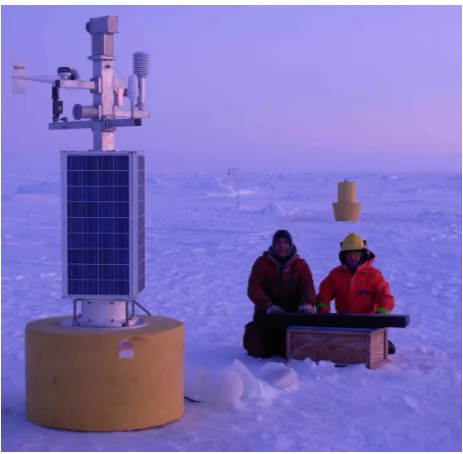
Fig. 6. Photograph of the O-buoy, solar panel array, and lead-acid
battery box as deployed on the Beaufort Sea. The lead acid packs (inside wooden box) are connected to the buoy via shielded cable in a manner that allows the lead acid batteries to tear away from the buoy in the event of a significant ice break up. Should this happen, the buoy will stay on via diode switching with power from the in-ternal lithium ion packs. Future versions will have larger flotation collars with cavities to store the lead acid batteries.
cycles between 14.5 volts and 11.5 volts the LA pack will be the source of power. This voltage range is de-termined by a pulse width modulated controller (Morn-ingstar SS-10) that arbitrates between the unregulated solar array and the LA battery bank.
2. Solar Elevation Near or Below the Horizon – The so-lar cells may not be capable of maintaining the charge on the LA batteries (LA voltage level falls to≤11.5 V). At this control point, the SC software turns on the Li bank. The Li batteries will exhibit an open circuit voltage above this level (>11.5 V) until they are almost completely exhausted. Our calculations indicate that the Li battery bank will last at least one winter for normal operation of the buoy.
3. Intermediate Solar Elevation – The solar array is able to provide significant power to the buoy via scattering from the sky and ice surfaces at intermediate solar an-gle. Both battery banks are on line where passive diode steering alone apportions the current load. This mode was tested during the deployment in Elson Lagoon from February – May 2009. Despite the sun being not much above the horizon, the solar array provided sufficient power to operate the buoy from the LA bank charge alone on a 24 h basis by mid-March 2009.
Power distribution was managed by the SC via the power control circuit. Identical electronic switches supplied the un-regulated DC power to all scientific devices, meteorologi-cal instruments and a pre-packaged satellite transceiver sys-tem. The power control circuit provided regulated voltage at +3.3 volts for its own analog and digital circuits. This circuit utilized a set of voltage and current sensing amplifiers which were read via a multi-input multiplexer via the SPI port on the SBC. There were sufficient parameters available that the system software could report the distributed voltage level and all significant current loads in the system.
2.6.3 Scheduling
Based on a predetermined scientific observation schedule (which was based, in turn, on the solar elevation angle), indi-vidual instruments were sequenced into operation as needed. The objective was to provide a maximum number of scien-tific observations achievable with the power available (max-imum of 16 W). The power consumption of each instrument and the SC is shown in Table 1. The satellite transceiver is excluded due to its great variability. Scientific functions were scheduled for operation and data acquisition between satel-lite service intervals (once every 24 h for a 2 h interval). Typ-ically data from the buoy were uploaded to the satellite dur-ing this time. Revised programs and schedules could also be downloaded to the O-buoy during an open satellite window. The results of these changes were seen at the next satellite window for the buoy 24 h later.
A more power efficient version of the SC system is now being developed. It is practical to reduce the power consump-tion of this part of the buoy system by a factor of two. This improvement may extend the unattended lifetime of the buoy to two years of operation in high latitude polar environments. 2.7 Communications
Satellite communication was done through an Iridium phone (NAL Research AL3A-SA). All communication to and from the buoy was achieved through this transceiver and was con-trolled by the SC. During transmission, the files (typically to-taling>200 KB) were aggregated and put into 10 KB chunks to limit the amount of data required to be resent should the transmitting signal be temporarily interrupted. Moreover, the data were routinely backed-up on the SC in case all transmis-sion capabilities were lost. The data were transferred from the SC every day at 18:00 UTC, and were sent to a temporary repository at SRI International where it could be accessed by the various groups involved via an Internet connection.
3 Deployment
slit was cut in the sea-ice (approximately 1 m thick) to low the O-buoy to be slid off the sled horizontally, and al-low the bottom to be al-lowered into the slit, thus positioning the O-buoy in a fully upright configuration (Fig. 6; http:// www.youtube.com/watch?v=2ijCZ arhzE for video). In Oc-tober of 2009 the buoy was re-deployed in the Beaufort Sea, at 76◦N, 138◦W, where it is still located. The buoy was transported via the CCGS Louis S. St. Laurent, and then via helicopter to its current location.
4 Results and conclusions
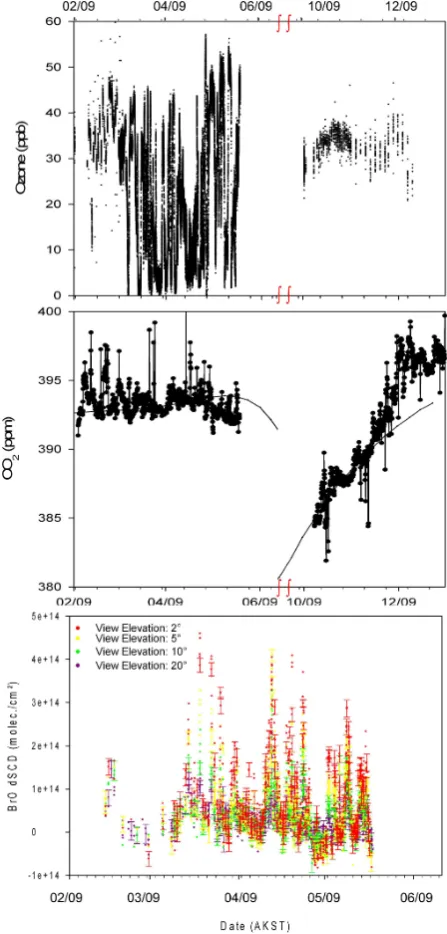
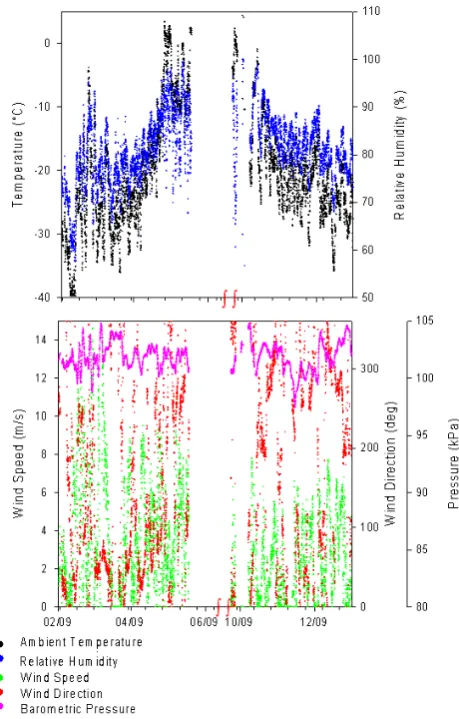
The data and associated metadata obtained during this field test can be found at http://www.aoncadis.org. As an example of the quality of data obtained from the O-buoy we present the data collected in 2009 at both sites in Figs. 7–8. The data depict the frequent ODEs during spring, but more stable ozone mole fractions in the fall. For the first deployment near Barrow, we compared our O3data with those measured at the NOAA lab in the Barrow Environmental Observatory. While it is quite possible that there are actual differences in ozone mole fraction at the two locations (5 km apart; the O-Buoy is on sea ice, while the NOAA lab is on the tundra), the average difference in ozone at the two locations over this period was 1.6 ppb. We note that the wind speed measurement (Fig. 8) may be in error, as our recorded wind speeds are significantly different from those measured at the ESRL site at low wind speeds. This is most likely due to icing on the anemometer’s propeller.
From the data collected it can be seen that the O-buoy system is fully operational and capable of functioning for extended periods of time in the harsh Arctic environment. We present these data as a proof of concept that such mea-surements are achievable over long periods, thus providing invaluable information regarding atmospheric chemistry and composition in the Arctic environment.
5 Future work
The first buoy is currently collocated with buoys measuring ice mass balance and the physical properties of the upper ocean creating an automated drifting station. Given the suc-cess of the O-buoy, additional units will be constructed and deployed throughout the Arctic Ocean to provide a better un-derstanding of where and how chemistry and composition in the Arctic are changing, and to further study and observe any future variations in Arctic atmospheric chemical compo-sition and meteorological parameters. Data from these buoys could be used to evaluate satellite measurements, and to im-prove their interpretation. The MAX-DOAS instrument is se-lectively sensitive to tropospheric chemical species (whereas satellites measure total column abundances). By making a comparison between long term O3 and BrO measurements on the buoy we will learn more about their relationship in
Fig. 7. Data plots from the three major instruments on the O-buoy
(O3, CO2, and BrO) during the entire test phase deployment and the
current Beaufort Sea deployment (date in mm/yy). The ozone and
CO2plots’ abscissas are broken after 06/09, as indicated by∫∫.
Note, BrO is plotted for only the spring period due to inadequate sample time (result of low sunlight) during the Fall deployment.
The smoothed line in the CO2plot is a NOAA derived decadal
av-erage.
Fig. 8. Plot of the meteorological data acquired on the O-buoy
dur-ing 2009. Note, the abscissas have a break.
Acknowledgements. We thank the NSF for funding this work
through grants No. ARC-0612331, ARC-0611992, ARC-0612047, and ARC-0612457 to P. Matrai, D. Perovich, P. Shepson, and W. Simpson, respectively, and the Canadian Government’s Fed-eral Program Office for the International Polar Year No. MD065, “OASIS-CANADA”.
We thank Lewis Brower and the staff at the Barrow Arctic Science Consortium for their generous logistical help; Pieter Tans, NOAA
ESRL for making the CCGG daily CO2data from the Barrow, AK
Observatory available; the Jonathan Amy facility for Chemical Instrumentation at Purdue University for machining and electrical work; and Sam Oltmans, NOAA ESRL for the Barrow, AK ozone data.
Edited by: J. Stutz
References
Alvarez-Aviles, L., Simpson, W. R., Douglas, T. A., Sturm, M., Perovich, D., and Domin´e, F.: Frost flower chemical composi-tion during growth and its implicacomposi-tions for aerosol produccomposi-tion and bromine activation, J. Geophys. Res.-Atmos., 113, D21304, doi:21310.21029/22008JD010277, 2008.
Barrie, L. A., Bottenheim, J. W., Schnell, R. C., Crutzen, P. J., and Rasmussen, R. A.: Ozone destruction and photochemical reac-tions at polar sunrise in the lower Arctic atmosphere, Nature, 334, 138–141, 1988.
Battle, M., Bender, M. L., Tans, P. P., White, J. W. C., Ellis, J. T., Conway, T., and Francey, R. J.: Global carbon sinks and their variability inferred from atmospheric O-2 and delta C-13, Sci-ence, 287, 2467–2470, 2000.
Bottenheim, J. W., Gallant, A. G., and Brice, K. A.: Measurements
of NOy Species and O-3 at 82-Degrees-N Latitude, Geophys.
Res. Lett., 13, 113–116, 1986.
Bottenheim, J. W., Netcheva, S., Morin, S., and Nghiem, S. V.: Ozone in the boundary layer air over the Arctic Ocean: mea-surements during the TARA transpolar drift 2006–2008, Atmos. Chem. Phys., 9, 4545–4557, 2009,
http://www.atmos-chem-phys.net/9/4545/2009/.
Carlson, D., Donohoue, D., Platt, U., and Simpson, W. R.: A low power automated MAX-DOAS instrument for the Arctic and other remote unmanned locations, Atmos. Meas. Tech. Discuss., 2, 2347–2375, 2009,
http://www.atmos-meas-tech-discuss.net/2/2347/2009/. Ciais, P., Tans, P. P., Trolier, M., White, J. W. C., and Francey, R. J.:
A Large Northern-Hemisphere Terrestrial CO2Sink Indicated by
the C-13/C-12 Ratio of Atmospheric CO2, Science, 269, 1098–
1102, 1995.
Comiso, J. C.: A rapidly declining perennial sea ice
cover in the Arctic, Geophys. Res. Lett., 29, 1956,
doi:1910.1029/2002GL015650, 2002.
Ding, J. T., Griggs, D. J., Noguer, M., van der Linden, P. J., Dai, X., Maskell, K., and Johnson, C. A.: Climate Change 2001: Synthe-sis Report: Third Assessment Report of the Intergovernmental Panel on Climate Change, Intergovernmental panel on Climate Change, Cambridge, UK, New York, NY USA, 2001.
Domin´e, F. and Shepson, P. B.: Air-snow interactions and atmo-spheric chemistry, Science, 297, 1506–1510, 2002.
Domin´e, F., Taillandier, A. S., Simpson, W. R., and Severin, K.: Specific surface area, density and microstructure of frost flowers, Geophys. Res. Lett., 32, L13502, doi:10.1029/2005GL023245, 2005.
Fan, S. M. and Jacob, D. J.: Surface Ozone Depletion in Arctic Spring Sustained by Bromine Reactions on Aerosols, Nature, 359, 522–524, 1992.
Foster, K. L., Plastridge, R. A., Bottenheim, J. W., Shepson, P. B., Finlayson-Pitts, B. J., and Spicer, C. W.: The role of Br-2 and BrCl in surface ozone destruction at polar sunrise, Science, 291, 471–474, 2001.
Friederich, G. E., Brewer, P. G., Herlien, R., and Chavez, F. P.:
Mea-surement of Sea-Surface Partial-Pressure of CO2from a Moored
Buoy, Deep-Sea Res. Pt I, 42, 1175–1186, 1995.
Haas, C., Pfaffling, A., Hendricks, S., Rabenstein, L., Etienne, J. L., and Rigor, I.: Reduced ice thickness in Arctic Transpolar Drift favors rapid ice retreat, Geophys. Res. Lett., 35, L17501, doi:17510.11029/12008GL034457, 2008.
Holland, M. M., Bitz, C. M., and Tremblay, B.: Future abrupt re-ductions in the summer Arctic sea ice, Geophys. Res. Lett., 33, L23503, doi:23510.21029/22006GL028024, 2006.
H¨onninger, G. and Platt, U.: Observations of BrO and its vertical distribution during surface ozone depletion at Alert, Atmos. En-viron., 36, 2481–2489, 2002.
H¨onninger, G., von Friedeburg, C., and Platt, U.: Multi axis dif-ferential optical absorption spectroscopy (MAX-DOAS), Atmos. Chem. Phys., 4, 231–254, 2004,
http://www.atmos-chem-phys.net/4/231/2004/.
Impey, G. A., Shepson, P. B., Hastie, D. R., Barrie, L. A., and An-lauf, K. G.: Measurements of photolyzable chlorine and bromine during the Polar sunrise experiment 1995, J. Geophys. Res.-Atmos., 102, 16005–16010, 1997.
Jacobi, H. W., Kaleschke, L., Richter, A., Rozanov, A., and Bur-rows, J. P.: Observation of a fast ozone loss in the marginal ice zone of the Arctic Ocean, J. Geophys. Res.-Atmos., 111, D15309, doi:15310.11029/12005JD006715, 2006.
Johannessen, O. M., Bengtsson, L., Miles, M. W., Kuzmina, S. I., Semenov, V. A., Alekseev, G. V., Nagurnyi, A. P., Zakharov, V. F., Bobylev, L. P., Pettersson, L. H., Hasselmann, K., and Cattle, H. P.: Arctic climate change: observed and modeled temperature and sea-ice variability, Tellus A, 56, 559–560, 2004.
Kaleschke, L., Richter, A., Burrows, J., Afe, O., Heygster, G., Notholt, J., Rankin, A. M., Roscoe, H. K., Hollwedel, J., Wagner, T., and Jacobi, H. W.: Frost flowers on sea ice as a source of sea salt and their influence on tropospheric halogen chemistry, Geo-phys. Res. Lett., 31, L16114, doi:16110.11029/12004GL020655, 2004.
Kalnajs, L. E. and Avallone, L. M.: Frost flower influence
on springtime boundary-layer ozone depletion events and at-mospheric bromine levels, Geophys. Res. Lett., 33, L10810, doi:10810.11029/12006GL025809, 2006.
Keeling, R. F., Piper, S. C., and Heimann, M.: Global and
hemi-spheric CO2sinks deduced from changes in atmospheric O-2
concentration, Nature, 381, 218–221, 1996.
Leckrone, K. J. and Hayes, J. M.: Efficiency and temperature de-pendence of water removal by membrane dryers, Anal. Chem., 69, 911–918, 1997.
Lindsay, R. W. and Zhang, J.: Arctic ocean ice thickness: Modes of variability and the best locations from which to monitor them, J. Phys. Oceanogr., 36, 496–506, 2006.
Oltmans, S. J. and Komhyr, W. D.: Surface Ozone Distributions and Variations from 1973–1984 Measurements at the NOAA Geo-physical Monitoring for Climatic-Change Base-Line Observato-ries, J. Geophys. Res.-Atmos., 91, 5229–5236, 1986.
Papakyriakou, T. N., Miller, L. A., Langlois, A., Mundy, C., and
O’Driscoll, P.: Sea ice and CO2exchange in the Canadian
Arc-tic, SOLAS Science 2004: A SOLAS open science conference, Halifax, Canada, 13–16 October 2004, #75, 2004.
Proshutinsky, A., Yang, J., Krishfield, R., Gerdes, R., Karcher, M., Kauker, F., Koeberle, C., Hakkinen, S., Hibler, W., Holland, D., Maqueda, M., Holloway, G., Hunke, E., Maslowski, W., Steele, M., and Zhang, J.: Arctic Ocean Study: Synthesis of Model Re-sults and Observations, EOS T. Am. Geophys. Un., 86, 368–371, 2005.
Rankin, A. M., Auld, V., and Wolff, E. W.: Frost flowers as a source of fractionated sea salt aerosol in the polar regions, Geophys. Res. Lett., 27, 3469–3472, 2000.
Richter, A., Wittrock, F., Eisinger, M., and Burrows, J. P.: GOME observations of tropospheric BrO in northern hemispheric spring and summer 1997, Geophys. Res. Lett., 25, 2683–2686, 1998. Rigor, I. G., Colony, R. L., and Martin, S.: Variations in surface air
temperature observations in the Arctic, 1979–97, J. Climate, 13, 896–914, 2000.
Semiletov, I., Makshtas, A., Akasofu, S. I., and Andreas, E. L.:
Atmospheric CO2 balance: The role of Arctic sea ice,
Geo-phys. Res. Lett., 31, L05121, doi:05110.01029/02003GL017996, 2004.
Simpson, W. R., Alvarez-Aviles, L., Douglas, T. A., and Sturm, M.: Halogens in the coastal snow pack near Barrow, Alaska: Evi-dence for active bromine air-snow chemistry during springtime, Geophys. Res. Lett., 32, L04811, doi:10.1029/2004GL021748, 2005.
Simpson, W. R., Carlson, D., Hnninger, G., Douglas, T. A., Sturm, M., Perovich, D., and Platt, U.: First-year sea-ice contact predicts bromine monoxide (BrO) levels at Barrow, Alaska better than potential frost flower contact, Atmos. Chem. Phys., 7, 621–627, 2007a, http://www.atmos-chem-phys.net/7/621/2007/.
Simpson, W. R., von Glasow, R., Riedel, K., Anderson, P., Ariya, P., Bottenheim, J., Burrows, J., Carpenter, L. J., Frieß, U., Goodsite, M. E., Heard, D., Hutterli, M., Jacobi, H.-W., Kaleschke, L., Neff, B., Plane, J., Platt, U., Richter, A., Roscoe, H., Sander, R., Shepson, P., Sodeau, J., Steffen, A., Wagner, T., and Wolff, E.: Halogens and their role in polar boundary-layer ozone depletion, Atmos. Chem. Phys., 7, 4375–4418, 2007b,
http://www.atmos-chem-phys.net/7/4375/2007/.
Strabo: Geographica, 1966 ed., Lipsiae: B.G. Teubneric, Leipzig, Germany, 1966.
Stroeve, J., Holland, M. M., Meier, W., Scambos, T., and Serreze, M.: Arctic sea ice decline: Faster than forecast, Geophys. Res. Lett., 34, L09501, doi:09510.01029/02007GL029703, 2007. Tang, T. and McConnell, J. C.: Autocatalytic release of bromine
from Arctic snow pack during polar sunrise, Geophys. Res. Lett., 23, 2633–2636, 1996.
Wagner, T. and Platt, U.: Satellite mapping of enhanced BrO con-centrations in the troposphere, Nature, 395, 486–490, 1998. Warren, S. H.: Arctic plants from the valley gravels of the River
Lea, Nature, 85, 206–206, 1911.
Weller, R. and Schrems, O.: Photooxidants in the marine Arctic troposphere in summer, J. Geophys. Res.-Atmos., 101, 9139– 9147, 1996.