INTRODUCTION
Saccharin{o-sulfobenzimide; 1,2-benzothiazol-3(2H)-one-1,1-dioxide; Hsac}, most widely used as an artificial sweetening agent Interaction of saccharin. with different biologically relevant cations attracted great interest due to the
suspected carcinogenicity of this compound 1-3
which was definitively ruled out in 20013-4.
Saccharin ligand has three potential donor sites, it is not expected to use all three towards the same metal because of geometrical constraints. It is therefore likely to acts as a monodentate or a bidentate. metal complexes of this ligand with transition and non transition metals have been studied extensively these have been
comprehensively revied5 and a large number of
papers published every year in this field. Saccharinate interacts with some heavy
non.-www.orientjchem.org
Est. 1984
An International Open Free Access, Peer Reviewed Research Journal CODEN: OJCHEG
2012, Vol. 28, No. (2): Pg. 781-786
Synthesis and Characterization of Mercury(II)
Complexes Containing Mixed Ligands of
Mono or Diphosphines and Saccharinate
SHIHAB A.O. AL-DURY and SUBHI A. AL-JIBORI*
Department of Chemistry, College of Science, University of Tikrit, Tikrit (Iraq). *Corresponding author E-mail: subhi_ [email protected].
(Received: May 09, 2012; Accepted: June 13, 2012)
ABSTRACT
Tetrahedral mercury(II) complexes of the types [HgCl(sac)(PPh3)2], [HgCl(sac)(diphos)],
[Hg(sac)2(PPh3)2] or [Hg(sac)2(diphos)] and octahedral complexes of the type [Hg(sac)2(dppe)2]
or [Hg(sac)2(dppp)2] {diphos = Ph2P(CH2)nPPh2; n=1, dppm; n=2, dppe; n=3, dppp; n=4,dppb} were
prepared and characterized by molar conductance, elemental analysis, infrared spectra, 1H and
31P-{1H} nmr data.
Key words : Mercury, Saccharinate, Diphosphine.
transition metal cations such as Cd(II) and Hg(II) to
yield of [Cd(sac)2(H2O)2].2H2O.6 and [Hg(sac)
2] 7 respectively. Mixed ligands Hg(II) complexes containing saccharinato and nitrogen donor ligands
have been reported8-14. However mixed ligand
complexes of Hg(II) with saccharin and mono or diphosphine seems to be unexplored although
such mixed ligand complexeshave been reported
for some other transition metals15-17 We expect that
mixed ligands complexes of tertiary phosphines and saccharin to be an important class of complexes and exhibit synergic effect attributed to the mixed ligands.
EXPERIMENTAL General
The experimental techniques were the same as those used in our recent paper from this
laboratory18.
Starting materials
The compounds HgCl2, Hg(OAc)2, dppm,
dppe, dppp, dppb, PPh3 and Nasac were commercial
products and were used as supplied. The
compounds [HgCl(sac)] and [Hg(sac)2] were
prepared according to literature methods19,20.
Preparation of complexes (1) – (12). [HgCl(Sac)(dppm)]2 (1)
A solution of dppm (0.07g, 1.9 mmol.) in warm EtOH (7ml) was added to a suspension of [Hg(sac)Cl] (0.08g, 1.9 mmol.) in hot EtOH (10ml). The mixture was stirred at room temperature for 1h. The pale white solid thus formed was filtered off washed with EtOH, dried under vacuum (yield 67%).The following complexes were prepared and isolated by a similar method; (2),(3) and (4).
[Hg(sac)2(dppm)] (5)
A solution of dppm (0.05g, 0.1 mmol.) in warm EtOH (7ml) was added to a suspension of
[Hg(sac)2] (0.08g, 0.1 mmol.) in hot EtOH (7ml). The
resulting clear solution was filtered off and evaporated. The pale white solid thus formed was filtered off washed with EtOH, dried under vacuum and recrystalized from DMSO, (yield 95%)
[Hg(sac)2(dppe)] (6)
A solution of dppe (0.07g, 0.18 mmol.) in warm EtOH (7ml) was added to a suspension of
[Hg(sac)2] (0.1g, 0.18 mmol.) in hot EtOH (10ml).
The mixture was stirred at room temperature for 1h. The pale white solid thus formed was filtered off washed with EtOH, dried under vacuum (yield 66%). The following complexes were prepared and isolated by a similar method; (7) and (8).
[Hg(sac)2(dppe)2] (9)
A solution of dppe (0.079g, 0.17 mmol.) in warm EtOH (10ml) was added to a suspension of
[Hg(sac)2] (0.059g, 0.088 mmol.) in hot EtOH (10ml).
The resulting clear solution was filtered off and evaporated to near dryness. n-Hexane (10ml) was
added, The pale white solid thus formed was filtered off washed with EtOH, dried under vacuum (yield 89%). The following complexes were prepared and isolated by a similar method; (10), (11) and (12).
RESULTS AND DISCUSSION Synthesis of complexes
It was reported previously 19 that reaction
of HgCl2 with sodium saccharinate in aqueous
medium gives [[HgCl(sac)]. Single crystal X-ray diffraction showed that this complex is linear with
N-Hg-Cl bond angle 177.6 (3)o. We have previously
reported [18] that two coordinate linear mercury(II) complexes may permit for coordination number to be extended to four or may be six. Treatment of the linear mercury(II) complex [HgCl(sac)] with one
mole proportion of the diphosphines Ph2P(CH)nPPh2
(n=1-4) or two mole proportion of PPh3 gave
tetrahedral complexes of the type [HgCl(sac)(µ-Ph2
PCH2PPh2)]2(1) or the [HgCl(sac) {Ph2P(CH)nPPh2}]
(n=2,3 or 4) (2), (3), (4), or the [HgCl(sac) {PPh3)2]
(11).
Treatment of the linear mercur y(II)
complex [Hg(sac)2] [20] with one mole proportion of
the diphosphines Ph2P(CH)nPPh2 (n=1,2,3 or 4) or
two moles proportion of PPh3 gave tetrahedral
complexes of the type [Hg(sac)2(diphos)] (5), (6),
(7), (8), or [Hg(sac)2{PPh3)2](12). However treatment
with two moles of the diphosphine gave octahedral
complexes of the type [Hg(sac)2(dppe)2](9) or
[Hg(sac)2(dppp)2](10).
Characterization of complexes
The prepared complexes were characterized by elemental analysis, i.r. spectra, conductivity measurements and some of then by
31P-{1H} and 1H nmr spectra and their data are listed
in tables 1-3. The molar conductivity of the complexes
in DMF, CH3OH, CHCl3, DMSO or CH2Cl2 is low
enough to suggest that they one non-electrolytes21.
Nuclear magnetic resonance
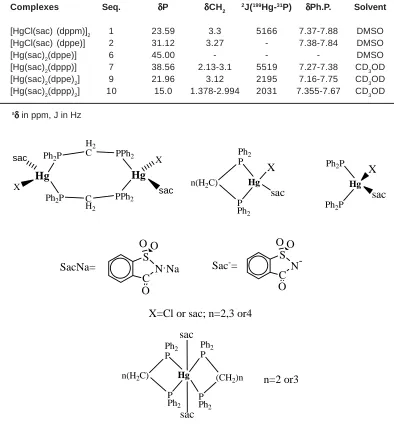
The 31P-{1H} and 1H nmr data of some of
the prepared complexes are given in Table 3. The
31P-{1H} nmr spectrum of [HgCl(Sac)(dppm)]
2(1)
showed a singlet at dP=23.59ppm with 2J(199
Hg-31P)=5166Hz. The positive dP value indicates that
Table 1: Color, Yield, Elemental analyses and conductivity of complexes (1) - (12)
(Ohm-1.cm2
Seq Complexes Color Yield Found(cal.)% .mol-1) Λ Λ Λ Λ Λ
% N H C CHCl3 CH3OH CH2Cl2 DMSO
1 [HgCl(sac)(dppm)]2 White 67 2.4 3.7 43.0 - - - 5.9
(2.1) (3.9) (42.7)
2 [HgCl(sac)(dppe)] White 60 1.4 5.6 53.8 - - 2.8
-(1.5) (5.7) (53.6)
3 [HgCl(sac)(dppp)] White 80 2.8 3.4 48.0 - - 3.1
-(2.9) (3.4) (48.1)
4 [HgCl(sac)(dppb)] White 95 3.2 4.5 48.2 - - 1.9
-(3.1) (4.5) (48.5)
5 [Hg(sac)2(dppm)] White 95 1.6 4.6 51.1 - - - 2.3
(1.6) (4.4) (50.8)
6 [Hg(sac)2(dppe)] White 66 1.7 4.4 51.0 - - - 4.3
(1.6) (4.3) (50.9)
7 [Hg(sac)2(dppp)] White 69 2.6 5.3 54.9 - 0.9 -
-(2.5) (5.3) (54.6)
8 [Hg(sac)2 (dppb)] White 76 2.9 4.6 53.4 2.1 -
-(2.6) (4.6) (53.1)
9 [Hg(sac)2(dppe)2] White 89 2.0 4.8 57.0 - 1.4 -
-(2.2) (4.8) (57.1)
10 [Hg(sac)2(dppp)2] White 89 2.2 5.0 60.2 - 2.4 -
-(1.9) (4.8) (60.1)
11 [Hg(sac)Cl(PPh3)2] White 95 3.0 4.6 52.7 3.2 - -
-(2.7) (4.4) (52.6)
12 [Hg(sac)2 (PPh3)2] White 89 2.3 4.5 58.1 - 2.1 -
-(2.3) (4.7) (58.2)
has been supported by the 1H – {31P} nmr spectrum
which showed a singlet at dH=3.3ppm assigned
for the methylene protons of the bridging dppm25.
The large 2J(199Hg-31P) which is 5166Hz indicated
a tetrahedral geometry around mercury26-29. The 31
P-{1H} nmr spectra of the other tetrahedral complexes
(2), (6) and (7) each showed a singlet at dP=31.12, 45.00 and 38.56ppm respectively. Complex(7)
showed 2J(199Hg-31P)=5519Hz which suggest four
coordinate tetrahedral arrangement around
mercur y. The 31P-{1H} nmr spectra for
[Hg(sac)2(dppe)2](9) and [Hg(sac)2(dppp)2](10)
showed a singlet each at dP=21.96 and 15ppm
respectively. The 2J(199Hg-31P) values for these two
complexes were low 2195 and 2031Hz
respectively which suggest a six coordinate
environment around mercury26-28 .
On the basis of the above nmr data and other identification data given in Tables 1 and 2, the structures shown in Fig. 1 have been suggested
Infrared Spectra
Selected infrared spectroscopic data of the prepared complexes (1)–(12) are listed in Table 2. All complexes display a sharp strong bands
between (1620-1697cm-1) attributed to the u(C=O)
of the saccharin ligand coordinated as
monodentate though the nitrogen atom29,30. Two
T
a
b
le 2 :
I.R.
spectra
a data cm -1 of the ligands and comple
x
es (1) – (12)
Seq. Complexes υ υ υ υ υ (C-H) υυυυυ υυυυυ υυυυυ (CNS) (SO 2 ) υυυυυ (P-Hg) υυυυυ (P-C) Alp. A r. (CO) (CC) (CN) υυυυυas υυυυυs υυυυυas υυυυυs [Nasac] 3099 w 1643 vs 1585 m 1450 m 966 s 1336 m 1275 s 1145 v 3072 w 1257 v 1126 s [HgCl(sac)] 3078 w 1697 vs 1583 m 1456 m 968 s 1338 m 1286 vs 1153 vs 1635 vs 1251 vs [[Hg(sac) 2 ] 1645 m 1577 m 1413 m 960 s 1342 s 1257 s 1153 m 1 [HgCl(sac)(dppm)] 2 2924 w 3051 w 1620 s 1575 m 1430 s 945 m 1330 m 1253s 1147 vs 335 vs 513 m 2864 w 2 [HgCl(sac)(dppe)] 2906 w 3057 w 1634 s 1581 m 1433 m 947 s 1340 m 1294 vs 1155 vs 350 vs 515 m 1247 m 3 [HgCl(sac)(dppp)] 2935 w 3055 w 1641 s 1570 m 1430 s 951 s 1340 w 1286 s 1149 vs 335 vs 519 m 1250 s 4 [HgCl(sac)(dppb)] 2935 w 3055 w 1686 s 1575 m 1438 m 957 s 1330 w 1290v s 1151v s 330 vs 519 m 1645 s 1246 s 5 [Hg(sac) 2 (dppm)] 2926 w 3059 w 1645 vs 1568 s 1444 m 950 s 1334 m 1290v s 1151 vs 335 vs 532 m 2866 w 1240 s 6 [Hg(sac) 2 (dppe)] 2964 w 3059 w 1662 vs 1581 m 1442 m 954 vs 1330 m 1290 vs 1159 vs 338 vs 522 m 2916 w 1564 m 1244 s 7 [Hg(sac) 2 (dppp)] 2914 w 3059 w 1643 s 1568 s 1442 m 951 s 1330 m 1288 s 1149 vs 335 vs 524 m 1247 s 8 [Hg(sac) 2 (dppb)] 2926 w 3059 w 1645 s 1572 s 1425 m 953 s 1336 m 1288 s 1151 vs 335 vs 532 m 2868 w 1257 s 9 [Hg(sac) 2 (dppe) 2 ] 2962 w 3057 w 1639 s 1577 m 1431 m 951 vs 1325 m 1286 vs 1147 vs 338 vs 522 m 2906 w 1247 s 1 0 [Hg(sac) 2 (dppp) 2 ] 2922 w 3057 w 1635 vs 1577 s 1433 m 949 s 1330 m 1278 s 1147 vs 335 vs 524 m 1253 s 1 1 [Hg(sac)Cl(PPh 3 )2 ] -3056 W 1661 s 1585 w 1433 s 951 s 1330 w 1292 vs 1153v s 332 vs 511 s 1240 s 1 2 [Hg(sac) 2 (PPh 3 )2 ] 3056 W 1649 m 1570 m 1431 m 953 s 1330 w 1290 s 1151 vs 352 vs 513 s 1252 s
Table 3: The 1H and 31P-{1H} n.m.r. dataa of the prepared complexes.
Complexes Seq. δδδδδP δδδδδCH2 2J(199Hg-31P) δδδδδPh.P. Solvent
[HgCl(sac) (dppm)]2 1 23.59 3.3 5166 7.37-7.88 DMSO
[HgCl(sac) (dppe)] 2 31.12 3.27 - 7.38-7.84 DMSO
[Hg(sac)2(dppe)] 6 45.00 - - - DMSO
[Hg(sac)2(dppp)] 7 38.56 2.13-3.1 5519 7.27-7.38 CD3OD
[Hg(sac)2(dppe)2] 9 21.96 3.12 2195 7.16-7.75 CD3OD
[Hg(sac)2(dppp)2] 10 15.0 1.378-2.994 2031 7.355-7.67 CD3OD
aδδδδδ in ppm, J in Hz
Fig 1. Suggested structures for the prepared mercury(II) complexes Infrared spectra
Hg
Hg
PPh2
PPh2
Ph2P
Ph2P
H2
C
C H2 sac
sac
X
X
Hg
P Ph2
Ph2
P
n(H2C)
X=Cl or sac; n=2,3 or4
X
sac
HgPh2P
Ph2P
X
sac
Hg
Ph2
P
P Ph2
(CH2)n
P Ph2
Ph2
P
n(H2C)
sac
sac
n=2 or3
SacNa=
S
C
N Na
O O
O
Sac
-=
S
C
N
-O -O
O
1153cm-1) are characteristic for the u
as SO2 and us
SO2 modes of sac, respectively. Whereas the bands
at ca. (1325-1342) and (949-968cm-1) are assigned
to the symmetric and asymmetric stretching of the CNS moiety in the sac ion. Additional bands
between 332-352cm-1 assigned to (P-C).The (C-H)
aliphatic appeared at ca. 2906-2935cm-1 while the
(C-H) aromatic appeared at ca. 3051-3059cm-1.
CONCLUSION
In summery reaction of the linear mercury(II) complex [HgCl(sac)] with mono or diphosphine resulted in the formation of tetrahedral complexes of the type [HgCl(sac)(diphos)].
Reaction of [Hg(sac)2] with one mole equivalent of
[Hg(sac)2(diphos)] while reaction with two mole equivalent gave octahedral complexes of the type
[Hg(sac)2(diphos)2].
ACKNOWLEDGMENTS
We would like to thank the nmr department Institute for Anorganische Chemic, Martin- luther-University, Halle, Germany for measuring the nmr spectra.
1. N. Suzuki and H. Suzuki; Cancer Res., 55,
4253 (1995).
2. J. Zurlo and R.A. Squire; J.Natl-Cancer Inst.,
90, 2 (1998).
3. M. R. Weihrauch, V. Diehl and H.Bohlen;
Mediz. Klin., 96, 670 (2001).
4. Chem. Brit., 37, 18 (2001).
5. E.G. Baran and V.T. Yilmaz; Coord.Chem. Rev.,
250, 1980 (2006).
6. S.Z. Haider, K.M.A. Malik, S. Das, M.B.
Hursthouse; Acta Crystallogr., C40 1147
(1984).
7. B. Kamenar, G. Jovanovski, D. Grdenic; Cryst.
Struct. Commun., 11, 263 (1982).
8. A. Hergold-Brundic, B. Kamenar, and G.
Jovanovski; Acta Crystallogr., C45: 556
(1989).
9. O. Grupce, G. Jovanovski, B. Kaitner and P.
Naumov; Croat. Chem. Acta.,72: 465 (1999).
10. Y. Topcu, O. Andac, V.T. Yilmaz and W.T.A.
Harrison; Cryst. Res. Technol., 37: 509 (2002).
11. V.T. Yilmaz, S. Hamamci, and C. Thoene; Cryst.
Res. Technol., 37: 1143 (2002).
12. V.T. Yilmaz, S. Caglar, and W.T.A. Harrison; Z.
Anorg. Allg. Chem., 630: 1512 (2004).
13. Z. S. Seddigi, A. Banu and G. M. G. Hossain,
The Arabian J. for Science and Engineering,. 32: 181 (2007).
14. R.M.K. Deng, K.B. Dillon, A.E. Goeta, M.
Mapolelo and H.J. Shepherd; Inorg. Chim. Acta., 362: 5109 (2009).
15. W. Henderson, B. K. Nicholson, and L. J.
McCaffrey., Inorg. Chim. Acta., 285: 145
(1999).
16. L. R. Falvello, J. Gomes,I. Pascual, M. Tomas,
E. P. Urriolabeitia and A. G. Schultz; Inorg.
REFERENCES
Chem., 40: 4455 (2001).
17. W. Henderson, B. K. Nicholson, and D.C.
Chung; Acta Crystallographica, Section E. Structure reported Online., E58, m432 (2002).
18. A.S.M. AL-Janabi, B.H. Abdullah and S.A.
Al-Jibori; Orient. J. Chem., 25(2): 277 (2009).
19. G. Jovanovski, B. Kamenar, G. Ferguson, and
B. Kaitner., Acta Crystallogr., C44: 616 (1988).
20. B. Kamenar, G. Jovanovski and D. Grdenic;
Cryst. Struct Commun., 11: 263 (1982).
21. W.J. Geary; Corrd. Chem. Rev., 7: 81 (1971).
22. C.T. Hunt and A.L. Balch; Inorg. Chem., 20:
2267 (1981).
23. L. J. Hayaly, B. H. Abdullah, A.A.N.
Al-Dulaimi and S.A. Al-Jibori; Orient. J. Chem., 24(2): 38 (2008).
24. S. A. Al-Jibori, A. S. S. Al-Zaubi, M. Y.
Mahammed and T. A. K. Al-Allaf ; Trans. Met. Chem., 32: 398 (2007).
25. E.C. Aleya, S.A. Dias, R.G. Goel, W.O. Ogini,
P. Pilom and D.W. Meek; Inorg. Chem., 17: 1697 (1978).
26. P.G. Pringle, D. Phill Thesis, Leeds University,
U.K. (1983).
27. P.G. Pringle and B.L. Shaw; J. Chem. Soc.
Dalton Trans., 5: 861 (1983).
28. M.D. Lumsden, K. E.ichele, R.E. Wasylishen,
T.S. Cameron and J.F.Britten; J. Am. Chem. Soc., 116: 11129 (1994).
29. S.A. Iqbal, Sibi Jose and Ishaq Zaafarany,
Orient. J. Chem. 28(1), 613-618 (2012)
30. P. Naumov, and G. Jovanovski; J. Mol. Struct.,
263/264: 335 (2001).
31. P. Naumov, and G. Jovanovski; Curr. Org.