
Themed Section: Engineering and Technology
Key Exchange Based on Genetic Algorithm
Amanie Hasn AlhussainInformation Technology Department, Peoples’ Friendship University, Moscow, Russia
ABSTRACT
In this study, has shown how to design key exchange algorithm based on the features of crossover and mutation operations of genetic algorithm (GA) and asymmetric key encryption. The number of the crossover points together with number of mutation points dictate the length of the secret key and hence the strength of the algorithm. The algorithm is further strengthened by making it difficult to break by permuting the key by a random permutation factor; the randomness together with permutation makes the algorithm robust and hard to break. The proposed algorithm solves the problem of storing and distribution of the secret key over the network; the various examples and implementation of the algorithm proves that it exchanges the keys over the channel successfully
Keywords: key exchange algorithm, Genetic Algorithm, Mutation, Crossover, public key, Asymmetric Key Encryption.
I. INTRODUCTION
The growing dependence on computers to process information and transmit it across virtually connected systems has increased the need for security. Cryptography is a fundamental technique for securing information. Any cryptographic system based on the use of cryptographic keys. In the symmetric cryptosystem sender and recipient of the message using the same secret key. It should be known to all other simultaneously and periodically updated by the sender and the recipient. The process of distribution (distribution) of secret keys between participants of information exchange in symmetric cryptosystems is very complex.
Asymmetric cryptosystem involves the use of two keys - public and private (secret). The public key can disclose, and private must be kept secret. In an exchange of messages must forward only the public key. An important requirement is to ensure the authenticity of the public key forwarded.
Key distribution is the most important process in the management of keys. It must meet the requirements of the efficiency and accuracy of distribution, and the confidentiality and integrity of the distributed keys [1].
For the distribution of keys between users of computer network, there are the following basic ways: 1. the use of one or more Key Distribution Center- 2. The direct exchange of session keys between the users of the network.
In both cases, should be provided with the authenticity of the communication session. This can be achieved by using a challenge-response mechanism or timestamps.
In literature to date, many key exchange algorithms has been proposed. Diffie-Hellman was the first public-key algorithm ever invented, way back in 1976. It gets its security from the difficulty of calculating discrete logarithms in a finite field, as
compared with the ease of calculating
exponentiation in the same field. Diffie-Hellman
can be used for key distribution but it cannot be used to encrypt and decrypt messages. Diffie-Hellman also works in commutative rings. Z. Shmuley and Kevin McCurley studied a variant of the algorithm where the modulus is a composite number. V. S. Miller and Neal Koblitz extended this algorithm to elliptic curves. Taher ElGamal used the basic idea to develop an encryption and digital signature algorithm [2].
Up to Genetic algorithm, it is a search heuristics that mimics the process of natural evolution. Genetic algorithms are based on the Darwinian theory of evolution. Genetic algorithms have been invented by J. Holland in 1960s [4], and since then they have been successfully applied to the variety of problems in the field of combinatorial optimization [3]
This paper is proposed an algorithm for key distribution and management and key exchange based on genetic algorithm and asymmetric key encryption.
The rest of the paper is organized as follows:
In Section II, the proposed algorithm was
introduced; Section III discusses about
implementation example of the algorithm; Section IV experimental results; Section V concludes the paper.
II. METHODS AND MATERIAL
THE PROPOSED ALGORITHM:
Description of the Key Exchange Algorithm:
The steps of the algorithms consist of two steps: The First Step:
It is on the sender side:
1. Choose Block size N, numbers of crossover points R, numbers of mutation points M
2. Create two random numbers, the first called random factor which range from 1 to 15, while the second called permutation factor which range from 1 to 7. 3. Send these values to the other side.
The second Step:
It is on the second side (receiver):
Input: Block size N, numbers of crossover points R, numbers of mutation points M, random factor, permutation factor
1. Complete the length of the key with spaces to equal the maximum key length=16 (supposed in our algorithms could be different depend on the purpose, constrains and conditions which algorithms is served).
2. Convert each character of the key into its ASCII cod value.
3. Convert each ASCII cod value into binary (8bit) representation.
4. Divide the string of the bits which is obtained in step 3 into block with size blockSize N to form one row matrix.
5. Transform one raw matrix which is generated in step 4 into matrix with N columns.
6. Transform multicolumn matrix which is obtained from step5 into transport matrix.
7. Merge the rows in the previous matrix into one strings, divide it into two substrings (which formed parents in our algorithm).
8. Generate R random crossover points which range from 1 to length(parent)-1,and sort them.
9. Crossover the parent strings which is generated in step7 according to the R crossover points which is created in step8 to generate new strings of bits which formed the children (multiple-point crossover).
10. Generate M random mutation points which range from 1 to length(child)-1.
11. Mutate each string (child) which is created in step9 with M mutation points which is created in step10 respectively.
12. Divide each child into substrings with 8bits length.
13. Create random cross point range from 0 t0 7which would be used to cross each 8bits string.
14. Divide each 8bits string into two parts according to cross point, and convert each part into hexadecimal value to form encrypted key which is the sequence of hexadecimal values.
15. Formulate private key which consists of the
sequence of block Size, crossover
mutation pointM , cross point, permutation factor and random factor.
16. Repeat random factor L times to form randomFactorString : L =the length of the sequence obtained in the previous step.
17. Formulate practical public key = (private key) XOR randomFactorString.
18. Create permutated practical public key by permutated practical public key according to permutation factor
19. Create Public key which is the sequence of permutated practical public key followed by permutation factor and random factor.
20. Message to send is encrypted key which is created in step15, followed by public key which is generated in step20.
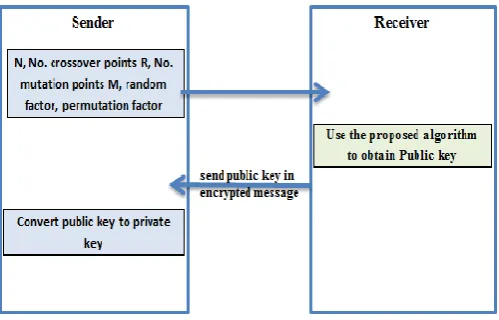
The public key would be sent directly from the sender to the receiver by inserting it at the end of the encrypted key to form the message which would be sent to the receiver (Fig.1), so the receiver would retrieve the private key from the public key by reverse the steps of obtaining the public key and based on the symmetry of the operations involved and the symmetry of XOR operations [5].
Figure 1. The schema for exchange the key
EXAMPLE OF APPLYING THE PROPOSED ALGORITHM: On the sender side:
If the sender chooses the following parameters: Block size N=4, numbers of crossover points R=2, numbers of mutation points M=4,
Random factor=14, permutation factor=2
On the receiver side:
Input: Block size N, numbers of crossover points R, numbers of mutation points M, random factor, permutation factor
Suppose input key: Agt8374HmC9
1. Complete the length of the key with spaces to equal the key length=16
2. Convert each character into its ASCII cod.
3. Convert each ASCII cod into binary (8bit).
4. Divide the string of the bits into block with size blockSize N=4.
5. Transform one raw into matrix with N columns.
6. Transform multicolumn matrix into transport matrix.
7. Merge the rows into one strings, divide it into two substrings.
8. Generate two random crossover points, and sort them.
10. Generate four random mutation points. Mutation point1:13; Mutation point2:32; Mutation point3:17; Mutation point4:16; 11. Mutate each string (child) with two mutation
points respectively.
12. Divide each child into substrings with 8bits length.
13. Create random cross point.
14. Divide each 8bits string into two parts
according to cross point, and convert each part into hexadecimal value.
15. Create two random numbers: random factor and permutation factor .Random Factor: 14; permutation Factor: 2;
16. Formulate private key.
17. Repeat random factor 8 times to form randomFactorString
randomFactorString: 14 14 14 14 14 14 14 14
18. Formulate practical public key = (the first eight parts of private key) XOR
randomFactorString.10 3D 2C 7 26 3 2 16 19. Create permutated practical public key 2C 7
26 3 2 16 10 3D 20. Create Public key 21. Message to send
Graphic user interface of this example is presented in the experimental results.
III.RESULTS AND DISCUSSION The first step is included sending the parameters from Bob to Anna
If the values of the parameters are chosen as: Block size N=4, numbers of crossover points R=2,
numbers of mutation points M=4, Random factor=14, permutation factor=2
The second step: In Anna side, when the key is entered, it would be encrypted after that the private and public key would be produced; the message to be sent is the encrypted key followed by produced public key.as shown in fig 2; the basic internal parameters that would be used is shown in fig 3; while the description of the encrypted key process is shown in fig 4.
Figure.2 public and private key and the message to be sent to the sender side (receiver side)
Figure. 4 the internal steps of the proposed system on the receiver side
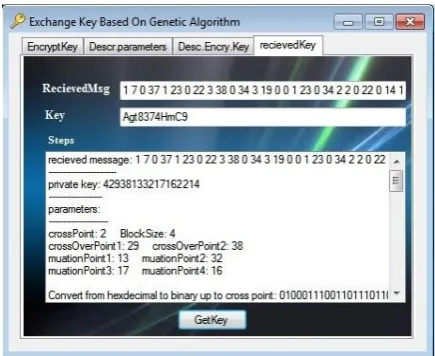
On the Bob side, Bob would receive the encrypted key as shown in fig. 5; the steps to retrieve the original key are shown in fig. 6.
Figure.5: Received encrypted key(on the sender side)
Figure 6: steps of retrieving original key
IV. CONCLUSION
In the present study a key exchange algorithm has been designed using the concept of genetic algorithms with the randomness and by the help of public key encryption. The algorithm solves the problem of key distribution and storing by using the genetic algorithm operators. The algorithm has been implemented using C#, and MATLAB is used as simulation platform. It has been tested and work successfully via network. This algorithm enhances the quality, efficiency and effectiveness of the algorithm being used for the cryptography and key exchange.
V. REFERENCES
[1] Handbook of Applied Cryptography, by A. Menezes, P. van Oorschot, and S. Vanstone, CRC Press, 1996.
[2] Applied Cryptography, Second Edition: Protocols, Algorthms, and Source Code in C by Bruce Schneier Wiley Computer Publishing, John Wiley & Sons, Inc.
[3] Poonam Garg, “Genetic Algorithm, Tabu Search & Simulated Annealing Attack on Transposition Cipher”, proceeding of third AIMS International conference on management at IIMA – 2006, 983-989
[4] Holland, J., “Adaptation in Natural and Artificial Systems”, University of Michigan Press, Ann Arbor, 1975.
![[NAME REDACTED] REVENUE COMMISSIONERS DETERMINATION](data:image/gif;base64,R0lGODlhAQABAIAAAP///wAAACH5BAEAAAAALAAAAAABAAEAAAICRAEAOw==)