Edited by
Theresa Lillis
Kathy Harrington
Mary R. Lea
Sally Mitchell
WORKING WITH
ACADEMIC LITERACIES
PERSPECTIVES ON WRITING
Series Editors, Susan H. McLeod and Rich Rice
Series Editor, Susan H. McLeod and Rich Rice
The Perspectives on Writing series addresses writing studies in a broad sense. Consis-tent with the wide ranging approaches characteristic of teaching and scholarship in writing across the curriculum, the series presents works that take divergent perspec-tives on working as a writer, teaching writing, administering writing programs, and studying writing in its various forms.
INTERNATIONAL EXCHANGES ON THE STUDY OF WRITING Series Editors, Terry Myers Zawacki, Magnus Gustafsson, and Joan Mullin
The International Exchanges on the Study of Writing Series publishes book-length manuscripts that address worldwide perspectives on writing, writers, teaching with writing, and scholarly writing practices, specifically those that draw on scholarship across national and disciplinary borders to challenge parochial understandings of all of the above. The series aims to examine writing activities in 21st-century con-texts, particularly how they are informed by globalization, national identity, social networking, and increased cross-cultural communication and awareness. As such, the series strives to investigate how both the local and the international inform writing research and the facilitation of writing development.
WORKING WITH
ACADEMIC LITERACIES:
CASE STUDIES TOWARDS
TRANSFORMATIVE PRACTICE
Edited by
Theresa Lillis, Kathy Harrington,
Mary R. Lea, and Sally Mitchell
The WAC Clearinghouse wac.colostate.edu Fort Collins, Colorado
Parlor Press, 3015 Brackenberry Drive, Anderson, South Carolina 29621
© 2015 by Theresa Lillis, Kathy Harrington, Mary R. Lea, and Sally Mitchell. This work is licensed under a Creative Commons Attribution-NonCommercial-NoDerivatives 4.0 International.
Printed in the United States of America
Library of Congress Cataloging-in-Publication Data Names: Lillis, Theresa M.,
1956-Title: Working with academic literacies : case studies towards transformative practice / edited by Theresa Lillis, Kathy Harrington, Mary R. Lea, and Sally Mitchell.
Description: Fort Collins, Colorado WAC Clearinghouse ; Anderson, South Carolina : Parlor Press, 2015 ; | Series: Perspectives on writing | Available in digital format for free download at http://wac.colostate.edu. | Includes bibliographical references and index. Identifiers: LCCN 2015042472 | ISBN 978-1-64215-067-4 (pdf) | ISBN
978-1-64215-068-1 (epub) | ISBN 9781602357617 (pbk. : alk. paper) | ISBN 9781602357624 (hardcover : alk. paper)
Subjects: LCSH: English language--Rhetoric--Study and teaching. | Academic writing.
Classification: LCC PE1404 .W65 2015 | DDC 808/.04207--dc23 LC record available at http://lccn.loc.gov/2015042472
Copyeditor: Don Donahue
Designers: Tara Reeser and Mike Palmquist
Perspectives on Wrirting Series Editors: Susan H. McLeod and Rich Rice
International Exchanges Series Editors: Terry Myers Zawacki, Magnus Gustafsson, and Joan Mullin
The WAC Clearinghouse supports teachers of writing across the disciplines. Hosted by Colorado State University, it brings together scholarly journals and book series as well as re-sources for teachers who use writing in their courses. This book is available in digital format for free download at wac.colostate.edu.
CONTENTS
Introduction . . . .3
Theresa Lillis, Kathy Harrington, Mary R. Lea and Sally Mitchell
Section 1. tranSforming PedagogieS of academic Writing and reading . 23 Introduction to Section 1 . . . .25 Chapter 1 . A Framework for Usable Pedagogy: Case Studies
Towards Accessibility, Criticality and Visibility . . . .29
Julio Gimenez and Peter Thomas
Chapter 2 . Working With Power: A Dialogue about Writing
Support Using Insights from Psychotherapy . . . .45
Lisa Clughen and Matt Connell
Chapter 3 . An Action Research Intervention Towards Overcoming
“Theory Resistance” in Photojournalism Students . . . . 55
Jennifer Good
Chapter 4 . Student-Writing Tutors: Making Sense of
“Academic Literacies” . . . .65
Joelle Adams
Chapter 5 . “Hidden Features” and “Overt Instruction” in Academic
Literacy Practices: A Case Study in Engineering . . . .75
Adriana Fischer
Chapter 6 . Making Sense of My Thesis: Master’s Level Thesis Writing
as Constellation of Joint Activities . . . .87
Kathrin Kaufhold
Chapter 7 . Thinking Creatively About Research Writing . . . .97
Cecile Badenhorst, Cecilia Moloney, Jennifer Dyer, Janna Rosales and Morgan Murray
Chapter 8 . Disciplined Voices, Disciplined Feelings:
Exploring Constraints and Choices in a Thesis Writing Circle . . . . 107
Kate Chanock, Sylvia Whitmore and Makiko Nishitani
Reflections 1 . How Can the Text Be Everything? Reflecting on
Academic Life and Literacies . . . . 117
Section 2. tranSforming the Work of teaching. . . 125 Introduction to Section 2 . . . . 127 Chapter 9 . Opening up The Curriculum: Moving from The Normative to The Transformative in Teachers’ Understandings of Disciplinary
Literacy Practices . . . . 131
Cecilia Jacobs
Chapter 10 . Writing Development, Co-Teaching and Academic
Literacies: Exploring the Connections . . . . 143
Julian Ingle and Nadya Yakovchuk
Chapter 11 . Transformative and Normative? Implications for
Academic Literacies Research in Quantitative Disciplines . . . . 155
Moragh Paxton and Vera Frith
Chapter 12 . Learning from Lecturers: What Disciplinary Practice
Can Teach Us About “Good” Student Writing . . . . 163
Maria Leedham
RefLections 2 . Thinking Critically and Negotiating Practices
in the Disciplines . . . . 175
David Russell in conversation with Sally Mitchell
Chapter 13 . Academic Writing in an ELF Environment:
Standardization, Accommodation—or Transformation? . . . . 185
Laura McCambridge
Chapter 14 . “Doing Something that’s Really Important”:
Meaningful Engagement as a Resource for Teachers’ Transformative
Work with Student Writers in the Disciplines . . . . 195
Jackie Tuck
Chapter 15 . The Transformative Potential of Laminating Trajectories: Three Teachers’ Developing Pedagogical Practices and Identities . . . . 205
Kevin Roozen, Rebecca Woodard, Sonia Kline and Paul Prior
Chapter 16 . Marking the Boundaries: Knowledge and Identity
in Professional Doctorates . . . . 217
Jane Creaton
Reflections 3 . What’s at Stake in Different Traditions?
Les Littéracies Universitaires and Academic Literacies . . . . 227
Isabelle Delcambre in conversation with Christiane Donahue
Contents
Introduction to Section 3 . . . . 239 Chapter 17 . Genre as a Pedagogical Resource at University . . . . 245
Fiona English
Chapter 18 . How Drawing Is Used to Conceptualize and Communicate Design Ideas in Graphic Design: Exploring Scamping Through a
Literacy Practice Lens . . . . 257
Lynn Coleman
Chapter 19 . “There is a Cage Inside My Head and I Cannot Let Things Out”: An Epistemology of Collaborative Journal Writing . . . . 267
Fay Stevens
Chapter 20 . Blogging to Create Multimodal Reading and Writing
Experiences in Postmodern Human Geographies . . . . 279
Claire Penketh and Tasleem Shakur
Chapter 21 . Working with Grammar as a Tool for Making Meaning . . . . 289
Gillian Lazar and Beverley Barnaby
Chapter 22 . Digital Posters—Talking Cycles for Academic Literacy . . . . 299
Diane Rushton, Cathy Malone and Andrew Middleton
Chapter 23 . Telling Stories: Investigating the Challenges to
International Students’ Writing Through Personal Narrative . . . . 307
Helen Bowstead
Chapter 24 . Digital Writing as Transformative: Instantiating
Academic Literacies in Theory and Practice . . . . 317
Colleen McKenna
Reflections 4 . Looking at Academic Literacies from a Composition
Frame: From Spatial to Spatio-temporal Framing of Difference . . . . 327
Bruce Horner in conversation with Theresa Lillis
Section 4.tranSforming inStitutional framingS of academic Writing. . 339 Introduction to Section 4 . . . . 341 Chapter 25 . Transforming Dialogic Spaces in an “Elite” Institution:
Academic Literacies, the Tutorial and High-Achieving Students . . . . 345
Corinne Boz
Chapter 26 . The Political Act of Developing Provision for Writing
in the Irish Higher Education Context . . . . 355
Chapter 27 . Building Research Capacity through an AcLits-Inspired Peda-gogical Framework . . . . 365
Lia Blaj-Ward
Chapter 28 . Academic Literacies at the Institutional Interface:
A Prickly Conversation Around Thorny Issues . . . . 375
Joan Turner
Reflections 5 . Revisiting the Question of Transformation in
Academic Literacies: The Ethnographic Imperative . . . . 383
Brian Street in conversation with Mary R. Lea and Theresa Lillis
Chapter 29 . Resisting the Normative? Negotiating Multilingual Identities in a Course for First Year Humanities Students in Catalonia, Spain . . . . 391
Angels Oliva-Girbau and Marta Milian Gubern
Chapter 30 . Academic Literacies and the Employability Curriculum:
Resisting Neoliberal Education? . . . . 401
Catalina Neculai
Chapter 31 . A Cautionary Tale about a Writing Course for Schools . . . . 413
Kelly Peake and Sally Mitchell
Reflections 6 . “With writing, you are not expected to come from your home”: Dilemmas of Belonging . . . . 421
Lucia Thesen
WORKING WITH
INTRODUCTION
Theresa Lillis, Kathy Harrington, Mary R . Lea and Sally Mitchell
WHY THIS BOOK?
The idea for this book arose from the many conversations over the years be-tween researchers and practitioners about what it means to adopt, or perhaps more accurately as reflected in the title of this book to work with an “Academic Literacies” approach to writing, and more broadly language and literacy, in contemporary higher education. Whilst not necessarily distinct people or groups, a gap in under-standings between researchers (those with a specific role in carrying out research about academic writing and reading) and practitioners (those with a specific role in working with students in their academic writing, such as teachers, curriculum de-signers, policy makers and academic administrators) often seems to be in evidence. The impetus to take forward a project that would bring together researchers, practi-tioners and researcher-practipracti-tioners to illustrate the specific ways in which they/we engage in and develop ideas from Academic Literacies came from the 2010 inter-national Writing Development in Higher Education conference, London, following a plenary workshop on “Academic Literacies” by a group of researcher-practitioners, Sally Baker, Lynn Coleman, Theresa Lillis, Lucy Rai, and Jackie Tuck (http://www. writenow.ac.uk/news-events/wdhe-conference-2010). Three questions arising from this plenary were debated and are reflected in the framing and contributions of this book:
1. What does working with Academic Literacies mean “in practice”? 2. How can the transformative approach argued for in Academic Literacies’
theorizing be instantiated in practice(s)?
regions—Australia, Brazil, Canada, Catalonia, Finland, France, Ireland, Portugal, South Africa, United Kingdom, United States. While some contributions are from within specific institutionally “writing designated” spaces (a well-known example being US Composition), many others engage with the question of writing from within disciplinary spaces. Contributions focus on issues such as: How to make language and writing visible in meaningful ways in disciplinary activity, including in areas as diverse as engineering, geography, nursing, natural sciences, graphic design, business studies and photojournalism? How can teachers across all disci-plinary areas meaningfully engage with writing? How can and do writing/language specialists work collaboratively with disciplinary specialists? How can a wider range of semiotic resources including modes, media and genres fruitfully serve academic meaning and knowledge making? What kinds of writing-specific designated spaces do we need and how can these be facilitated, for example through postgraduate writing circles and one-to-one language/writing tutorials? How can theory and practice from Academic Literacies be used to open up debate about writing and language at institutional and policy levels?
WHAT IS ACADEMIC LITERACIES?
What is the “Academic Literacies” that contributors are seeking to work with in this collection? While acknowledging that the phrase is used in a number of ways (see Theresa Lillis & Mary Scott, 2007), here we briefly set out the particular tradi-tion we are referring to and engaging with.
Introduction
& Barry Stierer, 2009), disciplinary teachers’ perspectives on their engagement with students’ writing (Tuck, 2012b), academic writing for publication (Theresa Lillis & Mary Jane Curry, 2010) and digitally mediated literacy practices inside and outside the academy (Lynn Coleman, 2012; Mary Lea & Sylvia Jones, 2011; Robin Goodfellow & Mary Lea, 2013). The approach has a particularly vigorous research base in the United Kingdom and South Africa (see for example, Awena Carter et al. (Eds.), 2009; Roz Ivanič, 1998; Cecilia Jacobs, 2010; Carys Jones et al., 1999; Mary Lea, 2005; Mary Lea & Barry Stierer (Eds.), 2000; Mary Lea & Brian Street, 1998; Theresa Lillis, 1997, 2001, 2003; Lillis & Scott (Eds.), 2007; Lucia Thesen & Linda Cooper, 2013; Lucia Thesen & Ermien van Pletzen, 2006) and has strong connections/resonances with critical arguments found in a number of pedagogical and theoretical traditions across a range of national contexts, for example, critical EAP (Sarah Benesch, 2001; Nigel Harwood & Gregory Hadley, 2004), “basic writing” (e.g., Bruce Horner & Min-Zhan Lu, 1999), didactique or
littéracies universitaires (Isabelle Delcambre & Christiane Donahue, 2011), writ-ing across the curriculum and writwrit-ing in the disciplines, WAC and WiD (e.g., Charles Bazerman et al., 2005; Donna LeCourt, 1996; David Russell, 2001) and multilingual academic writing (e.g., Suresh Canagarajah, 2002). (See Reflections 1, 3, 4, 6 this volume).
There are strong points of convergence in the ways in which researchers and teachers define or co-opt the notion “Academic Literacies” in their/our research and practice, as well as considerable points of debate and areas in need of development. A core point of convergence (and indeed the imperative driving much research and pedagogy) is a deep and consistent concern with the limitations of much official dis-course on language and literacy in a rapidly changing higher education world. This includes the prevailing deficit approach to language, literacy, and indeed students, whereby the emphasis tends overwhelmingly to be on what student writers don’t or
WHERE DOES “ACADEMIC LITERACIES” COME FROM?
The use of the phrase “Academic Literacies” to signal a critical and social prac-tice perspective on writing and reading in the academy seems to have been forged out of conversations taking place at different times and in different places by people with similar concerns. From the late 1980s onwards, the term was regularly used, for example, at monthly Academic Literacies sessions at the Institute of Education, London, chaired by Mary Scott—and the related extensive international mail and discussion list—and in ongoing discussions by scholars in South Africa, such as Lucia Thesen and Cecilia Jacobs. The principles underpinning what would come to be labelled as “Academic Literacies” were also evident in some innovative lan-guage pedagogy and policy work without the use of this label: for example, in a UK polytechnic in 1989, which subsequently became a “new” university,1 the Language Policy, written by Phyllis Creme, was designed to both recognize and value diversity and the language practices that students brought with them to the university (see Phyllis Creme & MaryLea, 1999). More widely at the time, the response of many of the new universities to both their students and their attempts to compete with other high status institutions was to develop targeted study skills provision. This frequently included “fixing” student writers with generic approaches, focused on surface features of form, grammar, punctuation, spelling etc.—what Lea and Street in their 1998 paper termed the “study skills” model. However, many practitioners working directly with student writers were increasingly finding these approaches unsatisfactory when faced with actual students completing real assignments.
Introduction
construed as teaching conventions (as if these were uncontested) that students must adopt (rather than critically engage with).
Of course the work that is central to articulating an “Academic Literacies” ori-entation—and widely cited across this book—is the 1998 paper by Lea and Street. In this paper they outlined three ways or “models” to articulate different approaches to student writing in the academy which they described in terms of “skills,” “social-ization,” and “academic literacies.” Whereas ‘“study skills” was primarily concerned with mastery of the surface features of texts, “academic socialization” pointed to the acculturation of students into the discourses and genres of particular disciplines as an essential prerequisite for becoming a successful writer. Lea and Street saw “ac-ademic literacies” as subsuming many of the features of the other two, illustrating that the three models were not mutually exclusive. Nevertheless, they claimed that the academic literacies model was best able to take account of the nature of student writing in relation to institutional practices, power relations and identities, there-fore offering a lens on meaning making that the other two models failed to provide.
An important point to signal about this 1998 article was that Lea and Street were adamant that it should speak to both practitioners and researchers—of writ-ing, language and literacy—and chose their target journal carefully. However, get-ting the article published was not without its challenges. They had to persuade the editor and reviewers that their approach “counted” as research in higher education and that the literacies as social practice frame was legitimate in a context dominated by psychological models of student learning. Its theorized and practitioner-focused orientation is still at the heart of the field that we call Academic Literacies although individual researchers and practitioners occupy different institutional positions and orientations. Some are centrally concerned with finding ways of providing imme-diate support to students, often in demanding institutional settings against a back-drop of institutional accountability; others are endeavouring to engage critically and make visible issues of power and control over knowledge and meaning making; and many are seeking to do both, as evidenced in the contributions to this volume.
whilst the phrase ‘academic literacy’ and even the plural form were in use in some contexts,2 the publication of the work by Lea and Street fulfilled three important scholarly functions in configuring the field:
1. It helped generate an intellectual space for the many scholars who were dissatisfied with dominant pedagogical and institutional approaches to student writing.
2. By indexing “New Literacy Studies” and Street’s robust critique of “autonomous” approaches to literacy, it opened up routes of intellectual inquiry that differed from the strongly “textualist” (Bruce Horner, 1999) and normative approaches available with which many scholars were also dissatisfied (across a number of traditions, such as English for Academic Purposes and Systemic Functional Linguistics).
3. It helped create a theoretically and empirically robust position from which to challenge the prevailing ideology of deficit which centered on what students could not do (rather than what they could) and also shifted attention towards disciplinary and institutional practices.3
WHAT DOES “TRANSFORMATION” MEAN IN ACADEMIC
LITERACIES?
At the heart of an Academic Literacies approach is a concern with “transforma-tion” and the “transformative.” But what does this mean? How is “transforma“transforma-tion” to be understood, and what does it look like when using an Academic Literacies lens to investigate and design writing practices in the academy? In this section, the book’s editors each offer a perspective on these questions—but without a desire to close them down. We recognize that individual practitioner-researchers will de-fine and work with the notion of transformation somewhat differently depending on their/our particular institutional and/or disciplinary positions and the specific questions they/we ask. An examination and elucidation of this contextual diversity is, indeed, one of the main aims of this volume.
t
hereSal
illiS: t
oWardSt
ranSformatived
eSignIntroduction
semiotic practices are valued, simply because they have become routinised rather than because they offer meaningful, valid and creative resources for knowledge production, evaluation and participation in the contemporary world. The chal-lenge, I think we all face, is to become aware of the vast array of semiotic resources potentially available to us and others (however we construe “us” and “others”—and in positions of both producers and receivers/evaluators) and to explore how these can be harnessed for meaning and knowledge making.
As part of this broader concern with conventions, why is transformation an im-portant notion to discuss? In an opening paper of a Special Issue on Academic Lit-eracies in the Journal of Applied Linguistics Mary Scott and I set out what we saw as a map of the field of “Academic Literacies” in its current state as well as offering a position statement on what the field could be, some ten years after Lea and Street’s influential 1998 paper. In addition to pointing to the key epistemological framing of “Ac Lits”—notably a social practice approach to language and literacy with a particular emphasis on ethnography as a research methodology—we also pointed to the ideological orientation of Ac Lits as being one of transformation. In broad terms, we made a contrast between two common stances (in research and pedagogy): those which could be characterized as “normative” and those that could be characterized as “transformative”. Normative stances and approaches to writing and literacy tend to work within a framework which raises questions about writing and literacy in the following terms: What is the nature of the writing and literacy required—at the level of genre, grammar, style, rhetoric? How can these most usefully be researched (made visible) and taught? A normative stance is often considered essential when seeking to induct people into the literacy practices that have become legitimized in academia to the extent that in order for people to participate in existing academic practices, these practices have to be taught and literally “practised”. However, we argued that Ac Lits has also encouraged a transformative stance towards writing and literacy which foregrounds additional questions such as: how have particular conventions become legitimized—and what might alternatives be? To what extent do they serve knowledge making—and are other ways of making knowledge, and other kinds of knowledge/knowing possible? Whose epistemological and ideological interests and desires do these reflect and enable—and whose interests and desires may be being excluded?
As transformation/transformative is a key theme in this book, I’d like to quote what Mary Scott and I wrote here:
describes: the homogeneity of the student population, the stability of disciplines, and the unidirectionality of the teach-er-student relation. Consonant with these myths is an interest to “identify and induct”: the emphasis is on identifying academ-ic conventions—at one or more levels of grammar, discourse or rhetorical structure or genre—and on (or with a view to) exploring how students might be taught to become proficient or “expert” and developing materials on that basis (for examples, see Flowerdew, 2000; Swales & Feak, 2004). A transformative approach in contrast involves an interest in such questions but in addition is concerned with: a) locating such conven-tions in relation to specific and contested tradiconven-tions of knowl-edge making; b) eliciting the perspectives of writers (whether students or professionals) on the ways in which such conven-tions impinge on their meaning making; c) exploring alternative ways of meaning making in academia, not least by considering the resources that (student) writers bring to the academy as legitimate tools for meaning making. (Lillis & Scott 2007, p. 12-13, emphasis added)
A key point we were seeking to make was that the normative stance is the de-fault position in much practice in academia (pedagogy and policy) and a necessary stance in order to participate (and enable participation) successfully in academic institutions as currently configured. However we also argued that there was a con-siderable amount of additional work to be done—thinking, research, engagement and reflection on practice—in order to harness the full range of semiotic practices to intellectual labour.
One conceptual way forward is to acknowledge the importance of critique which is strong in Academic Literacies research (for example the critique of the domi-nant deficit discourse on writing, the critique of an autonomous approach—Street (1984)—to language and literacy, the concern with issues of power and identity in academic writing) but at the same time to work with the notion of design. Gun-ther Kress usefully offers “design” as an epistemological and ideological move which builds on critique but moves beyond it:
Design rests on a chain of processes of which critique is one: it can, however, no longer be the focal one, or be the major goal of textual practices. Critique leaves the initial definition of the domain of analysis to the past, to past production. (Kress, 2000, p. 160)
Introduction
order to signal the critical basis for Kress’s notion—has been explored by colleagues and myself, Lillis (2003, 2006) and Lea (2004) in specific relation to the relevance and use of Academic Literacies to practice in higher education but we have both pointed to the need for considerably more work to be done. For this book, the four editors came together to begin to engage in this design work, each of us committed to the importance of interrogating possibilities for transformation and interested in exploring the potential of “Ac Lits” in designing pedagogy and policy and all aware that working towards transformative design in higher education is a large and challenging project, possible only through extensive collaboration. We see this collection as reflecting examples of transformative design and as therefore a part of this larger collaborative project.
k
athyh
arrington: B
orderc
roSSingMy interest in transformation, how I think about and understand what this might mean in the context of Academic Literacies, stems from the position I oc-cupy as a relative newcomer to the field, coming in from the outside and bringing with me questions and perspectives from other domains of knowledge, experience and work. In her book on encounters between science and other disciplinary fields in nineteenth century Britain, Gillian Beer (1996) suggests that “ideas cannot sur-vive long lodged within a single domain. They need the traffic of the apparent-ly inappropriate audience as well as the tight group of co-workers if they are to thrive and generate further thinking” (p. 1). I have been intrigued and stimulated by Beer’s ideas since coming across her work while writing my PhD in Victorian Studies in the late 1990s. What happens, I have been wondering more recently, when ideas harvested in other domains are trafficked into the field of Academic Literacies? What transformation might become possible in my own thinking and practice, particularly in my role as a teacher on academic and professional develop-ment programmes for other teachers in the academy?
So, what does this mean in practice? What “further thinking” do these perspec-tives and questions generate in the context of Academic Literacies? In her appli-cation of open systems theory to the study of organizations, Vega Zagier Roberts notes that “a living organism can survive only by exchanging materials with its environment, that is, by being an open system” (1994, p. 28). In keeping something alive, boundaries are important. They can provide a helpful frame and hold a space within which something can live and flourish, such as a research or teaching com-munity, ideas and people. But if drawn too tightly, boundaries can isolate and close down dialogue and growth. Boundary setting happens both from within and out-side a field, and there are gains to be had by questioning which interests are being served by these processes. Where are the lines around Academic Literacies being drawn, by whom, and why? The rich and various contributions in this volume at-test, I think, to the inspiring fecundity of thought and practice that comes of ques-tioning and constantly re-thinking where the edges of the field might lie, and how permeable, and to which outside influences, they might most vitally remain open. There is another sense in which working with a notion of boundaries informs my sense of the transformative potential of Academic Literacies. Boundaries can delineate an intellectual and professional field, but also an internal space, where
one’s own norms and assumptions—about the nature of writing and learning, about oneself as a teacher/authority and about the other/student—and one’s own experi-ences of difference, inequality and power situated in specific contexts and relation-ships, can be brought to the surface and worked with. In my understanding, this questioning, self-reflective attitude and challenging work of seeing and confronting one’s own assumptions is integral to the practice of teaching as informed by an Academic Literacies approach—and it is itself transformative, and empowering, for both teachers and students.
Introduction
“normative, ” as has sometimes been implied, it is through this critical process of nurturing transformation in self-understandings, uncertainties and identifications as teachers in higher education that I believe the normative has the potential to enable the transformative.
Returning to the notion of an open system, my sense of the transformative po-tential of Academic Literacies lies in being able to delineate living, creative yet protected spaces—within the curriculum and in institutional structures, in the in-teractions and relationships between and among students and teachers, in academ-ic professional development programmes where discussions about assessment and literacy inevitably bring deficit and autonomous models of student writing to the surface, and, perhaps most importantly, in ourselves—where diverse and often con-flicting beliefs, values and knowledges about writing in the academy can be made available for further thinking and ongoing transformation.
m
aryr. l
ea: h
euriStict
hinking, i
nStitutionSand
t
ranSformationalP
oSSiBilitieSMy interest has always been around the contested nature of textual practice. The ethnographic perspective—which permeates our Introduction and many con-tributions in this book—has been crucial here. It has helped me to develop my earlier work, which was concerned with making visible the detail of encounters between students and teachers around meaning making, towards the consideration of broader institutional perspectives.
associated with “teaching academic literacies”. As a heuristic—one that is in prog-ress as illustrated in this book—Academic Literacies has illuminated and helped me to understand more about the contested space of knowledge making and to build on this in practical ways in a range of practice settings in higher education. In con-trast, I see the normative approach as more orientated towards inducting students into academic and disciplinary writing conventions, what Brian Street and I have referred to as “academic socialization”. Although in some ways these may appear to be rather crude distinctions, I have found them invaluable when it comes to ex-amining institutional practice within the changing landscape of higher education. Indeed, they emerged for us from our own research.
The development of academic literacies as a field of study in the early 1990s re-flected a very different landscape from that which is in evidence today. The last de-cade has seen a combination of both structural and technological change, reflected in emergent textual practices around teaching and learning. Potentially these signal a breaking down of old boundaries and opening up of new spaces for meaning making in higher education. In this regard, my own curiosity about writing and academic professional practice (Lea, 2012; Lea & Stierer, 2009) was sparked by my teaching role in academic and professional development with Open University teachers. This signaled to me how different experiences of writing, values about writing in relation to academic identity and the models of writing associated with specific professional fields all suggest a contested space for teachers’ own writing and their students’ writing (see Lea, 2012; Tuck, 2013).
When Brian and I undertook the research for our 1998 paper, the use of dig-ital technologies was still in its infancy. As these have gained centre stage, practi-tioners and researchers—including myself—committed to an academic literacies orientation in their work have begun to explore the relationship between litera-cies and technologies (Robin Goodfellow & Lea, 2007; Bronwyn Williams 2009; Goodfellow & Lea, 2013; Lea & Jones, 2011; Colleen McKenna, 2012; Bronwyn Williams, 2009). Williams (2013) discusses how certain virtual learning environ-ments reinforce conservative views of knowledge-making practices, for example where the software and design of the online teaching environment privileges print and makes it difficult for students to engage in multi-modal text making. Colleen McKenna and Jane Hughes (2013) take a literacies lens to explore what technol-ogies do to writing practices, in particular the ubiquitous, institutional use of plagiarism detection software and how this is reframing the concept of plagiarism for students and their teachers, taking them away from useful discussions, in dis-ciplinary learning contexts, around attribution and knowledge-making practices.
il-Introduction
lustrating the complex interrelationship between literacies and technologies with the potential to disrupt traditional academic literacy practices. We argued that in order to understand the changes that are taking place for learners in today’s higher education more attention needs to be paid to textual practice around learning and less upon the technologies themselves and their applications. While on the one hand students accessed online resources and engaged in a wide range of digital and print-based textual practices, on the other we found that assignment rubrics did not generally reflect or engage with the rhetorical complexity of these practices. This meant that the opportunity for teachers to work explicitly with the processes of meaning making with their students was being missed. These examples signal to me the intransigent dominance of normative perspectives towards learning and literacies in a changing landscape and, therefore, the pressing need to think about transformation institutionally if we are going to work across the myriad nature of textual practices emerging in today’s higher education.
S
allym
itchell: o
Pen-
endedt
ranSformation:
e
thnograPhicl
enSandaS
uSPiciouSt
endencyIn my experience transformation is not to be understood as a finished state, something that is fully achieved, rather it is an inclination towards envisaging alter-native understandings of, and actions within any particular context. In this sense transformation is set against the normative and the status quo. And there are many things within educational settings which can become the object of transformative thinking. Clifford Geertz lists some of them when he calls for an “ethnography of thought, ” a consideration of thought’s “muscular matters”:
… translation, how meaning gets moved, or does not, reasonably intact from one sort of discourse to the next; about intersubjec-tivity, how separate individuals come to conceive, or do not, rea-sonably similar things; about how thought frames change (revolu-tions and all that), how thought provinces are demarcated (“today we have naming of fields”), how thought norms are maintained, thought models acquired, thought labor divided. (p. 154)
If an ethnography is a description and an interrogation of “what is” in a particu-lar setting, to this I would add a suspicious orientation towards findings, and, after that, a tendency to pose the next question—the transformative question—“what if”?
Suspicion is a term I borrow from Paul Ricoeur who in Freud and Philosophy
For me similar powerful ideas are the notion of taking a “paradigmatic” approach to “knowledge” (Aram Eisenschitz, 2000), and of acknowledging the crucial role of “warrants” and “backing’ (Stephen Toulmin, 1958) in establishing, and hence critiquing, any position (Sally Mitchell & Mike Riddle, 2000). These ways of un-packing knowledge claims help to make sense both of what I observe in practice and of how I might want to respond.
Looking at a fraction of data from my study of “argument” in educational set-tings in the 1990s (Mitchell, 1994; Richard Andrews, 1995) may help to anchor what I mean. Picture an upper secondary school sociology class where students are gathered in small groups around tables to discuss Ivan Illich’s (1976/1990) theory of “Iatrogenesis. ” In one group, two students dominate: Andrew—questioning the value of hospital treatment and pointing out that treatment ultimately doesn’t stop people from dying and is also costly; Susan—strongly resisting this view.
Susan: Rubbish. No sorry Andrew, I don’t agree. Andrew: Why?
Susan: Because I wouldn’t want to die and I don’t think you would and if it comes to the choice where you’d got a chance of living, you would have it. You would have it!
In this scene “argument”—the object of my study—emerges as a conflict be-tween what Susan knows and feels to be the case in her everyday experience and Andrew’s espousal of the new, counter-commonsensical idea. She’s annoyed, it seems, by his detaching himself (what he would do if he were ill and needed treat-ment) from the discussion. And indeed Andrew is getting more abstract in his thinking, becoming more “sociological. ” Towards the end of the discussion he seems to grasp—to arrive at for himself—the “bigger picture” argument being put forward by Illich. Referring to the Health Service, he says:
Andrew: So it’s an excuse for, like, the government not interven-ing in causes of ill health, isn’t it?
Andrew’s aha! moment isn’t the end of the story however: I observed how much of the argument that had emerged collaboratively and antagonistically through the peer to peer discussion dropped out of the writing the students subsequently did (see Mitchell, 1995). What accounted for this disappearance? Was it control over the medium, the medium itself, the fact that the writing would be read and assessed by the teacher as part of working towards a public exam, a resultant reluctance to take risks?
Introduction
about what I observed, to conceive of “argument” simply as a text or simply as talk. It was also absolutely necessary to think about beliefs, identities, permissions, what was tacit or silenced as well as what was shared—by whom and for what purposes.
Then comes the shift to new kinds of question. What other kinds of trans-formation besides those achieved through the class dialogue, would Andrew and Susan have had to make to express their insights powerfully in their written texts— and to have them recognized against official assessment criteria? What might have been done differently and by whom? What might make a difference? To what and to whom? What kind ofa difference? And why? Seeking to address these questions suggests that there would be no such thing as straightforwardly “better argument. ” This is absolutely not to say that change shouldn’t be tried—and my study gave rise to numerous suggestions, including ways of bridging the gaps between generative and formal writing, meta-discussion of what counts as knowledge and so on.
To return to where I started, however. The combination of an ethnographic lens with a suspicious tendency, means that any transformative goal is never finalized; being socially, politically, ideologically constructed, what counts as “good” or “bet-ter” is always rightly the object of further scrutiny. Many of the contributions to this book suggest a willingness to engage in such scrutiny.
THE CONTENTS OF THE BOOK
The goal of this book is to offer examples from a range of institutional contexts of the ways in which teacher-researchers are working with Academic Literacies, engag-ing directly with the three questions set out in the first section of this Introduction. The contributions are 31 “case studies, ” a term we use here to refer to the detailed discussion and/or illustration of specific instances of “transformative design” which are often also anchored to specific theoretical concerns. Contributors have worked hard to offer concise snapshots of their practice and key challenges in order to:
• illustrate how they have sought to “work with” Academic Literacies • offer their perspectives on what constitutes transformative design in
current practice
• provide resources for teacher-researchers working in a range of contexts which are practical in nature whilst being theoretically robust.
We have also included six contributions that we have called Reflections. These are comments and dialogue from scholars from different traditions and geoloca-tions and reflect some of the “troublesome” areas we are all seeking to grapple with, both theoretically and practically. These are interspersed across the book.
teach-ing: Section 3—Transforming resources, genres and semiotic practices: Section 4—Transforming institutional framings of academic writing. Whilst we provide an introduction at the beginning of each section, we do of course recognize that there is considerable overlap in themes, questions and issues across the contributions and we strongly encourage readers to move back and forth across the book to follow threadsof particular interest.
NOTES
1.“New” universities were created in 1992 in the United Kingdom, with the abolition of the binary divide between polytechnics and universities. Initially, they took students from the local community and had close links with colleges providing “Access to High-er Education” courses. Many of their students wHigh-ere the first in their family to attend university.
2. Tracking the use of terms is not straightforward. This is discussed in Lillis and Scott 2007.
3. These three points are discussed in more detail in Lillis 2013.
REFERENCES
Andrews, R. (1995). Teaching and learning argument. London: Cassell.
Barton, D., & Hamilton, M. (1998). Local literacies: Reading and writing in one community. London: Routledge.
Barton, D., & Papen, U. (Eds.). (2010). The anthropology of writing. Understanding textually-mediated worlds. London: Continuum International Publishing Group. Bazerman, C., Joseph, L., Bethel, L., Chavkin, T., Fouquette, D., & Garufis, J.
(2005). Reference guide to writing across the curriculum. West Lafayette, IN: Par-lor Press/The WAC Clearinghouse. Retrieved from http://wac.colostate.edu/ books/bazerman_wac/
Beer, G. (1996). Open fields: Science in cultural encounter. Oxford, UK: Oxford University Press.
Benesch, S. (2001). Critical English for academic purposes. Mahwah, NJ: Erlbaum. Brew, A. (2006). Research and teaching: Beyond the divide. Basingstoke, UK: Palgrave
Macmillan Publishing.
Canagarajah, A. S. (2002). Critical academic writing and multilingual students. Ann Arbor, MI: University of Michigan Press.
Carter, A., Lillis T., & Parkin, S. (Eds.). (2009). Why writing matters: Issues of access identity and pedagogy. Amsterdam: John Benjamins Publishing Company. Chang, H. (2005). Turning an undergraduate class into a professional research
Introduction
Clark, R., & Ivanic, R. (1991). Consciousness-raising about the writing process. In C. James & P. Garrett (Eds.), Language awareness in the classroom (pp. 168-185). London: Longman.
Coleman, L. (2012). Incorporating the notion of recontextualisation in academic literacies research: The case of a South African vocational web design and devel-opment course. Higher Education Research and Development, 31(3), 325-338. Creme, P., & Lea, M. R. (1999). Student writing: Challenging the myths. In P.
Thompson (Ed.), Academic writing development in higher education: Perspectives, explorations and approaches (pp. 1-13). Reading, Berkshire: Centre for Applied Language Studies, University of Reading.
Delcambre, I., & Donahue, C. (2011). University literacies: French students at a disciplinary “threshold”? Journal of Academic Writing, 1(1), 13-28. Retrieved from http://e-learning.coventry.ac.uk/ojs/index.php/joaw/article/view/6/47 Eisenschitz, A. (2000). Innocent concepts? A paradigmatic approach to argument.
In S. Mitchell & R. Andrews (Eds.), Learning to argue in Higher Education (pp. 15-25). Portsmouth, NH: Boynton/Cook.
Fairclough, N. (1992). Discourse and social change. Cambridge, UK: Polity Press. Flowerdew, J. (2000). Discourse community, legitimate peripheral participation,
and the nonnative-English-speaking scholar. TESOL Quarterly, 34(1), 127-150. Gee, J. (2007). Sociolinguistics and literacies (3rd ed.). London: Taylor & Francis. Geertz, C. (1993). Local knowledge. London: Fontana Press.
Goodfellow, R., & Lea, M. R. (2007). Challenging e-learning in the university: A lit-eracies perspective. Maidenhead, Berkshire, UK: Society for Research into Higher Education/Open UniversityPress/McGraw Hill.
Goodfellow, R., & Lea, M. R. (Eds.). (2013). Literacy in the digital university: Critical perspectives on learning, scholarship and technology. London/ New York: Routledge. Hamilton, M. (2000). Expanding the new literacy studies: Using photographs
to explore literacy as social practice. In D. Barton, M. Hamilton, & R. Ivanič (Eds.), Situatedliteracies (pp. 16-34). London: Routledge.
Harwood, N., & Hadley, G. (2004). Demystifying institutional practices: Critical pragmatism and the teaching of academic writing. English for Specific Purposes, 23, 355-377.
Horner, B. (1999). The birth of basic writing. In B. Horner & M.-Z. Lu (Eds.),
Representing the other: Basic writers and the teaching of basic writing (pp. 3-29). Urbana, IL: NCTE.
Horner, B., & Lu, M. (Eds.). (1999). Representing the “other” basic writers and the teaching of basic writing. Urbana, IL: NCTE.
Illich, I. (1976/1990). Limits to medicine, medical nemesis: The expropriation of health. London: Penguin.
Jacobs, C. (2010). Collaboration as pedagogy: Consequences and implications for partnerships between communication and disciplinary specialists. Southern Af-rican Linguistics and Applied Language Studies, 28(3), 227-237.
Jones, C., Turner, J., & Street, B. (Eds.). (1999). Students writing in the university: Cul-tural and epistemologicalissues. Amsterdam: John Benjamins Publishing Company. Kress, G. (2000). Multimodality. In B. Cope & M. Kalantzis (Eds.), Multiliteracies:
Literacy, learning and the design of social futures. London: Routledge.
Kress, G. (2007). Thinking about meaning and learning in a world of instability and multiplicity. Pedagogies. An International Journal, 1, 19-34.
Lea, M. R. (2004). Academic literacies: A pedagogy for course design. Studies in Higher Education, 29(6), 739-756.
Lea, M. R. (2012). New genres in the academy: Issues of practice, meaning making and identity. In M. Castelló & C. Donahue (Eds.), University Writing; Selves and texts in academic societies studies in writing (pp. 93-109). Bingley, UK: Emerald Group Publishing.
Lea, M. R., & Jones, S. (2011). Digital literacies in higher education: Exploring textual and technological practice. Studies in Higher Education, 36(4), 377-395. Lea, M. R., & Stierer, B. (Eds.). (2000). Student writing in higher education: New
contexts. Buckingham, UK: Society for Research into Higher Education/Open University Press.
Lea, M., & Stierer, B. (2009). Lecturers’ everyday writing as professional practice in the university as workplace: New insights into academic literacies. Studies in Higher Education, 34(4), 417-428.
Lea, M. R., & Street, B. (1998). Student writing In higher education: An academic literacies approach. Studies in Higher Education, 23, 157-172.
LeCourt, D. (1996). WAC as critical pedagogy: The third stage? JAC: A Journal of Advanced Composition Theory, 16(3), 389-405.
Lillis, T. (1997). New voices in academia? The regulative nature of academic writ-ing conventions. Language and Education, 11(3), 182-199.
Lillis, T. (2001). Student writing: access, regulation, desire. London: Routledge. Lillis, T. (2003). An ‘academic literacies’ approach to student writing in higher
education: Drawing on Bakhtin to move from critique to design. Language and Education, 17(3), 192-207.
Lillis, T. (2006).Moving towards an academic literacies pedagogy: Dialogues of par-ticipation. In L. Ganobscik-Williams (Ed.), Academic writing in Britain: Theories and practices of an emerging field. Basingstoke, UK: Palgrave Macmillan Publishing. Lillis, T., & Curry, M. J. (2010). Academic writing in a global context. London:
Routledge.
Introduction
literacies. Journal of Applied Linguistics, 4(1).
McKenna, C. (2012). Digital texts and the construction of writerly spaces: Aca-demic writing in hypertext. Pratiques: Littéracies Universitaires: Novelle Perspec-tives, 153-154, 211-229.
McKenna C., & Hughes, J. (2013). Values, digital texts, and open practices—a changing scholarly landscape in higher education. In R. Goodfellow & M. R. Lea (Eds.), Literacy in the digital university: Critical perspectives on learning, schol-arship and technology (pp. 15-26). London/New York: Routledge.
Mitchell, S. (1994). The teaching and learning of argument in sixth forms and higher education: Leverhulme final report. Kingston upon Hull, UK: Centre for Studies in Rhetoric, Hull University.
Mitchell, S. (1995).Conflict and conformity: The place of argument in learning a discourse. In P. Costello & S. Mitchell (Eds.), Competing and consensual voices: The theory and practice of argument (pp. 131-146). Clevedon, UK: Multilingual Matters.
Mitchell, S. (2000). Putting argument into the mainstream. In S. Mitchell & R. Andrews (Eds.), Learning to argue in higher education. Portsmouth NH: Boyn-ton/Cook.
Mitchell, S., & Riddle, M (2000). Improving the quality of argument in higher edu-cation: Leverhulme final report. London: School of Lifelong Learning & Educa-tion, Middlesex University.
Prensky, M. (2001). Digital natives, digital immigrants. On the Horizon, 9, 5. Re-trieved from http://www.nnstoy.org/download/technology/Digital%20Natives %20-%20Digital%20Immigrants.pdf
Prinsloo, M., & Breier, M. (Eds.). (1996). The social uses of literacy: Theory and practice in contemporary South Africa. Amsterdam: JohnBenjamins Publishing Company.
Ricoeur, P. (1970). Freud and philosophy. New Haven, CT: Yale University Press. Roberts, V. Z. (1994). The organization of work: Contributions from open systems
theory. In A. Obholzer & V. Z. Roberts (Eds.), The unconscious at work: individ-ual and organizational stress in the human services. London: Routledge.
Russell, D. R. (2001). Where do the naturalistic studies of WAC/WID point? A research review. In S. McLeod, E. Miraglia, M. Soven, & C. Thaiss (Eds.), WAC for the new millennium: Strategies for continuing writing-across-the-curriculum programs (pp. 259-298). Urbana, IL: National Council of Teachers of English. Russell, D. R., Lea, M., Parker, J., Street, B., & Donahue, T. (2009). Exploring
Street, B., & Street, B. V. (1984). Literacy in theory and practice. New York: Cam-bridge University Press.
Street, B. (1996). Academic literacies. InJ.Baker, C. Clay, & C. Fox (Eds.), Chal-lenging ways of knowing in English, Mathematics and Science. London: Falmer Press. Street, B. (1999). Academic literacies. In C. Jones, J. Turner, & B. Street (Eds.),
Students writing in the university: Cultural and epistemological issues. Amsterdam: John Benjamins Publishing Company.
Swales, J. M., & Feak, C. B. (2004). Academic writing for graduate students. Ann Arbor, MI: University of Michigan Press.
Thesen, L. (2001). Modes, literacies and power: A university case study. Language and Education, 15, 132-145.
Thesen, L., & van Pletzen, E. (2006). Academic literacy and the languages of change.
London/New York: Continuum.
Thesen, L., & Cooper (2013). Risk in Academic writing: Postgraduate students, their teachers and the making of knowledge. Bristol, UK: Multilingual Matters.
Toulmin, S. (1958.). The uses of argument. Cambridge, UK: Cambridge University Press.
Tuck J. (2012a). “Academic Literacies”: Débats et Développements Actuels. Re-cherches En Didactiques. Les Cahiers Theodile, 14, 159-173
Tuck, J. (2012b). Feedback-giving as social practice: Teachers’ perspectives on feed-back as institutional requirement, work and dialogue. Teaching in Higher Edu-cation, 17(2), 209-221.
Tuck, J. (2013). An exploration of practice surrounding student writing in the disci-plines in UK Higher Education from the perspectives of academic teachers (Unpub-lished doctoral thesis). The Open University, UK.
Turner, J. (2011). Language in the academy: Cultural reflexivity and intercultural dynamics, Bristol, UK: Multilingual Matters.
Williams, B. T. (2009). Shimmering literacies: Popular culture and reading and wit-ing online. New York: Peter Lang Publishing Group.
SECTION 1
TRANSFORMING PEDAGOGIES
INTRODUCTION TO SECTION 1
Section 1 focuses on the ways in which teachers are seeking to transform ped-agogies around academic writing and reading and re-negotiate opportunities for teaching and learning. A key theme running across the chapters is a commitment to making visible the dominant conventions governing academic writing so as to facilitate access to such conventions, whilst at the same time creating opportunities for student choice and active control over the conventions they use in their writ-ing. At the heart of this section is a concern with the pedagogic relationship and the ways in which teachers seek to transform this relationship in order to enhance students’ academic writing, reading, meaning making and knowledge making prac-tices. Transformation is explored along a number of dimensions drawing on a range of theoretical traditions and using a range of data, including teacher-researcher reflections, extracts from students’ writing, drawings and sketches, students’ talk about their writing and examples of curriculum design and materials. The section opens with a paper by Julio Gimenez and Peter Thomas who offer a framework for what they call a “usable pedagogy” or praxis. In offering this framework the authors are tackling head on the question of the usability of theory and principles developed in academic literacies work (and indeed theory more generally). Their framework for praxis includes three key goals: to facilitate accessibility, to develop criticality, to increase visibility. Transformation in their work draws on traditions of “transformative learning” foregrounding the importance of making students “visible participants of academic practices.” They illustrate the use of their frame-work with undergraduate students in Art and Design and Nursing. The following chapter by Lisa Clughen and Matt Connell also centres on the transformation of the pedagogic relationship by explicitly connecting issues of concern in academic literacies work with the psychotherapeutic approach of Ronald David Laing (1965, 1967). They explore in particular two key challenges: how tutors can validate stu-dents’ struggles around writing and reading without trapping them into feelings of stupidity, passivity or self-condemnation; and how tutors can share their power with students. Their dialogue is an instantiation of the collaborative relationship between “academic literacy” facilitator and discipline specialist—a relationship that is also explored in many chapters in the book—as well as an illustration of an alter-native model of writing that can be used in knowledge making and a theme that is focused on in detail in Section 3.
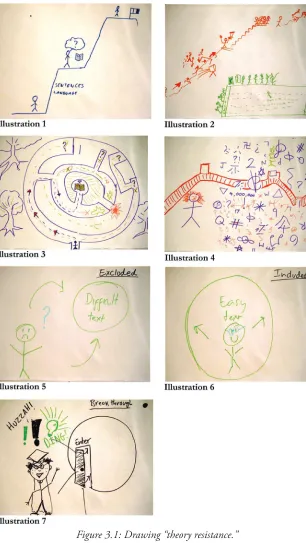
metaphor. She describes how she encouraged students to visually represent their feelings around attempting to engage with difficult texts and argues that an aca-demic literacies model “provides a framework for acknowledging the pressure faced by students as they negotiate unfamiliar literacy practices.”
Joelle Adams likewise foregrounds the academic learning potential in the peda-gogic use of visual rather than verbal (only) resources. Adams returns to a question that is nested in all contributions—how is “academic literacies” understood and taken up by practitioners?—focusing in particular on students taking on a tutoring role as part of an elective module in a Creative Writing course. Adams provides details of the kind of writing tutoring that student-tutors engage in, including designing subject specific writing workshops, but her main aim is to consider the ways in which student-tutors engage with academic literacy theory. Using sketches made by student-tutors as well as written extracts from their journals, she illustrates the ways in which student-tutors grapple with and take meaning from a key text in Academic Literacies (Lea & Street, 1998) and apply it to both their teaching and understandings about their own writing.
A theme prominent in Academic Literacies research and running across all con-tributions in Section1 is the implicit nature of many conventions in which students are expected to engage and the challenges teachers face in working at making such conventions visible. The paper by Adriana Fischer, focusing on an undergraduate engineering course in Portugal, seeks to explore the extent and ways in which the implicit or “hidden features” (Brian Street, 2009) of academic literacy practices can be made visible to both students and tutors. Fischer outlines a specific programme of interventions involving an academic literacy facilitator working with discipline specialists and highlights both the possibilities and limits to practices involving ‘overt instruction’ (Bill Cope & Mary Kalantzis, 2000). Transformation in Fischer’s work centres on combining attention to overt instruction, alongside the creation of spaces for ongoing dialogue between subject specialists, academic literacy facil-itators and students. She argues that overt instruction is important but that given the ideological nature of academic literacy practices, many specific understandings about these practices will inevitably remain implicit, an argument also made by Lawrence Cleary and Íde O’Sullivan in Section 4.
Introduction to Section 1
Jennifer Dyer, Janna Rosales and Morgan Murray also focuses on graduate writing, outlining a programme of workshops in a Canadian university aimed at supporting graduate students’ explicit knowledge of academic and research discourses, whilst encouraging their creative engagement with these. At the centre of this paper is a focus on “play,” with the authors arguing that play is an important way to encour-age “participants to move out of their usual ways of writing and thinking.” The paper draws on comments by workshop participants to illustrate the value of the approach adopted and to explore the extent and ways in which such involvement can be considered transformative. The question as to what counts as transforma-tive in graduate writing is also addressed in the final paper in this section by Kate Chanock, Sylvia Whitmore and Makiko Nishitani. Co-authored by a writing circle facilitator with a background in Applied Linguistics and two writing circle partici-pants in an Australian context, the paper focuses on the question of “voice” and the relationship between writer voice, disciplinary field and the specific object being investigated. Using extracts from writers’ texts and their concerns about these texts, the authors discuss how the writing circle provided a space for the consideration of how “academic socialization had shaped their writing” and opened up oppor-tunities for taking greater discursive control. The authors argue for the value of “informed” choice around acts of writing.
CHAPTER 1
A FRAMEWORK FOR USABLE
PEDAGOGY: CASE STUDIES
TOWARDS ACCESSIBILITY,
CRITICALITY AND VISIBILITY
Julio Gimenez and Peter Thomas
This chapter presents case studies of pedagogical applications of an academic literacies approach to the development of academic reading and writing. They were designed for degree programmes at a London university within the context of UK policies of widening participation.1 In most widening participation contexts the student profile is varied in terms of, inter alia, relationship with English,2 previous educational experiences, and length of time away from formal education. These el-ements of the student profile have a direct bearing on academic achievement, so we argue that academic literacies practices in contexts like that described in this chap-ter must take account of this variety and provide students with a balance between language learning, language development and literacy enhancement.
The two case studies here represent attempts to develop what we call a “usable pedagogy” informed by, and complementing, theoretical considerations of academ-ic literacy (e.g., David Barton, Mary Hamilton, & Roz Ivanič, 2000; Mary Lea, 2004; Mary Lea & Brian Street, 1998; Theresa Lillis, 2001, 2003; Joan Turner, 2012). This interrelation of theory and practice draws on Paulo Freire’s (1996) conceptualization of praxis, or research-informed action through which a balance between theory and practice is achieved. This balance, we believe, is important for widening participation contexts.
princi-ples form the basis of our framework for usable pedagogy which will be discussed in the next section.
The framework has been developed with the purpose of providing students with opportunities for transformative practices through which they can gain control over their own personal and educational experiences. Alongside most of the liter-ature on transformative learning (e.g., Jack Mezirow, 2000; Edmund O’Sullivan, 2003), we would argue that transformative practices involve shifts in a number of human spheres: thinking, feelings and actions. These shifts require changes in how we have learned to think of, feel about and act upon the world around us, including ourselves, the relations of power underlying institutional structures, opportunities for access to knowledge and resources, as well as opportunities for success. Trans-formative practices thus aim to help learners to develop a deep understanding of themselves as main agents in processes such as knowledge creation and discourse construction and co-construction, their own location and positioning, their rela-tionship with other learners and their teachers, and their feelings about themselves. Like constructivist approaches to education (e.g., Lev Vygotsky, 1978), transfor-mative practices recognize that knowledge in all its forms—technical, practical, propositional and procedural—is central to transformation and that learners can become more visible participants of academic practices through inquiry, critical thinking, and dialoguing with peers and lecturers.
Our approach is not a rejection of text-based approaches to academic writing instruction, often known as “English language support”3 (e.g., EAP), in favor of an academic literacies approach which emphasizes “social practices”. We contend that an either-or view is problematic in the context of universities committed to widening participation. Instead, we support Turner’s call for a balance or synergy, “whereby a focus on social practice feeds back into an awareness of textual practice” (Joan Turner, 2012, p. 19) (see also Turner Chapter 28 this volume; for relationship between Ac Lits and EAP, see Theresa Lillis and Jackie Tuck 2015).
Despite having developed in “quite different socio-political contexts” (Ken Hyland & Liz Hamp-Lyons, 2002, p. 4), EAP and academic literacies approaches both aspire to provide students with a more successful educational experience. Our approach couples text-centred pedagogy, which highlights how particular textual and genre-related features are used in specific disciplinary contexts, with the so-cio-political dimension emphasized by academic literacies. The former allows us to raise novice “home” and “international”4 student writers’ awareness of the rules that govern disciplinary academic discourses.5 The latter provides opportunities for stu-dents to become more aware of, and more confident in, their roles and positioning within their educational contexts.
sec-A Framework for Usable Pedagogy
tion concludes the chapter with a brief evaluation of the three underlying principles that make up the framework and the way in which they materialise social inclusion in higher education.
A FRAMEWORK FOR USABLE ACADEMIC LITERACY
PEDAGOGY
Paying attention to context, in particular the contextualization of pedagogical practices, is central to our understanding of academic literacies. Contextualization in our work includes a macro level of theorizing (the student’s individual and social realities before their institutional experiences, their individual and social identities, their new institutional realities, and the identity of their institution and disciplines) and a micro level of praxis, involving the modules and the lecturers for whom the students are writing. Our aim is that these levels of theory and practice should enable students to empower themselves in their reading and writing, as will be illustrated in the case studies.
Thus our framework aims to— Facilitate accessibility by:
• Challenging the “institutional practice of mystery” (Lillis, 2001; Turner, 2011) and, by means of analytical tools, helping students to gain access to the often tacit disciplinary expectations (Julio Gimenez, 2012);
• Helping students to develop effective means of expression through raising their awareness of the constitutive nature of language (Turner, 2011) in their construction and representations of knowledge.6 One common route to this is the identification of key textual and discursive features in their disciplines (by using linguistic tools), the consideration of alterna-tives and their impact, and the development of informed student use of such features.
Develop criticality by:
• Helping students to understand the role they play in the academic world that surrounds them. It is only through this understanding that stu-dents will be able to fully comprehend “the way they exist in the world
with which and in which they find themselves” and most importantly to “come to see the world not as a static reality, but as a reality in process, in transformation” (Freire, 1996, p. 64, emphasis in the original); • Helping students to critically analyze the multiplicity of factors
Donald Macedo, 2002). Increase visibility by:
• Encouraging visibility and writer’s voice development through a pro-cess we refer to as “dialogics,” that is, by establishing co-operation and dialogue between all the people involved in academic literacy practices. This idea resonates with Bakhtin’s views of dialogue as an aspiration to struggle for, “a range of possible truths and interpretations” (Lillis, 2003, p. 198);
• Empowering students to find ways of becoming more visible (to them-selves, their lecturers and institutions) and thus less peripheral to the processes of knowledge telling, transformation and creation, getting their voices as writers heard, and their writer authority respected.
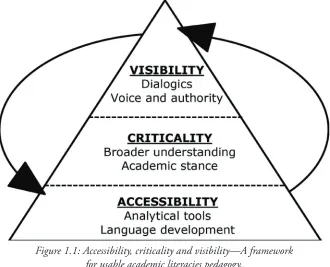
Figure 1.1 illustrates how the elements in the framework are interrelated: vis-ibility depends to a certain extent on criticality and both on accessvis-ibility. The di-agram also aims to show the proportional relationship between the elements: the more visible the students become as participants of knowledge-making processes, the wider the range of resources, linguistic and otherwise, they can access and con-trol. However, the relationship between the elements is fluid; their sequence is not