Are enterprise portals - knowledge management?
Marian Cloete and Retha (MMM) Snyman
University of Pretoria, Department of Information Science, South Africa
[email protected]; [email protected]
Received: 15thApril 2003
Accepted: 15thDecember 2003
Currently we are in the middle
of
the Information Age, suffering from information overload on the one hand and a lackof
knowledge on the other. Enterprise portals (EPs) are seen as the antidote to these problems bybecoming more and more the ultimate knowledge management (KM) tool. The current hype about EPs is focused on their application as KM tools. Very little attention is given to other aspects
of
KM, namely the organizational, human and cultural aspects. The articfe will provide an overviewof
the technical and strategic relationship between EPs and KM and illustrate that EPs are only the technology component and should not be mistaken for the essence ofKM. What are needed for successful KM in an organisation are not technology alone, but also a knowledge-sharing culture, knowledge-sharing policies, organizotional processes, performance measurement and business strategies.Keywords: Knowledge management, enterprise portal, culture
Introduction
We are currently finding ourselves in the middle of the Information Age, suffering from information anxiety caused by 'infoglut'. Researchpublished by the managementconsulting firm KPMG in March 2000 found that 70% of the companies surveyed claimed that they suffer from information overload despite implementing a variety of technologies such as corporate intranets and data warehouses. In spite of this apparent information overload, Gartner Uacobs,2002: 2) claims that we are at the same time experiencing 'infofamine', in terms of accessto knowledge. In the average United States Company, 80% of digitized information is stored in personal files on individual personal computers. Less than 5% of employee knowledge is actually captured and accessibleacross the enterprise (Wellset 012000: 22).
More and more, enterprise portals (EPs) are being presented as the antidote to the infoglut and infofamine phenomena, and as the tool to revolutionize our accessto information and knowledge. Portal technology hasgripped the imagination of information technology (IT) users and vendors ever since the popularization of the concept at the end of
1998 (Wellset 01,2000: 5). It is predicted that the growth of the portal market will be phenomenal.
In 1999 Gartner (Phifer, 1999:4) stated that' ... by 200 I the knowledge portal will become a standard component of successful knowledge management implementations.' This prediction is supported by Meta Group (Cain, 1999: I), claiming that by 2002 'knowledge management collaboration and innovation will permeate the Global 2000 corporation's strategy. However, more than 90% of the G2000 will recast knowledge management efforts as portals, delivering personalized, in-context information gathered through internal and external sources.' Ovum (Wells et 01, 2000: I I), estimated that the total market for portal software would be worth almost $1 billion in 2000 and would grow to more than $7 billion by 2005. This kind of hype about portal software tends to hide the key message of the knowledge management (KM) movement that people, not technology, solve information and KM problems.
The aim of the article is to provide an overview of the relationship between KM and IT and between KM and EPs. More specifically, it will be illustrated that implementing an EP is not implementing KM; an EP is only an IT tool in the implementation of KM. To test this theory, three case studies are used to describe the practical experiences of organizations where EPshave been implemented. The casestudies will determine to what degree EPsare implemented as part of a KM strategy and which KM elements are involved in the implementation. Through the case studies best practices will be identified for the implementation of an EP. Information for the case studies was gathered through interviewing the knowledge or information managersat each of the three organizations.
The relationship between KM and technology
In trying to define KM, O'Dell and Grayston (1998: 5-6) say: 'When explicitly managed,organizational knowledge is used to accomplish the organisation's mission. Knowledge management is therefore a conscious strategy of getting the right knowledge to the right people at the right time and helping people share and put information into action in ways that improve organizational performance ... it is a framework, a management mind-set...'
However, the term 'knowledge management' can be an unfortunate term since it promises the painless planning, organizing, directing and controlling of knowledge (which is unstructured), in the same way as is done with structured items. Therefore, for many managers,the term promises a simple IT solution that treats knowledge in the same way as
48
information or data. Actually, in order to obtain leverage on the knowledge within organizations, what is needed is far more subtle and widespread - it amounts to a whole new way of organizing and thinking (Widmayer, 2000: 12).
The elements that need to form part of KM can be illustrated by means of MITRE's model, which provides a holistic approach to KM - where KM is viewed from a two-dimensional perspective. The components of the model were derived from KM research performed in MITRE's technology program and a survey and comparison of KM models (e.g. Ernst
&
Young, APQC and DataWare) being used in industry or described in the literature (Taylor Small
&
Tatalias, 2000: 2).Figure I. MITRE's KM Model (Taylor Small & Tatalias 2000: 2)
The first dimension consists of the activities that are critical for knowledge creation and innovation: knowledge exchange, knowledge capture, knowledge re-use and knowledge internalization. Collectively, these processes build a learning organisation skilled at creating, acquiring and transferring knowledge as well as adapting its actions to reflect new insight and innovation (Taylor Small & Tatalias, 2000: 3).
The second dimension consists of those elements that enable or influence knowledge-creation activities. These include:
• Strategy -the alignment of corporate and KM strategies.
• Measurement -the measures and metrics captured to determine if KM improvement is occurring or if a benefit is
being derived.
• Policy -the written policy or guidance that is provided by the organisation.
• Content -the corporate knowledge base that is captured electronically.
• Process -the processes that knowledge workers use to achieve the organization's mission and goals.
• Technology -the IT that facilitates the identification, creation and diffusion of knowledge among organizational
elements within and across enterprises, e.g. an EP.
• Culture -the environment and context in which KM processes must occur (Taylor Small
&
Tatalias, 2000:2).This model illustrates that technology is only one element of KM. In order to achieve successful and effective KM within the organisation, all the elements mentioned above should be present. KM is not the implementation of technology; rather, it is a multi-disciplined approach that integrates business strategy, cultural values and work processes. KM programmes perform best when enabled with sophisticated technology, but an emphasis on technology alone will achieve very little progress towards KM (Harris et
ai,
I 999:i).As early as 1997 Gartner (Bair et
ai,
1997: ii-iii) predicted that, as KM matures into a megatrend, technology vendors will focus on the importance of technology, not cultural transformation. Vendor interests often preclude reminders that KM is complex and cannot be accomplished through technology alone. The same is currently happening in the EP market. EPs are promoted as the 'killer application' for KM and through clever software vendor marketing, companies might be misled to think that implementing an EP is equal to implementing KM.The relationship between KM and EPs
It is interesting to note that some of the very first research published on the topic of portals refers to the term
'knowledge portal', for instance a Gartner Research Note entitled: 'The knowledge portal: adding knowledge to
intranets', 30 December 1998 (Bair, 1998: I). It seems that right from the start, portals were connected to KM.
In current literature, the relationship between KM and EPs is described primarily as an IT relationship. For instance,
Gartner claims: 'The overlap between current KM and EP technologies is not surprising since they share the same parentage - the Internet ... .' Gartner continues to say that although KM has been promoted as a business management
issue for more than 20 years, the Internet was the technology trigger that launched KM into worldwide adoption. EPs
were also triggered by the Internet, as enterprises sought to replicate the Internet portal (e.g. Yahoo) within the
enterprise to unify information access and improve management of vast information resources (Harris et
ai,
1999: I). Another aspect of the IT relationship is seen in the fact that EPs are the value proposition first used by groupwaresystems such as Lotus Notes, and more recently, corporate intranets - which are both recognized KM tools. For many,
the portal approach merely seems like the natural evolution of intranets and groupware solutions into a common information infrastructure (Computer Finance, 200 I: 5; Watson, 2000: 18).
Gartner (Harris et
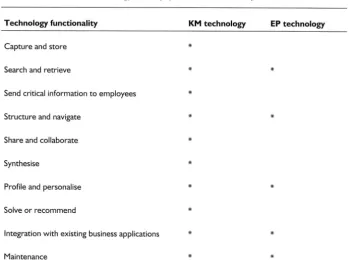
ai,
1999: 3) provides a checklist of KM technology requirements and identify EP's overlap. In Table I the significant overlap between EP and KM technology requirements can be seen, making EPs recognized KM tools:Table I KM and EP technology overlap (Harris et al 1999: 3)
Technology functionality
Capture and store
Search and retrieve
Send critical information to employees
Structure and navigate
Share and collaborate
Synthesise
Profile and personalise
Solve or recommend
Integration with existing business applications
Maintenance
KM technology
*
*
*
*
*
*
*
*
*
*
EPtechnology
*
*
*
*
*
In addition to the technical similarities, there are also a few authors who regard the relationship between KM and EPs as
being on a more strategic level. For instance, Meta Group says EPs are foremost a business strategy, not a technology
endeavor, and that the core value of EPs is information dissemination. In a KM context, the EP's main role is to provide easy access to the shared services and knowledge resources that constitute a network-based corporate memory. For
knowledge workers it provides a way to see and live in the corporate network (Cain, 1999: I; Computer Finance, 200 I: 5).
Wells et al. (2000: 23) also regard the current hype around portal software and applications as interesting since portals were originally conceived to address the cognitive (not technical) problem of providing easier access to information,
especially on the Internet. The spread of EPs promises to bring a sense of order to corporate information repositories similar to that which consumer Internet portals have brought to the World Wide Web. Wells et
al
therefore see the relationship not as technical but as strategic; KM and EPs share the same 'intellectual' purpose that of managing access to information and knowledge.However, although KM and EP applications both have rich technology support for information management and human processes and share the same strategic objective, implementing an EP is not implementing KM. Organizations
cannot achieve the implementation of a KM discipline with technology alone. EPs should therefore not be mistaken for the essence of KM (Harris et
ai,
1999: 2).so
EPs are not
KM
EPs need to be implemented within a comprehensive KM strategy. Briggs (2000: I) says: 'A comprehensive KM strategy is the foundation - and the purpose - for a successful portal.' Companies should not confuse the tactical advantages offered by portals with the fundamental changes required for effective KM. The portal is the interface, the place where information exchange and knowledge transfer takes place, but it is only one component of successful KM (Ifrah, 200 I: I). Louise Temkin (200 I), Knowledge Operations Associate Director at Accenture supports this view and illustrates the relationship between KM and EPs through a model adapted from the work of Karl-Erik Sveiby (1998) (Figure 2). According to Temkin, the potential of an EP can be enhanced if it is seen to be an enabler of intellectual or knowledge capital management which is directly linked to the ultimate profitability or increased effectiveness of an organisation. The EP links the different silos of knowledge capital with each other as well as with the value proposition and organizational culture of the enterprise.
As is shown in Figure 2, KM facilitates the creation, capturing, organisation, accessing and use of an enterprise's knowledge capital, consisting of:
• Human capital:
Knowledge, skills, experience, talent, competencies, education, intelligence, innovation, creativity and problem-solving ability of the people that work within, or in partnership with, an organisation.• Structural capital:
Systems, processes, methods, best practices, know-how, agreements, copyrights, patents, trade secrets, brands and techniques which get left behind when the employees leave.• Relational capital:
Relationship with customers, suppliers and external organizations.Value
is created by personalizing, aggregating and integrating the human, structural and relational capital. The value of KM should be unique and specific to every organisation and should be reflected in the bottom line. Anorganizational
culture
should be created that incorporates KM, including motivation, ability, performance, education, learning, training, trust, behavior, values and beliefs (Morris, 1998: 2; Sveiby, 1998; Temkin, 200 I) .•••
t
Figure 2. Model linking KM and the EP
The EP facilitates
human capital
creation by consolidating, integrating, enhancing and connecting to the knowledge people have within an organisation. It enablesstructural capital
to be shared, used, re-used, acquired, retained, identified, received, transmitted, applied and networked within an organisation. The EP facilitates, collaborates, updates, explores, interacts and promotes the image and the brand to customers, partners and interested parties(relational
capital).
Anorganizational culture
should be created in which the portal is used. For this reason the portal strategy cannot be stand-alone, it must be incorporated into the organizational strategy for knowledge capital management (Temkin, 200 I).Case studies
In order to test the theory, three case studies will be described where EPs have been implemented in South African organizations. All three EPs are still in initial stages and vary considerably in terms of content, use and functionality. However, since all three EPs are seen as KM tools, the basic components of a KM implementation as described in Figure
I should be present.
Case study 1: University
The EP implemented at this university is still in an experimental phase and was officially launched towards the end of 2002. The aim of the EP is to support the core businessactivities of the university, namely teaching and research, through providing a one-stop shop for all other systems and resources available at the university. The EP is seen as a KM tool, facilitating personal management of academic knowledge and information. Its design and usage processes are based on the following personal KM model:
A university has a somewhat unique character in terms of KM culture. As part of their work, academics traditionally share their
knowledge through conferences, lectures, courses and
publications. In the academic environment, Communities of Practice already exist and do not have to be created through KM processes. The role of KM should therefore be focused on assisting and facilitating existing knowledge-sharing and collaboration processes.This culture, in turn, determines the role of the EP. The EP is seen as a tool assisting academics and information specialists to perform their work more effectively. Since both of these groups' work is seen as 'knowledge work', the EP is automatically seen as a KM tool.
The EP has been designed and developed during the past two years with the initiative being driven by the information service division of the university and with strong sponsorship from the
Figure 3. Personal KM model executive leadership. The design and development of the EP are
in line with the IT strategy of the university. The initial design of the EP was based on research involving a focus group of eight senior academics, including testing a prototype portal as part of the research. The preliminary roll-out of the EP was facilitated by portal coordinators, each representing a service unit within the information service division. The portal coordinators trained the information specialists in their units who in turn trained the academics in their area of responsibility. The official launch of the EPwill involve a month of marketing and training activities.
Since the EP is an evolving system, the focus during the experimental phasewas to provide an initial basisfor the type of content and functionalities to be available. Following the launch, the focus will shift to providing more depth and integration. The EP's aim is therefore initially to be a useful tool and eventually to become an essential tool. The EP is accessibleto all university employees, but the content and functionality focus is currently on the needs of the academics and information specialists.
Content available on the EP includes: e-journals, e-articles, e-reserves, e-archives, e-books, e-dissertations, library catalogues, research databases,information specialists,websites and events.
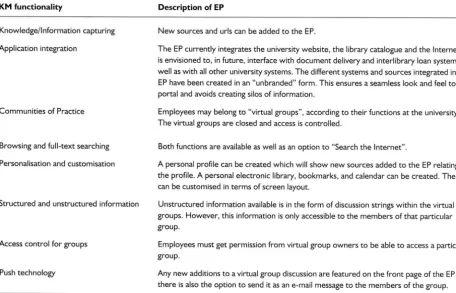
Some of the KM functionalities currently availableon the EP are shown in Table 2.
Additional functions that are anticipated for the future of the EP include: virtual conferences, virtual workspace for research projects, meta-database, indexing tools, e-publishing, e-Iearning in the form of virtual classrooms, demonstrations and lectures and an expert system.
Attempts have been made to address the cultural issues surrounding KM and to provide a context for the implementation of the EP. KM courses have been offered to the information specialists as well as two KM conferences. The conference during March 2002 focused specifically on Communities of Practice. A further seminar on the same subject was offered to all university employees.
During the experimental phase of the EP, resistance towards the use of the portal was experienced in three areas: • Employeesare still trying to grasp the portal concept. They havedifficulty understanding the difference in functionality
between the university website and the EP.
• Employees are reluctant to share and integrate certain specialized functions on the EP. They regard the integration of their products and services into the EP as losing control over their specific field of expertise. This resistance is mostly experienced within the support services (e.g. cataloguing and e-journals).
• Resistanceresults from a general lack of IT and web literacy.
At this stage of the process the view is held that the EPwill be 'pushed through' despite these reservations which will be addressed once the technology has been introduced and rolled out to all employees.
52
Table 2 University EP's KM functionalities
KM functionality
Knowledge/Information capturing
Application integration
Communities of Practice
Browsing and full-text searching
Personalisation and customisation
Structured and unstructured information
Access control for groups
Push technology
Description of EP
New sources and uris can be added to the EP.
The EP currently integrates the university website, the library catalogue and the Internet. It is envisioned to, in future, interface with document delivery and interlibrary loan systems as well as with all other university systems. The different systems and sources integrated in the EP have been created in an "unbranded" form. This ensures a seamless look and feel to the portal and avoids creating silos of information.
Employees may belong to "virtual groups", according to their functions at the university. The virtual groups are closed and access is controlled.
Both functions are available as well as an option to "Search the Internet".
A personal profile can be created which will show new sources added to the EP relating to the profile. A personal electronic library, bookmarks, and calendar can be created. The EP can be customised in terms of screen layout.
Unstructured information available is in the form of discussion strings within the virtual groups. However, this information is only accessible to the members of that particular group.
Employees must get permission from virtual group owners to be able to access a particular group.
Any new additions to a virtual group discussion are featured on the front page of the EP and there is also the option to send it as an e-mail message to the members of the group.
The benefit and success of the EP are linked closely to the main objectives of the university - teaching and research. It is accepted that the EP will only be used if it is seen as a tool that will assist academics and information specialists to perform their work more effectively. Usage of the EP will be measured and evaluated by the end of 2003, as was stipulated in the original research design. Indirectly, the success of the EP will be measurable through the improvement of the quality and quantity of research, publications and improved student numbers and performance.
The longer-term plans for the EP are to open access to the EP to university students and to start focusing on the information needs of the administration personnel. Another idea is to be able to 'sell' the portal to other universities.
Case study 2: Information technology consultancy
In 200 I, as part of its IT infrastructure strategy, this global IT consultancy designed and developed an EP. The EP provides a global, single point of entry to the organisation's knowledge, information and tools, in order to assists its employees in their day-to-day tasks.
The company's KM efforts are initiated to leverage the knowledge capital of a large, global, multidisciplinary organisation. Knowledge sharing is at the core of the programme, and the relevant KM solutions are provided to capture and organize its collective knowledge assets. All employees practice KM in that they use the knowledge environment as a touch point to collaborate with experts, to access relevant knowledge, to speed upproject work and to resolve issues. In addition, knowledge creation is emphasized in the expectation that all employees contribute their own experience and expertise to the collective knowledge base, and that they also utilize it to stimulate ideas for problem solutions, new services and new business.
The company's KM solutions were initially built on a Lotus-based KM technology architecture, but it is gradually moving to increased browser-based access. The web-based EP will eventually become the exclusive KM tool in the company. The design, development and implementation of the EP were driven by a project called 'Project Navigator', which was jointly sponsored by the IT team and the Media
&
Entertainment industry group. The EP governance team included senior managers from all areas of the company, e.g. business architecture, IT, KM and the business and support units. The involvement of senior leadership provided executive sponsorship to reinforce the usage of the EP. The channel management team created 'portal guiding principles' that were used in the design and development of the EP.The EP was launched as a pilot during May 200 I and the official global launch to all company employees took place during July 200 I, over a two-week period. The target audience for the initial launch of the EP was line consultants with the intent of making them more effective and efficient in delivering value to their clients.
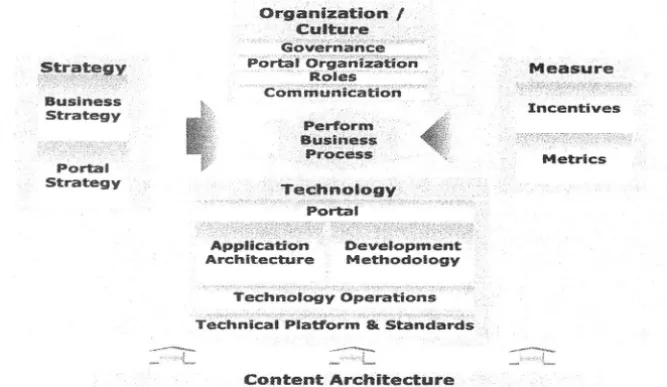
The implementation of the EP was based on the framework depicted in Figure 4, with the key components being: strategy, organisation/culture, measure, technology and content architecture. The heart of the model is helping the employee perform their businessprocesses more effectively.
,:~::~~~~1\~~;
Business St:rat:egy
Portal St:rat:egy
Orgimiza~ion\1 Cul~u•..e'- ,:
G:o"ern'"ance:'~-w,,:"","':_--PortaJ<Or9a~;'izatioi'l" " " Roles-- -''-,"
",-'--Ccr.-n~munication-'"~"
Perlorm, .-'Business
Process
Technology'""
~.<":.~s;/r ".,~'.:c,'_""~"'':-.:H.,~::::..o- .'~ ;,....,.•• ~':"'Y, ~..~" ..': '.' ;,,;:'"""-~.;..j>,';'--"?_. "';_. Portal
.'.\'-rP~J?1ff~~1?i~~fr1~7;~l~;t~~:(;,1?~;tJfW~~S't:~.~y~t
;~t~t?,~'::Application Development:
Archlt:ecture Met:hodology
, "--"'T;~h';;;;I~~()p-;;;ati;;;;;;c'
...."'-T~~h;:;i;:;;I'PI~ti;;;;:.;.<'
8t'S~,';d':;d~'
,---_~""LCon~entArchitecture
Figure 4. EP framework
Measure
>"~~?;!?~'~~?~~f.";.t~~.!.:;:::~
Incent:ives
Met:rics
--,....,
_~.''''~~:'L
The EP content includes: information on the company, knowledge capital (e.g. project deliverables) that is also available on Lotus Notes, news, learning and training available in the company, tools and services, travel information and career and benefit information.
Currently the EP contains the KM functionalities listed in Table 3:
Table 3 ConsultancyEP'sKM functionalities
KM functionality
Knowledge/Information capturing
Expert system
Application integration
Communities of Practice
Personalisation
eLearning
Automatic update of content created through linked applications
Browsing and full text searching
Structured and unstructured information
SAJnl Libs&Info Sci2004, 70( I)
Description of EP
Knowledge capital can be contributed directly to the EP as of April 2002 through standardised templates.
The EP contains an "expert finder" functionality.
The EP integrates a large number of Lotus Notes databases as well as other company sites. Applications not yet integrated include, for instance, the performance evaluation tools and office-specific directories,
Employees can subscribe and participate in discussion forums.
Limited personalisation, for instance the system recognises recurring users, and country preferences can be selected.
Through the EP, employees can access the eLearning database which contains all training available in the company.
Knowledge capital contributed to a database in Lotus Notes, is updated automatically in the EP, and the other way round.
Full-text searching provides the ability to search dozens of company sites and databases at once. This was not previously possible in Lotus Notes. The EP has a standard interface and navigation scheme with logical organisation and placement of content.
54
KM in the company is embedded within the human resource function. This means that, included in employees' performance evaluation, is the measurement of their contribution of knowledge capital to the Lotus Notes databases or
EP.
Despite the strong KM culture in the firm, the uptake of the EP as the new KM tool is still relatively low. Some of the reasons include:
• Most important the fact that the Lotus Notes databases still exist. Employees are more familiar with and aware of this tool and will continue using it until such time as Lotus Notes has been replaced by the EP.
• The EP is plagued by various technical problems including down-time and extremely slow connection time when working from client sites. Information contributed to the EPgets 'lost' and there are still problems with the automatic updating of information from Lotus Notes to the EP.
• The ownership of the content on the EP is fragmented and there is a silo effect. This results in varying data quality, for instance certain databases have been transferred completely to the EP and others not. In the latter instances employees still need to refer to the Lotus Notes database to be able to access all available information.
• The silo effect is also emphasized by the fact that moving from one section in the EP to another requires a continued input of an employee's enterprise password.
• Contributing knowledge capital in the form of project deliverables, best practices, proposals, procedures etc. to the EP needs to be done during a consultant's 'spare time', since it is a non-billable task. These contributions therefore take a low priority in consultants' daily work, resulting in a loss of valuable knowledge capital.
The success of the EP in this company will be measured in terms of the impact it makes on the bottom line, in other words the impact on the return on investment. In terms of the future of the EP, an announcement was made within the company that the EP will completely replace Lotus Notes during 2003, becoming the primary KM tool.
Case study 3: Transport parastatal
The EP of this transport parastatal was officially launched in December 200 I. The vision for the EP is to be the 'information delivery vehicle for employees' as well as the single point of entry to all organizational information. In addition, the EP provides the tool to link the different organizational units which currently function in silos with no process integration view.
The portal team, responsible for the EP design, development and implementation, is situated in the architecture division. This division is responsible for the technology and strategic direction of the organization's IT structure. In general, the architecture division oversees all applications, solutions, information and technology in the organisation. Although the parastatals knowledge centre is situated outside and functions separately from the architecture division and portal team, the EP provides the link between these units.
The origin of the EP was a basic organizational website with static pages. A need was then identified for content management within the broader organisation and the website was transformed into an EP. Currently, content and records management still form the key focus of the EP. Policies and procedures have been put in place to manage the content and records of the organisation on the EP, but also in general.
The launch of the EP in December 200 I was done through an organized, company-wide roll-out. Subsequently employees were constantly made aware of the EP through presentations and announcements at executive committee and other meetings. Employees are encouraged to use the EP as a tool to make information available to the rest of the organisation and to use the EP as the single point of entry to access any information available in the organisation. The fact that there exists no management information system (MIS) in the organisation means that the EP is the only tool to make management information accessible.
Eighty percent of employees in the organisation are blue-collar labourers, whose information needs are simplistic and focused on their line of responsibility. Of the 36 000 employees in the organisation, only 4000 have access to the Internet, intranet and the EP. The other employees are, however, able to access the EP at countrywide depots from info kiosks. Information capturing is done at this level and the information is fed into the EP to be accessible to other employees in the organisation.
The focus of the EP is currently on the needs of the higher-level employees. Their information needs are reflected in the content available through the EP, which includes account information, bookings, consignments, financial results and other flash reports, freight reports for instance daily sales, personal hobbies (e.g. favourite websites), meetings and contacts. No employment information is available on the EP, as this information is available through the intranet.
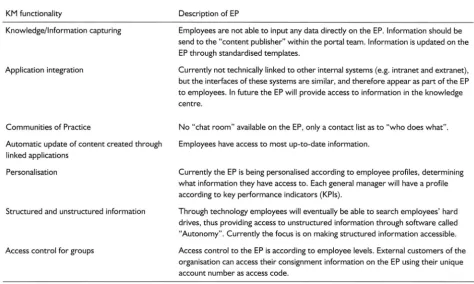
Table 4 outlines the EP's current and anticipated KM functionalities.
Table 4 Transport ParastatalEP's KM functionalities
KM functionality
Knowledge/Information capturing
Application integration
Communities of Practice
Automatic update of content created through linked applications
Personalisation
Structured and unstructured information
Access control for groups
Description of EP
Employees are not able to input any data directly on the EP. Information should be send to the "content publisher" within the portal team. Information is updated on the EP through standardised templates.
Currently not technically linked to other internal systems (e.g. intranet and extranet), but the interfaces of these systems are similar, and therefore appear as part of the EP to employees. In future the EP will provide access to information in the knowledge centre.
No "chat room" available on the EP, only a contact list as to "who does what".
Employees have access to most up-to-date information.
Currently the EP is being personalised according to employee profiles, determining what information they have access to. Each general manager will have a profile according to key performance indicators (KPls).
Through technology employees will eventually be able to search employees' hard drives, thus providing access to unstructured information through software called "Autonomy". Currently the focus is on making structured information accessible.
Access control to the EP is according to employee levels. External customers of the organisation can access their consignment information on the EP using their unique account number as access code.
Problems experienced with the EP implementation include:
• Since information is not contributed directly to the EP, but via the portal team, the EP often does not contain the most up-to-date information. There are also problems in terms of data integrity. Employees need to understand that the EP team is not the content owner.
• The initial deadline for the design of the EP 'proof of concept' was 8 weeks. This was too short a period. There was also no skills transfer from the initial developers of the EP to the current portal team.
Case studies - best practices
Although all three EPs discussed are in early phases of implementation, certain best practices can already be identified in implementing EPs. Some of these best practices include:
Table 5 EP implementation best practices
Best practice Case study
When determining scope, identify the key capabilities that will drive repeat usage. Case study I, 3
Build the site with the goal of creating a tool that isuseful initially,and then add features and Case study I information to make itessential, so that it eventually becomes the user'sworkspace.
Clearly understand the needs of the end-users upfront by conducting focus groups. Continue to Case study I drive decisions based on user input.
Clearly establish the target audience initially,do not attempt to be all things to all people. Case study I, 2, 3
Attempt to get executive sponsorship to reinforce the portal as the one portal recognised by Case study I, 2 leadership.
Organisational and cultural issues to be addressed include data ownership and encouraging Case study 2 employees to share and contribute to the corporate data pool.
Focus on incrementally adding communities rather than pursuing a big-bang approach for the whole Case study I, 2, 3 organisation. Each community will require attention and specialisation that could make an all-at-once
implementation daunting.
56
Conclusion
From the case studies it is clear that EPs are unique and will differ according to the specific objectives and characteristics of an organisation. The nature and value of KM are also unique in each of the three organizations, according to the type of knowledge capital available in the organisation, as was suggested in Figure 2.
Despite these differences, the theory highlighted the fact that implementing an EP requires a complete KM strategy which will have the same basic elements regardless of the type of organisation. In order to determine the degree to which the implementation of the EPs in each of the case study organizations was done within a KM strategy, the EPs will be evaluated against the basic elements identified in the KM model as described in Figure I.
The first dimension of the model, consisting of knowledge creation and innovation activities, was present in two of the organizations, namely the university and IT consultancy. However, the focus in the university was on informal knowledge exchange between employees (Communities of Practice), and in the second organisation on knowledge capture and the 'codification' of knowledge. Overall, it appeared that the more mature and established these basic KM activities were within the organisation, the more effective the EP was in achieving the necessary objectives in terms of sharing and providing access to knowledge and information. It supports the theory that EPs are therefore not a substitute for poor KM. Successful KM will lead to a successful EP, not the other way around.
In terms of the second dimension of the model, consisting of those elements that enable the knowledge-creation activities, Table 6 summarizes to what degree these elements were present in the case study organizations.
Table 6 EP alignment with KM elements
KM element
Strategy
Measurement
Policy
Content
Process
Culture
Case studies
All three EPs were implemented as part of the organisation's IT strategy. In all three organisations there is a clear alignment of the EP strategies with the objectives of the organisation; the EP supports the core business activities of the organisation. In two of the case studies, namely that of the university and the IT consultancy, the EP strategy is aligned with the organisational KM strategy.
Benefits achieved through the EP, in terms of improved access to and sharing of organisational knowledge and information, will be determined informally in the case of all three organisations. On a more direct level the university will measure and evaluate the usage of the EP by the end of 2003 and the IT consultancy will measure the use of their EP through employee performance evaluations.
No formal or written policy exists for information and knowledge management through the EP in any of the organisations. However, all three organisations have adopted and communicated this information sharing policy on a high level to employees. In the transport parastatal a formal policy has been created for records management on the EP.
It seems that the majority of KM initiatives in all three organisations revolve around identifying, classifying and indexing structured knowledge and information on the EP. In the IT consultancy there is a strong drive to capture human and structural capital on the EP (see Figure 2). In the university, human capital is captured in a limited degree through virtual group discussions.
The EPs in all three organisations are in the process of creating a technology environment where processes to achieve the organisation's objectives will be automated and where knowledge and information collaboration will be supported. However, as was mentioned in the second "best practice", the EP in all three organisations is currently useful, but it is not yet at a level where it is regarded asessential -employees do not yet "live" in the EP.
In all three organisations very limited time and energy is spent on creating and promoting a KM culture, in order to encourage knowledge, information sharing and collaboration across and among employees/business units through the EP. Since all three EPs are in the early stages of implementation and rollout, the focus is currently on technology and design issues.
Two issues emerged from this evaluation. In the first place it is clear that there still exist huge differences in opinion in terms of what an EP could or should be. The strong link between KM and EPs as found in the literature is also not necessarily seen in practice. At these early stages it seems that organizations use EPs as content and information management tools and only to a limited extent as true KM tools.
In conclusion, organizations that adopt EPs as KM tools should take account of all elements of KM, including human
processes and culture. Otherwise they will eventually find that they are effectively 'all dressed up with nowhere to go' -they have a 'knowledge repository' that decays through disuse.
References
Anonymous. 200/. Key drivers for portal adoption. Computer Finance, II (10): 1-9
Bair, j. 1998. The knowledge portal: adding knowledge to intranets. GartnerGroup, T-06-2507
Bair, j., Fenn, j., Hunter, R. and Bosik, D. /997. Foundations for enterprise knowledge management. GartnerGroup, R-400-1 05 Briggs, D. 2000. Maximizing the knowledge asset value within the enterprise. DM Direct, http://www.dmreview.com/
master.cfm?NavID= I 98&EdID=2 146 (Visited 10 April 2002)
Cain, M. 1999. Enterprise portals: a publishing model. Meta Group, Workgroup computing strategies, File 837
Harris, K., Fleming, M., Hunter, R., Rosser, B. and Cushman, A. 1999. The knowledge management scenario: trends and directions for 1998-2003. GartnerGroup, R-07-7706
Harris, K., Phifer, G. and Hayward, S. 1999. The enterprise portal: Is it knowledge management? GartnerGroup, SPA-08-8978 Ifrah, E. 200 I. Corporate portals require complete KM strategies. KMWorld, http://www.kmworld.com/publications/whitepapers/
portals/ennov.htm (Visited 3 March 2002)
jacobs, j. 2002. Case Studies: KM in the real world. GartnerGroup, ITSV-WW-PR-O 125
Morris, H. 1998. Three waves of information portals for knowledge management. KMWorld, 7( I) O'Dell, C. and Grayston, c.j. 1998. If only we knew what we knew. The Free Press
Phifer, G. 1999. Enterprise management alert: a winning e-business strategy. GartnerGroup, IGG:IGG-I 0 131999
Shilakes, c.c. and Tylman, j. 1998. Enterprise Information Portals. Merrill Lynch, As quoted by joseph Firestone at http://
www.dkms.com/EIPDF.htm/(Visited 6 April 2002)
Sveiby, K-E. 1998. The invisible balance sheet. http://www.sveiby.com/articles/lntangAss/denosynl.htm (Visited 25 September 2002)
Taylor Small, C. and Tatalias,j. 2000. Knowledge management model guides KM process. The Edge Newsletter, http://
www.mitre.org/pubs/edge/april_OO.htm (Visited 7 April 2002) Temkin, L. 200 I. Knowledge Operations Accenture, (Interview)
Watson, j. 2000. Understanding portals and KM. Information Management journal, 34(3): 18-22
Wells, D., Sheina, M. and Harris-jones, C. 2000. Enterprise portals: New strategies for information delivery. Ovum
Widmayer, K. 2000. Enterprise information portals and knowledge management. International Knowledge Management, ITRN 70 I, Section 7