P19
The career aspirations of Associate Degree students:
Implications for engineering educators and the profession
David Dowling ([email protected])
University of Southern Queensland, Australia
Abstract: During the period 2006-2008 there was a large and unexpected growth in the commencing enrolments in the distance education offer of the Associate Degree of Engineering program, with the commencing student total growing from 115 in 2005, to 337 in 2008. A small questionnaire was developed in 2006 to explore the reasons for this spike in enrolments, and to gather information about these students, who mostly study part-time because they work full-time in the engineering industry.
The online questionnaire was posted in March 2007 and all of the students enrolled in the program at that time were asked to complete the questionnaire. Since then, the students in each commencing cohort have been invited to complete the questionnaire during their first semester of study.
A preliminary analysis of the 247 responses from distance education students found that 63% of the students have a career goal to become a Professional Engineer and see the Associate Degree as a stepping stone to the Bachelor of Engineering. Surprisingly, less than 14% of the respondents intend to pursue a career as an Engineering Associate. This unexpected result challenges a long-held assumption that students in Australian Advanced Diploma and Associate Degree programs will pursue careers as Engineering Technicians.
This paper reports on an analysis of the 2007-2009 data and discusses the need for effective and efficient articulation (upgrade) pathways to encourage people employed in the engineering industry to undertake university studies and achieve their career goals. If implemented, the benefits will accrue to students, universities, employers, and the engineering profession.
Introduction
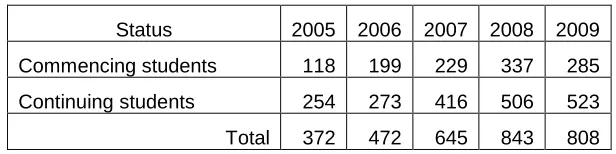
[image:1.595.143.451.646.723.2]During the period 2006 to 2008 the University of Southern Queensland (USQ) experienced rapid and unplanned growth in the enrolments in the two-year Associate Degree of Engineering program, which is offered by the Faculty of Engineering and Surveying. The growth (see Table 1) occurred in the distance education offer of the program and in 2009 more than 92% of the students in the program were enrolled in this study mode. While the students are spread throughout Australia, and in some overseas countries, the majority live and work in Queensland (77%) and New South Wales (14%).
Table 1: Growth in student numbers -2005-2009
Status 2005 2006 2007 2008 2009
Commencing students 118 199 229 337 285
Continuing students 254 273 416 506 523
Total 372 472 645 843 808
According to official government statistics, the 2006 USQ commencing cohort accounted for
Senior staff in the Faculty of Engineering and Surveying speculated about the reasons for the sudden growth in student numbers. The most plausible explanation was that those employers who were unable to employ graduate engineers, due the severe skills shortages in all levels of the engineering workforce, had responded by employing school leavers or older people as trainees (or cadets). Traineeships generally require the trainee to work full-time and study part-time, with the employer often supporting their studies through a range of mechanisms such as payment of course fees. The Associate Degree of Engineering is ideal for this purpose as it is available by distance education and can be completed in four years of part-time study.
As Associate Dean (Learning and Teaching) the author developed a research proposal that aimed to answer the following questions:
1. Why did the students choose to study the Associate Degree of Engineering program rather than the three-year Bachelor of Engineering Technology program or the four-year Bachelor of Engineering program, which are both available by distance education through USQ?
2. Why did the students choose to study the Associate Degree of Engineering program rather than an equivalent program offered by a Vocational Education provider, such as an Advanced Diploma in Engineering?
3. Why did the students choose to study part-time rather than full-time on-campus? 4. What were the career aspirations of the students when they commenced their program?
This paper describes the initial outcomes of the research project.
Background
The USQ Faculty of Engineering and Surveying has offered the Associate Degree of Engineering program on-campus and by distance education since 1977, although up until 1997 the name of the award was ‘Associate Diploma in Engineering’. From its inception, the aim of this program was to provide graduates with the underpinning knowledge and skills required for them to begin a career as an Engineering Technician.
At that time, the four-year Bachelor of Engineering was the only other undergraduate engineering program offered by the Faculty, and it was only available on-campus. The first two years of the Bachelor of Engineering were first offered by distance education in 1987, with the distance offers of the third and fourth years being phased in over the next 10 years. The whole of the degree was available in this study mode by 1997, when it was provisionally accredited by Engineers Australia. It was fully accredited by Engineers Australia in 2002.
A three-year Bachelor of Engineering Technology was introduced in 1993 and offered on-campus and by distance education. Students who articulate from the Bachelor of Engineering Technology to the Bachelor of Engineering generally have to complete an additional three to four years of part-time study, although this depends on their field of specialisation. The period of additional study can be shortened through the careful selection of ‘elective’ courses in their Bachelor of Engineering Technology program.
More than 2500 students are currently enrolled in the undergraduate engineering programs offered by the Faculty, with approximately 80% of them studying by distance education.
Program aims
By 1996 the Associate Degree had become a sub-set of the Bachelor of Engineering Technology program, a change that enabled Associate Degree graduates to articulate to the Bachelor of
Engineering Technology and graduate from that program after only one more year of full-time study, or two years of part-time study. This change was in response to part-time distance education student demands for an enhanced articulation pathway. This meant that the Associate Degree program now had two main aims:
to provide graduates with the academic requirements for them to practice as an Engineering Technician; and
to provide efficient articulation pathways to the Bachelor of Engineering Technology and Bachelor of Engineering programs.
‘In contemplating any major revisions to the engineering education system, all those consulted in the review agree that the system must allow students and graduates to transfer between qualification pathways with maximum efficiency, in terms of allowed credit and study duration.’
The need for articulation pathways is also mentioned in the Joint Quality Initiative (2004, p1) report on the shared Dublin descriptors:
‘A range of higher education awards are available to students who have undertaken a programme of study within the Bologna first cycle, but which do not represent the full extent of this cycle. Such awards may prepare the student for employment, while also providing preparation for, and access to, studies to completion of the first cycle. These awards are referred to as higher education short cycle (within the first cycle).’
However, there is an inherent tension between the two program aims, which often comes to the fore during curriculum design processes and reviews. This tension may be exacerbated when, due to low enrolments, there is an economic imperative to maximise the commonality between the courses in the different programs.
King (2008, p13) discusses another aspect of this dilemma, and highlights the differences between the two Australian awards that aim to prepare graduates for careers as Engineering Technicians, the Advanced Diploma offered by institutions in the Vocational Education and Training (VET) sector, and the Associate Degree, a higher education award which has, until recently, only been offered by universities, but is now being offered by some of the larger VET institutions.
‘The VET award system is unit-based around prescribed competencies, and designed to deliver an Advanced Diploma graduate with specific knowledge and workplace skills. The Associate Degree is, in contrast, a curriculum-based award intended primarily to be a pathway to a full bachelor degree. However, the award should also provide its graduates with clearly defined sets of outcomes that have value within the relevant industry sector.’
Accreditation
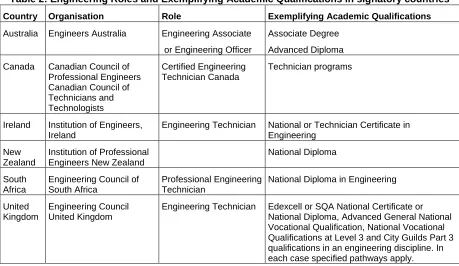
[image:3.595.68.527.496.762.2]The Faculty has applied to Engineers Australia (EA 2009, 2006) to have the Associate Degree of Engineering accredited. If accredited, it would be at the same level as the Exemplifying Academic Qualifications recognised by the Dublin Accord (IEA, 2009a, 2009b, and 2009c). The Dublin Accord is an International Agreement that defines the educational base for Engineering Technicians and is used for the recognition of equivalence of those qualifications. The employment roles and the Exemplifying Academic Qualifications of the four current signatories are shown in Table 2, along with the data for New Zealand (a provisional signatory) and Australia, which is seeking to become a signatory.
Table 2: Engineering Roles and Exemplifying Academic Qualifications in signatory countries
Country Organisation Role Exemplifying Academic Qualifications
Australia Engineers Australia Engineering Associate or Engineering Officer
Associate Degree Advanced Diploma Canada Canadian Council of
Professional Engineers Canadian Council of Technicians and Technologists
Certified Engineering Technician Canada
Technician programs
Ireland Institution of Engineers, Ireland
Engineering Technician National or Technician Certificate in Engineering
New Zealand
Institution of Professional Engineers New Zealand
National Diploma
South Africa
Engineering Council of South Africa
Professional Engineering Technician
National Diploma in Engineering
United Kingdom
Engineering Council United Kingdom
Methodology
A small questionnaire was developed in 2006 to gather information about the students in the
Associate Degree of Engineering program and the reasons for the spike in enrolments that occurred during that year. The aim was to use the resulting data to inform curriculum development and the educational environment and articulation pathways provided for these students.
The online questionnaire consisted of 13 questions, seven of which are relevant to this paper:
Three questions explored the reasons why students selected the USQ Associate Degree of Engineering as their program of study;
Two questions explored the student’s career aspirations and employment goals; and
Two questions explored the future study plans of the students enrolled in the Associate Degree of Engineering program.
The online questionnaire was first posted in December 2006. All of the students enrolled in the program at that time, both commencing and continuing, were invited to complete the questionnaire. Since then, the students in each commencing cohort have been invited to complete the questionnaire in their first semester of study at USQ. The aggregated data was analysed at the end of each year and the results have been used to inform reviews of the program curricula.
Results
By the end of Semester 2, 2009, a total of 264 students had completed the survey, a response rate of approximately 20%. Due to the low number of responses from on-campus students only the
responses from the 247 distance education students (51 females) are discussed in this paper. Their responses to seven of the questions are summarised in a series of tables in this section and then discussed in the following section.
Program selection
Three questions explored the reasons why students selected the USQ Associate Degree of Engineering as their program of study.
Why did you choose to study the USQ Associate Degree of Engineering?
[image:4.595.139.454.523.660.2]The responses to this question are shown in Table 3. As students were able to select one or more responses when they responded to this question, the data in the right hand column is the percentage of the number of students who chose that response compared to the total number of respondents for that question.
Table 3: Reasons for choosing the USQ Associate Degree of Engineering
Why did you choose to study the USQ Associate Degree of Engineering?
% of Students
The program has a good reputation 26.3%
My employer recommended the program 26.3%
It is a condition of my cadetship/traineeship 33.2% It was recommended by my careers advisor 1.6% It is the fastest way to get an engineering qualification 22.7%
Other… 25.9%
The data indicates that the two most popular reasons why the students selected the program were because it was recommended by their employer or because it was a requirement of their employment. The four most popular ‘Other’ reasons were:
USQ was the only university that offered the program by distance education.
The program will allow me to articulate to an engineering degree program.
This is the only way I can further my career.
Why did you choose to study the Associate Degree of Engineering program rather than the Bachelor of Engineering Technology program or the Bachelor of Engineering program? The responses to this question are shown in Table 4. As students were able to select one or more responses when they responded to this question, the data in the right hand column is the percentage of the number of students who chose that response compared to the total number of respondents for that question.
Table 4: Reasons for choosing the Associate Degree rather than an engineering degree
Why did you choose to study the Associate Degree of Engineering program rather than the Bachelor of Engineering Technology program or
the Bachelor of Engineering program?
% of Students
I did not have the necessary entry requirements for a higher level program 15.5%
I want to work as an Engineering Associate 13.4%
I want to graduate as soon as possible so I can get a promotion 15.8% I want to graduate as soon as possible so I am eligible for a pay rise 13.8% I want to graduate as soon as possible so I am able to change jobs 14.2% It was a requirement of my employment (e.g. cadetship)* 32.8%
Other 33.6%
The results indicate that nearly a third of the students selected the program because it was a requirement of their employment. The four most popular ‘Other’ reasons were:
A bachelor’s degree would take too long by part-time study.
I will start with this program and then articulate to an engineering degree program.
This is a good starting point.
I only need this qualification for my current or planned employment.
Did you consider studying full-time, on-campus, at USQ or another institution?
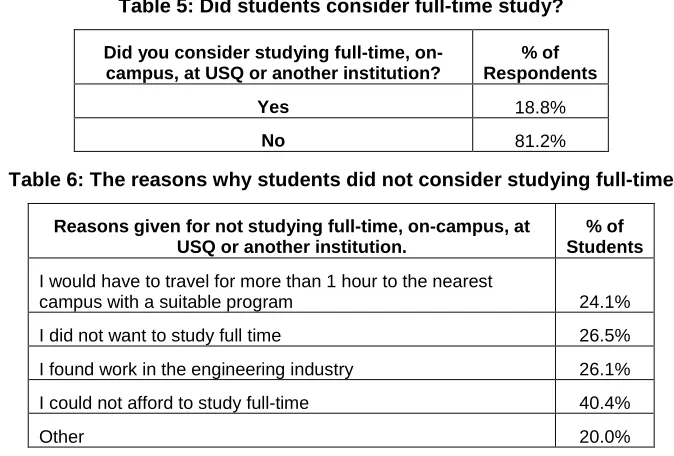
The responses to this question are shown in Table 5. Students who answered ‘No’ were able to indicate why they did not consider studying full-time and the resulting data is shown in Table 6. Students were able to select one or more responses, so the data in the right hand column is the percentage of the number of students who chose that response compared to the total number of students who responded to this question.
Table 5: Did students consider full-time study?
Did you consider studying full-time, on-campus, at USQ or another institution?
% of Respondents
Yes 18.8%
No 81.2%
Table 6: The reasons why students did not consider studying full-time
Reasons given for not studying full-time, on-campus, at USQ or another institution.
% of Students
I would have to travel for more than 1 hour to the nearest
campus with a suitable program 24.1%
I did not want to study full time 26.5%
I found work in the engineering industry 26.1% I could not afford to study full-time 40.4%
Other 20.0%
[image:5.595.127.464.499.727.2]Career aspirations
Two questions explored the student’s employment goals.
Please tick one or more of the following items to indicate what you expect to happen when you graduate from the Associate Degree of Engineering program.
The responses to this question are shown in Table 7. As students were able to select one or more responses when they responded to this question, the data in the right hand column is the percentage of the number of students who chose that response compared to the total number of respondents for that question.
Table 7: Expected changes in employment following graduation
Please tick one or more of the following items to indicate what you expect to happen when you graduate from the Associate Degree of Engineering program.
% of Students
I will stay in the same job and on the same pay rate 13.0% I will change jobs but stay in the same organisation 26.3%
I plan to apply for a job in another organisation 20.6%
I will receive a pay rise 48.2%
I will be eligible for promotion 39.3%
Other 17.0%
The data shows that nearly half of the students expect to receive a pay rise when they graduate, and nearly 40% expect to be eligible for promotion. Only 13% expect to stay in the same job and on the same pay rate. The written responses in the ‘Other’ category were quite varied. Interestingly, some students expect to use the qualification to support their work in an existing or new career in a non-engineering field. For example, one student works in the insurance field and will use his newly gained engineering knowledge and skills to inform his actuarial work.
What is your career goal?
The responses to this question are shown in Table 8 which shows that more than 62.7% of the students aspire to work as a Professional Engineer and only 13.4% expect to work as an Engineering Technician in the long term.
Table 8: The career goals of Associate Degree of Engineering students
What is your career goal? % of Respondents
To work as an Engineering Associate 13.4% To work as an Engineering Technologist 8.7% To work as a Professional Engineer 63.0%
Other 14.6%
The three most popular ‘Other’ career goals were:
To become a manager, project manager, or a business manager
To become highly skilled in their current technical field – a ‘master’.
To become a highly skilled designer
Future study plans
Two questions explored the future study plans of the students enrolled in the Associate Degree of Engineering program.
When you graduate from the Associate Degree of Engineering program do you plan to enrol in another program?
Table 9: Student plans for further studies
When you graduate from the Associate Degree of Engineering program do you plan to enrol in another program?
% of Respondents
Yes 81.4%
No 18.6%
Table 10 provides an indication of the programs the students plan to study. Surprisingly, more than 65% of the students indicated that they plan to study the Bachelor of Engineering program while only 24% plan to study the Bachelor of Engineering Technology which is, logically, the next step in the articulation pathway.
Table 10: Programs identified for further study
Which program?
% of Respondents
Bachelor of Engineering Technology 24.0%
Bachelor of Engineering 65.5%
Other 10.5%
The three most common answers in the ‘Other’ category were:
I am undecided at this time
Another engineering discipline
A postgraduate program in engineering
How important is it for you that you receive full credit for your Associate Degree courses when you transfer into a higher level program in the same field, such as the Bachelor of Engineering Technology?
The responses to this question are shown in Table 11 which shows that 96% of the students believe it is important or very important that they receive full credit for their prior studies when they articulate to one of the engineering degree programs in the same field.
Table 11: The importance of credit for prior studies
How important is it for you that you receive full credit for your Associate Degree courses when you transfer into a higher level program in the same field, such as the Bachelor of Engineering Technology?
% of Respondents
Very important 85.3%
Important 11.4%
Not important 3.3%
Discussion
The results of the survey provide an important insight into the reasons why the students chose to undertake the Associate Degree of Engineering program, and into their future career and study plans. The key findings are discussed in the following sections.
Program selection
The results suggest that more than 80% of the students believed they were qualified to undertake a university degree program but most chose not to, with 81% reporting that they did not consider full-time study. Instead, they undertook the Associate Degree of Engineering program part-full-time by distance education. While 40% of the students cited the high cost of full time study as the reason for their decision, the majority chose the program because it was recommended by their employer, or because it was a condition of their employment. A small number of the students selected the program because it was the first step in a defined articulation pathway and it allowed them to try university studies and, if successful, continue on their pathway to a degree program. Others liked the program because it enabled them to graduate in half the time it would take to complete a Bachelor of
The key finding was that there is a large pool of qualified people who cannot afford to, or do not want to, study full-time at university. This suggests that universities and employers should work together to provide and promote efficient and attractive pathways for people to undertake part-time engineering studies. This strategy may help to build the total number of students that commence engineering studies and, in time, help to alleviate the current skills shortages, particularly in regional areas.
King reported that, ‘Employers commented that much regional engineering work, particularly in infrastructure research and maintenance, and in operations in specific manufacturing and process industries, has characteristics and is conducted in locations that graduates from metropolitan
universities do not seek. Non-metropolitan communities strongly desire students from regions to have the opportunity to study and then practice in engineering, both in their regions and beyond’(King 2008, p40).
The results from this survey provide some evidence to support King’s assertion that, ‘More detailed work needs to be undertaken on the value and need for Associate Degrees in engineering, with the principle driver being to better meet the total employment demand for engineering officers’(King 2008, p14).
The fact that the majority of the students entered the program because of their employment rather than as result of the program’s reputation or the university’s marketing campaigns, prompted the author to develop a questionnaire to be completed by the employers and/or supervisors of the students who participated in the survey. The aim of the questionnaire is to identify:
The reasons why they employed a student.
The reasons why they offered a traineeship, and the conditions of the traineeship.
The reasons why they encouraged the student to undertake the Associate Degree of Engineering program.
Any government policies, taxes or other charges they believe discourage employers from employing and/or supporting part-time university students.
Any actions that they believe the University could take to encourage employers to offer a traineeship.
Any actions that the Faculty could take to better support students during their studies.
The online questionnaire will be distributed to employers and supervisors in May 2010.
Career aspirations and future study plans
The fact that nearly 81% of the participants plan to undertake further study and that nearly 63% of them have a career goal to work as a Professional Engineer, highlights the importance of providing efficient articulation pathways for these students. The data suggests that, from the students’
perspective, the most important articulation pathway is between the Associate Degree of Engineering program and the Bachelor of Engineering program, despite the fact that the designed pathway is to the Bachelor of Engineering Technology program. This finding from the part-time student community suggests that the students do not value the Bachelor of Engineering Technology. If true, they are aligned with the opinions of the academic and industry communities who have ‘considerable ambivalence towards three-year engineering (B.Tech) degrees and the engineering technologist occupation’(King 2008, p41).
An efficient, and stepped, articulation pathway is important, particularly for part-time students as they can take at least twice as long to complete a program. The separate awards they gain along the way are important milestones for these students as they may receive a pay rise, be promoted, or use the award to gain a new position with a different employer.
The results also support the Faculty’s decision to design the Associate degree of Engineering so that it achieves the dual aims of:
1. enabling students to meet the academic requirements for them to practice as an Engineering Technician; and
2. providing them with efficient articulation pathways to the Bachelor of Engineering Technology and Bachelor of Engineering programs.
To test this hypothesis, the author has developed a questionnaire for on-campus students enrolled in an engineering Associate Degree or Advanced Diploma program at a university or VET institution. The online questionnaire is similar to, but more extensive, than the one discussed in this paper and was delivered to the students at seven institutions in April 2010.
It is recommended that similar studies should be undertaken in other countries to see if the findings from this study are replicated for their Engineering Technician student cohorts.
The final stage of this project will be to track the progress of the participants in their current and, where appropriate, their future programs to see how many of them achieve their career goal, whether it was to work as an Engineering Technician, an Engineering Technologist or as a Professional Engineer.
Conclusion
The results of a study of more than 247 part-time, distance education students in an Australian Associate Degree of Engineering program found that 63% of those students have a career goal to become a Professional Engineer. Surprisingly, only 13.4% of the respondents intend to pursue a career as an Engineering Technician as they see the Associate Degree as a stepping stone to the Bachelor of Engineering program. This unexpected result challenges a long-held assumption that students in Australian Advanced Diploma and Associate Degree programs will pursue careers as Engineering Technicians. These findings should be used by engineering educators to inform future program reviews and to develop efficient articulation pathways, and by employers and industry organisations to develop strategies to address the current skills shortages in the engineering industry.
References
EA (2009)Engineering Associate Stage 1: Units and Elements of Competency. Engineers Australia. Available from http://www.engineersaustralia.org.au/education/program-accreditation/program-accreditation.cfm [accessed 8 February 2010]
EA (2006)Accreditation Criteria Guidelines; Document No. G02, Accreditation management system. Engineers Australia. Available from http://www.engineersaustralia.org.au/education/program-accreditation/program-accreditation.cfm [accessed 8 February 2010]
IEA (2009a)Graduate Attributes and Professional Competencies, Version 2, 18th June 2009, The International Engineering Alliance. Available from http://www.washingtonaccord.org/ [accessed 8 February 2010] IEA (2009b)Dublin Accord, The International Engineering Alliance. Available from
http://www.ieagreements.org/Dublin/ [accessed 8 February 2010]
IEA (2009c)Rules & procedures, International Education Accords,The International Engineering Alliance. Available from http://www.ieagreements.org/Rules_and_Procedures.pdf [accessed 8 February 2010] Joint Quality Initiative (2004)Shared ‘Dublin’ descriptors for Short Cycle, First Cycle, Second Cycle and Third
Cycle Awards. Available from, http://www.jointquality.nl/ [accessed 8 February 2010].
King, R. (2008)Engineers for the Future: addressing the supply and quality of Australian engineering graduates for the 21st century, An Australian Learning and Teaching Council funded project, Australian Council of Engineering Deans, Sydney.