
IOT Based Child Safety Device
Bhogamma1, Veeresh Pujari2, Baswaraj Gadgay31PG Student, VTU Regional Centre for PG Studies, Kalaburagi Karnataka, India 2-3Professor, VTU Regional Centre for PG Studies, Kalaburagi Karnataka, India
ABSTRACT
This work mainly focuses on alerting the individuals arround baby so as to locate the baby in safer zone before arrival of the parent. Among all the available wearable devices focusing on the conditions to provide the locality, action and so forth of the child to the parents via wireless Wi-Fi and Bluetooth, Bluetooth and Wi-Fi (wireless fidelity)becomes a very inconsistent resource to the communication. Hence by the implementation of IOT technology it is planned to use SMS/MAIL as the method of communiqué between the parent and child wearable device. This project development uses the Arduino Uno microcontroller board based on ATmega328P.The function of receiving SMS(message) or MAIL and calls are all due to the internet connection to Arduino UNO by NODE Mcu. The supplementary modules are employed which will provide the present situation of the child via message/MAIL. The external alert systems included here is to indicate the distress condition is SOS Light indicator and Alarm Buzzer to produce sound, both are programmed in Arduino UNO board.
Keywords : SMS/MAIL, UNO, SOS, UV Radiation, IFTTT
I.
INTRODUCTIONThe IOT (internet of things) system interconnect a set of devices by means of existent world sensors and actuators to the internet. IOT includes the number of systems like wearable devices, elegant cars and even human entrenched devices, home automation systems and illumination controls; smart phones are most of the times used to measure the globe around them. Weather conditions, tides, flood defences can be measured by sensor network. The two important aspects of IOT are: device scheme and server architecture both supports to IOT. The reason for this wearable is to increase the protection to childrens. Lost child can be tracked in crowded area.
To signify that the child needs assistance the individuals around the child are alerted so as to indicate child is in some harmful environment it
micro system and a low power NODE Mcu(Wi-Fi) module. The designed device communicates with the parent through SMS (message) or MAIL to make sure that there is a secured communication bond. Design can be Customised by reprogramming the Arduino system.
1.2 Motivation
The inspiration for this wearable comes mainly from the ever-increasing need of safety for small children in present times because there may be a chances of child lost in the major crowded areas. This manuscript mainly focuses on the key features of missing child can be helped by the individuals present around the child and plays an important role in the child's safety until reunite the parent to that location. Also, If child will not be taken care by the care taker this project is more helpful for the parent so that they can alert the care taker irrespective of their present location. Plenty of wearable’s are available nowadays and they are purposeful to provide the spot location, action and so on. In the scenario, a lost child can be located, care taker can be alerted by the people around the child by activation of secondary measures (SOS Light and Buzzer) and also parent can talk to device same application is reflected by the person around the child side too.
1.3 Objective
Objective behind this project is to make the process smart and as well it enhancess the performance of the overall system by using IOT technology. Information about the child can be observed by the parents from any where in the world this is though the IOT technology, Hence parents can get continuous real time information about the environmental condition arround the child. This project is to provide safety to child because they were unaware of the surrounding environment like UV Radiation, Temperature, Objects of unwanted when comes near by the child this system sends regular information to the parent
and take care person so that they can get alert and provide safety to the child. This system is the safeguard alert one but not the self secure system. This wearable can be used in any cell phone (internet connectable) compared to other available wearables and does not require any expensive smart phone and not even a technically skilled person to operate it.
II.
METHODS AND MATERIAL
DESIGN METHODOLOGY
Fig 1. Block diagram
A. System Overview
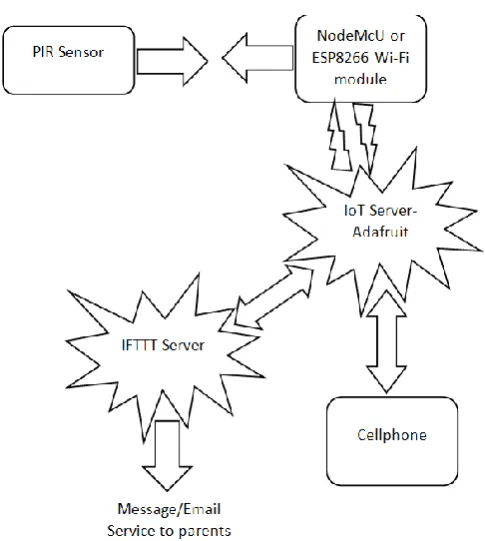
Then That) Server.T he continuous message/E-mail service to parent cellphone is sent by IOT System.
Arduino uno microcontroller receives information from all the different modules connected to it, and this will be programmed in such a way that if Temperature around the exceeds or become hazardous to the child then through Arduino uno GSM shield the microcontroller receives the information. In order to send this information to parents Arduino uno microcontroller does not has the Wi-Fi or internet with it, hence the NODE Mcu will be used because it has the Wi-Fi chip, the received information from the microcontroller will be connected to IOT which is triggered by IFTTT Server then parent gets message/mail to their cellphone.
Similarly UV Sensor senses the different radiations from the sun if those radiations are hazardous to the child then Message will delivered to parent.The proximity sensor detects the objects near by the child within the specified range. The IP Camera is used to view the physical condition around the child. The secondary measure used here are the SOS(signal on Strenth) Light and Distress Alarm BUZZER, which alerts the people near by the child by blinking the high intensity light and by producing the sound respectively. In order to receive the message/E-mail and to view the physical condition User cellphone should have Adafruit server And V380 App for both the processes. The 16x2 LCD Display is used to display the sensor output continuously.
B. Wearable IOT Device
Fig 2
The proposed design shown in above figure determines the IOT Based child safety wearable device. When it designed as a product it will be a smart wearable device but now the design is not as a SOC model. In this the main applications used are Temperature sensing, UV Radiation sensing, Object detection by PIR sensor. The camera module is used to view the physical atmosphere around the child parent can also Talk to device, make the video record of the and take the snapshot of the image. In order to store these all result device does not has sufficient storage capacity hence en external storage SD card will be used for future use. In addition to this the supplementary measures called SOS Light and Alarm Buzzer is used to indicate the need of help.
1. TEMPERATURE Sensor
temperature range and draws only 60 μA from the supply, it has very low self-heating of less than 0.1°C in still air. It operates on 3.3V to 5.5V supply. It has a 3-pins connected to input, output and ground.
2. UV Sensor
In order to measure the ultraviolet radiation intensity present around the surroundings of the child. The sensor works by outputting electrical signal which alters with UV intensity. It is a highly sensitive sensor. Ultraviolet (UV) radiation constitutes a portion of the electromagnetic spectrum from 100 to 400 nm, and is further subdivided into three wavelength ranges: UV-A (315 to 400 nm), UV-B (280 to 315 nm) and UV-C (100 to 280 nm). Much of the UV-B and all of the UV-C wavelengths from the sun are absorbed by the Earth’s atmosphere. There are also many artificial UV light sources available that output a selective wavelength range or offer a broadband UV radiation source. The sources of UV Radiations are Sun light(very high), Electric arc(very high), UV curing lamp and Mercury vapour lamp(Medium).Due to the transition of electrons in solid state LED light also constitutes UV Radiations.Continuous change in temperature will be updated to parent through SMS/MAIL.
3. PIR Sensor
PIR sensors used to detect and sense the motion of objects arround the child that has moved in or out of the sensors range, for small PIR sensor range will be 10m( thirty feet) and for wide PIR range its 100 feets. They are small, inexpensive, low-power, easy to use and don't wear out. For that reason they are commonly found in appliances and gadgets used in homes or businesses. They are often referred to as PIR, "Passive Infrared", "Pyroelectric", or "IR motion" sensors. PIRs are basically made up of pyroelectric materials. IR sensor not only measures the heat but also detects the objects. Detection of PIR can be known by receiving SMS/MAIL to parent cell phone.
4. CAMERA module
For surveillance of the child's surroundings, to get a clearer picture of the location, this wearable can also contain a camera module incorporated in it. The hardware that could be used would be adafruit TTL serial camera. . Since the major focus of this wearable project is the IOT Based one because which is a better alternative than GSM, Bluetooth, Wi-Fi or ZigBee due to the short range and connectivity issues of these technologies. Therefore, for this project using the IOT technologies is beneficial as it is available everywhere and since all the communication between the wearable and the user is taking place via SMS/E-mail continuously. the camera module which supports video streaming.
5. SOS Light and Alarm Buzzer
The another theory that this paper focuses on is that bystanders are the fust mode of help for a missing child. The purpose of the SOS light is to be able to alert the people nearby that the child might be in distress since the light will be flashing the universal SOS light symbol which many people now a days know for to be a sign for help.In the same way Alarm BUZZER used to produce the sound.
6. 16X2 LCD Display
LCD (Liquid Crystal Display) screen is an electronic display module and has a wide range of applications. The 16x2 LCD display is very basic module and is most commonly used in various devices and circuits. These modules are preferred over seven segments and other multi segment LEDs. The 16x2 LCD means it can display 16 characters per line and there are 2 such lines. It contains each character will be displayed in 5x7 pixel matrix.
C. GATE way
Fig 2
The Uno is a microcontroller board based on the ATmega328P. Arduino UNO has 14 digital input/output pins among those pins 6 can be used as PWM outputs, 6 pins are analog inputs, and has 16 MHz quartz crystal, USB connection, a power jack, an ICSP header and a reset button. It consists of microcontroller with USB cable connected to computer and it can be powered by using AC-to-DC adapter or battery.
All the modules are connected to ARDUINO UNO board and it does not has Wi-Fi chip with it hence to provide internet connection to this Node Mcu(ESP8226) Wi-Fi enabeled chip is used. Arduino receives informations from all the modules when Wi-Fi is connected (IOT is in active network) to it then real world data will be sent to parent cell phone through SMS/MAIL. The LCD will displays the continuously and SOS Light, buzzer activates when normal specified conditions around the child exceeds.
2. Cell phone APP interface
User cell phone should have V380 APP to view the camera module results and also to talk with device, take snapshot of image around the child, make video record of child. The other interfaced server that user need to use is ADAFRUIT IO Server. User should Login to this server so that continuous updates of temperature, UV Radiation levels and object detection by PIR can be known from this server.
III. RESULTS AND DISCUSSION
The output of all the modules connected to Arduino UNO board will be displayed in LCD screen which are shown in bellow figures. Fig 1 represents normal operation of the device as monitoring. Fig 2 shows when temperature around the child exceeds above the specified range. Fig 3 indicates when PIR sensor detects the object, and finally fig 4 point out when UV level exceeds the specified range. Finally fig 5 shows the Camera module output cell phone.
Fig. 3 Continuous monitoring result display
Fig. 4 Temperature alert diplay result
Fig. 5 PIR Detect display result
Fig. 6 UV sensor detected result display
Fig. 7 Camera Module result display
IV. CONCLUSION
used from anywhere individual to operate. This device helps parents to observe their children with ease. At the moment there are many wearables in the market which help track the daily activity of children and also help find the child using IOT services present on the device and it can be accessed everywhere. Therefore, the focus of this project is to have an IoT enabled communication medium between the children’s wearable and the parent as the environment for IoT communication is almost present everywhere. The parent can visit to the dash board/website and check the status of child from anywhere. The wearable device will update in log sheet text containing the real time accurate parameters of the child and will also provide the surrounding temperature, UV radiation index so that the parents can keep track if the TEMPERATURE, UV radiation is not suitable for the child. Parent view the physical environment present around the child through Camera at any time and also if any objects comes near by the child PIR Sensor detects it and the secondary measure called here SOS Light And Distress Alarm BUZZER activate and produces high intensity light and sound with high pitch respectively. Hence this project aims at providing parents with a sense of security for their child in today's time.
V.
REFERENCES
1. Jun Zheng; Simplot-Ryl, D.; Bisdikian, c.; Mouftah, H.T., "The internet of things [Guest Editorial]," in Communications Magazine, IEEE , vo1.49, no.ll, pp.30-31, November 2011 doi: 10.1109/MCOM.2011.6069706
2. S Nasrin and P. 1. Radcliffe, "Novel protocol enables DIY home automation," Telecommunication Networks and Applications Conference (ATNAC), 2014 Australasian, Southbank, VIC, 2014, pp. 212-216.
3. F A. Silva, "Industrial Wireless Sensor Networks: Applications, Protocols, and Standards [Book
News]," in IEEE Industrial Electronics Magazine, vol. 8, no. 4, pp. 67-68, Dec. 2014.
4. H Moustafa, H. Kenn, K. Sayrafian, W. Scanlon and Y. Zhang, "Mobile wearable communications [Guest Editorial]," in IEEE Wireless Communications, vol. 22, no. 1, pp. lO-l1, February 2015.
5. B Dorsemaine, 1. P. Gaulier, 1. P. Wary, N. Kheir and P. Urien, "Internet of Things: A Definition and Taxonomy," Next Generation Mobile Applications, Services and Technologies, 2015 9th International Conference on, Cambridge, 2015, pp. 7277.

![Presentasjon og kommentarer til norsk utgave av C Mullers bok “Lingvistisk Statistikk” (Presentation and comments on the Norwegian edition of C Muller’s book “Linguistic Statistics”) [In Norwegian]](data:image/gif;base64,R0lGODlhAQABAIAAAP///wAAACH5BAEAAAAALAAAAAABAAEAAAICRAEAOw==)