Original Research Article
Effects of training on coding accuracy of obstetrical
diagnosis in Naili DBS Hospital
Ressa Oashttamadea*
INTRODUCTION
Health financing is fundamental to the ability of health systems to maintain and improve human welfare. At the extreme, without the necessary funds no health workers would be employed, no medicines would be available and no health promotion or prevention would take place.1 Hospital medical billing is the process of submitting and following up on claims to insurance companies in order to receive payment for services rendered by hospitals. The hospital billing process begins when a patient arrives to the hospital for diagnosis and treatment of an injury, illness, disease, or condition. Until the patient‟s departure, all of the services and items provided are recorded to patient‟s account. In the next step, all information and
charges are processed for billing based on the requirements of insurance companies, which generally have reimbursement rules. During the billing process, if a hospital does not meet the requirements of an insurance company, stoppages to hospital payments and fines to the hospitals are generally charged.2
Accurate billing is crucial for the financial health of medical institutions. Billing and coding are based on what services are documented by the provider and selection of the appropriate code is most commonly done by the provider or a coding specialist.3 Medical coding is the transformation of healthcare diagnosis, procedures, medical services, and equipment into universal medical alphanumeric codes. It can be subsequently used for
ABSTRACT
Background: The accuracy of clinical coding is very important in the proper financing of health care centers. During January to February 2019, only 35 out of 60 obstetrical cases that were well coded (58%) in Naili DBS Hospital and this miscoding would led to a big financial loss. The aim of this study is to determine the effect of training on coding accuracy.
Methods: This study was conducted during April 2019 in Naili DBS Hospital using quasi experimental method, with one group pretest and post-test design. All 11 participants were given a pretest consisted of 10 long cases (maximum score=38) and the training was conducted based on the identified needs from the preliminary audit. They were then given a post-test to see the effect of the training.
Results: The mean score of pretest was 10.7 and the mean score of post-test was 19.7. The individual scores were normalized and then analyzed using SPSS with paired sample T-test. Based on statistical analysis, p<0.005 meaning the traning is statistically significant on improving the coding accuracy in obstetrical diagnosis.
Conclusions: The training has significantly improved the score of well coded obstetrical diagnosis, even though the participants have not reached the maximum score. Furthermore, our study suggests that it is important to analyze the coders‟ performance months after the training by conducting a coding audit.
Keywords: Coding accuracy, Miscoding, Training, Obstetrical, ICD 10
Department of Medical Record and Health Information Management, Apikes Iris, Padang, Indonesia
Received: 12 September 2019
Accepted: 11 October 2019
*Correspondence:
Dr. Ressa Oashttamadea,
E-mail: [email protected]
Copyright: © the author(s), publisher and licensee Medip Academy. This is an open-access article distributed under the terms of the Creative Commons Attribution Non-Commercial License, which permits unrestricted non-commercial use, distribution, and reproduction in any medium, provided the original work is properly cited.
clinical care, research, and other purposes. The code is measured in detail in order to accurately describe diagnoses (i.e. what is wrong with the patient) and the procedures performed to test or correct these diagnoses. The diagnoses and procedure codes are taken from medical record documentation, such as transcription of physician's notes, laboratory and radiologic results, etc. Medical coding professionals help ensure the codes are applied correctly during the medical billing process, which includes abstracting the information from documentation, assigning the appropriate codes, and creating a claim to be paid by insurance carriers. Because medicine is not an exact science, codes were developed to identify all reasons for seeking healthcare. Codes also allow insurance providers to map equivalences across different healthcare providers who may use different terminologies or abbreviations in claim forms.4,5
The standard of medical coding for diagnosis that is widely used around the world is The International Statistical Classification of Diseases and Related Health Problems (ICD). ICD is published by the World Health Organization (WHO) and is a classification of diseases, signs and symptoms, abnormal fidings and complaints, social circumstances, and external causes of injury or disease. ICD is used for tracking morbidity and mortality statistics and within reimbursement systems. ICD-10 is the 10th revision of this classification system and replaced the ICD-9 classification that was fist adopted in 1975. WHO has authorized the development of an adaptation of ICD-10 for use in the United States (ICD-10-CM). All modifications to ICD-10 must conform to WHO conventions for the ICD. Although ICD was developed for collection of statistical data and disease classification, it is also an important part of reimbursement models. ICD codes are used to facilitate payment of claims, evaluate utilization patterns, and review health care costs. The ability to communicate the justification for clinical services/medical necessity through reporting diagnosis codes is enhanced by the increased specificity of ICD-10-CM. ICD-10-CM is also expected to be an important tool in the move towards value-based purchasing because of its potential to disclose more information about quality of care and improved tracking of outcomes of care. This information can then be used to design more effective algorithms for clinical decision-making and to support clinical research.6 The accuracy of clinical coding is very important in the proper financing of health care centers. In a study conducted by Cheng at a tertiary trauma center in Australia, it was found that of the 100 medical records reviewed, 28% experienced errors in casemix that led to errors in financing. In another study of the causes and consequences of coding errors in a hospital in Australia, researchers found that from November 2004 to April 2005 there were 15.7% incorrect codes in the surgery department or equivalent to a financial loss of AU$ 575,290.80. An audit commission in the United Kingdom also found that during the financial year of 07/08 there
were 16.5% error coding and diagnostic procedures or the equivalent of £9 million.7,8
Based on preliminary survey, the obstetrics department is one of most visited department in Naili DBS Hospital during 2018. During January to February 2019, only 35 out of 60 obstetrical cases that were well coded (58%), and this miscoding would led to a big financial loss for the hospital. The hospital has never done any training regarding this case before, therefore the aim of this study is to give training for coders and analyze the effect on coding accuracy of obstetrical diagnosis, before and after training.
METHODS
This research was conducted during April 2019 in Naili DBS Hospital using quasi experimental method. A quasi experimental method is a study used to determine whether there is a result of something imposed on the subject by looking for the effect of certain treatments. The type of quasi experiment in this study was one group pretest and post-test design. This design is a technique to determine the effect given before and after treatment.
A clinical coding audit was conducted prior to study to establish the baseline quality of clinical coding at Naili DBS Hospital and the training was conducted based on the identified needs from the audit. This one day training was open to all coders in Naili DBS Hospital who are in charge of medical coding in Medical Records Unit.
All 11 participants were given a pretest consisted of 10 long cases. Each case had a primary and secondary diagnosis with the maximum score of 38. The topics of the training are: diagnostic coding of 1) abortus; 2) hyper-tension in pregnancy, childbirth, and puerperium; 3) diabetes in pregnancy, childbirth, and puerperium; 4) maternal care and delivery; and 5) other maternal conditions complicating pregnancy, childbirth, and puerperium. After the training, all participants were given a post-test of the sama cases to see the progress they‟ve made.
After the scores from pretest and post-test were calculated, the data was analyzed using SPSS with paired sample T-Test.
RESULTS
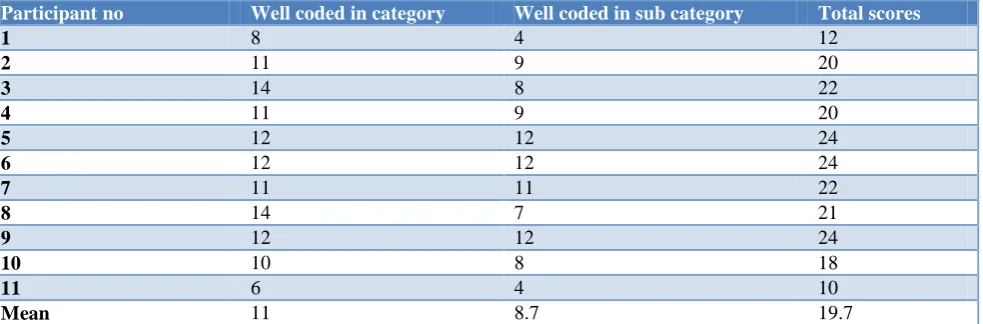
The data was collected from 11 participants (all coders in Naili DBS Hospital). The test maximum score is 38, and the result of pretest and postest are scored as well coded in category and subcategory based on ICD 10 coding rules. The result of the tests are shown in Table 1 and 2.
statistical analysis, p<0.005 meaning the training is statistically significant on improving the coding accuracy
in obstetrical diagnosis. The statistical analysis result is shown in Table 3.
Table 1: Pretest scores.
Participant no Well coded in category Well coded in sub category Total scores
1 7 2 9
2 10 7 17
3 6 2 8
4 10 7 17
5 7 5 12
6 5 5 10
7 3 2 5
8 10 4 14
9 4 3 7
10 6 4 10
11 6 3 9
Mean 6.7 4 10.7
Table 2: Post-test scores.
Participant no Well coded in category Well coded in sub category Total scores
1 8 4 12
2 11 9 20
3 14 8 22
4 11 9 20
5 12 12 24
6 12 12 24
7 11 11 22
8 14 7 21
9 12 12 24
10 10 8 18
11 6 4 10
Mean 11 8.7 19.7
Table 3. Paired sample T-test.
Paired Differences
t df Sig.
(2-tailed)
Mean Std. deviation
Std. error mean
95% CI of the difference Lower Upper
Pair 1 Total pre-
Total post -9.000 6.033 1.819 -13.053 -4.947 -4.948 10 0.001
DISCUSSION
According to Regulation of the Minister of Health No.269/Menkes/Per/III/2008 medical records are files that contain records and documents about patient identity, examination, treatment, actions and other services that have been given to patients. The main use of medical records is as evidence of the patient's illness (doctor's diagnosis) and treatment that has been given, communication tools among health staff who provide care to patients, sources of information for research and education, and as sources in collecting health statistics. A good medical record contains complete data and can be processed into information.9 The main responsibility for completing the medical record lies in medical personnel
on disease and procedural coding is fundamental in eliminating the inconsistency. Resultantly, there would be accurate research, improved adherence to the set standards, improved reliability of data on cause of death and higher capacity to conduct ICD certification and coding. Over time, health information systems, health data and disease classification professionals have been involved in the clinical coding process, yet the variation in results still exists. Several studies conducted within the field of classification of disease, the effectiveness of the ICD and the challenges that face the implantation of the ICD codes reveal particular gaps in training. After a training on quality of clinical coding at Mbagathi County Referral Hospital, Kenya, the overall code accuracy was fair given that slightly more than half (55%) of the code assignment were well coded. After training, however, the overall quality of clinical coding improved by 18%.10 It is evident that good documentation of patient information by clinicians will minimise coding errors and optimise reimbursement. Shaihid and Tindal reported that mistakes in the documentation of orthopaedic procedures caused an annual average loss of £118,056. From a study of Mahbubani, dkk the involvement of a fully registered doctor with the GMC of the UK who has completed 2 years of basic clinical training improved the accuracy of the coding process. The clinician helped the coders with the auditing workload and could provide help regarding medical issues and poorly documented diagnoses, while the auditors could teach the clinician about the coding process and inform them of the key problems faced. This resulted in a higher remuneration equating to an increase of £318 per patient.11
Other than good documentation; good communication and understanding between all health professions in the hospital also played a role in increasing the accuracy of the codes. In the hospital setting, the role of improving health and function is shared across all health professionals of the aim of successful discharge and reduced admissions. A great understanding of each other‟s clinical roles could improve the transition from medical to functional goals. Allied health staff noted that they were more likely to read other allied health professions‟ notes if there was a substansial relationship between them. The use of jargon and unapproved abbreviations was said to undermine readers‟ ability to extract information. Thus, informational continuity which is reliat to the transmission of accurate information from one discipline to another provide appropriate care based on previous care will be impaired. Verbal transfer of clinician information was reported to be preferred by many. Some participants read and used the written notes and sought verbal clarification for recommendations about the plan. There was a stated reference for verbal discussion of patient care which could potentially lead to different information being transferred between written and verbal intructions. Therefore, verbal clarification and interpretation may be used to assist readers‟
understanding and enable transfer of clinical information in the allied health notes.12
It has been suggested that education at graduate level, rather than undergraduate, is recommended to focus on enhancing inter-professional knowledge, skills, and attitudes to affect the way professionals practice. Therefore, the information needed to support improvements in a patient‟s health and function also changed over inpatient time and by profession.12 Based on another researches, an education or a training was suggested to improve healthcare professionals understanding of coding so that the accuracy of the codes can be improved. A study from Mahbubani dkk highlighted the value of clinician input in several ways. For example, one of largest increases in tariff (£4,475) was due to a change from a diagnosis of „hallucinations‟ to „urinary tract infection‟. The discharge summary had stated that the diagnosis was delirium. Although this is clinically correct, accurate coding requires the cause of the delirium to be identified where possible. Overall, the recommendation for inclusion of clinical staff involved in the patient journey as part of the coding process is a clear one, given the above results. Not only does the coding team benefit from the knowledge of the clinician, but the doctor also learns about the coding process, allowing them to improve their documentation appropriately in the future.11
Another previous study from Joose, dkk showed that a dedicated course on injury coding using the AIS98 significantly improved the overall percentage of correctly coded injuries and correctly assigned injury severity at the Trauma Centre Brabant in the Netherlands. The learning effect of a course seems to last, as the results of this study showed improved performance scores until six weeks after the course.13
Accurate coding not only benefit the hospital in billing and financial matters, but also benefit towards hospital governance, in terms of understanding the underlying activity so that resources may be better allocated and organised. Similarly, there are wider implications, at national and international level, as such codes are also used to estimate disease incidence and prevalence along with temporal and geographical variation. Indeed, such benefits afforded by precise coding would survive any change in hospital financing away from a PbR system.11 In a study conducted by Horsky, just over a half (56%) of all entered diagnostic codes were rated as appropriate and about one quarter were omitted.15 The reasons behind this miscoding can be: first, the clinicians entering codes are not adequately trained to understand the requirements and nuances of the ICD 10 coding system. Additional training and specialized resources may be necessary at many institutions. Second, the design of query systems in EHRs may negatively affect the code selection process and lead clinicians to choose a less specific or less desirable code. Lastly, accurate understanding of the meaning of a particular
code, especially those that indicate “unspecified,” is often possible only within the context of the code hierarchy. Clinicians therefore may need to have a good working knowledge of the ICD-10 structure to correctly identify what is unspecified and what may need to be specified. The core objective of decision support interventions is to assist them with this comparison by clearly contextualizing the returned candidate entries as the code set is too large and complex to be effectively learned in its entirety. The lack of appropriate coding may also affect reimbursement rates, especially with increased adoption of alternate payment models that rely on case-mix analysis to adjust financial reimbursement, as well as on potential utility of ICD-10 codes for research and other purposes.15
Other than training, it is also important to audit medical record documentation and coding application as a strategy for achieving compliance and reducing billing errors. When medical bills are submitted with missing and incorrect information, they may result in unpaid claims and loss of revenue to physicians. Health care is, no doubt, a costly endeavor for health care providers, consumers and insurers. The potential risk to physicians for improper billing may include loss of revenue, fraud investigations, financial sanction, disciplinary action and exclusion from participation in government programs. It is recommended to create an approach for assessing potential risk, preventing improper billing, and improving financial management of the medical practice.16
In this study, one day training has significantly improved the mean score of well coded obstetrical diagnosis. The fact that the coders have never received any spesific training or workshop in coding may be one of several factors causing miscoding in Naili DBS Hospital. Furthermore, our study suggests that it is important to
analyze the coders‟ performance months after the training by conducting a coding audit.
CONCLUSION
Based on statistical analysis, p<0.005 meaning the training is statistically significant on improving the coding accuracy in obstetrical diagnosis, even though the participants have not reached the maximum score. Furthermore, our study suggests that it is important to analyze the coders‟ performance months after the training by conducting a coding audit.
ACKNOWLEDGEMENTS
Thank you to Apikes Iris which has funded this research and to Naili DBS Hospital, especially the coders, who have been pleased to be the object of this research.
Funding: This research was funded by LPPM Apikes Iris (Board of Research and Community Engagement of Apikes Iris)
Conflict of interest: None declared Ethical approval: Not required
REFERENCES
1. WHO. Health systems financing. 2008. Available at: https://www.who.int/healthinfo/statistics/toolkit_hss /EN_PDF_Toolkit_HSS_Financing.pdf. Accessed on 20 February 2019.
2. Dasdemir E, Oguz MM, Atalay M, Bilgin V, Testik MC, Soydan G. Improving hospital billing processes for reducing cotsts of billing errors. Euro Network Business Industrial Statistics. 2013: 1-11.
3. Korb PJ, Scott SJ, Franks AC, Virapongse A, Simpson JR. Coding and billing issues in hospital neurology compensation. Neurol Clin Pract. 2016;6(6):487-97.
4. AAPC. Medical coding. Available at: https://www.aapc.com/medical-coding/medical-coding.aspx. Accessed on 18 January 2019.
5. Adeleke IT, Ajayi OO, Jimoh AB, Adebisi AA, Omokaye SA, Jegede MK. Current clinical coding practices and implementation of ICD-10 in Africa: a survey of Nigerian hospitals. Am J Health Res. 2015;3(11):38-46.
6. American Congress of Obstetricians and Gynecologists. Diagnostic coding in obstetrics and gynecology. ACOG. 2016.
7. Cheng P, Gilchrist A, Robinson KM, Paul L. The risk and consequences of clinical miscoding due to inadequate medical documentation: a case study of the impact on health services funding. Health Inf Manag J. 2009;38(1):35-46.
9. Musriati, Indar, Abdullah MT. Management of medical record in installation of inpatient regional public hospital Batara Guru Belopa. Int J Community Med Public Health. 2019;6(7):2772-7. 10. Gachoka JK, Otieno GO, Yitambe AO. Effects of
training on quality of clinical coding at Mbagathi County Referral Hospital, Nairobi City County, Kenya. Int J Innovat Educ Res. 2018;6(1):231-7. 11. Mahbubani K, Georgiades F, Goh EL,
Chidambaram S, Sivakumaran P, Rawson T, dkk. Clinician-directed improvement in the accuracy of hospital clinical coding. Future Healthcare J. 2018;5(1):47-51.
12. Pain T, Kingston G, Askern J, Smith R, Phillips S, Bell L. How are allied health notes used for inpatient care and clinical decision-making? A qualitative exploration of the views of doctors, nurses and allied health professionals. Health Inf Manag J. 2016;1-9.
13. Joosse P, Jongh M, Delft-Schreurs K. Verhofstad M, Goslings C. Improving performance and agreement in injury coding using the abbreviated injury scale: a
training course helps. Health Inf Manag J. 2014;43(2):17-22.
14. Ningtyas NK, Sugiarsi S, Wariyanti AS. Analisis ketepatan kode diagnosis utama kasus persalinan sebelum dan sesudah verifikasi pada pasien BPJS di RSUP Dr. Soeradji Tirtonegoro Klaten. J Kesehatan Vokasional. 2019;4(1):1-11.
15. Horsky J, Drucker EA, Ramelson HZ. Accuracy and completeness of clinical coding using ICD-10 for ambulatory visits. AMIA Annual Symposium Proceedings. 2017;2017:912-20.
16. Adams DL, Norman H, Burroughs VJ. Addressing medical coding and billing. J National Med Assoc. 2002;94(6):430-47.