R E V I E W
Open Access
Fatal anaphylaxis registries data support
changes in the who anaphylaxis mortality
coding rules
Luciana Kase Tanno
1,2,3*, F. Estelle R. Simons
4, Isabella Annesi-Maesano
3, Moises A. Calderon
5, Ségolène Aymé
6,
Pascal Demoly
2,3, on behalf of the Joint Allergy Academies
Abstract
Anaphylaxis is defined as a severe life-threatening generalized or systemic hypersensitivity reaction. The difficulty of coding anaphylaxis fatalities under the World Health Organization (WHO) International Classification of Diseases (ICD) system is recognized as an important reason for under-notification of anaphylaxis deaths. On current death certificates, a limited number of ICD codes are valid as underlying causes of death, and death certificates do not include the word anaphylaxisper se. In this review, we provide evidences supporting the need for changes in WHO mortality coding rules and call foraddition of anaphylaxis as an underlying cause of death on international death certificates. This publication will be included in support of a formal request to the WHO as a formal request for this move taking the 11thICD revision.
Keywords:Anaphylaxis, Classification, International Classification of Diseases, Mortality, World Health Organization
Background
Anaphylaxis definition and epidemiology
Definitions of anaphylaxis for clinical use by healthcare professionals all state the concepts of a serious, general-ized, allergic or hypersensitivity reaction that can be life-threatening and even fatal [1]. In all countries, epidemio-logical and health services research can serve as a baseline for quality improvement, prioritization of anaphylaxis pro-grams, and eventual reduction in morbidity and mortality.
Publications on anaphylaxis epidemiological data have increased in the past few years due to the need to under-stand the status and evolution of this disease more pre-cisely worldwide, improve in order to plan national or global actions to support better management and pre-vention globally and nationally, and support education and awareness. Data can differ widely depending on a number of variables. For instance, European data have indicated incidence rates for all-cause anaphylaxis ranging from 1.5 to 7.9 per 100 000 person/year, with an estimation that 0.3% (95% CI 0.1–0.5) of the population
will experience anaphylaxis at some point during their lifetime [2]. On the other hand, it is estimated that 1 in every 3000 inpatients in US hospitals suffer from an anaphylactic reaction with a risk of death around 1%, accounting for 500 to 1000 deaths annually in this country [3].
In public health terms, anaphylaxis is considered to be an uncommon cause of death [4–9]. The case fatality rate is difficult to ascertain with accuracy. Accurate anaphylaxis mortality data are hampered by the limited recognition of this condition among health professionals, the absence of historical details from eyewitnesses, incomplete death scene investigations, paucity of specific pathologic findings at postmortem examination, and the under-notification of anaphylaxis [9, 10].
Vital statistics: historical background and current standard methods
The first International List of Causes of Death was drafted by Jacques Bertillon and colleagues in 1885. It was prepared based on the principle of distinguishing between systemic diseases and those localized to a par-ticular organ or anatomical site, and officially adopted for use in mortality registries in 1893 [11]. This * Correspondence:[email protected]
1Hospital Sírio Libanês, São Paulo, Brazil
2University Hospital of Montpellier, Montpellier, France
Full list of author information is available at the end of the article
© The Author(s). 2017Open AccessThis article is distributed under the terms of the Creative Commons Attribution 4.0
classification, which was accepted by many countries and has been periodically revised, constituted the basis of the International Classification of Diseases (ICD). Anaphylaxis was not included in the original list because it was not formally described until 1902 [12]. Although a well-known cause of death, particularly in the fields of allergy and emergency medicine, anaphylaxis has never been appropriately classified in the different versions of the ICD, and has never been considered an underlying cause of death on death certificates.
Mortality statistics are widely used for medical re-search, monitoring of public health, evaluating health in-terventions and planning and follow-up of health care. Analysis of mortality data typically involves comparisons of data sets. However, unless the data have been com-piled using the same methods and according to the same standards, comparisons potentially yield misleading re-sults. For these reasons, the World Health Organization (WHO) issued international instructions on data collec-tion, coding and classificacollec-tion, and statistical presenta-tion of causes of death. In most countries, mortality statistics are routinely compiled according to regulations and recommendations adopted by the World Health Assembly (WHA). The international mortality coding instructions presuppose that data have been collected with a death certificate conforming to the International form of medical certificate of cause of death(Fig. 1) [13]. It is the responsibility of the medical practitioner or other qualified certifier signing the death certificate to indicate which morbid conditions led directly to death and to state any antecedent conditions giving rise to this cause.
The international death certificate form is split in 2 parts (Fig. 1). Part 1 is for diseases or conditions related to the sequence of events leading directly to death, and Part 2 is for unrelated but contributory conditions. The terminal
cause of death is the condition entered first on the first line of Part 1 of the death certificate. The underlying cause of death is the condition selected for such single-cause tabu-lation. In most cases, the underlying cause of death is the same as the starting point of the sequence described in Part 1. Special coding instructions on specific sequences and ICD categories may have the effect that a condition other than the starting point is selected as the underlying cause of death for use in the vital statistics [13].
If an apparent error is found in the mortality data no-tification, it should be reported to the WHO, which will either explain the rationale or take steps to correct the error at the international level. Individual countries should not correct what is assumed to be an error, since changes at the national level will lead to data that are not comparable to data from other countries, and thus less useful for analysis [13].
Anaphylaxis mortality data: unmet needs Allergic and hypersensitivity conditions in the ICD-11 Anaphylaxis mortality epidemiological data are sparse. Be-sides the different methods used and the different popula-tions studied (Table 1), the lack of standardized definipopula-tions for this condition in the WHO ICD [1, 10, 14] is a recog-nized challenge for the development of accurate and com-parable population-based vital statistics in the field.
Causes of deaths are classified and grouped according to the ICD edition in use at the time, currently ICD-10 (and adaptations), and the information on vital statistics is collected using the international form recommended by the WHO. However, on the current death certificates, a limited number of ICD-10 codes are considered to be valid for representing underlying causes of death. As an example, research showed an under-notification of ana-phylaxis deaths due to difficult coding under the ICD-10
Table
1
Anaphylaxis
mortality
publications,
bold
font
highlights
studies
that
utilized
ICD
registries
as
the
basis
for
analysis
(Co
ntinued)
Yilm
az
et
al.
(2009
)
[
8
]
Retrospe
ctiv
e
series
o
f
ca
ses
st
udy
w
ith
cli
n
ic-p
atholog
ic
da
ta
an
al
ysis
Drug
-induc
ed
anaphy
laxis
(100)
(2001
–
2006)
Counc
il
of
Fore
nsic
Medici
ne
database
in
Istanbul,
Tu
rkey
The
Counc
il
of
Foren
sic
Me
dicine
Yun
ginger
et
al.
(1988
)
[
43
]
Roc
hester,
Un
ited
States
of
Ame
rica
Re
trospe
ctive
series
of
cases
study
with
laboratory
inve
stiga
tion
7
Food
-induced
anaphylaxis
(100)
16
mon
ths
(1987
–
1988)
Loca
l
dat
abase
US
Nation
al
Mortality
Data
base
Yun
ginger
et
al.
(1991
)
[
44
]
Mar
yland,
Florida,
Vir
ginia;
Un
ited
States
of
Ame
rica
Prospe
ctive
post-m
ortem
case
–
cont
rol
st
udy
with
applicat
ion
of
laboratory
invest
igation
protocol
19
Hyme
noptera
stings
(47.3
),
food
s
(42.2),
or
diagno
stic/
therapeuti
c
agents
(10.5
)
No
data
Loca
l
dat
abase
US
Nation
al
Mortality
Data
using the Brazilian national mortality database, given that there are no anaphylaxis-specific ICD-10 codes which are considered valid for coding underlying causes-of-death [10]. Taking the window of opportunity presented by the on-going ICD-11 revision, the under-notification of death data [10] triggered a cascade of strategic international ac-tions supported by the Joint Allergy Academies and the ICD WHO governance [15–25] to update the classifica-tions of allergic condiclassifica-tions for the new ICD edition. These efforts have resulted in the construction of the new “Allergic and hypersensitivity conditions” section under the“Disorders of the Immune system”chapter [21, 26].
Here, in order to deliberate the new frame and follow the ICD-11 revision agenda, we reviewed the forms on which anaphylaxis has been classified in the ICD and the published anaphylaxis fatalities data, particularly with regards to the methods used for death notification. We also propose modifications in the WHO mortality cod-ing rules under the 11threvision of the ICD context.
Status of anaphylaxis in the ICD-10 and the ICD-11 Beta draft
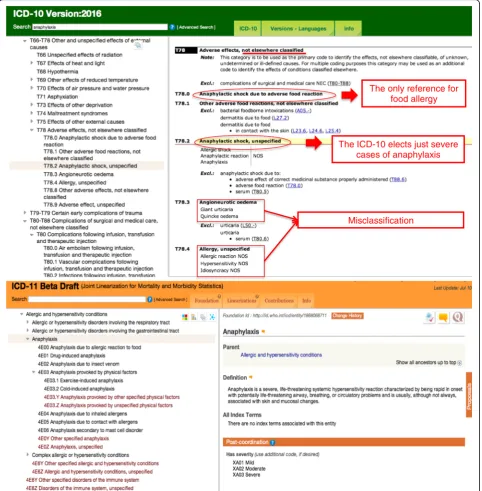
The search for the term“anaphylaxis” in the online ver-sions of the 10 (2016 version) [27] and of the ICD-11 Beta draft Linearization (July 2016 version) [26] allows us to demonstrate the main differences resulted from all the efforts over the last 4 years (Fig. 2). The ICD-10 inherited the hierarchical scheme of the previous ICD versions, essentially based in main organs or main cause (infectious diseases or external causes). Therefore, some systemic conditions such as anaphylaxis were ad-justed in the chapter related to external causes. As a re-sult of our search into the ICD-10 (2016 version) platform, we have addressed the “XIX Injury, poisoning and certain other consequences of external causes” chapter, specifically the “T78 Adverse effects, not else-where classified” section. In Fig. 2 (highlighted in red) we also underline the lack of awareness of allergic and hypersensitivity concepts verified in the T78 section. Under this section it is possible to observe that only se-vere cases of anaphylaxis have been prioritized (T78.2 Anaphylactic shock), which was classified at the same level of “Anaphylactic shock due to adverse food reac-tion”, “Angioneurotic oedema” and “Allergy, unspeci-fied”. In fact, obstruction of the upper and/or lower respiratory tract leading to respiratory distress and po-tential fatality is more commonly observed in anaphyl-axis than hypotension and shock per se. It is also possible to note the misclassification implied in the ICD-10 exemplified by scattering “T78.2 Anaphylactic shock” at the same level of the “T78.3 Angioneurotic oedema”, “T78.4 Allergy, unspecified” and “T78.9 Ad-verse effect, unspecified”under the same heading (Fig. 2, in bold).
In the new “Allergic and hypersensitivity conditions” section of ICD-11, it was possible to build a sub-section specifically addressed to anaphylaxis. For the first time, anaphylaxis is elected as individualized conditions into the ICD-11 frame, receiving a sub-section addressed to this condition. Currently, this subsection contains 7 main ana-phylaxis headings to be post-coordinated with severity and causality classification/specifications, still under tun-ing. The building block of this framework was the result of combined efforts and constant discussions with the groups of experts and the ICD WHO governance.
Based on the ICD-10 codes, some external stimuli are considered as underlying causes-of-death, but the word anaphylaxis as such has never been listed as an un-derlying cause-of-death. In fact, having allergic and hypersensitivity conditions classified in a more detailed scheme in the ICD-11 and not as in ICD-10 into a spe-cific chapter in the “External causes of morbidity and mortality” or in the“Injury, poisoning and certain other consequences of external causes” chapters allows for capture of more realistic anaphylaxis mortality data from now on.
cause-of-death. In other words, none of these deaths would have been found had the authors exclusively considered infor-mation from the underlying cause-of-death field.
Conclusion
Data support changes in the world health organization anaphylaxis mortality coding rules
In summary, in this manuscript, we provide evidence that supports the need for changes in the WHO mortality
coding rules by adding anaphylaxis as an underlying cause of death in international death certificates. This art-icle is a contribution to the establishment of ICD-11 to ensure a proper coding of anaphylaxis, in order to gener-ate an accurgener-ate knowledge of the consequences of this se-vere condition. This document will comprise part of a formal request to the WHO to change mortality coding rules so that anaphylaxis can be listed as an underlying cause of death in international death certificates.
The only reference for food allergy
The ICD-10 elects just severe cases of anaphylaxis
Misclassification
Once implemented by the WHO, there will be two im-mediate consequences of the use of the new classification based on the logic of the ICD-11: (i) although currently anaphylaxis fatalities are perceived as rare, the reported number of anaphylaxis deaths may increase [28] and (ii) most cases will be included in official mortality statistics, providing a global standard for comparability and, there-fore, for decision-making and prevention.
Abbreviations
ICD:International Classification of Diseases; WHA: World Health Assembly; WHO: World Health Organization
Acknowledgement
We are extremely grateful to all the representatives of the ICD-11 revision with whom we have been carrying on fruitful discussions, helping us to tune the here presented classification: Robert Jakob, Linda Best, Nenad Kostanjsek, Robert J G Chalmers, Jeffrey Linzer, Linda Edwards, Ségolène Ayme, Bertrand Bellet, Rodney Franklin, Matthew Helbert, August Colenbrander, Satoshi Kashii, Paulo E. C. Dantas, Christine Graham, Ashley Behrens, Julie Rust, Megan Cumerlato, Tsutomu Suzuki, Mitsuko Kondo, Hajime Takizawa, Nobuoki Kohno, Soichiro Miura, Nan Tajima and Toshio Ogawa. We acknowledge the assistance provided by Lori McNiven, Health Sciences Centre, Winnipeg, MB, Canada.
Joint Allergy Academies: American Academy of Allergy Asthma and Immunology (AAAAI), European Academy of Allergy and Clinical Immunology (EAACI), World Allergy Organization (WAO), American College of Allergy Asthma and Immunology (ACAAI), Asia Pacific Association of Allergy, Asthma and Clinical Immunology (APAAACI), Latin American Society of Allergy, Asthma and Immunology (SLAAI).
Funding
Not applicable.
Availability of data and materials
Data sharing not applicable to this article as no datasets were generated or analyzed during the current study.
Authors’contributions
LKT and PD contributed to the construction of the document (designed the study, analyzed and interpreted the data, and wrote the manuscript). FERS contributed to the anaphylaxis fatality references, and with SA, IA-M, MAC, contributed to tuning the document and revision of the manuscript. All authors read and approved the final manuscript.
Competing interests
The authors declare that they do not have any competing interests related to the contents of this article.
Consent for publication
Not applicable.
Ethics approval and consent to participate
Not applicable.
Author details
1Hospital Sírio Libanês, São Paulo, Brazil.2University Hospital of Montpellier,
Montpellier, France.3Sorbonne Universités, UPMC Paris 06, UMR-S 1136,
IPLESP, Equipe EPAR, 75013 Paris, France.4Section of Allergy & Clinical Immunology, Department of Pediatrics & Child Health, University of Manitoba, Winnipeg, Canada.5Section of Allergy and Clinical Immunology,
National Heart and Lung Institute, Royal Brompton Hospital, Imperial College London, London, UK.6INSERM, US14, Paris, France.
Received: 2 September 2016 Accepted: 13 December 2016
References
1. Simons FER, Ardusso LR, Bilò MB, Cardona V, Ebisawa M, El-Gamal YM, et al. International consensus on (ICON) anaphylaxis. World Allergy Organ J. 2014;7:9.
2. Panesar SS, Javad S, de Silva D, Nwaru BI, Hickstein L, Muraro A, Roberts G, Worm M, Bilò MB, Cardona V, Dubois AEJ, Dunn Galvin A, Eigenmann P, Fernandez-Rivas M, Halken S, Lack G, Niggemann B, Santos AF, Vlieg-Boerstra BJ, Zolkipli ZQ, Sheikh A, on behalf of the EAACI Food Allergy and Anaphylaxis Group. The epidemiology of anaphylaxis in Europe: a systematic review. Allergy. 2013;68:1353–61.
3. Neugut AI, Ghatak AT, Miller RL. Anaphylaxis in the United States: an investigation into its epidemiology. Arch Intern Med. 2001;161:15–21. 4. Liew WK, Williamson E, Tang ML. Anaphylaxis fatalities and admissions in
Australia. J Allergy Clin Immunol. 2009;123:434–42.
5. Bock SA, Muñoz-Furlong A, Sampson HA. Further fatalities caused by anaphylactic reactions to food, 2001–2006. J Allergy Clin Immunol. 2007;119:1016–8.
6. Greenberger PA, Rotskoff BD, Lifschultz B. Fatal anaphylaxis: postmortem findings and associated comorbid diseases. Ann Allergy Asthma Immunol. 2007;98:252–7.
7. Shen Y, Li L, Grant J, Rubio A, Zhao Z, Zhang X, Zhou L, Fowler D. Anaphylactic deaths in Maryland (United States) and Shanghai (China): A review of forensic autopsy cases from 2004 to 2006. Forensic Sci Int. 2009;186:1–5.
8. Yilmaz R, Yuksekbas O, Erkol Z, Bulut ER, Arslan MN. Postmortem findings after anaphylactic reactions to drugs in Turkey. Am J Forensic Med Pathol. 2009;30:346–9.
9. Simons FE, Ardusso LR, Bilò MB, El-Gamal YM, Ledford DK, Ring J, et al. World allergy organization guidelines for the assessment and management of anaphylaxis. World Allergy Organ J. 2011;4(2):13–37.
10. Tanno LK, Ganem F, Demoly P, Toscano CM, Bierrenbach AL. Undernotification of anaphylaxis deaths in Brazil due to difficult coding under the ICD-10. Allergy. 2012;67:783–9.
11. Moriyama IM, Loy RM, Robb-Smith AHT. History of the statistical classification of diseases and causes of death. Rosenberg HM, Hoyert DL, eds. Hyattsville, MD: National Center for Health Statistics. 2011. https://www. cdc.gov/nchs/data/misc/classification_diseases2011.pdf. Accessed Dec 2016. 12. Portier P, Richet C. De l’action anaphylactique de certains venins. C R
Séances Soc Biol. 1902;54:170.
13. World Health Organization, International Classification of Diseases website. cited, available: http://www.who.int/classifications/icd/en/. Accessed Jul 2016. 14. Muraro A, Roberts G, Worm M, Bilò MB, Brockow K, Fernández Rivas M,
Santos AF, Zolkipli ZQ, Bellou A, Beyer K, Bindslev-Jensen C, Cardona V, Clark AT, Demoly P, Dubois AEJ, DunnGalvin A, Eigenmann P, Halken S, Harada L, Lack G, Jutel M, Niggemann B, Ruёff F, Timmermans F, Vlieg–Boerstra BJ, Werfel T, Dhami S, Panesar S, Akdis CA, Sheikh A, on behalf of the EAACI Food Allergy and Anaphylaxis Guidelines Group. Anaphylaxis: guidelines from the European Academy of Allergy and Clinical Immunology. Allergy. 2014;69:1026–45.
15. Tanno LK, Calderon MA, Goldberg BJ, Akdis CA, Papadopoulos NG, Demoly P. Categorization of allergic disorders in the new World Health Organization International Classification of Diseases. Clin Transl Allergy. 2014;4:42. 16. Demoly P, Tanno LK, Akdis CA, Lau S, Calderon MA, Santos AF, et al. Global
classification and coding of hypersensitivity diseases–An EAACI–WAO survey, strategic paper and review. Allergy. 2014;69:559–70.
17. Tanno LK, Calderon MA, Goldberg BJ, Gayraud J, Bircher AJ, Casale T, et al. Constructing a classification of hypersensitivity/allergic diseases for ICD-11 by crowdsourcing the allergist community. Allergy. 2015;70:609–15. 18. Tanno LK, Calderon M, Papadopoulos NG, Demoly P. Mapping
hypersensitivity/allergic diseases in the International Classification of Diseases (ICD)-11: cross-linking terms and unmet needs. Clin Transl Allergy. 2015;5:20.
19. Tanno LK, Calderon MA, Demoly P, on behalf the Joint Allergy Academies. Making allergic and hypersensitivity conditions visible in the International Classification of Diseases-11. Asian Pac Allergy. 2015;5:193–6.
20. Tanno LK, Calderon MA, Demoly P, on behalf the Joint Allergy Academies. Optimization and simplification of the allergic and hypersensitivity conditions classification for the ICD-11. Allergy. 2016;71:671–6.
22. Tanno LK, Calderon MA, Papadopoulos NG, Sanchez-Borges M, Rosenwasser LJ, Bousquet J, et al. Revisiting desensitization and allergen immunotherapy concepts for the International Classification of Diseases (ICD)-11. J Allergy Clin Immunol Pract. 2016;4:643–9.
23. Tanno LK, Calderon MA, Li J, Casale T, Demoly P. Updating allergy/ hypersensitivity diagnostic procedures in the WHO ICD-11 revision. J Allergy Clin Immunol Pract. 2016;4:650–7.
24. Tanno LK, Calderon MA, Papadopoulos NG, Sanchez-Borges M, Moon HB, Sisul JC, Jares EJ, Sublett JL, Casale T, Demoly P, Joint Allergy Academies. Surveying the new allergic and hypersensitivity conditions chapter of the International classification of diseases (ICD)-11. Allergy. 2016;71(9):1235–40. 25. Tanno LK, Calderon M, Demoly P, Joint Allergy Academies. Supporting the validation of the new allergic and hypersensitivity conditions section of the World Health Organization International Classification of Diseases-11. Asia Pac Allergy. 2016;6(3):149–56.
26. World Health Organization, ICD-11 Beta Draft website. (cited, available: http://apps.who.int/classifications/icd11/browse/f/en. July 2016). 27. World Health Organization, ICD-10 version 2016 website. Cited, available:
http://apps.who.int/classifications/icd10/browse/2016/en. Accessed Jul 2016. 28. Tanno LK, Bierrenbach AL, Calderon MA, Sheikh A, Simons FE, Demoly P; on behalf of the Joint Allergy Academies. Decreasing the under-notification of anaphylaxis deaths in Brazil through the International Classification of Diseases (ICD)-11 revision. Allergy. 2016 Aug 18. doi:10.1111/all.13006. 29. Barnard JH. Studies of 400 Hymenoptera sting deaths in the United States.
J Allergy Clin Immunol. 1973;52:259–64.
30. Bock SA, Muñoz-Furlong A, Sampson HA. Fatalities due to anaphylactic reactions to foods. J Allergy Clin Immunol. 2001;107:191–3.
31. Delage C, Irey NS. Anaphylactic deaths: a clinicopathologic study of 43 cases. J Forensic Sci. 1972;17:525–40.
32. James LP, Austen KF. Fatal systemic anaphylaxis in man. N Engl J Med. 1964;270:597–603.
33. Jerschow E, Lin RY, Scaperotti MM, McGinn AP. Fatal anaphylaxis in the United States, 1999–2010: Temporal patterns and demographic associations. J Allergy Clin Immunol. 2014;134:1318–28. e7.
34. Lenler-Petersen P, Hansen D, Andersen M, Sørensen HT, Bille H. Drug-related fatal anaphylactic shock in Denmark 1968–1990. A study based on notifications to the Committee on Adverse Drug Reactions. J Clin Epidemiol. 1995;48:1185–8.
35. Low I, Stables S. Anaphylactic deaths in Auckland, New Zealand: a review of coronial autopsies from 1985 to 2005. Pathology. 2006;38:328–32. 36. Ma L, Danoff TM, Borish L. Case fatality and population mortality
associated with anaphylaxis in the United States. J Allergy Clin Immunol. 2014;133:1075–83.
37. Mosbech H. Death Caused by wasp and bee sting in Denmark 1960–1980. Allergy. 1983;38:195–200.
38. Pumphrey RHS, Roberts ISD. Postmortem findings after fatal anaphylactic reactions. J Clin Pathol. 2000;53:273–6.
39. Sampson HA, Mendelson L, Rosen JP. Fatal and near-fatal anaphylactic reactions to food in children and adolescents. N Engl J Med. 1992;327:380–4. 40. Savary T, Muller U. Deaths from insect stings in Switzerland. Schweiz Med
Wochenschr. 1994;124:1887–94.
41. Simon MR, Mulla ZD. A population-based epidemiologic analysis of deaths from anaphylaxis in Florida. Allergy. 2008;63:1077–83.
42. Turner PJ, Gowland MH, Sharma V, Ierodiakonou D, Harper N, Garcez T, Pumphrey R, Boyle RJ. Increase in anaphylaxis-related hospitalizations but no increase in fatalities: An analysis of United Kingdom national anaphylaxis data, 1992–2012. J Allergy Clin Immunol. 2015;135:956–63. e1.
43. Yunginger JW, Sweeney KG, Sturner WQ, Giannandrea LA, Teigland JD, et al. Fatal food-induced anaphylaxis. JAMA. 1988;260:1450–2.
44. Yunginger JW, Nelson DR, Squillace DL, Jones RT, Holley KE, Hyma BA, Biedrzycki L, Sweeney KG, Sturner WQ, Schwartz LB. Laboratory investigation
of deaths due to anaphylaxis. J Forensic Sci. 1991;36:857–65. • We accept pre-submission inquiries
• Our selector tool helps you to find the most relevant journal • We provide round the clock customer support
• Convenient online submission • Thorough peer review
• Inclusion in PubMed and all major indexing services • Maximum visibility for your research
Submit your manuscript at www.biomedcentral.com/submit