Original Research Article
Distance from referral hospital as a risk factor for mortality and length
of stay of neonates admitted in a tertiary care hospital
Kawal Krishen Pandita
*
INTRODUCTION
Millions of newborn babies die every year worldwide due to various reasons. Around 66% of infant and over 50% of under-five mortality occurs in newborn period. Two thirds of infant mortality rate are contributed by deaths within first week of life.1,299% of neonatal deaths occur in low and middle income countries.3 The first minutes after birth are the most important time for the survival of the neonates as it the transitional period from intra uterine to extra uterine life.4 Most of these deaths can be prevented by suitable interventions at various levels like
infrastructure development, manpower optimization, trainings and pre-natal diagnosis of high risk babies. As per SRS 2008, neonatal mortality rate in India is 35/1000 live births.5 This high mortality could be attributed to delay at three levels, which include a delay in recognition of severity of illness, delay in transport of the neonate and delay in delivery of appropriate health-care.6
Experience suggests that newborn intensive care units based in children’s hospitals that are exclusively for out born babies have higher institutional mortality than perinatal center neonatal intensive care unit (NICUs) with
ABSTRACT
Background: Around 66% of infant and over 50% of under-five mortality occurs in newborn period. 99% of neonatal deaths occur in low and middle income countries. Most of these deaths can be prevented by suitable interventions at various levels. The premise of the study is that the neonates who require long transportation (>1 hour) have higher chances of mortality or prolonged stay in the hospital.
Methods: A retrospective retrieval of data and prospective interview was conducted in G.B Pant children’s hospital Srinagar, an associated hospital of Govt. Medical College Srinagar in North India.
Results: During the period of study 1431 neonates from twelve districts of the state were referred to the hospital for treatment, out of whom, 102 (7.13%) could not be saved. Neonatal death rate was found highest (11.11%) in neonates referred from districts of category-III (>100 kms from the referral hospital), followed by category-II (50-100 kms from the referral hospital) and category-I (>50 kms from the referral hospital). Average length of stay was observed longest for the neonates referred from districts of category-III followed by category-II and category-I.
Conclusions: Several other studies found that transfer of sick neonates from another health facility were associated with relatively higher probability of morbidity and mortality after controlling for other predictors. Distance no doubt is a risk factor for neonatal outcome of referred neonates as we have observed in our study. To minimize neonatal deaths it is necessary to strengthen the perinatal services sick newborn care unit {(SNCUs) in district Hospitals)}.
Keywords: Neonates mortality, Average length of stay, National health mission, SNCU
Department of Hospital administration, North Eastern Indira Gandhi Regional Institute of Health and Medical Sciences, Shillong, Meghalaya, India
Received: 09 September 2019
Revised: 09 October 2019
Accepted: 10 October 2019
*Correspondence:
Dr. Kawal Krishen Pandita, E-mail: [email protected]
Copyright: © the author(s), publisher and licensee Medip Academy. This is an open-access article distributed under the terms of the Creative Commons Attribution Non-Commercial License, which permits unrestricted non-commercial use, distribution, and reproduction in any medium, provided the original work is properly cited.
obstetrical services, even after adjusting for severity of illness.7
The concept of organizing perinatal services within geographic regions according to the level of care provided first emerged in the late 1960s to improve outcome for infants requiring neonatal intensive care.8 Government of India acting on the lines of improving peri-natal services established Special Newborn Care Units (SNCUs) in district hospitals through National Rural Health Mission (now NHM) to decrease neonatal mortality in the country. Under the Child health component of the mission the strategy is to augment the neonatal care facilities at the District Hospitals so that neonates do not die due of delay in treatment because of long transportation during their most precious moments of life. These babies are critically ill and the outcome is also dependent on the effectiveness of transport system.
The referral hospital of the present study is the tertiary care Children’s hospital in the Kashmir division attached to the Govt. Medical College. It has a 61 bedded step down neonatal care unit equipped with Ventilators, CPAPs, vital sign monitors, baby warmers and many higher end equipments run by highly professional faculty.
The premise of the study is that the neonates who require long transportation (>1 hour) have higher chances of mortality or prolonged stay in the hospital. As a Hospital Administrator of the Hospital, the investigator of this work has observed that the referral system in the District Hospitals has not improved as expected after the NHM initiative, with the result newborns from all the Districts of the division are transported during their precious moments of life. This study was under taken to find out the relation between distance covered/ time wasted in travelling, by the sick newborns referred from different districts and their outcome in terms of mortality and length of stay.
METHODS
The design of the study is in two parts conducted in G B pant Children’s Hospital Srinagar,an associated tertiary care hospital of Govt. Medical college Srinagar Kashmir. First part is retrospective evaluation of patient records. All the neonates admitted in the NICU of the hospital from 1st February 2016 to 30th June 2016 were included in the study and their records were retrieved from the medical records section. The relevant data was recorded on a pre-designed proforma. The data so collected was
analyzed to obtain the required information. During the period of our study, patients were referred from ten districts of the Kashmir division and two districts of the Jammu division of the state. Following statistical tools were used to calculate the neonatal death rate and average length of stay (ALS) from the collected data.
Neonatal death rate was calculated by the formula
Neonatal death rate=
ALS was calculated by the formula
ALS= Second part of the study is prospective data collection to calculate the average time, the transport taken to reach the hospital. The data was collected by interviewing the drivers and attendants of the patients who actually covered the distance along with the neonates from the various districts. The data collected was recorded on a pre-designed proforma. Simple statistical techniques like rates, ratio and proportions were used to infer the results. On the basis of distance from the referral hospital, the districts were categorized in three categories which are category I includes district Srinagar, Ganderbal, Pulwama and Budgam, which fall less than 50 kms from the referral Hospital and the transport take less than one hour to reach the hospital; category-II includes district Bandipora, Baramulla, Anantnag, shopian and Kulgam which fall between 50 to 100 kms from the referral hospital and the transport take one to two hours to reach the hospital and category-III includes district Dada, Ramban and Kupwara which fall more than 100 kms from the referral Hospital and the transport take more than two hours to reach the hospital.
RESULTS
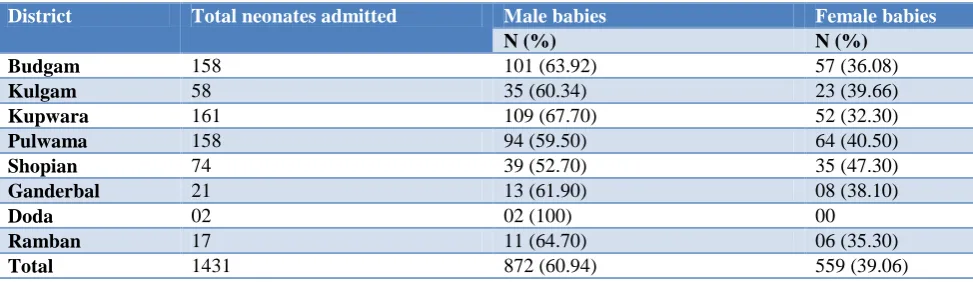
The hospital in our study is a tertiary care children’s hospital of the Kashmir division of the state of Jammu and Kashmir. During the period of our study 1431 neonates from twelve districts of the state were referred to the hospital for treatment. 872 (60.94%) were male babies and 559 (39.06%) were female babies. Male: female ratio of the referred babies was found to be 1.56: 1. The demographic profile of the patients is shown in table 1.
Table 1: Demographic profile of the neonates referred.
District Total neonates admitted Male babies Female babies
N (%) N (%)
Srinagar 358 210 (58.66) 148 (41.34)
Anantnag 168 93 (55.36) 75 (44.64)
Bandipora 77 45 (58.44) 32 (41.56)
Baramulla 179 120 (67.04) 59 (32.96)
District Total neonates admitted Male babies Female babies
N (%) N (%)
Budgam 158 101 (63.92) 57 (36.08)
Kulgam 58 35 (60.34) 23 (39.66)
Kupwara 161 109 (67.70) 52 (32.30)
Pulwama 158 94 (59.50) 64 (40.50)
Shopian 74 39 (52.70) 35 (47.30)
Ganderbal 21 13 (61.90) 08 (38.10)
Doda 02 02 (100) 00
Ramban 17 11 (64.70) 06 (35.30)
Total 1431 872 (60.94) 559 (39.06)
Table 2 depicts the mortality of the neonates referred from three different categories of the districts. The highest mortality (death rate=11.11%) was observed in the neonates referred from districts of category III,
followed by the neonates referred from the districts of category-II (death rate=9.71%). Lowest mortality (4.02%) was observed in the neonates referred from the districts of category-I.
Table 2: Distance and mortality outcome.
Category
Distance from the referral hospital (kms)
Time consumed to reach the hospital (hour)
Total number of neonates
discharged in the category Deaths
Death rate (%)
Category-I Upto 50 Within 1 667 28 4.02
Category-II 50-100 1-2 502 54 9.71
Category-III >100 >2 160 20 11.11
Table 3: Average length of stay outcome.
Category
Distance from the referral hospital (kms)
Time consumed to reach the hospital (hour)
Total number of inpatient days in the category
Total number of babies discharged (including deaths) in the category
ALS (days)
Category-I Upto 50 Within 1 3129 695 4.5
Category-II 50-100 1-2 3020 556 5.4
Category-III >100 >2 1267 180 7.03
Table 3depicts the ALS of the neonates referred from the three categories of the districts. ALS of neonates referred from category-III districts was observed to be longest (ALS=7.03 days) among all the three categories of districts, followed by neonates referred from the districts of category-II (ALS=5.4 days). ALS was observed shortest (4.5 days) for the neonates referred from districts of category-I.
DISCUSSION
Mortality and length of stay are two commonly used outcomes for comparing health care delivery in NICU. During the study period out of 1431 neonates admitted, 1323 (92.52%) were discharged after successful treatment however 102 (7.13%) neonates could not be saved. In a study by Punitha et al in one of medical college hospitals of South India reported that 93.4% of the referred neonates were treated successfully and 6.6% neonates died during their study period.9 Male: female ratio of referred babies in our study was found 1.56: 1. Male: female ratio in the above mentioned study was observed as 1.4: 1.9 The mortality ratio between the male
69 and female 33 neonates in our study was observed as 2.09: 1. The mortality is proportionately higher in male neonates 13: 1 as compared to female neonates 17: 1, which signifies that mortality of male neonates is higher as compared to the female neonates.
districts of category-II. Several other studies found that transfer of sick neonates from another health facility were associated with relatively higher probability of morbidity and mortality after controlling for other predictors.10-13 Narang et al in their study found that the transportation time of more than 1 hour duration were significant predictors for mortality among the transported neonates.14 Rosenberg et alreported that a referral hospital with 25% of patients transferred from another ICU when compared with another with a 0% transfer rate would have 14 excess deaths per 1000 admissions.15 The ambulances for transportation of sick neonates particularly in rural areas are not equipped for neonatal transport. Appropriate equipment’s and vehicle customized for neonates should be available for safe transport.
Our results for ALS of the referred neonates from the districts of three categories showed the similar trend as for the mortality indicator. ALS for the neonates of the category-III, districts was observed longest as 7.03 days. The ALS for neonates referred from category-II, districts was observed as 5.4 days. ALS was observed shortest (4.5 days) among the neonates of category-I, districts. Negi et al in a study also found a direct relation between the distance covered by the sick neonates and the their average length of stay in the hospital.16
CONCLUSION
Distance no doubt is a predictor of neonatal outcome of referred neonates as we have observed in our study besides many other such studies. To minimise neonatal death, the perinatal services (SNCUs in district hospitals) need to be strengthened and the components of the NHM need to be implemented on ground, particularly in the districts which are more than 1 hour journey from the referral centres. Simultaneously it is also imperative to adhere to strict neonatal transport protocol, stabilisation of babies before transportation. The transport of sick neonates should be accompanied by trained personnel, who have at least basic training in neonatal resuscitation. The ambulances for neonatal transport should be equipped with transport ventilator, incubator, oxygen reserve. Appropriate prior communication with the referral hospital will help to manage the referred neonates more efficiently on the arrival to the hospital.
ACKNOWLEDGEMENTS
I acknowledge the support of the medical records section of the hospital for extending their support to complete the current work. I also feel gratitude to the drivers of vehicles ferrying the patients from the districts to the referral hospital of the study, for their co-operation and sparing time to answer the queries.
Funding: No funding sources Conflict of interest: None declared
Ethical approval: The study was approved by the Institutional Ethics Committee
REFERENCES
1. Available at: SRS Bulletinship://www.censusindia
.gov.in/vitalstastics/vital–rates/vital-rates.aspx. Accessed on 1 September 2019.
2. Gogia S, Ramji S, Gupta P, Gera T, Shah D,
Mathew JL, et al. Community based newborn care: a systematic review and metaanalysis of evidence: UNICEF-PHFI series on newborn and child health, India. Indian Pediatr. 2011:48;537-46.
3. Lewn JE, Census S, Zupan J. 4 million neonatal
deaths,when ?where? Why?. Lancet.
2005;365(9462):891-900.
4. Gendisha G, Diriba K. Prevalence and factors
associated with neonatal hypothermia on admission to neonatal intensive care units in Southwest Ethiopia- a cross-sectional study. Plos One. 2019;14(6):e0218020.
5. Maternal health division. Ministry of health and family welfare. Government of India. Guidelines for Antenatal care and skilled attendance at birth, 2010.
Available at: http://www.nihfw.org/NCHRC/
Publication/Guidelines%20and%20Manuals/ANM %20Guidelines%20.pdf. Accessed on 25 May 2019.
6. Ramji S. Transport in community. J Neonatol.
2005;19:328-31.
7. Sankaran K, Chien LY, Walker R, Seshia M,
Ohlsson A. Variations in mortality rates among Canadian neonatal intensive care units. CMAJ 2002;166:173-8.
8. Yu VY, Doyle LW. Regionalized long-term
follow-up. Semin Neonatol. 2004;9:135-44.
9. Punitha P, Kumaravel KS, Pugalendhiraja KV,
Kumar S. A Study on the current status of neonatal transport to a special newborn care unit. Stanley Med J. 2016;3(3):55-9.
10. Berry MA, Shah PS, Brouillette RT, Hellmann J. Predictors of mortality and length of stay for neonates admitted to children’s hospital neonatal intensive care units. J Perinatol. 2008;28:297-302. 11. Hossain S, Shah PS, Ye XY, Darlow BA, Lee SK,
Lui K. Outborns or inborns: where are the differences?. A comparison study of very preterm neonatal intensive care unit infants cared for in Australia and New Zealand and in Canada. Neonatol. 2016;109:76-84.
12. Hohlagschwandtner M, Husslein P, Klebermass K,
Weninger M, Nardi A, Langer M. Perinatal mortality and morbidity Comparison between maternal transport, neonatal transport and inpatient
antenatal treatment. Arch Gynecol Obstet.
2001;265:113-8.
13. Dalal E, Vishal G, Solanki D. Study on neonatal transport at tertiary care centre. Int J Sci Res. 2013;2(12):289-92.
14. Narang M, Kaushik JS, Sharma AK, Faridi MMA.
15. Rosenberg AL, Hofer TP, Strachan C, Watts CM, Hayward RA. Accepting critically ill transfer patients: adverse effect on a referral center’s outcome and benchmark measures. Ann Intern Med. 2003;138:882-90.
16. Negi R, Agrawal R, Kaushal SK, Misra SK. Timely
referral and safe transport of neonates admitted to neonatal intensive care unit of tertiary care government hospital of Agra district: a cross
sectional study. Int J Community Med Public Health. 2019;6(5):2163-71.